



XAG/USD rebounds near $49.00 due to rising safe-haven demand after previous losses
Silver prices have risen to about $48.80 per troy ounce during Asian trading. This increase follows the decline of China’s RatingDog Manufacturing PMI, which dropped from 51.2 in September to 50.6 in October. Demand for silver has surged after US President Trump announced plans to limit China’s access to Nvidia’s advanced chips, raising tensions between the US and China.
The weak PMI data from China has made investors more cautious, enhancing silver’s appeal as a safe investment. Silver is important in many industries, including electronics and solar panels, and China’s industrial demand remains significant, despite the recent PMI numbers. Traders are also waiting for the US ISM Manufacturing PMI data, which could influence market trends.
The Chinese rating agency, RatingDog, reported a weaker-than-expected PMI for October, which was predicted to be 50.9. Additionally, the ongoing US government shutdown has introduced economic uncertainty, further making silver attractive to investors.
Silver is a popular choice for those looking to diversify their portfolios or protect against inflation. Investors can buy silver physically or through investment options like Exchange Traded Funds (ETFs). The price of silver is affected by various factors, including geopolitical events, industrial demand, and its correlation with the US dollar and gold. Silver’s industrial use, particularly in electronics and solar energy, significantly impacts its price.
With silver surpassing $48.80, we’re observing renewed interest in it as a safe haven due to multiple factors. The heightened US-China trade tensions over semiconductor access, alongside the extended government shutdown in the US, are creating market uncertainty. These conditions support assets like silver, driving prices toward the crucial level of $49.00.
The slowing manufacturing data from China adds complexity to this situation. Although the RatingDog PMI reading of 50.6 was disappointing, the official NBS Manufacturing PMI for October 2025 also fell to 49.9, signaling a contraction for the first time since June. This combination of weakened industrial demand and growing global economic fears paradoxically supports silver’s position as a safe asset.
In the US, the six-week government shutdown is starting to impact both the economy and the dollar. Recent reports from the Congressional Budget Office (CBO) estimated that the shutdown might reduce Q4 GDP growth by up to 0.2%. This has contributed to the US Dollar Index (DXY) dropping below the 103.50 support level. A weaker dollar generally makes dollar-priced commodities like silver more appealing to foreign buyers.
Under these circumstances, we are witnessing a rise in volatility expectations, with options markets anticipating larger price fluctuations in the upcoming weeks. For example, the Cboe Silver Volatility Index has risen over 15% in just two sessions, reflecting traders’ strategies to hedge against or speculate on potential price increases. Many are considering call options expiring in December 2025 and January 2026 to capture this momentum.
This situation resembles the market conditions of late 2019 when geopolitical trade tensions drove a significant rally in precious metals. The Gold/Silver ratio, which is currently around 75, remains historically high, indicating that silver could continue to outperform gold if this trend persists. We will closely monitor the upcoming US ISM Manufacturing PMI data for further insights.
Dividend Adjustment Notice – Nov 03 ,2025
Dear Client,
Please note that the dividends of the following products will be adjusted accordingly. Index dividends will be executed separately through a balance statement directly to your trading account, and the comment will be in the following format “Div & Product Name & Net Volume”.
Please refer to the table below for more details:
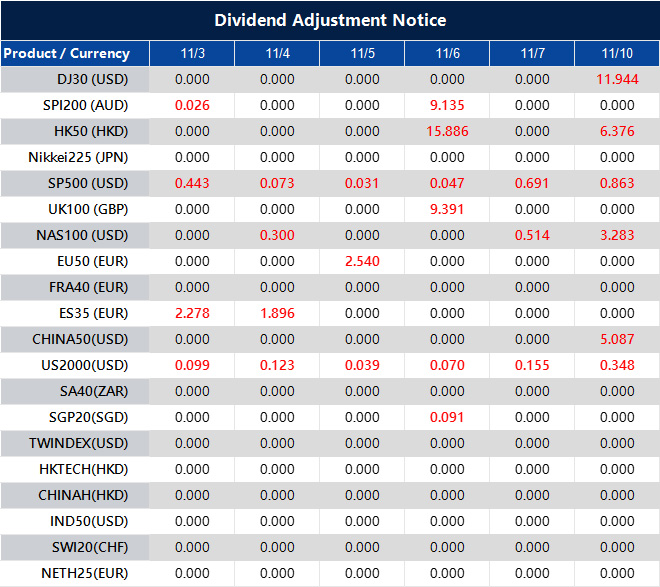
The above data is for reference only, please refer to the MT4/MT5 software for specific data.
If you’d like more information, please don’t hesitate to contact [email protected].
Indonesia’s monthly inflation rose from 0.21% to 0.28% in October.
Indonesia’s inflation rate rose from 0.21% to 0.28% in October. This change reflects month-over-month data.
Globally, various economic factors are in focus. The USD/INR exchange rate is stronger as the US Dollar gains momentum. Meanwhile, meme coins like Dogecoin, Shiba Inu, and Pepe are declining, partly due to less activity from major investors.
Gold Prices Surge
Gold prices have jumped above $4,000 due to a safe-haven demand linked to political events. In contrast, the GBP/USD pair is struggling, close to its lowest point in months, while the EUR/USD continues to decline. Forex market projections suggest that the USD will remain strong despite past economic events. The Federal Reserve’s monetary policy heavily influences currency dynamics, affecting key financial instruments and indices. In cryptocurrency, Cardano (ADA) has fallen below $0.58, facing increased bearish momentum and more traders shorting the asset. These moves occur amidst wider economic discussions driven by regional central bank policies and global market trends.US Dollar Strengthens
As of November 3, 2025, the US Dollar shows significant strength as expectations of a Fed rate cut in December decrease. This follows last week’s US jobs report, which revealed over 250,000 job additions, lowering the odds of a rate cut to below 20% in the futures market. Derivative traders might want to consider strategies for ongoing dollar strength, such as call options on the U.S. Dollar Index (DXY) or put options on pairs like EUR/USD and GBP/USD. The rise in gold prices above $4,000 indicates a growing risk-off sentiment, driven by geopolitical uncertainty following recent comments from Donald Trump. The VIX, which measures market fear, has risen above 25, a level not seen since the banking stress in 2023. This environment favors volatility traders, who might consider VIX call options or long straddles on major indices to profit from significant price movements in either direction. Central banks are following different paths, presenting clear opportunities in currency pairs. While the Fed maintains a hawkish stance, the Reserve Bank of Australia is cautious after Q3 inflation data came in higher than expected at 4.2%. This backdrop suggests looking at long positions in AUD against currencies with a more dovish outlook, for example, buying AUD/EUR futures. In emerging markets, we are closely monitoring Indonesia’s rising month-over-month inflation. The October figure brings the annual inflation rate to over 3.5%, a level not seen since late 2024. This will pressure Bank Indonesia to keep a tight policy, potentially increasing volatility in the USD/IDR pair and creating opportunities for options traders who can navigate the wider spreads. The notable drop in speculative assets like Dogecoin, Shiba Inu, and Cardano shows a broad shift away from risk. The waning interest from large investors suggests this trend may continue. Traders may interpret this as a cue to reduce their exposure to high-risk assets or use put options to capitalize on potential further declines in these volatile market segments. Create your live VT Markets account and start trading now.In September, Indonesia’s imports exceeded expectations by 7.17%, surpassing the anticipated 1% increase.
Indonesia’s imports in September rose by 7.17%, exceeding the expected 1% increase. This strong performance indicates solid domestic demand and possible economic strength.
Various currencies and commodities, such as AUD/JPY and gold, are fluctuating. Gold prices surpassed $4,000 due to comments from Trump, which increased safe-haven demand. Meanwhile, the AUD/JPY has broken above 101.50, reflecting a careful monetary policy from the Reserve Bank of Australia.
Forex Market Dynamics
The Forex market shows the USD/INR gaining strength, while the GBP/USD weakens, remaining low as chances of a December interest rate cut by the US Federal Reserve diminish. Additionally, Dogecoin and Shiba Inu cryptocurrencies face downward pressure as large holders reduce their investments. Next week, attention will turn to central bank meetings and new economic data, which could shift risk sentiment in financial markets. Cardano’s price has dipped below $0.58, with downward momentum growing. Analysts are also reviewing broker choices and trading strategies for 2025, catering to traders in various markets like Forex and CFDs. With gold trading above $4,000, it’s evident that traders are moving towards safe-haven assets. This rise comes after political comments heightened market uncertainty, a trend that typically boosts gold prices during geopolitical tensions in 2024. Derivative traders might consider long positions in gold futures or call options to capitalize on this trend. The strength of the US dollar leads the market narrative, driving pairs like EUR/USD below 1.1550. This shift is largely due to fading expectations for a Federal Reserve rate cut in December, especially after the recent jobs report indicated a strong addition of 250,000 jobs in October, well over predictions. Traders should approach the dollar cautiously, perhaps considering put options on the Euro for protection.British Pound Weakness
Conversely, the British Pound is particularly weak, with GBP/USD trading near multi-month lows. Recent data shows UK inflation dipped to 4.2% in September, falling faster than in other G7 countries, which raises the chances that the Bank of England might cut rates sooner than the Fed. This situation supports a bearish outlook, favoring short positions on GBP futures. We are keeping an eye on emerging markets, as Indonesia’s September imports significantly surpassed expectations. This suggests strong domestic demand and economic resilience that is not reflected everywhere else. This strength could provide opportunities to trade the Indonesian Rupiah against weaker currencies, even as the overall US dollar remains strong. Finally, interest in highly speculative assets is waning. The notable decline in meme coins like Dogecoin and Shiba Inu, along with reduced on-chain activity for Cardano, indicates that large investors are pulling back. This reflects a risk-off sentiment reminiscent of the 2022 crypto downturn, suggesting traders should be cautious with long positions in these volatile markets. Create your live VT Markets account and start trading now.In September, Indonesia’s trade balance missed expectations, recording $4.34 billion instead of the anticipated $4.79 billion.
**Gold Demand Spurs Interest in Safe Haven Assets**
Meme coins like Dogecoin and Shiba Inu are losing value as large holders trim their risk. This decline is largely due to falling interest from big investors.
Across the globe, currencies and commodities are showing notable changes because of central bank policies and economic data. The Australian and British dollars are moving in different directions ahead of their central banks’ upcoming meetings, while the USD is supported by actions from the Federal Reserve.
In the cryptocurrency world, Cardano has dropped to below $0.58, which is a 6% decrease. This follows a 10% drop from the previous week, driven by reduced on-chain activity and rising negative sentiment among traders.
**US Dollar Strengthens Against Major Currencies**
The US Dollar is gaining strength as hopes for a rate cut by the Federal Reserve in December fade. Recent data from the Bureau of Labor Statistics showed that core inflation stayed stubbornly above the Fed’s 2% target last quarter, reinforcing a tough stance. In this setting, it may be wise to consider derivatives that benefit from a strong dollar, such as buying USD call options against a range of major currencies.
Gold’s rise above $4,000 indicates that traders are choosing safety over traditional currency correlations. This increase is fueled by geopolitical uncertainties, including recent comments from former President Trump, showing high implied volatility in gold options. Strategies like straddles or strangles on gold ETFs could be used to take advantage of expected price movements in either direction.
A lower-than-expected trade surplus in Indonesia suggests possible challenges for emerging market currencies. This trend mirrors what we have seen over the last year, where a strong dollar pressures export-dependent economies. As a result, shorting the Indonesian Rupiah through futures contracts or buying USD/IDR call options could be a smart move.
Create your live VT Markets account and start trading now.
In September, Indonesia’s exports exceeded predictions with an 11.41% increase compared to 7.72%.
Indonesia’s exports in September grew by 11.41%, exceeding expectations of a 7.72% increase. This shows a stronger performance than expected.
In the broader market, the Australian Dollar is gaining strength due to a cautious outlook from the Reserve Bank of Australia. Meanwhile, the Japanese Yen is at a multi-month low against the US Dollar due to uncertainties with the Bank of Japan.
Gold Prices Surge
Gold prices are climbing above $4,000, driven by increased demand for safety following recent political comments. The possibility that the US Federal Reserve may not cut rates in December adds extra support for the US Dollar. Meme coins like Dogecoin, Shiba Inu, and Pepe are facing declines as interest from big investors fades. Cardano’s price has fallen below $0.58 due to a drop in on-chain activity and rising short positions. In currency markets, EUR/USD is trading around 1.1530, as speculation about a Fed rate cut decreases. Similarly, GBP/USD remains below the mid-1.3100s amid a bearish economic trend.US Dollar Strength Continues
The US Dollar maintains its strength as hopes for a Federal Reserve rate cut in December 2025 fade. With the Fed Funds Rate staying above 6.0% since the third quarter, the Dollar Index (DXY) is reaching highs not seen since the inflation scare of 2022. Derivative traders might benefit from this strength by buying puts on EUR/USD, which is struggling below 1.1550. The flight to safety is clear as gold prices rise beyond the $4,000 mark, a historically crucial level. Despite a strong dollar usually putting pressure on gold, geopolitical uncertainty is fueling this demand, with open interest in COMEX gold futures up by 15% in October 2025 alone. Traders could consider buying call options on gold to take advantage of further gains while minimizing risks from sudden market changes. We should note the strength in some emerging markets, like Indonesia’s export growth of 11.41%. This trend of positive trade surplus data for Indonesia has continued throughout 2025, averaging over $4 billion per month according to recent government stats. This could offer opportunities for relative value trades, such as going long on the Indonesian Rupiah (IDR) against currencies with weaker central banks. The current scenario is tough for speculative assets, with notable drops in meme coins and altcoins like Cardano. The Crypto Fear & Greed Index has fallen into “Extreme Fear,” a level it hasn’t seen for this long since the large correction in early 2024. For those involved, purchasing protective puts on crypto-related ETFs or shorting futures on volatile assets could be a wise strategy. Create your live VT Markets account and start trading now.Australian dollar rises against the US dollar supported by expectations of steady policy rates
The Australian Dollar (AUD) found support thanks to cautious feelings about the Reserve Bank of Australia’s (RBA) policy. The AUD increased against the US Dollar (USD), breaking a three-day losing streak. Despite this, the AUD performance came as the market anticipated no interest rate cuts from the US Federal Reserve (Fed) in December. In September, Australia’s Building Permits rose by 12% month-on-month (MoM), beating the expected 5.5% growth.
China’s Manufacturing Purchasing Managers’ Index (PMI) dropped to 50.6 from 51.2, impacting economic sentiment due to Australia’s close trade ties with China. At the same time, the US Dollar gained strength as the likelihood of Fed rate cuts decreased. Traders now see just a 69% chance of a December cut, down from 93% a week earlier. The Federal Reserve cut interest rates by 25 basis points, with mixed opinions among its members.
AUD/USD Pair Analysis
The AUD/USD pair is trading around 0.6550, indicating a time of consolidation on the daily chart. Resistance is at 0.6600, and downside support is at 0.6544; breaking this level could lead to further declines. The Australian Dollar showed strength against many major currencies, with the biggest gains against the Japanese Yen. Looking back, we recall the market’s anxiety over the RBA’s policy before its late-2023 decision. Fast forward to November 2025: the situation has changed as the RBA has cut rates multiple times to support a slowing economy. Recent Q3 2025 inflation data in Australia showed an annual rate of 2.9%, comfortably within the RBA’s target range, which supports its more cautious stance. During this period, the US Dollar’s strength was based on declining expectations for a Federal Reserve rate cut, but this proved to be short-lived. The Fed has since lowered its benchmark rate to 3.75%–4.0% in response to weakening economic data throughout 2024 and 2025. The latest US unemployment figures from October 2025 rose to 4.1%, providing more reasons for the Fed to maintain an accommodative policy.China’s Economic Influence
China continues to pose challenges for the Australian Dollar, a trend that has been developing for years. The latest Caixin Manufacturing PMI for October 2025 showed a reading of 50.2, indicating only slight growth and highlighting ongoing weakness in Australia’s largest trading partner. This instability in China limits significant rises for the AUD, even with a weaker US Dollar. For derivative traders, the clash between dovish central banks and weak Chinese growth suggests that volatility in AUD/USD might increase. Currently trading near 0.6850, the pair is stuck between supportive interest rate differentials and low demand for Australian commodities. This situation is ideal for exploring strategies like straddles or strangles to take advantage of potential price movements. Considering these conditions, selling out-of-the-money puts on the AUD/USD could be a good strategy to earn premium, betting that the support level around 0.6700 will hold due to the Fed’s dovish approach. Alternatively, traders expecting a gradual increase might consider buying call spreads to reduce the cost of a bullish position while managing their risk. The key is to watch both US and China data for the next big move. Create your live VT Markets account and start trading now.The Australian dollar rises against the US dollar due to expectations of steady policy rates
The Australian Dollar (AUD) found support as traders cautiously considered the Reserve Bank of Australia’s (RBA) policy. The AUD rose against the US Dollar (USD), ending a three-day decline. This happened even as expectations for no interest rate cuts from the US Federal Reserve (Fed) in December grew. In September, Australia’s Building Permits jumped 12% month-on-month, well above the expected 5.5%.
Meanwhile, China’s Manufacturing Purchasing Managers’ Index (PMI) dropped to 50.6 from 51.2, impacting economic sentiment because of the close trade relationship between Australia and China. The USD gained strength as traders reduced the chances of Fed rate cuts, now predicting only a 69% likelihood of a cut in December, down from 93% the previous week. The Federal Reserve recently cut interest rates by 25 basis points, though opinions among Fed members on this decision were mixed.
Currently, the AUD/USD pair is trading around 0.6550, suggesting a period of consolidation. The resistance level is at 0.6600, while support is at 0.6544. If this support level breaks, it could lead to further declines. The Australian Dollar has shown strength against several major currencies, particularly the Japanese Yen.
Looking back, market sentiment was anxious about the RBA’s policies ahead of its decision in late 2023. Now, in November 2025, the situation has shifted. The RBA has implemented several rate cuts to help a slowing economy. Recent inflation data for Q3 2025 showed an annual rate of 2.9%, well within the RBA’s target, supporting its more cautious approach.
During this time, the strength of the US Dollar stemmed from fading hope for a Fed rate cut, though this proved to be a short-lived situation. The Fed has since lowered its benchmark rate to a range of 3.75%–4.0%, responding to weakening economic data throughout 2024 and 2025. October 2025 saw US unemployment rise to 4.1%, encouraging the Fed to maintain a supportive stance.
China continues to be a challenge for the Australian Dollar, a trend we’ve observed for years. The latest Caixin Manufacturing PMI for October 2025 was 50.2, indicating only slight growth and showing ongoing weakness in Australia’s biggest trading partner. This instability in China limits the AUD’s potential rise, even against a weaker US Dollar.
For traders dealing in derivatives, the current situation — with central banks pursuing reserved policies amid slow growth in China — might lead to increased volatility in AUD/USD. The pair is currently trading around 0.6850 and faces pressure from combined interest rate differentials and weak external demand for Australian commodities. This environment is suitable for strategies like straddles or strangles, which could take advantage of a potential breakout.
In light of these factors, selling out-of-the-money puts on AUD/USD could be a good way to earn premium, betting on the support level around 0.6700 remaining intact due to the Fed’s policy. Alternatively, traders looking to capitalize on a gradual increase might consider buying call spreads, which would lower the cost of a bullish position while managing risk. Keeping an eye on incoming data from the US and China will be key to identifying the next market mover.
After two days of gains, USD/CAD stays above 1.4000 as CAD strengthens with rising oil prices.
The USD/CAD currency pair is stable at 1.4010 after recent gains, thanks to a stronger Canadian Dollar driven by rising oil prices. Canada, the top crude exporter to the US, benefits from West Texas Intermediate Oil prices sitting around $61.00 per barrel.
OPEC+ plans to pause production increases in early 2026 after a small increase next month, which is influencing both oil prices and the CAD. Meanwhile, the USD may gain strength again since expectations for a December rate cut by the Federal Reserve have decreased, despite recent cuts that lowered rates to 3.75%-4.0%.
Fed Chair Jerome Powell has shown caution regarding further cuts, with the chance of a December reduction falling to 69%, down from 93%. The ongoing US government shutdown, now in its sixth week, adds economic uncertainty due to Congressional gridlock.
Key factors affecting the Canadian Dollar include the Bank of Canada’s interest rates, oil prices, overall economic health, inflation, and trade balance. Higher interest rates tend to attract investments and boost the CAD, while fluctuations in oil prices directly impact its value. Inflation can influence the CAD through interest rate changes, and strong economic data generally increases the currency’s attractiveness.
Currently, the USD/CAD pair is stable around 1.4010, reflecting a significant tug-of-war. The Canadian Dollar is supported by solid oil prices, while the US Dollar is held up by a cautious Federal Reserve. This creates a delicate balance that traders should monitor closely in the coming weeks.
The strength of the Canadian Dollar isn’t just due to stable oil prices after OPEC+’s announcement. Statistics Canada reported last month that 45,000 jobs were added, exceeding expectations and bringing the unemployment rate down to 5.4%. These positive domestic factors provide extra support for the loonie, regardless of commodity prices.
On the US side, the Federal Reserve’s recent actions and statements are shaping the narrative. After cutting rates for the second time in 2025, Chairman Powell’s cautious remarks have lowered expectations for a third cut in December, with the probability dropping from 93% to 69% in just a week.
However, the US economic outlook is becoming clouded, complicating the Fed’s “wait-and-see” approach. The latest Non-Farm Payrolls report showed only 150,000 jobs were added in October, missing projections and raising concerns that the six-week government shutdown is affecting the economy. This mix of a hawkish Fed and weakening economic indicators points to potential volatility.
Looking at the charts, the 1.4000 level for USD/CAD is historically significant and has not been sustained since the market chaos of 2020. Traders should view this level as a potential resistance point that may be tough to break without strong supporting factors. The market is debating whether US economic issues will outweigh the Fed’s cautious stance.
With these opposing forces, expect increased implied volatility in USD/CAD options as the December Fed meeting approaches. Traders should consider strategies that could profit from significant price movements in either direction, as the conflict between strong Canadian data and uncertain US policy is unlikely to resolve smoothly. The focus will be on any changes in tone from Fed officials or further signs of economic impact from the government shutdown.
Traders expect stable policy rates, boosting support for the Australian dollar despite US dollar strength.
The Australian Dollar (AUD) is gaining due to expectations that the Reserve Bank of Australia (RBA) will keep its current policies. Meanwhile, the US Dollar (USD) is strengthening as the chance of a Federal Reserve rate cut in December is decreasing. China’s Manufacturing PMI dropped to 50.6 in October, which might affect the AUD because of strong trade links.
Australia’s Building Permits increased by 12.0% from last month, exceeding predictions. However, job ads fell by 2.2%. Traders are approaching the RBA’s upcoming meeting cautiously, expecting rates to stay the same after several cuts. The RBA’s decisions are guided by inflation data, including an annual rise of 3.1% in the Inflation Gauge and a Q3 CPI increase of 3.0% year-on-year.
The US Dollar Index hovered around 99.80 as the odds of a Fed rate cut dropped from 93% to 69%. The ongoing US government shutdown and mixed views among Fed members about rate changes contribute to market uncertainty. China’s NBS PMI fell to 49.0, further impacting market views.
The AUD/USD pair is around 0.6550, indicating a period of consolidation. If it exceeds 0.6600, it might signal a bullish trend, with support near 0.6544. Economic data from the US and China continues to play a role in shaping the AUD amidst RBA policy discussions.
With the RBA’s policy decision coming tomorrow, the market anticipates over a 90% chance that rates will remain steady. This comes after data from the Australian Bureau of Statistics showed Q3 2025 inflation at 3.2% year-on-year, still above the RBA’s target range. The RBA may not ease policies until inflation trends closer to the 2-3% target.
At the same time, the USD remains strong as hopes for a Federal Reserve rate cut have diminished. The CME FedWatch Tool shows the chance of a December 2025 cut has fallen below 25%, down from 69% just over a week ago. This change follows a robust US jobs report for October, which added 210,000 jobs, while core inflation remains around 3.5%.
China continues to be a wildcard for the AUD, as its recent economic data has raised concerns. The latest Caixin Manufacturing PMI for October 2025 was 50.4, just avoiding contraction, but still showing a slowdown in factory activity. Ongoing weakness in this major trading partner could limit the AUD’s gains, even if the RBA keeps a firm stance.
Given these mixed factors, selling volatility appears to be the safest strategy for the upcoming weeks. Using options, setting up an iron condor or a short strangle on AUD/USD with strike prices from 0.6450 to 0.6650 could be profitable. This strategy thrives on the pair staying in a range, which is likely as the strong Fed and poor Chinese data counterbalance the RBA’s position.
From our viewpoint in late 2025, this situation echoes what we saw in 2023 when different central bank policies led to clear currency trends. Back then, the Fed’s aggressive rate increases pushed the USD higher against currencies from central banks that were more cautious. We are witnessing a similar scenario now, where interest rate expectations drive currency moves.
For traders focused on futures or CFDs, the technical levels discussed are essential. A decisive break above the 0.6630 resistance level could indicate a good time to go long, targeting the 0.6700 area. On the other hand, if the price drops below the nine-day EMA around 0.6540, it could suggest momentum is weakening, leading to a test of the 0.6460 support level.







