



Gold prices in the Philippines have decreased today, according to recent market data analysis.
Gold prices in the Philippines fell on Tuesday, according to FXStreet. The price per gram decreased to 8,126.22 Philippine Pesos, down from 8,152.20 on Monday. The price per tola also dropped to PHP 94,784.10 from PHP 95,085.65 the day before.
FXStreet calculates these prices by converting international rates in USD to PHP, updating them based on daily market rates. These listed prices are for reference and may vary slightly from local rates. Gold has long been considered a safe store of value and a medium of exchange, often seen as a reliable investment during uncertain times. Central banks, which hold large quantities of gold, use it to diversify reserves and improve economic outlooks.
NZD/USD pair drops to around 0.5725, signaling continued downward momentum in the market
The NZD/USD has dropped to about 0.5725 as the New Zealand Dollar struggles. This decline is expected due to potential interest rate cuts by the Reserve Bank of New Zealand, which aims to control inflation. Meanwhile, the US Dollar strengthens as trade tensions with China ease.
During the Asian trading session, NZD/USD slipped by 0.27% to around 0.5725. A table shows the New Zealand Dollar losing ground against major currencies, especially the US Dollar. Stats New Zealand reported a 3% annual increase in the Consumer Price Index, driven mainly by temporary factors.
Monetary Policy Considerations
The ongoing decline in price trends may lead to more interest rate cuts. The NZD/USD is around 0.5740, its lowest level in over six months, with EMAs trending down. The 14-day RSI is below 40.00, indicating bearish momentum. If the pair falls below the October 14 low of 0.5682, it could drop to 0.5628. Conversely, if it breaks above 0.6000, it might rise towards the June 19 high of 0.6040. This week, traders are watching for delayed US CPI data, which could influence market activity. The Consumer Price Index, a key measure of inflation, affects the RBNZ’s interest rate choices and thus the NZD’s value. The bearish outlook for the NZD/USD pair is strengthening, showing clear opportunities in the weeks ahead. Central bank policies are diverging significantly; market expectations now suggest over a 75% chance of a Reserve Bank of New Zealand rate cut in November. In contrast, strong retail sales data from last week in the US has reduced the likelihood of a Federal Reserve rate cut this year to below 10%.Technical Analysis and Strategic Positions
Although New Zealand’s headline inflation recently rose to 3%, this increase was mainly due to one-time costs like land taxes and does not indicate a change in the overall cooling trend. Recent business confidence surveys from early October align with this perspective, showing declining sentiment that pressures the RBNZ to take action. This boosts the case for further interest rate cuts to boost the economy. Technically, the downward momentum is robust, with all major moving averages trending down. A drop below the recent low of 0.5682 should be seen as a key indicator for targeting further declines. The next support levels to monitor are the April low of 0.5628 and the psychological level of 0.5600. For options traders, this scenario is ripe for strategies like buying put options to profit from further declines. We might also explore bearish call spreads to earn premiums while managing risk, particularly with volatility in play. These strategies would leverage a shift toward the 0.5600 level over the next few weeks. The primary risk to this bearish view in the short term is the delayed US Consumer Price Index data due this Friday. A surprisingly low inflation figure from the US could weaken the dollar temporarily and trigger a sharp rebound in the pair. Therefore, it’s essential to manage positions cautiously leading up to that release. Create your live VT Markets account and start trading now.Gold prices in the United Arab Emirates have declined, according to recent data analysis.
Gold prices in the United Arab Emirates fell on Tuesday, according to FXStreet. The price per gram decreased from AED 514.35 to AED 512.39, and the price per tola decreased from AED 5,999.31 to AED 5,976.43.
The US Dollar gained strength for the third consecutive day, impacting Gold prices during the Asian trading session. Easing tensions between the US and China also lowered demand for Gold, which is typically seen as a safe investment.
US Trade Policies and Federal Reserve Expectations
US trade policies took center stage, with potential tariffs on China approaching 155% if no agreement is reached. However, expectations for a 25-basis-point rate cut by the Federal Reserve in October and December may support Gold prices amid economic uncertainty. The US government shutdown is now in its third week, affecting market conditions as the Senate failed once again to vote on reopening. Geopolitical tensions are evident, notably with Ukraine firmly rejecting Russia’s demand regarding Donetsk Oblast. Traders are waiting for upcoming US consumer inflation figures, which could influence the Federal Reserve’s rate decisions. FXStreet adjusts Gold prices in the UAE based on international rates using local currency and units, although actual rates may vary slightly. In 2022, central banks worldwide purchased 1,136 tonnes of Gold, showing a tendency to rely on it during uncertain times. Gold prices generally move in the opposite direction of the USD and fluctuate based on geopolitical and economic factors.Recent Market Trends
Gold prices are currently volatile, sitting around AED 685.20 per gram, reminiscent of daily dips from previous years. A stronger US Dollar is exerting pressure on Gold, a trend that has historically affected prices. This short-term weakness might provide opportunities for derivative traders to prepare for future uncertainties. In the past, aggressive Federal Reserve rate cuts acted as a boost for Gold prices. Today’s scenario is more complicated, with the CME FedWatch tool indicating an 85% chance that interest rates will remain stable until early 2026. This ongoing “higher for longer” approach from the Fed is limiting significant price increases for now. Geopolitical risks have changed, but their effect on Gold as a safe haven continues. While broad tariff threats from the Trump administration have lessened, tensions between the US and China over technology and resources still cause market anxiety. The unresolved conflict in Ukraine, now ongoing for a long time, adds another layer of uncertainty that encourages holding defensive assets. Traders are closely monitoring this week’s US consumer inflation figures, as the latest Consumer Price Index (CPI) reading of 3.1% remains above the Fed’s target. Despite daily market fluctuations, a strong long-term trend of central bank accumulation persists, with over 800 tonnes added to global reserves this year. This strategic buying supports Gold prices and indicates a move away from reliance on the US Dollar. Create your live VT Markets account and start trading now.Gold prices in Pakistan have recently declined, according to new information.
Gold prices in Pakistan fell on Tuesday. A gram is now priced at 39,486.39 Pakistani Rupees (PKR), down from 39,631.63 PKR on Monday. The price per tola also decreased to PKR 460,559.40, down from 462,255.60.
The strength of the US Dollar has put pressure on Gold prices. While US-China trade tensions have lessened, ongoing economic risks and geopolitical issues keep Gold in demand.
Potential Trade Deal
US President Donald Trump mentioned that maintaining full tariffs on China isn’t feasible, suggesting a potential deal could be on the horizon. Traders also expect the US Federal Reserve to cut rates by 25 basis points. This could limit the rise of the US Dollar, which may support Gold amid global economic uncertainties. The US government shutdown is affecting the economy, with the Senate unable to pass reopening measures. Additionally, geopolitical tensions are high as Russian President Putin has demanded Ukraine surrender Donetsk. Gold prices are affected by instability, fears of recession, and interest rate changes. Central banks hold large Gold reserves to bolster their economies. Investors worldwide often turn to Gold as protection against inflation and falling currencies. The strength of the US Dollar and interest rates greatly influence Gold’s value. This week, Gold prices are under some pressure, experiencing a slight decline similar to trends in local Pakistani markets. A strong US Dollar, indicated by the DXY index being above 105, is limiting significant price increases. This creates a challenging landscape where traditional factors impacting the metal are conflicted. In late 2019, expectations for multiple Federal Reserve rate cuts gave Gold a boost. Currently, the situation is uncertain. The CME FedWatch Tool shows only a 40% chance of a rate cut by year-end. This indecision keeps Gold trading within a narrow range.Geopolitical Risks and Market Impact
Geopolitical risks in Eastern Europe remain a factor, but their impact on the market has decreased. Now, trade negotiations and supply chain reports from Asia are more relevant to global growth. Any signs of slowing economic performance could revive interest in Gold as a safe haven. The support for Gold from central banks is significant and has strengthened since the record purchase of 1,078 tonnes in 2022. Recent data from the World Gold Council shows that central banks, especially in emerging markets, continue to buy aggressively through 2024 and into 2025. This steady demand helps stabilize prices, making a sharp drop unlikely. For traders dealing in derivatives, selling call options at key resistance levels near the $2,200 per ounce mark could be a smart strategy to earn income from range-bound activity. Meanwhile, buying long-dated put options can provide an affordable hedge against a sharp decline if the Fed takes a more aggressive approach. It’s essential to monitor rising US Treasury yields, which have recently hit multi-year highs. All eyes will be on the release of the latest US consumer inflation figures this Friday. Higher-than-expected inflation could boost the dollar’s strength and further pressure Gold prices. Conversely, a lower inflation number might revive speculation about a change in Fed policy, potentially leading to a breakout for Gold from its current consolidation. Create your live VT Markets account and start trading now.Dividend Adjustment Notice – Oct 21 ,2025
Dear Client,
Please note that the dividends of the following products will be adjusted accordingly. Index dividends will be executed separately through a balance statement directly to your trading account, and the comment will be in the following format “Div & Product Name & Net Volume”.
Please refer to the table below for more details:
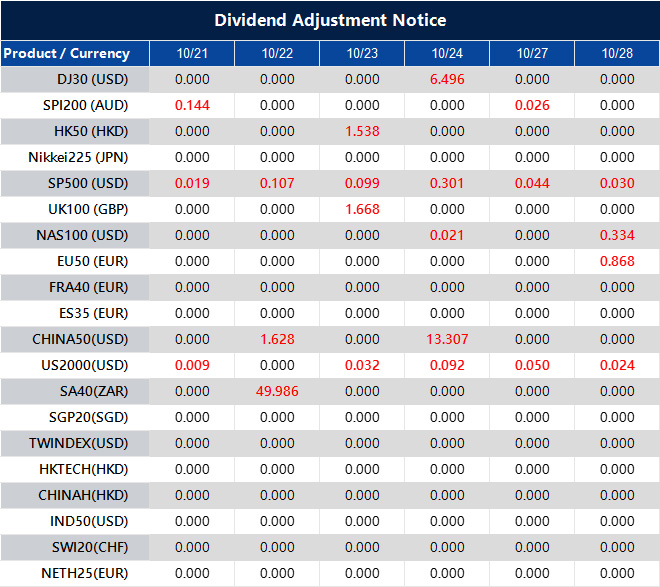
The above data is for reference only, please refer to the MT4/MT5 software for specific data.
If you’d like more information, please don’t hesitate to contact [email protected].
Gold prices in India decline, according to recent data findings.
Gold prices in India fell on Tuesday. The price per gram dropped to 12,277.96 Indian Rupees (INR) from 12,317.33 INR the day before. In tola terms, the price decreased from 143,662.20 INR to 143,207.70 INR.
Several factors led to this decline, including a slight rise in the US Dollar and a decrease in US-China trade tensions. These factors typically lower gold prices. Investors are also anticipating a 25-basis-point rate cut by the US Federal Reserve, which may prevent a significant drop in gold prices.
Geopolitical Tensions Impact
The ongoing US government shutdown and geopolitical issues, particularly involving Russia and Ukraine, continue to support gold as a safe-haven asset. Traders are waiting for US consumer inflation data, which could influence future price trends. Central banks are major buyers of gold, with countries like China and India boosting their reserves. Gold prices tend to rise when the US Dollar and riskier assets fall, displaying an inverse relationship. Local prices are adjusted based on international rates but may vary due to local conditions. These values reflect market sentiment toward gold. Gold prices are dipping today, mainly due to the strengthening US Dollar. The Dollar Index (DXY) is around 107 as the market expects the Federal Reserve to maintain its strict stance on interest rates, making gold—a non-yielding asset—more expensive for investors. This situation differs from late 2023 when markets anticipated multiple Fed rate cuts. While those cuts happened in 2024, they were quickly followed by rate hikes to fight rising inflation. This history is making traders hesitant to bet against the Dollar, limiting any significant rally in gold prices for now.Central Bank Demand and Market Strategy
Geopolitical risks continue to support gold prices, preventing a major sell-off. Ongoing tensions at the Russia-Ukraine border serve as a reminder of gold’s safe-haven status. Similar to events leading up to 2024, any escalation in this area could lead to a rush for safety, pushing gold prices higher. We must also acknowledge the steady demand from central banks, which plays a crucial role in the gold market. In 2022, they purchased a record 1,136 tonnes, and reports from the World Gold Council show that this trend continued into 2024 and the first half of 2025. This long-term buying from large institutions offers strong support for the market. Unlike between 2018 and 2020, when gold prices fluctuated greatly due to US-China trade news, the market focus has shifted. While global trade still matters, immediate risks now relate more to sovereign debt issues and regional conflicts. Nevertheless, a shaky global economy generally bodes well for gold. With a strong dollar pressuring prices and geopolitical support in place, we expect more volatility in the coming weeks. For derivative traders, this environment is ideal for strategies like straddles or strangles, which can profit from significant price changes in either direction. The upcoming US inflation data and the next FOMC meeting will be crucial in determining gold’s future direction. Create your live VT Markets account and start trading now.Gold prices decreased today in Malaysia, according to market data from various sources.
Gold prices in Malaysia fell on Tuesday, according to FXStreet data. The price dropped to 590.18 Malaysian Ringgits (MYR) per gram, down from MYR 591.87 on Monday. The price per tola also decreased, going from MYR 6,903.50 to MYR 6,883.67.
In Malaysia, gold prices are calculated based on international rates (USD/MYR) and are adjusted to the local currency. These prices are updated daily but may vary slightly from local rates.
Gold As A Safe Haven Investment
Gold has always been valued as a safe store of wealth and a means of exchange. It is often seen as a safe investment during uncertain times and acts as a hedge against inflation and currency decline. Central banks hold vast amounts of gold, purchasing 1,136 tonnes in 2022 alone. Gold prices typically move in the opposite direction of the US Dollar and US Treasuries. When these assets fall, gold usually increases, making it a useful diversification tool. Several factors can affect gold prices, including geopolitical tensions, fears of recession, interest rates, and the strength of the US Dollar. Generally, a stronger Dollar dampens gold prices, while a weaker Dollar tends to elevate them. The minor drop in gold prices to around MYR 590 per gram is just a brief fluctuation in a larger trend. There’s a tug-of-war going on between high interest rates, which put pressure on gold, and strong demand for the metal. It’s essential to focus on these larger forces rather than fixating on day-to-day price changes. The US Federal Reserve has kept interest rates steady throughout 2025 to curb inflation, which is still above 3%. This policy strengthens the US Dollar and makes gold, which doesn’t provide interest, less appealing for now. We’ve seen this pattern repeatedly during the rate hikes that began in 2022.Central Bank Buying Spree
Despite the recent drop, there seems to be a strong support level for gold prices. Central banks continue their aggressive purchasing, adding over 800 tonnes to reserves this year, according to the World Gold Council. This ongoing demand, particularly in emerging markets, acts as a solid buffer. Geopolitical tensions also play a significant role, keeping the demand for safe-haven assets high. This uncertainty means that volatility in gold options has not decreased, even with stable prices over recent months. The market is clearly factoring in the possibility of sudden events. In the coming weeks, we might consider strategies that take advantage of this tension. For instance, selling out-of-the-money puts could help us earn premiums by leveraging strong central bank support around the $1,980 per ounce mark (about 18,350 MYR). This strategy is effective if we expect prices to remain steady or rise slightly. We should also be prepared for any changes in Fed policy heading into 2026. If signs emerge that rate cuts could happen soon, gold could rally significantly. Using long-dated call options would allow us to position ourselves for this potential upside while limiting risk if high rates last longer than we expect. Create your live VT Markets account and start trading now.EUR/CAD sees slight increase during Asian session as CAD weakens, remaining within previous trading limits
The EUR/CAD cross made slight gains during the Asian session but stayed within the previous day’s trading range, between 1.6345 and 1.6350. Traders are waiting for Canadian CPI data to provide clearer direction, while the Canadian Dollar remains weak due to expectations of a rate cut by the Bank of Canada (BoC).
Oil prices and recent BoC surveys are adding more pressure on the Loonie, which supports the EUR/CAD pair. Additionally, the recent downgrade of France’s credit rating to A+ by S&P Global Ratings affects the Euro and limits its gains against the Canadian Dollar.
Christine Lagarde’s Upcoming Speech
Christine Lagarde, the President of the ECB, is set to speak at a conference but likely won’t discuss monetary policy. Although the Euro faces pressure from a strong US Dollar, lower expectations for further ECB interest rate cuts might help the EUR/CAD cross. Today, the Canadian Dollar has shown strength against the New Zealand Dollar. A heat map highlights percentage changes of major currencies, allowing for easy comparison by selecting a base currency from the left column and a quote currency from the top row. We are closely monitoring the EUR/CAD cross near the 1.6350 level as the market awaits today’s Canadian inflation data. A weaker inflation report, with forecasts predicting a drop to 2.3% from 2.5% last month, could very likely lead to a Bank of Canada rate cut next week, putting additional pressure on the Canadian Dollar.Bank of Canada Economic Outlook
The Bank of Canada’s recent surveys indicate a weakening economy, reinforcing the expectation of a rate cut at the October 29th meeting. This dovish outlook is backed by falling crude oil prices, with WTI struggling around $72 a barrel due to increased OPEC+ production. Currently, a weak Loonie seems to be the expected trend. Meanwhile, the Euro is facing challenges from the S&P downgrade of France’s credit rating, which limits its upward movement. However, the European Central Bank seems to be maintaining its stance after cutting rates earlier in 2025, as inflation remains stubbornly high. This contrast between a rate-cutting BoC and a holding ECB is the main factor supporting this currency pair. Given this outlook, there is an opportunity in options to take advantage of a potential rise in EUR/CAD after the CPI data is released. Buying call options with a mid-November expiry could allow us to benefit from a rally following the CPI and BoC meeting. A strike price around 1.6400 could provide good value if the pair breaks higher as we expect. Create your live VT Markets account and start trading now.GBP/USD pair drops to 1.3390 during Asian hours as the dollar strengthens against the pound
GBP/USD dipped to around 1.3390 during Tuesday morning in Asia. The US Dollar gained strength against the Pound Sterling due to eased tensions in US-China trade relations.
President Donald Trump mentioned that imposing 100% tariffs on Chinese goods is not practical. While he criticized Beijing for issues in trade talks, he is set to meet with Chinese President Xi Jinping.
US-China Trade Talks
US Treasury Secretary Bessent confirmed ongoing discussions between the US and China in Malaysia ahead of the Asia-Pacific Economic Cooperation conference. This news provided some support for the US Dollar. Traders are eagerly waiting for the UK’s Consumer Price Index (CPI) report for September, which will be released on Wednesday. Ongoing inflation in the UK may influence the Bank of England’s (BoE) decisions on interest rates. The UK’s CPI is expected to climb by 4.0% year-over-year in September. Core CPI is forecasted to rise by 3.7% year-over-year, which will shape trading strategies for the GBP/USD pair. The Pound Sterling is the official currency of the UK and ranks as the fourth most traded currency worldwide, with GBP/USD being a significant trading pair. The BoE’s monetary policy greatly affects the value of GBP, responding to inflation rates.Global Economic Data
Economic indicators like GDP, PMIs, and employment figures impact the Sterling alongside trade balance reports. A favorable trade balance can strengthen the currency as demand for exports increases. Looking at today, October 21, 2025, the factors affecting the GBP/USD pair have changed considerably. The long-standing focus on the 1.3400 level seems distant, as the pair traded around 1.22 toward the end of 2023 and is currently navigating a complex recovery phase. Nevertheless, the tension between inflation data and central bank actions remains the top concern for traders. Reflecting on the past, concerns surrounding the September 2023 CPI data were warranted, even though forecasts were optimistic. The actual figure came in at a surprising 6.7%, significantly above the 4.0% expected. This prompted the BoE to maintain a hawkish approach throughout 2024, which helped support the pound amidst global economic sluggishness. Today, the scenario is different; UK inflation has dropped to 2.8%, according to the latest reports, much closer to the BoE’s 2% target. However, this drop has come with economic growth challenges. The last quarter showed a mere 0.1% GDP growth, placing the BoE in a tough spot for its upcoming November meeting. For derivative traders, this uncertainty presents an excellent opportunity for volatility strategies. With mixed sentiments about whether the BoE will lower rates to boost growth or keep them steady due to persistent core inflation, buying straddles or strangles on GBP/USD options could be a smart move. This approach allows traders to profit from significant price shifts in either direction after the BoE’s announcement. On the US side, the dollar’s strength is increasingly tied to the Federal Reserve’s policies rather than specific trade statements. Recent US employment data exceeded expectations, with non-farm payrolls adding 210,000 jobs last month, pushing back predictions of a Fed rate cut. This contrast between a potentially dovish BoE and a steady Fed may put downward pressure on GBP/USD. Traders with a bearish outlook on the Pound might consider buying out-of-the-money put options on GBP/USD for a low-cost way to bet on a decline. Alternatively, utilizing futures contracts to hedge existing long positions on the pound is essential ahead of the next central bank announcements. These strategies help mitigate the risk that economic weakness could force the BoE to act more aggressively than the market expects. Create your live VT Markets account and start trading now.EUR/JPY recovers from four-day decline, nearing 176.00 as JPY weakens before parliamentary vote
The EUR/JPY rate has climbed close to 176.00 as Japan gets ready to confirm Sanae Takaichi as the new prime minister. The Japanese Yen has weakened due to the Liberal Democratic Party forming a coalition with the Japan Innovation Party to push through new fiscal policies.
There are concerns about how stable this coalition will be and how strict Takaichi may be. Additionally, Bank of Japan board member Hajime Takata has mentioned it might be time to raise interest rates, although they are expected to stay the same for now.







