



After a dip, silver rebounds to about $52.30 with a 0.7% increase
Silver prices have rebounded to about $52.30 after dropping from a peak of $54.50. This upswing happens as US-China trade tensions ease, which lessens the need for safe-haven assets like silver.
Traders believe there’s a small chance the Federal Reserve might cut interest rates by more than 50 basis points this year. Lower rates typically benefit non-yielding assets like silver. According to the CME FedWatch tool, there’s a strong expectation for a 50 basis point cut.
Technical analysis of silver shows it has pulled back from its high, but the short-term outlook is positive. The 20-day exponential moving average (EMA) is rising, and the Relative Strength Index (RSI) indicates strong upward momentum. We expect support at the 20-day EMA, while the previous all-time high may act as resistance.
Silver is a popular investment due to its historical value and role as a hedge against inflation. Factors that influence its price include geopolitical instability, the US dollar’s performance, and demand in electronics and solar energy. Silver prices often follow gold’s trends, and the gold-to-silver ratio helps compare their values.
Future events, like US-China trade talks and Federal Reserve decisions, could impact silver prices further.
Currently, silver is stabilizing above $52, but the sharp downturn from Friday’s high creates uncertainty for traders. This tension arises between easing US-China trade tensions, which reduce safe-haven demand, and strong expectations for Federal Reserve rate cuts. In the coming weeks, we will see which of these factors prevails.
The market is almost fully expecting at least a 50 basis point rate cut from the Fed by the end of the year, which historically benefits non-yielding assets like silver. We saw a similar trend in the summer of 2019 when a shift in Fed policy helped silver prices surge by over 25% in just three months. This basic support is further strengthened by industrial demand; reports from the Silver Institute show that consumption in the photovoltaic and electric vehicle sectors is 9% higher year-over-year.
The main risk to this bullish trend is any progress in US-China trade talks scheduled for later this month. Positive news from these meetings could quickly reduce silver’s geopolitical risk premium, making the recent high of $54.50 a significant barrier. Given this uncertainty, traders might consider buying put options to protect long futures positions or using volatility strategies to brace for sharp price movements in either direction.
In terms of relative value, silver remains appealing compared to gold. With gold trading just under $4,300, the gold-to-silver ratio is close to 82, which is much higher than the average of around 65 for the 21st century. This suggests silver might be undervalued compared to gold, offering greater potential for price increases if the precious metals market rises.
GBP/USD pair starts the week slowly, staying above 1.3400 amid varied conditions
The GBP/USD pair starts the new week quietly after a rollercoaster of price changes on Friday, staying above 1.3400 during the Asian session. With mixed economic conditions, it’s wise to be cautious about predicting a further rise from its recent low of 1.3250-1.3245, reached last Tuesday.
Despite gaining on Friday, the US Dollar struggles to maintain strength due to expectations of interest rate cuts by the US Federal Reserve this year. Other pressures on the USD include fears of a lengthy government shutdown, global trade concerns, and signs of a slowing US economy, which support the GBP/USD pair.
Pound Sterling Sees New Buying Interest
The Pound Sterling has attracted new buying interest around 1.3250 against the USD, pushing the pair closer to 1.3500. Even though there were difficulties earlier, GBP/USD buyers made a strong comeback last week as the USD lost its upward momentum against major currencies. Previously, the Pound faced headwinds from renewed US-China trade tensions and disappointing UK employment data. The UK’s unemployment rate hit 4.8% for the three months ending in August—a four-year high, up from 4.7% in July, according to the Office for National Statistics. Average earnings growth also fell to 4.7% during this time. The Pound is caught in a range between 1.3250 and 1.3500 against the Dollar. Both economies show signs of weakness; the US is slowing, and recent job numbers from the UK were disappointing. This creates a cautious atmosphere in the following weeks. The Dollar’s weakness appears to be the main factor supporting the GBP/USD pair. The recent Non-Farm Payrolls data for September 2025 revealed only 95,000 jobs added—far below expectations—reinforcing market expectations of a Fed rate cut before the end of the year. Futures markets now reflect a 75% chance of a cut in December, adding pressure on the US currency.Market Dynamics and Trading Strategy
On the Sterling side, the recent rise in UK unemployment to a four-year high of 4.8% complicates matters. However, last week’s UK CPI inflation reading was unexpectedly high at 2.9%, which may limit the Bank of England’s ability to reduce interest rates. The tension between slowing growth and persistent inflation is likely to keep the Pound’s movements unpredictable. Given this uncertainty, we suggest that selling volatility could be a practical strategy over the next two to three weeks. Traders might consider using options to set a range-bound position, like an iron condor, with strikes outside the 1.3200 to 1.3550 range. This could allow for profit as the pair remains directionless, benefiting from time decay. It’s also wise to prepare for a potential breakout, especially with US inflation data coming next week. We recall the sideways market of late 2023, which was eventually disrupted by an unexpected central bank announcement. Thus, holding positions that benefit from volatility, like a simple straddle, could be a smart hedge against a significant price move in either direction. Create your live VT Markets account and start trading now.USD/CHF strengthens near 0.7950 as economic concerns weaken the Swiss Franc in Asian trading
The USD/CHF pair has risen, reaching close to 0.7950, amid ongoing worries about the Swiss economy. SECO has maintained Switzerland’s GDP growth forecast for 2025 at a low 1.3%, citing a general slowdown expected during the second half of the year. Furthermore, SECO has lowered its 2026 GDP projection from 1.2% to 0.9%. The Swiss Trade Balance data, set to be released on Tuesday, may provide additional insights into Switzerland’s economic condition.
Even with the USD/CHF pair’s gains, the US Dollar is under pressure due to a government shutdown that is currently in its 19th day, with no end in sight. Senators have attempted and failed ten times to resolve the budget impasse. Additionally, the US Federal Reserve is expected to make more interest rate cuts, with markets indicating nearly a 100% chance of a reduction in October and a 96% chance for December.
Easing Trade Tensions
Improving trade relations between the US and China could help stabilize the USD. President Trump has shown interest in China buying soybeans at prior levels, suggesting a positive outlook for future trade deals. The Swiss Franc is affected by Switzerland’s economic stability, high living standards, and its role as a global tax haven. The USD/CHF pair is currently around 0.7950, caught between two opposing forces. The Swiss Franc is losing strength due to local economic worries, while the US Dollar struggles with its own issues stemming from the ongoing government shutdown. This situation creates a tricky environment for traders, with the Swiss Trade Balance data on Tuesday being an important indicator to monitor. The Swiss Franc’s ongoing weakness is supported by SECO’s bleak outlook, which forecasts below-average GDP growth of only 1.3% for 2025 and an even lower 0.9% for 2026. This could make purchasing call options on USD/CHF an appealing strategy, as profits would rise if the Franc continues to weaken. September 2025 inflation data, showing only a 1.1% year-over-year rise, reinforces the belief that the Swiss National Bank won’t rush to strengthen its currency. However, potential gains for USD/CHF face significant challenges from issues in the United States. The government shutdown, now at 19 days, is generating economic uncertainty and is approaching the length of major historical shutdowns, such as the 35-day period from 2018-2019. Additionally, the CME FedWatch tool indicates a nearly 100% chance of a Fed rate cut this month, further weakening the dollar.Traders Strategies
Given these conflicting factors, traders might benefit by employing strategies that prepare for potential volatility, rather than expecting a clear directional movement. Buying put options on USD/CHF could serve as a helpful hedge against a possible resolution to the US shutdown or if the anticipated Fed rate cuts begin to impact the dollar more significantly. This approach provides protection if the pair does not rise and instead reverses. Looking at the bigger picture, it’s important to note that the current USD/CHF level of 0.7950 is historically low. Between 2015 and 2023, the pair often traded well above 0.9000. This context suggests that, despite immediate challenges for the US dollar, the long-term potential for the pair to climb remains strong if Swiss economic issues keep prevailing. Create your live VT Markets account and start trading now.NZD/USD rises after New Zealand’s inflation figures but remains below mid-0.5700s
The NZD/USD pair saw some gains due to New Zealand’s recent inflation data and positive economic news from China. However, the prices stayed below the mid-0.5700s during the Asian session.
New Zealand Inflation and Chinese Growth
New Zealand’s Consumer Price Index (CPI) increased by 1.0% in Q3, up from 0.5% in the previous quarter. The annual inflation rate is now 3.0%, compared to 2.7% before. Meanwhile, China’s GDP grew by 4.8% in Q3 2025, with industrial production rising by 6.5% and retail sales by 3%. US President Donald Trump mentioned that imposing a full-scale tariff on China would not be feasible, which eased concerns about trade tensions. This positively impacted the NZD/USD pair, along with the US Federal Reserve’s indications regarding possible interest rate cuts. The US Dollar is facing challenges due to worries about the effects of a long government shutdown on economic performance. These conditions have kept interest in the NZD/USD pair strong, as traders look ahead to upcoming US inflation data. Economic indicators also influence the market, with China’s GDP serving as a key measure of economic activity. These data changes impact currency movements, focusing on future releases and overall economic health. Given New Zealand’s strong inflation and China’s positive economic data, the outlook for the NZD/USD pair looks good. Traders might want to buy call options to take advantage of potential price increases while limiting their risk to the premium they pay.New Zealand Reserve Bank Strategy
With New Zealand’s annual inflation at 3.0%, it sits at the top of the Reserve Bank of New Zealand’s target range. This situation may prevent the RBNZ from cutting rates, giving the Kiwi a yield advantage. The market may view this as a hawkish sign, providing a solid support level for the currency. Strong Chinese data, especially the 4.8% GDP growth, is also a big boost for the New Zealand dollar. This indicates a recovery from the economic slowdown and property sector troubles that have been in the spotlight throughout 2024. As China’s economy improves, demand for New Zealand’s exports should rise, further supporting the NZD. On the flip side, the US dollar seems weak due to expectations of more rate cuts from the Federal Reserve. The Fed has already reduced rates from the peaks of over 5.25% seen in 2023. Further cuts this year could diminish the dollar’s attractiveness compared to currencies with more stable or aggressive central banks. With the NZD/USD pair currently hovering below the mid-0.5700s before the US inflation data release, a cautious but optimistic strategy is advisable. A bull call spread strategy—buying one call option and selling another at a higher strike price—could be beneficial. This tactic lowers initial costs and positions traders for a possible breakout after the US data is revealed. More aggressive traders might consider selling out-of-the-money put options, set to expire after this Friday’s US inflation report. This approach allows for collecting a premium amidst the current uncertainty. It bets that strong fundamentals in New Zealand and a weak USD will keep the NZD/USD from dropping significantly, even if US inflation exceeds expectations. Create your live VT Markets account and start trading now.Gold prices have risen in Saudi Arabia, according to the latest market data.
Gold prices in Saudi Arabia have risen to 514.37 Saudi Riyals (SAR) per gram, up from 512.69 SAR on Friday, according to FXStreet data. The price per tola has also increased to SAR 5,999.42, from SAR 5,979.96.
FXStreet updates these prices every day, considering international market rates and currency fluctuations. Gold is valued for its reliability as a store of value and is seen as a safe-haven asset during uncertain economic times.
Central Bank Reserves
Central banks hold significant amounts of gold, adding 1,136 tonnes valued at about $70 billion in 2022. This was their largest yearly purchase ever, with countries like China and India rapidly increasing their gold reserves. Gold prices generally rise when the US Dollar weakens, as there is an inverse relationship between the two. When the stock market declines, gold tends to gain value. Additionally, geopolitical instability often drives up gold prices due to its appeal as a safe investment. Several factors affect gold prices, including interest rates and the strength of the currency. Gold typically increases when interest rates are low and becomes more appealing when the Dollar decreases in value. FXStreet warns that these market evaluations come with risks and uncertainties. With gold prices slightly rising on October 20, 2025, we are witnessing signs of strength. This uptick seems related to a small dip in the US Dollar, ahead of key inflation data expected later this week. Derivative traders should be aware of this classic inverse relationship currently at play.Market Dynamics and Strategies
The recent indications from the Federal Reserve about a possible pause in interest rate hikes have created uncertainty in the market, which usually benefits non-yielding assets like gold. According to the latest Commitments of Traders report, large speculators are increasing their net-long positions in gold futures. This suggests they expect higher prices, especially if the Fed adopts a more dovish approach in its November meeting. Growing trade tensions between the US and China are also creating global market unrest, leading capital to safer investments. This situation has raised gold’s implied volatility to its highest level in three months, making strategies like straddles more attractive for those anticipating significant price movements. Similar spikes in volatility occurred during the trade disputes of the late 2010s, often preceding sharp increases in gold prices. We should also consider the ongoing demand from central banks, which offers a solid foundation for gold prices. The World Gold Council’s recent data for the third quarter of 2025 shows that central banks added over 215 tonnes to their reserves. This trend continues from the record purchases in 2022, absorbing market supply and supporting a positive long-term outlook. Given the mix of geopolitical risks and potential shifts in monetary policy, it’s wise to establish bullish positions with controlled risk. Consider buying call options or implementing bull call spreads on December gold futures to take advantage of potential price increases as the year concludes. This approach allows traders to benefit from price rallies while minimizing costs and overall risk exposure. Create your live VT Markets account and start trading now.EUR/JPY pair strengthens towards 175.65 as the yen weakens due to political changes
The EUR/JPY exchange rate is currently at 175.65 in early European trading on Monday. The outlook looks positive, as the price is holding above the 100-day EMA and the 14-day RSI is above 56.85, indicating upward momentum.
**Resistance Levels and Targets**
The resistance for EUR/JPY is found between 176.90 and 177.00, aligned with the high from October 13. If the price breaks through this range, it could rise to targets of 178.00 and then 178.50.
On the downside, the first support level is at 174.82, the low from October 17. If it drops below this level, the price may decline further to 172.35 and potentially to 171.25.
The Japanese Yen is under pressure because of expectations for continued easy monetary policy. A delay in raising rates by the Bank of Japan (BoJ) could further weaken the Yen, boosting the EUR/JPY pair.
The upcoming release of the German PPI and Japan’s Prime Minister election will impact economic sentiment in both regions. Sanae Takaichi is expected to be elected Prime Minister, which raises market hopes for expanded fiscal measures and ongoing policy easing.
**Impact of ECB and BoJ Policies**
The Yen’s performance is linked to BoJ policies, US-Japan yield differences, and global risk sentiment. In the past, the Yen weakened due to ultra-loose policies (2013-2024), but recent gradual adjustments may provide some support.
As we start the week, the EUR/JPY remains bullish above 175.50. The market is pricing in the likely election of Sanae Takaichi as Japan’s next Prime Minister, suggesting continued loose monetary policy. This supports the Euro and adds pressure on the Yen.
In Japan, the Core CPI for September was 1.8%, further below the BoJ’s 2% target. This gives the new leadership a reason to postpone significant interest rate hikes, which contributes to the weak Yen. Traders are now more willing to bet against the Yen for the foreseeable future.
Meanwhile, European Central Bank officials signal a hawkish stance, as Eurozone core inflation remains stubbornly above 3%. This difference in policy is widening the gap between German and Japanese 10-year government bonds to over 360 basis points. The carry trade favoring the Euro over the Yen is very appealing in this context.
For derivative traders, this environment supports purchasing call options on the EUR/JPY or creating bull call spreads to manage costs. We see the 177.00 level as the main resistance, and breaking through it could lead to our next target of 178.00. Using options allows us to take advantage of this expected price increase while managing our risk.
It’s crucial to manage risk, especially considering the Yen’s quick recoveries in 2024 when policy shifts were initially announced. A decisive break below the 174.82 support level would be a warning sign that this trend may be weakening. Cautious traders might consider buying inexpensive out-of-the-money puts as protection against unexpected policy changes or shifts in market sentiment.
Create your live VT Markets account and start trading now.
Gold prices in the Philippines increased today, according to financial data.
Gold prices in the Philippines went up on Monday, based on FXStreet data. The price for gold per gram rose to 7,965.06 Philippine Pesos (PHP), up from PHP 7,939.89 last Friday.
The cost per tola increased to PHP 92,902.16, compared to PHP 92,609.33. Other prices include 10 grams at PHP 79,649.96 and a troy ounce at PHP 247,741.30.
FXStreet Pricing Methodology
FXStreet calculates these gold prices by converting international rates (USD/PHP) into local currency. They update these prices daily based on market rate changes. Gold is often seen as a safe investment and a way to preserve wealth, especially during tough economic times. It’s also a good protection against inflation and currency loss. Central banks are big buyers of gold, adding 1,136 tonnes to their reserves in 2022, the highest amount since records began. China, India, and Turkey are boosting their gold holdings. Gold’s value usually goes up when the US Dollar weakens and markets are unstable. Lower interest rates tend to increase its price, while higher rates can lower it, heavily influenced by dollar movements.Current Trends and Market Opportunities
As of October 20, 2025, gold is showing a small increase, indicating overall market strength. This slight rise fits into a broader trend towards safer assets. For those trading derivatives, this gradual increase presents a good chance to consider long positions. We believe this trend is mainly due to the US Federal Reserve signaling a pause in interest rate hikes. Typically, such shifts weaken the US Dollar, which we’ve observed recently with the Dollar Index (DXY) dropping below 103. Since gold usually rises when the dollar weakens, this supports higher gold prices. Additionally, recent geopolitical tensions and signs of slower growth in major economies boost gold’s attractiveness as a safe investment. The CBOE Volatility Index (VIX) has increased by 15% over the past month, highlighting rising uncertainty in the stock market. In times of instability, investors often move money from risky assets like stocks into the safety of gold. Central bank purchases continue to create a solid price foundation, a trend that has intensified since the record buying observed in 2022 and 2023. Recent data from the World Gold Council for the third quarter of 2025 shows that central banks in emerging markets remain net buyers, consistently increasing their reserves. This demand from institutions supports a stable long-term outlook for gold. Given these conditions, traders might consider call options on gold futures to capitalize on potential gains in the coming weeks. The current market suggests gold could hit resistance levels seen in the spring of 2024. It’s important to keep an eye on the Fed’s next announcements and key inflation data to time these trades well. Create your live VT Markets account and start trading now.Dividend Adjustment Notice – Oct 20 ,2025
Dear Client,
Please note that the dividends of the following products will be adjusted accordingly. Index dividends will be executed separately through a balance statement directly to your trading account, and the comment will be in the following format “Div & Product Name & Net Volume”.
Please refer to the table below for more details:
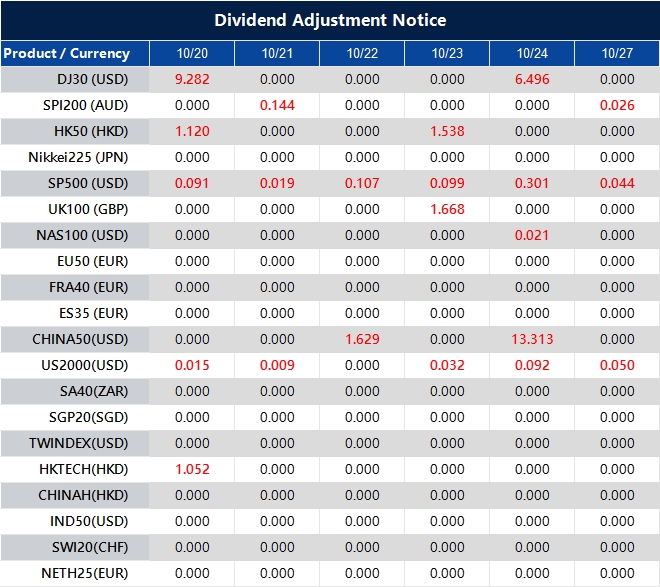
The above data is for reference only, please refer to the MT4/MT5 software for specific data.
If you’d like more information, please don’t hesitate to contact [email protected].
US Dollar Index drops around 98.50 due to government shutdown and Fed rate cut expectations
The US Dollar Index has dropped as the government shutdown enters its 19th day without a solution. Markets are now seeing a near certainty of rate cuts, with a 100% chance for October and 96% for December, according to the CME FedWatch Tool.
The US Dollar is stable around 98.50 but is being affected by the prolonged shutdown and expected Fed rate changes. The index tracks the dollar’s value against six major currencies and has recently lost ground from earlier gains.
Government Funding Lapse
This is the third-longest funding lapse in modern US history. The possibility of more rate cuts from the Federal Reserve adds pressure on the US Dollar. St. Louis Fed President Alberto Musalem indicated he might support a rate cut if job risks increase, advocating for a balanced approach. Improved relations with China could bolster the dollar, as President Trump looks to reduce tariffs based on Chinese actions. The US Dollar is the leading global currency, making up over 88% of foreign exchange transactions. Fed policies, whether easing or tightening, play a crucial role in determining its value, which in turn affects economic stability and job growth. We believe the US Dollar will face major challenges in the coming weeks. The ongoing government shutdown and the expectation of two Fed rate cuts this year create a bearish outlook, suggesting the dollar may weaken against other major currencies.Currency Options and Volatility
Historically, the 35-day shutdown from late 2018 to early 2019 cost the US economy about $11 billion, highlighting the high stakes of political gridlock. With the current shutdown reaching 19 days, implied volatility for currency options is expected to increase. This makes buying put options on the dollar an appealing, though pricier, strategy for hedging or speculation. The Fed’s dovish outlook is a strong driving force, with an October rate cut widely anticipated. Similar to 2019, when three rate cuts limited the dollar’s strength for several months, traders should keep an eye out for signs of ongoing economic slowdown. Recent data showing a slight rise in jobless claims to 215,000 supports this expectation. The biggest risk for short-dollar positions comes from US-China trade talks. A surprise breakthrough, like the earlier “Phase One” deal, could trigger a risk-on rally and temporarily strengthen the dollar. Traders should closely watch news from upcoming meetings for any developments on agricultural purchases or tariff cuts. Create your live VT Markets account and start trading now.Gold prices rise in the United Arab Emirates today, according to collected data.
Gold prices in the United Arab Emirates have risen. A gram of gold is now priced at 503.79 AED, up from 502.06 AED on Friday. The price for a tola has increased to 5,876.07 AED from 5,855.90 AED.
Here are the gold prices for various units in AED:
– 1 gram: 503.79
– 10 grams: 5,037.87
– Tola: 5,876.07
– Troy ounce: 15,669.12
FXStreet calculates these gold prices in the UAE by adjusting international rates to local currency and units. Prices are updated daily and may vary locally.







