



EUR/JPY pair strengthens towards 175.65 as the yen weakens due to political changes
The EUR/JPY exchange rate is currently at 175.65 in early European trading on Monday. The outlook looks positive, as the price is holding above the 100-day EMA and the 14-day RSI is above 56.85, indicating upward momentum.
**Resistance Levels and Targets**
The resistance for EUR/JPY is found between 176.90 and 177.00, aligned with the high from October 13. If the price breaks through this range, it could rise to targets of 178.00 and then 178.50.
On the downside, the first support level is at 174.82, the low from October 17. If it drops below this level, the price may decline further to 172.35 and potentially to 171.25.
The Japanese Yen is under pressure because of expectations for continued easy monetary policy. A delay in raising rates by the Bank of Japan (BoJ) could further weaken the Yen, boosting the EUR/JPY pair.
The upcoming release of the German PPI and Japan’s Prime Minister election will impact economic sentiment in both regions. Sanae Takaichi is expected to be elected Prime Minister, which raises market hopes for expanded fiscal measures and ongoing policy easing.
**Impact of ECB and BoJ Policies**
The Yen’s performance is linked to BoJ policies, US-Japan yield differences, and global risk sentiment. In the past, the Yen weakened due to ultra-loose policies (2013-2024), but recent gradual adjustments may provide some support.
As we start the week, the EUR/JPY remains bullish above 175.50. The market is pricing in the likely election of Sanae Takaichi as Japan’s next Prime Minister, suggesting continued loose monetary policy. This supports the Euro and adds pressure on the Yen.
In Japan, the Core CPI for September was 1.8%, further below the BoJ’s 2% target. This gives the new leadership a reason to postpone significant interest rate hikes, which contributes to the weak Yen. Traders are now more willing to bet against the Yen for the foreseeable future.
Meanwhile, European Central Bank officials signal a hawkish stance, as Eurozone core inflation remains stubbornly above 3%. This difference in policy is widening the gap between German and Japanese 10-year government bonds to over 360 basis points. The carry trade favoring the Euro over the Yen is very appealing in this context.
For derivative traders, this environment supports purchasing call options on the EUR/JPY or creating bull call spreads to manage costs. We see the 177.00 level as the main resistance, and breaking through it could lead to our next target of 178.00. Using options allows us to take advantage of this expected price increase while managing our risk.
It’s crucial to manage risk, especially considering the Yen’s quick recoveries in 2024 when policy shifts were initially announced. A decisive break below the 174.82 support level would be a warning sign that this trend may be weakening. Cautious traders might consider buying inexpensive out-of-the-money puts as protection against unexpected policy changes or shifts in market sentiment.
Create your live VT Markets account and start trading now.
Gold prices in the Philippines increased today, according to financial data.
Gold prices in the Philippines went up on Monday, based on FXStreet data. The price for gold per gram rose to 7,965.06 Philippine Pesos (PHP), up from PHP 7,939.89 last Friday.
The cost per tola increased to PHP 92,902.16, compared to PHP 92,609.33. Other prices include 10 grams at PHP 79,649.96 and a troy ounce at PHP 247,741.30.
FXStreet Pricing Methodology
FXStreet calculates these gold prices by converting international rates (USD/PHP) into local currency. They update these prices daily based on market rate changes. Gold is often seen as a safe investment and a way to preserve wealth, especially during tough economic times. It’s also a good protection against inflation and currency loss. Central banks are big buyers of gold, adding 1,136 tonnes to their reserves in 2022, the highest amount since records began. China, India, and Turkey are boosting their gold holdings. Gold’s value usually goes up when the US Dollar weakens and markets are unstable. Lower interest rates tend to increase its price, while higher rates can lower it, heavily influenced by dollar movements.Current Trends and Market Opportunities
As of October 20, 2025, gold is showing a small increase, indicating overall market strength. This slight rise fits into a broader trend towards safer assets. For those trading derivatives, this gradual increase presents a good chance to consider long positions. We believe this trend is mainly due to the US Federal Reserve signaling a pause in interest rate hikes. Typically, such shifts weaken the US Dollar, which we’ve observed recently with the Dollar Index (DXY) dropping below 103. Since gold usually rises when the dollar weakens, this supports higher gold prices. Additionally, recent geopolitical tensions and signs of slower growth in major economies boost gold’s attractiveness as a safe investment. The CBOE Volatility Index (VIX) has increased by 15% over the past month, highlighting rising uncertainty in the stock market. In times of instability, investors often move money from risky assets like stocks into the safety of gold. Central bank purchases continue to create a solid price foundation, a trend that has intensified since the record buying observed in 2022 and 2023. Recent data from the World Gold Council for the third quarter of 2025 shows that central banks in emerging markets remain net buyers, consistently increasing their reserves. This demand from institutions supports a stable long-term outlook for gold. Given these conditions, traders might consider call options on gold futures to capitalize on potential gains in the coming weeks. The current market suggests gold could hit resistance levels seen in the spring of 2024. It’s important to keep an eye on the Fed’s next announcements and key inflation data to time these trades well. Create your live VT Markets account and start trading now.Dividend Adjustment Notice – Oct 20 ,2025
Dear Client,
Please note that the dividends of the following products will be adjusted accordingly. Index dividends will be executed separately through a balance statement directly to your trading account, and the comment will be in the following format “Div & Product Name & Net Volume”.
Please refer to the table below for more details:
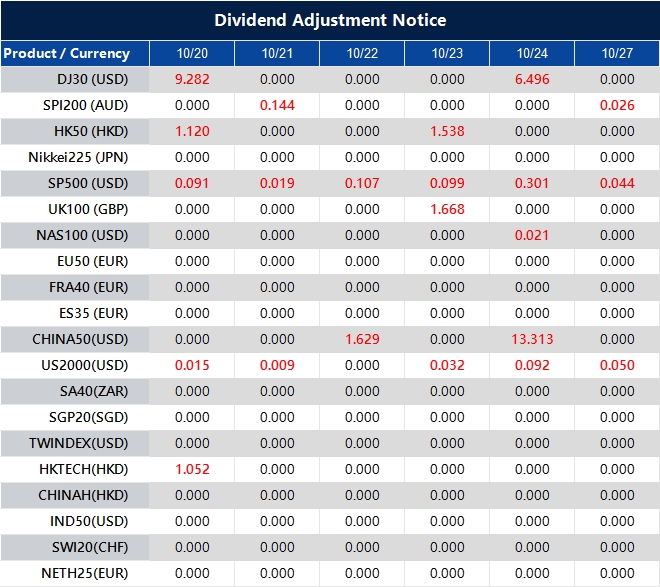
The above data is for reference only, please refer to the MT4/MT5 software for specific data.
If you’d like more information, please don’t hesitate to contact [email protected].
US Dollar Index drops around 98.50 due to government shutdown and Fed rate cut expectations
The US Dollar Index has dropped as the government shutdown enters its 19th day without a solution. Markets are now seeing a near certainty of rate cuts, with a 100% chance for October and 96% for December, according to the CME FedWatch Tool.
The US Dollar is stable around 98.50 but is being affected by the prolonged shutdown and expected Fed rate changes. The index tracks the dollar’s value against six major currencies and has recently lost ground from earlier gains.
Government Funding Lapse
This is the third-longest funding lapse in modern US history. The possibility of more rate cuts from the Federal Reserve adds pressure on the US Dollar. St. Louis Fed President Alberto Musalem indicated he might support a rate cut if job risks increase, advocating for a balanced approach. Improved relations with China could bolster the dollar, as President Trump looks to reduce tariffs based on Chinese actions. The US Dollar is the leading global currency, making up over 88% of foreign exchange transactions. Fed policies, whether easing or tightening, play a crucial role in determining its value, which in turn affects economic stability and job growth. We believe the US Dollar will face major challenges in the coming weeks. The ongoing government shutdown and the expectation of two Fed rate cuts this year create a bearish outlook, suggesting the dollar may weaken against other major currencies.Currency Options and Volatility
Historically, the 35-day shutdown from late 2018 to early 2019 cost the US economy about $11 billion, highlighting the high stakes of political gridlock. With the current shutdown reaching 19 days, implied volatility for currency options is expected to increase. This makes buying put options on the dollar an appealing, though pricier, strategy for hedging or speculation. The Fed’s dovish outlook is a strong driving force, with an October rate cut widely anticipated. Similar to 2019, when three rate cuts limited the dollar’s strength for several months, traders should keep an eye out for signs of ongoing economic slowdown. Recent data showing a slight rise in jobless claims to 215,000 supports this expectation. The biggest risk for short-dollar positions comes from US-China trade talks. A surprise breakthrough, like the earlier “Phase One” deal, could trigger a risk-on rally and temporarily strengthen the dollar. Traders should closely watch news from upcoming meetings for any developments on agricultural purchases or tariff cuts. Create your live VT Markets account and start trading now.Gold prices rise in the United Arab Emirates today, according to collected data.
Gold prices in the United Arab Emirates have risen. A gram of gold is now priced at 503.79 AED, up from 502.06 AED on Friday. The price for a tola has increased to 5,876.07 AED from 5,855.90 AED.
Here are the gold prices for various units in AED:
– 1 gram: 503.79
– 10 grams: 5,037.87
– Tola: 5,876.07
– Troy ounce: 15,669.12
FXStreet calculates these gold prices in the UAE by adjusting international rates to local currency and units. Prices are updated daily and may vary locally.
Gold As A Safe Haven
Gold acts as a store of value and a medium of exchange. It is often viewed as a safe-haven asset during uncertain times. Gold helps protect against inflation and falling currencies. In 2022, central banks, the largest gold owners, bought 1,136 tonnes, valued at around $70 billion. Gold generally moves in the opposite direction of the US Dollar and US Treasuries. Its price is affected by geopolitical tensions, fears of recession, and interest rates. A strong US Dollar usually keeps gold prices lower, while a weak Dollar tends to push them higher. The recent small increase in gold prices is part of a bigger trend that traders should monitor closely. This movement reflects gold’s traditional role as a safe haven during uncertain times. Ongoing geopolitical tensions and market instability are making investors nervous, leading them to seek tangible assets. Continued strong buying from central banks is noteworthy, particularly since the record purchases in 2022. According to recent World Gold Council data for the third quarter of 2025, central banks—especially in emerging markets—added another 220 tonnes to their reserves. This steady demand provides a solid support level for gold prices, indicating that large drops will likely be quickly bought.Interest Rate Impact On Gold
Reflecting on the aggressive interest rate hikes by the US Federal Reserve in 2022 and 2023, the situation looks different as we approach late 2025. The market now expects rate cuts in the first half of 2026 to address slowing growth, boosting the appeal of gold, which does not yield interest. This expectation is weakening the US Dollar, benefiting gold further. Recent inflation data has raised concerns, with the latest Consumer Price Index showing a persistent 3.4%, higher than many anticipated. This renewed fear of inflation, combined with a recent dip in equity markets, strengthens gold’s role as a hedge. For traders, this environment suggests buying dips in gold futures might be a wise strategy in the weeks ahead. Given this outlook, traders might find success using options to express a bullish stance while managing risk. Long call options on gold futures or ETFs would allow for potential gains with limited risk. This approach capitalizes on the expected monetary easing and ongoing demand for gold as a safe haven. Create your live VT Markets account and start trading now.The US dollar weakens, bringing USD/CAD down to around 1.4010 due to lower oil prices.
USD/CAD is currently at about 1.4010. The US Dollar has weakened due to the ongoing US government shutdown, which is now in its 19th day. Senators are still unable to reach an agreement, making this the third-longest funding lapse in US history.
Trade tensions with China might bring some relief, as President Trump mentioned possible tariff cuts. Talks between US Treasury Secretary Scott Bessent and Chinese Vice Premier He Lifeng are set to continue.
Impact of Falling Oil Prices
The Canadian Dollar is under pressure because of falling oil prices. Concerns about rising global supply have pushed West Texas Intermediate Oil down to around $57.00 per barrel. The International Energy Agency predicts an increase in production from OPEC+ members. The Canadian Dollar is affected by various factors like interest rates from the Bank of Canada and oil prices. When oil prices rise, the CAD usually strengthens; when they fall, the opposite occurs. Economic data and inflation also play a significant role. Strong data can boost the CAD’s value. These changing factors illustrate how interconnected global economic conditions are influencing currency values. Reflecting on market analysis from the past, we see a similar situation today where a politically unstable US Dollar faces a commodity-linked Canadian Dollar. On October 20, 2025, this dynamic continues, although the specific pressures have changed. Key drivers like oil prices, central bank policies, and US political stability remain crucial for traders.Current Challenges for the US Dollar
The US Dollar is struggling due to stalled budget talks in Washington, which is creating market uncertainty. The CBOE Volatility Index (VIX), a gauge of market fear, has increased by over 15% this month, highlighting trader worries about a funding lapse. This political tension is putting pressure on the dollar, making it weaker against major currencies. Unlike early 2019, when WTI crude was struggling below $57, oil prices have now become a strength for the Canadian dollar. Currently, West Texas Intermediate is above $85 per barrel, supported by recent EIA data showing US crude inventories decreasing for the fifth straight week. This robust energy market provides strong support for the loonie. This situation is creating opportunities in the options market, as the Bank of Canada (BoC) maintains a hawkish stance amid strong economic indicators. Meanwhile, the Federal Reserve is cautious due to domestic political issues. Overnight index swaps suggest there’s a 40% chance of a BoC rate hike by year-end. This difference in policies is a key factor driving the USD/CAD exchange rate lower. Canada’s strong economic status is also confirmed by recent trade data, which shows a trade surplus for the third consecutive month. According to Statistics Canada, this surplus is mainly due to high energy export values. This reinforces the CAD’s support that was missing during times of lower oil prices. Given these conditions, traders should consider positioning for further declines in the USD/CAD pair in the near future. Buying put options on this pair could be a defined-risk strategy to take advantage of this trend. Selling out-of-the-money call spreads may also effectively generate income while maintaining a bearish view on the pair. Create your live VT Markets account and start trading now.Gold prices in Pakistan rise according to today’s market data
Gold prices in Pakistan went up on Monday. The price per gram increased to 38,917.76 Pakistani Rupees (PKR) from 38,779.00 PKR last Friday.
The price for Gold per tola rose to PKR 453,929.20 from PKR 452,310.70 last week. The current rates for Gold in various units are 1,210,479.00 PKR per troy ounce and 389,160.30 PKR for 10 grams.
FXStreet Updates Gold Prices
FXStreet updates Gold prices in Pakistan by converting international prices into local currency. They make these updates daily. While these prices are mainly for reference, they might vary slightly from local market rates. Gold is historically significant as a safe store of value and as a medium of exchange. Today, it’s known as a safe-haven asset during uncertain times and serves as a hedge against inflation and currency depreciation. Central banks play a big role in the gold market, having purchased 1,136 tonnes in 2022, indicating strong demand. Gold typically rises when the US Dollar and US Treasuries fall. Geopolitical tensions or recession fears can push Gold prices higher as its safe-haven status attracts investors. Gold often thrives when interest rates are low, as this lowers borrowing costs; however, higher rates can negatively impact its value.Gold’s Safe Haven Status
Gold’s role as a safe-haven asset is becoming increasingly important. Renewed geopolitical tensions in the South China Sea are driving investors away from riskier assets like stocks. In this climate, holding gold becomes a smart choice during uncertain times. Central banks continue to buy gold heavily, following the trend seen in 2022. Recent data shows that global central banks added another 855 tonnes in the first three quarters of 2025, focusing on diversifying away from the US Dollar. This strong demand supports gold prices. The US Federal Reserve’s recent shift towards a softer monetary policy is crucial for traders. With the Fed hinting at possible interest rate cuts in early 2026 due to slowing GDP growth, holding gold becomes more appealing. US 10-year Treasury yields have slipped to 3.7%, lowering the cost of holding gold. This change in Fed policy has weakened the US Dollar. The Dollar Index (DXY) is currently around 101.2, which is a significant decline from its 2024 average. This decline historically benefits gold; as gold is priced in dollars, a cheaper dollar makes it more affordable for foreign buyers. In the coming weeks, derivative traders may want to plan for further increases. Buying call options with strike prices targeting $2,500 per ounce for a December 2025 expiry could capture this upward trend. Implied volatility has increased slightly, indicating the market anticipates larger price movements, which traders should consider in their strategies. Create your live VT Markets account and start trading now.Gold prices in India increased today, according to recent market data.
Gold prices in India rose on Monday. A gram of gold now costs 12,044.49 Indian Rupees (INR), up from 12,006.87 INR. The price for a tola increased to 140,487.90 INR, from 140,045.70 INR.
FXStreet regularly updates gold prices, converting international rates (USD/INR) to local currency. These prices serve as a reference; actual market rates may differ slightly.
Gold As A Safe Investment
Gold is traditionally viewed as a secure investment and store of value, especially in uncertain times. Central banks are major buyers, diversifying their reserves to support their currencies. Gold prices are affected by geopolitical issues and economic factors. Typically, prices go up when interest rates fall and the US Dollar weakens. In 2022, central banks globally added 1,136 tonnes of gold to their reserves. Gold tends to rise when the US Dollar and Treasury assets decline. In times of economic uncertainty or stock market drops, gold is seen as a stable choice. Today’s rise in gold prices illustrates its relationship with the US Dollar. The Dollar Index (DXY) recently fell below 102 for the first time since July, following disappointing US retail sales figures. This weakness in the dollar boosts the appeal of dollar-denominated assets like gold.Market Sentiment And Geopolitical Influence
Market sentiment is changing, influenced by expectations about future Federal Reserve policies. Previously, the Fed maintained stable rates through 2024 and most of 2025. However, recent data showing a decline in manufacturing has traders anticipating rate cuts possible in early 2026. As a non-yielding asset, gold becomes more appealing when interest rates decrease. Geopolitical tensions are also enhancing gold’s appeal as a safe haven. Ongoing trade issues between the US and China, especially related to semiconductor and rare earth mineral exports, increase investor caution about riskier assets like stocks. We saw a similar trend toward safety during trade disputes back in 2018-2019, which supported gold prices then too. Another factor is the strong demand from central banks, which maintains a solid price foundation. Following record purchases in 2022, the World Gold Council’s 2024 report confirmed that central banks in emerging markets continued to build their reserves at an unprecedented rate. This consistent buying protects against significant price drops. For derivative traders, this market environment suggests looking for strategies that can profit from upward trends and possible volatility. Buying call options on gold futures or gold-backed ETFs may be a good way to gain from potential price increases while managing risk. Given the market’s focus on the Federal Reserve’s future actions, contracts expiring between March and June 2026 could be of interest. Create your live VT Markets account and start trading now.Gold prices in Malaysia have increased, according to the latest available data from various sources.
Gold prices in Malaysia increased on Monday, as reported by FXStreet. The price hit 578.98 Malaysian Ringgits (MYR) per gram, up from MYR 577.73 on Friday.
The price of gold per tola rose to MYR 6,753.10 from MYR 6,738.47 on Friday. FXStreet calculates these prices by adjusting international rates (USD/MYR) for the local currency and measurement.
Gold as a Safe Haven Asset
Gold is seen as a safe-haven asset in uncertain times and is commonly used to protect against inflation. Central banks hold large gold reserves, adding 1,136 tonnes worth $70 billion in 2022, the highest annual purchase ever. Gold prices usually move opposite to the US Dollar and Treasuries. They tend to rise when the Dollar falls. Market instability or lower interest rates can push gold prices higher, while higher interest rates might keep prices down. All prices provided are for general reference and may vary slightly from local rates. Gold FAQ details serve informational purposes only and should not be taken as investment advice. All investment decisions should be made independently while considering the risks involved. Gold is showing strength today, continuing a recent trend. This increase is mostly due to a weaker US Dollar, which is falling against other major currencies. The Dollar Index (DXY) has recently dropped below 103, a significant fall from earlier highs, making dollar-priced gold cheaper for foreign buyers.Impact of Interest Rates and Central Bank Demand
A major factor influencing these changes is the outlook on interest rates. With the latest US inflation figures for September 2025 coming in lower than expected at 2.8%, markets now anticipate possible rate cuts from the Federal Reserve in early 2026. As gold doesn’t yield interest, it becomes more appealing when interest rates are expected to drop. We also see strong demand from central banks, which are buying more gold. Recent data from the World Gold Council shows that central banks added over 300 tonnes to their reserves in the third quarter of 2025, following record purchases in 2022. This ongoing demand, combined with rising geopolitical tensions in Eastern Europe and the South China Sea, strengthens gold’s status as a safe-haven asset. For traders using derivatives, this environment suggests considering long positions. Buying call options on gold futures or gold ETFs with expirations in early 2026, like the January or February contracts, could be a smart move to benefit from expected price increases. This strategy carries defined risk while providing upside potential. Alternatively, traders might explore bull call spreads to lower initial costs. By purchasing a call option and simultaneously selling a higher-strike call option, the premium paid is reduced, though potential profits are capped. This option suits those who expect a steady but moderate rise in gold prices over the coming weeks. Create your live VT Markets account and start trading now.Takata from the Bank of Japan states that Japan is close to achieving its inflation goal.
Japan has largely met the Bank of Japan’s (BoJ) price target, with inflation exceeding 2%. Signs suggest a broader rise in prices.
Consumption in Japan is expected to grow modestly. The Tankan report shows that tariffs haven’t significantly impacted the economy.







