



NZD/USD shows potential for a bullish reversal around 0.5730 after previous flat performance
The NZD/USD pair is currently trading around 0.5730 and may be poised for a bullish reversal within a descending wedge pattern. The 14-day Relative Strength Index (RSI) is just above 30, showing a bearish trend. Meanwhile, the pair’s short-term momentum is weak as it remains below the nine-day Exponential Moving Average (EMA).
EUR/GBP trades positively above 0.8700, near 0.8705, as the French political crisis calms
The EUR/GBP exchange rate remains strong, staying above 0.8700 as political issues in France calm down. The Euro is strengthening against the Pound Sterling after the French government survived no-confidence votes. People are looking forward to upcoming speeches from Bank of England officials, Huw Pill and Megan Greene.
French Political Stability and Economic Indicators
French Prime Minister Sebastien Lecornu successfully navigated two no-confidence votes, reducing political turmoil in France and boosting the Euro. At the same time, the Pound is supported by early signs of recovery in the UK manufacturing sector and slight GDP growth. The upcoming Autumn Budget may include tax increases. In August, the UK’s economy grew by 0.1% compared to the previous month, matching predictions after a previous contraction of 0.1%. Industrial Production improved by 0.4%, exceeding expectations. The Euro, which is widely used, accounted for 31% of foreign exchange transactions in 2022. The European Central Bank (ECB) affects the Euro’s value by adjusting interest rates. Important economic metrics like inflation and GDP data from leading Eurozone economies, such as Germany and France, guide policy decisions and influence currency strength. A positive Trade Balance helps increase currency value by attracting foreign investment. Earlier in late 2023, EUR/GBP found support above 0.8700, as political issues in France lessened. That risk has faded from memory, and the focus has shifted back to differences in central bank policies.ECB and Bank of England Policy Divergence
The Euro is supported by a European Central Bank that is still concerned about inflation. The Eurozone’s Harmonized Index of Consumer Prices (HICP) for September 2025 was a steady 2.8%, preventing the ECB from considering rate cuts. This is different from two years ago when global rate hikes were common. On the other hand, the UK’s economic situation is changing, as tax increases from the budgets of 2023 and 2024 have slowed down consumer spending. The latest UK Consumer Price Index (CPI) for September 2025 dropped to 2.5%, getting closer to the Bank of England’s target. This has caused some members of the Monetary Policy Committee to discuss when to consider future rate cuts. For derivative traders, this increasing divergence suggests positioning for more strength in EUR/GBP. The ECB’s strong position contrasts with the Bank of England’s softer outlook, creating upward pressure on the currency pair. We recommend buying call options with strike prices around 0.8750 in the coming months as a low-risk way to benefit from this trend. Moving forward, traders should pay attention to the upcoming flash Manufacturing and Services PMI data for October 2025. If UK economic activity shows more signs of slowing while the Eurozone stays strong, it will strengthen the case for a weaker Pound. This could push the EUR/GBP exchange rate beyond resistance levels observed this year. Create your live VT Markets account and start trading now.GBP/JPY declines to around 201.60 as the Japanese Yen strengthens against rivals.
The GBP/JPY pair is currently trading lower at around 201.60. This decline is mainly due to the Japanese Yen gaining strength amidst uncertainties in monetary policy. Bank of Japan Governor Ueda stated that he needs more data before deciding on a possible interest rate hike, as mentioned in a recent news conference.
UK Chancellor Rachel Reeves has confirmed that tax hikes will be included in the upcoming Autumn Budget this November. Despite these fiscal changes, the Pound Sterling is performing unevenly against other currencies, affected by current economic conditions.
Pound Sterling and the Bank of England
The value of the Pound Sterling is influenced by the decisions of the Bank of England (BoE), particularly interest rate changes. A thriving economy can lead to interest rate increases, which typically strengthen the currency by attracting foreign investments. On the other hand, weak economic data can cause the Pound Sterling to decline. The Trade Balance also plays a role, as it measures the difference between what a country earns from exports and what it spends on imports. A positive balance generally supports a stronger currency. The GBP/JPY pair shows notable weakness around the 201.60 level, and this trend is expected to continue in the near future. The strong performance of the Japanese Yen is the main factor, along with worries about upcoming UK tax hikes in the November Autumn Budget. This situation presents challenges for those holding long positions.Market Reactions to Economic Policies
Governor Ueda’s cautious remarks are being surpassed by more concrete data, which seems to be capturing market attention. Japan’s core CPI for September was reported at 2.9%, remaining above the Bank of Japan’s 2% target for over a year. As a result, traders are bracing for a potentially hawkish surprise from the BoJ’s meeting later this month, possibly even a change in guidance. On the Sterling front, the outlook is complicated by fiscal policy, despite some hawkish signals from certain members of the Bank of England. Recent GDP figures showed a slight contraction, and the government’s debt is nearly at 100% of GDP. The confirmed tax hikes will likely dampen economic growth further. This fundamental weakness in the UK economy limits any potential gains for the Pound. With uncertainties surrounding both the BoJ meeting and the UK budget, market anxiety is rising. Implied volatility on one-month GBP/JPY options has increased to 12.5%, indicating that traders expect a significant move. This environment makes strategies like buying puts for downside protection or straddles for potential breakouts attractive. Looking back to late 2024, we can see how quickly this pair can react to changes in BoJ policy expectations. During that time, speculation led to a sharp JPY rally that drove the pair down significantly in just a few weeks. Traders should stay alert, as a similar surge in volatility could happen again. Create your live VT Markets account and start trading now.Recent data analysis shows that gold prices have increased in Saudi Arabia.
Gold prices in Saudi Arabia rose on Friday. The price per gram reached 525.81 Saudi Riyals (SAR), up from SAR 521.90 the day before. The price per tola also increased, now at SAR 6,133.00, compared to SAR 6,087.31 yesterday.
Here are the current gold prices for different measurements:
– 1 gram: 525.81 SAR
– 10 grams: 5,258.14 SAR
– 1 tola: 6,133.00 SAR
– 1 troy ounce: 16,354.67 SAR
FXStreet calculates these prices using international figures converted to local currency and units, updating them daily to ensure accuracy.
Gold As A Hedge Against Inflation
Gold is still seen as a valuable asset. It has a long history as a store of value and is used during economic instability as a hedge against inflation. Central banks are major buyers, and in 2022, they added 1,136 tonnes to their reserves. Gold prices often rise when the US Dollar weakens. Factors like geopolitical issues, economic instability, and currency fluctuations heavily influence gold prices. Given gold’s recent strength, we expect this upward trend to continue in the coming weeks. The rise in price is supported by a weakening US Dollar. The Dollar Index (DXY) recently fell below the important 104 level for the first time since July 2025. This drop is happening amid renewed trade tensions between the US and China, prompting investors to seek safe-haven assets. The Federal Reserve’s recent comments suggest that they may pause interest rate hikes soon, especially after September 2025’s non-farm payroll report showed weaker-than-expected job growth at 150,000 jobs. Lower interest rates make non-yielding assets like gold more appealing. We believe this sentiment will keep gold prices strong through the fourth quarter.Central Bank Demand For Gold
We are also seeing strong demand for gold from central banks, a trend that began in 2022. The latest World Gold Council report for Q3 2025 shows that central banks added another 250 tonnes to their reserves. The People’s Bank of China and the Reserve Bank of India are leading these purchases. This institutional demand creates significant support for gold prices. For traders, this situation looks favorable for bullish strategies using derivatives. Buying call options on gold futures, like the December (GCZ5) contract, can help capture price gains while managing risk. We might also consider bull call spreads to lower costs, especially with implied volatility increasing. After the volatility seen in 2023, managing risk is crucial, even with a positive outlook. For those using futures contracts for a long position, we recommend setting tight stop-loss orders below recent support levels. Upcoming inflation data, especially the next Consumer Price Index release, might cause short-term price fluctuations. The inverse relationship between gold and the US Dollar is the key factor to watch. As long as economic data points to a slowing US economy, the dollar should remain under pressure. This will likely act as a major driver, pushing gold prices higher in the near future. Create your live VT Markets account and start trading now.GBP/USD pair has seen buyer interest for three consecutive days, recovering from recent lows.
The GBP/USD pair has been climbing for three days in a row. It is currently trading in the mid-1.3400s, moving away from its recent low of about 1.3250. This rise is partly due to a weaker US Dollar, but the gains are modest and lack strong upward momentum.
UK employment data has led to speculation about future rate cuts by the Bank of England. However, the pound’s growth is limited. Concerns about the UK’s fiscal outlook and the upcoming Autumn budget make traders cautious about betting heavily on the GBP, which affects the GBP/USD performance.
Sterling’s Recovery
The GBP/USD has continued its recovery, supported by slight UK GDP growth and a weaker US Dollar in the context of US-China trade tensions and a prolonged US government shutdown. Sterling has gained over one percent in the last two days and is currently trading around 1.3431, recovering from a drop earlier this week. Traders expect two upcoming 25-basis-point interest rate cuts by the Federal Reserve. While the GBP/USD could rise, it faces challenges like a technical barrier near the 50-day EMA at 1.3450 and a cautious market sentiment that might impact its direction. As we approach the weekend, the GBP/USD is gaining momentum, driven by a generally weaker US Dollar. However, traders should be careful as the pair faces resistance around the 50-day moving average of 1.3450, which has held in previous attempts. The ongoing US government shutdown, now in its third week, is weakening the US Dollar. Economic forecasts suggest that each week of the shutdown may reduce Q4 GDP growth by about 0.2%, increasing market worries. As a result, derivative markets are pricing in a high probability of a Federal Reserve rate cut this month. The CME FedWatch Tool shows over 90% likelihood of a 25-basis-point cut on October 29th.Impact of the British Pound
Despite the GBP’s improvements, it faces challenges that could limit significant gains. Recent data showed UK unemployment unexpectedly rising to 4.4%, raising concerns that the Bank of England may need to cut rates further. Ahead of the November budget presentation, anxieties about the UK’s fiscal situation are increasing, particularly with the national debt-to-GDP ratio still over 100%. For those trading derivatives, this situation encourages options strategies rather than direct bets on futures. Given the resistance and challenges facing the pound, buying put options with a strike price below 1.3300 could be an effective way to hedge against price declines. Alternatively, if traders expect the market to stay within a certain range, selling out-of-the-money calls above 1.3550 could be a way to earn premium income. This cautious mood is reflected in the wider market, as the VIX volatility index has risen above 20. This increase in expected volatility makes options pricier but also more valuable as hedges against sudden market changes. This situation is similar to the volatility spikes seen during the sovereign debt concerns in the early 2020s, where protection against volatility became essential. In this risk-averse environment, investors are turning to safe-haven assets like gold, which is near its all-time highs. Derivative traders might consider using call options on gold ETFs to gain potential upside while managing risk. This strategy aligns with historical trends, where uncertainty in major economies drives investment toward traditional safe-haven assets. Create your live VT Markets account and start trading now.Gold prices in the Philippines increase today, according to recent market data
On Friday, gold prices in the Philippines went up, according to FXStreet data. The price per gram increased to PHP 8,147.66 from PHP 8,086.72 the day before. For tola, the price rose to PHP 95,033.70 from PHP 94,321.95.
FXStreet modifies international gold prices (USD/PHP) to the local currency, updating them daily based on market rates. Local prices may slightly differ from the figures mentioned.
Gold’s Historical Value
Gold has always been valued for its role as a store of value and a medium of exchange. It serves as a safe investment during uncertain times and is a safeguard against inflation and currency loss. Central banks own the most gold, buying 1,136 tonnes worth about $70 billion in 2022, the highest annual purchase ever. Countries like China, India, and Turkey are quickly boosting their reserves. Gold’s price often moves in the opposite direction of the US Dollar and Treasury yields. When the Dollar loses value, gold usually gains value. It also reacts inversely to risk assets; when stock markets are strong, gold prices tend to fall. Geopolitical tensions and recession fears can drive up gold prices. Typically, gold prices rise when interest rates are low, while a strong US Dollar tends to keep its price in check.Global Trends in Gold Pricing
The recent increase in gold prices, now over PHP 8,147 per gram, reflects a larger global trend. This isn’t only a local currency issue—it relates to gold’s strength worldwide. We see this as evidence that gold is reclaiming its role as a safe investment amid market uncertainty. The US Federal Reserve’s recent statements from their September 2025 meeting suggested a pause on interest rate hikes, which is generally good for gold, a non-yielding asset. With US inflation still at 3.1% for September 2025, investors are seeking ways to protect their money. In this environment, gold becomes more attractive as a safeguard against currency loss. Gold’s inverse relationship with the US Dollar is important for traders. The Dollar Index (DXY) has weakened, dipping below 104 recently as markets expect a softer monetary policy from the Fed. A weaker dollar makes gold cheaper for people using other currencies, potentially increasing demand. Additionally, central banks continue to buy gold. According to the World Gold Council, over 800 tonnes were added to global reserves through the third quarter of 2025. There have also been significant investments in gold-backed ETFs this month, showing growing investor confidence. This institutional demand helps support gold prices, continuing the trend from record purchases in 2022. In the coming weeks, we believe that buying call options on gold futures or ETFs can offer a good risk-reward opportunity. Traders might consider near-dated calls to take advantage of short-term price changes or use bull call spreads to reduce upfront costs. Selling cash-secured puts is another option for those optimistic about gold and willing to buy the asset at a lower price. Create your live VT Markets account and start trading now.The USD/CHF pair falls for four straight days, hitting a two-week low as USD selling continues
The USD/CHF pair has decreased for four straight days, hitting a two-week low around 0.7900 due to ongoing weakness in the US Dollar. The US Dollar Index is under pressure from expected interest rate cuts by the Federal Reserve and a prolonged US government shutdown, with markets fully pricing in two additional cuts in October and December.
Rising tensions between the US and China, along with geopolitical risks, are strengthening the Swiss Franc (CHF) as a safe haven. President Trump has threatened to raise tariffs on Chinese goods, while China has limited rare earth exports. The two countries are also imposing reciprocal port fees, all of which are affecting equity markets and pushing down the USD/CHF from its recent high of 0.8075.
US Dollar’s Position Against Major Currencies
The table shows the US Dollar losing value against major currencies. It has fallen by 0.79% against the Euro and 1.37% against the Swiss Franc, while gaining 0.33% against the Japanese Yen. The heat map indicates a strong performance for the Swiss Franc this week, reflecting market reactions to geopolitical and economic uncertainties. Looking back, it seems like ages ago when USD/CHF was near 0.7900. Now, this pair has climbed higher, recently exceeding 0.9150 due to changing market conditions. The previous decline in the US Dollar has completely reversed over the last year. The main reason for this shift is the differing policies of central banks, a trend we’ve observed since early 2024. The Swiss National Bank (SNB) was one of the first major central banks to start easing, reducing its policy rate to 1.00% to tackle low inflation, which Swiss data from September 2025 shows is steady at 1.5% year-over-year. This has made the Swiss Franc less attractive for those seeking yield. In sharp contrast, the US Federal Reserve is sticking to a tight policy, keeping the Fed Funds Rate between 5.25% and 5.50%. Recent Consumer Price Index (CPI) data for September 2025 revealed that inflation remains stubbornly high at 3.4%, well above the Fed’s 2% target, supporting the narrative of “higher for longer.” This interest rate difference is driving the US Dollar upward against the Franc.Strategic Trade Positioning
For derivative traders, this strong policy-driven trend suggests a strategy for further USD/CHF strength. Purchasing call options with strike prices at 0.9250 and 0.9300 for the upcoming months seems a solid way to benefit from this anticipated movement. This approach offers defined risk while allowing for significant upside if the interest rate gap continues to impact currency flows. However, it is prudent to consider protective strategies in case of sudden market shifts. Buying out-of-the-money put options, perhaps with a strike around 0.9000, can be an affordable hedge against sudden reversals. This provides a safety net if geopolitical tensions escalate, which typically leads to increased demand for the Swiss Franc. Monitoring implied volatility around upcoming central bank meetings for both the Fed and the SNB is also wise. Trading volatility through straddles could prove lucrative, as any unexpected changes in policy statements are likely to cause significant price movements in either direction. These events are critical points for our current bullish outlook on the pair. Create your live VT Markets account and start trading now.Gold prices rise in the United Arab Emirates, according to multiple reports today.
Gold prices in the United Arab Emirates rose on Friday, as reported by FXStreet. The price increased to AED 515.12 per gram from AED 511.04. The price per tola also went up to AED 6,008.22 from AED 5,960.70.
Market events, such as US-China trade tensions and the US government shutdown, have driven up gold prices. The potential for interest rate cuts by the US Federal Reserve has weakened the US Dollar, making gold more attractive as a safe investment.
Gold Prices In The UAE
Gold prices in the UAE reflect global rates adjusted for local currency and measurement units. Gold is not tied to any specific government and serves as a protection against inflation and currency devaluation. It is particularly in demand during uncertain times. Central banks, which hold significant amounts of gold, aim to diversify their reserves to support national economies. In 2022, these banks, especially those in emerging markets, added a record 1,136 tonnes of gold. Gold prices typically rise when the US Dollar and US Treasuries drop. Economic fears and geopolitical instability can lead to higher gold prices due to its reputation as a safe asset. Low interest rates further encourage gold investments, while a stronger dollar generally keeps prices down. With rising gold prices, global economic risks, and expectations of interest rate cuts by the Federal Reserve, it seems like a good time for traders to explore strategies that benefit from potential price increases. Derivative traders could look into buying call options or setting up bull call spreads to take advantage of this upward trend with controlled risk.Federal Reserves Dovish Stance
The Federal Reserve’s more relaxed approach is a key factor driving market trends. Markets are fully expecting interest rate cuts during the upcoming October and December meetings. Recent economic data backs this expectation, as the September Non-Farm Payrolls report revealed only 85,000 new jobs, indicating a slowing labor market. This gives the Fed strong reasons to loosen monetary policy, which usually weakens the dollar and supports gold prices. Geopolitical tensions add pressure to safe-haven assets like gold. The early conflict in Ukraine in 2022 showed how such events can lead investors to seek safer options, and recent Russian attacks have reignited those fears. US-China trade tensions also enhance uncertainty, further driving interest in gold. This situation is placing noticeable stress on the US Dollar, which tends to move inversely to gold. The US Dollar Index (DXY) has already dipped below 103 as traders anticipate the Fed’s easing cycle. For investors, this dollar weakness makes gold more affordable for foreign buyers, strengthening the case for gold investment. Additionally, strong demand from central banks plays a crucial role in this trend. Following record purchases in 2022 and 2023, the latest data from the World Gold Council indicates that global central banks have added over 800 tonnes to their reserves this year alone. This steady demand creates a solid support for gold prices, suggesting that any major drops are likely to be brief. Create your live VT Markets account and start trading now.Gold prices rise in Pakistan, according to recent market data
**Factors Influencing Gold Prices**
Gold prices in Pakistan increased on Friday, reaching 39,537.74 Pakistani Rupees (PKR) per gram, up from 39,220.21 PKR on Thursday. The price per tola also rose to 461,159.90 PKR, compared to 457,456.90 PKR the previous day.
Gold is often viewed as a safe investment amid economic uncertainty and expectations of interest rate cuts. Recently, the trade tensions between the US and China and the extended shutdown of the US government have heightened demand for gold. Additionally, ongoing geopolitical tensions in Eastern Ukraine have also contributed to this rise.
Federal Reserve Chair Jerome Powell has expressed a softer approach to interest rates, suggesting possible cuts in upcoming meetings. This stance has put downward pressure on the US Dollar, making gold more attractive. FXStreet updates gold prices in Pakistan by adjusting international rates to reflect local market conditions.
During uncertain times, gold is still a trusted investment and is often used to protect against inflation. Central banks are significant holders of gold, having added 1,136 tonnes in 2022, marking the largest annual purchase ever. Gold prices can be affected by geopolitical issues, interest rates, and currency changes, typically moving in the opposite direction of the US Dollar.
Looking back, the strength of gold was supported by geopolitical risks and predictions of a Federal Reserve shift. As of October 17, 2025, with gold trading near $2,450 an ounce, many of these themes still apply, albeit in different forms. Traders should prepare for ongoing price volatility in this precious metal.
**Market Outlook for Gold**
The Federal Reserve has started an easing cycle, but recent data has complicated the future outlook. The September 2025 job report showed only 150,000 jobs added, indicating a slowing labor market, while core inflation remains stubbornly high at 3.1%. This uncertainty creates support for gold, as it limits how high real interest rates can rise.
While geopolitical risks have shifted, they have not disappeared, providing ongoing support for gold prices. Even though the major conflict in Ukraine has decreased following the 2024 accords, tensions have escalated in the South China Sea. This ongoing need for safe-haven assets keeps strategic buyers interested in gold.
For derivative traders, this climate suggests that buying protection or speculating on further gains is a smart strategy. Recently, there has been a 15% increase in open interest for December 2025 gold futures call options with a $2,500 strike price, reflecting bullish market sentiment. Strategies like bull call spreads could help traders capture potential profits while managing their risk.
The US Dollar continues to play a crucial role, and its recent behavior shows the market’s uncertainty. The Dollar Index (DXY) has been fluctuating within a narrow range around 103, as economic weakness is countered by high inflation. A decisive move in the dollar will likely impact gold prices significantly, making currency derivatives essential to monitor for hedging gold positions.
Create your live VT Markets account and start trading now.
Dividend Adjustment Notice – Oct 17 ,2025
Dear Client,
Please note that the dividends of the following products will be adjusted accordingly. Index dividends will be executed separately through a balance statement directly to your trading account, and the comment will be in the following format “Div & Product Name & Net Volume”.
Please refer to the table below for more details:
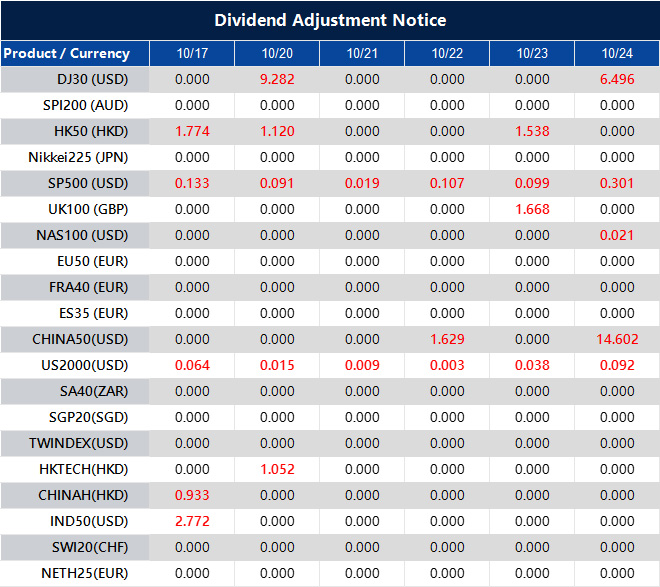
The above data is for reference only, please refer to the MT4/MT5 software for specific data.
If you’d like more information, please don’t hesitate to contact [email protected].







