



The USD/CHF pair falls for four straight days, hitting a two-week low as USD selling continues
The USD/CHF pair has decreased for four straight days, hitting a two-week low around 0.7900 due to ongoing weakness in the US Dollar. The US Dollar Index is under pressure from expected interest rate cuts by the Federal Reserve and a prolonged US government shutdown, with markets fully pricing in two additional cuts in October and December.
Rising tensions between the US and China, along with geopolitical risks, are strengthening the Swiss Franc (CHF) as a safe haven. President Trump has threatened to raise tariffs on Chinese goods, while China has limited rare earth exports. The two countries are also imposing reciprocal port fees, all of which are affecting equity markets and pushing down the USD/CHF from its recent high of 0.8075.
Gold prices rise in the United Arab Emirates, according to multiple reports today.
Gold prices in the United Arab Emirates rose on Friday, as reported by FXStreet. The price increased to AED 515.12 per gram from AED 511.04. The price per tola also went up to AED 6,008.22 from AED 5,960.70.
Market events, such as US-China trade tensions and the US government shutdown, have driven up gold prices. The potential for interest rate cuts by the US Federal Reserve has weakened the US Dollar, making gold more attractive as a safe investment.
Gold Prices In The UAE
Gold prices in the UAE reflect global rates adjusted for local currency and measurement units. Gold is not tied to any specific government and serves as a protection against inflation and currency devaluation. It is particularly in demand during uncertain times. Central banks, which hold significant amounts of gold, aim to diversify their reserves to support national economies. In 2022, these banks, especially those in emerging markets, added a record 1,136 tonnes of gold. Gold prices typically rise when the US Dollar and US Treasuries drop. Economic fears and geopolitical instability can lead to higher gold prices due to its reputation as a safe asset. Low interest rates further encourage gold investments, while a stronger dollar generally keeps prices down. With rising gold prices, global economic risks, and expectations of interest rate cuts by the Federal Reserve, it seems like a good time for traders to explore strategies that benefit from potential price increases. Derivative traders could look into buying call options or setting up bull call spreads to take advantage of this upward trend with controlled risk.Federal Reserves Dovish Stance
The Federal Reserve’s more relaxed approach is a key factor driving market trends. Markets are fully expecting interest rate cuts during the upcoming October and December meetings. Recent economic data backs this expectation, as the September Non-Farm Payrolls report revealed only 85,000 new jobs, indicating a slowing labor market. This gives the Fed strong reasons to loosen monetary policy, which usually weakens the dollar and supports gold prices. Geopolitical tensions add pressure to safe-haven assets like gold. The early conflict in Ukraine in 2022 showed how such events can lead investors to seek safer options, and recent Russian attacks have reignited those fears. US-China trade tensions also enhance uncertainty, further driving interest in gold. This situation is placing noticeable stress on the US Dollar, which tends to move inversely to gold. The US Dollar Index (DXY) has already dipped below 103 as traders anticipate the Fed’s easing cycle. For investors, this dollar weakness makes gold more affordable for foreign buyers, strengthening the case for gold investment. Additionally, strong demand from central banks plays a crucial role in this trend. Following record purchases in 2022 and 2023, the latest data from the World Gold Council indicates that global central banks have added over 800 tonnes to their reserves this year alone. This steady demand creates a solid support for gold prices, suggesting that any major drops are likely to be brief. Create your live VT Markets account and start trading now.Gold prices rise in Pakistan, according to recent market data
**Factors Influencing Gold Prices**
Gold prices in Pakistan increased on Friday, reaching 39,537.74 Pakistani Rupees (PKR) per gram, up from 39,220.21 PKR on Thursday. The price per tola also rose to 461,159.90 PKR, compared to 457,456.90 PKR the previous day.
Gold is often viewed as a safe investment amid economic uncertainty and expectations of interest rate cuts. Recently, the trade tensions between the US and China and the extended shutdown of the US government have heightened demand for gold. Additionally, ongoing geopolitical tensions in Eastern Ukraine have also contributed to this rise.
Federal Reserve Chair Jerome Powell has expressed a softer approach to interest rates, suggesting possible cuts in upcoming meetings. This stance has put downward pressure on the US Dollar, making gold more attractive. FXStreet updates gold prices in Pakistan by adjusting international rates to reflect local market conditions.
During uncertain times, gold is still a trusted investment and is often used to protect against inflation. Central banks are significant holders of gold, having added 1,136 tonnes in 2022, marking the largest annual purchase ever. Gold prices can be affected by geopolitical issues, interest rates, and currency changes, typically moving in the opposite direction of the US Dollar.
Looking back, the strength of gold was supported by geopolitical risks and predictions of a Federal Reserve shift. As of October 17, 2025, with gold trading near $2,450 an ounce, many of these themes still apply, albeit in different forms. Traders should prepare for ongoing price volatility in this precious metal.
**Market Outlook for Gold**
The Federal Reserve has started an easing cycle, but recent data has complicated the future outlook. The September 2025 job report showed only 150,000 jobs added, indicating a slowing labor market, while core inflation remains stubbornly high at 3.1%. This uncertainty creates support for gold, as it limits how high real interest rates can rise.
While geopolitical risks have shifted, they have not disappeared, providing ongoing support for gold prices. Even though the major conflict in Ukraine has decreased following the 2024 accords, tensions have escalated in the South China Sea. This ongoing need for safe-haven assets keeps strategic buyers interested in gold.
For derivative traders, this climate suggests that buying protection or speculating on further gains is a smart strategy. Recently, there has been a 15% increase in open interest for December 2025 gold futures call options with a $2,500 strike price, reflecting bullish market sentiment. Strategies like bull call spreads could help traders capture potential profits while managing their risk.
The US Dollar continues to play a crucial role, and its recent behavior shows the market’s uncertainty. The Dollar Index (DXY) has been fluctuating within a narrow range around 103, as economic weakness is countered by high inflation. A decisive move in the dollar will likely impact gold prices significantly, making currency derivatives essential to monitor for hedging gold positions.
Create your live VT Markets account and start trading now.
Dividend Adjustment Notice – Oct 17 ,2025
Dear Client,
Please note that the dividends of the following products will be adjusted accordingly. Index dividends will be executed separately through a balance statement directly to your trading account, and the comment will be in the following format “Div & Product Name & Net Volume”.
Please refer to the table below for more details:
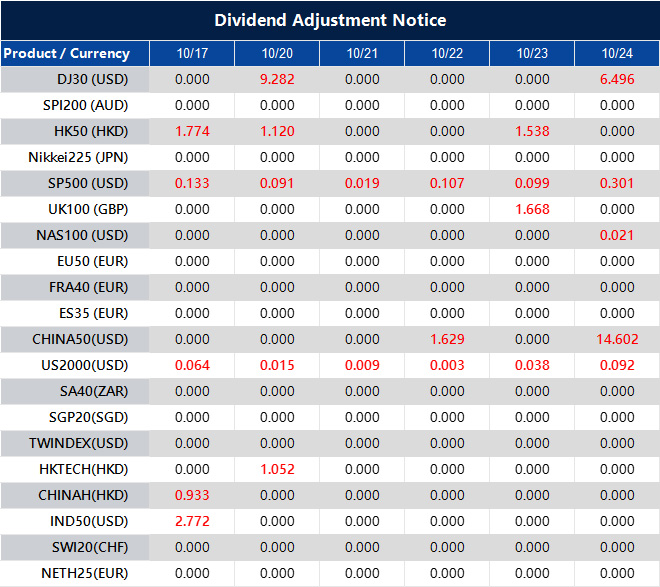
The above data is for reference only, please refer to the MT4/MT5 software for specific data.
If you’d like more information, please don’t hesitate to contact [email protected].
The US Dollar Index declines to nearly 98.00 amid expectations of a Fed rate cut
The US Dollar Index (DXY) is losing ground, sitting at around 98.20. Factors contributing to this include the ongoing US government shutdown, possible interest rate cuts in the US, and heightened trade tensions with China. The shutdown, which will stretch into next week, has postponed important economic data crucial for policy decisions. The US Senate has made ten attempts to pass a funding extension but has not succeeded.
US Federal Reserve Governor Christopher Waller is in favor of another interest rate cut in the upcoming policy meeting. Stephen Miran, the Fed’s newest governor, is pushing for a more aggressive approach to rate cuts by 2025. The Beige Book also points to economic difficulties, with increasing layoffs and reduced spending from middle- and lower-income households.
Impact Of US-China Tensions
US officials have criticized China’s plan to limit rare earth exports, calling it “economic coercion” and a “global supply chain power grab.” There are concerns about possible global decoupling, but it’s unclear if China will follow through with the proposed export controls. The US Dollar (USD) is highly sensitive to changes in US monetary policy, particularly those influenced by the Federal Reserve’s interest rate decisions. Quantitative easing (QE) is a strategy used in tough economic times to increase credit flow by printing more Dollars, which usually weakens the USD. Conversely, quantitative tightening does the opposite and often strengthens the dollar. As the US Dollar Index drops towards 98.00, signs of ongoing dollar weakness are clear. The government shutdown combined with dovish signals from the Federal Reserve presents a significant challenge. Markets now see a 92% chance of a 25-basis-point rate cut at the next meeting, according to the CME FedWatch Tool, indicating a major shift in sentiment. In this situation, buying put options on the US Dollar Index futures directly positions you for further declines with defined risk. Another strategy is to buy call options on major currency pairs like the EUR/USD, which has recently risen above 1.1700. These approaches will gain value as the dollar continues to weaken against other currencies.Trading Strategies During Uncertainty
The current uncertainty from the government shutdown, which is now in its 17th day, is increasing implied volatility in currency markets. The CBOE EuroCurrency Volatility Index has risen 15% in October, indicating that traders are preparing for bigger price changes. This environment makes long volatility strategies, such as buying straddles on the GBP/USD, an attractive way to navigate the expected fluctuations without choosing a specific direction. We should remember the lengthy shutdown from 2018-2019, which lasted a record 35 days, and consider that this situation might drag on. The delays in important releases, like the Non-Farm Payrolls and inflation reports, mean we must rely on sentiment rather than fundamental data. This lack of information often leads to stronger market reactions to headlines and Fed statements. With tensions rising between the US and China over rare earth minerals, safe-haven currencies are likely to gain interest. The Japanese Yen could strengthen, pushing the USD/JPY pair lower. Buying put options on USD/JPY could be a way to benefit from the broader US dollar weakness and a higher demand for safety. Create your live VT Markets account and start trading now.Amid geopolitical uncertainties and US-China trade tensions, the AUD/JPY remains strong above 97.00
The AUD/JPY faced some selling pressure around 97.10 during Friday’s Asian session. While the long-term outlook remains positive, it’s important to consider possible declines due to a bearish RSI. Key resistance is at 98.50, with initial support at 96.50.
Several factors are influencing the Japanese Yen, including ongoing US-China trade tensions and shifts in Japanese politics. Despite these challenges, the daily chart shows that AUD/JPY is above the 100-day EMA, supported by bullish momentum. However, the RSI indicates that prices may drop further before any potential rise.
Resistance And Support Levels
For AUD/JPY, the first resistance level is at 98.50, followed by 99.50. The psychological level of 100.00 is the ultimate target. On the downside, support is significant at 96.50, with another risk point at 96.15. If this level is broken, the AUD/JPY could fall to around 95.00-94.90. The value of the Japanese Yen is influenced by the Bank of Japan’s policy, bond yields, and global risk sentiment. Historically, the BoJ’s monetary policy has led to Yen depreciation, but recent changes have provided some support. During market stress, the Yen usually gains as a safe-haven asset. As of October 17, 2025, AUD/JPY is trading near 97.10, with a long-term bullish outlook but showing short-term weakness. The bearish signal from the RSI suggests further declines may occur before the upward trend resumes. For derivative traders, this situation offers complexity but also many opportunities. The strength of the Australian dollar is supported by recent economic data, helping to offset some negative sentiment. For instance, Australia’s September inflation report was 3.1%, slightly above the forecast of 2.9%, keeping the Reserve Bank of Australia in a hawkish position. This should provide ongoing support for the AUD against the Yen.Japanese Political Uncertainty
On the Japanese side, political uncertainty after the collapse of the LDP coalition could lead to Yen weakness. However, comments from the Bank of Japan suggest they remain cautious about further policy changes, particularly since the latest Tankan survey indicated a dip in business confidence. This caution reduces expectations for a rapidly strengthening Yen, which creates some stability for the AUD/JPY cross. Given the potential for an upward move, buying call options with a strike price above the 98.50 resistance level could be a smart way to prepare for a rally towards the psychological mark of 100.00. This strategy allows traders to benefit from potential gains while controlling their maximum risk to the premium paid. We must also acknowledge the weak RSI and the possibility of a drop toward the 96.50 support level, which aligns with the 100-day moving average. To manage this downside risk, buying put options with a strike near 96.00 could be a useful hedge against short-term downward momentum. This approach protects existing long positions or can be a speculative bet on a brief sell-off. We saw a similar situation in 2022-2023, when divergence in central bank policies primarily drove Yen weakness. This period teaches us that while the overall trend can be strong, sharp pullbacks due to global risk-off sentiment can occur, and we need to prepare for them. Create your live VT Markets account and start trading now.Gold prices increased in India today, according to compiled data.
Gold prices in India rose on Friday, going from 12,225.19 INR per gram to 12,322.78 INR. The price per tola also increased, reaching 143,737.90 INR from 142,592.20 INR.
Concerns about the global economy and potential interest rate cuts by the US Federal Reserve boosted gold demand. Rising trade tensions between the US and China, along with a lengthy US government shutdown, made gold an attractive safe haven.
Geopolitical Impact on Gold
Geopolitical tensions, particularly between the US and Russia, along with talks of meetings between leaders, complicate the economic situation. Comments from Federal Reserve officials suggest possible rate cuts, which could weaken the dollar and further influence gold prices. In India, gold prices reflect global rates adjusted for local currency values. Local variations can occur, but prices are regularly updated to match market conditions. Central banks around the world buy large amounts of gold to diversify their reserves and strengthen their economies. Gold serves as a hedge against inflation and currency decline, typically moving in the opposite direction of the US Dollar and riskier assets. Interest rates also affect gold prices; lower rates make gold more appealing. Market factors, like the strength or weakness of the dollar, significantly impact gold buying habits.Market Predictions and Strategy
Given the current market conditions, there is a strong argument for taking long positions in gold derivatives. Increasing US-China trade tensions, a dovish Federal Reserve, and ongoing geopolitical issues create favorable conditions for gold. These elements are raising the demand for safe investments, with gold being the main beneficiary. The market expects two 25-basis-point rate cuts from the Federal Reserve by the end of the year, which should continue to weaken the US Dollar. The CME FedWatch Tool shows over a 90% probability for a cut at the upcoming October 29th meeting. This follows the September jobs report that revealed lower-than-expected Non-Farm Payrolls, indicating a slowdown in the labor market. Implied volatility for gold options has increased, with the CBOE Gold ETF Volatility Index (GVZ) reaching a 12-month high last week. This resembles the volatility we saw during the banking sector stress in early 2024. Given these high premiums, traders might want to consider bull call spreads instead of outright calls, as this can reduce initial costs while still allowing for potential price gains. The upcoming meeting between President Trump and President Putin in Budapest poses a key risk that could affect this optimistic outlook. A surprise peace deal or significant easing of tensions in Ukraine could spark “risk-on” sentiment across markets, likely leading to a drop in gold prices. A similar, brief decrease in gold occurred after initial ceasefire talks in mid-2024, showing how sensitive the market can be. The strong link between gold and the US Dollar is crucial for this trade. This week, the US Dollar Index (DXY) dropped below the important 102.50 support level in anticipation of the Federal Reserve’s easing. Historically, after the Fed changed its policy in late 2023, the DXY fell over 4% in the next two months, while gold climbed nearly 8%, setting a clear precedent for the current situation. Create your live VT Markets account and start trading now.Gold prices in Malaysia rise according to market trend data
Gold prices in Malaysia rose on Friday, according to FXStreet data. The price reached 592.49 Malaysian Ringgits per gram, up from 588.00 MYR on Thursday.
The price per tola increased from MYR 6,858.26 to MYR 6,910.35. A troy ounce of gold is now worth 18,429.18 MYR.
How Malaysian Gold Prices Are Calculated
FXStreet calculates gold prices in Malaysia by aligning them with international prices in local currency. These prices are a reference point and may vary slightly from local rates. Gold has always been considered a safe-haven asset. People use it to protect against inflation and a declining currency. Central banks are the biggest buyers, boosting their gold reserves to enhance economic trust. In 2022, central banks bought 1,136 tonnes of gold, worth around $70 billion. This was the largest annual purchase recorded. Gold typically moves opposite to the US Dollar and US Treasuries. When the Dollar weakens, gold prices usually increase. Prices often drop during stock market rallies and rise during downturns. Factors affecting gold prices include geopolitical instability and changes in interest rates. The strength or weakness of the US Dollar has a big impact on gold’s value, as it is priced in dollars.Recent Market Movements
The increase in gold over 592 MYR per gram is significant. It shows gold’s traditional role as a safe haven during economic uncertainty. The upcoming weeks look unstable, and gold is responding as expected. Last quarter, the Federal Reserve paused its rate cuts after inflation turned out to be higher than expected, with September’s Consumer Price Index (CPI) at 3.1%. In this environment of uncertain interest rates, gold becomes more appealing as a safe asset. The market now predicts a lower chance of further cuts this year, adding to the uncertainty. We should also note the strong ongoing demand from central banks since the record purchases in 2022. Reports from the World Gold Council in 2024 confirmed that emerging economies continue to build their reserves. This creates a solid support level for gold prices, reducing significant downside risk for traders. Gold’s relationship with the US Dollar is important. With the recent drop in the DXY index below 104, gold has room to rise. Additionally, with increased volatility in equity markets—the VIX has been around 19 this month—traders are looking for protection against potential stock market declines, which is helping gold. In the coming weeks, buying call options on gold futures (GC) provides a way to take advantage of potential price increases with defined risk. If you expect steady growth rather than a sharp rise, consider bull call spreads to lower the upfront costs. This strategy balances potential profit with entry costs in a volatile market. We should closely monitor upcoming Federal Reserve statements and the next inflation report for further direction. Any indication of a more accommodating stance could push gold prices higher. Also, keep an eye on geopolitical news, as any increase in global trade tensions could lead investors back to gold. Create your live VT Markets account and start trading now.The GBP/USD pair shows strength in the mid-1.3400s, suggesting possible further increases.
The GBP/USD pair is on the rise, trading around the mid-1.3400s. This improvement comes as the US dollar weakens, marking a third straight day of gains after earlier dipping to around 1.3250.
However, uncertainties about the UK’s financial outlook and the decisions by the Bank of England (BoE) limit further increases. Technical indicators show a breakout above the 100-period Simple Moving Average (SMA) and the 38.2% Fibonacci retracement level, which might allow for more upward movement.
Potential Further Gains
If the trend continues, the GBP/USD pair could reach the 1.3480-1.3485 area and possibly break past the 1.3500 mark. Support is found around 1.3400, while corrections may attract buyers at 1.3355, 1.3300, and the previous lows near 1.3250. The Pound Sterling, issued by the Bank of England, is essential in the global foreign exchange market, particularly in pairs like GBP/USD. BoE decisions are influenced by inflation, which, in turn, impacts the GBP’s value. Economic data like GDP and trade balance also play a role in shaping the currency’s strength in global markets. As we progress through October 2025, the Pound is climbing against the Dollar, buoyed by a weaker US Dollar. Last week, the US Consumer Price Index (CPI) reported 2.5%, raising market speculation that the Federal Reserve may be done tightening. This situation opens the door for more gains in the GBP/USD pair. With key technical levels breaking, the GBP/USD may trend toward 1.3485 soon. For those trading derivatives, short-term call options with strike prices around 1.3500 could be valuable to capture this upward potential. The positive chart signals suggest further gains if the US Dollar continues to decline.Domestic Issues and Caution
That said, we should be cautious about getting too optimistic about the Pound because of ongoing domestic issues. The latest Office for National Statistics data shows UK inflation stubbornly at 2.8% for September 2025, which complicates the BoE’s approach to interest rates. Additionally, the UK’s public sector net debt is now at 99.5% of GDP, presenting significant challenges ahead of the November budget. This uncertainty hints that any drop back toward the 1.3400 level could be rapid. Traders might consider buying put options with strikes below 1.3350 to protect their bullish positions. A strong break below that support level could lead to a swift decline, making such protection worthwhile. Given the mixed signals, we believe strategies that can take advantage of price moves in either direction could be effective. Reflecting on the volatility after the 2022 mini-budget crisis, it’s clear how quickly sentiment can shift based on UK fiscal news. Therefore, setting up straddles or strangles may be a wise way to navigate the expected price fluctuations around the upcoming budget announcement. Create your live VT Markets account and start trading now.US-China trade tensions impact the Australian Dollar, leading to further declines against the US Dollar
The Australian Dollar (AUD) has dropped due to rising trade tensions between the US and China and expectations that the Reserve Bank of Australia (RBA) will cut rates in November. After September’s employment data, the likelihood of a rate cut surged from 50% to 85%. As a result, the AUD/USD pair has continued to fall, greatly affected by Australia’s strong trade ties with China.
China plans to regulate rare earth exports, which could disrupt the global supply chain. While the US criticized these plans, it also left the door open for negotiations. At the same time, the US Dollar weakened because of a government shutdown and speculation about interest rate cuts. The US dollar has dropped for four consecutive sessions, with the government shutdown prolonging as the Senate remains stalled.







