Japan’s Finance Minister Satsuki Katayama said G7 finance ministers and central bankers agreed that fluctuating oil prices are causing high volatility in financial markets and foreign exchange markets. She said Japan has been in close contact with G7 counterparts and will continue delivering messages.
Katayama said she would not comment on Japanese Government Bond yield levels. She also said the government has not estimated the cost of continuing subsidies aimed at keeping petrol prices in check.
Support For Southeast Asia Partners
She said there are no issues with the amount of oil stock, but raised the question of support for partners in South East Asia. She said policymakers are reviewing all scenarios for oil stockpiles, including optimistic and pessimistic ones.
At the time of writing, USD/JPY was up 0.03% on the day at 159.70.
The G7’s focus on oil-driven volatility is a critical signal for us right now. With West Texas Intermediate (WTI) crude recently breaking past $95 a barrel on renewed Middle East tensions, markets are pricing in more uncertainty. We are seeing this directly in the VIX, which has climbed over 21 this past week, a sharp increase from the low teens we saw in February 2026.
This environment puts immense pressure on the Japanese Yen, given Japan’s status as a major energy importer. We should anticipate continued choppiness in the USD/JPY pair, which is already hovering near the 160 level that triggered verbal interventions in the past. Traders should consider using options to hedge against a sudden spike in currency volatility or a sharp move in either direction.
Defensive Positioning For Equity Markets
For equity markets, this warning from policymakers suggests a defensive posture is warranted. High and unstable energy prices can erode corporate margins and dampen consumer spending, creating headwinds for indices like the Nikkei 225. We should look at buying put options on broad market indices as a cost-effective way to protect portfolios against a potential downturn in the coming weeks.
Direct plays on energy volatility itself are also attractive. The oil markets are reacting to every headline, and policymakers have admitted they are scenario-planning for both optimistic and pessimistic outcomes regarding supply. Using derivative strategies like long straddles on crude oil futures could be an effective way to profit from large price swings, regardless of the direction.
Looking back at the second half of 2025, we remember how a similar surge in energy prices stalled the expected central bank pivot, causing a sharp sell-off in bond markets. That historical precedent shows how quickly sentiment can shift based on oil fluctuations. This reinforces the need to be prepared for sustained volatility across asset classes, not just in the energy sector.
Create your live VT Markets account and start trading now.
Start trading now – Click here to create your real VT Markets account
Japan’s foreign reserves fell to $1B in March. They were $1410.7B in the previous period.
We must anticipate extreme volatility in the yen. This data suggests the Bank of Japan exhausted its firepower in March trying to defend the currency, an effort that has now clearly failed. With no reserves left, we should position for a significant depreciation of the JPY by acquiring long-dated USD/JPY call options.
Yen Volatility And Options Positioning
The yen has already breached 190 against the dollar this morning, a level unseen in modern history, following this reserve announcement. Implied volatility on yen options has surged past 50%, reminiscent of the 2008 financial crisis. We should prepare for these levels to climb even higher in the coming weeks.
This crisis will transition directly to the Japanese government bond (JGB) market. Without the ability to defend its currency, the BOJ’s control over its yield curve is effectively over. We expect a dramatic spike in JGB yields, so traders should use interest rate swaps or short JGB futures to position for collapsing bond prices.
Looking back at 2025, we observed how the Nikkei reacted negatively to even hints of policy tightening. Now, facing a full-blown currency and debt crisis, capital flight is the primary risk. We should build substantial short positions on the Nikkei 225 index through put options and futures contracts.
The impact is not contained to Japan, as the sale of over a trillion dollars in reserves was predominantly a liquidation of U.S. Treasuries. This massive supply shock is why the U.S. 10-year Treasury yield jumped to 5.8% yesterday, its highest in two decades. We anticipate further increases in U.S. yields as the market digests this unprecedented sale.
Japan’s overall household spending fell by 1.7% year on year in February.
This was below the forecast of a 0.7% fall.
Domestic Demand Weakness Signals Policy Caution
The drop in household spending is more severe than we anticipated, signaling a clear weakness in Japan’s domestic economy. This negative surprise suggests consumer confidence is faltering, which will likely weigh on first-quarter GDP figures. For us, this reinforces the view that the Bank of Japan will have little reason to accelerate any policy tightening in the coming weeks.
Given this, we should consider strategies that benefit from a weaker yen, as a dovish central bank is bearish for the currency. Recent data showing March core inflation slowing to 1.9% further reduces pressure on the BoJ to act. We remember how similar weak consumption figures in the spring of 2025 preceded a yen decline, making long USD/JPY positions, perhaps through call options, an attractive trade.
This consumer weakness is also a negative signal for the Nikkei 225, particularly for retail and domestic-focused sectors. The latest Tankan survey already showed a slight dip in business confidence among large non-manufacturers, and this spending data confirms that pessimism. We should therefore consider buying Nikkei put options to hedge against or profit from a potential market pullback from its recent highs.
The data also suggests an increase in economic uncertainty, which could lead to higher market volatility. We have seen implied volatility on Nikkei options tick up to 17.5% in early April, up from the 15% average in March. This environment may warrant looking at volatility trades, such as straddles on the index, to capitalize on potentially larger price swings regardless of direction.
Positioning For Yen Equity And Volatility Outcomes
US President Donald Trump said a US ceasefire proposal with Iran was not good enough, according to CNBC. He repeated a deadline for Iran to reopen the Strait of Hormuz or face attacks on civilian infrastructure.
At a White House press conference, Trump said he could not say whether the conflict was winding down or increasing. He also said Iran could be “taken out in one night”.
Market Reaction And Immediate Risk
Trump said the US would attack Iran’s energy and transportation infrastructure on Tuesday at 8 PM Eastern Time (ET) if the Strait was not reopened. Iranian state media reported that Iran rejected the proposal and called for a permanent end to the war.
A spokesperson for Iran’s top joint military command described Trump’s threats as “delusional”. The spokesperson said the threats would not address what they called “disgrace and humiliation” of the US in the region.
At the time of publication, WTI was down 0.21% at $103.65.
The deadline of 8 PM ET tonight puts us on high alert. With WTI crude already over $103, the market is tense but hasn’t fully priced in an actual attack. We are positioning for a significant price swing in either direction before markets open tomorrow.
Options And Hedging Strategies
An attack on Iran would almost certainly attempt to close the Strait of Hormuz, a chokepoint for nearly 21 million barrels of oil per day. We saw Brent crude spike over $120 after the conflict began in Ukraine in 2022, and a direct disruption here could be far more severe. Buying short-dated call options on oil futures is the most direct way to capitalize on this potential outcome.
The slight dip in oil prices yesterday suggests some believe this is posturing, much like the diplomatic flare-ups we saw back in 2025. If a last-minute deal is reached and the Strait reopens, we could see a rapid sell-off to below $95 a barrel. In this scenario, put options offer a way to profit from a sharp drop in oil prices.
Given the uncertainty, betting on a specific direction is a gamble. A more prudent strategy is to trade the volatility itself, perhaps through straddles on oil ETFs, which will profit from a large move either up or down. We’re also watching the VIX, which could easily double from its current levels if military action begins.
Beyond crude, we are looking at options on defense sector ETFs for potential upside from the conflict. Conversely, airline and transportation stocks are extremely vulnerable to a sustained oil price shock. We are hedging our broader equity portfolios with index puts in case of a wider market sell-off.
Create your live VT Markets account and start trading now.
Start trading now – Click here to create your real VT Markets account
Japan’s overall household spending fell by 1.7% year on year in February. This was weaker than the forecast decline of 0.7%.
The result indicates a larger drop in spending than expected for the month. It compares the actual figure (-1.7%) directly against the forecast (-0.7%).
Household Spending Signals Cooling Growth
The drop in household spending for February 2026, which was significantly worse than forecasted, suggests a cooling Japanese economy. This data confirms the fragility of the consumer sector, a trend we also observed in the latter half of 2025. Derivative traders should anticipate that this will weigh on future growth-sensitive assets.
This reinforces our view that the Bank of Japan will be extremely cautious about any further monetary tightening after its recent policy shift in March 2026. The widening interest rate differential with the U.S., where the Federal Reserve is holding firm, supports strategies that bet on a weaker yen. We are looking at USD/JPY call options as the exchange rate, currently around 152, could test higher levels.
For equity markets, this consumer weakness is a headwind for the Nikkei 225, particularly for retail and domestic service stocks. We saw how similar spending data in Q4 2025 preceded a brief market correction, reminding us that the index is not immune to domestic fundamentals. Buying put options on the Nikkei 225 offers a way to hedge against a potential downturn in the coming weeks.
Conversely, this weak economic signal is bullish for Japanese Government Bonds (JGBs). The data makes it less likely the BoJ will aggressively sell its bond holdings, potentially putting a cap on the 10-year JGB yield, which has been hovering around 0.75%. We expect to see increased interest in JGB futures from those anticipating a more dovish central bank stance.
Volatility May Reprice Higher
The surprise negative data increases overall economic uncertainty, which could cause market volatility to rise from its current low levels. The Nikkei Volatility Index, recently trading near 17, may see an upward move as investors re-price risk. This environment could make long volatility strategies, such as purchasing straddles on the index, attractive.
Create your live VT Markets account and start trading now.
Start trading now – Click here to create your real VT Markets account
US President Donald Trump said the latest US ceasefire proposal with Iran is “not good enough”, CNBC reported on Monday. He set a deadline for Iran to reopen the Strait of Hormuz or face attacks on civilian infrastructure.
At a White House press conference, Trump was asked whether the war with Iran was winding down or ramping up. He replied: “I can’t tell you.”
Hormuz Deadline And Market Stakes
Trump said Iran “can be taken out in one night, and that might be tomorrow night”. He repeated that the US would strike Iran’s energy and transportation infrastructure on Tuesday at 8 PM Eastern Time (ET) if the strait is not reopened.
Iran rejected the proposal and called for a permanent end to the war, according to Iranian state media. A spokesperson for Iran’s top joint military command described Trump’s threats as “delusional” and referred to “disgrace and humiliation” for the US in the region.
At the time of publication, WTI was down 0.21% on the day at $103.65.
With the 8 PM ET deadline just hours away, the immediate focus is on the Strait of Hormuz, a chokepoint for global energy. Given that nearly 21 million barrels of oil, or about 21% of global petroleum liquids consumption, pass through the strait daily, a closure would trigger a historic supply shock. We are therefore holding long positions in oil futures and adding short-term call options on crude to capture the upside from a potential military strike.
Volatility Hedging And Scenario Trades
Beyond oil, we expect a major risk-off event across all markets, pushing volatility indices sharply higher. Looking back at the initial phase of the Red Sea shipping crisis in late 2025, we saw the VIX jump over 40% as uncertainty paralyzed the markets. Consequently, we are buying VIX call options as a direct hedge against our equity exposure and to profit from rising fear.
There remains an outside chance this is political theater, and a last-minute agreement could be reached. A de-escalation would cause oil to plummet and equities to rally significantly. To prepare for this less likely outcome, we are purchasing a small number of cheap, far out-of-the-money put options on WTI, which act as a low-cost lottery ticket against a sudden peace dividend.
We are also targeting specific sectors that have a clear stake in the outcome. Call options on major defense contractors are prudent, as their valuations will rise with any sustained conflict. Conversely, we are buying puts on airline and shipping stocks, as their fuel costs would become unsustainable if crude prices were to spike past the $120 mark we saw in mid-2025.
The extremely high implied volatility right now makes outright buying of options very expensive. Therefore, we are using debit spreads to define our risk and lower our entry cost on these trades. This allows us to make directional bets on oil and the broader market without overexposing capital to volatility crush if the situation resolves peacefully tonight.
Create your live VT Markets account and start trading now.
Start trading now – Click here to create your real VT Markets account
Gold (XAU/USD) rose to about $4,660 in early Asian trading on Tuesday. Trading was cautious ahead of US President Donald Trump’s Tuesday deadline linked to Iranian actions affecting the Strait of Hormuz.
On Monday, Trump said a latest US ceasefire proposal with Iran was “not good enough”. He set a deadline of Tuesday at 8 p.m. ET for Iran to reopen the strait, or face attacks on civilian infrastructure.
Oil Prices And Inflation Risks
Oil prices have risen on supply concerns tied to the Strait of Hormuz. Higher oil can add to inflation worries and affect expectations for US interest rates, which can pressure non-yielding assets such as gold.
CME FedWatch data showed futures pricing virtually no chance of a move at the April 28–29 FOMC meeting. It also showed a 77.5% probability the Fed will stay on hold through the end of the year.
Gold is often used as a store of value in periods of stress and is also used in jewellery. Central banks added 1,136 tonnes of gold worth about $70 billion in 2022, the highest yearly purchase on record.
We are seeing gold trade near $4,660 as we monitor rising geopolitical tensions in the South China Sea. The current naval standoff is creating significant market uncertainty, which is increasing demand for safe-haven assets. This situation puts gold in a strong position if the conflict escalates further.
Fed Policy And Volatility Outlook
However, the latest U.S. inflation data from March showed core CPI holding at 3.1%, keeping the Federal Reserve in a cautious stance. With the Fed funds rate at 4.75%, the high cost of money makes holding a non-yielding asset like gold less attractive. This is creating a classic tug-of-war between geopolitical fear and restrictive monetary policy.
For derivative traders, this means implied volatility is likely to climb in the coming weeks as uncertainty builds. The CBOE Volatility Index (VIX) has already risen to 22, reflecting broad market anxiety over the situation. We believe strategies that benefit from a large price move, such as buying options straddles on gold ETFs, could be positioned well.
We saw a very similar dynamic back in 2025 during the U.S. and Iran standoff over the Strait of Hormuz. Looking back, gold surged on the initial military threats but its rally stalled as rising oil prices sparked inflation fears, limiting expectations for Fed rate cuts. That event is a key reminder of how monetary policy can act as a brake on a fear-driven rally.
A major underlying support for gold is the continued strong buying from central banks. New data shows that global central banks added another 1,050 tonnes to their reserves through 2025, continuing the trend of diversification away from the dollar. While this provides a solid floor for the price, the U.S. Dollar’s reaction to the current crisis will be the key driver for gold in the short term.
Create your live VT Markets account and start trading now.
Start trading now – Click here to create your real VT Markets account
GBP/JPY is trading above 211.00 but has not moved above 211.50. The 50-day SMA at 211.26 is close to current price, and market talk includes possible Japanese FX intervention.
The RSI is near neutral, suggesting unclear momentum in the near term. Price action remains range-bound unless 211.50 is broken.
Technical Levels And Market Tone
A break above 211.50 would open the way to the 20-day SMA at 211.90 and then 212.00. Further upside levels include 213.31 and 214.00.
If price falls below the 50-day SMA, 211.00 may be tested. Below that, support sits around 210.50–65, with the 100-day SMA at 210.31 next.
We are seeing GBP/JPY struggle below the 211.50 resistance level, creating a period of sideways consolidation. This suggests that option sellers could look at strategies like writing short strangles to collect premium, capitalizing on the current lack of direction. The neutral RSI indicator supports this view that momentum is undecided for the moment.
For a bullish outlook, a decisive break and close above 211.50 would be the key trigger for buying call options. The initial target would be the 212.00 mark, with a move toward the late March 2026 highs near 213.31 possible if risk appetite continues to improve. This would signal that the market is ignoring the threat of intervention from Japanese authorities.
Options Risk And Intervention Watch
On the other hand, the risk of intervention from Tokyo to strengthen the Yen remains very real, making us cautious. We remember the sudden, sharp drops in this pair in late 2025 when officials last stepped into the market. A failure to hold above the 211.00 level would prompt us to look at buying put options to hedge against a sharp decline toward support around 210.50.
The fundamental picture is tense, as recent UK inflation data for March 2026 came in at 2.3%, keeping the Bank of England on a hawkish path. This policy difference with the Bank of Japan is the main factor supporting the pair. However, official Japanese data from last week showed currency reserves have been built up, giving them plenty of firepower for intervention.
Given the tight range and the potential for a sudden, sharp move, traders could consider volatility plays. Buying a straddle, which involves purchasing both a call and a put option at the same strike price, could be effective. This strategy would profit from a significant breakout in either direction over the next few weeks, which seems increasingly likely.
Create your live VT Markets account and start trading now.
Start trading now – Click here to create your real VT Markets account
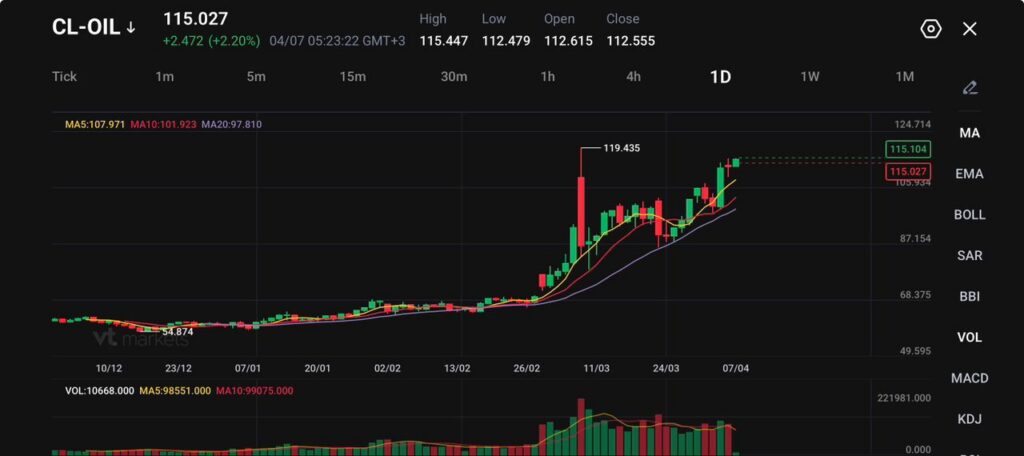
CL-OIL trades at 115.027, up 2.472 (+2.20%), after printing a session high of 115.447.
Brent crude rose 0.4% to $110.19, while WTI futures climbed 0.8% to $113.31 as traders waited for Tuesday’s deadline.
The Strait of Hormuz still carries about one-fifth of the world’s oil and natural gas supply, keeping the market focused on physical disruption rather than diplomacy alone.
Crude is still trading like supply risk has not eased. CL-OIL is holding above 115, and the broader futures market stayed firm as traders waited for Trump’s Tuesday deadline for a deal with Iran.
Brent held near $110.19 and WTI near $113.31, which kept the market in the upper end of the recent war-driven range.
The price action shows that the market is not willing to remove the risk premium ahead of an event that could escalate again within hours. Traders have seen enough failed diplomacy and partial relief headlines over the past month to keep paying for protection until Hormuz flows are clearly safer.
A cautious near-term view still favours elevated prices while the deadline remains live and the shipping picture stays unclear.
Hormuz Still Sets the Tone
The market is still trading the Strait of Hormuz first and everything else second. The route carries about 20% of global oil and natural gas supply, so any restriction there quickly feeds into shipping rates, insurance costs, and prompt crude pricing.
Iran has signalled that it wants a lasting outcome rather than a temporary ceasefire, and pressure to reopen the waterway has not yet produced a breakthrough.
Iran said it wanted a lasting end to the war with US-Israel, and pushed back against pressure to reopen the Strait of Hormuz while President Trump warned the country could be 'taken out' if it did not meet his Tuesday night deadline to reach a deal https://t.co/f6MWzfz103pic.twitter.com/1TP4tDkB0l
That leaves physical supply as the main variable. A market can tolerate aggressive rhetoric for a while. It reacts much more sharply when the main export artery for Gulf energy stays constrained.
That is why oil has stayed firm even when equities have tried to stabilise. The market still lacks a credible path to normal flows.
Equities Waver While Oil and the Dollar Stay Firm
Broader risk sentiment reflects the same hesitation. Asian equities moved in mixed fashion, with MSCI Asia-Pacific ex-Japan up 0.4%, while the Nikkei slipped 0.2%. At the same time, US stock futures fell 0.55%, showing traders were still reducing risk rather than fully buying the truce story.
The dollar also stayed supported. The dollar index held around 100.06, while the euro traded at $1.1538 and USDJPY hovered near 159.91, close to the level that keeps Tokyo sensitive to intervention risk.
That pattern is consistent with a market still pricing inflation pressure and slower growth together. Oil remains high enough to keep that stagflation mix in focus.
Inflation Risk is Starting to Show Up in US Data
The macro backdrop has started to absorb the energy shock. US services-sector growth slowed in March, while business prices paid rose at the fastest pace in more than 13 years, giving markets an early read on how the Iran war is feeding inflationary pressure.
That helps explain why traders are no longer pricing Fed cuts this year. Oil at these levels does not just hit fuel bills. It feeds into logistics, chemicals, transport, and broader input costs. Once that happens, central banks lose flexibility quickly.
A cautious forecast still points to tighter financial conditions if crude remains around current levels into the next inflation prints.
Technical Analysis
CL-OIL is trading near 115.03, continuing its strong upward trajectory after the sharp breakout from the late-February base. Price action shows sustained bullish momentum, with the market pushing steadily higher following the surge toward 119.43, and now consolidating just below that recent peak.
The structure remains clean, with higher highs and higher lows forming, indicating buyers are still in firm control.
From a technical standpoint, the trend remains firmly bullish. Price is trading well above all key moving averages, with the 5-day (107.97) leading the move higher, followed by the 10-day (101.92) and 20-day (97.81), all sloping upward in strong alignment. This reflects a persistent trend strength, while the current consolidation above the $110 region suggests the market is continuing to build rather than showing signs of exhaustion.
Key levels to watch:
Support: 110.00 → 105.90 → 101.90
Resistance: 115.50 → 119.40 → 124.70
The immediate focus is on the 115.50 area, which is acting as short-term resistance. A clean break above this level could open the path toward a retest of 119.40, with further upside potential if momentum accelerates.
On the downside, 110.00 is the key psychological and structural support. A break below this level could trigger a pullback toward 105.90, though such a move would likely remain corrective within the broader uptrend.
Overall, oil remains in a strong uptrend with consolidation at elevated levels. As long as price holds above the $110 zone, the bias stays firmly to the upside, with the market positioning for a potential continuation move toward recent highs.
What Traders Should Watch Next
The next move depends on whether the deadline produces a real reopening path for Hormuz or another escalation headline. Brent and WTI are already trading at levels that keep inflation fears alive, while the dollar and rates market continue to price that stress into the macro outlook.
If the deadline passes without progress and the waterway stays constrained, oil can keep pressing toward the recent highs.
If a deal emerges and traffic begins to normalise, the market can unwind part of the premium quickly, but it will likely need proof in flows rather than promises.
Learn more about trading Energies on VT Markets here.
Trader Questions
Why is Oil Still Holding Above $110?
Oil is holding high because traders still see a real risk of further disruption to Gulf energy flows while the Iran deadline remains unresolved. Brent was recently quoted at $110.19 and WTI at $113.31 in the wider futures market, which shows the risk premium is still firmly in place.
Why Does The Iran Deadline Matter So Much For Oil Prices?
A fixed deadline forces the market to price a near-term escalation risk. If no deal is reached and the Strait of Hormuz stays constrained, traders have to assume supply disruption could last longer and push prices higher.
Why is the Strait of Hormuz So Important for Crude?
The Strait carries about one-fifth of the global oil and natural gas supply, so even a partial disruption can lift freight costs, insurance premiums, and prompt crude prices very quickly.
Why Has Oil Stayed Firm Even Though Talks Are Still Happening?
The market is no longer reacting to diplomacy alone. It wants proof that energy flows will normalise. Until shipping risk clearly falls, traders are reluctant to strip out the premium from crude.
How Are Higher Oil Prices Affecting Broader Markets?
Higher crude prices are feeding inflation fears, tightening financial conditions, and keeping pressure on equities and central banks. Markets have already started pricing slower growth and firmer inflation together, which is why stagflation concerns keep resurfacing.
Why is the Dollar Staying Supported Alongside Oil?
The dollar is holding firm because investors are still using it as the main haven trade while the conflict remains live. The dollar index was recently around 100.06, which shows traders are still leaning defensive rather than moving fully back into risk assets.
Start trading now – Click here to create your real VT Markets account
Gold (XAU/USD) rose towards $4,660 in early Asian trading on Tuesday. The move came as markets watched a US deadline set by President Donald Trump linked to possible military action on Iranian infrastructure after the Strait of Hormuz was closed.
On Monday, Trump said the latest US ceasefire proposal with Iran was “not good enough”. He set a deadline for Iran to reopen the Strait of Hormuz or face attacks on civilian infrastructure.
Gold Rises On Geopolitical Deadline
Trump repeated on Tuesday that he could target Iran’s energy and transport infrastructure at 8 p.m. ET if the strait is not reopened. Higher crude oil prices tied to supply worries in the Strait of Hormuz may add to inflation fears.
Those inflation concerns could affect expectations for Federal Reserve rate cuts. Gold is often bought during geopolitical risk, but it pays no interest and can face pressure when rates stay high.
CME FedWatch data showed futures pricing almost no chance of a move at the April 28-29 FOMC meeting. It also showed a 77.5% probability the Fed will stay on hold through the end of the year.
We are seeing gold prices stabilize around the $4,500 mark after the intense volatility we experienced last year. The situation surrounding the Strait of Hormuz, with the US-Iran deadline, pushed gold to its peak of $4,660. That crisis has de-escalated for now, but the market memory keeps a floor under the price.
Inflation And Fed Policy In Focus
The spike in crude oil that followed the 2025 Strait closure has had a lasting effect, with WTI crude futures still trading above $145 a barrel. This has kept inflation stubbornly high, with the latest Consumer Price Index (CPI) report showing a 3.8% annual increase, well above the Fed’s target. This persistent inflation is the primary factor influencing central bank policy today.
Given this environment, implied volatility on gold options remains elevated. The CBOE Gold Volatility Index (GVZ) is holding near 19, significantly higher than its historical average, reflecting ongoing uncertainty. This makes selling premium through strategies like covered calls on gold miners or iron condors on gold ETFs an interesting, though risky, proposition for generating income.
Looking ahead, the Federal Reserve’s stance has become the main driver. While last year the market expected rates to hold steady, the CME FedWatch tool now shows a 65% probability of a 25-basis-point rate cut by the September FOMC meeting to support a slowing economy. This potential shift to a more dovish policy is creating bullish undercurrents for non-yielding gold.
For the coming weeks, we should consider using long-dated call options on gold futures to position for this potential rate-cut rally while clearly defining our risk. Buying December $4,700 calls offers exposure to the upside if the Fed does signal an easing cycle. This strategy protects capital if renewed inflation fears delay any planned cuts.
At the same time, the high energy prices continue to pressure corporate earnings and economic growth. We can hedge broader portfolio risk by purchasing put options on the S&P 500. This provides a counterbalance in case stagflationary fears take hold and trigger a downturn in equities.
Create your live VT Markets account and start trading now.
Start trading now – Click here to create your real VT Markets account