
Back

US equities opened lower as investors weighed reduced Trump TACO odds and rising Iran war escalation fears

US shares opened lower on Thursday as risk increased that the Iran war will escalate rather than de-escalate. The conflict is in its fourth week, and markets reacted after Iran said no talks had taken place despite US claims. Iran also said it did not take an administration “15-point” ceasefire deal seriously. The earlier market view was that economic fallout might trigger a policy reversal linked to the “TACO” phrase.

Rising Energy And Rate Pressures

US oil rose nearly 4% and moved towards $94 after dipping below $90 earlier in the week. US Treasury yields rose across the curve from 12-month to 30-year maturities. Reports described the movement of thousands of airborne and ground troops to the region, with talk of a major action after markets close on Friday. Axios reported planning for a “final blow”, with more bombing and attempts to seize Kharg, Abu Musa and Lakan islands near the Strait of Hormuz. The S&P 500 traded down 0.4% to 0.9% on Thursday morning, but was still up about 1% for the week. Key levels cited were 6,550, with further supports at 6,360 and 6,200, while 7,000 was described as resistance. The index was said to be below its 200-day simple moving average. The Fed indicated last week that rates would remain unchanged for the foreseeable future.

Positioning For A Volatility Surge

With talk of a major offensive after markets close on Friday, we should anticipate a significant spike in market volatility. Trading the VIX through futures or options is a direct way to play this uncertainty. A long straddle on the SPY, which profits from a large move in either direction, could also be a prudent strategy ahead of the weekend. The most direct trade is a bullish one on oil, as any escalation threatens to close the Strait of Hormuz. We saw WTI crude futures surge over 35% in just a few months following the start of the Ukraine war in 2022, and a direct conflict involving Iranian oil infrastructure could trigger a similar or even sharper move. Buying call options on WTI futures or energy sector ETFs like XLE positions us for this likely outcome. For the broader market, a defensive stance is warranted as the S&P 500 is struggling below its 200-day moving average. With the Fed signaling no rate cuts due to oil-driven inflation, there is little support for stocks in the near term. We should consider buying put options on the SPX to hedge portfolios or to speculate on a break below the key 6,550 support level. Beyond the major indices, we can look at specific sectors that will react differently to the conflict. Defense contractors in ETFs like ITA are poised to benefit from increased military action, making call options attractive. Conversely, airlines and consumer discretionary stocks will suffer from higher fuel costs and waning consumer confidence, creating opportunities for bearish put strategies. Given the risk of a sharp downturn, hedging long-term equity portfolios is critical right now. Looking back at the market turmoil in early 2022, we remember how quickly geopolitical events can erase gains, underscoring the value of protective puts. Any surprise de-escalation remains a tail risk, but the prevailing evidence points toward preparing for further downside. Create your live VT Markets account and start trading now.

Start trading now – Click here to create your real VT Markets account

Geopolitical tensions buoy the US Dollar, keeping AUD/USD near monthly lows around 0.6920, down 0.35%

AUD/USD traded near 0.6920 on Thursday, down 0.35% on the day, and stayed close to monthly lows during a bearish consolidation. The pair struggled to rebound as the US Dollar remained supported. Risk appetite stayed weak after Iran rejected talks and dismissed a ceasefire proposal. Ongoing Middle East tensions and extra US troop deployments supported the US Dollar and weighed on the Australian Dollar.

Middle East Risks And Dollar Support

Energy supply worries added to inflation pressure, with the effective closure of the Strait of Hormuz lifting oil prices. Higher oil raised expectations that major central banks, including the Federal Reserve, will keep policy hawkish, pushing US Treasury yields up. In Australia, remarks from RBA Assistant Governor Christopher Kent did not lift the currency. He referred to inflation risks from higher energy prices and the need to keep policy restrictive, but the market response was limited. Commerzbank reported a stagflation backdrop, citing weaker growth, falling consumer confidence, and Services PMI slipping into contraction. Markets still priced about a 54% chance of a rate rise in May. Rabobank said Australia’s net energy exporter position could support trade conditions, projecting 0.71 in 3–6 months and 0.72 in 12 months. Near term, safe-haven demand, higher US yields, and few local supports kept pressure on the pair. This analysis from early 2020 captured a moment when safe-haven demand for the US dollar was high due to tensions in the Middle East. The Australian dollar was under pressure, trading near 0.6920, with markets focused on hawkish central banks. It reflected a world worried about geopolitical conflict and energy-driven inflation.

Shifting Macro Backdrop

Looking back on that period from the perspective of 2025, we saw how the global pandemic completely changed the narrative within weeks of this analysis being written. The massive coordinated central bank easing that followed dwarfed the geopolitical concerns of the day. This shift propelled the AUD/USD well above the 0.72 level later in 2020 as risk appetite returned. Now, in late March 2026, the environment is defined by slowing global growth rather than sharp geopolitical risk. Australian inflation has cooled to 3.2% in the latest quarterly data, allowing the RBA to maintain a neutral policy stance. Recent figures show the unemployment rate has ticked up to 4.3%, giving the central bank little reason to consider hikes. The US Federal Reserve is in a similar position, with recent data showing annual core PCE inflation at 2.8%, much closer to its target. Consequently, the AUD/USD is trading in a relatively tight range around 0.6650, a level it has struggled to break away from for months. This lack of clear direction calls for strategies that can profit from sideways movement. Given this low-volatility environment, traders should consider selling options to collect premium. Selling an AUD/USD iron condor with strikes set outside the recent 0.65 to 0.68 trading range could be an effective strategy for the coming weeks. This approach benefits from time decay and the pair remaining range-bound. Alternatively, for those with a slightly bearish bias, a bear call spread would offer a defined-risk way to bet against a significant rally. For example, one might sell the 0.6750 call and buy the 0.6850 call expiring in late April. This profits if the pair stays below the short strike price by expiration. Create your live VT Markets account and start trading now.

Start trading now – Click here to create your real VT Markets account

AUDUSD Hits Two-Month Low As Energy Shock Bites

Key Points

  • AUDUSD drops to around 0.687, marking a two-month low.
  • Inflation risks rise, with CPI seen nearing 4.5% and possibly 5% in Q2.
  • Markets price a 68% chance of a May hike, with rates seen at 4.75% by year-end.

The Australian dollar weakened to around $0.687, falling to its lowest level in two months as markets reassessed global growth risks.

The move reflects rising concern that a prolonged Middle East conflict could trigger a sustained energy shock, weighing heavily on commodity-linked currencies like the Aussie.

As a proxy for global growth and commodity demand, AUDUSD tends to weaken when risk sentiment deteriorates.

The Aussie may remain under pressure if growth concerns deepen and commodity demand softens.

Yield Advantage Narrows as Global Tightening Expands

One of the key supports for the Australian dollar, its relatively higher interest rates, is beginning to fade.

Markets now expect other major central banks to maintain or even increase tightening, narrowing Australia’s yield advantage.

This shift reduces the incentive for capital flows into the Aussie, particularly as global uncertainty rises.

Despite this, markets still price a 68% probability of a rate hike in May, with expectations for rates to reach 4.75% by year-end.

Rate support may offer limited upside unless the RBA turns more aggressive than global peers.

Inflation Pressures Rise as Energy Costs Surge

A sharp rise in petrol prices is feeding directly into Australia’s inflation outlook.

Economists expect headline CPI to rise toward 4.5%, with the potential to approach 5% in Q2 if energy prices remain elevated.

This creates a difficult environment for policymakers, as higher inflation may require tighter policy, even as growth slows.

The combination of rising costs and weaker consumption is beginning to weigh on household spending.

RBA Faces Growth Versus Inflation Trade-Off

The Reserve Bank of Australia is navigating a complex policy environment.

RBA Assistant Governor Christopher Kent has warned that a prolonged Gulf conflict could weigh on economic growth, even as the central bank remains focused on anchoring inflation expectations.

This reflects a broader global theme where central banks must balance inflation control with weakening economic conditions.

The RBA may remain data-dependent, with policy decisions increasingly shaped by energy prices and global developments.

Technical Analysis

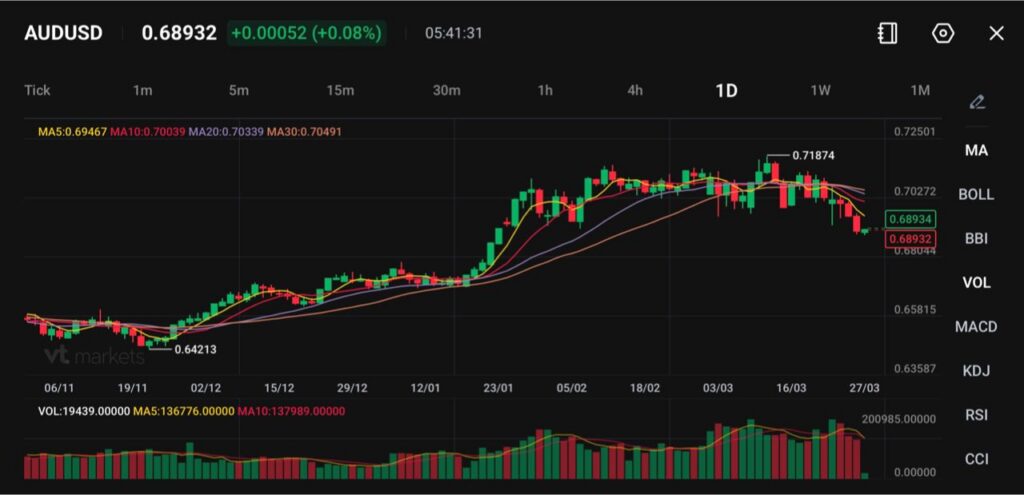
The AUDUSD is trading around 0.6893, continuing a steady pullback after failing to hold above the 0.71–0.7180 resistance zone. The structure has shifted from a strong uptrend into a corrective phase, with bearish pressure building in the short term.

Trend Structure and Moving Averages

Price is now sitting below all key short-term moving averages:

  • MA5: 0.6946
  • MA10: 0.7003
  • MA20: 0.7033
  • MA30: 0.7049

This alignment shows a clear bearish stack, with all MAs sloping downward. The rejection from 0.7187 marked a local top, followed by consistent lower highs and lower lows.

The fact that price cannot reclaim even the MA5 suggests sellers remain in control.

Key Levels to Watch

  • Immediate Resistance: 0.6945 → 0.7000
  • Stronger Resistance: 0.7030 → 0.7050
  • Support: 0.6850 → 0.6800
  • Breakdown Level: Below 0.6800 opens 0.6700 region

The 0.6850 area is the first key support. A clean break below this level would confirm continuation of the downside move.

Price Behaviour Insight

The rally from 0.6421 into the 0.7187 high was strong and trend-driven. However, the recent structure shows:

  • Repeated rejection near highs
  • Tight consolidation turning into breakdown
  • Increasing downside follow-through

This is typical of a distribution phase transitioning into correction.

Volume has increased during the recent decline, suggesting more active selling interest compared to the earlier consolidation.

What to Watch Next

Focus on how price reacts around 0.6945 (MA5 zone):

  • Failure to reclaim: Keeps downside pressure intact
  • Break above 0.7000: Could trigger a short squeeze toward 0.7030–0.7050

Also monitor macro drivers:

  • USDX strength remains a headwind for AUD
  • Commodity prices, especially iron ore and oil, can influence AUD direction

Cautious Outlook

The short-term bias remains bearish while below 0.7000, with rallies likely to be sold. Momentum only stabilises if price can reclaim the 0.7030–0.7050 zone. Until then, the structure favours a drift lower toward 0.6850 and potentially 0.6800.

What Traders Should Watch Next

AUDUSD remains sensitive to both domestic and global drivers. Key factors include:

  • Oil price movements and energy supply conditions
  • Global growth outlook and risk sentiment
  • RBA policy expectations and inflation data
  • Central bank divergence across major economies

For now, the Aussie dollar is reacting more to global risks than domestic policy support, with energy-driven inflation and growth concerns shaping its near-term direction.

Learn more about trading Forex Pairs on VT Markets here.

FAQs

Why Did AUDUSD Fall to a Two-Month Low?

AUDUSD dropped to around 0.687 as energy-driven growth concerns reduced demand for risk-sensitive currencies like the Aussie.

How Do Rising Oil Prices Affect the Australian Dollar?

Higher oil prices increase inflation and reduce global growth, which weakens commodity demand and pressures the Aussie.

What Is Driving Australia’s Inflation Outlook Higher?

Petrol costs are rising sharply, with CPI expected to reach 4.5% and possibly 5% in Q2 if energy prices stay elevated.

Why Is The Aussie Losing Its Yield Advantage?

Other central banks are expected to tighten policy, narrowing the interest rate gap that previously supported AUDUSD.

What Are Markets Expecting From The RBA?

Markets price a 68% chance of a May rate hike, with rates seen reaching 4.75% by year-end.

Start trading now – Click here to create your real VT Markets account

EIA data shows US natural gas storage fell 54B, surpassing the 49B forecast shortfall during March 20 release

US EIA data showed a natural gas storage withdrawal of 54 billion cubic feet for the week ending 20 March. Forecasts had been for a 49 billion cubic feet withdrawal. The larger-than-expected withdrawal of 54 billion cubic feet from natural gas storage is a bullish signal for the near term. It suggests that demand was stronger than we anticipated for the week ending March 20. This surprise tightening should provide immediate support for front-month futures contracts.

Inventory Levels And Near Term Price Impact

We must, however, view this within the larger context of our current inventory levels. As of this report, total working gas in storage stands at approximately 2,150 Bcf, which is still over 400 Bcf, or about 23%, above the five-year average for this time of year. This significant surplus will likely cap any major price rallies in the coming weeks. Looking forward, we are seeing production finally begin to decline, with recent rig counts from Baker Hughes showing a drop of 5% since the start of the year. This pullback, combined with consistently high demand from LNG export facilities now averaging over 14.5 Bcf per day, creates a supportive backdrop for prices later in the year. The market is weighing the immediate inventory glut against this future tightening. A key variable remains the weather as we exit the winter heating season. Forecasts pointing to a late-season cold snap in early April could trigger another significant storage draw and surprise the market again. We saw a brief price spike in similar shoulder-season conditions back in April of 2025, reminding us how sensitive this market is to weather surprises. Given these conflicting signals, we expect volatility to increase. Traders should consider purchasing options that benefit from price movement, such as straddles on the May and June contracts, as the market decides whether the high storage or the declining production will dominate price action. Implied volatility is still reasonable, offering a good entry point for these positions.

Calendar Spreads For Later Year Tightening

Another strategic play is to look at calendar spreads to capitalize on the tightening supply outlook for later in the year. We could establish positions that are short the May ’26 contract and long the January ’27 contract. This trade benefits if the market prices in a tighter supply-demand balance for next winter, causing the back end of the futures curve to rise more than the front. Create your live VT Markets account and start trading now.

Start trading now – Click here to create your real VT Markets account
Tukker and Schroeder observe markets price two or three ECB hikes in 2026, defying Lagarde expectations

Markets continue to price two to three European Central Bank rate rises in 2026. For April, pricing still implies a 60% chance of a rise. The European Central Bank is weighing how to stay guided by incoming data while also steering rate expectations across the yield curve. Markets have reacted to US efforts to seek a deal, but pricing for two to three rises remains in place.

Oil Prices And Inflation Outlook

Oil prices are treated as a key input for the near-term inflation outlook, and they have changed little since the start of the week. President Christine Lagarde said on Wednesday morning that the ECB would not act until it had enough information, and could look through a short-lived price shock. Market pricing implies the possibility of a firmer ECB response to stop a price spiral. Longer-dated forward inflation swaps have been relatively stable, while Euribor futures show a hump that points to some later reversal. The ECB faces trade-offs in its messaging, as a more dovish tone could push up long-end yields if inflation expectations drift higher. A more hawkish tone could shift attention to weaker growth. We see the market is convinced the European Central Bank will deliver at least two rate hikes this year, with a strong 60% probability priced in for a move as early as April. With the latest flash estimate for Eurozone inflation ticking up to 2.8%, driven by energy, the pressure on the ECB is building. This aggressive pricing suggests traders should be positioned for hawkish action.

Trading The Euribor Curve

The main variable remains the price of oil, which is creating a serious dilemma for the central bank. Brent crude has been stubbornly holding above $92 a barrel, and any further supply disruption could force the ECB to act decisively to prevent a price spiral. This contrasts with President Lagarde’s recent comments about looking through short-term shocks, creating the exact uncertainty traders can exploit. This environment suggests playing the “hump” in the Euribor futures strip, which implies the market expects hikes soon but a partial reversal later on. One could consider shorting near-term futures contracts to bet on a hike while buying longer-dated contracts to position for an eventual easing. The key is to trade the expected shift in the curve, not just the outright direction. Given the ECB’s balancing act between managing inflation expectations and avoiding a recession, volatility is a crucial play. The difference between what the market is pricing and what the ECB is signaling creates an opportunity to buy volatility through options. A straddle on German Bund futures heading into the April meeting could prove profitable if the bank delivers a surprise in either direction. Long-term inflation swaps remain relatively stable, suggesting confidence that the ECB has the tools to manage inflation, a credibility earned during the aggressive hiking cycle we saw end back in 2025. However, this time is different, as recent PMI data shows a fragile manufacturing sector that could be damaged by overly aggressive policy. The ECB might ultimately be forced to hike simply to meet market expectations and buy itself more time. Create your live VT Markets account and start trading now.

Start trading now – Click here to create your real VT Markets account

BNY’s Bob Savage says Bundesbank’s Nagel may back an April ECB hike if energy fuels inflation risks

Bundesbank President Joachim Nagel said the European Central Bank could raise interest rates as soon as April if higher energy prices increase inflation risks. He linked the risk to rising oil and gas prices and disruption tied to a closure of the Strait of Hormuz. Nagel said policymakers would have enough information by the ECB meeting on 29–30 April to decide whether to tighten policy or wait. He said that further tightening should not be ruled out too early.

Euro Area Money Supply Signals

Euro area monetary data showed weaker momentum in February. M3 growth slowed to 3.0% year on year from 3.2%, and M1 growth eased to 4.8% from 5.2%. The data point to more moderate liquidity conditions alongside steady but subdued credit growth across the euro area. The effect of the Middle East conflict on credit behaviour is not yet clear. The article states it was produced using an artificial intelligence tool and reviewed by an editor. The Euro is currently caught between two opposing forces, creating uncertainty for the coming weeks. We see hawkish talk from central bankers worried about Middle East energy prices, while key economic data shows slowing monetary momentum. This clash between words and numbers suggests a period of heightened volatility for the currency.

Trading For Volatility

For derivative traders, this environment is a classic signal to consider strategies that profit from price swings, regardless of the direction. Buying volatility on the Euro could be a prudent approach, as the market could react sharply to either an unexpected rate hike or a confirmation of economic weakness. The key is to be positioned for a decisive move rather than betting on a specific outcome. This view is strengthened by the latest inflation figures from earlier this month, which showed headline inflation ticking up to 2.8% on energy costs, while core inflation actually eased to 2.5%. This mixed data gives both hawks and doves at the ECB ammunition, adding to the market’s indecision. The uncertainty makes option strategies like straddles, which bet on a large price move, particularly relevant. The geopolitical risk is not just theoretical; we saw Brent crude futures jump last week after another tanker was briefly detained near the Strait of Hormuz. These real-time events give weight to Bundesbank President Nagel’s warning about a potential April rate hike to combat energy-driven inflation. This makes the hawkish scenario a tangible threat that the market must price in. We should also remember the ECB’s response to the energy shock back in 2022 and 2023, as viewed from our perspective in 2025. The central bank showed a clear willingness to hike rates aggressively to fight soaring energy inflation, even as the economy was slowing. This historical precedent suggests we should not underestimate their willingness to act again if they feel inflation is getting out of control. Looking at the interest rate markets, futures are currently pricing in only about a 35% probability of a 25-basis-point hike at the April meeting. This pricing offers a clear opportunity for traders to place bets based on their assessment of the situation. One could trade EURIBOR futures to speculate on whether the market is under- or overestimating the chances of the ECB acting next month. Create your live VT Markets account and start trading now.

Start trading now – Click here to create your real VT Markets account

Amid continued US-Iran tensions and fading Fed cut expectations, the Dollar Index remains well supported

The US Dollar Index (DXY) held firm on Thursday, trading near 99.75 and rising for a third day. Support came as tensions linked to the US-Israel war with Iran continued. Uncertainty over US-Iran talks persisted after Iran rejected a proposed 15-point plan from Washington, according to Press TV. Iran set conditions including a halt to hostilities, guarantees against renewed conflict, war reparations, a broader ceasefire, and recognition of its authority over the Strait of Hormuz.

Dollar Strength And Geopolitical Tension

US officials said discussions with Iranian negotiators were ongoing, while Iranian officials denied that any talks were taking place. Reports of further US military deployments kept concerns about a longer conflict in focus. Axios reported that US officials were evaluating military options aimed at Iranian positions. Locations mentioned included Kharg Island, Iran’s main oil export hub, plus sites around the Strait of Hormuz such as Larak Island and Abu Musa. Higher Oil prices raised inflation concerns and reduced expectations for Federal Reserve rate cuts, pushing US Treasury yields higher. Markets now expect rates to stay on hold through 2026, instead of earlier expectations for at least two cuts. A Reuters poll found 61 of 82 economists expect no rate change next quarter. For end-2026, 28 expected one cut and 37 expected two cuts.

Rates Outlook And Market Positioning

US Initial Jobless Claims were 210K versus 205K previously, with a four-week average of 210.5K versus 210.75K. Looking back at the analysis from 2025, we see the foundation for the dollar’s strength was already being laid. The expectation then for the Fed to hold rates proved correct, keeping the US Dollar Index elevated. The index currently sits near 104.50, reflecting that sustained policy tightness which has defined the last year. However, the landscape is now shifting, and we must position for a potential pivot later this year. The softer Non-Farm Payrolls report for February 2026, which came in at 175,000, suggests the labor market is finally cooling under the weight of high rates. This data, combined with a core CPI that has stubbornly hovered just above 3%, creates significant uncertainty about the timing of the first rate cut. This environment is ideal for traders looking to buy volatility in US interest rate futures. We are seeing increased interest in options on the Fed Funds futures, particularly strategies that will profit from a sharp move once the central bank finally signals its intentions. Long straddles on major currency pairs like EUR/USD could also prove profitable, positioned to capture a breakout from the recent tight ranges. The geopolitical risks mentioned back in 2025, while less acute, have not disappeared. With WTI crude oil having stabilized around $85 a barrel, any renewed tension in the Strait of Hormuz could quickly reignite inflation fears and complicate the Fed’s easing timeline. Therefore, using derivatives to hedge against a sudden spike in energy prices remains a prudent strategy for the coming weeks. Create your live VT Markets account and start trading now.

Start trading now – Click here to create your real VT Markets account

TD Securities’ Daniel Ghali cautions CTAs may sell gold without a strong price rebound next week

TD Securities said Commodity Trading Advisors (CTAs) are likely to sell gold unless prices rebound strongly in the coming week. It said a large price rise is needed to stop algorithms from selling most remaining long positions. The note said gold is trading more like a risk asset, linked to US dollar diversification flows. It also linked the move to war-related pressure on official-sector surpluses.

Official Sector Demand Weakens

It said the war in the Middle East has damaged Gulf economies and reduced surpluses in East Asia, affecting official-sector demand for now. It added that broad institutional participation has become more exposed, with fewer buyers during sell-offs. TD Securities said some market participants blame the fall on deleveraging, but its estimates show quant fund leverage has not changed since Day 2 of the war. It said this points to a weakening in market structure. It said liquidations have been large, but the market is still far from capitulation. It suggested waiting for CTA long capitulation before buying dips, and noted possible further unwinds of the “debasement trade”, including a Supreme Court decision linked to Lisa Cook’s trial. Commodity Trading Advisors (CTAs) will likely begin selling their gold holdings in most market scenarios. A significant price rally is needed over the next week to prevent these systematic funds from liquidating the majority of their long positions. This indicates that without strong buying, the market is positioned for a move lower.

Potential Catalysts Ahead

Gold is currently behaving more like a risk asset than a traditional safe haven. We’ve seen its correlation to equity markets increase since the Mideast conflict of 2025, which damaged the economies of key commodity-producing nations. This has disrupted the usual U.S. dollar diversification flows that typically support gold during uncertain times. A major source of demand has also weakened for the time being. The economic hit from last year’s war has significantly reduced the trade surpluses of major central bank buyers in the Gulf and East Asia. Looking back, we saw official sector purchases fall sharply in late 2025 from the record pace set in 2023 and 2024, leaving institutional investors exposed without that key support. The scale of liquidations has been large, but we are a long way from a full capitulation event. For derivative traders, this means buying this dip is premature until we see a washout from the CTA crowd. Watch for a sharp increase in selling volume as a sign that the last of these trend-following longs have been forced out. Upcoming events could also trigger a further unwind of the fear-based “debasement trade.” The pending Supreme Court decision on the Lisa Cook matter is creating uncertainty about the future of monetary policy. This is a key catalyst that could prompt more selling if the outcome is seen as reducing long-term financial risks. Create your live VT Markets account and start trading now.

Start trading now – Click here to create your real VT Markets account

HSBC expects NZD to remain pressured against USD soon, despite markets pricing further RBNZ tightening ahead

HSBC Global Research expects the New Zealand dollar (NZD) to stay under pressure against the US dollar (USD) in the coming weeks. Markets are still pricing further Reserve Bank of New Zealand (RBNZ) tightening over the next 12 months. The RBNZ is due to meet on 8 April, with the policy rate expected to remain at 2.25% (Bloomberg, 25 March 2026). Higher oil and gas prices linked to the Middle East conflict have pushed up local yields and added to projected rate rises.

Near Term Nz Usd Outlook

New Zealand interest rates have increased relative to Australian rates, which has supported NZD strength against the Australian dollar (AUD). Even so, NZD/USD is expected to remain weak unless the RBNZ delivers a more hawkish result than markets expect. The New Zealand dollar is likely to stay weak against the US dollar in the next few weeks. We’ve seen NZD/USD drift down to around 0.6150 this month, largely because recent US data, like last week’s non-farm payrolls which added a strong 250,000 jobs, is supporting the greenback. This trend looks set to continue ahead of the Reserve Bank of New Zealand’s meeting. While markets are expecting more RBNZ rate hikes over the next year, this is already baked into the price. With Brent crude oil holding firm around $95 a barrel and our own Q4 2025 inflation data coming in at a stubborn 3.8%, the path for future tightening is no secret. Therefore, the upcoming April 8th meeting, where rates are expected to hold at 2.25%, is unlikely to offer any new support. For us, this suggests a strategy of buying NZD/USD put options with expiries after the April meeting to position for further downside. Given that the market has already priced in the RBNZ’s likely moves, implied volatility on these options might be overstated. Selling volatility through strategies like short strangles could be profitable if the RBNZ delivers the expected steady outcome.

Relative Value Versus Australian Dollar

We saw a similar setup back in 2024 when the RBNZ maintained a hawkish stance but global growth concerns kept the kiwi pinned down. The market’s focus can easily remain on broader themes like US interest rate policy or risk sentiment, rather than just local rate expectations. This historical pattern supports the view that the NZD can weaken even when our own central bank is talking tough. In contrast, the kiwi looks much stronger against the Australian dollar. The rise in New Zealand’s two-year swap rates has outpaced Australia’s, widening the yield differential in our favor. This makes a long NZD/AUD position, perhaps using forward contracts, an attractive pair trade to isolate New Zealand’s relative rate advantage. Create your live VT Markets account and start trading now.

Start trading now – Click here to create your real VT Markets account

South Africa’s reserve bank holds its key interest rate at 6.75%, matching market expectations

South Africa’s central bank, the South African Reserve Bank (SARB), kept its main interest rate unchanged at 6.75%. This outcome was in line with expectations. The decision leaves borrowing costs steady for households and businesses. It also keeps the policy setting unchanged for the period ahead.

Market Reaction And Volatility Outlook

With the South African Reserve Bank holding rates as expected at 6.75%, the element of surprise is gone for now. We see this decision causing a drop in implied volatility for USD/ZAR currency pairs in the short term. This makes strategies like selling options attractive as markets have already priced in this stability. The rand should find support around current levels, as the high interest rate continues to attract carry traders. However, the market’s focus will now pivot entirely to when the first rate cut might happen later this year. With February 2026’s inflation print still firm at 5.8%, we believe a cut before the third quarter is unlikely. For those trading interest rate swaps, the forward curve likely overestimates the speed of future rate cuts. We are positioning for a flatter yield curve in the coming months, as short-term rates remain anchored by the SARB’s cautious stance. Looking back at 2025, we saw several false starts where the market priced in premature cuts, only to be disappointed. On the equity side, the JSE All-Share Index may see a relief rally now that this decision is out of the way. While the continued high rates are a headwind for growth, evidenced by the sluggish 0.9% GDP figure from late 2025, they benefit banking stocks’ net interest margins. We anticipate outperformance from financials relative to rate-sensitive sectors like retail or property.

Equities And Sector Positioning

Create your live VT Markets account and start trading now.

Start trading now – Click here to create your real VT Markets account

Back To Top
server

Hello there 👋

How can I help you?

Chat with our team instantly

Live Chat

Start a live conversation through...

  • Telegram
    hold On hold
  • Coming Soon...

Hello there 👋

How can I help you?

telegram

Scan the QR code with your smartphone to start a chat with us, or click here.

Don’t have the Telegram App or Desktop installed? Use Web Telegram instead.

QR code

