
Back

Ahead of Retail Sales data, the Canadian Dollar edges higher in Asian trading after Thursday’s decline

The Canadian Dollar traded slightly higher against major peers in Asia on Friday. USD/CAD eased to about 1.3735 after a fall on Thursday, and stayed near a more than two-week high of 1.3748. Lower oil prices weighed on the Canadian Dollar, as Canada is the largest oil exporter to the United States. WTI fell back to around $92.50 after failing to move above $100.

Geopolitical Risk And Energy Markets

Reuters reported that US President Donald Trump told Israeli Prime Minister Benjamin Netanyahu not to repeat attacks on Iranian energy infrastructure. Trump also said he did not know Tel Aviv would attack the South Pars gas field, the world’s largest gas field. Oil prices also fell as European nations and Japan showed readiness to help unblock energy shipments through the Strait of Hormuz. This added to downward pressure on crude. The Canadian Dollar was volatile after the Bank of Canada decision on Wednesday. The BoC kept interest rates unchanged at 2.25%. Markets are watching Canada’s January Retail Sales at 12:30 GMT on Friday. Sales are forecast to rise 1.5% month-on-month after a 0.4% fall in December. The US Dollar edged up after a sharp drop on Thursday. The US Dollar Index was up 0.2% to about 99.35, after falling over 1% to around 99.00.

Rates Volatility And The Cad Outlook

The US Dollar weakened after policy updates from the BoJ, BoE, and ECB. They provided hawkish guidance on rates, reducing fears of a gap with the Federal Reserve. Looking back at the situation in March 2025, we saw the Canadian dollar’s value tightly linked to a falling oil price. The Bank of Canada was holding interest rates steady at 2.25%, creating significant volatility around its policy announcements. This environment made short-term derivatives on the USD/CAD pair particularly sensitive to geopolitical news affecting energy markets. Today, the pressure from oil prices on the Canadian dollar remains, but the context has shifted. West Texas Intermediate (WTI) crude is now trading closer to $78 a barrel, a significant drop from the $92.50 levels seen last year, as OPEC+ has slightly increased production quotas to meet recovering global demand. This persistently lower price environment continues to act as a headwind for the loonie, suggesting that bearish positions on the currency may still have merit. The interest rate differential has also changed significantly from the scenario in 2025. The Bank of Canada has since begun an easing cycle, with the policy rate currently at 1.75%, while the US Federal Reserve has been more hesitant to cut. This widening gap between US and Canadian rates puts further downward pressure on the USD/CAD pair, a fundamental factor that was not as pronounced last year. Volatility in the energy sector continues to be a major factor for traders. The Crude Oil Volatility Index (OVX) is hovering around 35, indicating that unexpected price swings are still a significant risk. Traders should consider using options to define their risk, perhaps by purchasing puts on the Canadian dollar to speculate on further weakness while capping potential losses. In the coming weeks, we will be watching the upcoming Canadian Consumer Price Index (CPI) data very closely. The last report showed inflation cooling to 2.4%, slightly below expectations, which reinforces the market’s belief that the Bank of Canada may cut rates again before the summer. Any inflation number below consensus will likely weaken the Canadian dollar further. Create your live VT Markets account and start trading now.

Start trading now – Click here to create your real VT Markets account
During Asian trading, NZD strengthened against USD near 0.5880 as New Zealand’s trade deficit narrowed unexpectedly

NZD/USD rose to about 0.5880 in Asian trade on Friday, moving above 0.5850. The pair gained after New Zealand reported a smaller trade deficit than forecast, while traders also watched the ongoing Middle East conflict. Statistics New Zealand showed a trade deficit of NZ$257 million in February, down from NZ$627 million in January. Markets had expected a shortfall of NZ$470 million.

New Zealand Data And Near Term Limits

New Zealand GDP growth was softer than expected, which may limit further gains in the pair. The economy grew 0.2% QoQ in Q4 versus 0.9% in Q3 (revised from 1.1%), below the 0.4% forecast. On an annual basis, Q4 GDP rose 1.3% YoY versus 1.1% in Q3 (revised from 1.3%), but below the 1.7% forecast. In the US, the Federal Reserve kept the federal funds target range at 3.50-3.75% on Wednesday and projected a 0.25 percentage point rate cut by year-end. Looking back at this time last year, in March 2025, we saw the NZD react to a narrower trade deficit while weak GDP data capped the gains. Today, with the NZD/USD trading around 0.6150, the primary driver has shifted firmly to the divergence between central bank policies. The fundamental picture we observed in 2025 was the beginning of the economic slowdown that has since defined New Zealand’s performance. That weaker GDP growth seen in late 2025 persisted into this year, yet inflation has remained stubbornly high. The most recent data for the first quarter of 2026 showed New Zealand’s CPI at a higher-than-expected 4.2%, putting the Reserve Bank of New Zealand under pressure to maintain its restrictive stance. This stagflationary environment creates uncertainty, which is perfect for options traders. On the other side, the US Federal Reserve did proceed with the single rate cut signaled in 2025, but progress on inflation has stalled since then. The latest US CPI figure for February 2026 came in at 3.4%, which is well above the Fed’s target and has prompted a more hawkish tone from policymakers. This has poured cold water on expectations for further cuts in the near term.

Options Volatility And Trade Positioning

This growing policy divergence is increasing implied volatility in NZD/USD options. We see an opportunity in buying straddles ahead of the next RBNZ and Fed meetings, which would profit from a significant price move in either direction. The market appears to be underpricing the risk of a policy surprise from either central bank. The interest rate differential still favors holding the Kiwi, which has supported the pair over the last six months. Traders using futures to play the carry trade should be cautious, as any hint of a dovish pivot from the RBNZ could cause a rapid unwinding of these positions. We recommend using tight stop-losses on any long NZD futures contracts. Create your live VT Markets account and start trading now.

Start trading now – Click here to create your real VT Markets account

With February joblessness rising and China holding rates, the Australian dollar slides against the US dollar near 0.7080

AUD/USD traded lower near 0.7080 in Asian trading on Friday. The Australian Dollar weakened after Australia’s unemployment rate rose in February. Australian Bureau of Statistics data showed the unemployment rate increased to 4.3% in February from 4.1% in January. The result was above the market forecast of 4.1%.

Australian Labor Data Weakens The Aussie

The weaker labour data reduced expectations for Reserve Bank of Australia rate rises. Money markets cut the probability of a May 2026 rate hike to 57% from 61%. China’s central bank kept its benchmark lending rates unchanged on Friday. The one-year Loan Prime Rate stayed at 3.00% and the five-year rate held at 3.50%. The US Federal Reserve kept interest rates unchanged after its March meeting. The target range remained 3.50% to 3.75%. The Fed’s median dot plot still pointed to one 25-basis-point cut later in 2026. Some officials projected no cuts this year.

Fed Policy And Energy Shock Support The Dollar

Fed Chair Jerome Powell said the war in Iran has created an “energy shock” and increased uncertainty. He said this makes future policy decisions harder. With the Australian unemployment rate unexpectedly climbing to 4.3%, we see a clear signal of a softening local economy. This makes the Reserve Bank of Australia less likely to pursue the interest rate hike that markets were pricing in for May. This divergence between expectations and reality creates an opportunity against the Aussie dollar. This economic weakness is reflected elsewhere, with the latest Westpac Consumer Sentiment Index for March falling to 79.5, its third straight monthly decline. Looking back at 2025, we saw how the RBA stayed on the sidelines for months waiting for clear data, and this jobs report is a significant reason for them to remain cautious. The market is right to reduce the probability of a rate hike, and this sentiment will likely weigh on the AUD in the coming weeks. In contrast, the US Federal Reserve is facing a different problem, which supports a stronger dollar. The latest US CPI data for February showed core inflation holding firm at 3.8% year-over-year, well above the Fed’s target and complicating their plan for a rate cut. The Fed’s signal that some officials now expect no cuts at all in 2026 is a hawkish turn that we must take seriously. The energy shock from the ongoing conflict in Iran is pouring fuel on this inflationary fire, with WTI crude oil prices now trading consistently above $105 a barrel. This situation forces the Fed’s hand, making them less likely to cut rates while high energy costs act as a tax on global growth. This environment typically favors the US dollar as a safe haven and hurts commodity-linked currencies like the AUD. Given this setup, derivative traders should consider strategies that benefit from a falling AUD/USD. We believe buying AUD/USD put options with expirations in the next four to six weeks offers a direct way to position for further downside. Alternatively, a put spread could be used to lower the upfront cost while defining the risk and potential reward. This feels similar to the market jitters we experienced in late 2025 when an initial energy price spike caused a sharp, albeit brief, flight to quality. Volatility in the currency markets has picked up, with the Cboe FX Volatility Index (FXVIX) climbing 15% in the last month alone. This suggests that option premiums are rising, making defined-risk strategies even more prudent. Create your live VT Markets account and start trading now.

Start trading now – Click here to create your real VT Markets account

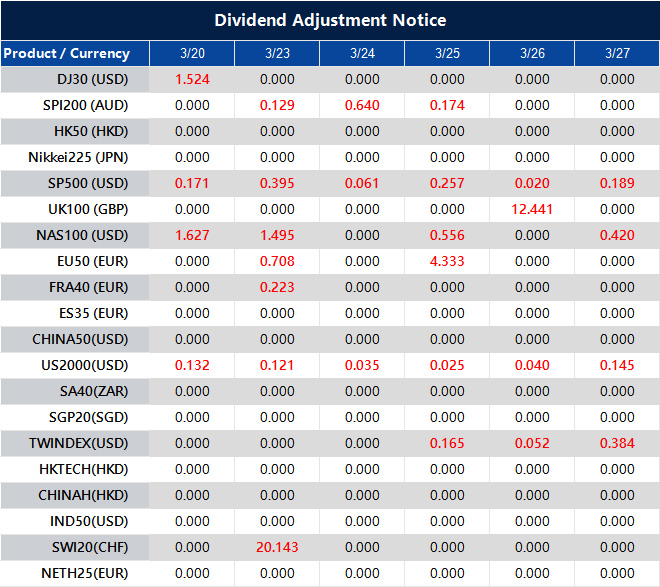
Dividend Adjustment Notice – Mar 20 ,2026

Dear Client,

Please note that the dividends of the following products will be adjusted accordingly. Index dividends will be executed separately through a balance statement directly to your trading account, and the comment will be in the following format “Div & Product Name & Net Volume”.

Please refer to the table below for more details:

Dividend Adjustment Notice

The above data is for reference only, please refer to the MT4/MT5 software for specific data.

If you’d like more information, please don’t hesitate to contact [email protected].

China’s central bank keeps one-year and five-year Loan Prime Rates unchanged in March at 3.00% and 3.50% respectively

The People’s Bank of China left its Loan Prime Rates unchanged on Friday. The one-year LPR stayed at 3.00% and the five-year LPR stayed at 3.50%. After the decision, AUD/USD was 0.08% lower on the day at 0.7081. This was the level at the time of writing.

Pboc Policy Objectives

The PBoC’s monetary policy aims include price stability, including exchange rate stability, and economic growth. It also works on financial reforms, including opening and developing the financial market. The PBoC is owned by the state of the People’s Republic of China, so it is not an autonomous institution. The Chinese Communist Party Committee Secretary, nominated by the Chairman of the State Council, has key influence; Pan Gongsheng holds both this role and the governor post. Policy tools include the seven-day Reverse Repo Rate, the Medium-term Lending Facility, foreign exchange intervention, and the Reserve Requirement Ratio. The Loan Prime Rate is the benchmark rate that affects loan and mortgage pricing, savings interest, and the renminbi exchange rate. China has 19 private banks. The largest include digital lenders WeBank and MYbank, and private funds were allowed to fully capitalise domestic lenders from 2014.

Market Implications And Trading Outlook

With the People’s Bank of China holding its key lending rates steady, we see this as a signal of managed stability rather than aggressive stimulus. For traders, this reinforces the view that Chinese authorities are prioritizing a controlled economic environment over a significant credit-fueled expansion. This comes after China’s National Bureau of Statistics reported a moderate Q4 2025 GDP growth of 4.6%, suggesting policy will remain cautious. This steady policy stance is likely to dampen volatility in currency markets, especially for China-linked pairs. The Australian dollar’s muted reaction is typical of this environment, as it removes the catalyst for a major move. We believe derivative traders should consider strategies that profit from low volatility, such as selling strangles on the USD/CNH pair, as implied volatility has been elevated, recently trading above 8%. The decision also has implications for commodities, particularly industrial metals like copper and iron ore. Without a rate cut to boost the property and construction sectors, we don’t expect a surge in demand, which should cap significant price upside in the coming weeks. We remember the price swings in iron ore during 2025, and this move suggests we are more likely to see range-bound trading, making covered call strategies on commodity futures potentially attractive. For equity index derivatives, the lack of a rate cut may temper bullish enthusiasm in the short term for indices like the Hang Seng or the FTSE China A50. The Hang Seng Tech Index has found some footing in the first quarter of this year after a challenging 2025, but this policy hold suggests a breakout is not imminent. This sets up an environment where range-trading strategies on these indices, such as iron condors, could be effective. Create your live VT Markets account and start trading now.

Start trading now – Click here to create your real VT Markets account

China’s PBoC keeps interest rates at 3%, matching forecasts, with markets largely unmoved overall

China’s central bank, the People’s Bank of China (PBOC), kept its interest rate decision in line with expectations. The rate referenced was 3%. No further details were provided on which policy rate was set at 3% or whether any other rates changed. The update only states that the decision matched market expectations.

Market Reaction And Volatility Implications

The People’s Bank of China holding the one-year loan prime rate at 3% was entirely priced in by the market. This lack of surprise should lead to a decrease in short-term implied volatility on Chinese-linked assets. For derivative traders, this means premiums on options for ETFs like FXI and ASHR may become cheaper in the coming days. We see this decision as a confirmation of a “wait and see” approach, especially after the latest data showed February 2026 manufacturing PMI at a tepid 50.1, barely in expansion territory. Looking back, we saw a similar pattern for much of 2025 as the economy digested significant property market reforms. This stability suggests the central bank is not yet ready to signal a new direction for the economy. With lower expected volatility, traders might consider strategies that benefit from a range-bound market. Selling premium through iron condors on major Chinese indices could be a viable approach for the next few weeks. This strategy profits if the underlying asset’s price remains stable, which the central bank’s decision supports for now. The stability also extends to the currency market, where the USD/CNH pair has been held in a tight band. Historical data from 2024 and 2025 showed the pair trading consistently within the 7.15-7.35 range during periods of policy certainty. This reinforces the case for selling volatility on the currency pair itself, as a major breakout seems unlikely without a new catalyst.

Upcoming Data Releases To Watch

Attention should now shift to upcoming data releases for the next market-moving event. The first-quarter GDP figures and the next industrial production numbers, due in mid-April, will be critical. These releases will provide the first real test of whether the current policy stance is enough to sustain modest growth. Create your live VT Markets account and start trading now.

Start trading now – Click here to create your real VT Markets account

WTI hovers near $93.50 as US and Israeli leaders reassure markets after Gulf energy facility damage

WTI, the US crude oil benchmark, traded near $93.50 in early Asian hours on Friday, falling after US and Israeli leaders issued statements aimed at easing market concerns over damage to Persian Gulf energy sites. US President Donald Trump said he was “not putting troops anywhere”, and Israeli Prime Minister Benjamin Netanyahu said Israel would avoid further attacks on Iranian energy facilities. The comments followed the largest day of strikes on energy assets since the war began on 18 February. Damage included the world’s biggest liquefied natural gas plant in Qatar, with repairs expected to take years.

Market Focus Shifts To Supply Risk

US crude stock data also added pressure to prices. The EIA reported that inventories rose by 6.156 million barrels in the week ending 13 March, after a 3.824 million-barrel rise the week before, versus a 400,000-barrel increase expected by the market. Markets are watching for developments that may affect the duration and scope of the conflict. Iranian officials said the response to Israel’s assault on South Pars “is underway and not yet complete”, which could affect supply risk and near-term WTI pricing. We see oil prices easing off the $93.50 mark as leaders try to calm the markets with words of de-escalation. This dip might be a short-term reaction, as the ongoing conflict and damaged infrastructure create a very nervous environment. This suggests a period of high volatility, which can present unique opportunities for traders who are prepared. The massive build in US crude stocks, adding over 6 million barrels against expectations of a tiny increase, is a strong bearish signal for now. This isn’t a one-off event; we’ve seen US production hovering near record highs of 13.4 million barrels per day while refinery utilization sits at a slightly sluggish 88%. This fundamental picture points to a well-supplied market in the United States, which could limit how high prices can go.

Options Strategies For An Unclear Direction

However, the risk of a sudden price spike is extremely high due to the physical damage in the Persian Gulf and Iran’s threat of further action. Looking back from our 2025 perspective, we only have to remember the drone attacks on Saudi facilities in 2019 to see how quickly millions of barrels of supply can be knocked offline. Therefore, buying protective call options or call spreads seems prudent to hedge against a repeat of that kind of supply shock. With strong bearish inventory data fighting against bullish geopolitical headlines, picking a clear direction is a gamble. This is a classic setup for a volatility play using options. Strategies like a long straddle, which involves buying both a call and a put option, could pay off if the price makes a sharp move in either direction in the coming weeks. Create your live VT Markets account and start trading now.

Start trading now – Click here to create your real VT Markets account

Netanyahu said Israel attacked an Iranian gas field alone, as regional energy tensions continued rising

Israel’s Prime Minister Benjamin Netanyahu said Israel “acted alone” in an attack on Iran’s South Pars gas field, as tensions rise over strikes on energy infrastructure in the region. The BBC reported the comments on Thursday. He said Iran has no capacity to enrich uranium or make ballistic missiles after 20 days of war. He said it is too soon to tell if Iranians will take to the streets.

Netanyahu Says Israel Acted Alone

Netanyahu said the US and Israel destroyed Iran’s fleet in the Caspian Sea. He said there are many possibilities for a ground component, but he would not share them. He said he would not put a stopwatch on ending the war. He also said Donald Trump asked Israel to hold off on future attacks like the one on South Pars. West Texas Intermediate (WTI) was down 0.64% at $93.40 at the time of writing. Looking back at the Israeli strike on South Pars in 2025, we see the initial market reaction was misleadingly calm. Today, with Brent crude trading over $115 per barrel due to sustained disruption, that conflict’s long tail is clear. The key takeaway for the coming weeks is that any statement from regional powers, no matter how small, can reignite extreme volatility.

Market Volatility And Hedging Strategies

We should therefore consider buying long-dated call options on crude oil to protect against sudden upside spikes. Implied volatility in the energy sector has remained stubbornly high, with the OVX (Cboe Crude Oil ETF Volatility Index) hovering near 55, a significant premium over its historical average. This indicates the market is still pricing in a high probability of another disruptive event. The initial drop in WTI prices back when the attack was announced reminds us of a classic pattern where fears of demand destruction from a prolonged war temporarily overshadow supply shocks. We saw a similar dynamic in the first weeks of the 2022 Ukraine conflict before supply realities took hold. Any sign of slowing global growth, such as the recent PMI data from China coming in at a contractionary 48.7, could trigger this pattern again and offer a brief window to enter long positions. Given the direct hit was on a major gas field, we must also focus on natural gas derivatives. With European TTF futures already elevated as the continent struggles to refill storage ahead of next winter, any further tension makes these contracts extremely sensitive. Current EU gas storage levels are at a five-year low of just 38% full for this time of year, leaving no buffer for another supply crisis. The American request for Israel to hold off on further attacks creates a ceiling on the conflict, suggesting that all-out regional war remains a less likely scenario. This presents an opportunity for traders to sell very high-strike, out-of-the-money call options, betting that American intervention will cap the ultimate peak in oil prices. This strategy allows us to collect premium while acknowledging the geopolitical guardrails that are in place. Ultimately, the open-ended nature of that conflict continues to fuel global inflation, with the last US CPI report for February 2026 showing an unexpected rise to 4.1%. This stagflationary environment suggests that positions shorting broad equity market futures, such as the E-mini S&P 500, could serve as a valuable hedge. The risk of a conflict-induced economic slowdown remains as potent as the risk of an oil price spike. Create your live VT Markets account and start trading now.

Start trading now – Click here to create your real VT Markets account

EU leaders urge pausing attacks on Middle East energy and water facilities, amid Iran war supply fears

EU leaders called for a moratorium on military strikes on energy and water facilities in the Middle East, amid concerns about the Iran war’s effect on the global economy. The comments were reported by Reuters on Thursday. In summit conclusions from Brussels, leaders from the EU’s 27 countries urged de-escalation and maximum restraint. They also called for protection of civilians and civilian infrastructure, and full respect for international law by all parties.

Freedom Of Navigation In The Strait Of Hormuz

The leaders noted increased efforts announced by member states to support freedom of navigation in the Strait of Hormuz, including stronger coordination with regional partners, subject to conditions being met. At the time of writing, West Texas Intermediate (WTI) was down 0.54% on the day at $93.47. Looking back at this call for de-escalation from March 2025, it is clear how much the market’s baseline anxiety has shifted. At that time, we saw WTI trading at $93.47, a level that now seems almost quaint. Today, with prices holding stubbornly above $105, the geopolitical risk premium from the ongoing Iran war has become structurally embedded in the market. Recent data shows the CBOE Crude Oil Volatility Index (OVX) has averaged a reading of 48 over the past quarter, a stark contrast to the mid-30s we saw this time last year. This sustained volatility is a direct result of continued minor skirmishes in the Strait of Hormuz, including a near-miss involving a tanker just last month that caused a 3% intraday spike. These events confirm that any headline can trigger sharp, unpredictable moves, making simple directional bets dangerous.

Trading Approaches For A High Volatility Oil Market

Given the high cost of options, traders should consider selling volatility rather than buying it outright. Strategies like short strangles or iron condors could be effective, capitalizing on periods of calm between flare-ups while defining risk. We are also seeing increased activity in calendar spreads, which bet on the shape of the futures curve and are less exposed to sudden spot price shocks. This market reminds us of the period in 2022 after the invasion of Ukraine, when implied volatility remained elevated for months. During that time, traders who successfully navigated the market did so by focusing on relative value plays rather than chasing headlines. The key takeaway then, as it is now, is that the risk of a supply disruption is very real, meaning downside price protection through put spreads remains a prudent portfolio hedge. Create your live VT Markets account and start trading now.

Start trading now – Click here to create your real VT Markets account

Sterling-dollar jumped 1.3%, finishing near 1.3430 above 1.3400 as BoE hawkish shift surprised amid dollar weakness

GBP/USD rose nearly 1.3% on Thursday, moving back above 1.3400 and closing near 1.3430. It opened around 1.3250 and reached about 1.3470, partly reversing the fall from the late-January high near 1.3870. The Bank of England kept rates at 3.75%, with a unanimous 9-0 vote. Markets had expected a 7-2 split, after a 5-4 hold in February.

BoE Inflation Outlook And Labor Signals

The MPC lifted its Q3 inflation forecast to about 3.5% from 2.0% in February, linked mainly to higher energy costs tied to the Iran conflict. UK labour data was mixed, with ILO unemployment at 5.2% versus a 5.3% forecast, employment change at 84K, and earnings excluding bonuses slowing to 3.8% from 4.1%. In the US, the Federal Reserve held rates at 3.50%–3.75% and still projects one cut this year. The dot plot showed seven of 19 officials see no cuts in 2026, while new home sales fell 17.6% month-on-month. GBP/USD was near 1.3427, below the 50-day EMA at 1.3452 and above the 200-day EMA around 1.3373. Key levels include 1.3550, 1.3620/1.3650, 1.3375, 1.3320, and 1.3250. Looking back at the Bank of England’s unanimous hawkish pivot in late 2025, we can now see it was a clear turning point for sterling. That policy divergence has only widened, as the BoE followed through with a rate hike to 4.0% this quarter while the Fed remains on hold. Recent UK inflation data for February 2026 confirmed this stance, coming in hot at 3.1% and keeping pressure on the central bank.

Options Volatility And Trading Positioning

This environment has kept option volatility elevated, with one-month implied volatility in GBP/USD now sitting around 9.5%. For traders, this means option premiums are rich, presenting opportunities to sell out-of-the-money puts below key support levels if we expect the uptrend to continue. The cost of protection is high, but it may be necessary for those managing large spot positions given the uncertain backdrop. The market is now pricing a greater than 60% chance of another BoE hike by the summer, making the upcoming meeting minutes critical for direction. From a technical standpoint, the 1.3650 level that capped the advance in early 2026 has now become a crucial support zone. A sustained break below this area could signal a deeper correction, while holding above it keeps the focus on the 1.3800 handle. Geopolitical risk from the Iran conflict, which first drove energy prices higher in 2025, remains a significant wildcard for currency markets. We’ve seen how quickly sentiment can shift, making it prudent to hedge long sterling exposure. Buying short-dated puts with a strike near the 1.3600 level could offer cheap insurance against a sudden dovish repricing or a surprise surge in the US dollar. Create your live VT Markets account and start trading now.

Start trading now – Click here to create your real VT Markets account

Back To Top
server

Hello there 👋

How can I help you?

Chat with our team instantly

Live Chat

Start a live conversation through...

  • Telegram
    hold On hold
  • Coming Soon...

Hello there 👋

How can I help you?

telegram

Scan the QR code with your smartphone to start a chat with us, or click here.

Don’t have the Telegram App or Desktop installed? Use Web Telegram instead.

QR code

