
Back

NZD/USD remains near 0.5950 after prior gains, while the US Dollar’s upward momentum pauses in Asia

NZD/USD held near 0.5950 in Asian trading on Thursday, keeping Wednesday’s gains. The pair stayed firm as the US Dollar paused, with the US Dollar Index struggling to add to Tuesday’s three-month high of 99.68. The US Dollar eased after a New York Times report said Iran was willing to hold talks with the US to end a war now in its sixth day. The report said operatives from Iran’s Ministry of Intelligence contacted the CIA indirectly with an offer to discuss terms, citing officials briefed on the outreach.

Geopolitical Headlines Support Safe Haven Demand

Iran later denied the report and said it would continue the war with Israel and the US. Precious metals remained strong, pointing to continued demand for safety in markets. In US data, private sector jobs rose by 63K in February, above estimates of 50K and January’s 11K. Markets are watching February Nonfarm Payrolls on Friday for more detail on US employment. The New Zealand Dollar was broadly flat, with attention on the Reserve Bank of New Zealand’s policy outlook. The US Dollar’s strength is the main story, and we see the pause mentioned as temporary. Recent data from February 2026 showed Nonfarm Payrolls adding a robust 210,000 jobs, beating expectations and signaling a resilient US labor market. This keeps the Federal Reserve on a hawkish path, making bets against the dollar risky for now.

Strategy Ideas For Trading NZDUSD Volatility

On the other side, the New Zealand economy is showing signs of slowing down. We saw in the last report that GDP growth for the fourth quarter of 2025 was a meager 0.1%, giving the Reserve Bank of New Zealand very little reason to consider rate hikes. This growing divergence in economic performance between the US and New Zealand puts fundamental downward pressure on the NZD/USD pair. We must also consider the persistent geopolitical tensions that can cause sharp, unpredictable moves. We all remember how the market reacted to the Iran/US headlines back in late 2025, causing a sudden flight to safety that temporarily weakened the US Dollar. These flare-ups create volatility, which presents opportunities for options traders. Given this backdrop, we see value in buying NZD/USD put options with expiration dates in late March or early April. This strategy allows us to profit from the expected decline in the pair while capping our potential losses if a geopolitical event causes an unexpected rally. Look for strike prices around the 0.5850 level as a potential target. The underlying theme is an increase in market nervousness, even with strong US data. The VIX, the market’s fear gauge, has been creeping up from its lows of late 2025, recently trading near 18.5. Using derivatives to trade this rising volatility directly could also be a prudent strategy over the next few weeks. Create your live VT Markets account and start trading now.

Start trading now – Click here to create your real VT Markets account
Georgieva of the IMF said renewed Middle East conflict is again testing the global economy’s resilience

IMF Managing Director Kristalina Georgieva said global economic resilience is being tested by a new conflict in the Middle East. She said that if the conflict is prolonged, it could affect energy prices, market sentiment and inflation. She said the conflict could place new demands on policymakers worldwide. She also said the IMF has warned its members that uncertainty is now the new normal.

Global Economy Faces Prolonged Uncertainty

Georgieva said the global economy could be entering a prolonged period of flux. She linked this risk to ongoing geopolitical tensions and their possible knock-on effects. With global economic resilience being tested, we must prepare for a prolonged period of uncertainty. This new conflict will likely drive significant market volatility in the coming weeks. For derivative traders, this means focusing on instruments that thrive on price swings and hedging portfolio risk. The most direct impact will be on energy prices, which affects everything else. Brent crude futures for May delivery have already jumped over 8% this week, crossing the $110 per barrel mark for the first time since late 2024. Traders should consider buying call options on oil futures or on energy sector ETFs to capitalize on further expected price increases. Market sentiment is deteriorating, creating a classic flight-to-safety environment. We’ve seen the CBOE Volatility Index, or VIX, surge to 28.5, a level we haven’t seen since the regional banking scare back in 2025. Buying VIX call options is a direct way to profit from this rising market fear.

Positioning Trades For Volatility And Policy Risk

This shock to energy will fuel inflation, placing new demands on policymakers. Implied inflation expectations from the 5-Year TIPS spread have widened by 30 basis points in just ten days, suggesting the market believes the Federal Reserve may have to delay planned rate cuts. This makes interest rate futures and options on bond ETFs critical tools for positioning against shifting monetary policy. We can look back at the market reaction in 2022 when similar geopolitical events caused an energy crisis. The initial spike in volatility was followed by a sustained period of inflation that reshaped central bank policy for over a year. History suggests this is not a short-term event, and initial positions should be structured with a multi-month view. Given the potential for a broad market downturn, hedging existing equity exposure is now paramount. We are using put options on major indices like the S&P 500. This provides a clear defensive position against the combined risks of higher inflation and geopolitical instability. Create your live VT Markets account and start trading now.

Start trading now – Click here to create your real VT Markets account

During Asian trading, AUD/USD slips near 0.7065 after Australia’s January trade surplus unexpectedly narrows

AUD/USD fell to about 0.7065 in Asian trading on Thursday, with the Australian dollar weaker versus the US dollar. The move followed an unexpected narrowing in Australia’s trade surplus, while traders also watched tensions involving the US, Israel and Iran. Australia’s trade surplus narrowed to 2,631M month on month in January, below the 3,900M forecast. This came after a December surplus of 3,373M.

Trade Flows And Market Reaction

Exports fell by 0.9% month on month in January, after a 0.9% rise in the prior month (revised from 1.0%). Imports rose by 0.8% in January, after a 1.8% fall in December (revised from 0.8%). The Reserve Bank of Australia has maintained a hawkish policy stance. After the December decision, Governor Michelle Bullock said inflation concerns were central and that a rate rise was possible. In the Middle East, Israel said it was launching new strikes across Iran and against what it called Hezbollah infrastructure in Beirut. Iran launched a drone attack on an Amazon data centre in Bahrain. Geopolitical risk may support demand for the US dollar as a safe-haven asset. US weekly Initial Jobless Claims are due later on Thursday.

Shifting Policy And Commodity Drivers

We recall how Australia’s narrowing trade surplus in January 2025 put initial pressure on the AUD/USD pair. At that time, this economic weakness was countered by the hawkish stance of the Reserve Bank of Australia. That fundamental tension between weak data and a hawkish central bank created significant uncertainty for us. Looking at today’s landscape in March 2026, that RBA hawkishness has since faded as global growth concerns took priority throughout last year. Australia’s trade balance is now heavily dependent on volatile iron ore prices, which have recently struggled to stay above the $115 per tonne mark amid questions over Chinese demand. This has kept a lid on any significant rallies for the Aussie dollar. On the other side of the pair, the safe-haven demand for the US dollar has been a persistent theme since the events we saw in 2025. More importantly, the Federal Reserve’s path to lower interest rates has been much slower than anticipated, with recent US core inflation data for February 2026 holding steady around 2.7%. This interest rate differential continues to favor the greenback over the Aussie. Given these dynamics, we see implied volatility in AUD/USD options as attractively priced for potential moves. Traders should consider strategies like buying straddles to position for a breakout, especially with Australian employment data and the next US CPI release on the horizon. This approach allows a position to profit from a significant move in either direction without needing to predict the specific catalyst. For those looking to manage risk on existing positions, purchasing out-of-the-money AUD put options offers a cost-effective hedge against a sudden drop below the 0.6400 level. We are also exploring currency spreads, such as being long AUD/NZD, to isolate Australia-specific factors from the dominant influence of the US dollar. This can provide a relative value play in a market driven by broader risk sentiment. Create your live VT Markets account and start trading now.

Start trading now – Click here to create your real VT Markets account

In a report to the National People’s Congress, Premier Li Qiang outlined China’s 2026 growth aim: 4.5–5%

China set a 2026 economic growth target of 4.5%–5% in an annual report delivered by Premier Li Qiang at the opening session of the National People’s Congress on Thursday. This is below the 5% growth rate achieved last year. The report said China will continue a “moderately loose” monetary policy. It also plans to support wider adoption of AI in the economy and to adjust the consumption tax.

Policy Priorities And Market Stabilization

China said it will work to stabilise the property market and curb local government debt. It also plans to prevent disorderly and wasteful investment by local governments. The report set out a goal to promote the cross-border use of the renminbi. It also said China aims to further open up its services sector. In markets, AUD/USD was last trading 0.07% lower on the day at 0.7070. It was weighed down by weak Australian trade data and China’s 2026 growth forecast. We see China’s reduced growth target as a clear signal to expect lower demand for industrial commodities. This comes after iron ore prices already showed significant weakness in the final quarter of 2025, falling over 15% on concerns about the property sector. We should therefore consider short positions on base metals like copper and aluminum futures for the coming weeks.

Options And Macro Trading Implications

The immediate drop in the Australian dollar is a direct consequence of this news, and we expect this trend to continue. The AUD/USD pair has now decisively broken below the 0.7100 support level we were watching. Buying put options on the Aussie dollar offers a defined-risk way to trade this expected weakness. For energy traders, this lower growth forecast casts a shadow over crude oil demand. The International Energy Agency’s report from last month had already projected a moderation in Chinese import growth from the levels we saw in 2025. Selling out-of-the-money call options on Brent or WTI crude could be a prudent strategy to capitalize on a potential price ceiling. The commitment to a ‘moderately loose’ monetary policy, while major Western central banks remain tight, suggests a weaker yuan. This divergence creates a clear opportunity in the currency markets. We view buying call options on the USD/CNH pair as an attractive way to position for further renminbi depreciation. Within China, the outlook for equities is mixed, creating opportunities for volatility traders. While the lower growth target is a headwind, targeted support for sectors like AI could create winners and losers. We believe selling strangles on the Hang Seng Index or FTSE A50 Index, which profits from the index staying within a range, is a viable strategy. This slowdown will have ripple effects on global equity indices with high exposure to Chinese consumption. We will be closely watching German automakers and European luxury brands, which were already reporting softer sales in China during their earnings reports for last year. Traders should consider hedging long positions in the German DAX index, as it is particularly sensitive to this dynamic. Create your live VT Markets account and start trading now.

Start trading now – Click here to create your real VT Markets account

During the early Asian session, USD/CAD slips near 1.3630 as oil lifts the Canadian Dollar, with US jobless claims awaited

USD/CAD edges down to about 1.3630 in early Asian trading on Thursday, as the Canadian Dollar strengthens. Traders are watching the US weekly Initial Jobless Claims report due later on Thursday. Higher crude oil prices support the Canadian Dollar, which often moves with oil because Canada is a major oil exporter. Oil is rising amid the US-Iran conflict and concerns about supply disruption through the Strait of Hormuz.

Oil Prices Lift The Canadian Dollar

US data may limit further falls in the US Dollar. The ISM Services PMI rose to 56.1 in February 2026 from 53.8, above the 53.5 forecast. The USD/CAD pair is currently facing opposing pressures, which creates a complex trading environment. West Texas Intermediate (WTI) crude oil has just pushed above $95 a barrel for the first time this year, a nearly 12% rise since early February, directly strengthening the Canadian dollar. This move is largely fueled by escalating geopolitical tensions in the Middle East. We are seeing clear signs of supply disruption risk following another naval standoff in the Strait of Hormuz last week. This is compounded by recent Energy Information Administration (EIA) data showing a surprise crude inventory drawdown of 3.1 million barrels, against expectations of a build. This tight supply narrative is providing a strong tailwind for oil and, by extension, the loonie. However, the US dollar is showing its own resilience, preventing a sharper fall in the currency pair. The strong ISM Services PMI report at 56.1 is now supported by last week’s Non-Farm Payrolls data, which showed the US economy added a robust 265,000 jobs in February. This consistent flow of positive data points to an American economy that is not slowing down.

Volatility Risks And Trading Approaches

Consequently, we’ve seen market expectations for a Federal Reserve interest rate cut in June fall significantly. The CME FedWatch tool now shows less than a 40% probability of a cut by mid-year, down from over 70% just a month ago. This expectation of higher-for-longer US rates provides a solid floor for the US dollar. This tug-of-war suggests that volatility in USD/CAD is the most likely outcome in the coming weeks. Implied volatility on one-month options has already climbed to its highest level since late 2025, meaning traders should consider strategies that profit from price movement itself, regardless of direction. Long straddles or strangles could be effective ways to position for a significant breakout. We remember how a similar oil spike in the third quarter of 2025 gave the loonie a temporary boost before tighter US monetary policy eventually won out. Therefore, while riding the oil-driven CAD strength, it is prudent to use options to hedge against a potential sharp reversal. A move back towards 1.3800 is very possible if US economic data continues to outperform and overshadow the energy markets. Create your live VT Markets account and start trading now.

Start trading now – Click here to create your real VT Markets account

XAG/USD maintains gains above $84.00, yet lacks momentum, staying rangebound and appearing slightly vulnerable

Silver (XAG/USD) rose for a second day on Thursday but lacked fresh buying and stayed within Wednesday’s wider range. It held above $84.00 in Asia, up over 1% on the day. The near-term tone is mildly bearish after falling from last week’s $86 area. Price remains below the rising 100-period SMA on the 1-hour chart, with that average near $88 acting as resistance.

Momentum Signals And Consolidation

MACD is moving back towards the zero line after a positive phase. RSI sits just under 50, pointing to consolidation and a softer downside bias rather than a sharp sell-off. Resistance is around $85.00, then $86.20, where previous peaks match weakening momentum. A break above $86.20 could target $88.00, where the 100-hour SMA is clustered and may draw selling. Support is at $83.50, then $82.00 near the latest reaction low and a nearby trend line. A drop below $82.00 would bring $80.95 into view and suggests a clearer move away from the medium-term uptrend. An upward support trend line from about $64 remains intact. Recent pullback into the low-$80s shows reduced buyer control.

Options Strategy And Key Levels

We are seeing silver trade in a tight range above the $84.00 mark, but it is failing to attract strong follow-through buying after pulling back from the $86.00 area last week. The current price action suggests a period of consolidation where neither buyers nor sellers have full control. This indecision means we should consider strategies that profit from either range-bound movement or a decisive break. Given the strong resistance capped around $86.20 and further up at $88.00, selling out-of-the-money call options or implementing a bear call spread could be a viable strategy for the coming weeks. This approach generates income if silver fails to break through these overhead barriers, capitalizing on the fading upside momentum. This tactic aligns with technical indicators like the RSI hovering below 50, which points to a lack of immediate buying power. Fundamentally, this cautious view is supported even as underlying demand remains strong. Reports from early 2026 continue to show robust industrial silver consumption, with projections for solar panel manufacturing expected to surpass 500 million ounces this year, building on the record demand we saw throughout 2025. This underlying support may prevent a steep crash but might not be enough to fuel an immediate breakout past recent highs, reinforcing the case for a range-bound market. On the downside, we must watch the $82.00 support level as a critical floor. A clean break below this point would signal a significant shift in sentiment and could trigger a move towards the $80.95 area. Traders anticipating this weakness could consider buying put options as a way to profit from a potential downward slide. However, we must respect the broader uptrend that originated from the $64 level, a key feature of the market landscape in 2025. For those who believe this long-term trend remains intact and that support will hold, selling cash-secured puts or bull put spreads with a strike price safely below $82.00 is an alternative. This strategy profits from time decay as long as silver does not suffer a significant breakdown. Create your live VT Markets account and start trading now.

Start trading now – Click here to create your real VT Markets account

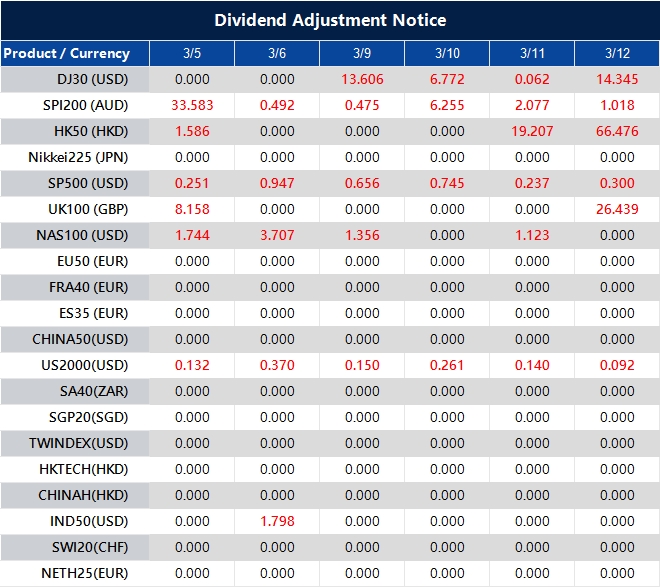
Dividend Adjustment Notice – Mar 05 ,2026

Dear Client,

Please note that the dividends of the following products will be adjusted accordingly. Index dividends will be executed separately through a balance statement directly to your trading account, and the comment will be in the following format “Div & Product Name & Net Volume”.

Please refer to the table below for more details:

Dividend Adjustment Notice

The above data is for reference only, please refer to the MT4/MT5 software for specific data.

If you’d like more information, please don’t hesitate to contact [email protected].

WTI trades around $75, extending a three-session rally as Hormuz disruptions lift crude amid Middle East war

WTI traded near $74.80 per barrel during Asian hours on Thursday, extending gains for a third session and holding close to $75.00. Prices rose as supply disruption risks continued amid the Middle East war. US and Israeli strikes on Iran and Iranian retaliation have affected energy infrastructure and disrupted oil and gas movements. The Strait of Hormuz, which handles about a fifth of global oil and LNG supplies, remains a key route.

Supply Risks In Focus

Reuters reported that Iraq, OPEC’s second-largest producer, has cut output by nearly 1.5 million barrels per day due to storage limits and blocked exports. Officials said Iraq could shut in up to 3 million bpd within days if flows do not restart. MarineTraffic data showed at least 200 ships, including oil and LNG tankers, anchored off Iraq, Saudi Arabia and Qatar. UKMTO said eight vessels, including Safeen Prestige, have been hit since Saturday. The campaign has entered its sixth day after reports that a US submarine sank an Iranian warship off Sri Lanka. US Defense Secretary Pete Hegseth said it was the “first such attack on an enemy since World War II.” Reuters also cited a scenario of a four- to five-week US campaign and an effective closure of Hormuz, with crude moving toward $100. US President Donald Trump offered risk insurance and naval escorts, while Treasury Secretary Scott Bessent outlined further steps.

Market Echoes And Strategy

Given the market’s memory of the Hormuz crisis in 2025, we see current conditions as a potential echo of that volatile period. Last year’s conflict, which saw WTI crude spike toward $100 a barrel, showed how quickly geopolitical events can upend supply. That price shock has created a persistent sense of caution in the energy markets. The CBOE Crude Oil Volatility Index (OVX) is currently hovering near 29, which is significantly lower than the peaks we saw during the 2025 disruptions. This suggests a degree of market complacency, creating an opportunity for those who anticipate renewed tensions. With the U.S. Strategic Petroleum Reserve still near 40-year lows at around 365 million barrels, the ability to cushion a new supply shock is limited. We believe traders should consider building long positions through call options on WTI for summer 2026 contracts. The tight supply situation, with OPEC+ widely expected to extend production cuts of 2.2 million barrels per day at their next meeting, provides a solid floor under prices. Buying the $85 and $90 strike calls offers significant upside exposure with a defined risk if another supply disruption materializes. Looking back at 2025, Iraq’s output was slashed by almost 1.5 million bpd, a scenario that could easily repeat. We are seeing early signs of renewed friction, with minor shipping delays reported near the Bab el-Mandeb strait last week. A strategy of buying June call spreads could therefore be prudent, allowing traders to finance longer-dated options by selling shorter-term ones. The macroeconomic picture supports this view, as the February 2026 Consumer Price Index reading came in slightly higher than expected at 3.3%. Another energy price surge would complicate central bank efforts to control inflation, potentially amplifying market reactions to any supply threats. This makes the energy sector particularly sensitive to geopolitical headlines in the coming weeks. Create your live VT Markets account and start trading now.

Start trading now – Click here to create your real VT Markets account

Amid escalating Middle East conflict, EUR/USD slips near 1.1635 as safe-haven demand lifts the US dollar

EUR/USD trades lower near 1.1635 in early Asian trading on Thursday, slipping below 1.1650. The US Dollar strengthens against the Euro as Middle East conflict drives demand for safer assets. The conflict involving the US, Israel, and Iran is in its sixth day on Thursday. Israel said on Wednesday it began a new wave of strikes on military infrastructure in Tehran, and the chairman of the Joint Chiefs of Staff said the US will strike “progressively deeper” into Iran.

Market Focus And Key Data

Markets now await Eurozone Retail Sales and US weekly Initial Jobless Claims, due later on Thursday. These releases may affect near-term moves in the pair. ECB policymaker Martins Kazaks said on Tuesday the ECB should keep rates steady for now because the impact of the war in Iran is uncertain. Rising oil and gas prices linked to the conflict have increased inflation concerns and added to expectations of an ECB rate rise. Money markets price in nearly a 40% probability of an ECB rate hike by year-end, Reuters reported. This follows hotter-than-expected February inflation data released on Tuesday. We remember looking back at 2025 when escalating Middle East tensions fueled a flight-to-safety, pushing the US Dollar higher and sending EUR/USD below 1.1650. That period was a stark reminder of how quickly geopolitical risk can dominate currency markets. The dollar’s role as the ultimate safe haven was reinforced for all of us.

Positioning And Volatility

Today, the situation has evolved, with EUR/USD trading significantly lower around 1.0780 as of early March 2026. The interest rate differential remains a primary driver, especially after the latest US Non-Farm Payrolls report showed a robust addition of 275,000 jobs, keeping pressure on the Federal Reserve to maintain its restrictive stance. In contrast, Eurozone inflation has cooled to 2.6%, giving the European Central Bank more room to consider rate cuts later this year. Last year’s conflict caused a dramatic spike in implied volatility, with options premiums surging as traders scrambled for protection. We are not seeing that level of panic now, with key volatility measures like the VSTOXX index trading near 12-month lows. This relative calm in the options market presents a different kind of opportunity for prepared traders. Given the current low volatility, buying put options on EUR/USD offers a relatively inexpensive way to hedge against a sudden geopolitical flare-up or a surprisingly strong US inflation report. This strategy provides downside protection while limiting risk to the premium paid. It is essentially a low-cost insurance policy against a return to the dollar strength we witnessed in 2025. We also recall how money markets in 2025 priced in a 40% chance of an ECB rate hike on energy-driven inflation fears, a hike that never materialized as growth concerns took precedence. A similar dynamic could play out if energy prices, with Brent crude currently holding steady around $85 a barrel, were to spike again. This makes long positions in EUR calls a potential contrarian play on a sudden hawkish shift from the ECB. To balance these risks, derivative traders should consider strategies that benefit from a clear directional move but at a reduced cost. A bear put spread, for instance, allows for a bet on a falling EUR/USD but caps both the potential profit and the upfront cost. This defined-risk approach is prudent in an environment where underlying economic data and dormant geopolitical risks could rapidly shift market sentiment. Create your live VT Markets account and start trading now.

Start trading now – Click here to create your real VT Markets account

Australia’s monthly exports dropped 0.9%, reversing the prior 1% increase, according to latest data released

Australia’s exports fell by 0.9% month-on-month in January. This followed a 1% rise in the previous month. We see the drop in January’s exports to -0.9% as a significant reversal from the growth we saw at the end of last year. This shift signals a potential slowdown in global demand for Australian goods, particularly from key partners. Recent purchasing managers’ index (PMI) data out of China has also been soft, with the manufacturing PMI dipping to 49.8, reinforcing concerns about the strength of our main export market.

Australian Dollar Risk And Positioning

This negative data puts immediate pressure on the Australian dollar, making bearish strategies attractive. We are considering buying AUD/USD put options to profit from a potential decline while limiting our risk to the premium paid. Implied volatility on these options has already increased slightly to 10.2%, suggesting the market is beginning to price in a period of greater uncertainty for the currency. The weakness is also likely to affect the ASX 200, especially the heavily weighted materials and energy sectors. Shorting index futures or buying put options on major mining stocks could be a prudent move to hedge against or capitalize on a market downturn. Resource companies, which saw their share prices rally in the final quarter of 2025, now face headwinds from both lower export volumes and potentially softer commodity prices. This trade data makes a hawkish stance from the Reserve Bank of Australia (RBA) less likely in the near term. We remember how in mid-2025, a similar pattern of weakening external accounts led the RBA to pause its policy tightening for several months. Traders will be closely watching the upcoming RBA minutes for any change in tone regarding future rate movements. The fall in exports, a large portion of which is iron ore and coal, points to weakening fundamentals for these key commodities. Given that over one-third of our total exports typically go to China, their reduced industrial appetite could weigh on prices for weeks to come. This may create opportunities for those positioned to short iron ore futures on exchanges like the Singapore Exchange.

Commodity Headwinds And Tactical Trades

Create your live VT Markets account and start trading now.

Start trading now – Click here to create your real VT Markets account

Back To Top
server

Hello there 👋

How can I help you?

Chat with our team instantly

Live Chat

Start a live conversation through...

  • Telegram
    hold On hold
  • Coming Soon...

Hello there 👋

How can I help you?

telegram

Scan the QR code with your smartphone to start a chat with us, or click here.

Don’t have the Telegram App or Desktop installed? Use Web Telegram instead.

QR code

