Foreign buying of Japanese shares rose from ¥402bn to ¥973.9bn in the week ending 27 February. The change shows a higher net inflow into Japan’s stock market over that period.
The increase from ¥402bn to ¥973.9bn equals a rise of ¥571.9bn. This compares the latest weekly figure with the previous week’s total.
Foreign Inflows Signal Rising Confidence
We are seeing a massive surge in foreign capital into Japanese stocks, with inflows more than doubling in the last week of February. This is a very strong bullish signal, suggesting that international investors are showing growing confidence in the market’s upward momentum. This level of investment is the highest we’ve seen since the major rally in the second quarter of 2025.
Given this, we should consider buying call options on the Nikkei 225 index or related ETFs to capitalize on expected gains in the coming weeks. The current market shows the Nikkei has already broken through the 41,000 resistance level, and this new flood of money could provide the fuel to test 42,500. A similar inflow pattern last year preceded an 8% climb over the following month.
This foreign buying spree puts upward pressure on the Japanese Yen, but the Bank of Japan’s policy is a more dominant force. With the BoJ still signaling it will maintain its accommodative stance to ensure inflation remains stable around 2%, the Yen is likely to stay relatively weak. We can use derivatives to bet on the USD/JPY pair remaining above the 152 level, which benefits Japan’s large exporters.
The significant capital injection will also likely increase market volatility in the short term. The Nikkei Volatility Index has already ticked up from 16 to 19.3 in the past ten days, reflecting uncertainty about the pace of the rally. We could look at selling out-of-the-money put options to collect premium from this heightened volatility, effectively getting paid to be bullish above a certain price.
We should also notice where the money is going, as recent flow data indicates a heavy concentration in semiconductor and financial stocks. These sectors have outperformed the broader market by nearly 5% since the beginning of the year. This suggests that using options on specific sector ETFs, rather than just the broad Nikkei, could provide a more targeted way for us to profit from this trend.
GBP/USD was almost unchanged on Wednesday, up 0.08% to about 1.3370 in a quiet session. It has dropped from a late-January peak near 1.3870 and is now testing the 200-day EMA, while the one-week forex heatmap shows Sterling down about 1.4% against the US Dollar this week.
In the UK, Rachel Reeves delivered the Spring Statement, and the OBR cut its 2026 growth forecast to 1.1% from 1.4% due to weaker activity in late 2025 and higher unemployment. The OBR said its forecasts were finalised before the US-Israeli strikes on Iran, and warned the conflict could have large effects on the global and UK economies.
Energy And Bank Of England Expectations
Energy prices rose after the closure of the Strait of Hormuz, and markets reduced bets on a Bank of England rate cut on 19 March. Futures now price less than a 15% chance of a cut.
In the US, demand for the Dollar has been supported by safe-haven flows, with key releases due on Friday, including Nonfarm Payrolls and January Retail Sales. Technically, GBP/USD is below the 50-day EMA, with resistance near 1.3505 and focus returning to 1.3650 if it closes above that level.
Support sits near the 200-day EMA around 1.3375, then 1.3360 and 1.3300. A break below these levels would point to further downside on the medium-term chart.
We have seen the Pound break below the critical 200-day moving average at 1.3375, a level it was only testing a day ago. The pair is now trading near 1.3350, confirming a bearish technical signal and suggesting that sellers are gaining more control. This break is significant as it had been a key support level for months.
Strategy And Risk Management
The fundamental picture for the UK has worsened since the recent Spring Statement. The February 2026 manufacturing PMI data, released just this morning, came in at 48.5, indicating a contraction and giving credit to the OBR’s decision to cut the growth forecast. This confirms the weaker economic activity we were already seeing in late 2025.
On the other side of the pair, safe-haven demand for the US dollar remains strong due to the unresolved tensions around the Strait of Hormuz. Brent crude oil prices have held firm above $95 per barrel for over a week, reinforcing global economic uncertainty. All eyes are now on tomorrow’s US Nonfarm Payrolls report, with consensus forecasts anticipating a solid gain of around 210,000 jobs, which would further support the dollar.
This creates a clear policy divergence between the central banks. The Bank of England is stuck between a slowing economy and high energy-driven inflation, making it very unlikely they will act at the March 19 meeting. Meanwhile, the Federal Reserve faces no immediate pressure to cut rates, given the robust US labour market and persistent global risks.
Given this outlook, we should consider buying GBP/USD put options to profit from further downside. A sustained break below 1.3360 opens the door to the 1.3300 psychological level in the near term. Options with an expiry date after the March 19th Bank of England meeting could capture any additional volatility.
For those wanting to manage risk, the 50-day average near 1.3505 now acts as firm resistance and a logical level for stop-losses on short positions. A bear put spread could also be an effective strategy, allowing us to bet on a decline while lowering the upfront cost of the position. This is a more conservative way to express a bearish view on the pound.
Create your live VT Markets account and start trading now.
Start trading now – Click here to create your real VT Markets account
USD/JPY fell 0.42% on Wednesday to about 157.00 after trading near 157.90 earlier. The pair has ranged between roughly 152.00 and 159.00 since late January.
Safe-haven demand for the US Dollar eased, helping the Yen recover slightly. Middle East tensions remained a main driver of broader US Dollar demand.
Strait Of Hormuz Shock
US and Israeli strikes on Iran led to the effective closure of the Strait of Hormuz. Higher crude oil prices added pressure to the Yen because Japan relies heavily on energy imports.
Japan’s Finance Minister Katayama said authorities are monitoring the currency’s decline. The Bank of Japan is holding rates at 0.75%, and recent volatility has raised the chance of no March hike.
In US data, ADP payrolls rose by 63K and ISM Services PMI came in at 56.1. The remaining high-impact releases this week are Friday’s US Nonfarm Payrolls and Retail Sales.
On the daily chart, USD/JPY was at 157.07, with resistance at 157.70 and 158.40, then 160.00. Support sits near 156.00 and 155.30, then 153.00.
How The Backdrop Changed
Looking back at the events of early 2025, we recall the extreme tension when USD/JPY was trading near 157.00 due to the Strait of Hormuz crisis. Today, with the pair trading much lower around 148.50, that period serves as a stark reminder of how quickly geopolitical risk can impact the yen. The easing of Middle East tensions throughout late 2025 allowed the focus to shift back to monetary policy fundamentals.
The policy divergence that drove the dollar higher last year has reversed significantly. While the Bank of Japan held rates at 0.75% during the March 2025 turmoil, they eventually hiked twice later in the year to 1.25%, where the rate currently stands. This, combined with the Federal Reserve’s two recent quarter-point cuts, has narrowed the U.S.-Japan 10-year yield spread to just under 3.3% from its peak of over 4.1% a year ago.
For derivative traders, this means implied volatility is now much lower than the elevated levels seen during the 2025 crisis. Three-month implied volatility for USD/JPY is currently hovering near 8.5%, a sharp contrast to the levels above 15% we saw during the shipping disruptions. This makes buying options relatively cheap, presenting an opportunity to position for future moves without the high premiums of last year.
Recent data reinforces the potential for renewed yen strength. Last week’s Tokyo Core CPI came in at 2.8%, beating expectations and fueling speculation that the Bank of Japan may signal another rate hike by summer. This stands in contrast to softening U.S. labor market data, which keeps the door open for further Fed easing.
Therefore, strategies should shift from the crisis-driven positioning of 2025. Given the lower volatility, purchasing long-dated JPY calls (or USD/JPY puts) offers a cost-effective way to speculate on a continued policy divergence that favors the yen. The 160.00 level that seemed possible a year ago is now a distant resistance, with traders instead using options to target a move toward the 145.00 support zone.
Create your live VT Markets account and start trading now.
Start trading now – Click here to create your real VT Markets account
AUD/USD rose 0.5% on Wednesday to about 0.7080 after earlier dipping towards 0.7000. It has moved in a 150-pip range between 0.7000 and the year-to-date high near 0.7150 for over a month, and is down about 0.65% over the past five sessions.
Australia’s Q4 GDP grew 0.8% quarter-on-quarter versus a 0.6% consensus, with annual growth at 2.6% from 2.1%. Growth was driven mainly by government spending and a rebound in inventories, after the RBA lifted rates to 3.85% in February.
Key Us Data And Geopolitical Risk
In the US, ADP payrolls and the ISM Services PMI beat forecasts on Wednesday. US Nonfarm Payrolls, the unemployment rate, and January retail sales are due Friday, while conflict in the Middle East and the Strait of Hormuz closure has supported USD safe-haven demand.
AUD/USD traded at 0.7079, above rising 50-day and 200-day exponential moving averages, with the Stochastic easing from overbought levels. Support is near 0.7040 and 0.7000, with the 50-day EMA around 0.6930; resistance sits near 0.7120 and then 0.7160.
AUD drivers include RBA policy, a 2–3% inflation target, China’s economy, trade balance, and iron ore, worth $118 billion a year in 2021.
Looking back to early 2025, we recall a period of optimism for the Aussie dollar, fueled by strong fourth-quarter GDP growth of 2.6% annually. This strength supported the Reserve Bank of Australia’s decision to raise rates to 3.85% at the time. Today, however, the landscape has shifted, with AUD/USD trading significantly lower around 0.6650.
Outlook And Strategy Considerations
The series of rate hikes that followed the period in 2025, peaking at 4.35%, have clearly cooled the economy as intended. The most recent data for the fourth quarter of 2025 showed annual growth slowing to just 1.5%, a noticeable drop from the robust pace seen a year prior. This slowdown suggests the RBA will remain on hold for the foreseeable future, removing a key pillar of support for the currency.
Furthermore, the outlook for Australia’s key trading partner, China, has softened, which weighs on the Aussie. Recent figures like the Caixin Manufacturing PMI dipping to 49.8 show a manufacturing sector in slight contraction. This has contributed to iron ore prices falling to around $115 per tonne, well off their highs from last year.
Given the divergence, where the US economy remains resilient and keeps the Fed on a ‘higher-for-longer’ path, the path of least resistance for AUD/USD appears to be lower. Unlike the range-bound trading we saw around 0.7100 in early 2025, the current trend is decidedly downward. Derivative traders may consider buying put options to hedge or speculate on further downside, especially with key support levels now under pressure.
Create your live VT Markets account and start trading now.
Start trading now – Click here to create your real VT Markets account
Gold traded near $5,145 in early Asian hours on Thursday, holding gains around $5,150. The move followed increased demand linked to the US–Iran conflict, with US weekly Initial Jobless Claims due later and Fed official Michelle Bowman scheduled to speak.
Israel’s military said it began a new wave of strikes targeting military infrastructure in Tehran, according to the BBC. US officials said the US will start striking “progressively deeper” into Iran, and Republicans rejected a resolution seeking to require congressional approval for future US military action against Iran.
Federal Reserve And Data Focus
US data showed the ISM Services PMI rose to 56.1 in February from 53.8, above the 53.5 forecast. This may support expectations of higher interest rates for longer, which can lift the US Dollar and pressure dollar-priced commodities.
Markets largely expect the Fed to keep rates unchanged until the summer. Separately, central banks added 1,136 tonnes of gold worth around $70 billion to reserves in 2022, the highest yearly purchase since records began, according to the World Gold Council.
We remember how last year, around this time, gold was pushing over $5,100 as the conflict with Iran escalated, creating a strong safe-haven bid. Today, with those direct military tensions having eased, the price has pulled back to around $4,900. The market’s main focus has now shifted from geopolitics to the Federal Reserve’s interest rate path.
The recent economic data gives us a mixed picture that creates uncertainty. February’s inflation numbers came in slightly hotter than expected at 3.1%, and last month’s jobs report showed a solid gain of 225,000 new payrolls. This strong data gives the Fed justification to keep interest rates higher for longer, which typically weighs on non-yielding gold.
Derivatives Positioning And Volatility
For derivatives traders, this environment suggests implied volatility could rise as we approach the next Fed meeting. The battle between stubborn inflation and the market’s hope for a summer rate cut creates a tense balance, making long straddle or strangle positions attractive to capture a significant price move. Selling covered calls against existing gold positions could also be a viable strategy to generate income if we anticipate the price will remain range-bound in the immediate weeks.
We must also consider the strong underlying support from central banks, which provides a floor for the price. The World Gold Council recently confirmed that central banks added another 1,050 tonnes to their reserves in 2025, continuing the aggressive buying trend we have seen for years. This persistent demand from official sources helps absorb any major dips caused by short-term sentiment.
The strong US Dollar, fueled by the current interest rate outlook, remains the primary headwind for gold. Traders should watch the Dollar Index (DXY) closely, as any sign of softening Fed rhetoric could weaken the dollar and trigger a sharp rally in gold. A surprise shift in tone from a Fed official could be the catalyst that breaks gold out of its current trading range.
Create your live VT Markets account and start trading now.
Start trading now – Click here to create your real VT Markets account
DBS Group Research economists Radhika Rao and Chua Han Teng said Indonesia’s growth outlook remains intact despite Middle East tensions. They said the direct effect on Indonesia’s trade and economic growth is marginal at present.
Indonesia’s trade exposure to Iran has been negligible over the past six years. Total trade with the wider Gulf region reached $17.8bn in 2025, equal to 3.4% of total trade.
Building Regional Economic Partnerships
Indonesia is strengthening links through existing agreements and Comprehensive Economic Partnership Agreement talks with Kuwait, Bahrain, Oman, and Qatar. These steps aim to broaden economic ties in the region.
Indonesia is a net oil importer but also a net commodity exporter. It said pressure on the trade balance could be offset if metals and minerals prices remain firm.
DBS kept its economic forecasts unchanged. It linked part of the buffer to a structural shift in energy subsidies, which were 0.8% of GDP last year.
The market seems to be overstating the risk to Indonesian assets from current Middle East tensions, creating a potential opportunity in the volatility space. We should consider selling out-of-the-money puts on the Jakarta Composite Index, as fundamentals suggest a limited downside. With the Rupiah holding steady around 15,600 per dollar despite Brent crude touching $95, implied volatility on currency options also appears elevated and attractive to sell.
Relative Value Trade Positioning
Looking back, the economic model from 2025, where Indonesia acted as a net commodity exporter, remains our key thesis for its resilience. The surge in nickel and coal prices we saw last year provided a significant buffer against higher oil import costs, a trend we expect to continue. This suggests long positions in Indonesian commodity futures could act as an effective hedge against broader emerging market downturns.
From a relative value perspective, Indonesia stands out against other regional economies that are pure net oil importers. The Jakarta Composite Index has already outperformed the MSCI Emerging Markets Index by over 2% year-to-date, and we see this trend continuing. A pairs trade, going long on an Indonesian equity ETF while shorting an ETF of a more vulnerable neighboring market, is a logical expression of this view.
The government’s fiscal position provides another layer of security, supported by the energy subsidy reforms we saw in 2025 that lowered the burden to 0.8% of GDP. This fiscal space, combined with recent inflation data for February coming in at a manageable 3.1%, suggests Bank Indonesia will not be forced into aggressive tightening. This stability supports a calm outlook for short-term interest rate swaps.
Create your live VT Markets account and start trading now.
Start trading now – Click here to create your real VT Markets account
AUD/USD rose 0.61% to 0.7077 on Wednesday, with broad US dollar weakness linked to improved market mood. The pair was near the day’s high at the time of writing.
The pair had fallen almost 1% on Tuesday, reaching a four-week low of 0.6944. The Relative Strength Index remained above 50 and was moving higher.
Key Upside Levels
A move above the March 3 daily high of 0.7122 would open the way to the yearly high at 0.7147. The next level above that is 0.7200.
On the downside, initial support is at 0.7000. A drop below 0.7000 could lead back to 0.6944 and the 50-day simple moving average at 0.6904.
With the AUD/USD pushing towards 0.7080 on broad US Dollar weakness, we should position for further gains. The latest US inflation report showing a cooldown to 2.8% supports this soft dollar view, reducing pressure on the Federal Reserve. This makes buying call options with strikes above the 0.7122 resistance an attractive strategy for the coming April expirations.
The Aussie’s strength isn’t just a dollar story; the Reserve Bank of Australia’s recent hawkish tone has put rate hikes back on the table. Adding to this, iron ore prices have climbed back above $120 a tonne, a significant rise from the range-bound trading we saw in late 2025. This fundamental backdrop provides a solid foundation for upside exposure targeting the yearly high of 0.7147.
Downside Risk Management
We must also manage risk if the sentiment reverses and the pair fails to hold the key 0.7000 psychological level. Buying put options with a strike price around 0.6980 could offer effective protection against a sharp downturn. A decisive break below this support would shift our focus towards the recent low of 0.6944 as the next target.
Create your live VT Markets account and start trading now.
Start trading now – Click here to create your real VT Markets account
USD/MXN traded near 17.56 on Wednesday, down 0.74%, as improved risk appetite supported the Mexican Peso. Middle East hostilities continued for a fifth day, while US data had limited impact on the pair.
The ISM Non-Manufacturing PMI for February showed New Orders rising from 53.1 to 58.6, the highest since September 2024. The Services index rose from 53.8 to 56.1, above the 53.5 forecast.
Us Data Highlights
The ADP National Employment Change report showed private hiring increased by 63K in February. January was revised down to 11K, and the market estimate was 50K.
Mexico had no major releases, with Gross Fixed Investment due on March 5 and the final February CPI print on March 9. Banxico’s poll projected 2026 headline inflation at 4% and core CPI at 4.17% versus 4.11% previously.
The poll also forecast 2026 growth rising from 1.5% to 1.8%, with the following year unchanged. USD/MXN was seen ending at 18.10 versus 18.50, and Banxico was expected to cut rates by 50 basis points to 6.50%.
Technically, USD/MXN sat above the 20- and 50-day SMAs at 17.25 and 17.50, with the 100-day SMA at 17.91. Support includes 17.00, while resistance includes 18.00 and a trendline linked to April 2025 highs near 21.07.
Market Outlook And Positioning
The market is sending mixed signals right now, as strong US economic data is being ignored in favor of general risk appetite, pushing USD/MXN down. We see the pair holding above the key 17.50 level, suggesting a period of consolidation before the next major move. This uncertainty is heightened by upcoming US employment reports and Mexican inflation data.
We must pay close attention to the shift in tone from the Bank of Mexico, which is now openly discussing rate cuts. This is a major change from the aggressive rate-hiking cycle we witnessed through 2024 and 2025 that created a very attractive interest rate differential over the US. The “carry trade” that benefited the peso for so long may be starting to unwind.
Given Banxico’s expected pivot, we should consider buying medium-term call options on USD/MXN to position for a potential reversal higher. If Banxico signals a faster cutting cycle than the market’s current 50 basis point expectation, the pair could move swiftly towards the 18.00 level. This strategy offers a defined-risk way to profit from a change in central bank policy.
Implied volatility will likely increase heading into the Mexican CPI release on March 9 and the US jobs data. Traders who anticipate a significant price swing, but are uncertain of the direction, could look at buying straddles or strangles. This would allow us to profit from a sharp move either up or down from the current 17.56 range.
However, we should not forget the strong fundamental tailwind for the peso from the nearshoring trend, which saw foreign direct investment hit records in recent years. This underlying demand for the peso could limit any significant upside in USD/MXN. For those with a moderately bullish view on the pair, a call spread could be a more prudent strategy to cap risk.
The technical picture supports a potential shift in momentum, with the price breaking a key downtrend line from the April 2025 highs. We are now watching the 100-day moving average at 17.91 as the next critical resistance level to be broken. A decisive move above this could trigger a larger rally toward the 18.10 forecast by analysts.
Create your live VT Markets account and start trading now.
Start trading now – Click here to create your real VT Markets account
South Korea’s foreign exchange reserves rose to $427.62bn in February. This was up from $425.91bn in the previous month.
The month-on-month increase was $1.71bn. The figures refer to South Korea’s total FX reserves for February.
We see that South Korea’s foreign exchange reserves rose to $427.62 billion in February, giving the central bank a larger cushion to manage currency fluctuations. This increase suggests a stable hand is available to support the Korean Won against any sharp, speculative moves. For traders, this signals that the Bank of Korea has ample firepower to prevent excessive currency weakness in the coming weeks.
This reserve build-up is happening alongside very strong economic data. Recent reports for February 2026 showed South Korean exports jumped over 15% year-over-year, driven by a remarkable 45% surge in semiconductor sales. This fundamental strength from trade surpluses provides a solid backbone for the Won, suggesting the higher reserves are not just from borrowing but from real economic activity.
Given this enhanced stability, we believe implied volatility in the USD/KRW options market may be too high. Selling options to collect premium could be an attractive strategy, as the central bank’s large reserve buffer is likely to dampen any extreme price swings. Looking back, this is a stark contrast to the volatile periods we experienced in mid-2025 when global rate uncertainty caused significant market turbulence.
The external environment is also becoming more favorable for the Won. With the U.S. Federal Reserve widely expected to hold interest rates steady at its upcoming March meeting, a key source of strength for the U.S. dollar has been neutralized for now. This removes a major headwind for the Won and supports the case for a more range-bound or slightly stronger Korean currency.
Therefore, traders might consider positioning for a stable-to-stronger Won over the next few weeks. This could involve using forward contracts to bet on a lower USD/KRW exchange rate or adjusting currency hedges to reflect reduced risk of Won depreciation. The combination of strong local fundamentals and a benign global monetary policy outlook makes aggressive bets against the Won seem particularly risky at this moment.
Start trading now – Click here to create your real VT Markets account
Brent crude rose $1.67, or 2.05%, to $83.07 per barrel, while U.S. West Texas Intermediate gained $1.94, or 2.60%, to $76.60.
Shipping through the Strait of Hormuz has nearly halted for the fifth day, with about 329 oil vessels stuck in the Gulf.
Iraq cut output by nearly 1.5 million barrels a day, while Qatar declared force majeure on gas exports, potentially disrupting energy supply for at least a month.
Oil prices pushed higher on Thursday as the widening conflict between the United States and Iran continued to disrupt flows through the Middle East. Brent crude rose $1.67, or 2.05%, to $83.07 per barrel by 0141 GMT, while U.S. West Texas Intermediate climbed $1.94, or 2.60%, to $76.60.
The move reflects growing anxiety in the energy market after shipping through the Strait of Hormuz, one of the world’s most critical energy corridors, slowed to a near halt.
The route normally carries close to one-fifth of global energy consumption, which makes even short disruptions highly sensitive for traders and governments.
Markets also reacted to the expansion of the U.S.–Iran war. On Wednesday, a U.S. strike hit an Iranian warship off Sri Lanka, and U.S. Senate Republicans voted against a bipartisan resolution that aimed to stop the air war and require Congress to authorise hostilities.
The US Department of Defense released video footage it says shows an Iranian warship being sunk by a US submarine off the southern coast of Sri Lanka, far from Iran, killing dozens of sailors and widening Washington's pursuit of the Iranian navy https://t.co/JiTJGPNG0apic.twitter.com/wxLq8QNQP2
This political backing signals that the military campaign could continue in the near term.
If tensions persist, traders may continue to price a geopolitical premium into crude. However, the market still watches how long the disruption lasts. Short conflicts often lead to fast spikes that fade once shipping resumes.
Shipping through the Strait of Hormuz has ground to a near halt for the fifth day, creating a sudden bottleneck for energy exports. J.P. Morgan estimates that about 329 oil vessels are stuck in the Gulf, unable to safely move cargo through the narrow channel.
Security concerns remain high after Britain’s maritime trade operations agency reported a large explosion heard and seen by the master of a tanker anchored 30 nautical miles southeast of Kuwait’s Mubarak Al Kabeer. A small craft was later seen leaving the area, adding to fears that commercial vessels may become targets.
The Gulf business hubs — Dubai, Doha, Kuwait — are massive energy exporters. And they're facing their biggest disruption ever. More on this week's Reuters Econ World podcast https://t.co/ny68Kat2G7pic.twitter.com/ybV63Z05yV
Even though Iran has avoided striking most major energy infrastructure so far, shipping risk remains elevated. Traders often respond to such risks by bidding up crude futures to secure supply, which partly explains the current rally.
If the blockage continues, refiners in Asia and Europe may face delayed shipments. That scenario could tighten physical markets and push prices further upward in the short term. If naval patrols reopen the route quickly, price pressure may ease.
Production Cuts Compound Supply Pressure
At the same time, production disruptions across the region have reduced the buffer normally available during geopolitical crises.
Iraq, the second-largest crude producer in OPEC, has cut output by nearly 1.5 million barrels a day due to storage shortages and the lack of a viable export route. With exports constrained, producers cannot move crude even if wells remain operational.
Meanwhile, Qatar declared force majeure on gas exports, with sources indicating that a return to normal production volumes may take at least a month. Qatar remains the largest liquefied natural gas producer in the Gulf, so any prolonged halt may tighten global gas markets as well.
These developments arrive at a time when energy inventories in several regions already sit near seasonal averages. Reduced output combined with blocked shipping could create short-term shortages in some markets, which would support oil prices if the situation drags on.
Technical Analysis
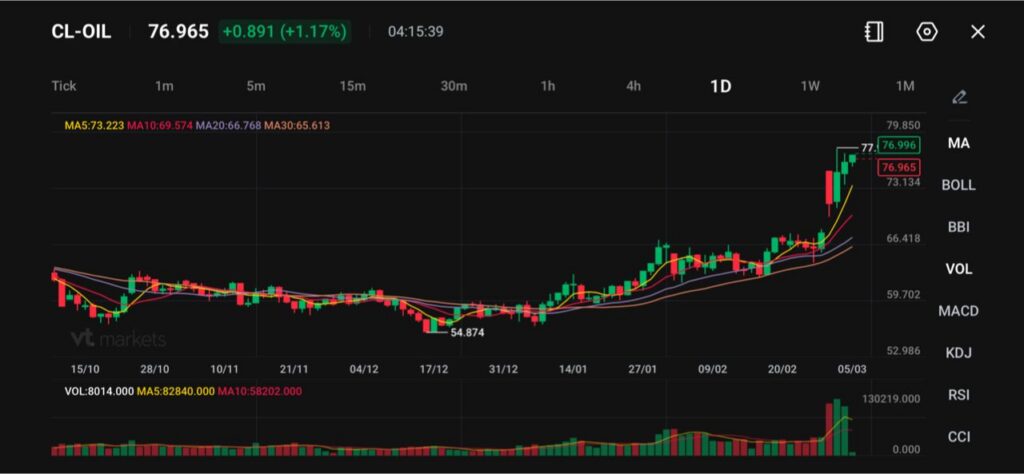
WTI crude oil (CL-OIL) is trading near $76.97, up around 1.17%, extending the strong upward momentum that has been building since the December low near $54.87. The daily chart shows a clear bullish trend, with price continuing to print higher highs and higher lows while accelerating into the upper range of the recent rally.
From a technical perspective, price is trading well above its key moving averages. The 5-day moving average (73.22) and 10-day (69.57) are rising sharply, while the 20-day (66.77) and 30-day (65.61) remain significantly below the current price level.
This widening spread between price and the longer-term averages reflects strong bullish momentum following the breakout above the $70 area.
Immediate resistance is seen around $77.50–$78.00, where the latest rally is approaching a short-term ceiling. A sustained break above this zone could open the path toward $79.80–$80.00, a key psychological and technical level.
On the downside, initial support is located near $73.00–$74.00, followed by stronger structural support around $70.00, where the short-term moving averages are clustered.
Overall, the trend remains constructive while prices hold above the $73–$74 region, though the sharp upward move may invite periods of consolidation before the next directional push.
Learn more about trading Energies on VT Markets here.
Frequently Asked Questions (FAQs)
Why Did Oil Prices Rise Today? Oil rose because traders priced in supply risk from the U.S.–Iran war and the shipping slowdown through the Strait of Hormuz. Brent moved up $1.67, or 2.05%, to $83.07 per barrel, while WTI rose $1.94, or 2.60%, to $76.60. When a key export corridor slows, markets often pay more for near term supply.
How Important is the Strait of Hormuz to Global Energy Supply? The Strait of Hormuz matters because it acts as a core pipeline for energy trade. It serves as a key conduit for nearly a fifth of global energy consumption. If shipping “nearly halts” for multiple days, buyers may face delays, and prices can rise fast as refiners compete for cargoes.
What Does It Mean That Shipping Has Nearly Halted for the Fifth Day? It means fewer tankers can move oil and fuel out of the Gulf on schedule. J.P. Morgan estimates about 329 oil vessels are stuck in the Gulf, which suggests a growing queue of delayed shipments. If this lasts, spot prices and freight costs can rise, and volatility often increases.
How Do Iraq’s Output Cuts Affect Oil Prices? Iraq cutting output reduces available supply in a market already dealing with logistics risk. Officials said Iraq cut output by nearly 1.5 million barrels a day due to limited storage and export routes. Less supply can tighten prompt crude balances and keep prices supported if demand stays steady.
What Does Qatar Declaring Force Majeure Mean for Energy Markets? Force majeure means Qatar says it cannot meet some contract obligations due to circumstances outside its control. Qatar, the biggest LNG producer in the Gulf, declared force majeure on gas exports, and sources said normal production volumes may take at least a month to return. That can tighten LNG supply and sometimes lifts crude sentiment too, since fuel markets are linked.
Start trading now – Click here to create your real VT Markets account