
Back

USD/CAD climbs near 1.3700 as ongoing safe-haven demand lifts the US Dollar bid overall

USD/CAD rose towards 1.3695 in early European trade as demand for the US Dollar increased. The pair has trended lower since January highs near 1.3930, and Tuesday’s session showed indecision around 1.3660. Oil prices jumped after Iran’s Revolutionary Guard said the Strait of Hormuz was closed, stopping tanker traffic through a route that carries about 20% of global oil consumption. WTI gained more than 2.35% on Wednesday and Brent traded near $79 per barrel, supporting the oil-linked Canadian Dollar.

Canada Data And Central Bank Outlook

Canada’s Q4 GDP contracted by 0.6%, the weakest result since 2020, though February’s manufacturing PMI rose to a 13-month high of 51. The Bank of Canada held its policy rate at 2.25% in January after nine cuts since June 2024, down from 5%, with the next decision due on 18 March. On the daily chart, USD/CAD traded near 1.3661, below the 50-day EMA around 1.3700 and the 200-day EMA near 1.3800. Resistance sits near 1.3715 and 1.3790–1.3800, while support lies at 1.3640, 1.3558, and 1.3490. On the weekly chart, resistance is at 1.3730, 1.3915, and 1.4000, with support at 1.3615, 1.3550, and 1.3450. The 200-week EMA is near 1.3600. The current situation presents a classic tug-of-war for the Canadian Dollar, making clear directional bets risky in the coming weeks. We see strong safe-haven demand for the US Dollar, supported by robust economic data like the recent US Services PMI which came in at a healthy 53.1 for February. However, the closure of the Strait of Hormuz is propping up oil prices, directly benefiting the Loonie.

Options Strategies Into The March Decision

Given these conflicting signals, we should consider strategies that profit from a significant price move, regardless of direction. Buying option straddles or strangles centered around the current 1.3700 level could be effective ahead of the Bank of Canada’s decision on March 18. Implied volatility for USD/CAD options is likely to rise as we approach that date. We must remember the underlying weakness in Canada’s economy, as shown by the 0.6% GDP contraction we saw in the final quarter of 2025. This followed a period in 2024 where the economy barely grew, with GDP for that entire year coming in at just 1.1%. The Bank of Canada’s aggressive rate cuts from 5% down to 2.25% throughout late 2024 and 2025 highlight these deep-seated concerns. From a technical standpoint, the pair is coiled tightly, with significant selling interest near the 50-day moving average around 1.3715. Any trades should use the key support at 1.3640 and that resistance as guideposts for setting strike prices on options. A decisive break of either level could trigger a more sustained move. Alternatively, if we believe geopolitical tensions will ease and the Bank of Canada will hold steady as expected, the pair could remain range-bound. This is supported by historical periods of volatility compression that we observed following major oil shocks back in the spring of 2025. Selling an iron condor with strikes safely above 1.3800 and below 1.3550 could be a viable strategy to collect premium from this market indecision. Create your live VT Markets account and start trading now.

Start trading now – Click here to create your real VT Markets account
In February, Japan’s Consumer Confidence Index reached 40, exceeding forecasts of 38.2 by analysts

Japan’s Consumer Confidence Index was 40 in February. This was above the forecast of 38.2. The index number indicates how households view current conditions and future expectations. No additional figures or breakdowns were provided.

Consumer Confidence Signals Firmer Domestic Demand

This stronger-than-expected consumer confidence reading suggests Japanese households are feeling more secure, likely leading to increased spending. This gives the Bank of Japan more justification to continue normalizing monetary policy. We should anticipate growing speculation about another interest rate hike in the coming months. Therefore, we should consider strategies that benefit from a strengthening yen. This data reinforces the trend we saw after the Bank of Japan finally abandoned its negative interest rate policy in the spring of 2025. With core inflation holding at 2.3% in January, well above the 2% target, the pressure on the central bank is mounting. For equity traders, this is a mixed signal for the Nikkei 225. While strong consumer spending is positive for corporate earnings, the threat of higher borrowing costs could cap the market’s rally which has seen a 12% gain since last autumn. Options strategies that protect against downside risk, such as buying puts or implementing collars on Nikkei futures, now appear more prudent. This outlook strengthens the case for being short Japanese Government Bonds (JGBs). The yield on the 10-year JGB has already risen to 0.95% in the last month, its highest level in over a decade. This confidence data will likely push yields higher as the market prices in a more hawkish central bank.

Positioning Implications Across Yen Rates And Equities

Create your live VT Markets account and start trading now.

Start trading now – Click here to create your real VT Markets account

FXStreet data shows gold prices increased in the United Arab Emirates, with the precious metal climbing overall today

Gold prices rose in the United Arab Emirates on Wednesday, based on FXStreet data. Gold was priced at AED 609.18 per gram, up from AED 601.85 on Tuesday. The price per tola increased to AED 7,105.33 from AED 7,019.88 a day earlier. Other listed rates were AED 6,091.77 for 10 grams and AED 18,947.64 per troy ounce.

Uae Gold Pricing Methodology

FXStreet converts international gold prices into UAE dirhams using the USD/AED rate and local measurement units. Prices are updated daily at the time of publication and are for reference, as local rates may differ. Central banks are the largest holders of gold. They added 1,136 tonnes worth about $70 billion in 2022, according to the World Gold Council, the highest annual total since records began. Gold prices can move with the US Dollar, interest rates, and market risk conditions. It often moves inversely to the US Dollar and US Treasuries, and can also move opposite to stocks. The recent upward move in gold, now trading around $5,150 per ounce, reflects growing market uncertainty. We are seeing traders position for the upcoming Federal Reserve meeting on March 18th amid conflicting economic data. This price action suggests a flight to safety is underway.

Market Drivers And Trading Implications

Last month’s higher-than-expected CPI print of 3.5% has challenged the market consensus that was pricing in stable rates for the rest of the year. This is happening as central banks continue to be major buyers, a trend we saw when they added over 1,037 tonnes to their reserves in 2024. That persistent demand has established a solid price floor for the metal. Given this, we see value in buying near-term call options to capture further upside potential driven by these safe-haven flows. Implied volatility has risen, with the CBOE Gold Volatility Index (GVZ) climbing to 19.5, its highest point since the market jitters of late 2025. This indicates that the market is expecting a significant price move. For traders who find outright options too expensive, bull call spreads offer a more capital-efficient way to express a moderately bullish view. This strategy would benefit from a continued steady rise in gold prices without needing a major breakout to be profitable. It is a prudent way to participate in the upward trend while capping potential risk. We should also monitor the inverse relationship with the US Dollar, which has been trading in a tight range. A break below the 103.50 level on the DXY index would likely act as a strong catalyst, pushing gold prices even higher. This dollar weakness would make gold cheaper for holders of other currencies, further boosting demand. Create your live VT Markets account and start trading now.

Start trading now – Click here to create your real VT Markets account

Amid Middle East tensions, safe-haven demand strengthens the Swiss franc, pushing USD/CHF down towards 0.7800

USD/CHF fell to about 0.7805 in early European trading on Wednesday, with the Swiss Franc gaining on safe-haven demand linked to Middle East tensions. The pair was near 0.7800. US and Israeli attacks continued in Iran and Lebanon, including strikes on a hotel near Beirut and the Assembly of Experts building in Qom. Iran reported retaliatory attacks on Israel and US targets, including strikes on the US embassy in Dubai and a port in Fujairah in the United Arab Emirates. The Swiss National Bank said on Monday it would act against what it called “rapid and excessive” Swiss Franc appreciation, citing risks to price stability in Switzerland. It said it was prepared to intervene in the foreign exchange market. Swiss Consumer Price Index data and the US February ISM Services Purchasing Managers Index are due later on Wednesday. A stronger-than-expected US services reading could support expectations of higher US interest rates for longer. The Swiss Franc is among the top ten most traded currencies, and it was pegged to the Euro between 2011 and 2015. After the peg ended, the Franc rose by more than 20%. The SNB meets four times a year and targets annual inflation of less than 2%. CHF often tracks the Euro closely, with models suggesting a correlation of more than 90%. We are looking at a very different picture than what we saw in early 2025. The intense safe-haven demand that pushed USD/CHF down near 0.7800 has eased for now. The pair is currently trading in a tighter range around 0.8250 as the market digests conflicting signals. The geopolitical risk premium has shrunk since a fragile ceasefire was brokered in the Middle East late last year. However, with tensions still simmering, any renewed conflict could trigger a rapid flight back into the Swiss franc. This underlying threat is keeping implied volatility elevated, making options strategies worth considering for hedging sudden downward moves. The Swiss National Bank (SNB) made good on its verbal warnings from 2025, cutting its policy rate to 1.25% in September of that year to curb the franc’s strength. With the latest Swiss inflation data for February 2026 coming in at a low 1.1%, the SNB has very little reason to reverse course. This dovish stance should act as a ceiling for the franc and provide a floor for the USD/CHF pair in the coming weeks. On the other side of the pair, recent US economic data has been mixed, creating uncertainty for the dollar. While the latest Non-Farm Payrolls report showed a robust gain of 250,000 jobs, the ISM Services PMI dipped slightly to 52.8, suggesting some cooling. This indecisive data leaves the Federal Reserve’s next move unclear, contributing to the current lack of direction. Given these opposing forces, derivative traders might consider strategies that profit from range-bound price action and elevated volatility. Selling short-dated USD/CHF strangles, for instance, could be a viable play on the expectation that the pair remains contained between SNB-induced support and geopolitically-capped resistance. This capitalizes on time decay while defining risk around key technical levels. We also have to remember the franc’s historically high correlation with the Euro, which some models still place at over 90%. Any unexpected hawkish or dovish shifts from the European Central Bank in its upcoming meetings will inevitably spill over and impact the franc. Therefore, traders must watch ECB commentary just as closely as they watch the SNB and the Fed for potential catalysts that could break the current impasse.

Start trading now – Click here to create your real VT Markets account

Data show gold prices in Pakistan increased, with compiled figures indicating a rise for local bullion markets

Gold prices in Pakistan rose on Wednesday, based on FXStreet data. Gold reached PKR 46,348.26 per gram, up from PKR 45,819.34 on Tuesday. The price per tola increased to PKR 540,595.90 from PKR 534,427.80 a day earlier. Other quoted prices were PKR 463,521.70 for 10 grams and PKR 1,441,592.00 per troy ounce.

How Local Gold Prices Are Calculated

FXStreet derives local gold prices by converting international rates using USD/PKR and local measurement units. The figures are updated daily using market rates at the time of publication, and local prices may vary slightly. Central banks hold the most gold. They added 1,136 tonnes worth about $70 billion in 2022, the highest annual total since records began, with emerging economies such as China, India and Turkey increasing reserves. Gold often moves inversely to the US Dollar and US Treasuries, and can also move against risk assets. Prices can also react to geopolitical risks, recession fears, and changes in interest rates, as gold is priced in US dollars (XAU/USD). We are seeing gold’s strength reflected locally in Pakistan, where the price is hitting new highs in Rupee terms. This is less a local event and more a symptom of a weakening US Dollar and persistent global inflation concerns. The core driver is the market shifting its view on central bank policy.

Strategy Implications For Investors

After the Federal Reserve held interest rates above 5% through all of 2025, the market is now pricing in at least two rate cuts before the end of this year. This expectation makes holding a non-yielding asset like gold much more attractive compared to government bonds. This fundamental shift is the primary reason we should maintain a bullish outlook for the coming weeks. Given this outlook, we should consider buying call options on gold futures or major gold ETFs, targeting strike prices 5-7% above the current market. For a more cost-effective strategy, bull call spreads will limit the upfront premium paid. This is a prudent move as implied volatility has ticked up following last week’s softer-than-expected jobs report. We also note that central bank buying continued its aggressive pace last year, with the World Gold Council confirming that global reserves increased by over 950 tonnes in 2025. This heavy, consistent demand from official sources provides a strong underlying floor for the price, absorbing dips. Emerging market central banks, in particular, continue to diversify away from the dollar. Ongoing geopolitical tensions and trade frictions are also keeping the safe-haven bid alive for gold. Any escalation in rhetoric between major economic blocs will likely send investors toward tangible assets. This suggests that even if the rate-cut narrative weakens temporarily, the downside risk for gold is likely limited. The inverse correlation with the US Dollar is playing out perfectly, as the DXY index has fallen nearly 3% from its peak last month. For traders viewing the price in currencies like the Pakistani Rupee, this effect is amplified as local currency depreciation against the dollar adds to gold’s gains. We expect this dual tailwind to continue for the foreseeable future. Create your live VT Markets account and start trading now.

Start trading now – Click here to create your real VT Markets account

Elliott Wave analysis suggests SPX completed wave one, corrected in wave two, then began three-wave recovery target

Short-term Elliott Wave analysis says the rally to 7002.28 on 28 January 2026 completed wave 1. A corrective wave 2 then ended at about 6712 after the move from the 21 November 2025 low. From the wave 1 peak, wave ((w)) fell to 6780.13, then wave ((x)) rose to 6993.48. Wave ((y)) then dropped to 6712.08, forming a double three correction.

Support Zone And Fibonacci Alignment

The 6712.08 low lines up with a 100%–161.8% Fibonacci extension of wave ((w)), with the measured range given as 6629–6768. This area is treated as a support zone in the analysis. After the pullback, the Index turned higher in wave 3. A break above 7002.28 is required to confirm the wider correction has ended, otherwise a broader corrective pattern may still be in place. The analysis notes the cycle from the April 2025 low is mature and could end at any time. In the near term, the outlook stays positive while the 6712.08 pivot holds. Based on the recent price action, we see that the S&P 500 has likely completed its corrective wave down to 6712. This level acted as significant support, and the market is now poised for a potential third wave higher. This suggests a shift from a defensive to a cautiously bullish stance in the coming weeks.

Trade Implementation And Risk Controls

To capitalize on this expected upside, we should consider buying near-the-money call options or implementing bull call spreads. The initial objective is a move back toward, and ultimately above, the January 28 high of 7002.28. This strategy allows us to participate in the rally while clearly defining our maximum risk, which is prudent given the market’s maturity. This technical outlook is supported by recent economic data that has calmed market fears. The February jobs report showed a healthy, but not overly inflationary, addition of 195,000 jobs. Furthermore, the latest CPI data printed at 2.8%, continuing the trend of disinflation and giving the Federal Reserve room to remain patient. Looking at market expectations, futures are pricing in a greater than 90% chance that the Fed will hold interest rates steady at its meeting later this month. This stability follows a better-than-feared Q4 2025 earnings season, where over 75% of companies beat their profit estimates. These fundamental factors provide a tailwind for the technically-driven rally we anticipate. Strict risk management is essential, and the key level for our bullish thesis is the pivot at 6712.08. A definitive break below this point would invalidate the immediate upward scenario and suggest the prior correction is deepening. Should this occur, we would quickly close bullish trades and could initiate positions using put options to hedge against further declines. The primary confirmation for a stronger, more sustained rally will be a decisive break above the 7002.28 peak. We can use this level as a trigger to add to long derivative positions with increased confidence. Until that breakout occurs, our positions should remain tactical and appropriately sized. Create your live VT Markets account and start trading now.

Start trading now – Click here to create your real VT Markets account

Compiled data indicates gold prices in India increased, with figures revealing a rise during midweek trading

Gold prices rose in India on Wednesday, based on FXStreet compiled data. The price per gram was INR 15,368.06, up from INR 15,165.92 on Tuesday. The price per tola increased to INR 179,237.70 from INR 176,891.30 a day earlier. Other listed prices were INR 153,675.00 for 10 grams and INR 478,003.80 per troy ounce.

Gold Price Conversion Method

FXStreet converts international gold prices into Indian rupees using USD/INR and local measurement units. Prices are updated daily at the time of publication and are for reference, as local rates may vary. Central banks hold the most gold. In 2022, central banks added 1,136 tonnes of gold worth around $70 billion, the highest annual total since records began. Gold often moves in the opposite direction to the US Dollar and US Treasuries. It can also move against risk assets, and may react to geopolitical instability, recession fears, and changes in interest rates. The recent uptick in gold prices reflects more than just daily market noise. We see this as a direct response to a softening US Dollar, which has recently dipped below the 101 mark on the DXY index for the first time since last fall. This inverse relationship is a classic driver for the metal, making it cheaper in other currencies and boosting demand.

Outlook For Gold Derivatives

The expectation of lower interest rates is providing significant tailwinds for gold. After the US Federal Reserve signaled a more dovish stance late in 2025 amid slowing economic growth figures, the appeal of a non-yielding asset like gold has increased considerably. We remember how rate hikes through 2024 capped gold’s potential, and now we are seeing the opposite effect play out. We cannot ignore the persistent demand from central banks, which continues to put a floor under the price. Official data showed that central banks, particularly in emerging markets, added over 950 tonnes to their reserves during 2025, continuing the strong purchasing trend we saw in the record-breaking years of 2022 and 2023. This strategic buying underscores a global move to diversify away from the dollar and adds a layer of stability to the gold market. Market uncertainty is also playing a key role, making gold’s safe-haven status highly attractive right now. We’ve observed increased volatility in equity markets through the first quarter of this year, with the S&P 500 struggling to find direction after a flat performance in late 2025. This environment encourages a flight to safety, directly benefiting gold. For the coming weeks, we believe a bullish stance on gold derivatives is warranted. Traders could consider buying call options to capitalize on further upside potential while managing risk. Given the macroeconomic backdrop, paying a premium for options that protect against a sharp upward move seems like a prudent strategy. Create your live VT Markets account and start trading now.

Start trading now – Click here to create your real VT Markets account

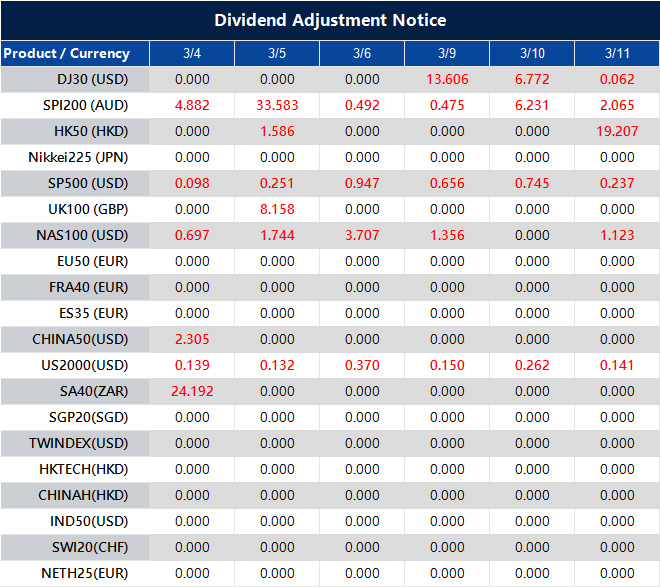
Dividend Adjustment Notice – Mar 04 ,2026

Dear Client,

Please note that the dividends of the following products will be adjusted accordingly. Index dividends will be executed separately through a balance statement directly to your trading account, and the comment will be in the following format “Div & Product Name & Net Volume”.

Please refer to the table below for more details:

Dividend Adjustment Notice

The above data is for reference only, please refer to the MT4/MT5 software for specific data.

If you’d like more information, please don’t hesitate to contact [email protected].

During Asian trading, NZD/USD slipped to 0.5875, pressured by mixed China PMIs and Middle East tensions

NZD/USD edged lower to about 0.5875 in Asian trading on Wednesday, with the New Zealand Dollar weaker against the US Dollar after mixed Chinese data. Markets are also watching the US February ISM Services PMI due later on Wednesday. China’s official Manufacturing PMI fell to 49.0 in February from 49.3 in January, below the 49.1 forecast. The NBS Non-Manufacturing PMI rose to 49.5 from 49.4, but missed the 49.8 estimate.

China Pmi Signals Mixed Momentum

China’s RatingDog Manufacturing PMI rose to 62.1 in February from 50.3 in January, above the 50.1 expected. The RatingDog Services PMI increased to 56.7 from 52.3, above forecasts. Rising tensions in the Middle East increased risk aversion, supporting the US Dollar and weighing on NZD/USD. The US and Israel targeted Iran’s leadership and nuclear infrastructure over the weekend, and President Donald Trump said on Monday combat operations would continue until US objectives are met. The NZD is often influenced by New Zealand economic conditions and Reserve Bank of New Zealand policy, which targets inflation between 1% and 3% with a 2% mid-point. Changes in Chinese growth, a key export market, plus dairy prices can also affect the currency, along with shifts in global risk sentiment. Looking back to early 2025, we saw the NZD/USD pair facing pressure around 0.5875 due to concerns over mixed Chinese economic data and geopolitical tensions. Those themes of a weak Chinese economy and a strong US dollar have largely defined the market over the past year. This established a bearish trend that traders have been watching closely ever since.

Outlook And Key Drivers In 2026

The weakness in China’s economy, which was a concern then, has persisted into 2026. The latest official NBS Manufacturing PMI for February 2026 came in at 49.1, marking the fifth consecutive month of contraction and signaling sluggish demand from New Zealand’s primary trading partner. This continued economic drag directly limits the upside potential for the New Zealand Dollar. Adding to the pressure on the Kiwi is the divergence in central bank policy that has become more pronounced since last year. While the Reserve Bank of New Zealand is now signaling a potential rate cut later this year as inflation cooled to 3.8% in the final quarter of 2025, the US Federal Reserve remains committed to holding rates firm. This interest rate differential heavily favors the US Dollar and suggests a path of least resistance to the downside for the NZD/USD. The dairy sector, a crucial component of New Zealand’s exports, has also failed to provide support. The most recent Global Dairy Trade auction in late February 2026 saw prices fall by 2.3%, reinforcing a trend of price weakness that has been evident for several months. This decline in a key source of national income further justifies a bearish outlook on the currency. Given these fundamental headwinds, we believe traders should consider strategies that profit from further declines in the NZD/USD. Buying put options with strike prices below the current spot rate provides a way to capitalize on potential downside over the next several weeks. This approach has a defined risk, limited to the premium paid for the option. Alternatively, for those expecting the pair to trade sideways or drift lower, selling out-of-the-money call options is a strategy to consider for generating income from premiums. This takes the view that any significant rally in the Kiwi is unlikely given the current economic backdrop. This should be approached with caution as it carries higher risk if the market moves unexpectedly upward. Create your live VT Markets account and start trading now.

Start trading now – Click here to create your real VT Markets account

Despite higher oil prices, USD/CAD rebounds towards 1.3700 as Canadian Dollar buyers hesitate during Asian trade

USD/CAD regained ground in Asian trading on Wednesday, moving back towards 1.3700 after a late pullback from its highest level since 23 January. The pair has still stayed within a range that has held for about two weeks. The US dollar stayed firm due to safe-haven demand linked to rising tensions in the Middle East. Traders also reduced expectations of three US Federal Reserve rate cuts because of concerns about persistent inflation.

Usd Cad Holds Range Near Key Level

The US Dollar Index (DXY) held a bullish tone just below its highest level in over three months. This supported demand for USD/CAD. Iran’s Islamic Revolutionary Guard Corps said the Strait of Hormuz was closed to shipping and warned that any vessel trying to pass would be set on fire. The strait is a key oil transit route, and the move raised supply concerns. Oil prices remained within reach of their highest level since June 2025, which supported the Canadian dollar. This limited the scope for further USD/CAD gains. Markets are watching the US ADP private-sector employment report and the ISM Services PMI. Reaction may be limited as attention remains on geopolitical developments.

Key Catalysts Could Break The Deadlock

We are seeing a classic standoff in the USD/CAD, with the pair struggling to break decisively from the 1.3700 level. The strong US Dollar is being directly challenged by elevated oil prices stemming from the escalating Middle East tensions. This creates a difficult environment for directional bets as the two opposing forces are keeping the pair tightly range-bound. The case for a stronger US Dollar is supported by hard data, as the latest Core PCE Price Index is holding stubbornly above 3%, keeping inflation fears alive. As a result, market odds for a Federal Reserve rate cut before July have now dropped below 40%, a significant shift from the sentiment we saw at the start of the year. This fundamental backdrop continues to provide a strong floor for the greenback against most currencies. On the other side, the closure of the Strait of Hormuz has pushed WTI crude to hold firm above $95 a barrel, its highest level since the spike in mid-2025. This provides significant support for the commodity-linked Canadian dollar and explains why every attempt for USD/CAD to rally has been quickly sold off. Until the global oil supply situation is clarified, it is difficult to see the Loonie weakening substantially. From our perspective, this reminds us of the market volatility seen back in 2022 when geopolitical events first caused a major energy price shock. Back then, the US Dollar also benefited from safe-haven flows, creating a similar tug-of-war for the USD/CAD pair. History suggests these situations can persist for weeks, defined by sharp moves within a broader range. For derivative traders, this suggests that long volatility strategies could be profitable in the coming weeks. Buying straddles or strangles allows us to profit from a large price move in either direction, which seems more likely than a sustained trend. One-month implied volatility for the pair has already climbed to 8.5%, reflecting this market uncertainty. Looking ahead, the upcoming US Non-Farm Payrolls report and the next CPI inflation reading will be critical for the US Dollar. Similarly, the Bank of Canada’s upcoming policy statement will be closely watched for any change in tone due to higher energy prices. These events will likely be the catalysts that finally break the current deadlock. Create your live VT Markets account and start trading now.

Start trading now – Click here to create your real VT Markets account

Back To Top
server

Hello there 👋

How can I help you?

Chat with our team instantly

Live Chat

Start a live conversation through...

  • Telegram
    hold On hold
  • Coming Soon...

Hello there 👋

How can I help you?

telegram

Scan the QR code with your smartphone to start a chat with us, or click here.

Don’t have the Telegram App or Desktop installed? Use Web Telegram instead.

QR code

