Gold prices in Pakistan rose on Wednesday, based on FXStreet data. Gold reached PKR 46,348.26 per gram, up from PKR 45,819.34 on Tuesday.
The price per tola increased to PKR 540,595.90 from PKR 534,427.80 a day earlier. Other quoted prices were PKR 463,521.70 for 10 grams and PKR 1,441,592.00 per troy ounce.
How Local Gold Prices Are Calculated
FXStreet derives local gold prices by converting international rates using USD/PKR and local measurement units. The figures are updated daily using market rates at the time of publication, and local prices may vary slightly.
Central banks hold the most gold. They added 1,136 tonnes worth about $70 billion in 2022, the highest annual total since records began, with emerging economies such as China, India and Turkey increasing reserves.
Gold often moves inversely to the US Dollar and US Treasuries, and can also move against risk assets. Prices can also react to geopolitical risks, recession fears, and changes in interest rates, as gold is priced in US dollars (XAU/USD).
We are seeing gold’s strength reflected locally in Pakistan, where the price is hitting new highs in Rupee terms. This is less a local event and more a symptom of a weakening US Dollar and persistent global inflation concerns. The core driver is the market shifting its view on central bank policy.
Strategy Implications For Investors
After the Federal Reserve held interest rates above 5% through all of 2025, the market is now pricing in at least two rate cuts before the end of this year. This expectation makes holding a non-yielding asset like gold much more attractive compared to government bonds. This fundamental shift is the primary reason we should maintain a bullish outlook for the coming weeks.
Given this outlook, we should consider buying call options on gold futures or major gold ETFs, targeting strike prices 5-7% above the current market. For a more cost-effective strategy, bull call spreads will limit the upfront premium paid. This is a prudent move as implied volatility has ticked up following last week’s softer-than-expected jobs report.
We also note that central bank buying continued its aggressive pace last year, with the World Gold Council confirming that global reserves increased by over 950 tonnes in 2025. This heavy, consistent demand from official sources provides a strong underlying floor for the price, absorbing dips. Emerging market central banks, in particular, continue to diversify away from the dollar.
Ongoing geopolitical tensions and trade frictions are also keeping the safe-haven bid alive for gold. Any escalation in rhetoric between major economic blocs will likely send investors toward tangible assets. This suggests that even if the rate-cut narrative weakens temporarily, the downside risk for gold is likely limited.
The inverse correlation with the US Dollar is playing out perfectly, as the DXY index has fallen nearly 3% from its peak last month. For traders viewing the price in currencies like the Pakistani Rupee, this effect is amplified as local currency depreciation against the dollar adds to gold’s gains. We expect this dual tailwind to continue for the foreseeable future.
Create your live VT Markets account and start trading now.
Start trading now – Click here to create your real VT Markets account
Short-term Elliott Wave analysis says the rally to 7002.28 on 28 January 2026 completed wave 1. A corrective wave 2 then ended at about 6712 after the move from the 21 November 2025 low.
From the wave 1 peak, wave ((w)) fell to 6780.13, then wave ((x)) rose to 6993.48. Wave ((y)) then dropped to 6712.08, forming a double three correction.
Support Zone And Fibonacci Alignment
The 6712.08 low lines up with a 100%–161.8% Fibonacci extension of wave ((w)), with the measured range given as 6629–6768. This area is treated as a support zone in the analysis.
After the pullback, the Index turned higher in wave 3. A break above 7002.28 is required to confirm the wider correction has ended, otherwise a broader corrective pattern may still be in place.
The analysis notes the cycle from the April 2025 low is mature and could end at any time. In the near term, the outlook stays positive while the 6712.08 pivot holds.
Based on the recent price action, we see that the S&P 500 has likely completed its corrective wave down to 6712. This level acted as significant support, and the market is now poised for a potential third wave higher. This suggests a shift from a defensive to a cautiously bullish stance in the coming weeks.
Trade Implementation And Risk Controls
To capitalize on this expected upside, we should consider buying near-the-money call options or implementing bull call spreads. The initial objective is a move back toward, and ultimately above, the January 28 high of 7002.28. This strategy allows us to participate in the rally while clearly defining our maximum risk, which is prudent given the market’s maturity.
This technical outlook is supported by recent economic data that has calmed market fears. The February jobs report showed a healthy, but not overly inflationary, addition of 195,000 jobs. Furthermore, the latest CPI data printed at 2.8%, continuing the trend of disinflation and giving the Federal Reserve room to remain patient.
Looking at market expectations, futures are pricing in a greater than 90% chance that the Fed will hold interest rates steady at its meeting later this month. This stability follows a better-than-feared Q4 2025 earnings season, where over 75% of companies beat their profit estimates. These fundamental factors provide a tailwind for the technically-driven rally we anticipate.
Strict risk management is essential, and the key level for our bullish thesis is the pivot at 6712.08. A definitive break below this point would invalidate the immediate upward scenario and suggest the prior correction is deepening. Should this occur, we would quickly close bullish trades and could initiate positions using put options to hedge against further declines.
The primary confirmation for a stronger, more sustained rally will be a decisive break above the 7002.28 peak. We can use this level as a trigger to add to long derivative positions with increased confidence. Until that breakout occurs, our positions should remain tactical and appropriately sized.
Create your live VT Markets account and start trading now.
Start trading now – Click here to create your real VT Markets account
Gold prices rose in India on Wednesday, based on FXStreet compiled data. The price per gram was INR 15,368.06, up from INR 15,165.92 on Tuesday.
The price per tola increased to INR 179,237.70 from INR 176,891.30 a day earlier. Other listed prices were INR 153,675.00 for 10 grams and INR 478,003.80 per troy ounce.
Gold Price Conversion Method
FXStreet converts international gold prices into Indian rupees using USD/INR and local measurement units. Prices are updated daily at the time of publication and are for reference, as local rates may vary.
Central banks hold the most gold. In 2022, central banks added 1,136 tonnes of gold worth around $70 billion, the highest annual total since records began.
Gold often moves in the opposite direction to the US Dollar and US Treasuries. It can also move against risk assets, and may react to geopolitical instability, recession fears, and changes in interest rates.
The recent uptick in gold prices reflects more than just daily market noise. We see this as a direct response to a softening US Dollar, which has recently dipped below the 101 mark on the DXY index for the first time since last fall. This inverse relationship is a classic driver for the metal, making it cheaper in other currencies and boosting demand.
Outlook For Gold Derivatives
The expectation of lower interest rates is providing significant tailwinds for gold. After the US Federal Reserve signaled a more dovish stance late in 2025 amid slowing economic growth figures, the appeal of a non-yielding asset like gold has increased considerably. We remember how rate hikes through 2024 capped gold’s potential, and now we are seeing the opposite effect play out.
We cannot ignore the persistent demand from central banks, which continues to put a floor under the price. Official data showed that central banks, particularly in emerging markets, added over 950 tonnes to their reserves during 2025, continuing the strong purchasing trend we saw in the record-breaking years of 2022 and 2023. This strategic buying underscores a global move to diversify away from the dollar and adds a layer of stability to the gold market.
Market uncertainty is also playing a key role, making gold’s safe-haven status highly attractive right now. We’ve observed increased volatility in equity markets through the first quarter of this year, with the S&P 500 struggling to find direction after a flat performance in late 2025. This environment encourages a flight to safety, directly benefiting gold.
For the coming weeks, we believe a bullish stance on gold derivatives is warranted. Traders could consider buying call options to capitalize on further upside potential while managing risk. Given the macroeconomic backdrop, paying a premium for options that protect against a sharp upward move seems like a prudent strategy.
Create your live VT Markets account and start trading now.
Start trading now – Click here to create your real VT Markets account
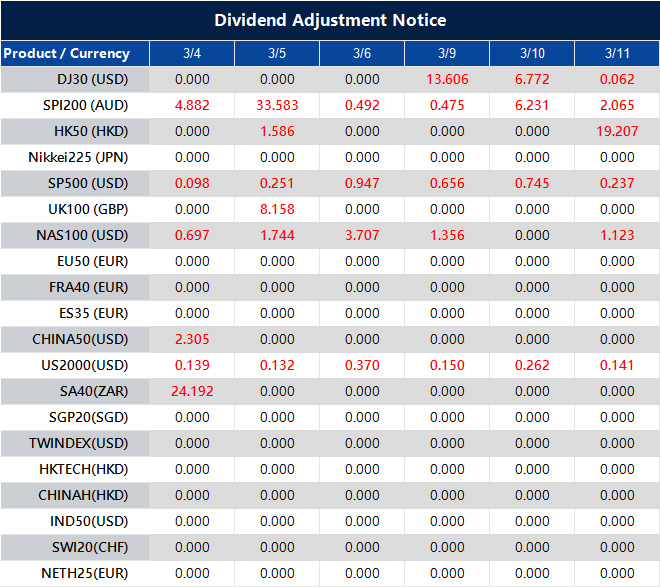
Please note that the dividends of the following products will be adjusted accordingly. Index dividends will be executed separately through a balance statement directly to your trading account, and the comment will be in the following format “Div & Product Name & Net Volume”.
Please refer to the table below for more details:
The above data is for reference only, please refer to the MT4/MT5 software for specific data.
If you’d like more information, please don’t hesitate to contact [email protected].
NZD/USD edged lower to about 0.5875 in Asian trading on Wednesday, with the New Zealand Dollar weaker against the US Dollar after mixed Chinese data. Markets are also watching the US February ISM Services PMI due later on Wednesday.
China’s official Manufacturing PMI fell to 49.0 in February from 49.3 in January, below the 49.1 forecast. The NBS Non-Manufacturing PMI rose to 49.5 from 49.4, but missed the 49.8 estimate.
China Pmi Signals Mixed Momentum
China’s RatingDog Manufacturing PMI rose to 62.1 in February from 50.3 in January, above the 50.1 expected. The RatingDog Services PMI increased to 56.7 from 52.3, above forecasts.
Rising tensions in the Middle East increased risk aversion, supporting the US Dollar and weighing on NZD/USD. The US and Israel targeted Iran’s leadership and nuclear infrastructure over the weekend, and President Donald Trump said on Monday combat operations would continue until US objectives are met.
The NZD is often influenced by New Zealand economic conditions and Reserve Bank of New Zealand policy, which targets inflation between 1% and 3% with a 2% mid-point. Changes in Chinese growth, a key export market, plus dairy prices can also affect the currency, along with shifts in global risk sentiment.
Looking back to early 2025, we saw the NZD/USD pair facing pressure around 0.5875 due to concerns over mixed Chinese economic data and geopolitical tensions. Those themes of a weak Chinese economy and a strong US dollar have largely defined the market over the past year. This established a bearish trend that traders have been watching closely ever since.
Outlook And Key Drivers In 2026
The weakness in China’s economy, which was a concern then, has persisted into 2026. The latest official NBS Manufacturing PMI for February 2026 came in at 49.1, marking the fifth consecutive month of contraction and signaling sluggish demand from New Zealand’s primary trading partner. This continued economic drag directly limits the upside potential for the New Zealand Dollar.
Adding to the pressure on the Kiwi is the divergence in central bank policy that has become more pronounced since last year. While the Reserve Bank of New Zealand is now signaling a potential rate cut later this year as inflation cooled to 3.8% in the final quarter of 2025, the US Federal Reserve remains committed to holding rates firm. This interest rate differential heavily favors the US Dollar and suggests a path of least resistance to the downside for the NZD/USD.
The dairy sector, a crucial component of New Zealand’s exports, has also failed to provide support. The most recent Global Dairy Trade auction in late February 2026 saw prices fall by 2.3%, reinforcing a trend of price weakness that has been evident for several months. This decline in a key source of national income further justifies a bearish outlook on the currency.
Given these fundamental headwinds, we believe traders should consider strategies that profit from further declines in the NZD/USD. Buying put options with strike prices below the current spot rate provides a way to capitalize on potential downside over the next several weeks. This approach has a defined risk, limited to the premium paid for the option.
Alternatively, for those expecting the pair to trade sideways or drift lower, selling out-of-the-money call options is a strategy to consider for generating income from premiums. This takes the view that any significant rally in the Kiwi is unlikely given the current economic backdrop. This should be approached with caution as it carries higher risk if the market moves unexpectedly upward.
Create your live VT Markets account and start trading now.
Start trading now – Click here to create your real VT Markets account
USD/CAD regained ground in Asian trading on Wednesday, moving back towards 1.3700 after a late pullback from its highest level since 23 January. The pair has still stayed within a range that has held for about two weeks.
The US dollar stayed firm due to safe-haven demand linked to rising tensions in the Middle East. Traders also reduced expectations of three US Federal Reserve rate cuts because of concerns about persistent inflation.
Usd Cad Holds Range Near Key Level
The US Dollar Index (DXY) held a bullish tone just below its highest level in over three months. This supported demand for USD/CAD.
Iran’s Islamic Revolutionary Guard Corps said the Strait of Hormuz was closed to shipping and warned that any vessel trying to pass would be set on fire. The strait is a key oil transit route, and the move raised supply concerns.
Oil prices remained within reach of their highest level since June 2025, which supported the Canadian dollar. This limited the scope for further USD/CAD gains.
Markets are watching the US ADP private-sector employment report and the ISM Services PMI. Reaction may be limited as attention remains on geopolitical developments.
Key Catalysts Could Break The Deadlock
We are seeing a classic standoff in the USD/CAD, with the pair struggling to break decisively from the 1.3700 level. The strong US Dollar is being directly challenged by elevated oil prices stemming from the escalating Middle East tensions. This creates a difficult environment for directional bets as the two opposing forces are keeping the pair tightly range-bound.
The case for a stronger US Dollar is supported by hard data, as the latest Core PCE Price Index is holding stubbornly above 3%, keeping inflation fears alive. As a result, market odds for a Federal Reserve rate cut before July have now dropped below 40%, a significant shift from the sentiment we saw at the start of the year. This fundamental backdrop continues to provide a strong floor for the greenback against most currencies.
On the other side, the closure of the Strait of Hormuz has pushed WTI crude to hold firm above $95 a barrel, its highest level since the spike in mid-2025. This provides significant support for the commodity-linked Canadian dollar and explains why every attempt for USD/CAD to rally has been quickly sold off. Until the global oil supply situation is clarified, it is difficult to see the Loonie weakening substantially.
From our perspective, this reminds us of the market volatility seen back in 2022 when geopolitical events first caused a major energy price shock. Back then, the US Dollar also benefited from safe-haven flows, creating a similar tug-of-war for the USD/CAD pair. History suggests these situations can persist for weeks, defined by sharp moves within a broader range.
For derivative traders, this suggests that long volatility strategies could be profitable in the coming weeks. Buying straddles or strangles allows us to profit from a large price move in either direction, which seems more likely than a sustained trend. One-month implied volatility for the pair has already climbed to 8.5%, reflecting this market uncertainty.
Looking ahead, the upcoming US Non-Farm Payrolls report and the next CPI inflation reading will be critical for the US Dollar. Similarly, the Bank of Canada’s upcoming policy statement will be closely watched for any change in tone due to higher energy prices. These events will likely be the catalysts that finally break the current deadlock.
Create your live VT Markets account and start trading now.
Start trading now – Click here to create your real VT Markets account
China’s RatingDog Manufacturing Purchasing Managers’ Index (PMI) rose to 62.1 in February from 50.3 in January, according to data released on Monday. The result was above the expected 50.1.
The Services PMI increased to 56.7 in February from 52.3 previously. The market forecast was 52.3.
Market Reaction And Currency Snapshot
At the time of writing, AUD/USD was trading near 0.7004, down 0.52% on the day.
Looking back at the February 2025 data, we saw an exceptionally strong economic signal from China. The manufacturing reading of 62.1 was not just expansionary; it was the highest figure we had seen since before the 2022 economic slowdowns. This suggests the recovery is far more robust than initial forecasts predicted.
The immediate drop in the AUD/USD, despite being a traditional proxy for Chinese economic health, should be viewed with caution. This move was likely driven by broader strength in the US dollar, with the DXY index firming above 104 on the back of separate inflation data. We believe this created a disconnect where the currency’s move did not reflect the positive underlying fundamentals for Australian exports.
Given this, we see opportunities in positioning for a surge in commodity demand over the next several weeks. Call options on industrial metals, particularly copper futures, look attractive as manufacturing ramps up. With copper prices recently stabilizing around $8,600 per metric ton, the foundation for a significant move higher is in place based on this new demand signal.
Equities And Volatility Positioning
This strength should also translate to Chinese and regional equities, which have been lagging. We can use derivatives to gain exposure to a potential rally in indices like the Hang Seng. Historically, we saw a similar setup in late 2022 when the Hang Seng rallied over 40% in three months on reopening optimism, and this PMI data is a much more concrete signal of activity.
The sharp divergence between the economic data and the initial currency reaction suggests an increase in market uncertainty. This makes buying volatility a prudent short-term strategy through options on currency pairs like AUD/JPY, which is highly sensitive to shifts in risk sentiment. An increase in volatility is likely as the market digests whether this strong data is a one-off event or the start of a sustained trend.
Create your live VT Markets account and start trading now.
Start trading now – Click here to create your real VT Markets account
China’s Ratingdog Manufacturing PMI rose to 62.1 in February. The forecast was 50.1.
A PMI reading above 50 suggests expansion in manufacturing activity. The February result was 12.0 points above the forecast.
China Manufacturing Surge
The February manufacturing data is a massive shock to the system, blowing past all expectations. A reading of 62.1 indicates an explosive acceleration, not the modest growth we were positioned for. This forces a complete re-evaluation of China’s economic trajectory for the coming months.
We must immediately consider long positions on industrial commodities. This PMI number suggests a voracious appetite for raw materials, a trend confirmed by recent data showing iron ore inventories at Chinese ports falling for five consecutive weeks. Look at call options on copper futures and major miners like BHP, as their earnings are directly tied to this unexpected industrial boom.
This data should provide a significant tailwind for Chinese equities, which underperformed during the second half of 2025. We are looking at bullish strategies on the Hang Seng and CSI 300 indices through futures or options. ETFs like FXI and MCHI are direct ways to play this renewed confidence in the Chinese market.
The Australian dollar is now a primary focus for currency traders, given its role as a proxy for Chinese industrial health. We anticipate the AUD/USD pair, which struggled to maintain the 0.6500 level late last year, will break significant upside resistance. Consider long futures positions or call options on the Aussie dollar.
The scale of this surprise will spike implied volatility across related assets. We see an opportunity in buying front-month call options on Chinese large-cap stocks while the market digests the news. The immediate jump in volatility makes these options more expensive, but the upward momentum could far outweigh the initial cost.
Global Freight Implications
Second-order effects on global logistics must be priced in. A surge in manufacturing output directly translates to higher shipping volumes, a sector that saw freight rates soften in the final quarter of 2025. We expect global shipping stocks and freight futures to rally strongly in the coming weeks.
Create your live VT Markets account and start trading now.
Start trading now – Click here to create your real VT Markets account
A potential policy shift at the Federal Reserve under Kevin Warsh would favour delayed liquidity intervention rather than immediate market support.
The US–Iran conflict could accelerate the liquidity cycle through oil shocks, stronger US dollar flows and tighter financial conditions.
In the short term, this implies dollar strength and pressure on risk assets, including Bitcoin.
Over the medium to long term, geopolitical stress and fiscal expansion increase the probability of renewed monetary easing.
The core issue is the timing of liquidity, not whether it eventually returns.
A Monetary Debate Meets a Geopolitical Shock
Discussion around the future direction of the United States monetary policy has intensified following Donald Trump’s nomination of Kevin Warsh to lead the Federal Reserve, subject to confirmation by the United States Senate.
Obstacles are mounting for Kevin Warsh to deliver the drastic rate cuts President Donald Trump wants if he becomes the next chair of the Federal Reserve https://t.co/jKt7wcUtln
While the confirmation process is still ongoing, markets are already adjusting their expectations.
The policy debate is no longer taking place in isolation. Rising tensions between the United States and Iran add a geopolitical dimension to an already fragile macroeconomic environment. The question now is not simply whether a new monetary regime is emerging, but whether external shocks are speeding up its arrival.
The fundamental issue is not whether liquidity will return, for it always does. The focus is on timing, scale and the method of implementation. Geopolitical instability has a way of shortening those timelines.
A Shift in Monetary Philosophy
Kevin Warsh served as a Federal Reserve Governor from 2006 to 2011, placing him at the centre of policy decisions during the Global Financial Crisis. Since leaving the institution, he has consistently argued that financial markets have become overly reliant on central bank support.
Injecting liquidity too early, in his view, prevents necessary repricing and encourages excessive risk-taking under the assumption of a guaranteed rescue.
Warsh does not oppose lower interest rates outright. He acknowledges that structurally high debt levels and housing affordability pressures may require accommodative policies. What he resists is perpetual balance sheet expansion — the notion that every downturn must be smoothed immediately through asset purchases and liquidity facilities.
This contrasts with the approach associated with Jerome Powell, under whom the Federal Reserve has favoured rapid liquidity deployment to dampen volatility and stabilise markets.
Both frameworks ultimately increase liquidity. The difference lies in the distribution of pain:
One cushions downturns early and gradually.
The other tolerates stress, forces repricing, and intervenes decisively only when systemic risk emerges.
This distinction materially influences the behaviour of currencies, bonds, equities and digital assets.
Where the US–Iran Conflict Enters the Equation
Geopolitical escalation, particularly involving energy infrastructure or military confrontation, affects markets through three immediate channels:
Oil price volatility
Safe-haven flows into the US dollar
A tightening of global financial conditions
Heightened tensions between the United States and Iran increase the risk of supply disruptions in the Middle East, driving crude prices higher. Rising energy costs feed inflation expectations at a moment when central banks are striving to manage disinflation.
This creates a policy dilemma.
If inflation accelerates due to geopolitical supply shocks, justifying a liquidity-restrictive stance becomes more difficult. Yet if financial markets react violently, especially in credit or emerging markets, pressure mounts for intervention.
In effect, geopolitical stress shortens the period during which a “tolerate the pain” strategy can realistically function.
Implications for the US Dollar, Bitcoin and Precious Metals
US Dollar
During periods of geopolitical escalation, the US dollar typically strengthens as global capital seeks safety and liquidity. A Warsh-style reluctance to deploy immediate stimulus would amplify that near-term dollar strength.
However, if conflict-induced instability threatens the functioning of the financial system, liquidity facilities would likely be expanded swiftly. Once large-scale intervention resumes, the longer-term risk of purchasing power erosion once again becomes the dominant theme.
Liquidity-sensitive assets, such as Bitcoin, are particularly exposed to shifts in the monetary regime.
A deliberate withholding of liquidity tends to weigh on speculative positions in the short term. Crypto markets contract when marginal liquidity dries up.
However, if geopolitical conflict forces an abrupt intervention, particularly through expanded repo facilities or balance-sheet tools, the rebound in risk assets could be swift. The path becomes more volatile, though not necessarily more bearish over the long term.
The key distinction lies in sequencing: pain first, liquidity later.
The same dynamics apply to precious metals such as gold and silver.
For gold and silver, timing matters less than inevitability. Whether liquidity is deployed early or late, sustained fiscal deficits, rising defence spending and geopolitical fragmentation ultimately require financing.
In a prolonged US–Iran conflict scenario, defence expenditure would rise, fiscal balances would deteriorate further, and the likelihood of future monetary accommodation would increase. Precious metals tend to price that forward.
Under a Warsh-influenced Federal Reserve, the emphasis would likely shift away from permanent quantitative easing and toward balance-sheet-neutral tools.
The Standing Repo Facility would take centre stage. Rather than engaging in continuous bond purchases, banks would access overnight liquidity against high-quality collateral as needed. Liquidity would act as emergency oxygen — available, but not constantly flooding markets.
This framework relies heavily on adjustments to the Supplementary Leverage Ratio (SLR), introduced after the 2008 crisis, which require banks to hold capital against total balance-sheet exposure. Relaxing SLR constraints during periods of stress would allow private balance sheets to expand without immediate central bank asset purchases.
In theory, this preserves market discipline while preventing systemic collapse. In practice, however, geopolitical shocks may shorten the tolerance threshold.
Is the Liquidity Regime Shift Being Accelerated?
The emerging regime shift is not a question of whether liquidity returns. It is about whether policymakers allow volatility to cleanse excess before intervening.
The US–Iran conflict raises the likelihood that stress will arrive sooner than intended.
If energy prices spike, inflation complicates rate decisions. If markets sell off sharply, financial stability risks increase. If fiscal deficits expand due to defence spending, the case for monetary accommodation grows over time.
Geopolitical escalation, therefore, acts as a catalyst. It does not alter the underlying philosophy, but it may force earlier execution.
The paradox is this: a leader advocating discipline may ultimately oversee even more dramatic intervention, simply because the external environment demands it.
A Possible 2026 Outlook
Looking towards 2026, a two-phase scenario emerges — but tensions between the United States and Iran may influence the duration of each phase.
Phase One: Liquidity Discipline
If Kevin Warsh follows the approach outlined, liquidity restraint would dominate early in the year. Quantitative tightening or limited intervention would strengthen the US dollar, weigh on exports, and trigger a correction in risk assets, potentially around mid-year.
However, geopolitical escalation, like spikes in oil prices or defence-driven fiscal expansion, could shorten this phase. Rising energy costs would complicate inflation dynamics, while market volatility might force earlier intervention. In this sense, the US–Iran conflict may not prevent tightening, but it could accelerate the point at which discipline gives way to support.
Phase Two: Liquidity and Legitimacy
In the second phase, liquidity returns, whether through expanded repo facilities or broader intervention if markets begin to fracture.
At the same time, a rejection of central bank digital currency frameworks, combined with formal recognition of Bitcoin, repositions crypto from a purely speculative instrument to a strategic asset. Within this framework, Bitcoin benefits less from excess liquidity and more from institutional legitimacy amid a fragmented geopolitical landscape.
Conclusion
Ultimately, the outcome depends less on ideology than on execution.
One possibility is that Trump tolerates market pain to prioritise domestic growth and structural reform. Another is more tactical: Warsh provides credibility, rate cuts follow, and if markets break under geopolitical strain, aggressive intervention resumes.
In both scenarios, the conclusion converges. Short-term liquidity discipline may strengthen the US dollar and weigh on Bitcoin. Yet if geopolitical tension accelerates fiscal expansion and financial instability, the return of liquidity could arrive sooner than intended.
The path may be volatile, but the destination, renewed monetary expansion, remains difficult to avoid.
1) How does the US–Iran conflict affect global liquidity?
Escalating tensions between the United States and Iran can tighten global liquidity through higher oil prices, increased market volatility, and stronger demand for the US dollar. If conflict disrupts energy supply or increases defence spending, fiscal deficits may widen — increasing the likelihood of future monetary expansion.
In short, geopolitical conflict can initially drain liquidity, but over time it may accelerate the return of monetary support.
2) What is a liquidity regime shift?
A liquidity regime shift refers to a structural change in how central banks manage money supply and financial stress. Under the current system, the Federal Reserve has often deployed liquidity early to stabilise markets.
A regime shift would involve tolerating market volatility first, allowing asset repricing, and only intervening when systemic risk emerges. The difference lies in timing — not the eventual return of liquidity.
3) Why would Kevin Warsh change Federal Reserve policy?
Kevin Warsh has argued that financial markets have become overly dependent on central bank support. His framework suggests limiting continuous quantitative easing and relying more on emergency facilities such as repo operations.
If confirmed, policy may initially emphasise discipline and reduced balance sheet expansion — though history suggests intervention remains likely during systemic stress.
4) Would the US–Iran conflict strengthen the US dollar?
Historically, geopolitical tensions increase demand for safe-haven assets. The US dollar often strengthens during global uncertainty because it remains the primary reserve currency and funding currency for global trade.
However, if prolonged conflict expands fiscal deficits and forces monetary accommodation, longer-term purchasing power erosion could follow.
5) How would Bitcoin react to a liquidity regime shift?
Bitcoin is highly sensitive to global liquidity conditions.
During liquidity restraint, Bitcoin may face short-term pressure due to reduced speculative flows.
If market stress forces renewed monetary expansion, Bitcoin could benefit from increased liquidity and its perception as a scarce asset.
Geopolitical fragmentation may also increase Bitcoin’s strategic relevance beyond pure speculation.
6) Could war accelerate money printing?
War itself does not automatically trigger money printing. However, conflict increases government spending, raises borrowing needs, and heightens financial instability. If markets struggle to absorb rising debt issuance, central banks may eventually intervene to stabilise conditions.
This is why geopolitical escalation can accelerate — rather than prevent — a liquidity cycle.
Start trading now – Click here to create your real VT Markets account
China’s official NBS non-manufacturing PMI came in at 49.5 in February. The consensus forecast was 49.8.
A reading below 50 indicates contraction in non-manufacturing activity. The result was below the expected level.
China Services Construction Signal Weakness
The non-manufacturing PMI for February came in at 49.5, indicating a contraction and missing expectations of 49.8. This suggests China’s economic recovery is faltering more than we thought, especially in the crucial services and construction sectors. We should therefore consider buying put options on China-focused ETFs, such as the FXI, to position for a potential decline in the coming weeks.
This economic weakness increases pressure on the People’s Bank of China to introduce more stimulus. We saw them take aggressive action in late 2025 when they cut the five-year loan prime rate to support the property market, and with youth unemployment recently reported at 15.1%, they may act again. A bearish position on the offshore yuan (CNH) against the US dollar, using futures or options, is a logical response to potential monetary easing.
We must anticipate that slowing activity in China will reduce demand for industrial commodities. Copper prices, which have already seen a 3% dip since their January highs, are particularly exposed to a downturn in Chinese construction. Shorting copper futures or buying puts on related mining company ETFs represents a direct way to trade this view.
The slowdown will also impact global companies that rely heavily on Chinese consumers. European luxury brands, which derive over 25% of their total sales from China, and major technology firms with large supply chain and market exposure are vulnerable. We should be identifying and purchasing protective put options on these specific international stocks, as they are likely to underperform.
Broader uncertainty stemming from China’s weakness could lead to a spike in global market volatility. Historically, during periods of global growth fears, such as the market jitters we observed in the third quarter of 2025, the CBOE Volatility Index (VIX) has risen significantly. Buying VIX call options can serve as an effective hedge or a speculative play on this anticipated increase in market fear.