
Back

During European hours, Dow futures dip 0.52%, S&P down 0.05%, while Nasdaq 100 rises 0.17%

Dow Jones futures fell 0.52% to near 48,750 in European trading on Thursday, ahead of the US open. S&P 500 futures slipped 0.05% to about 7,160, while Nasdaq 100 futures rose 0.17% to around 27,370.

US futures were mixed after varied company results and cautious outlooks. Meta Platforms fell 8% in pre-market trade after weaker user growth and lower-than-expected capital spending.

Tech Earnings Drive Diverging Futures

Microsoft dropped nearly 1.5% despite beating revenue and profit estimates and reporting a 40% rise in Azure and cloud revenue. Alphabet climbed 7% after beating first-quarter revenue forecasts, with Google Cloud also ahead of expectations.

Amazon rose about 4% after earnings topped estimates and cloud revenue increased strongly. In Wednesday’s session, the Dow fell 0.57% and the S&P 500 dipped 0.04%, while the Nasdaq 100 added 0.04%.

Markets reacted after the Federal Reserve held rates steady but signalled a firmer approach due to inflation concerns. Morgan Stanley now expects no Fed rate changes through year-end, after previously forecasting cuts in September and December.

The FOMC voted 8-4 to keep rates at 3.5%–3.75%. It was the first time since October 1992 that four members dissented, and it cited inflation remaining elevated, partly linked to higher global energy prices.

Given the market’s mixed signals, we anticipate increased price swings in the coming weeks. The CBOE Volatility Index (VIX) has recently been hovering around 15, which seems low given the clear division within the Federal Reserve. We see this as an opportunity to purchase VIX call options or establish long straddles on specific volatile stocks ahead of their next earnings calls.

Strategy Implications For Volatility And Fed Risk

The sharp divergence in big tech earnings presents a clear path for pairs trading. With global cloud infrastructure spending having grown over 20% in the last reported year, we are favoring companies like Alphabet and Amazon that are excelling in this area. This involves using options to go long on the winners while simultaneously taking bearish positions on firms showing weakness in user growth or forward guidance.

The Federal Reserve’s hawkish stance suggests we should be cautious about the broader market, especially rate-sensitive sectors. This is a significant shift from the sentiment at the end of 2025 when the market was pricing in multiple rate cuts. Consequently, we are using a portion of our portfolio to buy protective puts on the Dow Jones index, which is showing more weakness than the tech-heavy Nasdaq.

The 8-4 split on the FOMC vote is a rare event that signals deep disagreement on the path forward for interest rates. This level of internal conflict, the highest since 1992, means future policy announcements could be unpredictable and cause sharp market reactions. We are therefore positioning to capitalize on overreactions to the next few monthly inflation reports, which will be critical in shaping the Fed’s debate.
Create your live VT Markets account and start trading now.

First-quarter Netherlands year-on-year non-seasonally adjusted GDP stayed unchanged at 1.8%, according to latest figures

The Netherlands’ gross domestic product (non-seasonally adjusted) grew by 1.8% year-on-year in the first quarter (1Q).

This rate was unchanged from the previous reading at 1.8%.

Steady Growth Supports Volatility Selling

The Netherlands’ economy grew by 1.8% in the first quarter, showing a consistent pace. This steady performance, matching the growth we saw at the end of 2025, removes immediate fears of either a sharp slowdown or an overheating economy. For us, this points towards selling volatility on AEX index options, as major economic surprises now seem less likely.

We’re seeing the Netherlands outperform the broader Eurozone, which is currently tracking closer to 1.2% growth for the same period. This divergence suggests that long positions on Dutch equities hedged against a short on the broader Euro Stoxx 50 could be a viable pair trade. The relative strength of the Dutch economy provides a buffer that may not exist in other member states.

With recent Dutch inflation data coming in at 2.1%, we are nearing the European Central Bank’s target, further cementing the idea of policy stability. This contrasts with the slightly more stubborn inflation we observed across the bloc in late 2025. Consequently, we should consider that interest rate futures are likely overpriced for any hawkish ECB action in the near term.

This environment of steady but unspectacular growth reminds us of the recovery period we navigated back in 2024, where picking the right sectors was key. We’re currently seeing strength in Dutch technology and semiconductor stocks, while consumer-facing companies are lagging. This suggests call options on specific large-cap tech names on the AEX might offer better opportunities than broad index plays.

Sector Selection May Drive Returns

Create your live VT Markets account and start trading now.

Eurostat releases Eurozone April HICP and first-quarter 2026 GDP, potentially moving EUR/USD during Thursday’s 09:00 GMT publication

Eurozone flash Q1 2026 GDP rose 0.1% quarter-on-quarter, below the 0.2% forecast. Annual GDP growth was 0.8% versus 0.9% expected and 1.2% previously.

Eurozone annual HICP inflation was 3.0% in April, above 2.9% forecasts and 2.6% in March. Core inflation eased to 2.2% versus 2.3% expected.

Growth Slows While Inflation Stays Elevated

On the month, headline HICP rose 1.0% and core HICP rose 0.9%. In March, monthly headline and core inflation were 1.3% and 0.8%.

Eurostat released the preliminary April HICP and first-quarter GDP at 09:00 GMT. The preview had pencilled in 2.9% annual HICP, 2.3% core inflation, 0.2% QoQ GDP, and 0.9% annual GDP.

In the US, the FOMC voted 8–4 to keep rates at 3.5%–3.75%, the first time four members dissented since October 1992. EUR/USD was around 1.1680, with the 50-day EMA at 1.1678, the nine-day EMA at 1.1700, and an eight-month low of 1.1411 set on 13 March; the 14-day RSI was near 49.

In 2022, the euro accounted for 31% of global foreign exchange transactions, with average daily turnover above $2.2 trillion. EUR/USD represented about 30% of all FX transactions, while EUR/JPY was 4%, EUR/GBP 3%, and EUR/AUD 2%.

Trading Implications And Key Risk Events

We are now looking at an economy with slowing growth, as Q1 GDP came in at only 0.1% instead of the expected 0.2%. At the same time, headline inflation has ticked up to 3%, surprising the market which was expecting 2.9%. This combination of weak growth and persistent inflation creates a challenging environment.

This situation puts the European Central Bank in a difficult position, as it may be forced to consider a rate hike in June to combat inflation despite the fragile economy. The US Federal Reserve, by contrast, is sounding more assertive about fighting its own inflation, which helps strengthen the US Dollar. This divergence in central bank outlooks is a key factor for us to watch.

We’ve seen this pattern before, particularly looking back at the weak German industrial output figures through much of 2025 which suggested a manufacturing slowdown. This new GDP data confirms that the Eurozone’s economic engine is sputtering, drawing uncomfortable parallels to past periods of stagflation. The recent Eurostat release from April 22, 2026, which showed a 0.5% month-over-month drop in industrial production for March, reinforces this view.

Given this outlook, we should consider strategies that profit from a potential decline in the EUR/USD. Buying put options with strike prices below the current 1.1680 level could be a prudent way to position for a move toward the March lows near 1.1411. This approach allows us to manage risk while capturing potential downside over the next several weeks.

The conflicting economic signals will likely increase market volatility, making long volatility positions attractive. The upcoming ECB meeting in June is now a critical event, and we can expect implied volatility on Euro options to rise as we get closer. Structuring trades around that meeting, perhaps using option spreads to cheapen the cost, could be an effective tactic.

Create your live VT Markets account and start trading now.

Gold rebounds towards $4,600 in early European trade, restrained by hawkish Fed and Iran tensions boosting dollar

Gold (XAU/USD) rose from a monthly low and moved back towards $4,600 in early European trading on Thursday. The US Dollar entered a bullish consolidation after reaching its highest level since 13 April, which supported gold.

The Federal Reserve kept its policy rate at 3.50%–3.75%. The decision had three dissents, the most since 1992, and Jerome Powell said the debate was about the statement’s tone, not the need to raise rates.

Fed Outlook And Inflation Risks

Traders cut expectations for Fed easing in 2026 and priced in over a 10% chance of a rate rise by year-end. Higher energy prices linked to the conflict and stalled US-Iran talks added to inflation concerns and supported the US Dollar.

Donald Trump rejected Iran’s proposal to end the two-month conflict and said there would be no deal unless Iran gives up its nuclear programme. He also said a naval blockade of Iranian ports is disrupting energy supplies through the Strait of Hormuz.

Gold ended a three-day losing run, with focus turning to the Advance Q1 GDP report and the PCE Price Index, plus Bank of England and European Central Bank updates. Technically, price action sits below the 200-period SMA, below the 38.2% retracement, with RSI near 38 and MACD negative.

Support levels are $4,494.59, then $4,401.36 and $4,268.64.

Strategy And Technical Bias

We are treating the current recovery in gold with caution, as it appears to be a temporary bounce in a bearish market. The Federal Reserve’s unexpectedly hawkish stance is the dominant factor, capping any real upward momentum for the metal. For derivative traders, this suggests that selling call options on strength or buying puts on rallies could be a prudent strategy in the coming weeks.

The Fed’s position is reinforced by stubborn inflation, with the latest Core PCE data for March 2026 coming in at 3.9%, well above the central bank’s target. The level of dissent seen at the last meeting reminds us of the early 1990s, when similar internal debates at the Fed led to prolonged dollar strength. As long as inflation remains a primary concern, rate cut expectations will stay muted, which is negative for non-yielding gold.

Geopolitical tensions are providing a floor for gold but are simultaneously boosting the US Dollar, with the Dollar Index (DXY) holding firmly above the 108.00 level. This strength acts as a direct headwind, making gold more expensive for foreign buyers and limiting its appeal. We believe any further escalation in the naval blockade of Iranian ports will likely drive the dollar higher, not gold.

From a technical standpoint, the failure to break above key moving averages suggests that sellers remain in control. We see any move toward the $4,600 mark as an opportunity to build short positions, possibly through bear call spreads to take advantage of elevated volatility. The key support levels to watch on the downside are near the $4,494 and $4,401 Fibonacci retracement zones.

Traders should remain alert for the upcoming US Q1 GDP report and updates from the Bank of England and European Central Bank. While we expect these events to introduce volatility, the fundamental backdrop of a strong dollar and a hawkish Fed is likely to remain the primary driver. A weaker-than-expected GDP print might offer a brief lift, but we would view it as a selling opportunity.

Create your live VT Markets account and start trading now.

Following the Fed’s hawkish pause and rising oil prices, USD/INR climbs as the rupee falls

USD/INR rose to a record near 95.35 at Thursday’s open as the rupee weakened alongside higher oil prices and a firmer US Dollar after the Federal Reserve decision. WTI was up almost 1% at about $107.00, the highest level in over seven weeks.

The US continued a naval blockade affecting Iranian sea ports after President Donald Trump rejected a proposal linked to reopening the Strait of Hormuz. The strait carries almost 20% of global energy supply, and disruptions have added to oil supply pressures.

Dollar Strength And Fed Signals

The US Dollar extended gains for a third trading day, with Fed Chair Jerome Powell saying the number of officials supporting a move away from an easing bias has increased. The Dollar Index (DXY) edged up to near 99.10.

The Fed kept rates at 3.50%–3.75% by an 8–4 vote. One member dissented for a cut, while three dissented against including an easing bias, and Powell referred to risks and Middle East-related uncertainty.

Foreign Institutional Investors were net sellers in Indian shares for eight straight sessions, selling Rs. 22,863.50. Technical levels cited include the 20-period EMA at 93.83, RSI near 67, and a potential move towards 96.00.

The intense pressure on the Indian Rupee has not subsided, with the pair now trading near 97.00 as of late April 2026. We see that the core drivers from late 2025, a strong US Dollar and elevated energy costs, continue to dictate the trend. This environment suggests that long positions in USD/INR remain the favorable trade for the coming weeks.

Outlook For USDINR

The Federal Reserve’s position has become even more firm, with the benchmark rate now in the 4.00%-4.25% range following further hikes in the first quarter of 2026. Market pricing, reflected in fed funds futures, now indicates less than a 20% chance of a rate cut before the end of the year. This sustained policy tightness continues to attract capital to the US Dollar, creating a headwind for the Rupee.

While oil prices have retreated from the highs above $107 seen during the peak of the Iranian blockade in 2025, WTI crude has stabilized around a stubbornly high $95 per barrel. Persistently tight global supply and resilient demand mean energy costs remain a major drain on India’s foreign reserves. As one of the world’s largest oil importers, India’s trade balance remains vulnerable, weighing heavily on the currency.

Given this backdrop, we believe traders should consider buying USD/INR call options to gain upside exposure while limiting downside risk. Implied volatility has remained elevated, reflecting the ongoing uncertainty, making strategies like call spreads attractive to reduce the initial premium cost. This approach allows participation in a potential move towards the 98.00-99.00 range.

The technical picture reinforces this bullish outlook, as the previous target of 96.00 mentioned last year has now become a support level. We can use futures contracts to establish long positions, looking for a sustained break above the recent highs. A prudent strategy would be to place stop-loss orders below the 96.00 mark to manage risk in case of a sharp reversal.

Create your live VT Markets account and start trading now.

France’s monthly producer prices rose to 2% in March, reversing the previous -0.2% decline

France’s producer prices rose by 2% month-on-month in March. This followed a -0.2% change in the previous month.

The sharp 2% jump in French producer prices for March is a significant warning sign for inflation. This data suggests that companies are facing higher costs, which will likely be passed on to consumers in the coming months. We are now watching to see if this trend appears in the broader Eurozone CPI data, which recent flash estimates already put at a stubborn 2.5%.

Implications For Ecb Policy

This development directly challenges the European Central Bank’s recently communicated path towards potential rate cuts. Markets, which had been pricing in a possible rate reduction by summer, must now reconsider that timeline entirely. We expect upcoming statements from ECB officials to adopt a much more cautious, or hawkish, tone.

For derivatives, this points towards taking short positions on European government bonds, such as futures on the German Bund. The German 10-year yield, a key benchmark, already jumped 8 basis points on the news, and we expect it to climb higher as the market reprices ECB policy. We saw a similar dynamic back in 2022, when surging producer prices were a clear signal for the aggressive rate hikes that followed.

On the equity side, we anticipate pressure on indices like the French CAC 40 as higher input costs and the threat of higher-for-longer interest rates will squeeze corporate profit margins. Buying put options on European index ETFs could provide a valuable hedge against a potential downturn in May and June. The industrial and consumer discretionary sectors look particularly vulnerable to this cost pressure.

This unexpected inflation data will certainly increase market uncertainty and price swings. We anticipate a rise in volatility, making long positions on the VSTOXX index, which tracks Euro Stoxx 50 volatility, an attractive strategy. At the same time, the prospect of a more hawkish ECB could strengthen the Euro, presenting opportunities to go long the EUR/USD currency pair.

Key Trades And Risk Factors

Create your live VT Markets account and start trading now.

Danske Bank anticipates ECB holding 2.00% deposit rate, signalling June-July hikes, as Eurozone inflation eases towards 2.8–2.9%

Danske Research Team expects the ECB to keep the deposit rate at 2.00% and to leave open the option of tightening in summer. It expects 25bp rises in both June and July.

The focus is expected to be on signals from Christine Lagarde, with no commitment to a specific move. The approach is described as “wait and see” for the current meeting.

Expected Inflation And Growth Backdrop

For inflation, the euro area flash April HICP is forecast at 2.9% y/y, up from 2.6% y/y, linked to energy prices. Core inflation is expected to ease to 2.2% y/y, while HICP is also cited at 2.8–2.9% y/y.

Data from Germany and Spain are said to show no change in the monthly momentum of core inflation. The moves are described as “first round” effects from the oil shock.

Euro area flash Q1 GDP is forecast to rise 0.3% q/q. The March unemployment rate is expected to remain at 6.2%.

How The View Shifted By 2026

The article notes it was produced with an AI tool and reviewed by an editor.

Looking back at this time in 2025, we were anticipating the European Central Bank would hold its deposit rate at 2.00% while signaling summer rate hikes. The expectation was driven by an energy price shock, even as core inflation was showing signs of easing. This created a complex situation where the ECB needed to talk tough on inflation without committing to a fixed path.

The trading strategy then was to position for lower short-end swap rates, betting that the negative growth effects from the supply shock would ultimately outweigh the central bank’s tightening bias. Two 25 basis point hikes were fully expected for June and July of 2025, but the market was already looking past them. The play was that the economic slowdown would force the ECB to pause sooner than anticipated.

As of today, April 30, 2026, the situation has evolved significantly from the forecasts made last year. The ECB did indeed deliver those two hikes, bringing the deposit rate to 2.50%, where it has remained for the past nine months. Eurostat’s flash estimate for April 2026 shows headline inflation has cooled to 2.4%, but core inflation remains sticky at 2.7%, proving more persistent than we saw in 2025.

This persistence in core inflation, combined with weak economic data, presents a new challenge for traders. The latest figures show the Euro Area economy grew by only 0.1% in the first quarter of 2026, and the unemployment rate has ticked up to 6.5%. With growth stalling, the market is no longer pricing in hikes but is now focused on the timing of the first rate cut.

Therefore, derivative strategies should shift from betting on the peak of the rate cycle to positioning for the start of an easing cycle. We see value in options on EURIBOR futures that would profit from a rate cut in late 2026 or early 2027. The weak growth and rising unemployment create a strong case for the ECB to consider easing policy, even if core inflation is not yet at its 2% target.

Create your live VT Markets account and start trading now.

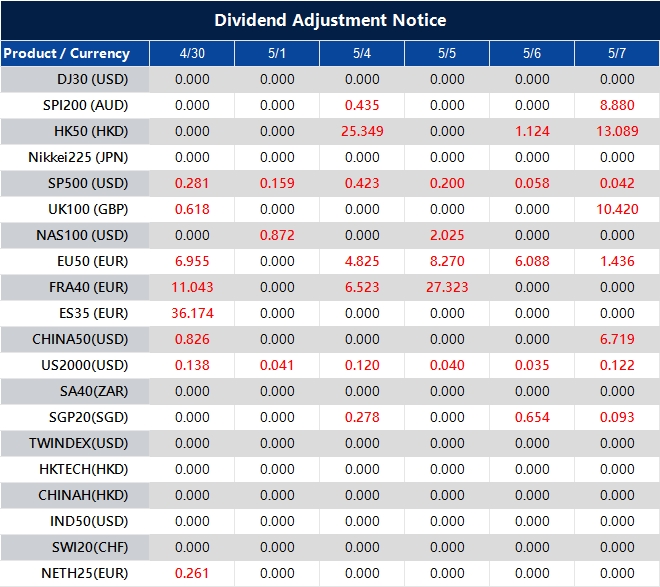
Dividend Adjustment Notice – Apr 30 ,2026

Dear Client,

Please note that the dividends of the following products will be adjusted accordingly. Index dividends will be executed separately through a balance statement directly to your trading account, and the comment will be in the following format “Div & Product Name & Net Volume”.

Please refer to the table below for more details:

Dividend Adjustment Notice

The above data is for reference only, please refer to the MT4/MT5 software for specific data.

If you’d like more information, please don’t hesitate to contact [email protected].

Despite an Asian-session rise, GBP/USD bulls remain cautious; the pair hovers near 1.3500 above 100-day SMA

GBP/USD failed to build on an Asian lift towards 1.3500 and traded around 1.3475–1.3480, almost flat on the day. It stayed above the 100-day Simple Moving Average (SMA) as traders waited for the Bank of England (BoE) decision and US inflation data.

The BoE was due to announce policy and was expected to keep rates unchanged. Market pricing indicated a higher chance of two rate rises in 2026, linked to inflation risks from higher energy prices, with attention on the statement, press conference, and Andrew Bailey’s guidance.

Intraday Price Action

On Wednesday, GBP/USD tried to hold 1.355 before falling, then hit a low near 1.3460 after 18:00 GMT and later closed near 1.3480. A Donald Trump Truth Social post after 08:00 GMT helped lift Brent above $110/bbl, supporting the US Dollar.

The Fed held rates at 3.5% to 3.75% with the most divided FOMC vote since 1992. Powell’s press conference pushed the 10-year US Treasury yield above 4.4%, and GBP/USD was near 1.3480, down 0.30%.

Thursday’s schedule included the BoE decision at 11:00 GMT, Bailey at 11:30 GMT, and US releases at 12:30 GMT: March PCE, Q1 advance GDP, Q1 Employment Cost Index, and weekly jobless claims. Chicago PMI followed at 13:45 GMT.

Powell said he would remain a Governor until a criminal investigation ends, keep a low profile, and stay after May 15, when his eight-year term as Chair ends.

Market Backdrop Since Late 2025

We can see how much the landscape has changed since late 2025 when GBP/USD was struggling to hold 1.3500. The divergence between the Federal Reserve and the Bank of England, which we saw hints of back then, has now become the market’s main story. The pair is currently trading much lower, near 1.2850, reflecting sustained dollar strength.

The Fed’s hawkish tilt at Jerome Powell’s final meeting was not a bluff, and the trend has continued under Chair Warsh. With the federal funds rate now at 4.25-4.50% and the 10-year Treasury yield sitting at 4.7%, the dollar remains the clear favourite. The latest Core PCE reading from March came in at a sticky 3.1%, giving the Fed little reason to signal a dovish pivot anytime soon.

Meanwhile, the Bank of England has been more hesitant than the two rate hikes we priced in for 2026 might have suggested. While they did hike once, recent UK CPI data showing inflation at 3.5% is now coupled with weakening growth forecasts. This policy conflict is weighing on Sterling, making it difficult for the currency to find a footing against the high-yielding dollar.

For traders, this suggests continued pressure on the GBP/USD pair in the weeks ahead. Buying put options with a strike price around 1.2700 could be a prudent way to position for a potential slide towards the 2025 lows. This strategy offers a defined risk while capturing any further downward momentum driven by central bank divergence.

Alternatively, for those expecting the pair to become range-bound after its recent drop, selling volatility could be attractive. Implied volatility is lower than during the chaotic period in late 2025, suggesting a strategy like selling a strangle with strikes at 1.2750 and 1.2950 might yield positive theta decay. This profits if the pair remains contained as the market awaits fresh catalysts.

Looking ahead, the upcoming US non-farm payrolls report will be critical for gauging the Fed’s next move. Any signs of a still-hot labor market will likely reinforce the dollar’s dominance. Traders should also watch for any change in tone from Bank of England officials regarding the UK’s growth outlook.

Create your live VT Markets account and start trading now.

During European trading, XAG/USD rose 1.5% near $72.35, rebounding from $70.86 three-week low

Silver rose 1.5% to about $72.35 in European trading on Thursday, after hitting a three-week low of $70.86 on Wednesday. Price direction remained uncertain after the Federal Reserve left rates unchanged at 3.50%–3.75% and warned of upside inflation risks.

Jerome Powell said the Fed remained attentive to risks on both sides of its mandate and that the energy surge had not yet peaked. Three rate-setting members supported moving away from an easing bias, citing higher energy prices and de-anchored inflation expectations.

Expectations for a rate cut this year weakened after the decision. CME FedWatch showed the odds of one cut falling to 3.3% from 18.4% on Tuesday.

Oil rose after comments from US President Donald Trump that Washington’s naval blockade on Iran would extend further. Higher oil prices can lift inflation expectations and make it less likely that central banks ease policy.

Silver was still below the 20-day EMA near $75.43, with the RSI around 41. Resistance stood near $75.43, with $80 above, while further downside could target the April 7 low of $68.28.

We are in a very different environment than what we saw in 2025 when the Federal Reserve was holding firm against inflation. Now, with the latest headline CPI moderating to 3.4%, the conversation has shifted towards the timing of the first rate cut. This change in tone is a key factor for silver’s recent performance.

Given the current uncertainty around the Fed’s first move, implied volatility in silver options has become more pronounced, especially compared to last year’s bearish sentiment. Traders might consider using options strategies that benefit from this environment to manage risk around core positions. This allows for participation in further upside while defining a clear risk profile.

The fundamental picture has also strengthened considerably since the geopolitical jitters of 2025. Industrial demand is now projected by The Silver Institute to reach a record 1.2 billion ounces this year, driven largely by investment in the solar and electronics sectors. This robust demand creates a strong underlying price floor that was less certain when we were focused solely on the Fed’s hawkish stance.

Looking at market positioning, we see that managed money has built a significant net long position in silver futures, a stark contrast to the more cautious stance seen in 2025. From a technical standpoint, the levels that were resistance last year, such as the $75.43 area, are now being tested as key support. A sustained hold above this level would signal strong conviction from buyers.

The CME FedWatch tool now shows a greater than 65% probability of at least one rate cut by the end of the third quarter, a world away from the 3.3% odds we saw this time last year. Traders should therefore watch for dips toward key support levels as potential buying opportunities. The strategy for the coming weeks appears to be buying into weakness rather than selling into rallies.

Back To Top
server

Hello there 👋

How can I help you?

Chat with our team instantly

Live Chat

Start a live conversation through...

  • Telegram
    hold On hold
  • Coming Soon...

Hello there 👋

How can I help you?

telegram

Scan the QR code with your smartphone to start a chat with us, or click here.

Don’t have the Telegram App or Desktop installed? Use Web Telegram instead.

QR code


