Back

As safe-haven demand wanes, the Dollar Index drops 0.18%, ending near 98.90 after five-week peak retreat

The US Dollar Index (DXY) fell about 0.18% on Wednesday to near 98.90, after reaching 99.68 on Tuesday. It rose nearly 2% across Monday and Tuesday, then eased as demand cooled. DXY has rebounded from the late-January low near 95.56. Two strong daily gains early in the week pushed it above the 200-day EMA for the first time since late November.

Geopolitical Tensions And Shipping Risks

Fighting between the US, Israel and Iran reached its fifth day on Wednesday, with casualties rising. Iran’s Revolutionary Guard said the Strait of Hormuz was closed to shipping. Oil prices climbed to their highest levels since mid-2025, adding inflation concerns. This affects expectations for Federal Reserve policy. US data were mixed: ADP jobs were 63K in February versus a 50K consensus. ISM services PMI rose to 56.1 versus a 53.5 forecast, while prices paid eased to 63 from 66.6. Focus now shifts to Thursday’s jobless claims and productivity, and Friday’s Nonfarm Payrolls. Consensus expects 59K jobs versus January’s 130K.

Technical Levels And Market Focus

On the daily chart, DXY spot was 98.82. Support sits near 97.95, then 97.60 and 96.90; resistance is around 98.70–98.75, then 99.05. We are looking at a very different picture today, March 5th, 2026, than what we saw this time last year. We remember how the US Dollar Index surged toward 99.70 in early March 2025 following the conflict in the Gulf, which sent oil prices soaring. That safe-haven bid was intense but cooled quickly, showing how geopolitical shocks can create volatile, two-way action. The backdrop today is less explosive, which changes how we should approach volatility. While tensions in the South China Sea keep a floor under the dollar, we aren’t seeing the kind of panic that closed the Strait of Hormuz in 2025. Crude oil is trading near a stable $81 per barrel, a stark contrast to the spike above $110 we saw last year that fueled major inflation fears. This stability is reflected in the economic data, giving the Federal Reserve a much clearer path. We just saw a strong 275,000 jobs added in the last Nonfarm Payrolls report, far healthier than the weak 59,000 consensus estimate that worried the market in March 2025. With the latest CPI data showing inflation moderating to 2.8%, the Fed is not being forced into a corner by a sudden price surge. Given this lower geopolitical temperature, implied volatility on dollar options is considerably lower than it was during the 2025 crisis. This makes it cheaper to establish positions to hedge against unexpected moves or to speculate on a breakout. With the DXY currently hovering around 103.80, buying calls with a 105 strike or puts below the 102 support level presents a cost-effective strategy. The market’s focus has shifted from geopolitical bombshells to economic data points. With CME Group’s FedWatch Tool showing a 92% probability that the Fed will hold rates steady at its next meeting, upcoming jobless claims and NFP reports will be the primary drivers of short-term dollar direction. This suggests that trading short-dated options around these data releases could be more effective than positioning for a larger, shock-driven event like we saw last year. Create your live VT Markets account and start trading now.

Start trading now – Click here to create your real VT Markets account

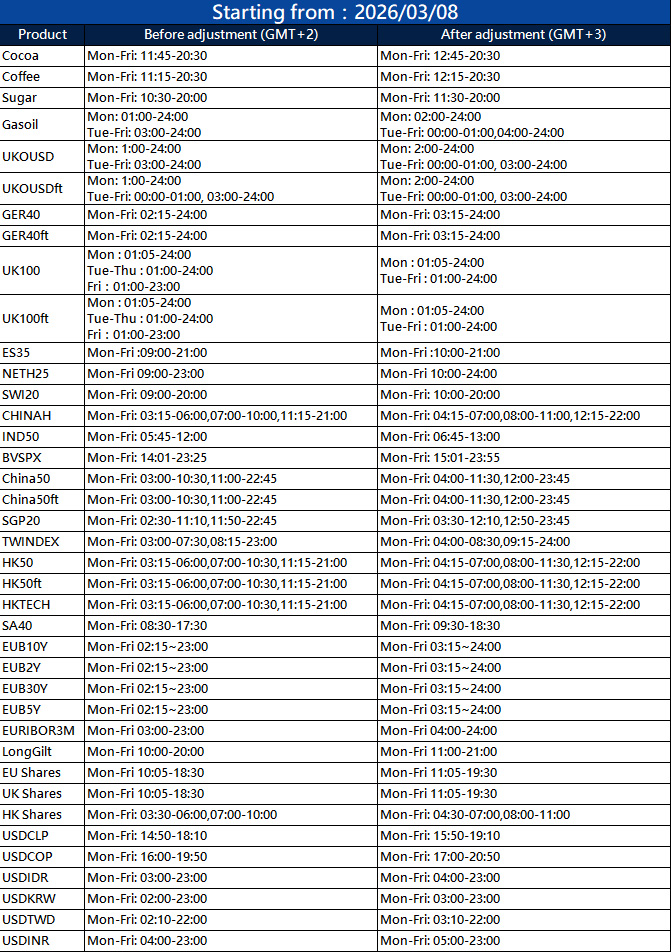
Notification of Trading Adjustment – Mar 05 ,2026

Dear Client,

The trading hours of some MT4/MT5 products will change due to the upcoming Daylight-Saving Time change in US.

Please refer to the table below outlining the affected instruments:

Notification of Trading Adjustment

System time will be adjusted from winter time GMT+2 to daylight saving time GMT+3.

The above information is provided for reference only; please refer to the MT4/MT5 software for specific data.

If you’d like more information, please don’t hesitate to contact [email protected]

Fintech in Mexico: Economic stability and expansion in 2026

  • The fintech ecosystem in Mexico continues to mature, reflected in 131 new jobs

Mexico is entering an economic landscape that reflects both strengths and challenges. Macroeconomic stability remains moderate, with GDP growth projections between 1.2% and 1.5%, low formal unemployment, and an exchange rate of less than 18 pesos per dollar. However, inflation has shown a slight acceleration, reaching 3.77% in the first half of January, which calls for greater vigilance in monetary policies.

Fintech sector dynamics

Mexico’s fintech ecosystem continues to mature, focusing on digital payments, crypto assets, and innovative Defi solutions that respond to the demand for financial inclusion. In 2025, 131 new ventures were registered, contributing to growing revenues and an expanding market, in which regulation and technology adoption play a key role. This growth positions Mexico as a regional hub, attracting investment and specialized talent in a predictable but cautious economic environment.

Money Expo Mexico 2026

This event is celebrating its fourth edition on February 18 and 19 at the Banamex Center, establishing itself as the most important financial event for trading, investment, fintech, and blockchain in the country. In a context of regional fintech growth, it offers workshops, market analysis, and B2B opportunities for professionals and institutions.

VT Markets returns after participating in the inaugural edition in 2023, highlighting its commitment to the global financial community. This year, it intensified its presence with two activities led by Eduardo Romero, senior market analyst, on the first day, with a round table discussion entitled “Preparing for the future: what will really change the markets in 2026?”; and a presentation on the second day of the event, entitled “The new trading game: how professionals operate in highly uncertain markets.”

Since last year, with Donald Trump’s presidency, we’ve seen a series of aggressive trade measures that have increased market volatility and kept investors and traders on constant alert. High-profile issues like the political situation between Iran and the United States trigger market movements,says Eduardo Ramos, Senior Market Analyst at VT Market.

As an investor, navigating market uncertainty can be a constant challenge. Therefore, Eduardo Ramos, drawing on his expertise, emphasizes that “stability coexists with periods of uncertainty; the difference lies not in predicting the market, but in operating with a solid method for reading and analyzing data.”

This participation underscores the collaboration with industry professionals in a rising fintech hub such as Mexico.

They assess whether a March NASDAQ 100 peak is unlikely, citing pre-election years’ average patterns historically

A prior February 11 update said that in pre-election years the NASDAQ 100 typically bottoms on 5 February, peaks around 15 February, dips towards 21 February, then rises to a 18 March high before falling until October. It also set an Elliott Wave downside area of 24,200 ± 200. The index bottomed on 5 February, peaked on 11 February, then made another low on 17 February, followed by a secondary high on 25 February. It then fell to its lowest level since the November 2025 low after joint military operations in Iran, but later erased Monday’s losses. The 24,200 ± 200 target zone was met at the 24,315 low. Price is described as being at the same level as five months ago. The broader Elliott Wave count still points to about 26,600 for the red W-b, provided the index stays above warning levels. The text states daily moves can be noisy, with weekly giving structure and monthly setting the trend. The 26,600 area is calculated as 161.8% of the 2020-2021 rise: W-1 from 6,772 to 16,765 (9,993 points), W-2 at 10,440 on 13 October 2022, and W-3 target 10,440 + 9,992 × 1.618 = 26,608. Warning levels listed are 24,992, 24,795, 24,637, 24,497, and 24,315. As of today, March 5, 2026, we see the NASDAQ 100 has recovered strongly from the market’s reaction to the joint military operations in Iran. The index hit our target low of $24,315 and bounced, suggesting the immediate selling pressure is over. This price action reinforces the view that the market is setting up for one final rally. For the next few weeks, the primary strategy is to position for an upward move toward the $26,600 target. With the CBOE Volatility Index (VIX) retreating back under 16 after last week’s geopolitical spike, call options expiring in late March or mid-April have become more attractively priced. This short-term bullish outlook remains valid as long as the index holds above its recent lows. However, we must view this potential rally with caution, as it fits the historical pattern of a deceptive peak before a significant decline. We saw a similar setup in February 2020, when the market pushed to a new all-time high right before a sharp C-wave sell-off. These irregular B-waves are designed to draw in final buyers before the trend reverses. Therefore, as the index approaches the $26,600 level, traders should begin planning for the other side of the trade. The latest economic data showing core inflation remaining persistent at 3.6% could provide the fundamental reason for a market turn. Cautious traders might start buying longer-dated put options, for May or June, to prepare for a substantial drop. Strict risk management is essential, and the key warning levels must be respected. Any sustained break below the $24,992 and $24,795 supports would signal that the expected final rally is off the table. A move below Monday’s low of $24,315 would invalidate the entire bullish short-term structure.

Start trading now – Click here to create your real VT Markets account

Amid a broad US Dollar pullback, the New Zealand Dollar drove NZD/USD up 0.73% to 0.5940

NZD/USD rose about 0.73% on Wednesday to around 0.5940, with the New Zealand Dollar leading major currencies. The pair had dipped below the 50-day EMA earlier, with a low near 0.5860 close to the 200-day EMA, after January lows near 0.5710 and a February peak near 0.6090. The RBNZ kept the Official Cash Rate at 2.25% in February, and markets shifted expected timing for a first rise to December at the earliest. The RBA lifted its rate to 3.85% in February, and GBP/NZD fell 0.82% on the session. US data were mixed, with ADP jobs at 63K versus a 50K forecast. ISM services PMI rose to 56.1 versus 53.5, while the prices paid index eased to 63 from 66.6. Friday’s Nonfarm Payrolls are forecast at 59K for February versus 130K in January. Retail sales are expected to be flat after a 0.3% fall. NZD/USD was near 0.5940, with EMAs around 0.5920 (50-day) and 0.5880 (200-day). Support levels were cited at 0.5920, 0.5890 and 0.5880, with resistance at 0.5990, 0.6050 and 0.6100. Looking back a year ago, in early 2025, we saw the Reserve Bank of New Zealand holding its rate at a low 2.25% with no rush to hike. Today, the situation is vastly different, as that dovish stance has been completely reversed following a period of persistent inflation. The NZD/USD is now trading near 0.6250, a significant climb from the 0.5940 level seen at that time. The RBNZ has since raised the Official Cash Rate multiple times to its current level of 3.75% to fight inflation, which registered a stubborn 4.2% year-over-year in the last quarter of 2025. This contrasts sharply with the US Federal Reserve, which is widely expected to begin an easing cycle in the second half of this year. This growing rate differential continues to provide a strong tailwind for the Kiwi dollar. The US jobs market is no longer the headwind for the NZD/USD that it was in early 2025, when a meager 59,000 jobs were anticipated for February. The most recent report for February 2026 showed a healthier, but not inflationary, gain of 190,000 jobs. This solidifies the market’s view that the Fed has room to cut rates later this year as inflation continues to cool, further weighing on the US Dollar. For derivative traders, this environment suggests selling downside protection on the NZD/USD may be a viable strategy. Selling out-of-the-money put options with expirations in the next one to two months could allow traders to collect premium, capitalizing on the pair’s underlying strength. This view holds as long as the pair remains above its key technical support levels. However, we must remain mindful of external risks that were present a year ago and persist today. China’s economic recovery remains uneven, with the latest Caixin Manufacturing PMI barely in expansionary territory at 50.9, which could limit demand for New Zealand’s exports. While the Global Dairy Trade Price Index has stabilized around $3,600/MT, it is not providing a fresh catalyst for a major rally. From a positioning standpoint, the pair is trading comfortably above its 200-day moving average, which now acts as support near 0.6100. Traders might consider using this level as a reference point for structuring bullish trades, like call spreads, to target a retest of the year-to-date highs around 0.6310. Any break below that key moving average would require a swift reassessment of this positive outlook.

Start trading now – Click here to create your real VT Markets account

USD/CHF slid 0.25% after failing to close above 0.7819 50-day SMA amid rising risk aversion

USD/CHF fell 0.25% on Wednesday after it did not close above the 50-day Simple Moving Average (SMA) at 0.7819. The US dollar gave back part of its earlier gains as risk aversion increased, leaving the pair below 0.7800. Price action keeps the downtrend in place, with lower highs and lower lows still intact. A move above Tuesday’s high of 0.7878 would bring the 100-day SMA resistance at 0.7909 into view.

Technical Momentum Signals

The Relative Strength Index (RSI) remains bullish but has turned lower towards its neutral level. A second daily close below the 50-day SMA suggests room for a further pullback. If USD/CHF drops below Tuesday’s low of 0.7784, the next level to watch is 0.7700. Further weakness would expose a support trendline in the 0.7660 to 0.7680 area. Looking back at our analysis from this time in 2025, we saw the USD/CHF pair struggling below the 0.7800 mark and failing at its 50-day moving average. The technical outlook then was clearly bearish, pointing towards potential tests of the 0.7700 level. This bearish sentiment was largely based on the downtrend that was in place at the time. The situation today is quite different, with the pair now trading firmly above 0.8100. Recent Swiss inflation data for February came in at a cool 1.1%, fueling market speculation that the Swiss National Bank may be the first major central bank to cut rates this cycle. This policy divergence is a significant catalyst that was absent last year.

Policy Divergence Outlook

This contrasts sharply with the United States, where last week’s non-farm payrolls report showed a robust 250,000 jobs added, keeping the Federal Reserve on a steady path. This fundamental split suggests the path of least resistance for USD/CHF is upward, a direct reversal of the technical weakness we observed in 2025. The failure to break lower last year built a strong base for the current rally. Given this policy divergence, buying call options on USD/CHF could be a viable strategy in the coming weeks. We are looking at strike prices around 0.8200 with expirations in late April to capture potential upside from a hawkish Fed and a dovish SNB. This allows traders to position for a continued move higher with defined risk. For those more cautious, a bull call spread could limit upfront costs while still positioning for a move towards the 0.8250 resistance level. Implied volatility has remained moderate, making option premiums relatively attractive for initiating new positions. We should monitor upcoming central bank commentary closely for any change in tone. Create your live VT Markets account and start trading now.

Start trading now – Click here to create your real VT Markets account

WTI eases from earlier rises, hovering near $74.32 after $77.20 peak, as traders weigh US-Iran tensions

WTI eased on Wednesday after reaching a one-year high near $77.20 on Tuesday, and was trading near $74.32. Prices were still up nearly 10% this week as traders tracked the US-Iran conflict. A New York Times report said Iranian operatives had shown openness to talks on ending the war. Oil flows through the Strait of Hormuz remained disrupted, keeping a risk premium in prices.

Strait Of Hormuz Risk Premium

US President Donald Trump said the US would escort tankers through the Strait of Hormuz if needed. He also said the US would provide political risk insurance for ships travelling through the Gulf to support energy shipments. The EIA reported US crude inventories rose by 3.475 million barrels last week, above expectations of 2.2 million barrels. The build followed a previous increase of 15.989 million barrels. On charts, WTI has stayed in an uptrend since a low of $54.88 on 16 December, with higher highs and higher lows. RSI was near 77, and MACD remained above its signal line with a rising histogram. Resistance stood near $77.20, then $79.00–$80.00, including $79.37 from 15 January 2025, with $85.00 beyond that. Support was seen at $69.00–$70.00, then the 21-day SMA near $65.86 and the 50-day SMA around $62.30.

Options Positioning And Key Levels

We remember the tension in early 2025 when the US-Iran conflict pushed WTI to a one-year high near $77. The market was driven by fears of supply disruptions in the Strait of Hormuz. That geopolitical premium seems to be a persistent factor in today’s market. Today, the situation has evolved with WTI trading around $80 a barrel. Unlike the inventory builds we saw last year, the most recent EIA report showed US crude stocks increasing by only 1.4 million barrels, less than the expected 2.1 million. This suggests demand remains surprisingly firm. Given this backdrop, we are seeing increased volatility, making long call options an attractive strategy to capture upside potential while defining risk. The recent decision by OPEC+ to extend their voluntary production cuts of 2.2 million barrels per day through the second quarter provides a strong floor for prices. This commitment to supply management removes a significant amount of oil from the market, tightening the global balance. The resistance level we watched around $79-$80 in January 2025 has now become a key support zone. We are seeing significant open interest in WTI call options with strike prices at $85 and $90 for the coming months. A bull call spread could be a cost-effective way to play a gradual move towards those higher targets. However, we must remain watchful of the technical indicators, as the RSI is again approaching overbought territory, similar to the setup last year. Any sign of a diplomatic breakthrough in the Middle East or a slowdown in China’s economic recovery could trigger a sharp pullback. Therefore, using put options for downside protection is prudent. Create your live VT Markets account and start trading now.

Start trading now – Click here to create your real VT Markets account

Amid Middle East conflict, gold surpasses $5,100, gaining over 1% despite prior dollar-driven losses

Gold rose by over 1% in North American trading on Wednesday, after earlier losses of about 4.40% linked to broad US Dollar strength. It traded near $5,150 as tensions in the Middle East continued. The New York Times reported Iranian intelligence contacted the CIA indirectly a day after the attacks to discuss terms to end the war. US officials were sceptical about near-term de-escalation, and reports of a US submarine sinking an Iranian warship affected risk appetite.

Dollar Yields And Energy Disruptions

The US Dollar Index fell 0.25% to 98.82, while the 10-year US Treasury yield was unchanged at 4.069%. Some Middle East countries halted oil and gas production, with the conflict in its fifth straight day. The ISM Services PMI rose from 53.8 in January to 56.1, a three-and-a-half year high. ADP private payrolls were 63K versus a 50K estimate, after January’s 11K downward revised figure. Thursday brings Challenger Job Cuts and Initial Jobless Claims, plus remarks from Fed Governor Michelle Bowman. Money markets priced 43 basis points of Fed easing by year-end. Gold levels include resistance at $5,200, then $5,249, $5,300, $5,379, and $5,419. Support sits below $5,000 at $4,950, $4,841, and the 50-day SMA near $4,810, with RSI described as rising but weak.

Framing The Current Setup

Looking back at the analysis from early 2025 reminds us how geopolitical shocks drove gold toward $5,150. That rally faded as the specific US-Iran conflict de-escalated and a strong dollar took hold for the rest of that year. Today, with gold hovering near $4,900, the situation presents a familiar, yet different, set of variables for us to consider. We are seeing renewed tensions in the Middle East, this time centered on maritime shipping disruptions, which is putting a floor under gold prices. We remember how quickly prices ran up to the March 2025 peak of $5,379 during the peak of last year’s crisis. This history suggests that any further escalation could trigger a rapid move upward, catching many traders off guard. However, the US economy remains a powerful headwind for precious metals. The most recent Consumer Price Index report for February 2026 showed inflation remains sticky at 3.1%, and forecasts for this Friday’s Nonfarm Payrolls report are for another strong gain of 190,000 jobs. This persistent economic strength is very different from the slowdown some were expecting back in early 2025. This economic resilience has forced a major repricing of Federal Reserve expectations. Whereas the market priced in 43 basis points of cuts in early 2025, current money markets are pricing in just one 25 basis point cut by the end of 2026. Fed Chairman Powell’s hawkish tone last week reinforces this “higher for longer” stance, which continues to support the US Dollar. This creates a classic conflict between geopolitical fear and economic reality, a perfect environment for options strategies. We should consider buying out-of-the-money call options to position for a potential spike in prices. This provides us with upside exposure to a geopolitical event while strictly defining our risk to the premium paid. Specifically, we are looking at purchasing April and May 2026 call options with strike prices around the $5,000 to $5,050 level. The goal is to establish these positions before implied volatility rises further on the back of Mideast headlines. This allows us to profit from a sharp move higher while risking a relatively small amount of capital if the strong US economy continues to dominate the narrative. Create your live VT Markets account and start trading now.

Start trading now – Click here to create your real VT Markets account

DBS economists see strong Singapore growth, AI boosts, low inflation; oil shocks could strain exports, consumers, MAS

Singapore’s economy is seeing strong growth momentum, support from AI-related activity, and low inflation. Rising oil prices and supply chain disruption linked to Middle East risks could still raise costs for households and export-focused firms. As an energy importer and price taker, Singapore may face higher electricity, transport-fuel, and shipping costs if disruption continues. The effects could spread across consumers, exporters, and manufacturers.

Energy Driven Inflation Exposure

Around 7+% of the overall CPI basket is estimated to be directly affected by higher energy prices. This reflects the share of items tied closely to energy costs. Imported price pressure may stay contained if the SGD nominal effective exchange rate keeps appreciating. This could change if Brent crude oil prices rise further, which may affect the Monetary Authority of Singapore’s policy stance. Manufacturers are already dealing with capacity limits and supply chain issues. In February, the supplier deliveries sub-index of the manufacturing purchasing managers’ index fell to 49.6, the lowest level in about two years since early 2024. The article was produced with an AI tool and reviewed by an editor.

Market Volatility Trading Approach

Given the recent spike in Brent crude to over $95 a barrel, we see a clear risk-off sentiment building despite Singapore’s strong underlying growth. This tension between solid domestic fundamentals and external geopolitical threats creates opportunities in volatility. Derivative traders should be positioning for wider price swings in the weeks ahead. We are watching the Monetary Authority of Singapore closely, as continued strength in the Singapore dollar is the main buffer against imported inflation. With last month’s core inflation ticking up to 3.5% and over 7% of the consumer price basket directly exposed to energy costs, there is a growing case for using interest rate swaps to price in a more hawkish MAS stance. A further surge in oil could force the central bank’s hand before its next scheduled meeting. The pressure on manufacturers is already evident, as last month’s supplier deliveries index hit 49.6, a low we haven’t seen since the supply chain snarls of early 2024. This signals that corporate margins for export-oriented firms will be squeezed by higher shipping and input costs. We recommend buying put options on the Straits Times Index as a direct hedge against this expected weakness in the broader market. For more targeted plays, we are looking at options on individual transport and industrial stocks, which are most vulnerable to rising fuel costs. Consider short positions on airline and logistics company derivatives, as their operational expenses will rise significantly. These can be paired with long positions in the few local energy sector stocks that might benefit from higher prices. Ultimately, the core strategy should revolve around volatility itself, as the outcome of the Middle East situation remains highly uncertain. Buying straddles or strangles on broad market indices allows traders to profit from a significant move in either direction. This approach acknowledges the market’s current state of anxiety, where a sudden escalation or de-escalation could trigger a sharp rally or sell-off. Create your live VT Markets account and start trading now.

Start trading now – Click here to create your real VT Markets account

The Dow regained Tuesday’s steep losses, rising 312 points to 48,807 as ADP and ISM calmed growth fears

The Dow Jones Industrial Average was up 312 points, or 0.65%, at 48,807 on Wednesday, after falling as much as 1.2K points intraday on Tuesday and closing down 403 points. It opened at 48,368, hit 48,853, and stayed below the 50-day exponential moving average of 48,979. The S&P 500 rose 0.87% to 6,875 and the Nasdaq Composite gained 1.47% to 22,847. Markets moved as oil prices eased and the US-Iran conflict remained in focus.

Economic Data And Fed Watch

ADP reported 63K private-sector jobs added in February versus 50K expected, after January’s revised 11K. ISM Services PMI rose to 56.1 from 53.8, above 53.5 forecast; new orders were 58.6 and prices paid was 63. Friday’s Nonfarm Payrolls estimate is 60K jobs versus 130K in January, with earnings seen at 0.3% MoM and 3.7% YoY and unemployment at 4.3%. Thursday includes jobless claims (215K), productivity and unit labour costs, and Wednesday brings the Beige Book ahead of the 18–19 March FOMC meeting. Brent crude fell to about $81 after touching $85.12 on Tuesday, following comments from Treasury Secretary Scott Bessent about plans to stabilise Persian Gulf oil flows. Disruption in the Strait of Hormuz continued, alongside a pledge to insure and escort shipping. CrowdStrike posted adjusted EPS of $1.12 on $1.31 billion revenue, with $331 million net new ARR, total ending ARR above $5 billion, and fiscal 2027 guidance of $5.87–$5.93 billion revenue and $4.78–$4.90 EPS. Target reported adjusted EPS of $2.44, outlined a $2 billion 2026 investment and guided $7.50–$8.50 EPS; Pinterest rose after a $1 billion Elliott stake and a $3.5 billion buyback plan, while Box gained over 6%. The Dow tracks 30 US stocks and is price-weighted, using a divisor of 0.152, and was founded by Charles Dow. Trading exposure can be gained through ETFs such as DIA, futures, options, and mutual funds, while Dow Theory compares the DJIA and DJTA and describes three phases: accumulation, public participation, and distribution.

Options Strategies For Volatile Markets

Given the market’s recent volatility and sharp intraday swings, we should prepare for continued choppiness. The Dow’s failure to reclaim its 50-day moving average suggests some technical weakness, making outright long positions risky. Using options to define risk, such as buying call spreads on the SPDR Dow Jones Industrial Average ETF (DIA), allows for upside participation while capping potential losses. The strong economic data from the ADP and ISM reports creates a complex picture for the Federal Reserve. While robust growth pushes back on recession fears, the high prices paid component keeps inflation concerns on the table ahead of the March 18-19 meeting. This data cross-current suggests the Fed will remain on hold, creating uncertainty that can be traded using volatility instruments like VIX futures or options. All attention is now on the Nonfarm Payrolls (NFP) report, and recent data shows we must be prepared for a surprise. While initial forecasts pointed to a modest 60,000 job gain, the actual report for February showed the economy added a much stronger 275,000 jobs. This kind of significant beat pressures the Fed to delay any rate cuts and will likely cause sharp moves in index futures upon release. Furthermore, the latest Consumer Price Index (CPI) reading for February came in at 3.2%, with core inflation at 3.8%, both remaining stubbornly above the Fed’s target. This persistent inflation, a trend we also observed through much of 2025, reinforces the “higher for longer” interest rate narrative. This environment makes trading interest rate-sensitive sectors, like technology via the Nasdaq 100, particularly challenging without proper hedging. The ongoing US-Iran conflict makes the energy sector a focal point for derivative traders. The pullback in Brent crude to $81 on diplomatic news shows how quickly prices can move on headlines. We should consider using options on the Energy Select Sector SPDR Fund (XLE) to speculate on or hedge against further disruptions in the Strait of Hormuz. Individual stocks are still offering clear opportunities based on their fundamental performance. Target’s (TGT) powerful move on strong guidance makes its call options attractive for capturing further upside. Conversely, one could analyze the implied volatility in CrowdStrike (CRWD) options to see if they are overpriced after its recent earnings report. Looking back at the sharp market corrections we saw in 2025, the current environment warrants a cautious but opportunistic approach. We should be watching to see if the Dow Jones Transportation Average confirms the direction of the Industrials, as per Dow Theory, to gain confidence in the primary trend. The current divergence between strong economic data and geopolitical risk is creating the kind of environment where smart money can accumulate positions while public participation is hesitant. Therefore, building positions using derivatives that benefit from either a range-bound market or a sharp directional move is prudent. Buying protective puts on a broad index like the S&P 500 can hedge existing portfolios against a sudden geopolitical escalation. For those anticipating big moves around economic data, an options strangle on the DIA or S&P 500 ETFs could prove effective in the coming weeks. Create your live VT Markets account and start trading now.

Start trading now – Click here to create your real VT Markets account

Back To Top
server

Hello there 👋

How can I help you?

Chat with our team instantly

Live Chat

Start a live conversation through...

  • Telegram
    hold On hold
  • Coming Soon...

Hello there 👋

How can I help you?

telegram

Scan the QR code with your smartphone to start a chat with us, or click here.

Don’t have the Telegram App or Desktop installed? Use Web Telegram instead.

QR code