



OCBC sees limited EUR/USD gains as dollar weakens, but says the euro isn’t undervalued; ECB cautious, Germany supportive
EUR/USD is getting modest support. This is mostly due to expected US dollar weakness, not euro strength. The euro does not look clearly undervalued. The European Central Bank is also staying cautious, even as Germany adopts a more expansionary fiscal stance.
The Federal Reserve sounds firmer than markets expect. A later start and smaller scale US rate-cut cycle could cap further gains in EUR/USD.
XAG/USD rebounds from prior-session losses near $90.50–$91.00 in early European trading
Silver (XAG/USD) traded near $90.50 per troy ounce in early European trading on Wednesday. It rebounded after losses in the previous session. The 14-day RSI was near 56, which is above the midpoint and still below overbought levels.
Price stayed above the nine-day and 50-day EMAs, which suggests a recovery after the sharp sell-off. The nine-day EMA was trending higher, while the 50-day EMA was mostly flat.
Technical Levels And Momentum
Resistance was seen near the psychological $100.00 level. Another key level is the record high of $121.66, set on 29 January. Support includes the nine-day EMA near $84.43 and the 50-day EMA at $79.94. A drop below both could open the door to the two-month low of $64.08, recorded on 6 February. Silver is a precious metal that can be bought physically or through products such as ETFs that track its price. Prices can move due to geopolitical risk, recession concerns, interest rates, the US Dollar, investor demand, mining supply, and recycling. Industrial demand also matters. Uses in electronics and solar can lift demand, along with economic conditions in the US, China, and India. Silver often follows Gold, and the Gold/Silver ratio is used to compare their relative value.Strategy And Risk Management
Silver holding around $90.50 supports a cautiously bullish view. With price staying above key moving averages, the easier path may be higher, toward the $100.00 level. Traders may look at bullish strategies that fit this momentum, such as call options with strikes closer to $100.00. This technical strength also lines up with recent fundamental changes. Minutes from the Federal Reserve’s early February 2026 meeting pointed to a more dovish stance. That has helped push the US Dollar Index below 102. A weaker dollar and the chance of lower rates have historically supported silver. Industrial demand also appears strong. Global data for Q4 2025 showed solar panel installations rose 15% year over year. Solar is a major user of silver. This demand is expected to remain firm through 2026, taking up a large share of mining supply. Relative value has also shifted since last year. The Gold/Silver ratio sat near 85:1 for much of 2025, but it has tightened to about 75:1. This change reflects silver’s recent strength versus gold and suggests momentum is currently favoring silver. Even with these positives, risk management remains essential. A break below the first support at the nine-day EMA near $84.43 would be an early sign the trend is weakening. Derivative traders could use this level to take profits on bullish trades or add protective puts. A stronger bearish signal would be a close below the 50-day EMA near $79.94. That would weaken the recovery setup and bring the February 6 low of $64.08 back into view. In that case, a more defensive approach—such as bearish positioning or short hedges—may be appropriate. Create your live VT Markets account and start trading now.Germany’s fourth-quarter year-on-year GDP growth meets expectations at 0.4%, latest estimates show
Germany’s gross domestic product (GDP) rose 0.4% year on year in the fourth quarter, in line with forecasts. This shows the economy grew compared with the same quarter a year earlier.
The reading matched expectations at 0.4%, with no gap between the actual number and the forecast. This update applies to the year-on-year measure for Q4.
Market Reaction And Options Implications
Germany’s fourth-quarter GDP for 2025 came in exactly as expected, confirming the 0.4% annual growth already priced in. Because the data held no surprises, implied volatility in DAX index options may ease in the days ahead. That would make selling premium—through strategies like covered calls or cash-secured puts—more appealing than buying options. This result supports the 2025 theme of slow growth, not a strong recovery. The DAX has traded in a tight range since the start of the year, and this release provides no clear trigger for a breakout. As a result, range-based approaches—such as iron condors on the index—could work well over the next few weeks. Early 2026 data also points to a cautious outlook. February’s IFO Business Climate survey edged up to 86.1, but it remains low and does not yet suggest a clear shift in confidence. Markets still seem to be searching for direction, but they are constrained by this slow-growth backdrop. The European Central Bank is also under pressure. January’s final Eurozone inflation print was 2.6%, still above the ECB’s target. Weak growth in Germany, the region’s largest economy, makes it harder for the ECB to stay hawkish on rates. Upcoming ECB comments will matter, especially if the tone turns more dovish, since that could be the next key catalyst.Euro Outlook And Positioning
For now, the euro may stay under pressure versus the dollar due to the growth gap. In EUR/USD options, traders could consider put-buying strategies or bear call spreads to position for potential downside. Soft German data offers little support for sustained strength in the single currency. Create your live VT Markets account and start trading now.Germany’s fourth-quarter GDP rose 0.3% quarter on quarter, matching expectations and signalling steady growth
Germany’s gross domestic product rose 0.3% quarter-on-quarter in the fourth quarter, matching forecasts.
This means the economy grew compared with the previous quarter. The update did not include any further details.
Market Impact Outlook
Germany’s fourth-quarter 2025 GDP growth came in exactly as expected at 0.3%, so we do not expect an immediate or sharp market reaction. The result points to slow, steady growth rather than a surprise rebound or a slide back toward recession. Much of this was likely already priced in, so traders’ attention should shift from this backward-looking release to what comes next. For DAX index options traders, this confirmation of modest growth may reduce near-term implied volatility. After the late-2025 rally—driven by hopes of avoiding a recession—this data supports a calmer outlook. Strategies that fit range-bound trading or a gradual move higher may be more suitable than positions aimed at a major breakout. This report also adds little pressure on the European Central Bank to change its interest-rate stance. We expect interest-rate futures to stay aligned with the view that the ECB will hold steady, especially with January inflation still firm at 2.8%. Any rate cuts are still priced as a mid-2026 possibility at the earliest, and only if inflation cools further. In FX markets, the euro is unlikely to get a clear direction from this release alone. EUR/USD will likely respond more to upcoming U.S. data and changes in expectations for the Federal Reserve’s policy path. This GDP print mainly reinforces the idea of the Eurozone as a slow-growth economy, offering little catalyst for a stronger currency.Key Data To Watch
Focus now shifts to more forward-looking indicators, especially the next German IFO Business Climate survey and the February Eurozone inflation report. These are more likely to move markets in the coming weeks because they will shape expectations for the first quarter of 2026. GDP confirms what already happened; inflation data will set the tone for what comes next. Create your live VT Markets account and start trading now.Sweden’s annual producer prices fell 2% in January, improving from a previous 2.7% decline
Sweden’s Producer Price Index (PPI) fell 2% year on year in January. This compares with a 2.7% year-on-year drop in the previous reading.
In January, producer prices fell less than expected. The year-on-year decline was -2%, rather than the deeper -2.7% seen before. This suggests the deflation seen at the factory gate is starting to ease. It is an important sign that producer inflation may be finding a floor.
Producer Deflation Shows Signs Of Fading
This softer deflation may make the Riksbank less willing to cut its policy rate, which is currently 3.75% after its early-February meeting. Because of this, Swedish interest rates may stay firm in the coming weeks. Short-term interest rate futures that price in large and fast cuts now look exposed to a rebound higher. A less dovish central bank often helps the currency. That means the Swedish Krona could strengthen. EUR/SEK, which has been trading in a range near 11.20, could move lower if rate-cut expectations are scaled back. SEK call options could be a practical way to position for this move against the Euro. From the perspective of early 2026, markets still remember the sharp rate hikes of 2024, which were needed to bring down inflation after it climbed well above 9%. Because that episode is still fresh, investors may react quickly to any data that hints inflation is not fully gone. That could lead to a fast repricing of rate expectations based on this PPI report alone. For the OMXS30 index, the message is mixed and could raise volatility. Better pricing power can support earnings, but worries about “higher for longer” rates could pressure valuations.Equity Volatility May Increase
Given the uncertainty, options strategies like straddles may be better suited to target a rise in volatility, rather than betting on a single direction. Create your live VT Markets account and start trading now.Sweden’s monthly producer prices rose 2.4%, rebounding from -1.1% in the previous reading
Sweden’s producer price index (month-on-month) rose to 2.4% in January. This was up from -1.1% in the previous period.
This means producer prices moved from falling month to month to rising. The latest figure shows prices were higher than the month before.
Producer Prices Reverse Higher
Sweden’s producer prices jumped in January. The index rose 2.4% month-on-month, after a -1.1% drop in the prior month. This is a clear turnaround and suggests price pressures may be building again. It also challenges the view that inflation was fading, so markets may need to rethink the Riksbank’s next steps. After this data, the chance of a Riksbank rate cut in the first half of 2026 looks much lower. Officials may sound more hawkish, similar to early 2025 before the policy shift. Derivative markets that had priced in at least a 25 basis point cut by July may now move toward a “higher for longer” view on rates. For rates traders, this points to higher short-term rates. Paying fixed on Swedish interest rate swaps (IRS), especially in the 2-year tenor, could benefit if the market continues to price out rate cuts. Swedish bonds sold off sharply in late 2024 when inflation surprised on the upside; something similar could happen again. In FX, the Swedish Krona (SEK) may strengthen, especially versus the Euro. The European Central Bank is still pointing to a possible summer rate cut, which would widen the policy gap in Sweden’s favor. One way to express this is buying SEK call options against the EUR, looking for EUR/SEK to move back toward 11.15, where it traded in Q4 2025. Higher inflation is also a risk for Swedish equities. If borrowing costs stay higher, company margins can come under pressure. The OMXS30 rose almost 4% in January 2026 on hopes of easier policy, and that rally could now be at risk. Buying put options on the index can work as a hedge, or as a way to position for a near-term pullback.Equity Risk And Hedging
Create your live VT Markets account and start trading now.Germany’s GfK consumer confidence fell to -24.7, below the March forecast of -23.5
Germany’s GfK consumer confidence index was -24.7 for March. That was weaker than the expected -23.5.
This reading shows consumer sentiment is softer than forecast. The update did not include any other survey details.
German Consumer Sentiment And Spending Risk
Germany’s March consumer confidence reading came in at -24.7. That missed our forecast and suggests households are more worried than we expected. This matters because weak confidence can quickly lead to less spending, which is a key risk for the Eurozone’s largest economy. This move also follows other weak data. German factory orders for December 2025 fell 1.2%, marking a third straight monthly decline. With this backdrop, we should consider buying put options on the DAX over the next few weeks. The index has a heavy mix of industrial and consumer-facing firms, which could suffer most if sentiment turns into weaker sales. A drop toward the 16,500 support level looks more likely. The weak German outlook also adds pressure on the euro. We should treat any EUR/USD strength as a chance to open short positions, as it will be hard for the European Central Bank to defend a hawkish stance. A move below 1.06 in the second quarter is now a realistic scenario. Bonds may react too. Traders are likely to reduce pricing for any ECB hike in 2026. We see value in buying German Bund futures on the view that yields can fall as the market shifts toward a more dovish ECB. This view is supported by January inflation data showing Eurozone core inflation at a modest 2.5%.Historical Parallel And Market Sensitivity
From our 2025 viewpoint, this echoes the sharp drop in sentiment during the 2022 energy crisis. Back then, the DAX sold off hard as consumer fear weakened the outlook. The causes are different today, but the lesson is similar: German equities can react strongly to changes in consumer mood. Create your live VT Markets account and start trading now.EUR/GBP rises above 0.8700 as sterling weakens on looming UK political uncertainty, near 0.8725
EUR/GBP traded higher near 0.8725 in early European trade on Wednesday. It moved back above 0.8700 and snapped a three-day decline. The Pound weakened against the Euro ahead of UK political events. European Central Bank President Christine Lagarde is also scheduled to speak later on Wednesday.
A by-election will be held on Thursday in Manchester’s Gorton and Denton constituency to fill a vacant parliamentary seat. The vote comes as UK Prime Minister Keir Starmer faces rising tension within his party and low approval ratings.
Uk Political Risk And Sterling
In the US, the Supreme Court ruled on Friday against many tariffs introduced by President Donald Trump. On Saturday, Trump said he would add a further 15% tariff. On Monday, the European Parliament agreed to delay a vote on the EU–US trade agreement. Fresh trade tensions could weigh on the Euro, because the Eurozone is more exposed to trade disruption than the UK. Looking back at 2025, UK politics were a key driver of Sterling weakness. Attention on the Manchester by-election added uncertainty and helped push EUR/GBP above 0.8700. By-elections are often tough for the party in power. Since 2000, ruling parties have lost more than half of these contests. However, the larger risk is the renewed trade dispute between the US and the European Union. Similar tariff escalation in 2018 helped drive a drop of more than 5% in the Euro in a single quarter. Germany is especially exposed because its economy depends heavily on exports. This risk can limit how far EUR/GBP can rise.Volatility Outlook And Trading Approach
With these pressures pulling in different directions, the main expectation is higher volatility rather than a clear trend. One-week implied volatility for EUR/GBP is already rising, moving from an average of 5.5% to nearly 8% as traders price in these events. Derivatives traders may therefore look at strategies such as long straddles or strangles. These can profit from a large move either way and may suit a choppy market. Create your live VT Markets account and start trading now.Dividend Adjustment Notice – Feb 25 ,2026
Dear Client,
Please note that the dividends of the following products will be adjusted accordingly. Index dividends will be executed separately through a balance statement directly to your trading account, and the comment will be in the following format “Div & Product Name & Net Volume”.
Please refer to the table below for more details:
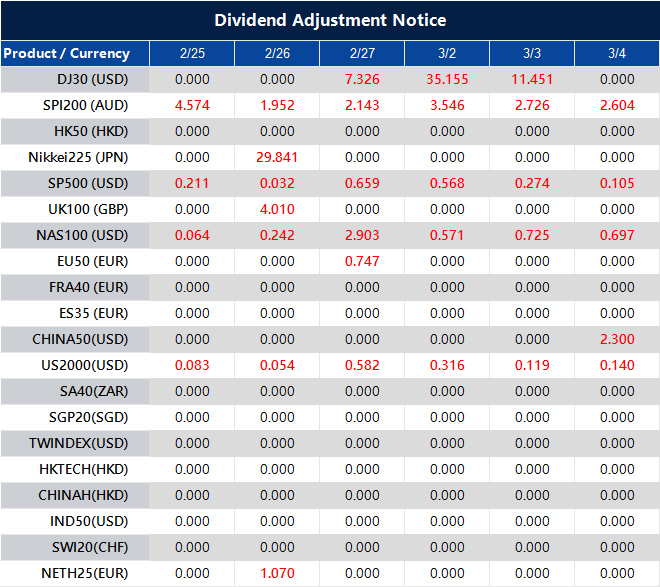
The above data is for reference only, please refer to the MT4/MT5 software for specific data.
If you’d like more information, please don’t hesitate to contact [email protected].
FXStreet data shows gold prices in the Philippines rose during Wednesday trading
Gold prices in the Philippines rose on Wednesday, based on FXStreet data. Gold was priced at PHP 9,588.53 per gram, up from PHP 9,555.42 on Tuesday.
Per tola, gold increased to PHP 111,838.70 from PHP 111,452.50 a day earlier. Other listed prices were PHP 95,885.27 for 10 grams and PHP 298,236.80 per troy ounce.







