Back

GBP/USD nears 1.3400, climbing as a Iran ceasefire boosts risk appetite and weakens the US Dollar

GBP/USD rose from the low 1.3200s to a session high near 1.3400 after President Trump announced a two-week pause in military operations against Iran. The pair moved into the upper 1.3300s and traded above the 50 and 200-period hourly moving averages.

Markets shifted towards risk assets as WTI crude fell from above $106 to below $90 per barrel. S&P 500 futures gained over 1%, while the US Dollar Index (DXY) slipped back towards 100.00.

Uk Data And Pmi Weakness

UK data was weaker, with the final March services PMI revised to 50.5 from 51.2 and down from February’s 53.9. The composite PMI fell to 50.3, with new work dropping for the first time since November 2025 and input cost inflation at an eleven-month high.

The Bank of England has held rates at 3.75% since December 2025 and voted unanimously to keep them unchanged in March. Pricing moved from two to three cuts in 2026 to four quarter-point hikes by year-end, before the ceasefire altered rate expectations.

Iran rejected a temporary ceasefire hours before the announcement, and Polymarket put the chance of a lasting ceasefire by end-April at 22.5%. Key releases include FOMC Minutes (18:00 GMT), Core PCE (12:30 GMT), and March CPI at 12:30 GMT, with CPI seen at 3.3% YoY (prior 2.4%) and core at 2.7% (prior 2.5%).

UK indicators due include Halifax House Prices, construction PMI, the BoE Credit Conditions Survey, and RICS Housing Price Balance at -18%. GBP/USD levels cited include the 200-period EMA at 1.3261, resistance near 1.3480, and a range between 1.3160 and 1.3480.

Looking back to this time in 2025, the market was reacting to the temporary ceasefire announcement, which we viewed with heavy skepticism. The surge in GBP/USD was a classic risk-on dollar selling event, but implied volatility in the options market remained high, signaling a disbelief in the truce’s durability. This is similar to the VIX index holding above 30 in early 2022 even on brief market rallies, showing that traders were still pricing in significant tail risk.

Options Volatility And Risk Hedging

The weakness in the UK economy, particularly the dismal services PMI revision to 50.5, was the critical factor for us. This stagflationary signal meant buying GBP/USD was a risky bet on a fragile currency, not just a simple play against the dollar. Therefore, many of us preferred strategies like buying GBP/USD put options to protect against a reversal, or even initiating relative value trades like shorting the pound against a stronger currency.

With major data points like the US CPI and FOMC Minutes due that week in 2025, positioning for central bank divergence was key. Historically, a surprise of just 0.2% in US Core CPI can move GBP/USD by over 40 pips almost instantly, making short-dated options that expired after the release a popular tool. This allowed us to trade the expected burst of volatility around the announcement without carrying the risk over many weeks.

The dramatic fall in WTI crude oil from over $106 to below $90 was the primary driver of the dollar weakness we saw. This tight correlation meant many of us were hedging our currency positions directly in the energy market. A common structure was to pair a long GBP/USD spot position with buying put options on WTI futures, creating a buffer in case the ceasefire collapsed and oil prices reversed sharply higher.

The technical levels mentioned at the time, such as resistance near 1.3480, were perfect for structuring options trades. We saw significant volume in weekly call options with a 1.3500 strike price, which offered a cheap way to bet on a continued rally if the positive sentiment held. At the same time, the 1.3300 level became a popular strike for put options, serving as a floor to hedge long positions against a sudden return of risk aversion.


Create your live VT Markets account and start trading now.

In February, Japan’s unadjusted current account came in at ¥3.933B, missing the ¥3,549B forecast

Japan’s current account (not seasonally adjusted) was below forecasts in February. The forecast was ¥3549B.

The actual figure was ¥3.933B. This compares directly with the stated forecast gap.

Current Account Surprise And Yen Implications

With Japan’s February current account surplus coming in at ¥3.93 trillion, well above the ¥3.55 trillion forecast, we see this as a clear signal of underlying yen strength. This positive surprise suggests robust export performance and strong returns on overseas investments flowing back into the country. Derivative traders should interpret this as a headwind for the USD/JPY pair.

This strong economic data provides more justification for the Bank of Japan to continue its policy normalization path. After we finally saw the end of negative interest rates in late 2025, another small rate hike is now more firmly on the table. This diverges from the outlook for many other central banks, creating a favorable environment for the yen.

Adding to this, we see that core inflation has remained stubbornly above the BoJ’s 2% target, with recent statistics showing it at 2.3%. This is a significant shift from the deflationary environment we experienced for years prior to 2025. This persistent inflation increases the pressure on the central bank to act sooner rather than later.

In the coming weeks, we believe traders should consider positioning for a lower USD/JPY. Buying put options on the pair with expirations in May or June could be an effective strategy to capitalize on a potential downward move. This data could be the catalyst that pushes the pair below key technical support levels.

Given the risk of verbal or actual intervention from the Ministry of Finance to manage the currency’s strength, implied volatility may rise. Therefore, strategies that benefit from increased price swings, such as long straddles, might also be worth considering. This allows traders to profit from a large move in either direction, hedging against unexpected policy announcements.

Policy Divergence And Trading Considerations

The policy divergence between a more hawkish Bank of Japan and a Federal Reserve that is holding rates steady further supports this view. We are looking at a fundamental shift that has been building over the last year. This current account surplus figure is a key piece of evidence supporting a stronger yen going forward.

Create your live VT Markets account and start trading now.

AUD/USD climbs 1.3%, rising from 0.6970 to near 0.7060 after Trump delays Iran strikes two weeks

AUD/USD rose over 1.3% on Tuesday, climbing from about 0.6970 to near 0.7060 by the close. The move followed a two-week pause in military action against Iran, and WTI fell from above $106 to below $90 per barrel.

WTI remains about 55% above its pre-war level near $58 after the late-February Strait of Hormuz disruption. AUD/USD moved back above the 200-period EMA on the four-hour chart near 0.6970, marking its strongest one-day rise in weeks.

Risk Sentiment And Oil Shock

Markets had been pricing an RBA rate move to 4.35% or higher at the May meeting amid higher energy costs. In Australia, the S&P Global Composite PMI for March fell to 46.6 from 47, while the TD-MI Inflation Gauge rose 1.3% month-on-month and the annual rate increased to 4.3% from 3.6%.

The pause was announced ahead of a midnight GMT Wednesday deadline set by President Trump. Pakistan’s Prime Minister brokered the pause, and Tehran delivered a 10-point proposal, after Iran had rejected a 45-day ceasefire earlier.

S&P 500 futures rose 1.1% and Nasdaq futures gained 1.2%, reducing US Dollar demand. February US Durable Goods Orders fell 1.4%, while the ex-transport measure rose 0.8%.

FOMC Minutes are due Wednesday, with speeches from Fed officials Daly and Waller. Traders are watching for shipping to restart through the Strait of Hormuz after four deadline changes since late February.

Technically, the Stochastic Oscillator is nearing overbought. Holding above 0.7000 may target 0.7120, while a drop back below 0.6970 may refocus attention on 0.6900.

Lessons From The April 2025 Rally

Looking back at the sharp AUD/USD rally in early April 2025 reminds us how sensitive the pair is to geopolitical shocks and shifts in risk appetite. The sudden de-escalation between the US and Iran sent oil prices tumbling, which dramatically altered the inflation outlook for the Reserve Bank of Australia. We should remain positioned for similar volatility, as any unexpected peace dividend can trigger an aggressive unwinding of safe-haven US Dollar positions.

That dynamic from last year, where falling energy prices eased pressure on the RBA, contrasts with today’s situation. The RBA has now held its cash rate steady at 4.35% for seven consecutive meetings, as the quarterly Trimmed Mean CPI has only cooled to 3.7%, still stubbornly above target. This sustained restrictive policy means any sudden drop in commodity prices could give the RBA cover to signal a dovish pivot, creating a powerful catalyst for traders using interest rate swaps to bet on rate cuts.

We learned in 2025 that headlines can spark huge rallies, but follow-through requires confirmation, which in that case was the physical resumption of shipping. Today, with the US Dollar supported by a Federal Reserve hesitant to cut rates while core PCE remains at 3.0%, we should be wary of chasing headline-driven rallies. Instead, we can use options to define our risk, such as buying short-dated AUD/USD call spreads to cheaply position for a potential upside surprise without being fully exposed if it proves to be another false dawn.

The collapse in WTI crude from over $106 to below $90 a barrel was the core driver of the 2025 move, directly impacting Australia’s terms of trade and inflation expectations. With WTI currently trading near $92 on the back of tight supply and steady global demand, the memory of last year’s 15% drop in just a few sessions is a crucial lesson. Traders holding long energy positions should consider using puts on oil futures as a portfolio hedge against a sudden geopolitical breakthrough that could once again flood the market.

Technically, the 2025 rally saw AUD/USD slice through its 200-period moving average on the four-hour chart, a key level that had been resistance. That event shows how quickly sentiment can invalidate technical patterns, turning former ceilings into new floors for price. We can apply this by setting alerts around major long-term moving averages, and if a risk-on event pushes the price through one, we can use it as a signal to initiate positions with a stop-loss just below that same average.

Create your live VT Markets account and start trading now.

Euro rises above 1.1650 as EUR/USD hits 1.1670 after Trump accepts a two-week Iran ceasefire

EUR/USD rose to about 1.1670 in early Asian trading on Wednesday, moving above 1.1650. The Euro strengthened against the US Dollar after US President Donald Trump agreed to a two-week ceasefire with Iran.

A White House official said Trump agreed to the two-week ceasefire on Tuesday, on the condition that Iran reopen the Strait of Hormuz. CNN reported that Israel also agreed to the ceasefire.

Ceasefire Developments And Market Focus

The announcement followed a proposal from Pakistan’s Prime Minister Shehbaz Sharif for a ceasefire to allow diplomatic talks between the US and Iran. Markets are watching developments around the ceasefire and wider Middle East tensions.

Later on Wednesday, attention turns to the minutes of the Federal Open Market Committee meeting. The minutes may provide detail on how officials assess the recent energy shock linked to Middle East conflicts.

Looking back at the events of 2025, we saw the EUR/USD spike above 1.1650 on the temporary US-Iran ceasefire news. That rally was a classic risk-on reaction, driven by the immediate relief of tensions in the Strait of Hormuz. The effect was short-lived, as the underlying disagreements were never resolved.

As of today in April 2026, the market has completely priced out that optimism, with EUR/USD having fallen back to a range around 1.0900. We’ve seen Brent crude prices creep back up, averaging over $92 per barrel in the first quarter of 2026, reflecting the renewed geopolitical risk premium. This sustained pressure on energy contrasts sharply with the brief dip we saw following the 2025 ceasefire announcement.

Positioning And Volatility Implications

The lesson from last year is that any diplomatic progress can cause sharp, but temporary, drops in volatility. We are seeing one-month implied volatility for EUR/USD options trading near 8.2%, up significantly from the lows of around 5.5% seen during that brief de-escalation period. Traders should consider buying options, such as straddles or strangles, to position for sharp moves in either direction as headlines continue to create uncertainty.

Last year, we noted the Federal Reserve was monitoring the energy shock, but their focus has since returned to domestic inflation and labor data. Recent inflation figures in the US for February 2026 came in at 2.8%, still stubbornly above the Fed’s target, limiting their ability to ease policy. In contrast, the European Central Bank remains more exposed to energy price volatility, creating a policy divergence that weighs on the euro.

Given this context, selling rallies in EUR/USD on any new, temporary peace headlines appears to be the prudent strategy. We can use last year’s spike to 1.1670 as a historical reference point for an extreme risk-on reaction. Using call credit spreads on the euro could be an effective way to collect premium while defining risk against another short-lived relief rally.

Create your live VT Markets account and start trading now.

In February, South Korea’s current account balance rose to 23.19B, up from 13.26B previously

South Korea’s current account balance rose in February. It increased to 23.19B from 13.26B in the previous period.

Given the massive jump in South Korea’s current account surplus, we should anticipate continued strength in the Korean won. This surplus indicates a huge demand for the won from foreign trading partners. For the coming weeks, we will be looking at long positions on the KRW against the USD through futures or options contracts.

This economic strength is largely powered by a global recovery in semiconductor demand, with recent preliminary trade data for March 2026 showing chip exports are already up 18% year-over-year. The USD/KRW exchange rate has already broken below the key 1,280 support level on this news. We see a potential move towards 1,250 in the near term.

This trend also signals a bullish outlook for the Korean stock market, particularly export-heavy giants in the tech and auto sectors. We should consider buying call options or futures on the KOSPI 200 index. These companies are the direct beneficiaries of a strong export cycle and a favorable global economic backdrop.

The size of this surplus was a surprise, which means we can expect increased volatility in currency markets leading up to the release of the March data in early May. We could use straddles on the KRW to play a big move, as the market will be pricing in either a continuation of this powerful trend or a sharp reversion. This is a significant shift from what we saw last year in 2025, when the trade balance was far more unpredictable due to fluctuating global energy prices.

That prior uncertainty in 2025 kept many traders on the sidelines. The current stability and powerful export performance suggest a much clearer directional trend for us to follow. The strength of the economy also reduces the likelihood of an interest rate cut by the Bank of Korea, which provides a fundamental floor for the won’s value.

Donald Trump announced on Truth Social a two-week pause on planned US strikes against Iran

Donald Trump posted on Truth Social that he would suspend US bombing and attacks on Iran for two weeks. He said the pause followed talks with Pakistan’s Prime Minister Shehbaz Sharif and Field Marshal Asim Munir, and was subject to Iran agreeing to the COMPLETE, IMMEDIATE, and SAFE OPENING of the Strait of Hormuz.

He described the plan as a double sided CEASEFIRE and said US Military objectives had been met and exceeded. He said the US had received a 10 point proposal from Iran, and that a two week period would allow an agreement to be finalised.

Market Reaction And Key Price Moves

After the post, US equities rose, with the S&P 500 up over 1.50% and the Nasdaq 100 up more than 1.70%. Gold also rose over 1.50%, trading at around $4,770.

WTI fell more than 7.50%, dropping from around $108 to $101 per barrel. The US Dollar Index (DXY) extended losses, down 0.47% at 99.51 at the time of writing.

The article also explains market terms “risk-on” and “risk-off”, and lists assets and currencies that often move in each environment. It notes that safe-haven moves often involve bonds, Gold, the US Dollar, the Japanese Yen, and the Swiss Franc, while AUD, CAD, NZD, RUB, and ZAR tend to rise in risk-on periods.

The announcement of a two-week ceasefire has injected a strong “risk-on” sentiment into the market, but this is built on a very fragile foundation. The immediate sharp drop in WTI crude oil and the rally in equities reflect relief, yet the situation hinges entirely on negotiations over the next fourteen days. Derivative traders must position for the binary outcome of this period, where volatility is almost a certainty.

Given the immediate 7.50% drop in WTI crude, the implied volatility in oil options has likely surged. We should consider strategies like long straddles or strangles on oil futures, which profit from a large price move in either direction without betting on the outcome of the talks. The Strait of Hormuz, a chokepoint for nearly 20% of global petroleum liquids consumption, remains the key variable, meaning a deal failure would send prices soaring well above their previous levels.

Equities Volatility And Options Positioning

For equity indices like the S&P 500, the recent spike has likely crushed the CBOE Volatility Index (VIX), making options premiums cheaper. We saw a similar pattern after the initial Russia-Ukraine de-escalation talks back in 2022, where the VIX fell over 15% in a single week. Traders who believe the ceasefire will hold could sell put spreads on the SPX, collecting premium as fear continues to recede from the market.

The US Dollar Index’s decline signals a flight from safety, which benefits commodity currencies. We should look at proxy trades for risk appetite, such as going long the Australian Dollar against the Japanese Yen (AUD/JPY). Historically, this pair shows a strong positive correlation with the S&P 500, making it an effective way to trade the broader risk-on sentiment in the FX market.

The unusual rally in gold alongside equities, pushing it toward $4,800, suggests the market is pricing in a weaker US dollar and persistent inflation rather than seeking a traditional safe haven. US CPI data from last month showed core inflation remains stubbornly above 3.5%, a trend that a peace-driven economic boom could worsen. We can use options on gold futures (GC) to bet that this inflation hedge demand will continue, even if the geopolitical risk premium fades.

Create your live VT Markets account and start trading now.

In February, South Korea’s current account balance rose from 13.26B previously to 23.19B

South Korea’s current account balance rose to 23.19B in February. This was up from 13.26B in the previous period.

The sharp rise in South Korea’s current account surplus is a strong bullish signal for the South Korean Won. This massive inflow of foreign currency puts direct upward pressure on the KRW against the US dollar. We should therefore consider positioning for a lower USD/KRW exchange rate in the coming weeks by buying Won call options or selling USD call options.

Trade Surplus Supports Equity Upside

This surplus is not an anomaly, as March’s preliminary trade data showed semiconductor exports surged by over 40% year-over-year, their eighth consecutive month of growth. A robust export sector directly boosts the earnings of major companies listed on the KOSPI index. This makes buying KOSPI 200 index futures an attractive trade to capture the broad market upside.

Such a strong external position gives the Bank of Korea more flexibility to keep interest rates firm to combat inflation, which is still hovering just above their 2% target. We remember how the BOK’s hawkish stance in late 2025 stabilized the currency during a period of global uncertainty. Therefore, the risk of a sudden dovish pivot that could weaken the Won appears low for now.

From an equity derivative standpoint, implied volatility on the iShares MSCI South Korea ETF (EWY) has been steadily declining. This makes buying call options on the ETF a cost-effective strategy to gain exposure to the strengthening Korean market. We see this as a better risk-reward than last year, when concerns over global supply chains in mid-2025 kept volatility elevated.

Lower Volatility Improves Options Pricing

Create your live VT Markets account and start trading now.

Trump announced on Truth Social that bombing plans against Iran are being postponed for two weeks

Donald Trump posted on Truth Social that the United States would suspend bombing and attacks on Iran for two weeks. He said the pause followed talks with Pakistan’s Prime Minister Shehbaz Sharif and Field Marshal Asim Munir, and was conditional on Iran agreeing to the “COMPLETE, IMMEDIATE, and SAFE OPENING” of the Strait of Hormuz.

Trump described the pause as a “double sided CEASEFIRE” and said US military objectives had been met. He also wrote that the US had received a 10 point proposal from Iran, and that many past disputes between the two countries had been agreed, with the two-week period intended to finalise an agreement.

Markets React To Ceasefire Headlines

After the post, risk appetite improved and US equities rose. The S&P 500 gained over 1.50% and the Nasdaq 100 rose more than 1.70%.

Gold climbed over 1.50% to around $4,770. WTI fell more than 7.50%, dropping from about $108 to $101 per barrel.

The US Dollar Index (DXY) extended losses by 0.47% to 99.51 at the time of writing.

We are seeing a significant drop in WTI crude oil because the potential reopening of the Strait of Hormuz eases major supply fears. This strait is a critical chokepoint; as recently as 2024, data showed it handled about 21 million barrels per day, or roughly 20% of global petroleum consumption. Given the fragile two-week nature of this ceasefire, we should look at options that profit from high volatility, as a snap-back is very possible if talks fail.

The sharp rally in the S&P 500 has likely crushed the Volatility Index (VIX), making protective options cheaper. We remember from the trade disputes back in 2019 how quickly positive sentiment could be reversed by a single message, causing volatility to spike from below 15 to above 20 in a matter of days. Buying VIX call options or puts on the SPY ETF now could serve as inexpensive insurance against this deal collapsing before the deadline.

Positioning For A Binary Two Week Outcome

We noticed that gold rallied alongside equities, which is explained by the dollar’s sharp decline, with the DXY falling below 100. Historically, a weaker dollar provides a strong tailwind for gold prices, a relationship we saw play out repeatedly during the high inflation years of 2021-2022. Any sign of the ceasefire failing would likely reverse this, strengthening the dollar as a safe haven and putting pressure on gold.

The central theme for the next two weeks is the temporary nature of this social media-announced ceasefire. The market is reacting as if peace is secured, but we should position for the binary outcome of the deadline. This suggests strategies like buying straddles or strangles on the most affected assets, like oil ETFs, to play the expected explosion in volatility rather than picking a definitive direction.

Create your live VT Markets account and start trading now.

Nikkei 225 Surges as Ceasefire Slams Oil Prices

Key Points

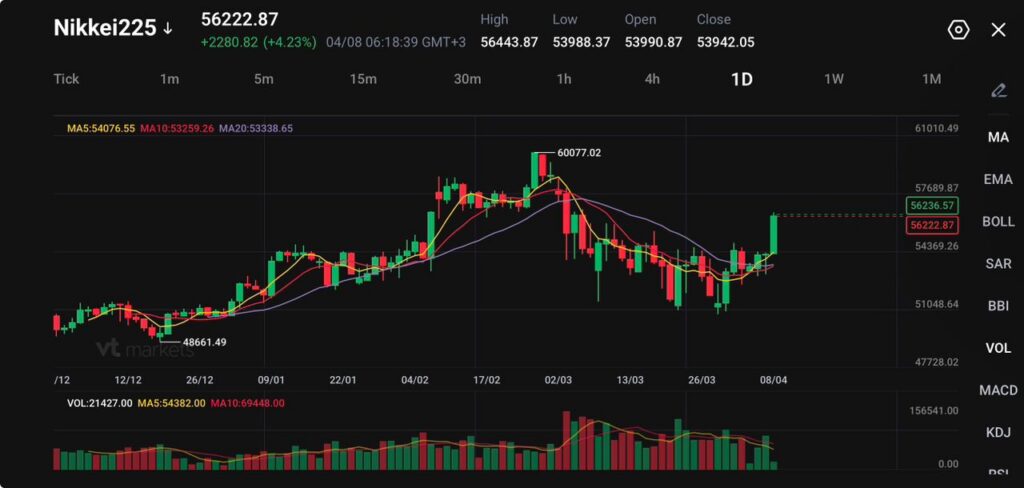
  • Nikkei 225 rose 4.96% to 56,078.83 in the morning session, while the broader move in the chart shows 56,222.87, up 2,280.82 (+4.23%).
  • A two-week ceasefire and a temporary reopening of the Strait of Hormuz triggered a relief rally across Asia and knocked back crude prices.
  • Japan posted a current account surplus of 3.933 trillion yen in February, above the 3.549 trillion yen forecast, with exports up 2.8% and imports up 9.7%.

Japanese equities jumped as traders rushed back into risk after the ceasefire announcement cut the immediate threat to Gulf energy flows. The Nikkei 225 rose 4.96% to 56,078.83 in the morning session, and the broader chart reading at 56,222.87 shows the strength of the rebound.

The move followed a sharp drop in crude after the United States and Iran agreed to a two-week ceasefire tied to safe passage through the Strait of Hormuz.

Lower oil is a direct tailwind for Japan. The country imports most of its energy, so a fall in crude reduces pressure on margins, cools imported inflation, and eases the drag on household spending. That shift supported a broad rally rather than a narrow bounce.

A cautious near-term view still favours follow-through while crude stays off the highs, though the market will keep treating the ceasefire as temporary until shipping flows normalise more clearly.

Exporters, Banks, and Chip Stocks Lead the Charge

The rebound spread across nearly every major cyclical group. Exporters rose as the drop in oil improved the macro backdrop. Financials moved higher as lower energy stress reduced immediate stagflation fears. Chip names and index heavyweights led the sharpest gains as traders rotated back into growth after last week’s risk-off trade.

In the session snapshot, SoftBank Group rose more than 6%, Fast Retailing gained almost 5%, Toyota climbed almost 4%, and Honda added more than 2%.

In technology, Advantest jumped more than 10%, Screen Holdings surged almost 8%, and Tokyo Electron advanced almost 9%. Banks also joined the move, with Sumitomo Mitsui Financial and Mizuho Financial up more than 4%, while Mitsubishi UFJ Financial gained almost 3%.

The laggards made sense too. Energy names slipped because the crude rally broke lower. Inpex fell more than 5%, while shipping stocks such as Mitsui O.S.K. Lines, Kawasaki Kisen Kaisha, and Nippon Yusen moved lower as the oil risk premium started to unwind.

With the Nikkei’s performance increasingly tied to global tech flows, traders may consider tracking key AI and semiconductor stocks available across our CFD Shares offering.

Wall Street Gave the Rally a Solid Base

The overnight lead from the United States also helped. The Nasdaq rose 0.1% to 22,017.85, the S&P 500 edged up 0.1% to 6,616.85, and the Dow slipped 0.2% to 46,584.46. That was not a runaway rally, but it was enough to keep the tone constructive going into the Asian session.

The bigger catalyst still came from the ceasefire and the drop in oil, but the US close removed one more obstacle to aggressive dip-buying.

Across Asia, the move was broad. South Korea and Taiwan surged, while Hong Kong, China, Australia, and New Zealand all traded higher. That regional strength confirmed that traders were buying the same macro theme everywhere: lower oil, lower inflation pressure, and a temporary break in the war premium.

Nikkei 225 Technical Outlook

The Nikkei 225 is trading near 56,223, staging a sharp rebound after the recent pullback that followed the rejection from the 60,077 high.

Price action shows strong bullish momentum returning, with a wide bullish candle breaking out from the recent consolidation range and pushing back above key moving averages.

This move suggests buyers are stepping back in aggressively after the correction phase seen through March.

From a technical standpoint, the structure is shifting back toward bullish. Price has reclaimed the 5-day (54,076) and 10-day (53,259) moving averages, both of which are now turning higher and providing immediate support.

The 20-day (53,338) is also flattening and beginning to slope upward, indicating that downside pressure is fading and momentum is rebuilding. The recent push higher signals a potential trend continuation if price can sustain above current levels.

Key levels to watch:

  • Support: 54,300 → 53,300 → 51,000
  • Resistance: 56,300 → 57,700 → 60,000

The immediate focus is on the 56,300 zone, which price is currently testing as resistance. A sustained break above this level could open the path toward 57,700, with a broader move potentially retesting the 60,000 region if momentum continues to build.

On the downside, 54,300 now acts as first support, aligning with the recent breakout area. A break below this level could signal a loss of short-term momentum and lead to a pullback toward 53,300, though such a move would likely remain corrective within the improving structure.

Overall, the Nikkei is showing strong recovery momentum after its recent dip, with buyers regaining control in the short term. If price can hold above the 54,000–54,300 region, the bias shifts back toward upside continuation, with the market potentially building toward another test of prior highs.

What Traders Should Watch Next

The next move depends on whether the ceasefire turns into stable energy flows rather than another short pause. Lower crude has done most of the heavy lifting so far.

If Hormuz traffic stays open enough to keep oil under control, the Nikkei can keep rebuilding toward the upper 50,000s. If the truce frays and crude reverses higher, the same sectors driving today’s rally could give back ground quickly.

Learn more about trading Indices on VT Markets today.

Trader Questions

Why Did the Nikkei 225 Jump So Sharply?

The rally came after a two-week ceasefire and a temporary reopening of the Strait of Hormuz reduced immediate energy-supply fears. Lower oil prices improved the outlook for Japan, which imports most of its energy, and that helped trigger a broad risk-on move across the region.

Why Does Falling Oil Help Japanese Stocks So Much?

Lower crude prices reduce imported energy costs, ease inflation pressure, and improve the outlook for household spending and corporate margins. That tends to support the Nikkei more than many other major indices because Japan is highly exposed to external energy prices.

Why Did Exporters, Chip Stocks, and Banks Lead the Rally?

Exporters benefited from an improving macro backdrop, chip stocks tracked stronger risk appetite and growth expectations, and banks gained as the market moved away from the worst stagflation fears. The move was broad enough to lift most cyclical sectors together rather than just one narrow theme.

Why Did Energy Stocks Lag the Nikkei?

Energy names weakened because the same drop in oil that helped the broader index reduce earnings support for producers and oil-linked shares. That is why stocks such as Inpex moved the other way while the rest of the market rallied.

What Did the Current Account Data Add to the Story?

Japan posted a 3.933 trillion yen current account surplus in February, above the 3.549 trillion yen forecast. Exports rose 2.8%, imports rose 9.7%, and the trade balance showed a 267.6 billion yen surplus. That data added to the sense that Japan’s external position was holding up better than feared.

Start trading now – Click here to create your real VT Markets account

TD Securities expects the RBNZ to hold rates, urging patience on supply shocks amid slack economic conditions

TD Securities’ Global Strategy Team expects the Reserve Bank of New Zealand to keep the Official Cash Rate unchanged at its next meeting, in line with market expectations.

The team expects the RBNZ to communicate a patient approach to supply shocks while the economy is operating below capacity.

Market Pricing And Policy Signals

It reports that markets are pricing in more than 75 basis points of interest-rate rises in 2026, and says it will review that pricing against what the RBNZ communicates.

The team plans to read the meeting Minutes for any indication that the RBNZ could shift towards bringing forward rate rises.

The article states it was produced with the assistance of an artificial intelligence tool and reviewed by an editor.

We believe the market is misinterpreting the Reserve Bank of New Zealand’s intentions. Current market pricing is factoring in more than 75 basis points of hikes for 2026, which seems excessive. We expect the RBNZ to hold the Official Cash Rate and communicate a need for patience.

Implications For Traders And Nzd

This view is supported by the latest economic data. Inflation has been steadily cooling from the stickier levels we saw through 2025, with the latest Q1 2026 figures showing CPI at 3.1%. Furthermore, recent GDP data showed the economy expanded by only 0.2%, confirming that it is operating below its potential and is sensitive to further tightening.

For derivatives traders, this suggests a strategy of positioning against the market’s aggressive rate hike expectations. This could involve using overnight index swaps or options to bet that the OCR path will be much lower than currently priced in. The core of the trade is that the central bank will use its statement to push back against current market assumptions.

This dovish stance should also weigh on the New Zealand dollar. We saw a similar pattern in 2025 when the RBNZ signaled a pause, causing the NZD/USD to weaken considerably over the following weeks. Options strategies that would profit from a falling Kiwi dollar could therefore be advantageous.

The primary risk is a surprise hawkish tone in the upcoming meeting Minutes. We will be looking for any signs that the Bank’s concern over persistent domestic inflation is starting to override its worries about weak economic growth. Such a change would indicate that earlier rate hikes are, in fact, back on the table.

Create your live VT Markets account and start trading now.

Back To Top
server

Hello there 👋

How can I help you?

Chat with our team instantly

Live Chat

Start a live conversation through...

  • Telegram
    hold On hold
  • Coming Soon...

Hello there 👋

How can I help you?

telegram

Scan the QR code with your smartphone to start a chat with us, or click here.

Don’t have the Telegram App or Desktop installed? Use Web Telegram instead.

QR code