



During Asian trading, USD/CAD slips toward 1.3695 as rising crude prices boost the Canadian dollar
USD/CAD slipped to around 1.3695 in Asian trading on Thursday. Higher crude oil prices supported the Canadian dollar, as Canada is a major oil exporter. Oil prices climbed on ongoing tension between the US and Iran.
Canada’s CPI inflation eased to 2.3% year over year in January, down from 2.4% in December, according to Statistics Canada data released Tuesday. The figure missed the 2.4% market forecast, which increased expectations of another Bank of Canada rate cut.
Australia’s part-time employment fell by 32.7K from a 10.4K increase, signalling a downturn in hiring trends
Australia’s part-time employment fell by 32.7K in January. The previous figure was 10.4K.
That’s a 43.1K swing from the prior month. It shows a shift from growth to a decline in part-time jobs.
Labor Market Warning Sign
January’s sharp drop in part-time employment is a clear warning sign for the Australian economy. This is not a small pullback. It is the largest monthly fall in part-time roles in more than a year and suggests businesses are becoming more cautious about hiring. This data also challenges the view that the labor market stayed resilient through most of 2025. This softer labor market will likely push the Reserve Bank of Australia (RBA) toward a more cautious, or dovish, stance. Inflation eased to 3.4% in the final quarter of 2025, and this employment report strengthens the case for the RBA to pause any plans for further rate hikes. Derivative markets may now price in a lower peak for the cash rate in this cycle. For currency traders, this may increase downside pressure on the Australian dollar, especially against the US dollar. If the RBA turns more cautious while the US Federal Reserve stays focused on inflation, the interest rate gap becomes less supportive for the AUD. Traders may look at put options on AUD/USD futures to hedge against a move back toward 0.6400, a level last tested in late 2024. In rates markets, a rally in government bond futures could push yields lower. The Australian 3-year government bond futures (YT) are worth watching because they respond quickly to changes in cash rate expectations. If markets start to rule out future rate hikes, these contracts could rise in the next few sessions.ASX 200 Options Outlook
The outlook for the ASX 200 is more mixed, which can create opportunities for options traders. A weaker economy can hurt corporate earnings, but lower interest rates for longer can support equity valuations. This push-and-pull may lift volatility, making strategies like buying straddles on the XJO index attractive for traders expecting a large move in either direction. Create your live VT Markets account and start trading now.Australia’s participation rate hit 66.7%, falling short of the 66.8% forecast in January’s labour market report
Australia’s participation rate was 66.7% in January. This was slightly below the market expectation of 66.8%.
A participation rate that misses expectations by a small margin can signal a cooling labour market. If the labour market is easing, wage growth may slow too. That, in turn, can reduce inflation pressure. For us, this lowers the chance of near-term interest rate hikes from the Reserve Bank of Australia.
Dovish Rba Positioning
Traders may want to position for a more dovish RBA through interest rate derivatives. The market has already moved in this direction. Pricing for the RBA cash rate now implies less than a 15% chance of a hike by mid-year, down from more than 30% last month. We see value in strategies that benefit if the RBA holds rates steady or begins to signal cuts. This shift in rate expectations also affects the Australian dollar, making it less attractive to hold. A softer labour market could pull AUD/USD, now around 0.6580, down toward key support levels. We think short AUD exposure via futures, or buying put options, is a reasonable approach in the weeks ahead. For equity index derivatives, the picture is less clear. Lower rate expectations can support the ASX 200. However, weaker labour data can also point to a broader slowdown, which could hurt earnings. With these forces pulling in different directions, we expect implied volatility to rise. That makes options strategies that benefit from larger moves more appealing. Looking back to 2025, a tight labour market pushed the RBA into multiple rate hikes to fight inflation. This January reading is one of the first clearer signs that those earlier policy moves may be working. It supports the view that the hiking cycle is over.Next Key Data Watch
Our focus now shifts to the next monthly CPI indicator release. If inflation also comes in soft, it would confirm the message from labour data and likely increase expectations for RBA rate cuts later this year. We will watch that release closely and adjust our positions as needed. Create your live VT Markets account and start trading now.Nasdaq Recovers As Technology Strength Bolsters Asian Markets
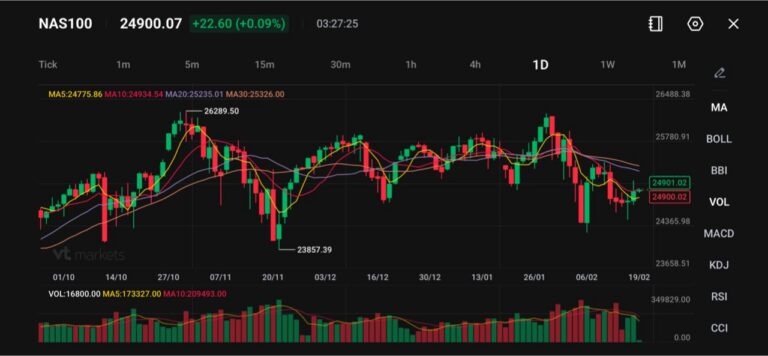
Asian equities moved higher following a firm rebound in US technology shares, while encouraging US economic figures provided additional support to Wall Street.
The Nasdaq 100 advanced by 0.8%, with the S&P 500 adding 0.6%, helping to steady market sentiment after recent swings linked to concerns over artificial intelligence-driven earnings disruption.
The MSCI Asia Pacific Index posted gains for a second consecutive session. Markets in Australia and Japan rose, and South Korea’s main index reached a fresh record high.
Activity across parts of the region was subdued, however, as mainland China, Hong Kong and Taiwan remained closed for the Lunar New Year holiday.
The recovery in US technology stocks suggests investors are revisiting earlier anxieties surrounding AI-related profit pressures. Some institutional participants have started selectively rebuilding positions after the recent correction.
Firm US Data Underpin Risk Appetite
Confidence was further supported by solid US economic releases. Industrial production recorded its strongest rise in January, orders for business equipment in December exceeded expectations, and housing starts climbed to their highest level in five months.
Together, these indicators point to sustained growth momentum at the outset of 2026.
Nonetheless, bond markets signalled a degree of caution. A $16 billion auction of 20-year US Treasuries met with tepid demand, and Treasury prices weakened during the New York session. The dollar index rose 0.5% on Wednesday, although it edged lower against most Group-of-10 currencies during Asian trading hours.
Technical Analysis
The NAS100 is trading near 24,900, holding modest gains but remaining confined within a broader consolidation range after failing to retake the late-January highs around 26,300.
Daily price action appears uneven, with a series of lower highs forming since the recent peak, indicating that upward momentum has moderated.
The index is currently positioned just beneath the 20-day moving average (25,235) and the 30-day moving average (25,326), while the shorter-term 5-day (24,776) and 10-day (24,934) averages are flattening.
This configuration points to a neutral-to-soft bias, as the market struggles to generate sustained upside continuation. Immediate resistance lies within the 25,200–25,300 range, where several moving averages converge. Near-term support is located around 24,350, followed by the November swing low region near 23,850.
A clear break above 25,300 would indicate a revival of bullish momentum and reopen the route towards 26,000 and higher. Conversely, an inability to reclaim that area may leave the index range-bound, with downside pressure building should 24,350 fail to hold.
Cautious Outlook
While resilient US economic data continue to underpin risk assets, rising yields and uneven bond demand suggest markets remain attentive to inflation and policy uncertainties. The next decisive move is likely to depend on whether economic strength can persist without triggering renewed inflationary pressures.
In January, Australia’s full-time employment eased to 50.5K from 54.8K in the previous month
Australia’s full-time employment rose by 50.5K in January. This was lower than the 54.8K increase in the previous period.
This means full-time job growth slowed compared with last month. No other figures were included in the release.
Cooling Signals In Full Time Jobs
The January full-time employment data suggests the Australian labor market is cooling slightly. Job growth is still strong, but the smaller gain shows that momentum may be easing. This may be an early sign that tighter financial conditions are starting to affect the economy. This result also lowers pressure on the Reserve Bank of Australia (RBA) to raise rates again soon. Recent CPI data, with headline inflation easing to 3.1%, supports the idea that the RBA is more likely to cut rates next than hike. We expect markets may start pricing in a more dovish central bank. For currency traders, this could point to a weaker Australian dollar. We saw a similar pattern in mid-2025, when softer labor reports came before a noticeable fall in AUD/USD. Traders may consider put options or short positions in AUD futures to position for AUD weakness. In the bond market, Australian government bond yields may fall as expectations for further rate hikes fade. This could create opportunities in interest rate derivatives, such as receiving fixed in interest rate swaps. Traders may position for the cash rate to stay on hold or be cut later in the year.Market Implications Across Assets
Volatility in the ASX 200 could rise as investors weigh mixed signals. A less aggressive RBA can support equities, but a slowing economy may weaken earnings outlooks. This backdrop may suit strategies such as buying straddles on the XJO, which can profit from large moves in either direction. Create your live VT Markets account and start trading now.Australia’s seasonally adjusted unemployment rate fell to 4.1% in January, beating forecasts of 4.2%
Australia’s seasonally adjusted unemployment rate was 4.1% in January. This was lower than the expected 4.2%.
This means the actual figure was 0.1 percentage points below the forecast. The data is for January and is seasonally adjusted.
Implications For RBA Policy
January’s unemployment rate came in at 4.1%, beating the market’s 4.2% expectation. This suggests the labour market remains strong and is not slowing as many had expected. As a result, the Reserve Bank of Australia (RBA) is more likely to keep rates unchanged, since a tight jobs market can support faster wage growth and keep inflation higher. The rates market reacted quickly. The chance of an RBA rate cut by August has now dropped to below 40%, down from almost 60% yesterday. Combined with quarterly CPI still above the target at 3.8%, this forces investors to rethink how soon policy easing will arrive. Derivatives traders may expect higher short-term yields and adjust positions to reflect that. Higher rates for longer could support the Australian dollar. A similar move happened in mid-2025, when a run of strong economic data helped AUD/USD rally for several weeks. This supports a case for positioning for further AUD strength, such as through call options or long futures. For equity derivatives, the picture is less clear. A strong economy can help company earnings, but delayed rate cuts can raise borrowing costs and pressure valuations. This could create headwinds for the ASX 200 in the near term. Hedging, such as buying put options, may help protect against potential downside.Equity Derivatives Considerations
Create your live VT Markets account and start trading now.EUR/USD slips to around 1.1785 as hawkish Fed minutes lift the dollar and boost rate-hike expectations
EUR/USD slipped below 1.1800 to around 1.1785 in early Asian trade on Thursday. The move came after the US Dollar strengthened following hawkish Federal Reserve meeting minutes.
The January FOMC minutes showed that almost all members supported keeping rates unchanged, while a couple favored a cut. Officials said cuts are still possible if inflation falls as expected. However, several warned that rate hikes may be needed if price pressures continue.
Lagarde Exit Speculation
The Financial Times reported that ECB President Christine Lagarde may step down before her term ends in October 2027. The report said she wants to give French President Emmanuel Macron and German Chancellor Friedrich Merz a chance to choose her successor. No timeline was provided. Markets will watch preliminary PMI data from Germany and the Eurozone on Friday. Stronger readings could help limit near-term losses in the Euro. The Euro is used by 20 EU countries in the Eurozone. It accounted for 31% of global FX turnover in 2022, with average daily turnover above $2.2 trillion. EUR/USD is estimated to make up 30% of all FX transactions, followed by EUR/JPY at 4%, EUR/GBP at 3%, and EUR/AUD at 2%. The ECB, based in Frankfurt, sets policy to keep inflation near its 2% target and meets eight times a year. The four largest euro-area economies produce about 75% of total Eurozone output.Policy Divergence Focus
At this point in 2025, markets were reacting to hawkish Fed minutes that hinted at further rate hikes. That helped push EUR/USD below 1.1800, while investors also faced uncertainty about ECB leadership. Today, the story has changed. Markets are now focused on policy divergence, not a shared tightening cycle. The Fed’s tone has softened a lot since early 2025. With the latest US CPI for January 2026 at 2.8%, the Fed is signaling a long pause. Compared with last year, this suggests the US dollar has less upside from surprise rate moves. In Europe, the ECB faces a different setup. Eurozone HICP inflation is still high at 3.1% as of January 2026. At the same time, the Eurozone Composite PMI has moved back into expansion at 50.5. Together, these factors may keep pressure on the ECB to stay relatively hawkish. Talk about leadership succession has faded, but it remains a background risk that could return. With this policy gap developing, traders may look at strategies that could benefit if the Euro rises gradually against the US dollar. One approach is selling out-of-the-money EUR/USD puts to collect premium, assuming the pair finds support from a patient Fed. Traders may also look for chances to buy call spreads to target a steady move higher, while limiting risk if ECB leadership concerns return. Create your live VT Markets account and start trading now.Foreign investors bought ¥1B of Japanese shares, down sharply from ¥543.2B previously
Japan recorded ¥1 billion of foreign investment in Japanese stocks on 13 February.
This compares with ¥543.2 billion in the previous period.
Foreign Sentiment Shifts Sharply
Foreign investment in Japanese stocks fell sharply to just ¥1 billion. That is a steep drop from the ¥543.2 billion inflow seen the week before. A move this fast can signal that overseas funds are taking profits and stepping back after a strong run. The reversal follows the Nikkei 225 moving above 41,000 in January, ending a powerful rally we tracked through 2025. Recent Bank of Japan comments about moving toward more normal policy may have unsettled investors. Markets are now placing higher odds on an interest rate hike happening sooner than expected. Inflation is also staying high. The latest core CPI is 2.8%, which is above the central bank’s target. At the same time, the yen has strengthened, with USD/JPY dropping into the low 140s. A stronger yen can reduce earnings for major Japanese exporters. Together, these factors can make it harder for the stock market to keep rising. For derivatives traders, this may be a period to look at defensive or bearish positions in the weeks ahead. Buying Nikkei 225 put options is one direct way to prepare for a potential decline. The sudden change in capital flows can also lift implied volatility, which may make strategies like long straddles more appealing. It is also worth recalling a similar, but smaller, increase in foreign outflows in late 2024. That was followed by a market pullback of nearly 10% over the next couple of months. History does not repeat exactly, but it can help frame the downside risks now.Key Risk Scenarios Ahead
Create your live VT Markets account and start trading now.Japan’s machinery orders jumped 19.1% month on month in December, far exceeding the 4.5% forecast
Japan’s machinery orders rose 19.1% month on month in December, well above the expected 4.5% increase.
This suggests order volumes were stronger than forecast for the month. The figures are reported on a month-on-month basis.
December Machinery Orders Signal Strong Capex
December 2025 machinery orders sent a very strong signal. The 19.1% month-over-month jump, far above the 4.5% forecast, points to faster corporate spending on equipment. In simple terms, companies appear more confident about demand and may be investing more for 2026. This supports a positive near-term view on Japanese equities. We may want to increase long exposure to Nikkei 225 futures or consider out-of-the-money call options to target further upside. The index is already up more than 6% year to date, and this report adds fundamental support for the move. The Japanese yen is also important to watch. Stronger data like this could push the Bank of Japan to adjust policy sooner than expected. It raises the chance of an interest rate hike in the first half of the year. One way to position for a stronger yen is through JPY call options or USD/JPY put options. Options-market volatility may rise after such a large surprise. When results deviate this much from consensus, markets may reprice expectations for the central bank’s next steps. A potential way to trade this is with long exposure to the Nikkei Volatility Index. It is near 18.5, which is still a moderate level given the new information.Historical Context And Key Watch Items
A monthly rise this large has not been seen since the post-pandemic rebound in 2022, which was followed by strong economic performance. That comparison suggests December may be the start of a new investment cycle, not just a one-off spike. Next, we should watch the Tankan survey and preliminary Q1 GDP closely for confirmation. Create your live VT Markets account and start trading now.In December, Japan’s machinery orders rose 16.8% year-on-year, beating the 3.9% forecast
Japan’s machinery orders rose 16.8% year on year in December, well above the expected 3.9%.
That is 12.9 percentage points higher than the forecast. The data compares December with the same month a year earlier.







