
Back

Destatis reports February German retail sales fell 0.6% monthly, contradicting forecasts for 0.2% growth

German retail sales fell again in February, based on figures from Destatis. Sales dropped by 0.6% month-on-month, compared with a forecast rise of 0.2%. January sales were revised down to a 1.1% monthly fall from -0.9%. On a year-on-year basis, retail sales rose by 0.7%, below the 1% forecast and down from the previous 1.2%.

Euro Reaction After The Release

There was no immediate move in the euro after the release. At the time of reporting, EUR/USD was slightly higher at about 1.1470. Retail sales data from Statistisches Bundesamt Deutschland track short-term changes in sales across Germany’s retail sector. The monthly percentage change is used as an indicator of consumer spending and is often monitored for possible effects on the euro. We remember looking at German retail sales data from February 2025, which showed a surprising contraction and a downward revision for the prior month. This data pointed toward weakness in the German consumer, a trend that warrants close attention. That annualized growth of only 0.7% last year was an early warning sign for the broader Eurozone economy. That pattern of consumer weakness appears to be continuing into this year. The latest data for February 2026, released just weeks ago, showed another monthly decline of 0.4%, defying expectations for a modest rebound. This confirms that the consumer spending issue we saw developing in 2025 has not yet been resolved and may be deepening.

Implications For Traders And The Euro

This persistent weakness, combined with the latest Eurozone manufacturing PMI which printed at a contractionary 47.8, puts pressure on the European Central Bank. While the March flash HICP inflation estimate held at 2.6%, the deteriorating growth outlook complicates the ECB’s policy path. We believe this increases the probability of the central bank signaling a more dovish stance in the coming months. For traders, this outlook suggests considering downside protection on the Euro. Buying EUR/USD put options with an expiry in late April or May could be a prudent way to position for a potential slide. This strategy offers a defined risk while providing exposure to any negative reaction from upcoming ECB commentary or data releases. Volatility in the currency markets may also present an opportunity. With the market uncertain about the timing of any potential ECB rate cut, options pricing may not fully reflect the risk of a sharp move. We see value in looking at short-dated volatility instruments tied to the Euro, as a surprise in either growth or inflation data could trigger a significant repricing. Specifically, with EUR/USD currently trading around 1.0830, we are monitoring key support levels. Any break below the 1.0800 psychological level could accelerate selling pressure. Therefore, puts with strike prices around 1.0750 could offer an effective hedge against a fresh downturn in the currency pair. Create your live VT Markets account and start trading now.

Start trading now – Click here to create your real VT Markets account
USD/CAD continues climbing for a seventh session, holding above 1.3920 after reaching 1.3945 in 2026

The US Dollar rose for a seventh straight day against the Canadian Dollar on Tuesday. USD/CAD held above 1.3920 after reaching a 2026 high of 1.3945 on Monday. The US Dollar trend stayed positive even as the US Dollar Index eased. Reports that President Donald Trump may seek a swift end to the war in Iran lifted risk appetite in early Asian trading.

Trump Signals Potential Iran Exit

The Wall Street Journal reported on Tuesday that Trump told close aides he is willing to end the military campaign in Iran even if the Strait of Hormuz stays largely closed. The report said he sees reopening it as extending the war beyond five or six weeks, so he would leave that for later. The report pushed the US Dollar lower against major peers as demand for safe assets eased. Asian markets fell moderately, while European and Wall Street futures pointed to a positive open. Trump repeated a threat to destroy Iran’s energy plants if Tehran does not open the Strait of Hormuz. Iran rejected US peace proposals, launched more missiles at Israel, and Kuwaiti authorities reported an attack on an oil tanker anchored at Doha harbour. On Monday, Federal Reserve Chair Jerome Powell played down expectations of an immediate rate rise and said inflation pressures are anchored for now. Treasury yields fell, adding pressure on the US Dollar.

Volatility Strategy Considerations

Given the conflicting signals, we see a high probability of sharp, unpredictable moves in the currency markets. The President’s comments on a swift end to the Iran conflict contrast sharply with the Fed’s dovish stance, creating an environment ripe for volatility. Derivative traders should consider strategies that profit from a large price swing, regardless of the direction. We are seeing implied volatility on USD/CAD one-month options surge to levels not seen since the energy market turmoil in 2025. This indicates the market is pricing in a significant move as traders hedge against both a sudden peace deal or a major escalation in the conflict. Buying options, such as a straddle, could be an effective way to position for this uncertainty. The situation is further complicated by oil prices, with West Texas Intermediate (WTI) crude currently holding above $95 per barrel due to the risk in the Strait of Hormuz. Normally, this would strengthen the Canadian dollar, but the overwhelming safe-haven demand for the US dollar is overriding this effect. A sudden resolution in Iran could cause both oil prices and the USD to fall simultaneously, leading to a complex reaction in USD/CAD. The Fed’s recent communication adds another layer of risk for those holding long US dollar positions. According to the CME’s FedWatch tool, futures markets are now pricing in less than a 10% chance of an interest rate hike by June, a dramatic reversal from over 50% just last month. This dovish shift could quickly undermine the dollar’s strength if geopolitical tensions ease even slightly. This reminds us of market reactions during the initial phases of past Middle East conflicts, where sharp risk-off rallies were often followed by equally sharp reversals on news of de-escalation. The current situation, with Trump’s rhetoric on one hand and ongoing missile attacks on the other, creates the perfect setup for a whipsaw market. We should therefore be prepared for the USD/CAD pair to violently reverse its recent gains. Create your live VT Markets account and start trading now.

Start trading now – Click here to create your real VT Markets account

Danske Bank expects Japanese inflation to rise, boosting prospects of a BoJ rate hike in April

Tokyo’s March core CPI rose 1.7% year on year, below forecasts, as fuel subsidies reduced the impact of higher costs. An index excluding fresh food and fuel rose 2.3% after a 2.5% increase in February. Higher oil prices and a weaker yen are expected to push inflation up. Markets are pricing a 70% chance of a Bank of Japan rate rise in April, with Governor Kazuo Ueda indicating that action is possible.

Growth Data And Near Term Context

February figures showed a 2.1% month-on-month fall in factory output and a 0.2% year-on-year drop in retail sales. These data are described as less relevant to current conditions. The Q1 Tankan business survey is due next and is expected to inform the Bank of Japan ahead of its policy meeting. Rising energy costs and yen weakness may reduce household purchasing power and weigh on the recovery. We see the market pricing a high probability of a Bank of Japan rate hike in April, driven by rising oil prices and a persistently weak yen. With USD/JPY having recently tested the 152 level, similar to the situation back in 2024, the pressure on the central bank to act is immense. Traders should consider buying puts on USD/JPY or establishing call spreads on the JPY to position for a potential strengthening of the currency. The anticipation of this policy shift has pushed up implied volatility on yen currency pairs, making options more expensive. As of this morning, three-month implied volatility on USD/JPY is sitting near 9.5%, a significant jump from the lows we saw at the end of 2025. This suggests that while a hike is expected, the magnitude of the market’s reaction remains a key uncertainty.

Rates Positioning And Risk Assets

In the rates market, we are positioning for a steeper yield curve by selling short-term Japanese Government Bond (JGB) futures. This is a direct play on the Bank of Japan lifting its policy rate, a move that would echo the historic decision in March 2024 to end negative interest rates. Any hawkish surprise in the upcoming Tankan survey will only accelerate this repricing. For equities, a rate hike could create headwinds for the Nikkei 225, which has been hovering near all-time highs above 40,000 points. We are hedging long equity portfolios by purchasing out-of-the-money puts on Nikkei futures. Looking back at the market’s initial wobble after the 2024 hike, we see a precedent for short-term weakness even if the long-term trend remains positive. These pressures are not happening in a vacuum, as WTI crude oil is now firmly above $85 per barrel, directly feeding into inflation and squeezing consumer spending. The drop in February retail sales, although dated, highlights the fragility of the consumer. This combination of external cost pressures and a weak currency gives the Bank of Japan very little room to remain accommodative. Create your live VT Markets account and start trading now.

Start trading now – Click here to create your real VT Markets account

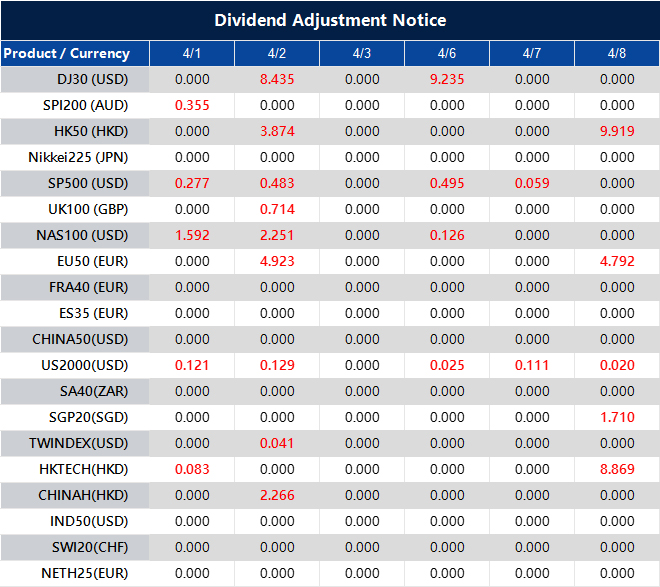
Dividend Adjustment Notice – Apr 01 ,2026

Dear Client,

Please note that the dividends of the following products will be adjusted accordingly. Index dividends will be executed separately through a balance statement directly to your trading account, and the comment will be in the following format “Div & Product Name & Net Volume”.

Please refer to the table below for more details:

Dividend Adjustment Notice

The above data is for reference only, please refer to the MT4/MT5 software for specific data.

If you’d like more information, please don’t hesitate to contact [email protected].

Silver remains above $72, easing from mid-$73 highs; bears dominate below the 100-day SMA

Silver (XAG/USD) pulled back from a four-day high in the mid-$73.00s reached on Tuesday. It traded just above $72.00 in early European hours, up 3.0% on the day and rising for a third session. The near-term setup stays bearish while price remains below the 100-day Simple Moving Average (SMA) near $75. The 100-day SMA is rising but is acting as resistance, as silver moves towards the 200-day Exponential Moving Average (EMA) near $63.

Bearish Momentum Signals

Momentum signals point lower, with the MACD (12, 26, 9) below its signal line and in negative territory, and a weak histogram. The Relative Strength Index (RSI) is 41.83, below 50, indicating ongoing selling pressure rather than oversold conditions. Support is near $69.00, with the recent low at $67.85 underneath. A break below this zone may open a move towards $63.00, where the 200-day EMA is located. Resistance is around $75.00, where the 100-day SMA meets a prior breakdown area. A daily close above $75.00 could reduce bearish pressure and leave $80.00 as the next barrier. The note states the technical analysis was produced with help from an AI tool.

Trading Implications And Key Risks

Given the technical pressure on silver, we should view the current rally toward the mid-$73.00s as a potential selling opportunity. The $75.00 level, where the 100-day moving average sits, represents a formidable ceiling. For derivative traders, this suggests establishing short positions or buying put options on any sign of weakness below this key resistance in the coming days. This bearish view is supported by the broader economic environment, as the latest US inflation figures for February 2026 came in slightly above expectations at 3.4%. This data makes it less likely the Federal Reserve will rush to cut interest rates, which provides underlying support for the US dollar. A stronger dollar is typically a headwind for silver prices, reinforcing the negative technical signals. We are also seeing sentiment turn against precious metals, as the most recent Commitment of Traders report shows managed money has been cutting its net long exposure to silver futures. In addition, major silver-backed ETFs have recorded net outflows of over 12 million ounces in the first quarter of 2026, indicating that investment demand is softening. This lack of buying interest from large players makes a sustained rally less probable. A potential strategy is to target a move down to the initial support area around $69.00. We recall a similar technical pattern in the third quarter of 2025, where a failure at the 100-day SMA led to a quick retest of lower support levels. If the $67.85 low is breached, the primary target becomes the 200-day average near $63.00, which offers a more attractive risk-reward for bearish plays. The main risk to this outlook is a decisive daily close above the $75.00 resistance zone. Such a move would invalidate the current bearish structure and could force a quick covering of short positions, potentially pushing prices toward the $80.00 barrier. Therefore, any short positions should have a defined stop-loss just above the $75.00 mark to manage this risk effectively. Create your live VT Markets account and start trading now.

Start trading now – Click here to create your real VT Markets account

Standard Chartered says BOJ inflation meets target; as USD/JPY nears 160, earlier rate rises look likelier

New Bank of Japan data indicate underlying inflation is near or above the target and the output gap is positive. With USD/JPY testing 160, the risk of a Bank of Japan rate rise before Standard Chartered’s Q3 baseline has increased. Standard Chartered says there is still a high hurdle for the Bank of Japan to meet market expectations of two rate hikes in 2026. The bank also notes that market pricing for roughly two Bank of Japan hikes by December stayed stable in March.

Rising Volatility Risks Around Usd Jpy

The analysis points to policy remaining accommodative, using a benchmark rate of 0.75% that is below the estimated neutral rate range. It links this backdrop to bear steepening in the 2Y/10Y Japanese government bond spread since the outbreak of the war, reflecting inflation risks tied to higher fuel costs. It contrasts this with other developed markets, where 2Y/10Y spreads have mostly bear flattened. That pattern is attributed to policy rate increases being priced back in after the recent oil price shock. The article states it was produced with the help of an AI tool and reviewed by an editor. With USD/JPY now testing the 160 level, the risk of a Bank of Japan (BoJ) rate hike coming sooner than our Q3 expectation has grown significantly. We are watching for a potential spike in currency volatility, especially recalling the Ministry of Finance’s interventions back in 2024 when the pair crossed similar thresholds. As of this morning, the pair is trading around 159.85, putting immense pressure on policymakers.

Potential Boj Hike Timeline

The BoJ is falling behind the curve, and recent data supports this view. The latest core inflation reading for February 2026 came in at 2.3%, remaining above the bank’s 2% target, while strong Q4 2025 GDP growth of 0.5% confirms the economy has a positive output gap. With a policy rate of just 0.75%, the current monetary stance is far too loose for these conditions. For derivative traders, this situation signals an opportunity to position for increased price swings in the coming weeks. We believe buying short-dated USD/JPY options, like one-month straddles, is a sound strategy to capitalize on this building tension. This allows a trader to profit from a large move in either direction, whether from a surprise hike or a decisive break above 160. The Japanese government bond market is also sending unique signals about lingering inflation risks. We see the 2-year/10-year yield spread continuing to steepen, meaning long-term borrowing costs are rising faster than short-term ones. This is different from other developed markets, where a fear of immediate hikes is causing yield curves to flatten. Despite the drama at the 160 level, the swaps market has remained stable, pricing in roughly two rate hikes by December 2026. We remember how the BoJ moved very cautiously throughout 2025, which suggests the hurdle to meet even this pricing is high. Any action or inaction that challenges this two-hike consensus will create a significant trading opportunity. Create your live VT Markets account and start trading now.

Start trading now – Click here to create your real VT Markets account

Rabobank’s Michael Every says RBA minutes cite Middle East uncertainty, clouding rate outlook amid oil inflation risks

The Reserve Bank of Australia (RBA) said it cannot forecast the cash rate path with confidence because of uncertainty over the breadth and duration of the Middle East conflict. The minutes noted that oil price moves are a key risk to the outlook. The RBA estimated that oil staying around $100 would push headline CPI to about 5% in Q2. This would be 0.75% higher than expected in February, and the minutes said persistently higher oil prices would lift inflation more widely over time.

Policy Outlook Under Oil Price Uncertainty

A majority of policymakers considered further policy tightening likely in the near term. A minority raised concerns about the risk of stagflation. Separately, the text reported that about half a million young Australian workers will receive up to a 42% pay increase linked to changes in minimum wage rates. The article stated it was produced with help from an AI tool and reviewed by an editor. We see the RBA’s stated uncertainty playing out as we head into the second quarter of 2026. Back in 2025, we saw inflation moderate, but with Brent crude now hovering near $98 a barrel, that progress is at risk. This brings the central bank’s old forecast of 5% headline CPI directly into the spotlight for the coming months. This high degree of uncertainty suggests traders should consider buying volatility on Australian interest rate futures. The RBA is clearly split between fighting inflation and worrying about stagflation, meaning their next moves are genuinely unpredictable. This environment makes strategies that profit from a large move in either direction, rather than a specific directional bet, more appealing.

Implications For Rates Wages And Currency Markets

We cannot forget the domestic wage pressures that were flagged, which continue to be a factor. The latest data from the end of 2025 showed the Wage Price Index was still elevated at 4.2%, confirming that inflation has deep domestic roots beyond just energy costs. This gives the more hawkish members of the RBA board ammunition to argue for further tightening. For currency traders, this puts the Australian dollar in a difficult position, creating opportunities in the options market. While higher interest rates should be supportive, the risk of a sharp economic slowdown could weigh heavily on the currency. Therefore, positioning for a wider trading range in AUD/USD seems more sensible than betting on a breakout in one direction. Create your live VT Markets account and start trading now.

Start trading now – Click here to create your real VT Markets account

Destatis reports February German retail sales fell 0.6% monthly, contradicting forecasts for 0.2% growth

German retail sales fell again in February, based on figures from Destatis. Sales dropped by 0.6% month-on-month, compared with a forecast rise of 0.2%. January sales were revised down to a 1.1% monthly fall from -0.9%. On a year-on-year basis, retail sales rose by 0.7%, below the 1% forecast and down from the previous 1.2%.

Euro Reaction After The Release

There was no immediate move in the euro after the release. At the time of reporting, EUR/USD was slightly higher at about 1.1470. Retail sales data from Statistisches Bundesamt Deutschland track short-term changes in sales across Germany’s retail sector. The monthly percentage change is used as an indicator of consumer spending and is often monitored for possible effects on the euro. We remember looking at German retail sales data from February 2025, which showed a surprising contraction and a downward revision for the prior month. This data pointed toward weakness in the German consumer, a trend that warrants close attention. That annualized growth of only 0.7% last year was an early warning sign for the broader Eurozone economy. That pattern of consumer weakness appears to be continuing into this year. The latest data for February 2026, released just weeks ago, showed another monthly decline of 0.4%, defying expectations for a modest rebound. This confirms that the consumer spending issue we saw developing in 2025 has not yet been resolved and may be deepening.

Implications For Traders And The Euro

This persistent weakness, combined with the latest Eurozone manufacturing PMI which printed at a contractionary 47.8, puts pressure on the European Central Bank. While the March flash HICP inflation estimate held at 2.6%, the deteriorating growth outlook complicates the ECB’s policy path. We believe this increases the probability of the central bank signaling a more dovish stance in the coming months. For traders, this outlook suggests considering downside protection on the Euro. Buying EUR/USD put options with an expiry in late April or May could be a prudent way to position for a potential slide. This strategy offers a defined risk while providing exposure to any negative reaction from upcoming ECB commentary or data releases. Volatility in the currency markets may also present an opportunity. With the market uncertain about the timing of any potential ECB rate cut, options pricing may not fully reflect the risk of a sharp move. We see value in looking at short-dated volatility instruments tied to the Euro, as a surprise in either growth or inflation data could trigger a significant repricing. Specifically, with EUR/USD currently trading around 1.0830, we are monitoring key support levels. Any break below the 1.0800 psychological level could accelerate selling pressure. Therefore, puts with strike prices around 1.0750 could offer an effective hedge against a fresh downturn in the currency pair. Create your live VT Markets account and start trading now.

Start trading now – Click here to create your real VT Markets account

USD/CAD continues climbing for a seventh session, holding above 1.3920 after reaching 1.3945 in 2026

The US Dollar rose for a seventh straight day against the Canadian Dollar on Tuesday. USD/CAD held above 1.3920 after reaching a 2026 high of 1.3945 on Monday. The US Dollar trend stayed positive even as the US Dollar Index eased. Reports that President Donald Trump may seek a swift end to the war in Iran lifted risk appetite in early Asian trading.

Trump Signals Potential Iran Exit

The Wall Street Journal reported on Tuesday that Trump told close aides he is willing to end the military campaign in Iran even if the Strait of Hormuz stays largely closed. The report said he sees reopening it as extending the war beyond five or six weeks, so he would leave that for later. The report pushed the US Dollar lower against major peers as demand for safe assets eased. Asian markets fell moderately, while European and Wall Street futures pointed to a positive open. Trump repeated a threat to destroy Iran’s energy plants if Tehran does not open the Strait of Hormuz. Iran rejected US peace proposals, launched more missiles at Israel, and Kuwaiti authorities reported an attack on an oil tanker anchored at Doha harbour. On Monday, Federal Reserve Chair Jerome Powell played down expectations of an immediate rate rise and said inflation pressures are anchored for now. Treasury yields fell, adding pressure on the US Dollar.

Volatility Strategy Considerations

Given the conflicting signals, we see a high probability of sharp, unpredictable moves in the currency markets. The President’s comments on a swift end to the Iran conflict contrast sharply with the Fed’s dovish stance, creating an environment ripe for volatility. Derivative traders should consider strategies that profit from a large price swing, regardless of the direction. We are seeing implied volatility on USD/CAD one-month options surge to levels not seen since the energy market turmoil in 2025. This indicates the market is pricing in a significant move as traders hedge against both a sudden peace deal or a major escalation in the conflict. Buying options, such as a straddle, could be an effective way to position for this uncertainty. The situation is further complicated by oil prices, with West Texas Intermediate (WTI) crude currently holding above $95 per barrel due to the risk in the Strait of Hormuz. Normally, this would strengthen the Canadian dollar, but the overwhelming safe-haven demand for the US dollar is overriding this effect. A sudden resolution in Iran could cause both oil prices and the USD to fall simultaneously, leading to a complex reaction in USD/CAD. The Fed’s recent communication adds another layer of risk for those holding long US dollar positions. According to the CME’s FedWatch tool, futures markets are now pricing in less than a 10% chance of an interest rate hike by June, a dramatic reversal from over 50% just last month. This dovish shift could quickly undermine the dollar’s strength if geopolitical tensions ease even slightly. This reminds us of market reactions during the initial phases of past Middle East conflicts, where sharp risk-off rallies were often followed by equally sharp reversals on news of de-escalation. The current situation, with Trump’s rhetoric on one hand and ongoing missile attacks on the other, creates the perfect setup for a whipsaw market. We should therefore be prepared for the USD/CAD pair to violently reverse its recent gains. Create your live VT Markets account and start trading now.

Start trading now – Click here to create your real VT Markets account

Danske Bank expects Japanese inflation to rise, boosting prospects of a BoJ rate hike in April

Tokyo’s March core CPI rose 1.7% year on year, below forecasts, as fuel subsidies reduced the impact of higher costs. An index excluding fresh food and fuel rose 2.3% after a 2.5% increase in February. Higher oil prices and a weaker yen are expected to push inflation up. Markets are pricing a 70% chance of a Bank of Japan rate rise in April, with Governor Kazuo Ueda indicating that action is possible.

Growth Data And Near Term Context

February figures showed a 2.1% month-on-month fall in factory output and a 0.2% year-on-year drop in retail sales. These data are described as less relevant to current conditions. The Q1 Tankan business survey is due next and is expected to inform the Bank of Japan ahead of its policy meeting. Rising energy costs and yen weakness may reduce household purchasing power and weigh on the recovery. We see the market pricing a high probability of a Bank of Japan rate hike in April, driven by rising oil prices and a persistently weak yen. With USD/JPY having recently tested the 152 level, similar to the situation back in 2024, the pressure on the central bank to act is immense. Traders should consider buying puts on USD/JPY or establishing call spreads on the JPY to position for a potential strengthening of the currency. The anticipation of this policy shift has pushed up implied volatility on yen currency pairs, making options more expensive. As of this morning, three-month implied volatility on USD/JPY is sitting near 9.5%, a significant jump from the lows we saw at the end of 2025. This suggests that while a hike is expected, the magnitude of the market’s reaction remains a key uncertainty.

Rates Positioning And Risk Assets

In the rates market, we are positioning for a steeper yield curve by selling short-term Japanese Government Bond (JGB) futures. This is a direct play on the Bank of Japan lifting its policy rate, a move that would echo the historic decision in March 2024 to end negative interest rates. Any hawkish surprise in the upcoming Tankan survey will only accelerate this repricing. For equities, a rate hike could create headwinds for the Nikkei 225, which has been hovering near all-time highs above 40,000 points. We are hedging long equity portfolios by purchasing out-of-the-money puts on Nikkei futures. Looking back at the market’s initial wobble after the 2024 hike, we see a precedent for short-term weakness even if the long-term trend remains positive. These pressures are not happening in a vacuum, as WTI crude oil is now firmly above $85 per barrel, directly feeding into inflation and squeezing consumer spending. The drop in February retail sales, although dated, highlights the fragility of the consumer. This combination of external cost pressures and a weak currency gives the Bank of Japan very little room to remain accommodative. Create your live VT Markets account and start trading now.

Start trading now – Click here to create your real VT Markets account

Back To Top
server

Hello there 👋

How can I help you?

Chat with our team instantly

Live Chat

Start a live conversation through...

  • Telegram
    hold On hold
  • Coming Soon...

Hello there 👋

How can I help you?

telegram

Scan the QR code with your smartphone to start a chat with us, or click here.

Don’t have the Telegram App or Desktop installed? Use Web Telegram instead.

QR code

