


Back

Bitcoin Holds Near $67k to New Crypto Rule

Key Points

  • The US Labour Department has proposed a rule that would give 401(k) fiduciaries a process-based path to consider alternative assets, including crypto, rather than steering them away from specific asset classes.
  • BTCUSD trades near 67,504.63, up +865.24 (+1.30%), after failing to hold moves above $68,000 earlier in the week.
  • The proposal focuses on prudence, fees, liquidity, valuation methods, benchmarks, and complexity, which could support long-term institutional access without guaranteeing immediate inflows.

Although the Bitcoin market remains cautious in the near term, the policy environment has just changed in a significant way in the long run.

The US Department of Labour, through the Employee Benefits Security Administration, has proposed a regulation that would set out the steps 401(k) plan managers should take when considering alternative assets in plan menus.

The proposal also creates process-based safe harbours for fiduciaries selecting designated investment alternatives.

In simple terms, it does not tell fiduciaries to buy crypto, but it does give them a clearer route to consider it without the same level of regulatory ambiguity that weighed on the market before.

That is a meaningful shift from the department’s 2022 guidance, which urged “extreme care” around adding crypto to 401(k) plans. The department formally rescinded that 2022 guidance in May 2025, saying it had departed from ERISA’s historically neutral, principles-based approach.

This does not create an instant demand shock for Bitcoin, but it does improve the long-term policy narrative. If the rule moves forward in something close to its current form, it could gradually lower one of the institutional barriers that have limited retirement-plan adoption.

What the Rule Actually Does

The proposal is process-driven, not promotional. The Labour Department says fiduciaries would need to evaluate potential alternatives using factors such as expected performance, fees, liquidity, valuation methods, appropriate performance benchmarks, and complexity. The department also stresses that the rule is asset-class neutral.

That distinction matters for Bitcoin. It means crypto would be assessed alongside other alternatives under a prudent framework rather than singled out for unusual treatment. It also means fiduciaries still carry real responsibility. They would need to justify how any crypto-related option fits participant needs, risk controls, cost structure, and operational oversight.

For the Bitcoin market, that is more constructive than a blanket warning, but it is still far from a green light for reckless inclusion.

Larger plans and better-resourced fiduciaries may be more willing to study crypto exposure first, while smaller plans may still wait due to governance, operational, and reputational concerns.

Why This Matters for Bitcoin Even Without Immediate Buying

Bitcoin often reacts hardest to ETF flows, macro liquidity, and Fed expectations in the short term. Retirement-plan policy works differently. It changes the addressable market slowly.

A formal framework for 401(k) fiduciaries could matter because retirement assets sit in one of the deepest pools of long-duration capital in the United States. Even a small future allocation rate would change how investors think about Bitcoin’s structural demand profile.

At the same time, the market is unlikely to price all of that in at once. Fiduciaries move slowly. Committees move slowly. Consultants move slowly. Recordkeepers and plan providers move slowly. That is why this news can be strategically important without being immediately explosive for the price.

The proposal can support the “institutional maturation” story for Bitcoin over time, but traders will still need a cleaner macro backdrop before they price in a stronger, sustained move.

Technical Analysis

Bitcoin (BTCUSD) is trading near 67,500, attempting to stabilise after a sharp decline from the 97,900 high and a subsequent low around 60,000. Price action shows the market trying to base within a broad range, but upside momentum remains limited, with the pair struggling to reclaim higher ground.

From a technical standpoint, the trend is currently neutral to slightly bearish. Price is trading around the short-term moving averages, with the 5-day (67,151) and 10-day (68,635) clustered near current levels, offering little directional clarity. The 20-day (70,072) and 30-day (69,701) remain above price and are starting to flatten or slope lower, indicating that the broader trend has weakened following the earlier breakdown.
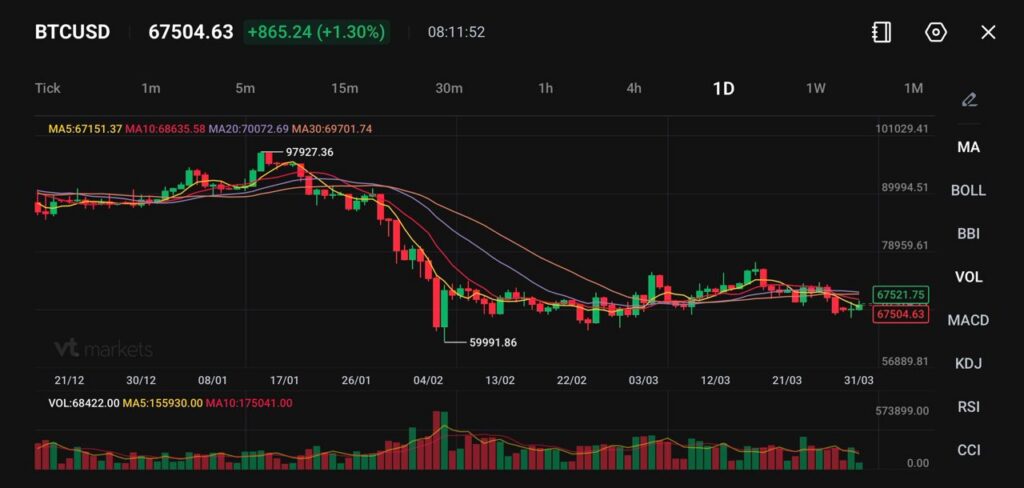
Key levels to watch:

  • Support: 65,000 → 60,000 → 58,000
  • Resistance: 68,600 → 70,000 → 72,000

Price is currently consolidating within the 65,000–70,000 range, with repeated rejections near the 68,600–70,000 zone capping upside attempts. A sustained break above 70,000 would be needed to shift momentum back toward the upside, potentially opening a move toward 72,000 and beyond.

On the downside, 65,000 is acting as immediate support. A break below this level could expose the 60,000 region, with further downside risk toward 58,000 if selling pressure accelerates.

Cautious Outlook

Overall, Bitcoin remains in a consolidation phase following its earlier correction, with price lacking strong directional conviction.

While the broader structure is not decisively bearish, the inability to reclaim higher resistance levels suggests that momentum remains fragile, and traders should watch for a breakout from the current range to guide the next move.

Create a live VT Markets account today to access our platform features, including market insights and educational content.

Trader Questions

What is the New 401(K) Crypto Proposal?

The proposal introduces a framework allowing retirement plans to consider alternative assets like Bitcoin (BTCUSD) under strict evaluation rules.

Does the Rule Allow Direct Investment in Bitcoin?

Yes, but indirectly. Plan fiduciaries can include crypto as an option if they follow a prudent, process-driven assessment.

What Are Safe-Harbour Rules in This Context?

Safe-harbour rules provide legal protection to plan managers who follow defined steps when evaluating and offering crypto investments.

What Must Fiduciaries Assess Before Adding Crypto?

They must review performance expectations, fees, liquidity, valuation methods, benchmarks, and the complexity of the asset.

Why Was Crypto Previously Limited in 401(K) Plans?

Earlier guidance discouraged crypto exposure due to regulatory uncertainty and fiduciary risk concerns.

How Does This Proposal Change the Landscape?

It shifts the focus from restricting asset classes to ensuring a disciplined evaluation process, giving fiduciaries more flexibility.

How Might This Impact Bitcoin Prices?

Greater institutional access through retirement funds could support long-term demand, though short-term moves still depend on macro factors.

Start trading now – Click here to create your real VT Markets account

Tokyo inflation excluding food and energy eased year-on-year to 1.7%, down from 1.8% previously

Tokyo’s CPI excluding fresh food and energy fell to 1.7% year on year in March. It was 1.8% in the previous reading. With Tokyo’s core inflation, excluding food and energy, easing to 1.7%, it signals that underlying price pressures are softening. This data moves inflation further away from the Bank of Japan’s 2% target, reducing the immediate need for monetary tightening. This is a significant development following the BoJ’s cautious stance throughout 2025.

Implications For Bank Of Japan Policy

This inflation reading makes another interest rate hike in the second quarter much less likely. The Bank of Japan, after finally exiting its negative interest rate policy back in March 2024, will probably favor a prolonged pause to assess the economy. A more patient central bank means Japanese interest rates will stay low for longer. For currency traders, this reinforces the case for a weaker Japanese yen. The interest rate difference between Japan and the United States remains substantial, with the Fed funds rate still well above 4%. We should therefore anticipate the USD/JPY pair climbing higher in the weeks ahead. This environment suggests that buying USD/JPY call options is a clear strategy to pursue. These options provide upside exposure to a weakening yen with a defined risk. We can target strike prices above the recent resistance levels, recalling how the pair surged during similar policy divergence back in late 2024 and early 2025. A weaker yen is also historically a powerful catalyst for Japanese stocks, as it boosts the value of overseas profits for the country’s large exporters. The Nikkei 225 has shown a strong inverse correlation with the yen, a trend that provided major tailwinds for the index through much of the last two years. As of early 2026, corporate earnings forecasts have remained robust on the assumption of a weaker currency.

Positioning In Japan Equity Markets

Therefore, we should consider bullish positions on Japanese equities through derivatives. Buying Nikkei 225 futures or using bull call spreads offers a direct way to capitalize on this expected market strength. This strategy allows us to leverage the positive impact of a dovish central bank and a favorable currency exchange rate on the stock market. Create your live VT Markets account and start trading now.

Start trading now – Click here to create your real VT Markets account

In March, Tokyo’s annual consumer price inflation in Japan eased to 1.4% from 1.6%

Japan’s Tokyo Consumer Price Index (CPI) year-on-year fell to 1.4% in March. It was 1.6% in the previous reading. This means the annual rate of price growth in Tokyo eased in March. The data compares prices with the same month a year earlier.

Implications For Boj Policy

The dip in Tokyo’s core inflation to 1.4% is a key signal for us. It suggests the Bank of Japan’s goal of sustained 2% inflation is still out of reach. We anticipate the BoJ will therefore delay any further interest rate hikes in the second quarter of 2026. This policy stance should continue to weaken the Japanese Yen, especially as interest rate differentials with other major economies remain wide. We should look at long positions in USD/JPY, as the pair has historically climbed when BoJ policy remains accommodative. Recent data showing Japan’s industrial production unexpectedly fell 0.8% last month further supports the case for a cautious central bank and a weaker currency. For the equities market, this environment is positive for the Nikkei 225. A weaker yen boosts the overseas profits of Japan’s major exporters, a significant component of the index. We saw this pattern clearly in the 2023-2024 period when the Nikkei surged over 40% while the yen depreciated. Therefore, we should consider buying call options on the Nikkei 225 index for the coming months. Implied volatility on these options is currently sitting near a six-month low of 15.2%, suggesting that the potential for an upside move is currently underpriced. This presents a favorable entry point for bullish strategies.

Trade Implementation And Risk

Create your live VT Markets account and start trading now.

Start trading now – Click here to create your real VT Markets account

March saw Tokyo CPI excluding fresh food rise 1.7% year-on-year, undershooting the 1.8% forecasted level

Japan’s Tokyo CPI excluding fresh food rose 1.7% year on year in March. The forecast was 1.8%. The result came in 0.1 percentage points below expectations. It indicates slightly slower price growth in this measure for the month.

Implications For Bank Of Japan Policy

The softer-than-expected Tokyo inflation figure of 1.7% changes our immediate outlook on the Bank of Japan’s policy path. This data point suggests that underlying price pressures are not as strong as many had anticipated. Consequently, the BoJ will likely feel less urgency to proceed with another interest rate hike in the coming quarter. We see this as a signal to reconsider short-term yen strength. After the yen rallied following the end of negative rates back in 2025, this inflation miss widens the interest rate gap with the United States Federal Reserve again. Buying USD/JPY call options with a strike price around 158 seems viable, as the pair could re-test the 160 level seen earlier this year. The 10-year JGB yield, which had climbed to 1.05% on expectations of further policy tightening, should now face downward pressure. This news reinforces the view that yields will not rise aggressively from here. We would look at positions in JGB futures to capitalize on a potential dip in yields back towards the 0.90% level.

Equity Market Effects And Trade Ideas

A weaker yen is a direct tailwind for Japan’s export-heavy Nikkei 225 index. Corporate earnings for major manufacturers get a boost from more favorable currency translation, a trend that supported the market through much of 2024 and 2025. Therefore, buying Nikkei 225 futures or call options is an attractive strategy to pursue over the next few weeks. We must still consider the strong results from the recent “shunto” spring wage negotiations, where major firms agreed to hikes averaging 5.1%. While this points to future inflationary pressure, today’s soft CPI reading suggests it is not translating into broad price increases just yet. The market will likely focus on the immediate inflation data over the forward-looking wage numbers for now. Create your live VT Markets account and start trading now.

Start trading now – Click here to create your real VT Markets account

Japan’s February unemployment rate was 2.6%, undershooting the forecast of 2.7%

Japan’s unemployment rate was 2.6% in February. This was below the expected 2.7%. The stronger-than-expected jobs data for February supports the view that the Bank of Japan has room to tighten policy further. With the unemployment rate at a low 2.6%, wage pressures are likely to build, pushing inflation towards the central bank’s target. We are therefore positioning for a more hawkish stance from the BOJ in the second quarter. This outlook strengthens the case for a stronger Japanese Yen in the coming weeks. We anticipate the USD/JPY pair, which has been hovering around the 151 level, could test support lower towards 148 as interest rate differentials narrow. Derivative traders should consider buying JPY call options or selling USD/JPY futures to capitalize on this expected move. Conversely, we see potential headwinds for Japanese equities. A stronger yen directly impacts the profitability of Japan’s large exporters, which make up a significant portion of the Nikkei 225 index currently trading near 40,500. This is especially relevant after the index’s powerful rally over the past year, making it vulnerable to a pullback on currency strength. Given this, we are looking at buying put options on the Nikkei 225 as a hedge or a direct bearish bet. Implied volatility has already risen by about 5% over the last week, suggesting the market is beginning to price in more uncertainty. This makes acting sooner rather than later a more cost-effective strategy. Looking back, we saw a similar reaction in late 2025 when the BOJ first signaled a definitive end to its most aggressive easing policies, causing a sharp but temporary spike in the yen. The current solid economic data suggests the follow-through this time could be more sustained. This reinforces our view that the primary trades will revolve around yen strength and equity market weakness.

Start trading now – Click here to create your real VT Markets account

Tokyo inflation excluding food and energy eased year-on-year to 1.7%, down from 1.8% previously

Tokyo’s CPI excluding fresh food and energy fell to 1.7% year on year in March. It was 1.8% in the previous reading. With Tokyo’s core inflation, excluding food and energy, easing to 1.7%, it signals that underlying price pressures are softening. This data moves inflation further away from the Bank of Japan’s 2% target, reducing the immediate need for monetary tightening. This is a significant development following the BoJ’s cautious stance throughout 2025. This inflation reading makes another interest rate hike in the second quarter much less likely. The Bank of Japan, after finally exiting its negative interest rate policy back in March 2024, will probably favor a prolonged pause to assess the economy. A more patient central bank means Japanese interest rates will stay low for longer. For currency traders, this reinforces the case for a weaker Japanese yen. The interest rate difference between Japan and the United States remains substantial, with the Fed funds rate still well above 4%. We should therefore anticipate the USD/JPY pair climbing higher in the weeks ahead. This environment suggests that buying USD/JPY call options is a clear strategy to pursue. These options provide upside exposure to a weakening yen with a defined risk. We can target strike prices above the recent resistance levels, recalling how the pair surged during similar policy divergence back in late 2024 and early 2025. A weaker yen is also historically a powerful catalyst for Japanese stocks, as it boosts the value of overseas profits for the country’s large exporters. The Nikkei 225 has shown a strong inverse correlation with the yen, a trend that provided major tailwinds for the index through much of the last two years. As of early 2026, corporate earnings forecasts have remained robust on the assumption of a weaker currency. Therefore, we should consider bullish positions on Japanese equities through derivatives. Buying Nikkei 225 futures or using bull call spreads offers a direct way to capitalize on this expected market strength. This strategy allows us to leverage the positive impact of a dovish central bank and a favorable currency exchange rate on the stock market.

Start trading now – Click here to create your real VT Markets account

In March, Tokyo’s annual consumer price inflation in Japan eased to 1.4% from 1.6%

Japan’s Tokyo Consumer Price Index (CPI) year-on-year fell to 1.4% in March. It was 1.6% in the previous reading. This means the annual rate of price growth in Tokyo eased in March. The data compares prices with the same month a year earlier.

Implications For Boj Policy

The dip in Tokyo’s core inflation to 1.4% is a key signal for us. It suggests the Bank of Japan’s goal of sustained 2% inflation is still out of reach. We anticipate the BoJ will therefore delay any further interest rate hikes in the second quarter of 2026. This policy stance should continue to weaken the Japanese Yen, especially as interest rate differentials with other major economies remain wide. We should look at long positions in USD/JPY, as the pair has historically climbed when BoJ policy remains accommodative. Recent data showing Japan’s industrial production unexpectedly fell 0.8% last month further supports the case for a cautious central bank and a weaker currency. For the equities market, this environment is positive for the Nikkei 225. A weaker yen boosts the overseas profits of Japan’s major exporters, a significant component of the index. We saw this pattern clearly in the 2023-2024 period when the Nikkei surged over 40% while the yen depreciated. Therefore, we should consider buying call options on the Nikkei 225 index for the coming months. Implied volatility on these options is currently sitting near a six-month low of 15.2%, suggesting that the potential for an upside move is currently underpriced. This presents a favorable entry point for bullish strategies.

Trade Implementation And Risk

Create your live VT Markets account and start trading now.

Start trading now – Click here to create your real VT Markets account

March saw Tokyo CPI excluding fresh food rise 1.7% year-on-year, undershooting the 1.8% forecasted level

Japan’s Tokyo CPI excluding fresh food rose 1.7% year on year in March. The forecast was 1.8%. The result came in 0.1 percentage points below expectations. It indicates slightly slower price growth in this measure for the month.

Implications For Bank Of Japan Policy

The softer-than-expected Tokyo inflation figure of 1.7% changes our immediate outlook on the Bank of Japan’s policy path. This data point suggests that underlying price pressures are not as strong as many had anticipated. Consequently, the BoJ will likely feel less urgency to proceed with another interest rate hike in the coming quarter. We see this as a signal to reconsider short-term yen strength. After the yen rallied following the end of negative rates back in 2025, this inflation miss widens the interest rate gap with the United States Federal Reserve again. Buying USD/JPY call options with a strike price around 158 seems viable, as the pair could re-test the 160 level seen earlier this year. The 10-year JGB yield, which had climbed to 1.05% on expectations of further policy tightening, should now face downward pressure. This news reinforces the view that yields will not rise aggressively from here. We would look at positions in JGB futures to capitalize on a potential dip in yields back towards the 0.90% level.

Equity Market Effects And Trade Ideas

A weaker yen is a direct tailwind for Japan’s export-heavy Nikkei 225 index. Corporate earnings for major manufacturers get a boost from more favorable currency translation, a trend that supported the market through much of 2024 and 2025. Therefore, buying Nikkei 225 futures or call options is an attractive strategy to pursue over the next few weeks. We must still consider the strong results from the recent “shunto” spring wage negotiations, where major firms agreed to hikes averaging 5.1%. While this points to future inflationary pressure, today’s soft CPI reading suggests it is not translating into broad price increases just yet. The market will likely focus on the immediate inflation data over the forward-looking wage numbers for now. Create your live VT Markets account and start trading now.

Start trading now – Click here to create your real VT Markets account

Japan’s February jobs-to-applicants ratio beat forecasts, rising to 1.19 against expectations of 1.18

Japan’s jobs-to-applicants ratio in February came in above expectations. The forecast was 1.18. The actual reading was 1.19. This indicates there were 1.19 job openings for each applicant during the month.

Labor Market Remains Tight

This stronger-than-expected jobs ratio for February points to a persistently tight labor market. It reinforces the view that wage pressures are building, giving the Bank of Japan more reason to continue its policy normalization path. We are now watching for a potential rate hike in the second quarter. For currency traders, this data should support the yen. We believe positioning for a lower USD/JPY is the logical move, potentially through buying put options to capitalize on a downward move. Looking back at the market reaction in late 2025 when similar strong data was released, the yen saw immediate, albeit short-lived, appreciation. On the equity side, this makes us more cautious about the Nikkei 225’s recent rally. The prospect of higher borrowing costs could weigh on stocks, so hedging long portfolios with index puts seems prudent. This is especially true given the index’s sensitivity to central bank policy that we observed throughout last year. The jobs-to-applicants ratio has now remained above the 1.15 level for over a year, a trend of labor tightness we have been tracking since early 2025. Combined with core inflation that has consistently stayed above the 2% target, the pressure on the central bank is mounting. This suggests that implied volatility in yen currency pairs may be too low and could rise in the weeks ahead.

Implications For Markets

Create your live VT Markets account and start trading now.

Start trading now – Click here to create your real VT Markets account

XAG/USD hovers near $70, confined between $67.50–$71.50, as neither side breaks the consolidation range

Silver has held near $70.00 for three straight trading days, moving within a $67.50 to $71.50 range. Price action remains range-bound as neither side has pushed beyond these levels. The short-term bias is slightly bearish, with resistance at the 100-day SMA of $74.11. Support is seen at the March 23 swing low of $61.02.

Silver Price Trend Outlook

After reaching $96.39 on March 2, silver formed a run of lower highs and lower lows. The decline paused when price failed to break below the $61.00 area, followed by a rebound towards $70.00 and consolidation. The RSI is bearish and remains below the 50 level. While it stays under 50, downside pressure may persist. If XAG/USD falls below $60.00, focus turns to the 200-day SMA at $57.85. Below that, levels to watch include $55.00 and then $50.00. If silver breaks above $71.50, the next resistance is the 100-day SMA at $74.11. Above $74.11, price may move towards the 20-day SMA at $77.05, then $80.00.

Key Levels And Trade Scenarios

Silver is consolidating around the $34.00 mark, trading within a tight range between $33.20 and $34.80 for the past week. This sideways movement indicates that neither buyers nor sellers have enough conviction to establish a clear direction. The market appears to be waiting for a new catalyst after the recent economic data releases. Our short-term bias is cautiously bearish, with the price capped by resistance at the 100-day Simple Moving Average (SMA) of $35.10. On the downside, silver is finding support near the March 19th low of $32.80. This technical posture suggests that the path of least resistance may be lower in the immediate term. We remember the strong rally in the last quarter of 2025, but the price has been printing lower highs since it peaked near $37.50 in February. The downtrend paused when sellers failed to push below the $32.00 level, leading to the current consolidation. This suggests the market is taking a breath and digesting those earlier gains. Adding to the pressure, the Federal Reserve’s minutes from last week signaled a “higher for longer” stance on interest rates, making non-yielding assets like silver less attractive. We have also seen silver ETF holdings drop by nearly 2% in March, showing waning investor appetite. Statistics from the COMEX show managed money traders have been reducing their net long positions. If silver breaks below the $32.80 support level, traders should consider buying puts or establishing short futures positions. The next significant area of interest would be the 200-day SMA, currently around $31.50. A failure to hold that level would likely trigger a move toward the psychological support at $30.00. On the other hand, if buyers manage to push the price firmly above the $35.10 resistance, it could signal an end to the current weakness. This would be a cue to look at call options, with an initial target at the February high of $37.50. A successful break of that resistance would bring the $40.00 milestone into view. Create your live VT Markets account and start trading now.

Start trading now – Click here to create your real VT Markets account

Back To Top
server

Hello there 👋

How can I help you?

Chat with our team instantly

Live Chat

Start a live conversation through...

  • Telegram
    hold On hold
  • Coming Soon...

Hello there 👋

How can I help you?

telegram

Scan the QR code with your smartphone to start a chat with us, or click here.

Don’t have the Telegram App or Desktop installed? Use Web Telegram instead.

QR code
