


Back

EURUSD Slips as Oil Shock Reshapes ECB Outlook

Key Points

  • EURUSD trades at 1.14696, up +0.00071 (+0.06%), but the euro ended March below $1.15 after losing more than 2% against the dollar during the month.
  • Markets now expect at least two ECB rate hikes in 2026, replacing earlier pricing that implied a 40% chance of a rate cut.
  • Rising energy costs and a largely blocked Strait of Hormuz are feeding inflation fears across Europe and weighing on the euro.

The euro closed March below $1.15, leaving the single currency close to its weakest level in nearly two weeks. The broader picture is more telling than the small day-to-day moves. Over the month, the euro lost more than 2% against the dollar as traders worked through the economic fallout from the deeper Middle East conflict.

That decline reflects a market that has become less confident in Europe’s near-term growth outlook. When energy costs rise sharply, the euro zone tends to feel the pain quickly because it remains heavily exposed to imported energy.

That mix can hurt growth, keep inflation high, and leave the euro caught between weak activity and tighter policy expectations.

If energy prices stay elevated and the conflict remains unresolved, EURUSD may struggle to build a strong rebound and could stay heavy around the mid-1.14 area.

Oil Shock Forces a Sharp Rethink on ECB Policy

The biggest shift this month has been in rate expectations. Soaring oil prices have pushed inflation fears higher across Europe, and that has forced markets to radically reprice the European Central Bank path.

Investors now anticipate at least two interest rate hikes in 2026. Earlier, the market had been pricing a 40% chance of a rate cut instead. That is a sharp swing in expectations, and it tells you just how much the energy shock has changed the tone.

In theory, more rate hikes should help the euro. In practice, the euro has still weakened because the market sees the hikes as defensive rather than growth-positive. Tighter policy in response to an oil shock does not necessarily improve the outlook for risk assets or the currency if the economy is also slowing.

French central bank chief François Villeroy de Galhau reinforced that cautious tone by saying the ECB remains committed to containing energy-driven inflation, but also warned it is “too early” to say when any move will come.

If ECB officials keep sounding worried about inflation but reluctant to commit on timing, EURUSD may remain range-bound rather than stage a clean recovery.

Middle East Tensions Keep Pressure on the Euro

Geopolitics remains at the centre of the move. A Wall Street Journal report said former US President Donald Trump had signalled a possible end to the US military campaign against Iran, even if the Strait of Hormuz remained largely blocked.

That is important because the market is no longer trading just the risk of war. It is trading the risk of an energy bottleneck that may outlast the most intense phase of direct military action. A blocked or partially blocked Strait keeps freight, insurance, and crude costs elevated. Europe feels that quickly.

This helps explain why the euro has not benefited much from any relief headlines. Traders are looking past diplomatic tone and focusing on physical energy flows.

Even if the conflict cools at the political level, EURUSD may stay under pressure if oil routes remain disrupted and inflation stays sticky.

Technical Analysis

EURUSD is trading near 1.1470, hovering just above recent lows as the pair struggles to recover from its broader decline following the rejection from the 1.2080 high. Price action shows continued downside pressure, with rallies failing to hold and sellers stepping in on strength, keeping the pair under sustained resistance.

From a technical standpoint, the trend remains bearish. Price is trading below all key moving averages, with the 5-day (1.1506) and 10-day (1.1535) positioned just above current levels, acting as immediate resistance. The 20-day (1.1550) and 30-day (1.1620) continue to slope downward, reinforcing the weakness in the broader structure and confirming that momentum remains tilted to the downside.
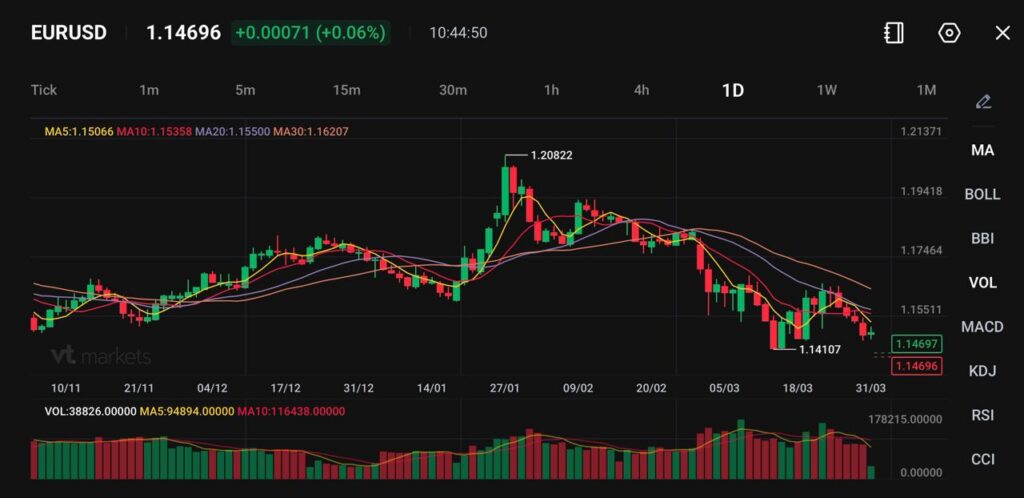
Key levels to watch:

  • Support: 1.1410 → 1.1350 → 1.1300
  • Resistance: 1.1500 → 1.1550 → 1.1620

The pair is currently consolidating below the 1.1500–1.1550 zone, which has capped recent upside attempts. A break above this region would be needed to ease immediate bearish pressure and open a move toward 1.1620, though momentum would still need to build to sustain a broader recovery.

On the downside, 1.1410 remains the key near-term support. A break below this level could trigger a move toward 1.1350, with further downside risk if selling accelerates.

Overall, EURUSD remains in a clear downtrend, with price action suggesting continued pressure on support levels. Unless the pair can reclaim the 1.1550 area, rallies are likely to be sold into, keeping the bias skewed to the downside in the near term.

What Traders Should Watch Next

The euro now sits at the intersection of three forces: energy prices, ECB repricing, and geopolitical headlines. For the next move, traders will need to see whether oil stays high, whether the ECB becomes more explicit about the new rate path, and whether the Strait of Hormuz remains effectively constrained.

If oil cools and freight risk eases, EURUSD could stabilise quickly. If Europe keeps importing an energy shock while policy turns more defensive, the euro may stay under pressure even with rate-hike expectations rising.

Learn more about trading Forex Pairs on VT Markets here.

Trader Questions

Why Did EURUSD End March Below 1.15?

EURUSD ended March below $1.15 because the euro lost more than 2% against the dollar during the month as traders priced the economic damage from the Middle East conflict and the inflation shock caused by higher energy costs.

Why Can the Euro Fall Even if Markets Expect Ecb Rate Hikes?

The euro can still weaken when rate hikes are driven by an oil shock rather than stronger growth. Markets now expect at least two ECB rate hikes in 2026, but the euro zone is also more exposed to expensive imported energy, which hurts growth and offsets the usual support from higher rates.

What Has Changed in ECB Expectations?

Markets have swung from pricing a 40% chance of a rate cut earlier to pricing multiple ECB hikes in 2026. Reuters reported that markets are now forecasting three rate hikes in 2026, with the first expected by June, which shows how sharply the energy shock has changed rate expectations.

Why Does the Strait of Hormuz Matter So Much for EURUSD?

The Strait of Hormuz matters because it carries about 20% of the world’s oil and a large share of LNG. If it stays largely blocked, Europe faces higher import costs, higher inflation, and weaker growth, which can keep pressure on the euro.

Did Relief Headlines Around Trump Help the Euro?

Only briefly. Reuters reported that the Wall Street Journal said Trump was open to ending the military campaign even if Hormuz stayed shut, which gave markets some relief. But oil stayed elevated and traders kept focusing on energy flows rather than political tone alone.

What Did François Villeroy De Galhau Say About ECB Policy?

Villeroy said the ECB is ready to act against energy-driven inflation, but that it is too early to discuss the timing of any rate hike. That message supports a hawkish bias, but it does not yet give traders a firm timetable.

Start trading now – Click here to create your real VT Markets account
Price Action Vs Indicators: What Are The Actual Differences?

Price action reads the raw price movement directly on the chart. Indicators process the same price data through a formula and display the result as a line or histogram. The core difference is timing. Price moves first, indicators follow. If you want to read the market, it makes more sense to read the source.

Quick Comparison: Price Action Vs Indicators

For a more detailed breakdown, jump to this section.

@vtmarkets.my

Price action! It’s the heartbeat of trading. Follow the beat, you’ll follow the market. vtmarkets vtmarketsmy fypシ fyp tradingvideo tradingforex foryoupage foryou priceactiontrading

♬ original sound – VT Markets Malaysia – VT Markets Malaysia

What Is Price Action Trading?

Price action trading means making decisions based on what the price is doing on the chart, nothing else.

You’re looking at how candles form. You’re seeing where price stalls. You’re seeing where it reverses. This shows who controls the market at any moment.

The idea is that everything you need to know about a market is already visible in price. If buyers are stepping in aggressively, you’ll see it in the candles. If the price breaches key levels twice, that’s meaningful.

Not because a formula tells you so, but because you can see it happening in real time.

For CFD traders, this matters.

Markets can move fast. If you wait for an indicator to confirm what price showed a few candles ago, you may miss a good entry. You could even miss the trade!

What Price Action Traders Actually Look At

Candlestick Patterns

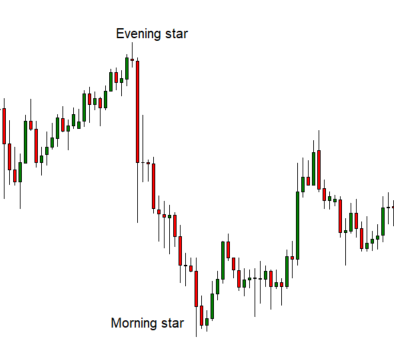
Engulfing candles, morning star, and evening star that signal potential reversals or continuation.

Support And Resistance Levels

Horizontal zones where price has previously reacted, stalled, or reversed.

Market Structure

The sequence of highs and lows that tells you whether a market is trending, ranging, or breaking down.

Break And Retest Setups

Where price breaks a key level and returns to it before continuing.

Momentum Shifts

Changes in candle size, wick length, or closing position that suggest conviction is changing.

What Are Technical Indicators?

Technical indicators are tools that calculate a value based on past price or volume data. The indicators then plot this value visually on your chart.

The most common indicators are RSI (Relative Strength Index), MACD (Moving Average Convergence Divergence), and Bollinger Bands.

Each of them is trying to answer a specific question: Is price overbought or oversold? Is momentum shifting? Is volatility expanding or contracting?

This is what you’ll get when you add all three indicators to one chart.

Used selectively, indicators can add structure to your analysis, particularly as a secondary filter before entering a trade. The issue isn’t that they’re wrong. The issue is that they’re a step removed from the actual market.

Why Indicators Lag Price

Here’s the insight that changes how most traders think about this: every single indicator is derived from price.

RSI is calculated from closing prices. MACD is built from moving averages of price. Bollinger Bands are plotted around a moving average of price.

None of them generates new information. They reprocess information that already exists in the raw chart.

That’s what makes them lag by nature. They can only tell you what price has already been done, formatted into a different visual.

Price action is the upstream source. It builds the indicators. When you read the price directly, you’re working with the original data, not a processed summary.

This doesn’t make indicators useless. But it does mean this: if you trust an indicator more than the price, you have it going on backwards.

The 6 Biggest Differences Explained

1. Speed Of Signal

Price action is immediate. The signal is the candle closing, the level holding, the structure breaking. You see it as it happens.

Indicators, by design, process historical price data before producing an output, which means the signal always arrives after the fact. In fast-moving CFD markets, that delay can be the difference between a clean entry and chasing a move that’s already extended.

2. Learning Curve

Indicators feel easier to start with, and that’s precisely what makes them appealing to newer traders. You attach RSI to a chart, you see a line cross a level, and there’s an immediate sense of structure.

Price action, by contrast, asks you to develop pattern recognition and contextual judgment. These are skills that need nurturing.

3. Chart Clarity

A clean price action chart contains just candlesticks and the levels you’ve drawn.

Is your chart too busy and blurry? Price action offers a clearer view of market activities.

A chart loaded with indicators quickly becomes visually cluttered. Imagine multiple lines, histograms, bands, and oscillators all competing for attention.

For some traders, that extra data feels reassuring. For most, it creates noise.

4. Subjectivity

Indicators feel objective because they produce a specific number. RSI reads 68.4, not “somewhere around overbought.”

Price action carries moderate subjectivity. Traders will draw levels slightly differently. But the underlying information is unfiltered. With indicators, you’re interpreting data that’s already been processed once.

5. Interpretation In Trending Markets

Both approaches work in trends. A moving average crossover or MACD holding above its signal line can be useful for staying in a move and avoiding early exits.

Price action gives you the same information faster. Higher highs and higher lows confirm the trend. A break of a prior swing low signals it may be ending. The indicator tells you the same thing, just a bit later.

6 Interpretation In Range-Bound Markets

This is where the gap widens. Price action in a range is straightforward. Buy support, sell resistance, wait for a breakout with conviction. The logic stays consistent.

Indicators break down in ranging conditions. RSI repeatedly tags overbought and oversold without follow-through. MACD crossovers fire false signals in both directions.

Which Should You Use First?

People often frame the price action vs technical indicators debate as an either/or choice. It doesn’t need to be.

But the order you learn them in matters more than most traders realise.

Start with price action. Learn to read structure, identify key levels, and understand what a chart is telling you before you add anything else on top of it. Once you have that foundation, indicators can play a supporting role rather than thinking for you.

The reason this order matters.

If you start with indicators, you end up relying on a layer of abstraction you don’t fully understand.

You see RSI cross 70 and call it overbought, but without understanding the price context around it, that number means nothing. Plenty of strong trending markets will hold RSI above 70 for extended periods and keep running.

Silver demonstrated an impressive bullish rally from November 2025 until late January 2026. The RSI showed sustained >70, which clashes with common RSI wisdom that price will likely reverse once it crosses overbought territory.

Price action gives you the context. Indicators, when used selectively, can help confirm timing or filter out lower-quality setups. That’s a sensible combination. Just don’t let the indicator become the primary signal.

For CFD traders in forex, indices, or commodities, this approach is practical.

It works on all timeframes and instruments. You do not need to reset your tools when market conditions change. Price is price.

Frequently Asked Questions

1. Which indicators work best with price action?

To trade effectively, it is not about which indicators work best, but about avoiding indicators that give the same information. The Golden Rule is to combine indicators from different categories.

If you use the Relative Strength Index (RSI) and Stochastics together, you are just looking at two different versions of bound oscillators.

Instead, combine bound oscillators, like RSI, with a Trend Following Momentum indicator like MACD. This creates confluence, where two different mathematical models agree on a trade setup.

2. Does price action trading apply to all asset classes?

Yes. Price action is universal because it is a visual representation of human psychology, like greed, fear, and indecision, which exists in every market.

3. Can you trade with price action only?

This is often referred to as “naked trading.”

Many professional traders prefer a clean chart because it allows them to focus purely on market structure, support/resistance levels, and candlestick patterns without the noise of lagging indicators.

You only have to be an expert at reading the story the market is telling.

4. Does high-impact economic news disrupt price action trading principles?

Yes and no. While news can cause temporary chaos on a chart, it rarely breaks the long-term price action structure.

Instead, news often acts as a catalyst for a move that the price action was already preparing for.

For example, this is often seen in the “Priced In” phenomenon, where bullish patterns like higher lows or continuation patterns form days before a positive release as “smart money” positions itself. The news then acts as the wind in the sails to break price out of the continuation pattern and continue the previous trend.

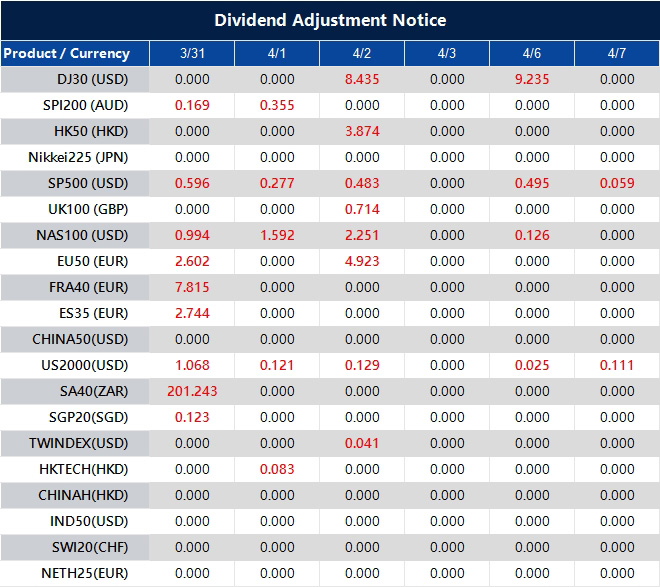
Dividend Adjustment Notice – Mar 31 ,2026

Dear Client,

Please note that the dividends of the following products will be adjusted accordingly. Index dividends will be executed separately through a balance statement directly to your trading account, and the comment will be in the following format “Div & Product Name & Net Volume”.

Please refer to the table below for more details:

Dividend Adjustment Notice

The above data is for reference only, please refer to the MT4/MT5 software for specific data.

If you’d like more information, please don’t hesitate to contact [email protected].

In February, Germany’s monthly retail sales fell 0.6%, missing forecasts of a 0.2% rise

Germany’s retail sales fell by 0.6% month on month in February. This was below the forecast of a 0.2% rise. The result shows weaker retail activity than expected for the month. No further figures were provided in the update.

German Consumer Demand Weakens

The unexpected drop in February’s retail sales signals that the German consumer is weaker than we anticipated. This challenges the recent optimism priced into the market. We must now adjust our view to account for slowing domestic demand in Europe’s largest economy. This weak consumer data follows the recent March Ifo Business Climate index, which also fell to 89.5, confirming a broader cooling trend. Looking back, this marks a clear departure from the slow but steady recovery we witnessed in the second half of 2025. This pattern suggests the risk of a German economic contraction in the first quarter has now significantly increased. For the DAX index, which is up nearly 8% year-to-date, this news makes it vulnerable to a correction. We should consider buying put options with May expirations to protect against a potential downturn. The sectors most at risk are consumer discretionary and automotive. This data will likely weigh on the euro, reinforcing its recent weakness against the dollar. With the EUR/USD exchange rate already testing the 1.0750 level, this could be the catalyst for a move lower. We see an opportunity in shorting EUR/USD futures, as money markets are now pricing in a 75% chance of an ECB rate cut by June.

Positioning And Hedging Ideas

In fixed income, we anticipate a flight to safety, which will increase the value of German government bonds. We should look at buying call options on Bund futures, betting that yields will fall further on these recessionary fears. This strategy also provides a hedge against the bearish equity positions we are considering. Create your live VT Markets account and start trading now.

Start trading now – Click here to create your real VT Markets account

German annual retail sales rose 0.7% in February, undershooting the 1% forecast, indicating softer demand

Germany’s retail sales rose 0.7% year on year in February. This was below the forecast of 1.0%. The result shows retail sales growth came in 0.3 percentage points under expectations. No further data was provided in the release summary.

Implications For Consumer Demand

The weaker-than-expected German retail sales data for February suggests a slowdown in consumer spending, the backbone of Europe’s largest economy. This signals potential economic headwinds for the entire Eurozone. We should anticipate that this news will dampen sentiment in the coming weeks. This consumer weakness makes it less likely the European Central Bank will pursue aggressive monetary tightening. We’ve seen Eurozone inflation cool slightly to 2.3% last month, and this retail data further supports a more cautious ECB stance. Traders should consider options strategies that profit from a weaker Euro, such as buying puts on the EUR/USD pair. For the German DAX index, the outlook is mixed, creating opportunities for sophisticated plays. The slowdown is directly negative for consumer discretionary stocks, and we could explore buying put options on companies in that sector. We remember in 2025 when similar consumer data preceded a sharp underperformance of retail-focused equities compared to the broader market. However, the prospect of a more dovish ECB could provide a tailwind for the overall stock market. A weaker Euro would also benefit Germany’s large export-oriented industrial sector, making their goods cheaper abroad. This suggests considering call options on major industrial exporters while staying bearish on domestic consumer names. This economic uncertainty typically increases demand for safe-haven assets like German government bonds. The German 10-year bund yield has already fallen 20 basis points this past month to 2.6%, and this data could push it lower. We should look at long positions in Bund futures to capitalize on falling yields.

Potential Bund Market Opportunities

Create your live VT Markets account and start trading now.

Start trading now – Click here to create your real VT Markets account
In February, Germany’s monthly Import Price Index exceeded expectations, rising 0.3% against the predicted 0.2%

Germany’s Import Price Index rose by 0.3% month on month in February. This was above the forecast of 0.2%. The outturn was 0.1 percentage points higher than expected. The figures compare the month-on-month change in import prices for February.

Implications For Ecb Policy

The higher-than-expected German import price data from February, released today, suggests underlying inflationary pressures are not fading as quickly as hoped. This puts a spotlight directly on the European Central Bank’s upcoming policy decisions. We need to be prepared for the possibility that the ECB will adopt a more cautious or “hawkish” stance in the near term. This data lessens the probability of an aggressive ECB rate cut in the second quarter. The swaps market has already reacted, with the implied probability of a June rate cut falling from nearly 75% last week to just below 60% this morning. Traders should consider positioning for a delay in easing by looking at options on Euribor futures that would profit from interest rates staying higher for longer. A more resolute ECB is typically bullish for the Euro. We remember how the EUR/USD pair strengthened in late 2025 when similar inflation data surprises forced the market to rethink central bank divergence. Consequently, buying EUR/USD call options with expirations in May or June could be a viable strategy to capitalize on potential currency strength. For equity markets, this news presents a headwind, as persistent inflation could dampen corporate earnings and valuations. Volatility is likely to increase, with the VSTOXX index already climbing 8% to 16.5 from its recent lows. Buying protective put options on the DAX index or call options on the VSTOXX can offer a hedge against a potential market dip over the next few weeks.

Key Risk Event Ahead

The most critical data point to watch now will be the flash Eurozone Consumer Price Index (CPI) reading for March, due next week. If that report also shows persistent price pressures, it will solidify the market’s new, more cautious outlook. We should anticipate heightened market sensitivity to any speeches from ECB governing council members until that data is released. Create your live VT Markets account and start trading now.

Start trading now – Click here to create your real VT Markets account

Germany’s year-on-year Import Price Index for February stayed steady, holding at a 2.3% decline year-on-year

Germany’s Import Price Index was unchanged year on year in February. It remained at -2.3% compared with the same month last year. The data indicates that import prices continued to fall at the same annual rate as in the previous reading. No month-on-month figure was provided in the statement.

Eurozone Deflation Signal

With German import prices continuing their year-over-year decline into February, we see this as a persistent deflationary signal for the Eurozone’s largest economy. This ongoing trend of falling import costs is likely to weigh on the European Central Bank’s thinking in the coming weeks. It reduces the pressure on the ECB to consider any near-term monetary tightening. This leads us to anticipate continued weakness in the Euro, especially against the US Dollar. Recent data confirms this view, as the latest Eurozone flash CPI for March came in at 1.8%, still stubbornly below the ECB’s 2% target. We should therefore consider strategies like buying EUR/USD put options to profit from a potential slide in the currency. Looking back at 2025, we saw a similar period of disinflation in the first quarter which prompted the ECB to adopt a more dovish stance. This historical parallel suggests that the market will price in lower-for-longer interest rates. This makes long positions in German government bond futures, or Bunds, an attractive trade. The data also presents a potential opportunity in German equities. Lower input costs can improve profit margins for manufacturers, and a weaker Euro would make German exports more competitive globally. We believe call options on the DAX index could be a way to position for this, particularly as the index has gained over 3% this month.

Key Risks To Monitor

However, we must also consider that falling import prices could signal weakening global demand, not just lower energy costs. This would be a negative for Germany’s export-driven economy. We will be closely watching incoming global PMI data, especially from China, to gauge the health of global trade. Create your live VT Markets account and start trading now.

Start trading now – Click here to create your real VT Markets account

FXStreet data indicates India’s gold prices increased, with gold climbing higher across the country today

Gold prices rose in India on Tuesday, based on FXStreet data. Gold was priced at INR 13,947.14 per gram, up from INR 13,787.85 on Monday. The price per tola increased to INR 162,679.20 from INR 160,818.70 a day earlier. Other listed prices were INR 139,473.60 for 10 grams and INR 433,805.00 for a troy ounce.

How FXStreet Calculates India Gold Prices

FXStreet derives India’s gold prices by converting international prices using USD/INR and local units. The figures are updated daily at publication time, and local market rates may vary slightly. Central banks are the largest holders of gold. They added 1,136 tonnes worth about $70 billion in 2022, according to the World Gold Council, the highest annual total since records began. Gold often moves in the opposite direction to the US Dollar and US Treasuries, and it can also move against risk assets. Its price may shift with geopolitical risks, recession concerns, interest rates, and changes in the US Dollar because gold is priced in dollars (XAU/USD). With gold showing upward momentum as of late March 2026, we are closely watching its inverse relationship with the US Dollar. The Dollar Index has recently dipped below 103, providing a tailwind for the precious metal. This dynamic is a key focus for positioning in the coming weeks.

Key Market Drivers To Watch

Much of this price action hinges on expectations for future interest rate policy, as gold is a non-yielding asset. After a period of restrictive rates throughout 2025, the market is now pricing in potential rate cuts later this year, making gold more attractive. The upcoming central bank meetings in the next quarter will be critical events. We’ve also seen persistent support from central banks, which have continued their accumulation trend. Data shows that central banks added over 200 tonnes to their reserves in the first quarter of 2026, signaling a continued strategic shift. This strong underlying demand provides a solid floor for prices. For derivative traders, the current environment suggests that implied volatility may be undervalued. The uncertainty surrounding the timing of the first rate cut could lead to significant price swings in the coming weeks. Therefore, strategies that benefit from rising volatility, such as long straddles or strangles on gold ETFs, could be considered. Geopolitical tensions also remain a key factor supporting gold’s role as a safe-haven asset. Any escalation in global conflicts could see a rapid flight to safety, pushing prices higher irrespective of interest rate moves. We are monitoring these risks as a potential catalyst for a sharp breakout. Create your live VT Markets account and start trading now.

Start trading now – Click here to create your real VT Markets account

FXStreet’s compiled data shows gold prices in Malaysia increased, with Tuesday recording an upward movement today

Gold prices in Malaysia rose on Tuesday, based on FXStreet data. Gold was priced at MYR 592.53 per gram, up from MYR 586.08 on Monday. The price per tola increased to MYR 6,911.14 from MYR 6,835.97 a day earlier. Other listed prices were MYR 5,925.32 for 10 grams and MYR 18,429.73 per troy ounce.

Malaysia Gold Pricing Method

FXStreet derives Malaysian gold prices by converting international prices using the USD/MYR exchange rate and local units. The figures are updated daily using market rates at the time of publication, and local prices may vary slightly. Gold is used as a store of value and medium of exchange, and it is also used in jewellery. It is often used during market stress and as protection against inflation and currency weakness. Central banks hold large gold reserves and use them to diversify holdings. In 2022, central banks added 1,136 tonnes of gold worth about $70 billion, the highest annual total on record. Gold often moves opposite to the US Dollar and US Treasuries, and it can move against risk assets such as shares. Prices can also react to geopolitics, recession fears, and interest rates, with many moves linked to the US Dollar because gold is priced in dollars.

Market Drivers And Trading Context

Given the recent strength in gold, we see its role as a safe-haven asset becoming increasingly important. The metal is not just for jewelry; it is a critical investment during turbulent economic times. This makes it a key instrument for hedging against inflation and potential currency weakness in the weeks ahead. Central bank buying continues to provide a strong floor for gold prices. We saw this trend accelerate through 2025, building on the record purchases from previous years where central banks added over 1,037 tonnes in 2023 alone. This sustained demand, particularly from emerging economies diversifying their reserves, suggests that any significant dips in price will likely be viewed as buying opportunities. The outlook for interest rates is creating a favorable environment for gold. After the aggressive rate hikes we saw a couple of years ago, major central banks like the U.S. Federal Reserve have signaled a more cautious stance, which typically weighs on the US Dollar. As gold is priced in dollars, a softer dollar often leads to higher gold prices, a trend we anticipate continuing. Geopolitical instability remains a persistent factor that should keep gold on every trader’s radar. Tensions in various parts of the world encourage a flight to safety, and gold is the classic destination for capital in such scenarios. We view this backdrop as supportive for bullish positions in gold derivatives, such as call options or long futures contracts. We are also watching the inverse correlation between gold and risk assets like stocks. After a strong run in the S&P 500 through much of 2025, there is growing concern about high valuations, making a market correction more likely. Traders should consider using gold derivatives as a hedge against potential downturns in their equity portfolios. The current environment of uncertainty suggests that volatility in the gold market may increase. This could make options strategies that benefit from price swings, not just direction, particularly attractive. Therefore, traders should be prepared for sharp movements and position themselves to capitalize on them over the next several weeks. Create your live VT Markets account and start trading now.

Start trading now – Click here to create your real VT Markets account
AUD/JPY stabilises around 109.70 in Asian trade as weak Aussie sentiment follows China PMI after Japan CPI

AUD/JPY traded near 109.70 in Asian hours on Tuesday after losses in the prior session. The pair may face pressure as the Australian Dollar stayed weaker after China’s latest NBS PMI figures. China’s Manufacturing PMI rose to 50.4 in March from 49.0 in February, above the 50.1 forecast and the strongest reading since March last year. The Non-Manufacturing PMI increased to 50.1 from 49.5, also above the 49.9 forecast, after two months of contraction.

Rba Minutes And Inflation Outlook

The Reserve Bank of Australia’s March meeting minutes said further policy tightening would likely be needed, though members differed on timing. They noted oil near $100 per barrel could lift June-quarter CPI to around 5%, and most were concerned inflation expectations could become unanchored without prompt action. The Japanese Yen found support from repeated public warnings from Tokyo and rising expectations of possible intervention. Currency official Atsushi Mimura said on Monday the government would act decisively if needed, echoing earlier comments from Finance Minister Satsuki Katayama. Tokyo CPI rose 1.4% year on year in March, down from a revised 1.5% in February, while core CPI rose 1.7% from 1.8% and below the 1.8% forecast. Both readings stayed under the Bank of Japan’s 2% target. We are seeing the AUD/JPY cross hold near 109.70, but the dynamics have changed significantly from what we observed around this time in 2025. Last year, we saw a mixed Chinese manufacturing report cause worry, but today China’s latest Caixin Manufacturing PMI for March 2026 came in at a strong 51.1, its fifth consecutive month of expansion. This suggests the Australian dollar’s main trading partner is on a much firmer footing than previously thought.

Shifting Central Bank Divergence

Last March, in 2025, we recall the Reserve Bank of Australia was discussing the need for further rate hikes to combat inflation which was threatening to reach 5%. Now, with Australia’s quarterly inflation having eased to 3.8% by the end of 2025 and the RBA holding its cash rate steady at 4.35% for several months, the urgency for tightening has faded. This removes a key pillar of support for the Aussie dollar that was present a year ago. The situation in Japan has reversed dramatically from what we saw in 2025. Back then, Tokyo’s CPI was running at a mere 1.4%, well below target, but now the latest figures show it is running at 2.6%, firmly above the Bank of Japan’s goal. This sustained inflation prompted the BoJ to finally end its negative interest rate policy earlier this month, a major policy shift that provides fundamental support for the yen. The verbal warnings about intervention from Japanese officials we heard throughout 2025 are now backed by actual monetary policy action. The interest rate difference that made borrowing yen to buy Aussie dollars so attractive is beginning to shrink. This shift suggests that the long-held upward momentum in AUD/JPY may be exhausted. For derivatives traders, this signals a potential increase in volatility as the market reprices the new central bank realities. Given the RBA is on hold and the BoJ has just begun a potential tightening cycle, purchasing AUD/JPY put options could be a prudent strategy to guard against a downward correction. We should also watch for opportunities in selling call spreads to capitalize on the limited upside potential we now see for the pair. Create your live VT Markets account and start trading now.

Start trading now – Click here to create your real VT Markets account

Back To Top
server

Hello there 👋

How can I help you?

Chat with our team instantly

Live Chat

Start a live conversation through...

  • Telegram
    hold On hold
  • Coming Soon...

Hello there 👋

How can I help you?

telegram

Scan the QR code with your smartphone to start a chat with us, or click here.

Don’t have the Telegram App or Desktop installed? Use Web Telegram instead.

QR code


