



Analysts Quek Ser Leang and Lee Sue Ann predict slight upward momentum for the Euro against the Dollar, with a possible rise to 1.1840, but expect resistance at 1.1860 to hold.
UOB analysts say the Euro is showing slight upward pressure against the US Dollar. It may rise to 1.1840, but it’s unlikely to surpass 1.1860. To continue this upward trend, it needs to stay above 1.1785.
Right now, the Euro might increase a bit, but weak momentum could limit its rise at 1.1840. The 1.1860 resistance level is strong unless the Euro falls below 1.1765 soon, which would lower the risk of a downward move. If the Euro does break above 1.1860, we could see a period of range trading.
Asian equities soar, with Japan’s Nikkei 225 hitting a record high following elections
Asian stocks soared on Monday, with Japan’s Nikkei 225 hitting an all-time high after Prime Minister Sanae Takaichi’s strong election win. The Nikkei 225 rose by 4.45% to 56,660, as the coalition led by the Liberal Democratic Party secured 352 out of 465 seats, taking a majority in Japan’s House of Representatives.
South Korea’s Kospi Index climbed 4.2% to 5,305, boosted by a renewed appetite for risk following a significant rebound in US stock indexes. China’s SHANGHAI Index increased 1.25% to 4,115, while the Hong Kong Stock Exchange rose 1.57% to 26,975. Additionally, India’s Nifty50 grew by 0.66%, and Taiwan’s Taiex gained 1.96% to 32,405. Australia’s S&P/ASX 200 saw an increase of 1.85% to 8,870. Other Southeast Asian markets also posted positive results.
Key Sectors in Asian Stock Markets
Important sectors in Asian stock markets include technology, financial services, manufacturing, retail, and e-commerce. These markets are influenced by company earnings, economic conditions, central bank policies, and various political and technological factors. However, risks such as political instability, geopolitical tensions, natural disasters, and currency fluctuations can also affect market performance. Japan’s decisive election win is a key indicator right now, driving the Nikkei 225 to an all-time high. With Prime Minister Takaichi receiving a strong mandate, we can expect policies favoring exporters, likely putting continued pressure on the yen. Traders might want to position themselves for further increases through Nikkei 225 call options or futures, as the political stability is a significant driver. This rally is supported by a weak currency, a trend we anticipate will continue. The Japanese yen is currently trading around 168 to the US dollar, its lowest in over 20 years, making Japanese exports much more competitive. A similar situation occurred in 2025 when a weaker yen significantly boosted corporate profits, and this election result will likely enhance that in the upcoming weeks. Volatility is an essential factor to monitor now. After a single-day surge of more than 4%, the Nikkei Volatility Index has jumped over 25, creating an opportunity for sellers of premium options. Selling out-of-the-money puts or using bull put spreads on the Nikkei 225 can be smart strategies, taking advantage of the upward trend and the increased market fear.Positive Sentiment and Market Strategies
A positive sentiment is spreading through Asia, with Japan and South Korea leading with over 4% gains. There are significant capital inflows, with global funds investing over $20 billion in developed Asian markets in January 2026, reversing the outflows from late 2025. This overall risk-on attitude, buoyed by a strong finish on Wall Street, indicates it’s a good time to invest in regional indices. Nonetheless, we should also prepare for a potential short-term pullback after such a sharp increase. Buying protective puts on the Kospi 200 or Taiwan’s Taiex, which heavily feature the cyclical tech sector, could be a cost-effective hedge. We remember the mid-2025 market pullbacks when rallies became too stretched, so allocating some funds to bearish positions could safeguard profits. While the region is thriving, the gains in the Chinese and Hong Kong markets are less pronounced. This difference presents a clear opportunity for pair trading. Taking a long position on the Nikkei 225 while shorting the Hang Seng Index might be profitable, as China continues to face challenges in its property sector and regulatory issues. Create your live VT Markets account and start trading now.Traders watch the US Dollar Index stay close to 97.50 while waiting for key economic data releases.
The US Dollar Index is currently steady around 97.50 as traders await important economic data that has been delayed due to a partial government shutdown. In January, the US Nonfarm Payrolls are projected to show stability in the labor market, with an expected addition of 70,000 jobs and an unemployment rate of 4.4%. Market sentiment improved when the Michigan Consumer Sentiment Index unexpectedly rose to 57.3 in February, beating the forecast of 55.0.
The US Dollar Index, which reflects the US Dollar’s value against six major currencies, has seen losses for the second consecutive day, trading near 97.60 during Asian trading hours on Monday. Markets expect the Federal Reserve to keep interest rates steady in March, with possible cuts in June and September. San Francisco Fed President Mary Daly noted that the economy may stay in a low-hiring and low-firing phase. In contrast, Atlanta Fed President Raphael Bostic highlighted the ongoing risk of high inflation for the Fed.
How Monetary Policy Affects the Dollar
The Federal Reserve’s monetary policy plays a crucial role in shaping the US Dollar’s value. This includes changes to interest rates and methods like quantitative easing, which is used during crises to boost credit flow but often weakens the Dollar. On the other hand, quantitative tightening, which reduces bond buying, tends to strengthen the Dollar. Currently, the Dollar is weak, trading around 97.60, as we wait for significant economic reports due to the partial government shutdown. With Wednesday’s job numbers and Friday’s inflation data on the horizon, the market is tense. This uncertainty may create opportunities. The key point is that we are likely to see a significant price movement in either direction once the data is revealed. Implied volatility for currency options has risen, with the Cboe FX Volatility Index increasing over 8% in the last two weeks. This signals that traders may want to adopt strategies that benefit from sharp movements, like straddles on major pairs such as EUR/USD. The expectation for only 70,000 new jobs in January highlights a slowdown in the labor market. If the unemployment rate holds at 4.4%, it will signal a continuing upward trend observed during the latter half of 2025, likely reinforcing the market’s bet on a Fed rate cut in June.Getting Ready for Economic Changes
With the market already pricing in rate cuts for June and September, any sign of economic weakness could lead to more Dollar selling. To prepare, consider bearish strategies, like buying put options on the US Dollar Index, which allow for profit from a decline while clearly setting a maximum risk. However, be cautious of a sudden turnaround. Recall how a stronger-than-expected inflation report in the fall of 2025 caused a spike in the Dollar. The recent surprise in the Michigan Consumer Sentiment Index and hawkish comments from Atlanta Fed President Bostic remind us that a weak Dollar isn’t guaranteed. Therefore, any bearish strategies should include protection against unexpectedly strong economic reports. For example, if job gains exceed 150,000, this could challenge the narrative of a rate cut and create a push for the Dollar. A small out-of-the-money call option can act as a cost-effective insurance policy against such a scenario. Create your live VT Markets account and start trading now.Dividend Adjustment Notice – Feb 09 ,2026
Dear Client,
Please note that the dividends of the following products will be adjusted accordingly. Index dividends will be executed separately through a balance statement directly to your trading account, and the comment will be in the following format “Div & Product Name & Net Volume”.
Please refer to the table below for more details:
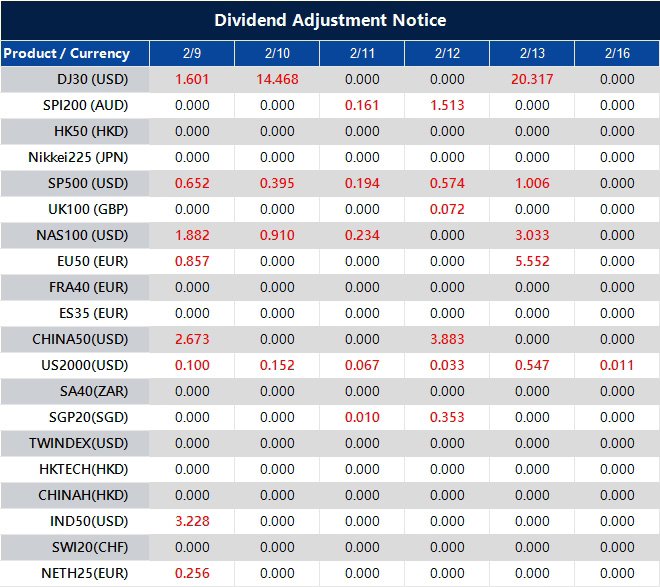
The above data is for reference only, please refer to the MT4/MT5 software for specific data.
If you’d like more information, please don’t hesitate to contact [email protected].
GBP/USD pair is currently near 1.3605, influenced by possible Bank of England interest rate cuts.
GBP/USD is trading around 1.3605 in the early European session on Monday, showing a strong trend above the 100-day EMA. Initial support stands at 1.3580, while resistance is at 1.3870. The pair is facing pressure due to expectations of a rate cut from the Bank of England (BoE).
The BoE is expected to keep rates steady at 3.75%, although support for this action among members is lower than anticipated. Analysts predict a rate cut in March, followed by a pause before returning to normal policies in 2027. The daily chart for GBP/USD shows strength above the 100-day EMA, with widening Bollinger Bands and an RSI of 52.
Remaining above the 20-day middle band at 1.3580 keeps the outlook positive, with resistance set at 1.3870. If it breaks below this point, the next support target would be 1.3290.
The Pound Sterling, the currency of the UK, is significantly impacted by the BoE’s monetary policy. Interest rate decisions and economic indicators like GDP and PMIs influence its value. Additionally, the Trade Balance plays a role; positive net exports strengthen the Pound, while a negative balance weakens it. Sterling represents 12% of global currency transactions, averaging $630 billion daily.
Currently, GBP/USD hovers around 1.3610, maintaining the key support level established during the latter half of 2025. The market is now pricing in a 55% chance of a BoE rate cut in March, down from near certainty seen in the last quarter of the previous year. This uncertainty before the next Monetary Policy Committee meeting creates clear opportunities for derivative traders.
Looking back to 2025, the expectation for a rate cut stemmed from a steady decline in inflation. However, the latest CPI data for January 2026 shows a persistent 2.7%, while final GDP figures for Q4 2025 indicated a slight contraction of 0.1% in the UK economy. This mix of stubborn inflation and stagnant growth complicates the BoE’s decision-making and adds to currency volatility.
Given this context, buying volatility through options strategies seems wise for the upcoming weeks. The 1.3600 level is critical; a significant drop below it could lead to a move towards the 1.3290 area. Traders might consider purchasing put options with a strike price around 1.3550 to prepare for a potential dovish surprise from the Bank of England.
Conversely, if upcoming UK jobs or wage data exceeds expectations, the market may entirely discount the March cut. This scenario could prompt the pair to test the resistance at 1.3870, which capped the highs seen last year. Buying out-of-the-money call options presents a low-cost way to position for this upside potential.
February Futures Rollover Announcement – Feb 09 ,2026
Dear Client,
New contracts will automatically be rolled over as follows:
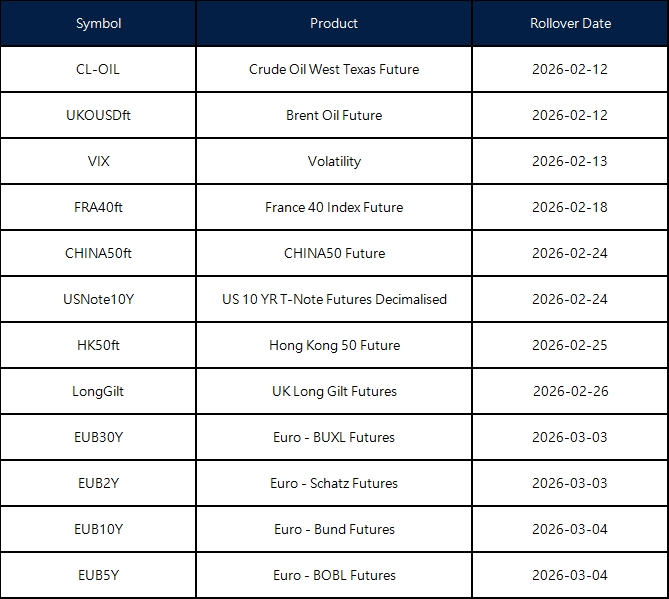
Please note:
• The rollover will be automatic, and any existing open positions will remain open.
• Positions that are open on the expiration date will be adjusted via a rollover charge or credit to reflect the price difference between the expiring and new contracts.
• To avoid CFD rollovers, clients can choose to close any open CFD positions prior to the expiration date.
• Please ensure that all take-profit and stop-loss settings are adjusted before the rollover occurs.
• All internal transfers for accounts under the same name will be prohibited during the first and last 30 minutes of the trading hours on the rollover dates.
The above data is for reference only. The actual rollover date shall be subject to the Liquidity Provider’s determination.
If you’d like more information, please don’t hesitate to contact [email protected].
Pound Sterling weakens to about 1.3605 due to expected Bank of England rate cuts
The GBP/USD pair is trading lower, around 1.3605, early on Monday in Europe. A potential interest-rate cut by the Bank of England is affecting the Pound Sterling against the US dollar.
The Bank of England was expected to keep interest rates steady at 3.75%. However, not enough Monetary Policy Committee members supported this decision. Last week’s central bank meeting maintained rates at 3.75% but hinted at possible cuts to control inflation at 2% over the medium term.
Speculation About Rate Cuts
GBP/USD fell to about 1.3610 during the early Asian session, driven by speculation about a Bank of England rate reduction. There are also expectations for more insights from the US Federal Reserve. The pair has seen notable swings, losing nearly 200 pips as demand for the US dollar rose. This follows a peak of 1.3869 in January. A shift in focus from overvalued growth assets to value assets has boosted the US dollar, impacting GBP/USD levels. With the Bank of England’s cautious approach, the Pound Sterling is under continued pressure. The market’s current narrative centers around a rate cut in March, suggesting any short-term strength in GBP/USD should be seen as a selling opportunity. Traders might consider buying put options on GBP/USD, with expiration dates after the March BoE meeting. Strike prices around 1.3500 or even 1.3450 could be profitable if the central bank follows through with expected cuts. This strategy helps capitalize on downward momentum while clearly defining maximum risk.The Strength of the US Dollar
The strength of the US dollar contributes to the bearish outlook for this pair. Recent data indicates that the US economy added a strong 210,000 jobs in January 2026, keeping the unemployment rate low at 3.7%. This starkly contrasts with the UK’s economic situation, highlighting the policy divergence between the Fed and the BoE. In the UK, the latest Consumer Price Index (CPI) numbers show inflation falling to 3.1%, giving the BoE more leeway to ease its policies. This data suggests the central bank is preparing to cut rates to support the economy, making the dollar more attractive than the pound. This marks a significant shift from the strong pound sentiment seen in the latter half of 2025. The recent drop from the 1.3869 high signals a change in market expectations for the pound. Another strategy is to sell GBP/USD futures contracts, betting directly on the price decline. Increased volatility, shown by the recent 200-pip drop, means traders should brace for sharp movements. This trend of capital moving into the safe-haven dollar is likely to continue in the coming weeks. Create your live VT Markets account and start trading now.Gold prices increased today in Saudi Arabia based on data from various sources.
Gold prices in Saudi Arabia went up on Monday, according to FXStreet data. The price per gram rose to 604.53 Saudi Riyals (SAR) from 597.25 SAR on Friday.
The cost per tola increased to SAR 7,051.11 from SAR 6,966.25. The price for a troy ounce was recorded at SAR 18,802.91.
FXStreet Data Update
FXStreet updates international gold prices (USD/SAR) to match the local currency and measurement units. Prices refresh daily but are for reference only, since local rates may vary slightly. Gold is a commonly used store of value and a safe investment. It is considered a good choice during uncertain times and serves as protection against inflation and currency loss. Central banks hold the most gold, adding 1,136 tonnes worth about $70 billion to their reserves in 2022. The largest purchases came from China, India, and Turkey. Gold tends to move opposite to the US Dollar and US Treasuries. Typically, gold prices rise when the Dollar weakens and drop during stock market upswings. The price of gold is affected by geopolitical issues, interest rates, and the strength of the US Dollar. Lower interest rates can drive gold prices up, while a strong Dollar can keep them down.Factors Influencing Gold Prices
Gold is gaining strength, showing its role as a safe investment during tough times. The increased market volatility since the start of this year is drawing attention to this trend. Traders should see this as a sign that market sentiment may be shifting away from riskier assets. Gold prices are highly tied to interest rates since it does not provide any yield. Recent comments from the Federal Reserve in late January 2026 suggested a potential rate cut in the second quarter due to slowing manufacturing data. A forecast for lower interest rates makes holding gold more appealing in the weeks ahead. We also need to factor in gold’s inverse relationship with the US Dollar. The Dollar Index (DXY) has fallen over 3% since the new year, which usually helps gold prices. A weaker Dollar means gold is cheaper for buyers using other currencies, often leading to higher global demand. Central bank demand offers solid support for the gold market. After historic purchases in 2022, central banks continued to buy heavily through 2025, adding nearly 950 tonnes to their reserves. This ongoing trend of moving away from the Dollar shows strong interest from institutions. Given that major stock indices have become more volatile and the VIX volatility index recently reached 20, gold’s inverse relationship with risk assets is essential. Derivative traders might want to adopt strategies that take advantage of this situation, such as buying call options on gold futures or ETFs, allowing them to benefit from possible price increases with defined risk. This can also act as a hedge against further weakness in the stock market. Create your live VT Markets account and start trading now.Gold prices in the Philippines increased today, according to data from various sources.
Gold prices in the Philippines have risen. The price increased to 9,416.65 Philippine Pesos per gram, up from 9,306.78. For tola, prices went up to 109,833.90 PHP from 108,552.50 PHP.
This information comes from FXStreet, which calculates international gold prices and converts them into local currency and measurements. Price updates reflect current market rates, though there may be slight local differences.
The Role of Gold as a Safe Haven Asset
Gold has always been important in history as a value store and medium of exchange. It is considered a safe-haven asset, especially during economic uncertainty. In 2022, central banks added a total of 1,136 tonnes of gold, worth around $70 billion, to their reserves. Several factors influence gold prices, including geopolitical issues, interest rates, and changes in the US Dollar. Generally, when the US Dollar and stocks decline, gold prices tend to rise. Lower interest rates can also boost gold prices since it is a non-yielding asset. The recent increase in gold prices indicates that it is functioning as a classic safe-haven asset. The ongoing weakness of the US Dollar and expectations that the Federal Reserve will cut rates are mainly driving gold prices above $5,000. Derivative traders should see this as a momentum opportunity driven by broader economic trends. The steady demand from central banks, especially from the People’s Bank of China, creates a strong foundation for gold prices. Historical data shows this trend solidified through 2024 and 2025, after central banks purchased nearly 1,037 tonnes in 2023. This continued demand suggests that price dips may be viewed as buying chances.Market Implications and Strategies
As a non-yielding asset, gold’s trajectory is largely determined by interest rate expectations. A more dovish Federal Reserve makes gold more appealing. Therefore, long-dated call options could be a good strategy to capitalize on further price increases if rate-cut expectations become solid. The negative correlation with the US Dollar is also crucial. A weaker dollar makes gold cheaper for holders of other currencies, supporting the current price rise. Traders might consider strategies that benefit from both rising gold prices and a falling dollar, such as buying Gold futures while selling US Dollar Index (DXY) futures. Given the high price, implied volatility will be significant, leading to expensive options. Using credit or debit spreads on gold derivatives might be wise. This strategy allows participation in upward trends while controlling risk and managing high options premiums. Create your live VT Markets account and start trading now.Gold prices rise today in the United Arab Emirates, according to recent data analyses.
Gold prices in the United Arab Emirates increased on Monday to **592.12 AED** per gram, according to FXStreet data. This is up from **584.96 AED** per gram on Friday.
In local terms, the price was **6,906.37 AED** per tola, rising from **6,822.84 AED** the previous trading day. FXStreet updates global gold prices (USD/AED) daily, adjusting them based on market trends.
Historically, gold has been a safe store of value and a means of exchange. It serves as a refuge during economic instability and guards against inflation and currency decline, as it is not linked to any specific government or issuer.
Central banks are the biggest holders of gold, as it helps enhance currency trustworthiness. In 2022, they added **1,136 tonnes** of gold to their reserves to support economic stability, especially during times of currency fluctuation.
Gold often moves in the opposite direction of the US Dollar and Treasuries; when these assets drop, gold prices tend to rise. It can also react to global events and changes in interest rates, usually rising with concerns about recessions or falling interest rates.
Gold prices reflect changes in the US Dollar since it is priced in global markets. A strong dollar can lower gold prices, while a weak dollar often raises them.
Currently, gold prices are stabilizing, indicating a trend that extends beyond today’s increase in the UAE. The US Dollar Index has dropped significantly from its 2025 peak to around **101.5** recently. This inverse relationship is a major factor driving gold’s strength.
The market is responding to new data highlighting a slowing US economy. Notably, the January jobs report revealed only **85,000** new jobs added. This has increased speculation that the Federal Reserve may need to consider cutting rates sooner than expected. As an asset that does not yield interest, gold becomes more appealing with lower rates.
The latest Consumer Price Index data from January shows inflation stubbornly remains above the Fed’s target at **3.1%**. This combination of slowing growth and ongoing inflation creates market uncertainty, increasing the demand for gold as a hedge against economic difficulties and currency devaluation.
Central bank purchases continue to provide strong support for the market, a trend visible throughout 2025. The World Gold Council’s latest report indicated that central banks, especially from emerging markets, added **290 tonnes** in the last quarter of last year. This steady demand suggests a strategic shift toward diversifying reserves away from the dollar.
For traders, this environment signals that implied volatility in gold options is likely to rise in the coming weeks. We should expect larger price fluctuations as the market processes mixed economic signals. Bullish strategies, such as buying call options or creating bull call spreads, could help take advantage of potential price increases while managing risk.
Given the inverse relationship with risk assets, gold derivatives can also serve as a useful hedge against possible weaknesses in equity markets. Last year, stock indices like the Nikkei 225 reached record highs, and some portfolios may now be overexposed. Using options to safeguard against a market downturn is a wise approach in this environment.







