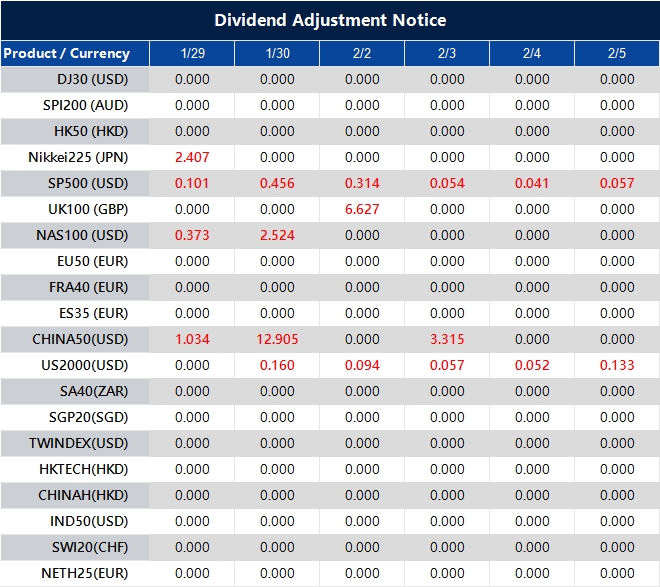
Dividend Adjustment Notice – Jan 29 ,2026

Dear Client,

Please note that the dividends of the following products will be adjusted accordingly. Index dividends will be executed separately through a balance statement directly to your trading account, and the comment will be in the following format “Div & Product Name & Net Volume”.

Please refer to the table below for more details:

Dividend Adjustment Notice

The above data is for reference only, please refer to the MT4/MT5 software for specific data.

If you’d like more information, please don’t hesitate to contact [email protected].

Monthly Analyst Scope: The Hidden Crypto Signal In Q4 Earnings

As the Quarter 4 2025 earnings season kicks off, investors’ eyes are fixed on the scoreboard to see if corporate America can justify the record valuations seen at the end of last year. Heading into Quarter 3, analysts expected S&P 500 earnings to grow by 7.9%.

Corporate America crushed expectations and delivered earnings growth of approximately 13.3%.

While that marked the ninth consecutive quarter of growth, it revealed a crack in the foundation regarding the consumer. Tech giants thrived, but companies exposed to everyday borrowers flashed warning signs.

Forward guidance was cautious, hinting that while the corporate engine is running hot, the fuel of consumer spending might be running low.

However, for the crypto market, the specific earnings-per-share numbers are almost irrelevant. The real signal lies in the macroeconomic ripples these reports create, specifically how they influence the one metric that matters most for digital assets, which is the US Dollar Index (USDX).

The Expectations For A Market Priced For Perfection

According to the latest data from FactSet, the consensus estimate for Q4 2025 earnings growth sits at 8.3%. If realised, this would secure a tenth straight quarter of expansion. Analysts are currently optimistic and project that this momentum will carry into 2026 with double-digit growth expectations of roughly 15%.

However, good news for the stock market is not necessarily good news for crypto. This is where the logic requires a shift away from simple correlations and toward the mechanics of global liquidity.

How The Dollar Controls Crypto Prices

To understand the link between earnings and crypto, we must look at the Federal Reserve’s reaction function.

The primary driver of Bitcoin’s price action over the last cycle has been global liquidity, which is essentially how much cheap money is moving around the system. The gatekeeper of this liquidity is the US Dollar.

If this earnings season delivers a blowout performance where companies report soaring profits and raise their guidance for 2026, it signals that the US economy is accelerating. In this situation, the Federal Reserve loses the incentive to cut interest rates.

Consequently, bond yields would likely rise and make the US Dollar more attractive to global investors. A surging Dollar acts like a vacuum that sucks liquidity out of risk assets. For Bitcoin, which is priced in USD, a strong Dollar often acts as a price cap.

Conversely, the scenario that traditionally ignites a crypto rally is a soft earnings season.

If we see a slight miss in earnings, particularly in the retail and consumer discretionary sectors, it suggests the economy is cooling. This forces the bond market to price in aggressive rate cuts from the Fed to support the economy. When the market anticipates rate cuts, the Dollar typically weakens as yields fall.

A falling Dollar increases the M2 money supply and creates the Goldilocks zone for crypto, which is an economy weak enough to demand liquidity injections but not so weak that it triggers panic.

However, traders must be careful because this logic has a breaking point.

We are currently facing a market with a split personality where stocks rely on growth to go up, while crypto often relies on liquidity to go up.

If earnings soften just enough to worry stock investors, the Fed typically steps in with the medicine of rate cuts. In that specific scenario, stocks might still feel sick from the lack of growth, but crypto rallies on the medicine of new liquidity.

The danger arises if the news becomes too bad. The argument that bad news is good news only holds if the economy is bending rather than breaking. If earnings are disastrous with massive layoffs or collapsing revenue, we are no longer looking at a slowdown but a potential recession.

In a true panic, the promise of future liquidity matters less than immediate safety. Investors will sell everything, including stocks, bonds, gold, and crypto, in a desperate dash for cash. Therefore, crypto bulls should be rooting for a soft landing in earnings, not a crash.

The Verdict

Ultimately, crypto traders should view this earnings season not as a report card on corporate health, but as a barometer for liquidity.

The key is to watch the reaction of the US Dollar immediately after major earnings prints. If the Dollar spikes, the economy is likely too hot, and crypto volatility may remain suppressed.

If the Dollar falls, the liquidity gates are opening, signalling a potential run for Bitcoin. However, if the Dollar spikes while stocks crash simultaneously, it indicates a recession scare where cash becomes the only safe haven.


The export price index for Australia increased by 3.2% in the fourth quarter, rebounding from a decline of 0.9%

Australia’s export price index has increased by 3.2% in the fourth quarter, reversing a previous drop of 0.9%. This change reflects a positive shift in export prices compared to the prior quarter. The rise in the export price index signals changes in global demand and market conditions. Analysts note that such shifts can affect the country’s trade balance and economic forecasts.

Changes for Exporters

Exporters could see revenue changes due to these price shifts. The new data may influence their strategies regarding export volumes and target markets. Overall, these quarterly figures offer valuable insights into Australia’s economic landscape. They provide a glimpse into the trading conditions faced by businesses in the export sector. The notable rise in Australia’s export price index during the fourth quarter of 2025 is a strong positive sign. This data supports the trend noted earlier in the December 2025 trade balance figures, which reported a surplus of A$13.2 billion—the highest surplus in six months. Traders should consider that this strength may continue to bolster the Australian dollar, making long positions in AUD/USD futures or call options appealing. The price increase is driven by commodities, particularly iron ore, which has remained above $135 a tonne throughout January 2026 due to strong demand from Asia. This trend benefits major exporters listed on the ASX, with companies like BHP and Rio Tinto outperforming the broader market since the year began. Traders might consider call options on the XJO index or specific mining and energy stocks to capitalize on this momentum.

Economic Data and Inflation Worries

The recent strong economic data raises inflation concerns, especially after last week’s Q4 2025 CPI reading was higher than anticipated at an annual rate of 3.4%. As a result, market expectations for a mid-year interest rate cut by the Reserve Bank of Australia have largely disappeared. Traders should prepare for the RBA to keep rates steady and possibly adopt a more hawkish stance at its upcoming meeting. Given this situation, increased market volatility is likely as expectations are adjusted. While the overall trend looks encouraging, implementing strategies like collars on equity positions can help shield against sudden reversals in commodity prices. Options on the AUD/USD provide a defined-risk way to speculate on currency movements linked to these strong trade conditions. Create your live VT Markets account and start trading now.

here to set up a live account on VT Markets now

Major tech firms had mixed earnings: Meta excelled, Microsoft underperformed, and Tesla exceeded expectations.

The tech sector had mixed earnings results, with notable reports from Microsoft, Meta, and Tesla. **Microsoft** did well by exceeding revenue expectations, but its shares dropped 5% after hours. While the overall numbers looked strong, the company expects declines in earnings and revenue growth by 2025. Critics pointed out that its big investments in AI haven’t significantly boosted earnings, with capital expenditures reaching $37.5 billion. **Meta**, in contrast, saw its shares jump more than 8% after reporting revenues and forecasts that beat expectations. The company plans to increase capital expenditures on AI to $135 billion, a move investors welcomed thanks to its strong ad revenue. Unlike Microsoft, Meta doesn’t face capacity constraints and is determined to meet ambitious AI objectives, attracting more investor interest. **Tesla** shares rose by over 3%. Even though car sales decreased, the energy storage division performed well, and a weaker dollar worked in its favor. The company is focusing on expanding its cyber taxi business and investing in AI, aiming to transform from just a car manufacturer into a broader technology player. With lower capital expenditures of $2.39 billion, Tesla positions itself as a contender in the AI space while signaling potential recovery in stock prices. The Q4 2025 earnings reports show that the market is punishing companies for substantial AI spending that doesn’t quickly improve profitability. Microsoft’s stock decline reflects investor impatience despite strong overall results. This scenario could lead traders to consider buying puts or creating bear call spreads on Microsoft, anticipating continued disappointment. The stock’s 5% drop to around $425 has increased 30-day implied volatility to about 35%, raising options premiums. Since the company indicated that data center issues may not improve until the latter half of 2026, we could see sideways or downward movement in stock prices. Selling covered calls against long positions might be a wise way to earn income while waiting for the AI investments to pay off. In sharp contrast, **Meta** is being rewarded for its AI investments because its growing advertising business offsets costs. The stock surged over 8% in after-hours trading to just under $555, indicating strong bullish sentiment. This momentum makes strategies like buying call options or putting together bull put spreads appealing in the coming weeks. With the significant price rise, implied volatility has increased, making outright call purchases costly. Instead, traders might consider selling cash-secured puts at a strike price where they would be comfortable owning the stock, such as $520. This strategy lets them earn a hefty premium while maintaining a bullish to neutral perspective. **Tesla** presents a more complex situation. The market responded positively to its earnings beat and shifting narrative. The 3% price increase reflects cautious optimism as it’s increasingly recognized as an AI and energy company, not just a car maker. This shift, combined with lower capital expenditures than competitors, might support the stock price. After a tough start to 2026, with the stock below $240, this earnings report could serve as a recovery catalyst. Given Tesla’s historically high volatility, selling out-of-the-money puts for February or March 2026 expirations could be an effective way to collect premium, betting that the evolving AI narrative will stop the stock from dropping significantly further.

here to set up a live account on VT Markets now

In January, New Zealand’s ANZ Business Confidence dropped from 73.6 to 64.1.

New Zealand’s business confidence index, reported by ANZ, fell from 73.6 in December to 64.1 in January. This drop indicates that businesses are becoming more cautious due to ongoing economic challenges. While some sectors remain optimistic, overall sentiment is weakening. This change could impact future investment and spending decisions. People will be watching for new economic data and government actions that might affect business conditions and consumer confidence in New Zealand.

Impact of Dropping Business Confidence

The decline in New Zealand’s business confidence, from 73.6 to 64.1, shows that the economy’s outlook is softening. This suggests the New Zealand dollar’s recent strength might be peaking. We should prepare for more price fluctuations and possibly a downward trend for the Kiwi in the coming weeks. The situation looks more significant when we consider the recent inflation rate, which fell to 4.7% in the last quarter of 2025. This decrease in price pressure, along with weakening business sentiment, could lead the Reserve Bank of New Zealand to change its strict approach. Now, the market may start to seriously consider interest rate cuts later this year, which seemed unlikely just a few months ago. Given this, there is an opportunity in the currency markets through derivatives. Buying put options on the NZD/USD is a simple way to prepare for a possible decline while managing risk. A drop in the Kiwi seems likely as interest rate expectations shift against it.

Comparisons to Past Economic Trends

This situation is reminiscent of what we saw in 2024, when the effects of the RBNZ’s aggressive rate hikes began to slow business activity. At that time, early signs of a slowdown led to a longer period of economic cooling. We should consider this confidence report as a possible early warning of a similar trend developing now. This outlook also affects the local equity market and interest rate swaps. Hedging long equity positions with NZX 50 index futures could be a wise move against a potential downturn in company profits. At the same time, traders might look to secure fixed rates in the swaps market, taking advantage of the rising expectation of lower official cash rates. Create your live VT Markets account and start trading now.

here to set up a live account on VT Markets now

Gold price hits historic high in early Asian trading due to safe-haven demand

Gold prices soared past $5,500, reaching a record $5,579 in the Asian market. This surge was driven by geopolitical tensions and economic uncertainties. A weaker US Dollar also increased demand for gold as a safe investment. The Federal Reserve kept interest rates between 3.5% and 3.75%. Low rates make holding gold cheaper, which makes it more attractive to buyers.

Geopolitical Tensions Rise

Geopolitical tensions escalated after US President Donald Trump cautioned Iran about its nuclear weapon negotiations. Iran’s threats of retaliation heightened concerns and made gold more appealing. The expectation of a new Fed Chair appointed by Trump added to the uncertainty, further boosting gold demand. Worries about the Fed’s independence and potential interest rate cuts under new leadership shaped market behavior. Despite gold’s rise, some profit-taking could affect its short-term performance, especially after an 80% annual increase. Central bank purchases and interest from trend-following funds were major factors in the market, hinting at potential buying opportunities during price dips. Supportive fundamentals are expected to last until 2026. As gold hits $5,500, we see strong bullish sentiment driven by geopolitical issues and a steady Fed. However, with an 80% increase over the last year, the market may be overextended, and a sharp pullback could occur. This creates challenges but also opportunities for traders in the coming weeks.

Trading Strategies and Market Outlook

With strong underlying support from global tensions and steady interest rates from the Fed, traders seeking further gains might consider buying call options. This strategy allows participation in any rally while limiting risk to the premium paid, enabling traders to stay long without full exposure to a sharp downturn. The rapid increase in prices signals caution. A similar situation happened in 2011 when gold peaked above $1,900 an ounce before dropping by over 25% the following year. Buying put options could be a smart way to hedge existing long positions or bet on a near-term correction. The upcoming announcement of a new Fed Chair is a key factor for potential volatility. This uncertainty is reflected in the Cboe Gold Volatility Index (GVZ), which is currently around 25, a level not seen consistently since early 2023’s banking stresses. Strategies like long straddles, which profit from a significant price shift in either direction, might work well until the new Fed leadership is clarified. Create your live VT Markets account and start trading now.

here to set up a live account on VT Markets now

Foreign investment in Japanese stocks dropped from ¥874 billion to ¥328.1 billion in January 2023

Foreign investment in Japanese stocks dropped significantly from ¥874 billion to ¥328.1 billion in January. This is a notable decrease compared to earlier totals. The US Federal Reserve decided to keep interest rates steady during its January meeting, keeping the Fed Funds Target Range at 3.50%-3.75%. This matched what the market expected.

Forex Market Movements

In the forex market, the USD/CHF pair fell to about 0.7650 due to worries about US trade policy and the independence of the Federal Reserve. Meanwhile, the EUR/USD pair rose above 1.1950, as the US dollar weakened against the Euro amid economic policy uncertainties. Gold prices have reached new record highs, nearing $5,600, driven by geopolitical tensions and economic concerns. Various cryptocurrencies like Worldcoin, Canton, and Jupiter have held their value despite market corrections. The technical outlook for certain currency pairs, such as GBP/USD, indicates possible bearish reversals. Bittensor, an AI-related token, showed positive movement, rising above $240 as retail interest in the derivatives market grows. Please remember, all information here is for informational purposes only and should not be seen as financial advice. Always do thorough research before making investment choices.

Investment Strategies and Market Volatility

Foreign investment in Japanese stocks has sharply decreased, raising concerns for the Nikkei’s recent rally. This follows the index reaching all-time highs in 2024 and 2025, indicating a potential top is forming. Traders might consider buying Nikkei 225 put options to hedge against or speculate on a short-term correction. The Federal Reserve’s decision to maintain rates confirms that the rate-cutting cycle from much of 2025 is currently on hold. The Fed Funds rate has dropped to 3.50-3.75%, down from over 5% in 2024, reducing the dollar’s interest rate advantage. We should think about selling US Dollar Index futures or buying call options on pairs like AUD/USD, which is nearing multi-year highs. Gold continues its strong rise toward $5,600, supported by a weaker dollar and ongoing global uncertainties. This trend follows its breakout past the previous $2,100 resistance level in early 2024. Maintaining long positions through gold futures or call options is a key strategy until a significant reversal happens. Given the combination of a paused Fed, political uncertainty in Japan, and general geopolitical risks, we predict market volatility will rise. After a relatively calm period in parts of 2025, the CBOE Volatility Index (VIX) is showing renewed activity. Buying VIX call options may be an affordable way to protect portfolios against a sudden market drop in the coming weeks. Create your live VT Markets account and start trading now.

here to set up a live account on VT Markets now

USD/JPY rises above 153.00 as Bessent backs strong US dollar strategy

USD/JPY was around 153.35 in the early Asian session on Thursday. The US Dollar strengthened against the Japanese Yen after US Treasury Secretary Scott Bessent backed a strong dollar policy. The Federal Reserve kept interest rates between 3.5% and 3.75%. Bessent reaffirmed the US’s commitment to a strong dollar without intervening in the currency market. Later on Thursday, the US Initial Jobless Claims report is expected. The Fed held interest rates steady, citing ongoing inflation and economic growth. Fed Chair Jerome Powell mentioned that the Fed is ready to review data from meeting to meeting.

Impact Of Japanese Economic Policies

The Japanese Yen is affected by Japan’s economy, the Bank of Japan’s (BoJ) policies, differences in US-Japan bond yields, and trader sentiment. The BoJ’s past very loose policies weakened the Yen, but recent changes are helping it strengthen. Although the bond yield gap favors the US Dollar, adjustments made by the BoJ are closing this gap. The Japanese Yen is considered a safe haven, attracting investments during uncertain times. As a result, it tends to gain against riskier currencies. This safe-haven status means that during market stress, investors often turn to the Yen for its reliability and stability. A year ago, USD/JPY was firmly above 153 as the US government promoted a strong dollar and the Fed kept rates steady. During that time, the dollar had a significant interest rate advantage. Early 2025 marked the peak of dollar strength against the Yen. Since then, changes have happened as expected. The Federal Reserve began its rate-cutting cycle in the second half of 2025, while the Bank of Japan started to move away from its very loose policy with two small rate hikes. This has started to reduce the large interest rate gap between the US and Japan.

Current Market Trends

At the moment, USD/JPY is around 145.80, reflecting this new reality. The latest US Non-Farm Payrolls report from early January 2026 showed job growth slowing to 165,000, which was below expectations and indicates a cooling US economy. This data supports the idea of more Fed rate cuts in upcoming meetings. On the other hand, Japan’s recent Tokyo Core CPI data was 2.4%, remaining above the BoJ’s target. This ongoing inflation puts pressure on the BoJ to consider another rate hike by the second quarter. The differing directions of the central banks are key for the Yen’s relative strength. For derivative traders, this suggests planning for a slow, gradual decline in USD/JPY over the coming weeks. Buying JPY call options or USD put options could be a straightforward way to act on this view. Using put option spreads on USD/JPY can also be a useful strategy to lower costs while aiming for a move towards the 142-143 range. We should also monitor implied volatility, which is currently moderate. As we approach the next Fed decision in March and important US inflation data, volatility may rise, making options pricier. This could be a chance to sell out-of-the-money call spreads on USD/JPY, collecting premiums with the expectation that the pair will not increase significantly from this point. Create your live VT Markets account and start trading now.

here to set up a live account on VT Markets now

The Euro drops below 1.2000 against the Dollar as Powell’s neutral stance keeps rates steady.

The EUR/USD dropped below 1.2000, falling by more than 0.60% after the Federal Reserve decided to keep interest rates unchanged. Currently, the exchange rate is at 1.1955, as Fed Chair Jerome Powell took a neutral view on monetary policy. The Federal Reserve expressed patience regarding the economy, citing improvements in the labor market and ongoing inflation concerns. Core PCE inflation might reach about 3%, with price increases expected to peak around mid-year.

Consumer Confidence and ECB Concerns

In Germany, consumer confidence has improved, but the European Central Bank is worried about how a weaker US Dollar might affect inflation. Meanwhile, the US Dollar Index increased by 0.55% to 96.34. At the recent Federal Reserve meeting, interest rates stayed at 3.50%–3.75% after a split vote. Officials noted that inflation remains “somewhat elevated” and that economic uncertainty continues, which will influence future decisions based on the dual mandate. The EUR/USD has retreated from recent highs and is stabilizing near 1.1950, with possible further changes depending on Federal Reserve actions. Decisions from the Fed’s eight annual meetings greatly influence the US Dollar, with quantitative easing and tightening altering its value and attractiveness internationally. Reflecting on this period in 2025, the Federal Reserve’s firm approach pushed the EUR/USD below the 1.2000 mark. Now, as the pair trades closer to 1.1500, we see a shift as last year’s tightening impacts become evident. Recent reports indicate US inflation has dropped to 2.8%, its first reading below 3% in over eighteen months, suggesting the end of the rate-hiking cycle.

Shifting Monetary Policy Dynamics

Last year’s focus for the Fed was on stabilizing labor conditions. Today, however, the emphasis has shifted to a cooling market. With the Fed funds rate at 4.25%, discussions are now regarding when the first rate cuts will happen. The latest jobs report revealed an uptick in the unemployment rate to 4.1%, prompting traders to anticipate a policy change before summer. A year ago, European Central Bank officials were concerned about a strong euro, but the dollar’s recent rally has changed that. Now, ECB policymakers sound more hawkish than the Fed, as Eurozone core inflation remains above their target. Derivative markets expect 75 basis points of cuts from the Fed in 2026, while only 25 basis points are anticipated from the ECB. In the upcoming weeks, this growing policy difference suggests a possible strengthening of the euro against the dollar. We might consider using options to trade a move back towards the 1.1750 resistance level, such as buying call options or setting up bull call spreads. Implied volatility is likely to rise before the next FOMC meeting, so taking positions beforehand could be advantageous. Create your live VT Markets account and start trading now.

here to set up a live account on VT Markets now

Tesla shares rise 3% after a quarterly earnings beat, fueled by adjusted EPS growth

Tesla shares rose by 3% in after-hours trading after the company reported better-than-expected earnings. Tesla showed an adjusted earnings per share of $0.50 and revenue of $24.9 billion, exceeding estimates by $140 million, even though revenue fell by 3% from the previous year. Revenue from the automotive division dropped by 11% year-over-year, while the energy sector grew by 25%. Tesla’s operating margin decreased by 50 basis points to 5.7% due to an 11% drop in operating income, which was influenced by a 39% increase in operating expenses. In the fourth quarter of 2025, Tesla reported free cash flow of $1.42 billion, a decline from $3.99 billion the year before. On the progress of the Optimus humanoid robot, Tesla announced plans to reveal the Optimus Gen 3 in the first quarter. This Gen 3 model will feature significant upgrades and is the first designed for mass production, aiming to produce 1 million robots per year before the end of 2026. While the share price increase is appealing, there’s a classic case of optimism overshadowing the current weak performance. With the earnings event behind us, we expect the high volatility seen before the report to drop significantly. This “volatility crush” will lower the prices of newly bought long options, hurting those who purchased them at peak prices yesterday. Traders bullish on the Optimus narrative might want to buy call options with expirations after the planned Q1 unveiling. In the past, similar events like AI Day events in the early 2020s have created a buildup of excitement, driving prices up. Buying call options now, after the initial volatility crush, could be a smart move ahead of the Gen 3 reveal. On the flip side, the fundamentals present a bearish outlook. The 11% decline in automotive revenue comes as overall EV sales growth slowed to just 25% in 2025, according to IEA data. With the stock trading at over 55 times its forward earnings, some traders might see this as a chance to buy put options, betting that the weak cash flow and lower margins will eventually overshadow the hype surrounding the robot. The struggle between the weak auto business and the Optimus story creates significant uncertainty. Current options pricing suggests a possible 12% movement in the stock over the next month, making strategies like long straddles appealing for those who expect a big swing. Alternatively, traders who think the stock will stay within a certain range as the market absorbs this news might consider selling iron condors to profit from the still-high volatility.

here to set up a live account on VT Markets now

Back To Top
server

Hello there 👋

How can I help you?

Chat with our team instantly

Live Chat

Start a live conversation through...

  • Telegram
    hold On hold
  • Coming Soon...

Hello there 👋

How can I help you?

telegram

Scan the QR code with your smartphone to start a chat with us, or click here.

Don’t have the Telegram App or Desktop installed? Use Web Telegram instead.

QR code