



Gold prices decline today in Saudi Arabia, according to market analysis
Gold prices in Saudi Arabia decreased on Friday. The price per gram is now 554.44 Saudi Riyals (SAR), down from 555.24 SAR the day before. The price for one tola of gold is now SAR 6,466.87, down from SAR 6,476.25.
FXStreet calculates local gold prices by adjusting international figures and updating them daily. These prices serve as a reference and may vary slightly from local rates due to market changes.
Japan’s finance minister Satsuki Katayama says all measures, including currency intervention, are being considered for yen stability.
Japan’s Finance Minister, Satsuki Katayama, has announced that the government is considering all options, including direct intervention in the currency market, to tackle the recent weakness of the Japanese Yen. Currently, the USD/JPY pair has dropped by 0.24%, now at 158.25.
The value of the Japanese Yen largely depends on factors like Japan’s economic performance and the monetary policies of the Bank of Japan (BoJ). Additionally, it is influenced by the differences in bond yields between Japan and the US, as well as traders’ risk appetite.
Role of The Bank of Japan
The Bank of Japan (BoJ) manages currency control and sometimes intervenes in the currency markets to lower the Yen’s value. The BoJ has maintained an ultra-loose monetary policy from 2013 to 2024, which led to a weaker Yen. Recently, a shift away from this policy has started to support the Yen. The widening gap between Japanese and US bond yields is due to their different monetary policies. However, recent changes by the BoJ and rate cuts in other countries are starting to close this gap. The Yen is often viewed as a safe investment, attracting more buyers during market uncertainty, which can increase its value against riskier currencies. The Finance Minister’s remarks about taking “bold action” indicate the government is concerned about the Yen’s current weakness. With USD/JPY at 158.25, there’s a strong chance of direct intervention to bolster the Yen, similar to efforts made in late 2022 and again when the pair fell below 155 in October 2024. This situation poses a significant short-term risk for traders holding long USD/JPY positions. The main issue continues to be the interest rate difference between the US and Japan. Currently, the US 10-year Treasury yield is about 4.1%, while Japan’s 10-year government bond yield is only 1.1%. This wide gap remains attractive for carry traders and has been a key factor behind the Yen’s weakness in 2025, even as the BoJ slowly moves away from its ultra-loose policy.Impact on Derivative Traders
For derivative traders, the government’s warning raises the expected volatility for USD/JPY in the coming weeks. The implied volatility for one-month options has surged to over 12%, compared to an average of 9% in the last quarter of 2025. It might be wise to consider buying JPY calls or USD/JPY puts as a hedge against or a way to profit from a rapid drop triggered by intervention. Keep in mind that verbal intervention is much simpler than actual market actions, which could cost Japan billions in foreign reserves. Japan’s core inflation, which was reported at 2.3% for December 2025, does not warrant aggressive rate hikes from the BoJ just yet. Additionally, with global equity markets remaining stable, there is limited safe-haven demand to support the Yen naturally. Create your live VT Markets account and start trading now.Gold prices in the Philippines decline, according to today’s data from relevant sources
Gold prices in the Philippines dropped on Friday, as reported by FXStreet. The price per gram went down to 8,784.39 Philippine Pesos (PHP) from 8,796.89 the day before.
The price per tola also fell, decreasing to PHP 102,458.10 from PHP 102,605.10. The price of gold per Troy ounce was PHP 273,225.10. FXStreet converts international gold prices to local currency using the USD/PHP rate.
A Safe Haven Asset
Gold is seen as a safe-haven asset and a way to protect against inflation. Central banks are the biggest buyers of gold, using it to diversify their reserves and support local currencies in uncertain times. In 2022, central banks bought 1,136 tonnes of gold worth around $70 billion. Gold prices often move in the opposite direction of the US Dollar and US Treasuries. They can also change based on geopolitical events and economic conditions. Factors like interest rates, currency performance, and investor demand affect gold prices. FXStreet notes that market information is for reference only and may vary. Readers should do their own research before investing in gold or other assets. Currently, we are seeing a small decline in gold prices. This seems to be a minor adjustment rather than the beginning of a big downtrend. This short-term weakness is occurring as the US Dollar has weakened from its 2025 highs. This inverse relationship is important for our outlook in the coming weeks.Market Expectations
The market now anticipates possible Federal Reserve rate cuts later this year. This outlook is backed by the December 2025 jobs report, which showed a slower labor market with only 155,000 jobs added. Last week’s inflation data, showing a Consumer Price Index (CPI) of 2.9% for the year, suggests that peak interest rates may be behind us. Lower interest rates usually make non-yielding gold more attractive. We must also keep in mind the strong demand that has kept prices steady. Throughout the chaos of 2023 and 2024, central banks were major buyers. The World Gold Council’s latest report for Q4 2025 indicates that this buying spree continued, with net purchases exceeding 950 tonnes for the year. This steady buying from official sources acts as a safety net against large price drops. In the coming weeks, this dip might be a chance to prepare for a future price increase. Buying call options or setting up bull call spreads could be a smart way to gain upside exposure while managing risk. Traders who already have long positions might want to consider buying out-of-the-money put options to protect against any sudden reversals due to geopolitical de-escalation. Create your live VT Markets account and start trading now.Dividend Adjustment Notice – Jan 16 ,2026
Dear Client,
Please note that the dividends of the following products will be adjusted accordingly. Index dividends will be executed separately through a balance statement directly to your trading account, and the comment will be in the following format “Div & Product Name & Net Volume”.
Please refer to the table below for more details:
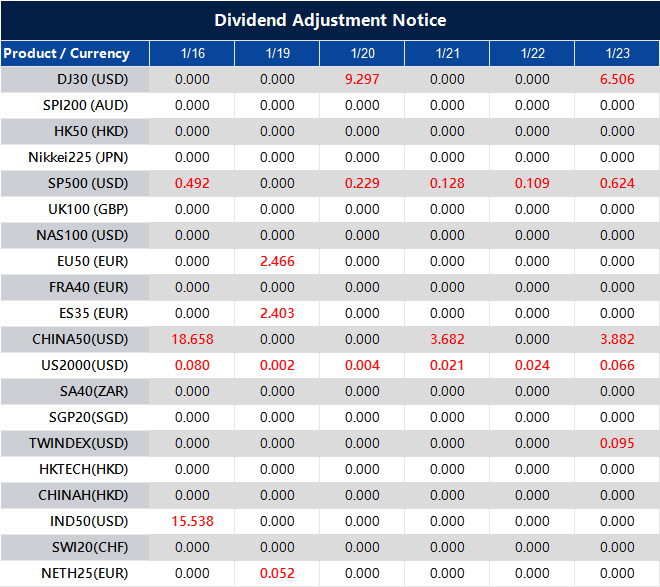
The above data is for reference only, please refer to the MT4/MT5 software for specific data.
If you’d like more information, please don’t hesitate to contact [email protected].
Gold prices in the United Arab Emirates have recently declined, according to new data.
Gold prices in the United Arab Emirates fell on Friday. The price per gram decreased to 543.00 AED from 543.81 AED the day before.
For 10 grams, the price is now 5,430.27 AED. The price per tola dropped to 6,333.47 AED from 6,342.87 AED.
Gold Pricing Mechanism
Prices are set by FXStreet, which adjusts international rates to local currency. These prices change daily, but local market rates may differ. Gold has long been a way to exchange value and store wealth. In 2022, central banks added about 1,136 tonnes, worth $70 billion, to their gold reserves. Gold demand generally increases during times of geopolitical instability. It serves as a safeguard against inflation and declining currencies. Interest rates and the value of the US Dollar also affect gold prices. Lower interest rates typically boost gold demand, while a strong US Dollar can lower prices.Market Impact and Trading Strategies
The recent dip in gold to 543.00 AED per gram is a moment of pause after a strong climb at the end of 2025. This slight drop might be a good time for traders to prepare for the next move. The overall economic environment is still very supportive of gold. The US Federal Reserve’s minutes from early January 2026 confirmed a halt in raising rates, and markets expect possible cuts by mid-year. The latest US Consumer Price Index data for December 2025 showed stubborn inflation at 3.2%, keeping fears of currency devaluation alive. This situation has put pressure on the US dollar, with the DXY index falling below the key 100 level for the first time since 2024. A weaker dollar is good for gold prices, and this trend is likely to continue into the first quarter of 2026. For those trading derivatives, buying call options for April and May 2026 looks appealing. The implied volatility for gold options is around 16%, which is low, even with rising tensions in the South China Sea. This means options are reasonably priced compared to the chance for a price increase. Given the strong buying from institutions, we believe the downside is limited. Central banks continued to buy in 2025, adding around 995 tonnes to global reserves, according to the World Gold Council’s latest numbers. This ongoing demand provides a solid foundation for the market, making strategies like selling out-of-the-money put options a good way to earn premiums. Create your live VT Markets account and start trading now.Gold prices decline in Pakistan today, according to market data
Gold prices in Pakistan dropped on Friday. The cost for one gram of gold fell to 41,461.99 Pakistani Rupees (PKR) from 41,523.44 PKR the day before. Meanwhile, the price per tola decreased to 483,604.60 PKR, down from 484,321.20 PKR.
FXStreet determines gold prices by converting international rates to local currency and measurements. These prices change daily and serve as reference points. They may not exactly match local market rates.
Gold As A Safe Haven Asset
Gold is viewed as a safe-haven asset, providing protection against inflation and currency decline. Central banks are significant buyers, having added 1,136 tonnes to their reserves in 2022, as reported by the World Gold Council. Gold usually moves in the opposite direction of the US Dollar and US Treasuries. Price shifts can be affected by geopolitical tensions, recession worries, and interest rate changes. A strong US Dollar typically lowers gold prices, while a weaker Dollar can push them up. We are witnessing a slight decline in gold prices, following a strong performance in the last quarter of 2025. The market is currently responding to mixed signals, especially regarding the US Federal Reserve’s upcoming actions on interest rates. This uncertainty creates a tense environment, where a significant price movement may be on the horizon. In this context, traders should focus on strategies that benefit from price volatility rather than choosing a specific direction. Buying straddles or strangles on gold futures—especially prior to the next inflation report—could be a smart way to capture any breakout. This method allows us to profit whether gold rises due to recession fears or falls on a hawkish Fed statement.Central Banks And Volatility
Looking back, central banks have maintained a strong buying trend, adding over 950 tonnes to their reserves through 2025. This continued demand provides solid support for gold. However, the implied volatility in gold options, as measured by the Cboe GVZ index, has increased to 17% this month, up from 13% in November 2025. This indicates the market is expecting a larger price movement soon. The inverse relationship with the US Dollar continues to be crucial. The dollar index (DXY) has been trading within a narrow range since late last year, suggesting a potential breakout. A significant movement in the Dollar outside its 103-105 range—held since late 2025—would likely result in a major corresponding move in gold prices. Additionally, ongoing geopolitical tensions in Eastern Europe are providing a safety net for safe-haven assets. This persistent risk reduces the likelihood of a sharp decline in gold prices, even if interest rate expectations shift. We should stay prepared for a sudden move, as the current stability seems temporary. Create your live VT Markets account and start trading now.Gold prices in India decline today based on market trend data
Gold prices in India fell on Friday, according to FXStreet data. Gold now costs 13,405.44 Indian Rupees (INR) per gram, down from INR 13,426.52 the day before. The price per tola dropped to INR 156,358.50 from INR 156,604.30.
FXStreet adjusts international Gold prices into INR by considering currency changes and market conditions. These daily updates provide reference points, but local rates may vary slightly.
Gold as a Safe Asset
Gold is regarded as a stable form of value and a means of exchange. Beyond jewelry, many see Gold as a safe investment during tough economic times, shielding against inflation and currency loss. Central banks are significant buyers of Gold. They buy Gold to support their currencies and improve their economic standing. In 2022, central banks acquired 1,136 tonnes, totaling about $70 billion, which set a new record. Gold prices typically move in the opposite direction of the US Dollar and US Treasuries. When the Dollar weakens, Gold prices often rise; however, strong stock market performances can bring Gold prices down. Various factors like geopolitical events and interest rates can sway Gold prices. A strong Dollar stabilizes markets, while a weak Dollar tends to lift Gold prices. Today’s small price dip could be a good opportunity to buy rather than a sign of a downward trend. The reasons for owning Gold seem to be strengthening. This slight decline is likely just background noise before a new upward trend begins.Market Environment and Strategy
Interest rates play a big role in our strategy for the upcoming weeks. After high rates throughout 2024 and 2025, the US Federal Reserve has hinted at easing its policies later this year. Lower rates can make bonds less appealing, making non-yielding assets like Gold more attractive. Additionally, the US Dollar has started to weaken in early 2026, which typically supports Gold prices. December 2025 inflation reports showed that while price increases have lessened from their 2023 highs, inflation remains stubbornly above targets in both the US and Europe. This situation reinforces Gold’s traditional role as a hedge against currency depreciation. We must also note the strong and steady demand from central banks, which continued throughout 2025. Following the record purchases in 2022, the World Gold Council’s latest Q4 2025 data revealed that emerging market banks added another 230 tonnes to their reserves. This institutional buying helps create a solid price floor and reduces the risk of declines. With stock markets seeming fully valued after last year’s strong performance, diversifying into safe-haven assets is a wise choice. Therefore, traders should consider using this price drop as a chance to build long positions through call options or futures contracts. The current conditions suggest that any significant price dips are unlikely to persist for long. Create your live VT Markets account and start trading now.Gold prices in Malaysia have decreased according to the latest available data.
**Gold Prices as a Safe Haven**
Gold prices in Malaysia dropped on Friday, according to FXStreet. The price per gram went down to MYR 599.96 from MYR 600.89 the day before.
Prices also decreased to MYR 6,997.95 per tola, down from MYR 7,008.68 earlier. The price for a Troy Ounce is now MYR 18,660.88.
FXStreet calculates Malaysia’s gold prices by converting international rates to local currency and updating them daily. Keep in mind that local prices may vary slightly as these figures are mainly for reference.
Gold is not only used for jewelry; it is also considered a safe-haven asset during economic uncertainty. Investors often turn to gold as a hedge against inflation, providing stability regardless of government actions.
Central banks buy gold to strengthen their economies. In 2022, they purchased 1,136 tonnes, valued at around $70 billion, marking a record high.
Gold prices tend to move in the opposite direction of the US Dollar and Treasuries. A weaker Dollar can increase gold prices, while a stronger Dollar might lower them.
**Strategies for Market Volatility**
Economic instability often raises gold prices due to its safe-haven status. When interest rates are low, gold becomes more appealing; higher rates generally make it less attractive.
Currently, we see a small dip in gold prices, but this is just a minor fluctuation in a broader context. The real value of gold is linked to its inverse relationship with the US Dollar, which has been strengthening due to recent economic reports. This situation is causing tension in the market that we should watch closely.
The main factor to consider is the policy of central banks, especially the US Federal Reserve. After the recent US inflation report in December 2025 showed inflation at 2.9%, the market now expects a slower pace of interest rate cuts this year. Anticipation of higher rates for an extended period puts pressure on gold, as it does not generate interest.
However, strong demand for physical gold provides solid support. According to the World Gold Council data for the third quarter of 2025, central banks, especially the People’s Bank of China, continued to increase their reserves at almost record levels. This steady buying serves as a price floor, making significant dips likely short-lived.
Given these mixed signals, traders should explore strategies that benefit from volatility instead of making a straightforward bet. The CBOE Gold Volatility Index (GVZ) has been rising from the lows we saw last fall, now sitting around 16.5 this week. This indicates that options are becoming more valuable as uncertainty about the Fed’s decisions and global stability increases.
We recommend moving away from simple long or short futures positions. Instead, consider buying call options to capture potential gains from any unexpected dovish shift by the Fed, while using put options to hedge against a stronger dollar if upcoming US economic data remains strong. This balanced approach is more fitting for a market experiencing conflicting forces.
**Create your live VT Markets account and start trading now.**
The US Dollar Index trades near 99.30, influenced by jobless claims that support a Fed pause.
The US Dollar Index (DXY) is stabilizing around 99.50 as jobless claims raise expectations that the Federal Reserve will keep interest rates steady. The CME FedWatch tool indicates a 95% chance of unchanged rates at the January meeting.
Initial US Jobless Claims dropped to 198K, better than the expected 215K, and down from last week’s 207K. The US Dollar remains strong due to solid labor market conditions, pushing expectations for rate cuts to June.
Market Sentiment And Influences
Despite slight declines, DXY is trading near 99.30. Traders are looking for US industrial production data and comments from Federal Reserve officials. President Trump’s support for Fed Chair Jerome Powell and a US-Taiwan trade agreement have also boosted market sentiment. The US Dollar is the official currency of the US and is crucial in global markets, accounting for over 88% of foreign exchange transactions. Its value is heavily influenced by Federal Reserve policies aimed at price stability and employment. Monetary actions like quantitative easing (QE) and tightening (QT) greatly affect the Dollar’s strength. QE usually weakens the Dollar, while QT tends to strengthen it. Each strategy represents different approaches to managing economic conditions. Reflecting on January 2025, a strong labor market kept the US Dollar Index stable around 99.50. Initial jobless claims were impressively low at 198K, leading to delayed rate cut expectations. This strong performance sharply contrasts with our current situation.Changes In Economic Strategies
Today, the economic landscape has changed significantly, leading to a new strategy. Recent data indicates that inflation has eased, with the most recent Consumer Price Index (CPI) showing a year-over-year increase of just 2.4%. Meanwhile, initial jobless claims have risen to 225,000, indicating a softening labor market compared to last year. This slowdown has allowed the Federal Reserve to start easing rates. With two rate cuts in the last quarter of 2025, the target rate has dropped to between 4.75% and 5.00%. As a result, the US Dollar Index is under sustained pressure, now trading around 95.00. This marks a shift from the previous “higher for longer” sentiment of last year. For traders in the coming weeks, this suggests a continued US dollar weakness and potential for more volatility. Strategies like buying put options on the DXY or shorting the dollar against currencies with more aggressive central banks could be beneficial. The main focus is now on a Federal Reserve that prioritizes growth over fighting inflation. Create your live VT Markets account and start trading now.EUR/USD stabilizes around 1.1610 after three-day decline, with RSI indicating bearish momentum
EUR/USD has bounced back from its six-week low of 1.1589, trading at approximately 1.1610 during the Asian session on Friday. The 14-day Relative Strength Index (RSI) is at 35, suggesting a neutral to bearish trend. Resistance is initially at the nine-day Exponential Moving Average (EMA) of 1.1648.
Technical analysis shows that EUR/USD is trading below both the nine-day and 50-day EMAs, indicating a bearish trend. The short-term EMA is below the medium-term EMA, which restricts price recoveries. Bearish pressure will continue if the pair stays below the short-term EMA.







