



China’s December exports exceeded forecasts, growing by 6.6% instead of the expected 3% year-on-year.
China’s exports rose by 6.6% in December compared to last year, beating the expected 3% growth. This shows strong demand for Chinese products.
In other news, the USD/CHF currency pair gained slightly, while gold prices increased in several countries, according to FXStreet data. The EUR/USD remained stable around 1.1650 without significant changes.
AUD/USD stabilizes just below 0.6700 during Asian hours after slight losses in previous trading
AUD/USD is stabilizing under 0.6700, currently around 0.6680 in the Asian session after slight losses earlier. The US Dollar is strengthening despite US inflation data being lower than expected, hinting at possible interest rate cuts by the Federal Reserve.
In December, the US Core Consumer Price Index increased by 0.2%, falling short of market forecasts, while annual core inflation remained steady at 2.6%. This indicates easing inflation, but strong job figures suggest a solid labor market.
Support for the Australian Dollar
The Australian Dollar may receive support from expected rate hikes by the Reserve Bank of Australia (RBA). In November 2025, dwelling approvals in Australia rose by 15.2%, showing strong housing demand and possibly influencing inflation concerns for the RBA. Upcoming trade balance data from China is expected, with a projected surplus of $113.60 billion for December. Year-over-year, exports are predicted to increase by 3.0% and imports by 0.9%. China’s economic situation, a significant trading partner for Australia, directly affects the Australian Dollar, with any changes impacting AUD exchange rates. The value of AUD is influenced by RBA interest rates and iron ore prices, Australia’s top export. Export demand plays a crucial role, making the trade balance a key focus. As AUD/USD hesitates below the important 0.6700 level, there’s clear tension that derivative traders can take advantage of. The US Dollar’s unexpected strength, despite December 2025’s inflation data indicating future rate cuts by the Federal Reserve, creates uncertainty that is favorable for options strategies aiming for a specific move or a surge in volatility.Effects of Inflation and Rate Cuts
The lower US core inflation figure of 2.6% for 2025 is a big drop from the 3.9% seen at the start of 2024, strongly indicating that the Fed’s next action will likely be a rate cut. Market pricing is now aggressively factoring in several rate cuts for the year, similar to late 2023. Traders may consider buying AUD/USD call options to bet on US Dollar weakness once the market fully processes this dovish inflation news. On the other hand, the Australian Dollar has its own strengths, especially with the booming housing market reflected in the 15.2% rise in dwelling approvals from November 2025. This domestic inflationary pressure could push the RBA to adopt a more aggressive stance than currently expected. The potential policy split, with the RBA increasing rates and the Fed decreasing them, forms a solid basis for a long AUD/USD position. However, the immediate focus is on China’s trade data, a vital factor for the Australian economy and its currency. Iron ore prices, which were mainly above $120 a ton throughout 2024, are highly influenced by Chinese industrial demand reported in this data. A positive surprise could boost the AUD, making short-dated call options an appealing way to trade this event. Given these opposing yet powerful forces, we recommend traders use derivatives to manage risk and speculate on outcomes. Buying call spreads on AUD/USD can be a cost-effective strategy to bet on the currency rising due to the anticipated policy divergence in the coming weeks. For those more cautious about the China data, purchasing puts can provide a cheap hedge against a downside surprise that temporarily strengthens the US Dollar. Create your live VT Markets account and start trading now.GBP/USD dips to around 1.3425 as demand for US Dollar rises and market awaits data releases
Concerns About Fed Independence
In the UK, a cautious approach from the Bank of England could weaken the Pound Sterling against the USD. Recently, the Bank cut its interest rate to 3.75% in December and hinted at more cuts by 2026 as inflation slows down. The Pound Sterling is the UK’s official currency and makes up 12% of global forex transactions. The Bank of England’s decisions on inflation and interest rates greatly affect the Pound’s value. Key economic data, such as GDP and the trade balance, also play a significant role in determining the Pound’s strength. Currently, the GBP/USD is trading around 1.3425, influenced by the differing policies of the Bank of England and the Federal Reserve. The Bank of England is clearly indicating it will ease monetary policy, putting the Pound in a weak position as we approach important US economic data releases.Immediate Focus for the Coming Sessions
Looking back at 2025, the Bank of England reduced its interest rate to 3.75% in December as inflation began to ease. Recent data confirmed this, showing UK inflation for November 2025 dropped to 3.1%, giving the central bank further reasons to act. We expect another rate cut could happen in the March or April meetings this year. In contrast, the US Federal Reserve seems to be holding steady. The latest core CPI reading for December was slightly lower at 2.6%, but this did not change market predictions for a rate cut, which remains slated for June rather than April. Futures markets currently show less than a 30% chance of a rate cut by the April meeting, keeping the US dollar strong. Create your live VT Markets account and start trading now.NZD/USD declines, trading near 0.5730 ahead of China’s trade data release
The NZD/USD pair has dipped below 0.5750, even with a 2.8% rise in New Zealand’s building permits for November, reversing a decline from October. Expectations are for China’s trade balance in December to widen to $113.60 billion, which could affect the NZD since China is New Zealand’s biggest trading partner.
During Asian trading hours on Wednesday, the pair continued to decline, hovering around 0.5730, despite the positive building permits data. With China’s exports and imports expected to rise, New Zealand’s economy and currency could be influenced due to their close trade ties.
Impact of the US Dollar
The US Dollar is gaining strength, even with low inflation that might lead the Federal Reserve to consider lowering interest rates. The US Core CPI increased by only 0.2% in December, which is below what was expected, indicating easing inflation. Strong Nonfarm Payrolls and falling unemployment rates highlight a solid labor market. Several factors affect the NZD, including China’s economic performance and dairy prices, which are New Zealand’s main exports. The Reserve Bank of New Zealand makes interest rate decisions to keep inflation between 1% and 3%, influencing the value of the NZD. Economic growth data and risk sentiment also impact the NZD’s value, with stronger economies boosting the currency. By late 2025, the NZD/USD struggled to stay above the 0.5750 mark, pressured by a surprisingly strong US Dollar despite softer inflation numbers. The market was eagerly awaiting Chinese trade data for guidance on the commodity-linked Kiwi dollar, setting the stage for ongoing weakness as the new year approached. Last week’s expected Chinese trade data for December disappointed the market. Exports grew by only 1.4% year-over-year, below the 3.0% forecast, indicating weaker global demand and affecting New Zealand’s economic outlook. This confirmed the negative sentiment for the NZD that had been building at the end of the previous year.Market Influences
Moreover, the Global Dairy Trade auction on January 6th revealed a price index drop of 1.9%, marking the second consecutive decline. Falling dairy prices are a significant challenge for the New Zealand Dollar. Historically, ongoing declines in dairy prices have preceded periods of NZD/USD weakness, as seen during the downturn in mid-2023. On the US Dollar side, it continues to find support. The strong Nonfarm Payrolls report from December 2025 showed that the US economy added 216,000 jobs, leading markets to postpone expectations for a Federal Reserve rate cut until the second quarter of 2026. This widening interest rate difference makes holding US Dollars more appealing than New Zealand Dollars. Given these challenges, traders may want to consider strategies that could benefit from further weakness in NZD/USD in the upcoming weeks. Buying put options with strike prices below 0.5700 offers a defined-risk strategy for those expecting a continued decline. For those with a neutral-to-bearish outlook, selling call option spreads above the 0.5750 resistance level could be a good way to earn premium as the pair remains capped. Create your live VT Markets account and start trading now.In December, New Zealand’s ANZ commodity price fell from -1.6% to -2.1%
The New Zealand ANZ Commodity Price Index dropped from -1.6% to -2.1% in December. This decline indicates ongoing problems in the commodity sector and highlights difficulties with production and pricing in New Zealand’s markets.
Global market changes and trade tensions may also impact commodity prices. Stakeholders need to keep a close eye on these developments.
Upcoming Reports And Data Releases
As the economy evolves, stakeholders will look to upcoming reports and data releases to grasp market trends and potential price shifts. This information is crucial for making smart trading decisions. Stay tuned for updates on the economic environment and any efforts that may help tackle these commodity price challenges. The drop in our commodity price index to -2.1% for December 2025 points to a significant challenge for New Zealand’s export-reliant economy. We can expect further weakness in the New Zealand dollar (NZD) in the coming weeks. Derivative traders should think about strategies that might benefit from a falling currency. This negative outlook is backed by recent data from the Global Dairy Trade auction, which revealed a 2.9% drop in average prices last week, marking the fourth straight decline. As dairy products make up a large part of our exports, this trend directly impacts New Zealand’s trade balance, putting the NZD in a delicate situation, especially against the US dollar.Historical Patterns And Economic Outlook
Reflecting on late 2022, we noticed that a steady decline in commodity prices preceded a drop in the NZD/USD exchange rate. The current situation seems to follow a similar pattern. Therefore, it makes sense to consider short positions in NZD futures or to buy put options. Inflation data from the fourth quarter of 2025 indicates a cooldown, partly due to these falling prices. This reduces pressure on the Reserve Bank of New Zealand to raise interest rates anytime soon. When the central bank is less aggressive, a currency’s value often declines. Given these conditions, we’ll be watching closely for any break below the support levels that the NZD held during the last quarter of 2025. A decisive move below that point could lead to more selling. Upcoming employment and trade balance figures will be essential to monitor for any changes to this bearish trend. Create your live VT Markets account and start trading now.Nikkei Surges Beyond 54,000 As Rally Accelerates
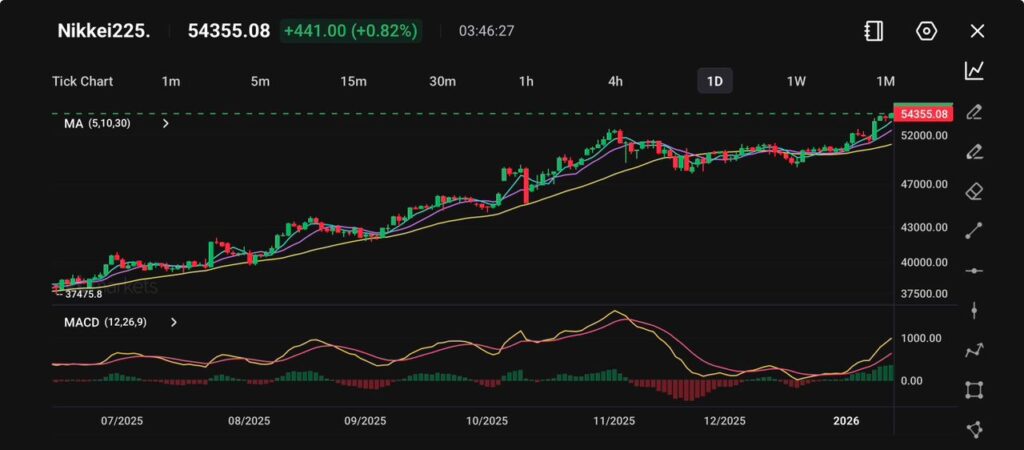
Japan’s Nikkei 225 climbed to a fresh all-time high on Wednesday, extending a rally that has gathered notable momentum since the start of the year. The benchmark advanced 1.3% to 54,219.24 in early trading, briefly clearing the 54,000 threshold for the first time.
The move followed a strong 3% gain in the prior session, sparked by reports suggesting Prime Minister Sanae Takaichi could dissolve parliament as early as this month, paving the way for a general election in February. Markets took the prospect as an indication that additional fiscal stimulus may be forthcoming to support economic growth.
Weaker Yen Lifts Export-Oriented Stocks
A renewed decline in the yen provided an additional boost to Japanese equities. The currency fell sharply late last week, enhancing the value of overseas revenues for export-focused companies and improving earnings expectations.
USDJPY slipped to its weakest level since July 2024 on Tuesday and was last trading around 159.2 per dollar. The softer yen has continued to favour sectors with significant foreign income exposure, particularly technology names and industrial exporters.
Politics And Policy Shape Market Mood
Investors remain closely attuned to the political landscape. Speculation around an early election has strengthened expectations that the government may adopt a more expansionary fiscal stance in the months ahead, a backdrop that is typically supportive for equities.
Meanwhile, the weaker yen has eased concerns over margin pressure for exporters, even as uncertainty persists over the pace and extent of future monetary tightening by the Bank of Japan.
Technical Analysis
The Nikkei 225 has carried its bullish trend into 2026, printing fresh highs near the 54,400 area. Prices remain comfortably above the 5-, 10- and 30-day moving averages, which are aligned in bullish formation and continue to slope higher, underscoring strong upside momentum.
The latest breakout follows a prolonged consolidation between 47,000 and 52,000, with the index now clearly trading above that former resistance zone.
Momentum indicators reinforce the positive tone. The MACD has moved above its signal line with widening separation, while the histogram is expanding to the upside, pointing to continued bullish follow-through.
With little in the way of immediate overhead resistance, momentum remains firmly on the side of buyers. Near-term support is seen around 52,000, though attention will be on whether the index can establish a durable base above 54,000.
Caution After Rapid Gains
Despite the strong momentum, investors may become more selective following the sharp advance. Political developments and currency fluctuations are likely to remain key drivers of near-term volatility.
If the yen stays weak and election speculation continues, Japanese equities could remain well supported. However, traders will remain alert to signs of profit-taking or shifts in policy expectations that may temper the rally in the short term.
Japan’s M2+CD money supply decreases to 1.7% year-on-year in December, down from 1.8%
Japan’s money supply, measured by M2+CD, rose by 1.7% year-on-year in December. This is a small drop from the last month’s rate of 1.8%.
M2+CD includes cash, checking deposits, and savings deposits. It shows how much liquid money is available in the economy.
Money Availability and Economic Impact
The growth rate indicates how much money is available for spending and saving. Changes in M2+CD can influence inflation and economic growth. The slight decrease from the previous month hints at a small shift in the availability of money. Analysts pay close attention to this information, as it can guide economic policy and help maintain financial stability. In December 2025, Japan’s money supply growth slowed to 1.7%, a minor dip from the month before. This suggests that the Bank of Japan (BoJ) is unlikely to tighten its monetary policy anytime soon. The ongoing slow growth in money supply indicates a continued low-inflation environment.Impact on Currency and Investment Strategies
The slowing money supply indicates that the interest rate gap between the US and Japan will likely remain large, which may weaken the yen. Investors might consider buying USD/JPY call options or going long on futures, aiming for prices above the recent highs of late 2025. Last year, the USD/JPY pair increased by over 12% as the Federal Reserve kept rates steady while the BoJ maintained its supportive stance, a trend that seems likely to continue. A weaker yen benefits Japan’s major exporters, which could lift the Nikkei 225 index. We are looking into out-of-the-money call options on the Nikkei 225 as a budget-friendly way to take advantage of this potential upside. This strategy worked well in the latter half of 2025, when the index rose nearly 8% due to favorable currency conditions. With the BoJ not expected to increase rates, Japanese Government Bond (JGB) yields should stay stable. This makes holding long positions in JGB futures a secure option in the coming weeks, serving as a hedge against any sudden market changes that might temporarily strengthen the yen. The market’s expectation of a steady BoJ has kept implied volatility for currency pairs like USD/JPY relatively low, with recent data from the Cboe Japan Exchange showing it has fallen to multi-month lows. While this indicates a calm market, we should be alert for any changes in the BoJ’s messaging. A hint at a policy shift could create a sudden rise in volatility, making long vega positions a potential hedge, even though it may seem counterproductive. Create your live VT Markets account and start trading now.Gold prices rise to about $4,600 as traders expect rate cuts amid Fed uncertainty
Gold prices climbed to about $4,600 during the early Asian session on Wednesday. This increase was fueled by expectations of interest rate cuts in the US after the recent inflation data. Upcoming US Retail Sales and Producer Price Index (PPI) reports may offer more clarity on future interest rate changes.
The US Consumer Price Index (CPI) showed that core CPI dropped below expectations. This suggests the US Federal Reserve may continue to reduce interest rates, making gold more appealing because it lowers the cost of holding the non-yielding metal. Geopolitical tensions, such as US threats to Iran over handling protests, also enhance gold’s attractiveness.
Factors Influencing Gold Prices
Investors will closely monitor Wednesday’s US Retail Sales and PPI data. If inflation rises, it could strengthen the US Dollar, which might impact the price of gold since it is priced in USD. Central banks, the largest holders of gold, continue to buy substantial amounts, with a record purchase of 1,136 tonnes in 2022, worth around $70 billion. Gold prices are influenced by various factors, including political instability and interest rates. Gold typically rises when the Dollar weakens or when risky assets drop, but it falls when the Dollar strengthens or stock markets surge. With gold reaching $4,600, a key factor is the market’s strong expectation that the Fed will cut interest rates. The recent weak inflation report supports this view, but we need to be cautious about the Retail Sales and PPI data expected later today. Any unexpectedly strong numbers could quickly boost the dollar and reverse gold’s upward trend. Reflecting on 2024 and 2025, we saw persistent inflation that prevented the Fed from acting sooner. Now that inflation is softening, markets are aggressively pricing in rate cuts, similar to the shift seen in late 2024. This expectation makes holding bonds less attractive and boosts the appeal of zero-yield gold.Investment Strategies and Market Anxiety
For traders, this environment suggests buying call options to capture upward momentum while managing risk. However, with important data on the horizon, buying near-term put options could provide a safeguard against sudden price drops. The geopolitical uncertainty, particularly regarding Iran, has led to higher implied volatility, making options more expensive but essential for risk management. This ongoing tension significantly bolsters gold’s status as a safe haven. The Volatility Index (VIX) has been rising, reflecting investor anxiety, a trend we also saw during market fluctuations in 2025. In these times, gold’s inverse relationship with risk assets like stocks becomes more pronounced. Additionally, the steady, strong demand from central banks supports gold prices. Following record purchases in 2022 and 2023, central banks added over 1,000 tonnes to their reserves in both 2024 and 2025, with China and India leading the way. This trend shows no signs of slowing down and serves as a powerful long-term support for gold prices. Create your live VT Markets account and start trading now.The Euro weakened against the Dollar, trading at 1.1642 due to strong US labor statistics.
US Economic Data Overview
The EUR/USD pair has had a tough time against the resistance at the 20-day SMA, dropping below 1.1650. Sellers are still strong, with a risk of dropping further to the 200-day SMA at 1.1575. If the pair crosses above the 50 and 100-day SMAs, it may recover and aim for the 20-day SMA at 1.1716. The Euro, mainly influenced by the ECB, is affected by various economic factors, like inflation and trade balance, which shape its value. The recent decline in EUR/USD below 1.1650 indicates that the US dollar is gaining strength. This is mainly due to a surprisingly strong American labor market, shown by the December 2025 Nonfarm Payrolls report that added 353,000 jobs, far exceeding expectations. Despite low US inflation, the strength in the labor market makes it less likely for the Federal Reserve to cut rates soon. In 2025, the Fed lowered rates because of a weak job market, even while inflation remained high. Now, the opposite is true: we have a strong labor market, and core inflation is still above target, ending December 2025 at 3.9% year-over-year. This situation makes it hard for the Fed to justify the steep rate cuts that were expected.Rate Expectations and Market Impact
Due to this, we are witnessing a significant change in rate expectations for 2026. The chance of a rate cut in March has dropped sharply, and many are now predicting the first 25-basis point cut for the second quarter, possibly as late as June. This change is boosting the dollar’s value against the euro. Meanwhile, the Eurozone is showing signs of economic divergence. The most recent Harmonized Index of Consumer Prices for the area was 2.8%, much lower than US inflation, giving the European Central Bank more flexibility to cut rates sooner. Additionally, important data, like the 0.7% month-over-month decline in German industrial production for December 2025, indicates a weaker economic situation. Create your live VT Markets account and start trading now.USD/JPY rises above 159.00 amid concerns about Japan’s fiscal and political issues
USD/JPY has risen to its highest level since July 2024, hitting about 159.15 during the early Asian trading session. The Japanese Yen has weakened against the US Dollar due to worries about Japan’s government spending and political instability.
Japan may see political changes soon, as the Prime Minister is considering an early general election. Additionally, upcoming US data on the Consumer Price Index (CPI) and Producer Price Index (PPI) could influence interest rates in the US.







