



The NZD/USD pair sits close to 0.5825, pulling back from a recent multi-month high.
The NZD/USD pair fell during the Asian session on Wednesday, moving down from recent highs around 0.5850-0.5855. Currently trading at about 0.5825, the decline is minor, with a drop of less than 0.15% for the day.
US President Trump’s tariff threats against European allies, linked to tensions over Greenland, have raised concerns about a trade war. This has weakened market sentiment and the Kiwi currency. However, Trump’s comments have also led to a drop in the US Dollar, with the USD Index nearing its lowest level since January 6. This situation suggests we should be cautious before expecting more depreciation of the NZD/USD.
Netflix Slips As WBD Bid Rekindles Cost Fears
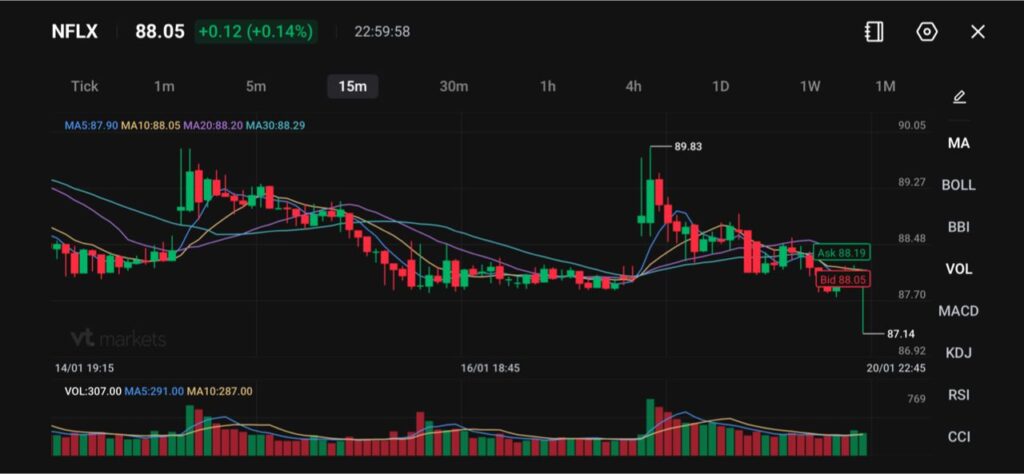
Netflix shares came under pressure after the company signalled a fresh acceleration in content spending while pressing ahead with its bid for Warner Bros. Discovery’s studio and streaming businesses.
The stock dropped by more than 5% in after-hours trading, adding to an already pronounced retreat from its June highs.
Market unease centres on the perception that cost discipline may be weakening again, even though revenue growth trends remain solid.
Netflix indicated that content expenditure is set to increase by roughly 10% this year, pushing total spend close to USD 20 billion. This will cover scripted television, films, live programming, and newer areas such as video podcasts.
All-Cash Offer Raises the Bar
The company upgraded its proposal for WBD’s studio and streaming assets to an all-cash bid of USD 27.75 per share, preserving an implied valuation of USD 82.7 billion.
While the move is intended to strengthen Netflix’s competitive position against other potential bidders, it has also heightened investor concerns around deal execution and regulatory risk.
Management continues to emphasise the strategic rationale of greater scale and deeper content ownership, but analysts caution that regulatory approvals could take 12 to 18 months, or longer.
A substantial break-up fee attached to the deal suggests a high level of commitment, reducing Netflix’s room to manoeuvre should market conditions turn less favourable.
Margins Under Scrutiny
Although Netflix’s projected revenue growth of 12%–14% for 2026 came in above expectations, its profitability outlook failed to impress.
Forecast operating margins of 31.5% undershot market estimates, reinforcing worries that rising content costs and potential integration expenses could limit near-term earnings upside.
The company also announced a pause in share buybacks, removing a layer of downside support at a time when valuations remain sensitive.
Technical Analysis
Netflix (NFLX) is trading around 88.05, up marginally by 0.14%, but recent price behaviour points to waning momentum following a sharp push to 89.83.
That rally was quickly followed by a steady pullback, with lower highs and lower lows forming as short-term moving averages begin to roll over.
Prices are now consolidating near the 88 handle, sitting below the 20- and 30-period moving averages, which signals short-term downside pressure. A dip to 87.14 suggests the market is testing support, while the subsequent bounce has lacked conviction in volume terms.
Unless buyers can regain the 88.50–89.00 zone swiftly, selling pressure may intensify. The near-term technical setup remains delicate, with range-bound trade likely in the absence of a clear catalyst.
Outlook
Netflix’s longer-term investment case continues to rest on its global footprint, pricing flexibility, and expanding advertising business. However, current market reactions suggest investors are placing greater emphasis on execution discipline alongside growth ambitions.
Until there is clearer visibility on margin sustainability and the trajectory of the WBD transaction, elevated volatility is likely to persist. Investors will be looking for proof that higher spending can deliver lasting earnings growth, not just headline expansion.
Gold price (XAU/USD) nears $4,775 in early trading amid political and economic uncertainty
Gold prices jumped to around $4,775 during early trading in Asia on Wednesday. This rise is linked to tensions between the US and Europe, which have been fueled by talks about Greenland and proposed tariffs on eight European countries.
Gold is considered a safe-haven investment, especially during times of geopolitical uncertainty. As US-European tensions grow, traders are turning to Gold, hoping that political changes will affect global economic stability.
Federal Reserve Speculations
The US Federal Reserve is expected to cut interest rates, starting in June, with another reduction likely later in the year. Even with a strong US Dollar, lower interest rates could help boost Gold prices. Central banks are the biggest buyers of Gold. In 2022, they added 1,136 tonnes worth $70 billion to their reserves. Countries like China, India, and Turkey are increasing their Gold holdings significantly. Gold prices respond to geopolitical events and interest rate changes. Generally, lower rates benefit Gold since it doesn’t earn interest, while a stronger Dollar can lower its value. The relationship between Gold and the US Dollar, or treasuries, is important in understanding its price movements. With Gold nearing $4,775, the spotlight is on geopolitical news from Davos. The US-Europe standoff over Greenland tariffs is the main concern and creates a classic scenario where investors seek safety. If the talks escalate or the US-EU trade deal is officially suspended, Gold prices might rise even more.Trading Strategies Amid Uncertainty
Given the current political uncertainty, we can expect significant price fluctuations. For those trading derivatives, high implied volatility makes strategies like long straddles or strangles appealing. These strategies can profit from large price swings in either direction without having to predict the outcome. It’s a good time to trade based on volatility, not just direction. We witnessed a similar situation during the US-China trade war in 2019, when rising tariff threats contributed to a Gold rally of over 20% that year. This historical example suggests that ongoing geopolitical tensions can be a strong driving force for Gold. We should consider this period as a reference for how markets might react if these disputes deepen. In addition to the political turmoil, the market anticipates a Federal Reserve rate cut in June, which could support Gold prices. Lower interest rates reduce the opportunity cost of holding an asset like Gold that doesn’t generate returns, making it more attractive. With another cut expected in the fourth quarter, the monetary policy environment is becoming increasingly favorable for Gold advocates. We should also note the ongoing demand from central banks, which have been reducing their reliance on the Dollar. They purchased a record 1,136 tonnes of Gold in 2022, and data from the World Gold Council shows this aggressive buying trend is expected to continue into 2024 and 2025. This consistent demand provides a solid base for the market, helping to absorb any price dips. Create your live VT Markets account and start trading now.Euro strengthens against the dollar, nearing 1.1725 amid Trump’s tariff threats
EUR/USD climbed to 1.1725 after Donald Trump threatened tariffs, which weakened the US Dollar. The pair rose nearly 0.7% as Trump’s interest in Greenland and proposed duties on European countries led to a bigger sell-off of the Dollar.
The EUR/USD closed at 1.1724, with a rise of more than 0.69% for the second consecutive day. Trade tensions increased when the White House announced 10% tariffs on imports from eight European nations, causing the S&P 500 and Nasdaq to drop by 2.1% and 2.39%, respectively.
Global Bond Yields And Economic Data
Global bond yields jumped, boosted by tax cuts announced in Japan. Japanese 40-year bond yields rose almost 29 basis points to an all-time high. Although US job data was strong, it didn’t meet expectations, and European inflation data showed deeper deflation, although German economic sentiment showed some recovery. Other important events include speeches from Christine Lagarde of the ECB and releases of US housing data. The US Dollar Index fell 0.58% to 98.56. New tariffs announced for February 1 on European countries could lead the EU to consider retaliatory tariffs worth €93 billion. Technical analysis indicates that EUR/USD could see more gains, with recent highs at 1.1763 and resistance levels at 1.1750 and 1.1800. If the price falls below the 20-day SMA at 1.1697, we could see lower targets.Retaliatory Measures And Market Volatility
At the end of 2025, the US Dollar faced a big hit due to tariff threats against several European countries. This political move created a risk-off sentiment, pushing the EUR/USD pair toward 1.1725. The market reacted with higher foreign exchange volatility and a drop in US stocks. The situation has stayed tense as Brussels officially submitted a €95 billion counter-tariff list to the World Trade Organization last week. This formal action reveals the EU’s intention to retaliate, putting pressure on the Dollar and strengthening the Euro. With new US tariffs set for February 1, the next two weeks are crucial. This ongoing uncertainty suggests that volatility will continue. The Cboe EuroCurrency Volatility Index (EVZ), which measures expected swings for the Euro, climbed to a 12-month high of 9.8 in late 2025 and remains above 8.5 today. Traders might consider buying options, like straddles, to benefit from big price changes in either direction as news continues to affect the market. These trade disputes are also impacting central bank expectations for the coming months. The CME FedWatch Tool now indicates a 65% chance of a 25-basis-point rate cut by the Federal Reserve in March, up from 40% a month earlier. This increasing expectation for more lenient US monetary policy could further pressure the Dollar. Currently, the EUR/USD is consolidating around the 1.1700 level, just above the key moving average tested late last year. Buying call options with a strike price of 1.1750 presents a good opportunity for potential gains if the pair rises. On the other hand, put options below 1.1650 could offer a safety net against a sudden downturn if trade negotiations improve. Create your live VT Markets account and start trading now.As the US dollar weakens, the British pound stays steady due to UK labor market data.
The GBP/USD pair has stabilized, supported by a weaker US dollar, even though the UK labor market data is mixed and there are worries about declining wage growth. The British Pound is being cautious, with key inflation data due Wednesday likely to impact the Bank of England’s (BoE) policy outlook.
Global Risk Sentiment and Trade Uncertainties
Market conditions are keeping pressure off the Pound as global risk sentiment is influenced by geopolitical tensions and trade uncertainties. The US dollar’s weakness aids Sterling, despite concerns over UK data. GBP/USD has seen slight gains this week, mainly due to the softness of the US dollar rather than strong UK economic indicators. Movements of the pair are restricted by weak UK labor statistics and uncertainty about the BoE’s monetary policy. Wednesday’s UK Consumer Price Index (CPI) inflation report will be crucial in guiding GBP/USD’s near-term direction. Sterling continues to play a significant role in the foreign exchange markets, making up 12% of daily transactions that average $630 billion. The value of the Pound largely depends on the Bank of England’s monetary policy, with economic indicators like GDP and the trade balance also significantly affecting its strength or weakness. The Pound is managing to stay firm against the dollar, but there is a cautious atmosphere ahead of the essential UK inflation data. The broader weakness of the US dollar provides some support, caused by new trade uncertainty between the US and the European Union. However, the main focus for Sterling traders remains the domestic situation in the UK. The recent UK labor market data showed a slowdown in wage growth to 4.1%, which continues to dampen sentiment. This has sparked discussions about the pace at which the Bank of England (BoE) will implement rate cuts in 2026 after starting its easing cycle late last year. Looking back, inflation was persistently high throughout 2024 and 2025, making the central bank cautious about acting too quickly.Inflation Data and Market Expectations
Today’s CPI release for December is the key event that will likely influence the Pound’s direction in the upcoming weeks. The market anticipates a slight increase in the annual inflation rate to 2.8%. If this is confirmed, it could delay the expectations for the BoE’s next rate cut. Recent data from the derivatives market indicates that traders now see only a 40% chance of a rate cut by the end of the first quarter, down from 75% just a month ago. The main reason why Cable (GBP/USD) hasn’t dropped further amidst these UK-specific concerns is the weakness of the US dollar. Recent tariff announcements have hurt investor sentiment towards the US, reducing the demand for the greenback. This situation is keeping GBP/USD steady within a tight range as we await the CPI data. Given the uncertainty surrounding the inflation data, a significant price movement in either direction is likely. This points to using options to trade potential volatility instead of taking a direct position beforehand. Strategies like buying a straddle or a strangle could be wise ways to profit from a sharp move, whether the inflation report is higher or lower than expected. Create your live VT Markets account and start trading now.USD/JPY stabilizes above 158.00 during early Asian session amid US tariff concerns
**USD/JPY Stable Amid Fiscal Concerns**
**Japanese Government Bond Yields Surge**
The Japanese yen is mainly affected by the Bank of Japan’s monetary policy, the difference in bond yields between the US and Japan, and global market sentiment. These factors significantly influence the yen’s value.
Often seen as a safe-haven asset, the yen attracts investment during market instability, leading to its strength compared to more volatile currencies during stressful global events.
In 2025, USD/JPY remained around the 158 level due to two main issues. One was fears of a “Sell America” trend caused by tariff threats, while the other was Japan’s growing fiscal troubles, which added pressure on the yen. Ultimately, the worry about Japan’s economic direction became the stronger influence on the market over the past year.
**US Tariff Threats and Market Responses**
The tariff threats against Europe did not cause a lasting decline for the dollar, as some predicted. Instead, the market adjusted trade flows, shifting its focus to the Federal Reserve’s consistent interest rate policy amidst ongoing, though easing, inflation. Now, with USD/JPY near 165.50, the dollar’s yield advantage has become the key point of interest.
On the other hand, concerns about Japan’s fiscal situation have grown. The government’s debt-to-GDP ratio has exceeded 268%, raising fears that prolonged yen weakness may be necessary to reduce this burden. This environment has encouraged traders to bet against the yen.
The Bank of Japan’s gradual exit from its very loose monetary policy has disappointed those hoping for a stronger yen. The interest rate gap between US and Japanese 10-year government bonds is still large, around 3.5 percentage points. This makes borrowing yen to buy dollars, a strategy known as the carry trade, very appealing.
Looking ahead, this situation suggests that using options to gain long exposure to USD/JPY is a smart choice. Buying call spreads could be a cost-effective way to profit as the pair moves higher towards the 168-170 range. Traders should stay vigilant for any strong warnings from Japanese officials, as the risk of currency intervention increases with rising prices.
**Create your live VT Markets account and start trading now.**
Dow Jones Industrial Average drops as Trump intensifies tariff threats during Greenland acquisition talks amid rising geopolitical risks
US stocks took a big hit on Tuesday due to increased tension in global politics. President Donald Trump ramped up his focus on acquiring Greenland and threatened new tariffs on US allies. As a result, many investors pulled back on US assets. The Dow Jones Industrial Average fell by 1.4%, while the S&P 500 dropped 1.6%, and the Nasdaq Composite decreased by 1.8%.
The VIX index rose above 20, signaling growing uncertainty in the market. Trump plans to impose tariffs starting at 10% on imports from eight NATO countries, with the rate increasing to 25% by June. He also threatened 200% tariffs on French wine. European leaders are discussing possible retaliatory actions, which could make the situation even more tense. The market’s previous optimism has left it vulnerable to sudden changes in policy.
The Euro Strengthens
The Euro gained strength against the US Dollar as bond prices fell sharply. Tech stocks struggled, with Apple and Meta down about 8% for the year and Microsoft down around 6%. In contrast, defensive stocks like Walmart and Procter & Gamble reached new highs, providing some stability. Additionally, small-cap stocks showed strength, with the Russell 2000 outperforming the S&P 500 for the twelfth straight session. On the policy front, Treasury Secretary Scott Bessent noted that Trump might soon announce the next Federal Reserve chair, with a decision expected soon. This will be an important factor for the market. With the VIX over 20, a level not seen since last November, it’s wise to consider buying protection against further declines. This could mean purchasing put options on broad market indices like the SPDR S&P 500 ETF (SPY). Reviewing the volatility during the 2018-2019 trade disputes, the VIX often stayed above 20, indicating that this recent spike might be just the start if tensions worsen. The clear differences between sectors suggest focused strategies. A bearish stance on large-cap tech can be achieved through put options or bear call spreads on the Invesco QQQ Trust (QQQ), since high-valuation stocks are especially at risk from policy shifts. Meanwhile, the strength of defensive names like Walmart and Procter & Gamble suggests that selling cash-secured puts on these stocks could help collect premiums during this upheaval.Small Cap Outperformance
The strength of small caps is a key trend to monitor. We should consider pairs trades like buying call options on the iShares Russell 2000 ETF (IWM) while also buying put options on the Nasdaq-tracking QQQ. This strategy highlights the success of domestically-focused companies, as recent data shows that firms in the Russell 2000 earn nearly 80% of their revenue domestically, compared to about 60% for the S&P 500. Another area to watch is the US Dollar, which has dropped sharply. Continued tariff threats could dampen foreign demand for US assets. Buying call options on currency-hedged ETFs, particularly those focusing on European stocks, may provide benefits from a weaker dollar. The upcoming meetings in Davos will be crucial in showing if this currency decline continues. Events such as the Davos meetings and the Federal Reserve chair nomination will likely add more volatility. We could employ options straddles or strangles on major indices to benefit from large price movements, regardless of the outcomes of these pivotal events. This approach is a wise way to prepare for the uncertainty expected in the coming weeks. Create your live VT Markets account and start trading now.Geopolitical tensions and rising bond yields push gold price to a record high above $4,750
Gold has reached an all-time high of $4,766. This surge is driven by fears of a potential US-EU trade war and increasing geopolitical tensions. Additionally, rising global bond yields and weak US debt auctions have pushed prices up, with gold hitting a peak of $4,766 on Tuesday.
Silver prices are on the rise too, now at $95.86 per troy ounce. Confidence in US assets is declining as high Treasury yields and the ‘Sell America’ trend affect markets. As yields climb, both the US Dollar and stocks are dropping.
Danish Pension Fund Exit
A Danish Pension Fund intends to exit its US Treasuries due to worries about President Trump’s policies. Trump has threatened tariffs on European countries unless an agreement regarding Greenland is reached. This could lead to €93 billion in tariffs from the EU. US Treasury yields are continuing to rise, with the 10-year note reaching 4.291%. The US Dollar Index is falling, and a weaker ADP Employment Change report does not lead traders to anticipate a Federal Reserve interest rate cut soon. Gold faces resistance at $4,800 and support at $4,700. Seen as a safe haven, gold tends to retain its value during uncertain times, with central banks being major buyers. Its price usually moves opposite to the US Dollar and riskier assets. With gold hitting record highs, we are witnessing a strong shift in options activity towards safe-haven assets. Traders might consider buying call options targeting the $4,800 mark. However, due to overbought signals on the Relative Strength Index, employing bull call spreads could be a smarter strategy. This approach allows traders to benefit from potential gains while managing costs and protecting against sudden drops.Sell America Theme Intensifies
The “Sell America” theme is growing stronger, fueled by worries stemming from the shaky US Treasury auctions from 2025. To protect against a deeper downturn in US markets, buying put options on major indices like the S&P 500 is a direct response to this capital flight. Recent weakness in debt auctions suggests that foreign buyers are indeed pulling back. The current level of geopolitical tension, with direct threats of US-EU tariffs, is likely to lead to increased market volatility. We are turning our attention to derivatives linked to the VIX, as this market fear gauge is rising toward levels not seen since early 2025’s banking issues. For context, the VIX spiked above 80 during the 2020 market crash, indicating there’s still room for fear to expand. The significant drop in the US Dollar plays a crucial role in this trend, and we expect this weakness to continue in the coming weeks. Traders may want to use futures contracts to short the US Dollar Index (DXY) or buy options on currency-hedged ETFs. This trend is further supported by central banks, which have been steadily increasing gold reserves since 2022, including a record addition of 1,078 tonnes, a strategy that is now gaining momentum. Lastly, silver often behaves as a more volatile and aggressive play on gold’s movements. With silver surpassing $95, there is a strong demand for precious metals, and historical price ratios with gold suggest it has more potential for growth. Traders seeking leveraged exposure to this rush for safe havens are increasingly looking at silver futures and options. Create your live VT Markets account and start trading now.The Canadian dollar increases as the US dollar falls over Greenland threat.
The Canadian Dollar (CAD) has gained strength against the US Dollar (USD) due to recent global events. President Trump threatened new tariffs on the EU, which lowered confidence in the market and caused the USD to drop.
In just two days, the USD fell by 0.76%, making it its worst week since June of last year. Meanwhile, low Crude Oil prices have limited the CAD’s gains, even though geopolitical issues could increase the CAD’s value.
Inflation Data in Canada
Inflation data in Canada has affected expectations about interest rates set by the Bank of Canada, indirectly benefiting the CAD. The rise of the Canadian Dollar reflects a bounce from a 200-day EMA on the USD/CAD chart, suggesting more movement might happen if current trends continue. Several factors impact the CAD, including interest rates, Oil prices, economic health, and trade balances. Key economic indicators, such as GDP and employment rates, also impact the CAD’s performance. A strong economy tends to support the Canadian Dollar by attracting foreign investment. This information is for reference only and carries risks and uncertainties. Caution is advised when making investment choices, and thorough research is recommended. The article does not guarantee any outcomes and does not provide personalized investment advice.A Familiar Pattern
On January 21, 2026, we are observing a pattern reminiscent of early 2025. Back then, geopolitical uncertainty weakened the US dollar, and now, renewed trade tensions with Mexico are creating a similar mood in US markets. This is putting pressure on the US dollar while boosting the CAD. The US Dollar Index (DXY) has fallen by 1.1% in the past week, marking its weakest performance since last October. This broad dollar weakness is the main reason the USD/CAD pair is declining. Investors are moving their money into safer assets like US Treasuries, which are lowering yields and making the dollar less appealing. In Canada, the economic fundamentals are favorable for the Loonie. The latest Consumer Price Index (CPI) data for December 2025 showed inflation at 3.2%, above the Bank of Canada’s target range. This suggests that the Bank will keep interest rates steady at its next meeting, avoiding a policy split that could weaken the CAD. Crude oil, an important Canadian export, is stable but not the main factor driving this trend. West Texas Intermediate (WTI) is trading around $74 a barrel, a level that supports the Canadian economy without causing a major rally on its own. The current strength of the CAD is mostly due to USD weakness rather than rising oil prices. Traders expecting further USD weakness can consider buying put options on the USD/CAD pair to speculate on a continued downturn while managing risk. If the USD/CAD drops below the key support level of 1.3250, it could push the move further down, making options expiring in late February or March appealing. This strategy allows traders to take advantage of downward momentum while limiting potential losses to the premium paid. However, since this market is influenced by headlines, sentiment can change rapidly. To manage this risk, traders might implement a bear put spread by buying a higher-strike put and selling a lower-strike put to finance the position. This method limits both potential profit and initial costs, making it suitable for a moderately bearish outlook. Create your live VT Markets account and start trading now.Argentina’s trade balance in the month exceeded forecasts, reaching $1,892 million instead of $1,372 million.
Argentina’s trade balance for December reached $1,892 million, surpassing predictions of $1,372 million. This figure adds to ongoing economic discussions.
In the currency market, Silver (XAG/USD) holds steady near $95.00 due to heightened safe-haven demand. Similarly, Gold (XAU/USD) is trading above $4,750, driven by tensions between the U.S. and Europe.







