



Pound Sterling remains strong around 1.3450 due to latest employment data release
The GBP/USD pair rose after UK employment grew by 82,000 in the three months to November, recovering from a previous drop of 17,000. Traders are now looking forward to the UK’s December CPI, PPI, and Retail Price Index data, which will be released later on Wednesday.
Currently, GBP/USD is trading at about 1.3430, showing gains for the third session in a row. Average earnings, excluding bonuses, rose by 4.5% compared to last year, while earnings that include bonuses increased by 4.7%. The unemployment rate held steady at 5.1%, missing the anticipated drop to 5.0%.
December’s Consumer Price Index from ONS could raise inflation concerns and affect Bank of England rate expectations
The UK Consumer Price Index (CPI) for December is about to be released, and it’s expected to rise to 3.3%, up from 3.2% in November. Core inflation is likely to stay above 3.0%, indicating ongoing inflation concerns.
The Bank of England (BoE) uses CPI as an important measure of inflation when setting monetary policy. The BoE’s Monetary Policy Committee (MPC) will meet soon, and this inflation data could impact their decision to maintain the bank rate at 3.75%.
December Rate Decision
In December, the MPC decided to lower the bank rate by 25 basis points, despite worries about inflation. The new data will be crucial for future monetary policy choices regarding interest rates and the value of the Pound Sterling. The BoE’s job is to manage inflation through interest rate changes, which also affect the Pound’s value. If inflation rises, interest rates might go up, attracting foreign investments to the UK. The BoE uses tools like quantitative easing and tightening to affect the economy and the currency’s strength. Traders are eagerly awaiting the CPI report, as it could lead to changes in monetary policy. We’re keeping an eye on this Wednesday’s inflation figures, with overall CPI expected to rise to 3.3%. This would be the first annual increase since inflation started to decline in 2025. This could complicate matters for the Bank of England. A big difference from this prediction could create volatility in the Pound.Interest Rate Strategy
The Bank of England reduced rates four times in 2025, but steady wage growth in the mid-4% range is limiting further cuts. Currently, the market expects just over 42 basis points of additional cuts for the rest of the year, leaving little room for surprises. Any rise in inflation data could have a strong effect. Given the uncertainty regarding how the data might affect the February 5th rate decision, there’s an opportunity to buy volatility. A long straddle or strangle on GBP/USD, using options that expire shortly after the BoE meeting, could be a smart way to prepare for potential price swings. This strategy benefits from significant moves in either direction. If inflation is higher than expected, the market could quickly reduce the anticipated easing for this year. In that case, GBP/USD might reach its year-to-date ceiling around 1.3567. Traders might want to consider call options with strike prices above 1.3500 to take advantage of this possibility. On the other hand, if the inflation report is weaker than anticipated, it would support the easing approach the BoE took last year when it cut rates by a full percentage point. This could lead the Pound to break its current support near 1.3340 and target the December 2025 low of 1.3179. Put options with strikes around 1.3300 could offer effective protection if this happens. Create your live VT Markets account and start trading now.Yen strengthens against the dollar amid fears of intervention and hawkish Bank of Japan expectations
The Japanese Yen is stable against the US Dollar during the Asian session. However, worries about Japan’s financial health and the upcoming Bank of Japan (BoJ) meeting on Friday have made traders cautious. Potential actions from authorities to support the Yen and expectations of the BoJ tightening policies offer some reassurance.
Japan’s Finance Minister has mentioned the possibility of a joint intervention with the US to counter the Yen’s weakness. The prospect of BoJ tightening and safe-haven buying have also helped strengthen the currency. Recent surveys show that Japanese households expect inflation to keep rising, with inflation staying above the Bank’s 2% target for four straight years.
Impact Of Fiscal Policies
Concerns about Japan’s financial situation have pushed government bond yields up, driven by Prime Minister Takaichi’s fiscal policies. Upcoming US reports on PCE and GDP will influence the Fed’s rate decisions, impacting the USD/JPY pair. While the USD has gained recently, it remains under pressure from renewed trade war fears. The USD/JPY bears are in control below the 100-hour SMA, with technical indicators showing little momentum. Market perspectives differ in “risk-on” and “risk-off” scenarios. In “risk-off” situations, currencies like the US Dollar, Japanese Yen, and Swiss Franc gain favor due to their perceived stability. The Yen benefits as domestic investors hold onto their investments, even during crises. As we approach late January 2026, we see a familiar pattern emerging. In 2025, Yen bulls hesitated due to expectations of BoJ tightening and serious concerns about the government’s financial health. This tug-of-war resulted in sharp, tradable movements, and we may see a similar environment now. The case for a stronger Yen is bolstered by BoJ policy, which has gained credibility after two small rate hikes in 2025. With core inflation at 2.3% for December 2025—above the BoJ’s 2% target—markets anticipate at least one more rate hike by mid-year. Traders might consider buying call options on the Yen (or puts on USD/JPY) as they prepare for a potential hawkish surprise from the BoJ.Challenges From Fiscal Constraints
Still, Japan’s fiscal policy poses challenges that limit the Yen’s potential. The country’s debt-to-GDP ratio is high, recently reported at over 261%, restricting the government’s ability to support the currency without sparking a selloff in the bond market. This indicates that any Yen rallies may not last long, making selling out-of-the-money JPY calls a potentially profitable strategy. Conversely, the situation for the US Dollar has changed from the optimism about rate cuts we saw earlier last year. With US inflation remaining stubbornly high—printing at 3.1% for December—the Federal Reserve’s future decisions are less predictable. This renewed strength in the Dollar suggests the USD/JPY pair is unlikely to drop significantly, even with a hawkish BoJ. This sets the stage for volatility traders in the upcoming weeks. The conflicting drivers—a hawkish central bank versus a weak fiscal situation—create an environment ripe for significant price swings instead of a clear trend. Strategies like long straddles or strangles on USD/JPY, which profit from large movements in either direction, could be effective, especially leading up to the next BoJ meeting. With the current USD/JPY spot price around 148.00, options with strike prices close to the psychological level of 150.00 are likely to see increased activity. Traders should monitor implied volatility closely, as a spike could indicate that the market anticipates a breakout. Setting positions before volatility becomes costly will be crucial. Create your live VT Markets account and start trading now.As the US dollar weakens, EUR/USD strengthens to around 1.1730 amid rising concerns.
The EUR/USD pair is on the rise, trading close to 1.1730 as the US Dollar weakens. This shift is driven by growing tensions between the US and Greenland and the possibility of tariffs from the US on eight EU countries, which could hurt economic growth.
President Trump has also raised concerns with a potential 200% tariff on French wines. At the same time, the European Parliament is discussing the suspension of a US trade deal, which could further strain US–Europe relations.
Economic Indicators and Their Importance
Recent US labor market data indicates that the Federal Reserve is unlikely to cut rates soon, which may help support the Dollar. Conversely, the Euro is gaining strength from optimism about Germany’s economy. The ZEW Economic Sentiment Index rose to 59.6 in January, indicating hopes for a rebound by 2026. The Euro is the currency used by 20 EU countries and is the second most traded currency worldwide after the US Dollar. In 2022, it accounted for 31% of foreign exchange transactions, with daily trading over $2.2 trillion. The European Central Bank (ECB), based in Frankfurt, manages monetary policy. Inflation data significantly impacts the Euro’s value, and a healthy trade balance typically strengthens a currency, bolstering the Euro’s market presence. Currently, the EUR/USD shows a clear upward trend, trading around 1.1750. This rise is fueled by a weak US Dollar due to trade issues and a strong Euro. Germany’s ZEW index has reached its highest point since July 2021, confirming an increase in factory orders noted in late 2025. This points to growing confidence in the Eurozone economy in the upcoming year.Market Strategies and Risks
The escalating rhetoric from the US regarding Greenland and tariffs is putting pressure on the Dollar and adding uncertainty to the market. We’re watching for the European Parliament’s official decision on the US trade deal, which could significantly impact market movements. This uncertainty has caused the one-month implied volatility on EUR/USD options to rise from 5.8% to 6.5% in just the past week, making options strategies pricier but potentially more effective. With the current trend of a weak Dollar and a strong Euro, there’s an opportunity for further upside. Buying near-the-money call options or setting up bull call spreads on EUR/USD could be a smart way to benefit from this upward movement. This strategy offers defined risk while targeting a possible breakout above the recent highs from late 2025. However, we must remain cautious, as the US Dollar’s weakness may not last. Strong labor data from December 2025 has pushed expectations for a Federal Reserve rate cut back to June, providing support for the Dollar. This may limit the pair’s rally, especially as it approaches the 1.1850 resistance level that held firm last October. Create your live VT Markets account and start trading now.WTI rises above $59.65 amid supply disruptions in Kazakhstan and the Greenland crisis
WTI crude oil prices rose to about $59.65 during early Asian trading hours on Wednesday. This increase is due to supply disruptions in Kazakhstan, especially at the Tengiz and Korolev oil fields, which have temporarily halted production because of fires. The shutdown may last another seven to ten days.
Moreover, Kazakhstan’s crude oil production has dropped by 900,000 barrels per day due to drone strikes affecting the Caspian Pipeline Consortium terminal. Tensions also rise with the US President threatening tariffs on eight European countries related to Greenland, which could reach up to 25% by June 1. Such developments may impact market sentiment and limit further oil price increases.
Wti Oil Influences
WTI Oil, a premium US oil, has a significant effect on global markets. Priced in US Dollars, its value can change with dollar fluctuations. Key factors influencing WTI prices include supply and demand, political instability, and OPEC’s decisions. Important inventory data from the American Petroleum Institute (API) and the Energy Information Agency (EIA) can also affect WTI pricing. A drop in inventory often signals higher demand, which can raise prices. OPEC, made up of oil-producing nations, frequently impacts WTI prices by setting production quotas. Currently, WTI hovers around $78, influenced by ongoing supply risks and a cloudy economic outlook. This situation is similar to brief price spikes caused by past Kazakh outages in the mid-2020s. However, today’s geopolitical tensions in the Red Sea are causing prolonged shipping disruptions, which help keep prices elevated.Supply Side And Demand Picture
On the supply side, OPEC+ is sticking to its plan, extending production cuts into the first quarter of 2026 to stabilize the market. However, strong non-OPEC supply, especially from the US, where crude output hit a record of 13.3 million barrels per day late last year, is balancing this. This means any sudden disruption could lead to significant price changes. Demand, on the other hand, poses a concern that is preventing major price rallies, unlike the trade war worries we saw in 2025. The IMF recently predicted a slow global GDP growth of only 2.9% this year, citing ongoing economic weaknesses in Europe and China. Last week’s EIA report confirmed this, showing an unexpected crude inventory increase of 2.1 million barrels when a decrease was anticipated. Given this back-and-forth situation, a practical strategy for the coming weeks is to trade options to take advantage of expected volatility. Buying straddles on March futures allows for profit from sharp price changes, whether due to a supply shock or a sudden decrease in demand. We believe implied volatility is currently undervalued, making it a good time to enter such positions. For those who feel moderately bullish, a bull call spread provides a low-risk way to bet on potential price increases. By purchasing one call option and simultaneously selling another with a higher strike price, we can reduce costs while aiming for a move toward the $82 level. It’s essential to manage this position carefully around the weekly API and EIA inventory reports, as another unexpected increase could challenge the bullish outlook. Create your live VT Markets account and start trading now.Amid geopolitical tensions, silver stays near recent peak of $95.89 at around $94.80
Silver is attracting buyers due to rising geopolitical tensions. It’s currently trading around $94.80, close to its all-time high of $95.89.
US President Donald Trump’s interest in Greenland and talks of new tariffs on the European Union are raising concerns about economic growth. The European Parliament plans to announce the suspension of a US trade deal, which may increase demand for safe-haven assets in the short term.
Speculation on Federal Reserve and Labor Market
The speculation about a US Federal Reserve rate cut is now being postponed as signs show the US labor market is improving. The next rate cut is anticipated by June, with interest rates likely to stay high for a longer period. Silver is a popular investment because it acts as a store of value and a hedge against inflation. Prices are influenced by geopolitical issues, interest rates, the strength of the US Dollar, and investment demand. Industrial demand, especially from the electronics and solar energy sectors, also affects silver prices. Economic activity in the US, China, and India contributes to price changes. Silver often follows the price trends of gold since both are viewed as safe-haven investments. The Gold/Silver ratio helps assess the relative value of silver compared to gold; a high ratio may suggest that silver is undervalued.Impact of US-EU Trade Disputes on Silver
Silver is holding close to its all-time high of $95, largely due to ongoing trade disputes between the US and the EU. Notably, transatlantic trade volumes fell by 5% in the last quarter of 2025, adding to the current uncertainty. This situation indicates that traders should monitor safe-haven flows into precious metals. That said, the outlook for interest rates poses a challenge for silver prices. Core inflation in December 2025 was stronger than expected at 3.1%, causing expectations for a Federal Reserve rate cut to be delayed. This “higher for longer” interest rate scenario could limit silver’s price gains, making it costly to hold an asset with no yield. However, strong fundamentals from industrial use provide important support. Global solar panel installations grew a record 25% year-over-year in 2025, and this trend is expected to continue. Such robust demand helps establish a solid price floor, meaning any significant price drops might be brief. Historically, silver has followed gold’s lead, but the Gold/Silver ratio has now decreased to a low of around 55, signaling silver’s unique industrial strength. With silver prices reaching new highs, implied volatility in the options market is quite high. This makes income-generating strategies like selling covered calls or credit spreads especially attractive while establishing defined risk. Create your live VT Markets account and start trading now.The USD/CNY central rate is fixed at 7.0014, which is higher than yesterday’s rate.
The People’s Bank of China (PBOC) set the USD/CNY central rate for Wednesday at 7.0014, an increase from the previous day’s rate of 7.0006. This also surpasses the Reuters estimate of 6.9578.
The PBOC works to keep prices stable, including the exchange rate, while also encouraging economic growth. It is focused on financial reforms to develop and open up the financial market.
Structure and Leadership
The PBOC is owned by the People’s Republic of China and is influenced by the Chinese Communist Party’s Committee Secretary. Currently, Mr. Pan Gongsheng is both the Committee Secretary and the Governor. The PBOC uses various policy tools, including the seven-day Reverse Repo Rate, the Medium-term Lending Facility, and the Reserve Requirement Ratio. The Loan Prime Rate acts as the main interest rate, affecting loans, mortgages, and savings rates. China permits 19 private banks, which make up a small portion of its financial system. Leading digital lenders in this sector include WeBank and MYbank, backed by tech giants Tencent and Ant Group. Since 2014, these private banks, funded entirely by private capital, have operated within China’s state-controlled financial system. The PBOC’s decision to set the currency reference rate above the 7.00 mark signals its policy direction. This choice allows the yuan to weaken, similar to managed depreciations seen in 2025, when economic support was necessary.Economic Indicators and Analysis
Recent data from late 2025 backs this supportive approach, with Q4 GDP growth at 4.8%, just shy of the annual goal. December’s exports dropped by 1.5%, marking three consecutive months of decline due to weak global demand. A weaker currency can help make Chinese goods more competitive internationally. Consumer inflation remains low, rising only 0.1% in December 2025, giving the central bank more room to ease policies. After two cuts to the Loan Prime Rate (LPR) in late 2025, a further reduction seems likely in the coming weeks. This would widen the interest rate gap with the US dollar, putting gentle pressure on the yuan. For derivative traders, this suggests positioning for continued, managed yuan depreciation against the dollar in the upcoming weeks. They might consider buying call options on USD/CNY to profit from potential increases while limiting risks. The key is to expect a gradual climb rather than a sharp surge, as the PBOC aims to maintain stability. Create your live VT Markets account and start trading now.USD/CAD rises slightly above 1.3800 amid new US tariff threats
Increase In Canada’s CPI Inflation
The USD/CAD pair is slightly up at 1.3835 during the early Asian session on Wednesday. Ongoing tensions between the US and Europe regarding Greenland might limit the US Dollar’s gains against the Canadian Dollar. An 88% majority of market participants expect the Bank of Canada (BoC) to hold rates steady on January 28. US President Trump’s threat to impose a 25% tariff on European countries opposing his Greenland plans could pressure the US Dollar. The upcoming emergency summit in Brussels and Trump’s speech at the World Economic Forum will likely affect the currency pair’s future movements. Canada’s annual Consumer Price Index (CPI) inflation rose to 2.4% in December from 2.2% in November, although monthly figures showed a slight decrease of 0.2%. Core inflation, which the BoC closely monitors, continues to ease. This leads analysts to anticipate a stable rate decision at the January 28 meeting. Several factors influence the Canadian Dollar, including Federal interest rates, oil prices, and overall economic health, such as trade balance. The BoC’s interest rate decisions play a significant role in CAD’s strength, while oil prices directly affect its value due to Canada’s reliance on exports. Better economic data typically strengthens the CAD. We are noticing a similar pattern of US dollar pressure emerge, reminiscent of the geopolitical tensions that affected markets last January 2025. During that time, threats of tariffs against Europe over Greenland created a “Sell-America” environment that benefited the Canadian dollar. Although the specific issues are different now, the challenge of a strong US dollar facing global trade friction is once again a crucial factor.Outlook For Canadian Dollar
The current administration’s focus on trade imbalances with Asia is creating uncertainty, putting pressure on the US Dollar. The U.S. Dollar Index (DXY), which tracks the dollar against several currencies, has fallen by 2% this month to about 101.50. This is a shift from early 2025, when the dollar was stronger before the recent trade threats. On the Canadian side, the economic outlook is more robust compared to the mixed conditions of early 2025. Data from Statistics Canada shows that December’s annual inflation rate is steady at 2.6%, leading markets to anticipate a higher chance of a BoC rate hike in the first half of this year. This hawkish stance is a clear departure from January 2025, when it seemed likely that the BoC would keep rates unchanged for most of the year. Oil prices, crucial for the Canadian economy, are also providing support. West Texas Intermediate (WTI) crude is trading above $82 per barrel due to recent production controls from OPEC+. This is much better for Canada than the sub-$75 range we saw last year. The strength of Canada’s top export adds further support for its currency. Given these factors, traders should consider strategies that position for potential downside in the USD/CAD pair. We recommend buying USD/CAD put options with March or April 2026 expiry dates, as this provides a favorable risk-reward opportunity. It allows traders to benefit from a potentially stronger Canadian dollar backed by a hawkish BoC and stable energy prices while a weaker US dollar offers additional support. Create your live VT Markets account and start trading now.The NZD/USD pair sits close to 0.5825, pulling back from a recent multi-month high.
The NZD/USD pair fell during the Asian session on Wednesday, moving down from recent highs around 0.5850-0.5855. Currently trading at about 0.5825, the decline is minor, with a drop of less than 0.15% for the day.
US President Trump’s tariff threats against European allies, linked to tensions over Greenland, have raised concerns about a trade war. This has weakened market sentiment and the Kiwi currency. However, Trump’s comments have also led to a drop in the US Dollar, with the USD Index nearing its lowest level since January 6. This situation suggests we should be cautious before expecting more depreciation of the NZD/USD.
Reserve Bank of New Zealand Policy Outlook
The Reserve Bank of New Zealand recommends waiting for strong selling signals before predicting a peak in prices. Upcoming data releases, including the US PCE Price Index and Q3 GDP on Thursday, as well as New Zealand’s inflation figures on Friday, could affect the NZD/USD pair. In financial markets, “risk-on” refers to a time when investors are willing to take risks, leading to gains in assets like stocks and cryptocurrencies. “Risk-off” describes a time of caution, driving investors toward bonds, gold, and safe currencies like the JPY, CHF, and USD due to their stability. Currently, the NZD/USD pair is trading in a narrow range around 0.6150, which is stronger than the 0.58 level we observed in late 2019. Despite the underlying tensions feeling somewhat similar, a hawkish central bank in New Zealand supports the Kiwi against global uncertainties. This situation makes it challenging to plan straightforward trades in the coming weeks. Reflecting on 2019 and 2020, we recall that the “Sell America” theme was fueled by unpredictable tariff threats. Today, there’s a weaker dollar trend, supported by economic data showing US inflation easing to 2.5% annually. This raises expectations that the Federal Reserve may cut rates before mid-year. In contrast, New Zealand’s inflation remains above 3.5%, leading the RBNZ to take a more assertive approach.Reserve Bank of New Zealand Hawkish Outlook
The Reserve Bank of New Zealand’s hawkish perspective continues to support the Kiwi, a trend we’ve observed throughout 2025. With the Official Cash Rate at a multi-decade high of 5.5%, the interest rate difference favors the NZD. However, we believe that the peak of the rate hiking cycle has been reached, which might cap any potential gains for the pair unless new factors emerge. Given the current dynamics, the one-month implied volatility for NZD/USD options is relatively low at 9%. This indicates that the market is not expecting significant moves. In this stable environment, strategies like selling strangles could be more effective than buying options in hopes of a breakout. Traders should focus on collecting premiums while the pair remains steady. It’s essential to keep an eye on the upcoming US employment data and New Zealand’s quarterly inflation report. Any weakness in the US labor market or continued inflation in New Zealand would strengthen the narrative of policy divergence between the two countries. These data points are likely to trigger a movement in the pair out of its current range. Create your live VT Markets account and start trading now.Netflix Slips As WBD Bid Rekindles Cost Fears
Netflix shares came under pressure after the company signalled a fresh acceleration in content spending while pressing ahead with its bid for Warner Bros. Discovery’s studio and streaming businesses.
The stock dropped by more than 5% in after-hours trading, adding to an already pronounced retreat from its June highs.
Market unease centres on the perception that cost discipline may be weakening again, even though revenue growth trends remain solid.
Netflix indicated that content expenditure is set to increase by roughly 10% this year, pushing total spend close to USD 20 billion. This will cover scripted television, films, live programming, and newer areas such as video podcasts.
All-Cash Offer Raises the Bar
The company upgraded its proposal for WBD’s studio and streaming assets to an all-cash bid of USD 27.75 per share, preserving an implied valuation of USD 82.7 billion.
While the move is intended to strengthen Netflix’s competitive position against other potential bidders, it has also heightened investor concerns around deal execution and regulatory risk.
Management continues to emphasise the strategic rationale of greater scale and deeper content ownership, but analysts caution that regulatory approvals could take 12 to 18 months, or longer.
A substantial break-up fee attached to the deal suggests a high level of commitment, reducing Netflix’s room to manoeuvre should market conditions turn less favourable.
Margins Under Scrutiny
Although Netflix’s projected revenue growth of 12%–14% for 2026 came in above expectations, its profitability outlook failed to impress.
Forecast operating margins of 31.5% undershot market estimates, reinforcing worries that rising content costs and potential integration expenses could limit near-term earnings upside.
The company also announced a pause in share buybacks, removing a layer of downside support at a time when valuations remain sensitive.
Technical Analysis
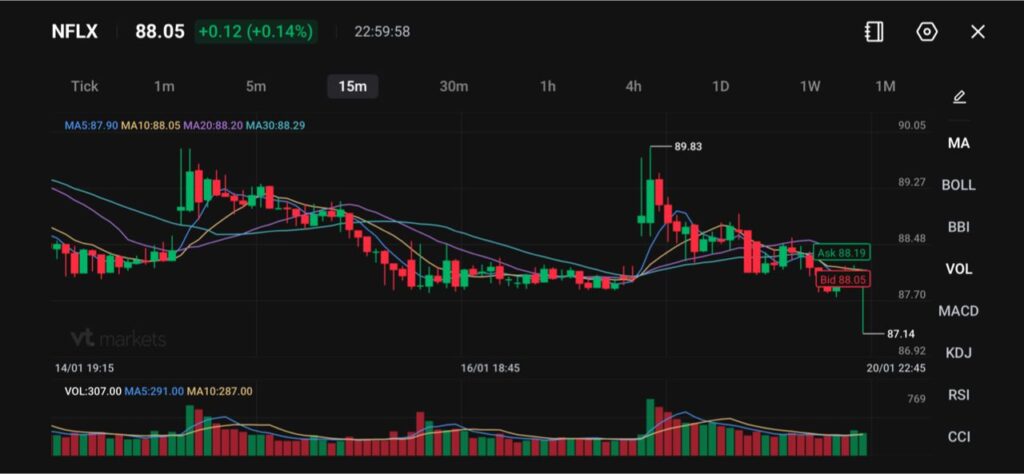
Netflix (NFLX) is trading around 88.05, up marginally by 0.14%, but recent price behaviour points to waning momentum following a sharp push to 89.83.
That rally was quickly followed by a steady pullback, with lower highs and lower lows forming as short-term moving averages begin to roll over.
Prices are now consolidating near the 88 handle, sitting below the 20- and 30-period moving averages, which signals short-term downside pressure. A dip to 87.14 suggests the market is testing support, while the subsequent bounce has lacked conviction in volume terms.
Unless buyers can regain the 88.50–89.00 zone swiftly, selling pressure may intensify. The near-term technical setup remains delicate, with range-bound trade likely in the absence of a clear catalyst.
Outlook
Netflix’s longer-term investment case continues to rest on its global footprint, pricing flexibility, and expanding advertising business. However, current market reactions suggest investors are placing greater emphasis on execution discipline alongside growth ambitions.
Until there is clearer visibility on margin sustainability and the trajectory of the WBD transaction, elevated volatility is likely to persist. Investors will be looking for proof that higher spending can deliver lasting earnings growth, not just headline expansion.







