



NZD/USD remains steady around 0.5785 ahead of US data release
Gold prices have decreased in the United Arab Emirates, according to recent market data.
**Gold As A Safe Haven**
Gold prices in the United Arab Emirates fell on Wednesday, according to FXStreet data. The price per gram dropped to 527.18 AED from 530.61 AED on Tuesday. The price per tola decreased to 6,148.97 AED, down from 6,188.90 AED.
FXStreet calculates these UAE gold prices by adjusting international prices to local currency and measurement units, updating daily. These prices serve as a reference; local rates may vary slightly.
Gold has long been recognized as a way to store value and as a method of exchange. Besides its use in jewelry, it acts as a safe-haven asset and a hedge against inflation and currency loss, especially during economic turmoil.
Central banks, which hold the most gold, use it to diversify their reserves, strengthening their economies. In 2022, central banks added 1,136 tonnes of gold—worth about $70 billion—to their reserves, marking the largest annual purchase ever recorded.
Gold prices often move in the opposite direction of the US Dollar and US Treasuries. When these decrease, gold prices generally increase. Its value is influenced by geopolitical unrest, economic concerns, interest rates, and the behavior of the dollar; typically, a strong dollar puts pressure on gold prices.
**Gold Price Trends**
Gold prices recently dipped to 527.18 AED per gram. We see this as a minor fluctuation rather than a shift in trend. This small pullback could be a chance for traders to prepare for the upcoming weeks. The main market drivers continue to support gold.
A key factor is the inverse relationship with the US Dollar, which is currently under pressure. The DXY index has dropped from its peak in late 2025 to around 103.5, benefiting gold prices. We anticipate this trend will persist, especially as discussions about possible Federal Reserve rate cuts later this year gain traction.
Speculation about interest rates arises from recent data showing US inflation has cooled to 2.5% and the unemployment rate has slightly increased in the last quarter of 2025. In a climate of falling interest rates, gold becomes more attractive as it does not yield interest. This economic backdrop points to a positive outlook for the weeks ahead.
We also need to consider the steady demand from central banks, which provides strong support for prices. Following record purchases in previous years, the World Gold Council reported that another 950 tonnes were added to official reserves by the end of 2025. This ongoing institutional buying helps reduce major downside risk for traders.
In this context, we view the current price dip as an opportunity to enter or increase bullish positions. Purchasing call options might be a smart move to take advantage of potential upside while managing risk. We are monitoring key technical levels, and a return above recent highs would confirm that the uptrend is resuming.
Create your live VT Markets account and start trading now.
Gold prices in Pakistan decreased today, according to market data reported by analysts.
Gold prices in Pakistan fell on Wednesday. The price was 40,245.19 Pakistani Rupees (PKR) per gram, down from 40,487.64 PKR the day before. The cost per tola also dropped to PKR 469,412.00 from PKR 472,239.90.
FXStreet adjusts international prices to reflect local currency and units, updating them daily. However, local market prices can vary slightly from these references.
Gold as a Hedge Against Inflation
Gold is often seen as a safe investment and a way to protect against inflation and currency loss. Central banks hold a lot of Gold, with 1,136 tonnes added to global reserves in 2022, making it the largest yearly purchase ever. Gold prices tend to move opposite to the US Dollar and Treasuries. A weaker Dollar can lead to higher Gold prices, especially when interest rates are low. Economic issues like geopolitical unrest or fears of recession can quickly change Gold’s value, as it is viewed as a safe choice. Factors like geopolitics and interest rates, especially concerning the US Dollar, greatly impact Gold prices. A strong Dollar generally keeps Gold prices down, while a weak Dollar can push them up. Currently, we are experiencing a small drop in gold prices, which seems to be a temporary fluctuation rather than a long-term trend. The main influence on Gold in the coming weeks is the outlook for U.S. interest rates. According to the CME FedWatch Tool, traders see over a 70% chance of a Federal Reserve rate cut by the second quarter, which could weaken the Dollar and boost Gold.Inflation and Gold Sensitivity
In 2025, persistent inflation concerns kept Gold appealing as a safe investment, even though the U.S. headline CPI averaged 3.1% for the year. This suggests that any signs of economic instability could quickly increase Gold demand. For traders, this means Gold is highly sensitive to political news and fears of recession. A major factor supporting Gold is the ongoing purchasing by central banks, which surged remarkably after record purchases in 2022 and 2023. Data from the World Gold Council shows that strong buying from official sectors continued into 2025, led by emerging market banks. This steady demand creates a solid price floor, reducing the immediate risk of price drops. Gold’s opposite relationship with riskier assets is also essential now, particularly after the S&P 500’s strong performance through the end of 2025. With stock markets near their all-time highs, Gold offers a relatively undervalued hedge against potential downturns in equities. Weakness in stock prices can signal strength in Gold. Given these factors, derivative traders should see current price levels as a good chance to take bullish positions. Using long-term call options, ideally expiring in the second or third quarter, could effectively leverage anticipated rate cuts. This method allows traders to benefit from a weaker Dollar while managing risk. Create your live VT Markets account and start trading now.Dividend Adjustment Notice – Jan 07 ,2026
Dear Client,
Please note that the dividends of the following products will be adjusted accordingly. Index dividends will be executed separately through a balance statement directly to your trading account, and the comment will be in the following format “Div & Product Name & Net Volume”.
Please refer to the table below for more details:
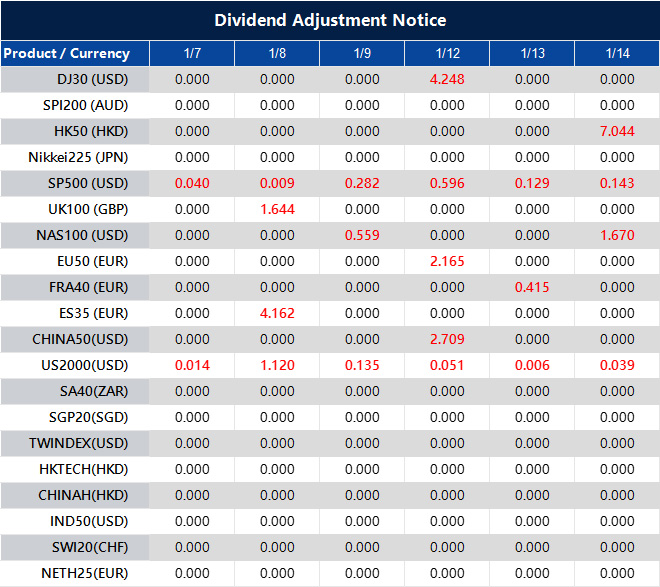
The above data is for reference only, please refer to the MT4/MT5 software for specific data.
If you’d like more information, please don’t hesitate to contact [email protected].
DAX reaches new highs, confirming a bullish breakout towards 25,450
The DAX Index is moving up towards new highs, showing a strong bullish market trend. The drop from the low on November 21, 2025, at 22,943 marked the end of wave (2), leading to a rally in wave (3) with clear Elliott Wave patterns.
Wave ((i)) reached its peak at 23,392.2, then wave ((ii)) dropped to 23,139.27. The Index climbed to 23,883.98 in wave ((iii)), with wave ((iv)) finding support at 23,433.48. Finally, wave ((v)) pushed prices up to 24,474.62, completing wave 1 of a larger pattern.
The Correction And Subsequent Rally
A zigzag correction took place in wave 2, where wave ((a)) ended at 24,173.28, wave ((b)) at 24,318.3, and wave ((c)) at 23,923.97. This correction completed wave 2, opening the door for more gains. The Index is continuing its rise in wave 3 of (3). The target for this move is between 25,450 and 26,403, based on the 100% to 161.8% Fibonacci extension of wave 1. As long as the pivot at 22,943.3 holds, any pullbacks should find support in normal corrective patterns, allowing for continued upward momentum. The DAX shows clear signs of a strong bullish trend as we enter the new year. The correction that ended late in 2025, especially at the low of 23,923, has led to a powerful upward surge. We are in the early stages of the third wave, which is usually the strongest part of a bull market cycle. This positive outlook is backed by improving economic indicators. December 2025 data revealed a surprise 1.5% rise in German factory orders, while the latest ZEW Economic Sentiment survey reached an 11-month high, reflecting increasing investor confidence. This environment boosts the likelihood of continued gains in German stocks.Strategic Trading Insights
For derivative traders, this is a signal to prepare for upward movement in the weeks ahead. We recommend buying March 2026 call options with strike prices around 24,500—this directly positions you for the expected rise toward the 25,450 target. Consider using bull call spreads as a way to lower upfront costs and manage risk. We expect any market dips to be minor, presenting good buying opportunities. Keep an eye on the pivotal level at 22,943 from November 2025; staying above this point means our bullish outlook is secure. This structure is similar to the rally we observed after the correction in the second quarter of 2023, which also started with a sharp move upwards. Given the market’s upward trend, selling out-of-the-money put spreads that expire in late February or March is another solid strategy. This allows us to collect premium while betting that the DAX will not significantly drop below recent lows. Implied volatility has decreased since the end of last year, making these credit strategies appealing for income generation. Create your live VT Markets account and start trading now.US dollar weakens as GBP/USD climbs above 1.3500, currently around 1.3510
GBP/USD has risen above 1.3500 as the US Dollar weakens ahead of the ISM Services PMI release. On Wednesday during the Asian session, the pair traded around 1.3510, building on a slight gain from the previous session.
Fed Governor Stephen Miran has called for aggressive interest rate cuts to boost the US economy, while President Neel Kashkari warned of potential job losses. Richmond Fed President Tom Barkin stressed the importance of careful interest rate adjustments based on economic data.
Geopolitical Tension and British Growth
Amid geopolitical tensions from US actions in Venezuela, the Pound Sterling has held its ground. On Tuesday, S&P Global announced that the UK Composite PMI rose to 51.4 in December 2025, though it was revised down from 52.1. This marks eight consecutive months of growth in the British private sector. The Pound Sterling, the oldest currency in the world, is widely traded, making up 12% of global foreign exchange transactions. The Bank of England’s decisions on monetary policy, especially regarding interest rates, significantly impact its value. Key economic indicators like GDP, PMIs, and Trade Balance are essential for understanding the Pound’s trajectory, as they reflect the economy’s health and can influence currency demand. Looking back to late 2025, the US Dollar began to weaken notably as dovish signals came from the Federal Reserve. Key officials hinted at possible rate cuts, a trend that has continued to gain support. This has created a favorable environment for GBP/USD, pushing it above the 1.3500 level.US Economic Data and Policy Divergence
Recent US economic data confirmed this weakness. The ISM Services PMI for December 2025 fell to 50.8, falling short of expectations. Job openings also dropped, strengthening the case for the Fed to ease its policy. Currently, the CME FedWatch Tool indicates over a 90% chance of a rate cut this month. In contrast, the Bank of England is dealing with persistent UK inflation, last reported at 2.4% for December 2025. This difference in monetary policy, with the Fed likely to cut rates while the BoE may hold steady, supports the Pound’s strength. Historically, such policy differences, like those seen in 2014-2015, have often led to sustained trends in the GBP/USD pair. In the coming weeks, consider strategies that take advantage of further GBP/USD gains and rising volatility. Buying call options might be an effective way to gain exposure while minimizing downside risk. We are closely monitoring the 1.3650 level as the next key resistance point. Even with a positive outlook, we must stay cautious of underlying risks highlighted late last year, including geopolitical tensions. The UK’s economic data, especially the upcoming Q4 2025 GDP figures, could also lead to volatility. Any unexpected strength in US data could quickly reverse the dollar’s recent decline. Create your live VT Markets account and start trading now.Gold prices in India decline, according to recent market data
Gold prices in India have decreased, according to FXStreet. The new rate is 12,949.15 INR per gram, down from the previous day’s 13,024.56 INR.
For those measuring in tolas, the price fell to 151,037.20 INR from 151,931.10 INR. FXStreet updates gold prices daily, reflecting changes in the USD/INR exchange rate.
The Role Of Gold
Gold has long been a safe haven and a way to trade. It’s considered a protective asset during uncertain times, especially against inflation and currency decline. Central banks primarily keep gold to boost currency stability. In 2022, they bought 1,136 tonnes of gold for about $70 billion—the highest amount ever purchased. Gold prices often move inversely to the US Dollar and US Treasuries. When the Dollar is strong, gold prices typically drop. However, when the Dollar weakens, gold prices usually rise. Various factors, including geopolitical issues, can affect gold prices. Low interest rates generally push gold prices up, while high rates tend to lower them.Market Reactions
Gold prices are experiencing a slight drop today, which is expected after climbing past $4,500 recently. This rise was largely due to geopolitical tensions from the US’s actions in Venezuela. The current dip seems to be ordinary profit-taking, as the market pauses ahead of important economic reports from the United States. Everyone is watching the upcoming US ADP employment and ISM Services reports. These numbers will play a crucial role in shaping how the market views the strength of the US economy and possible actions by the Federal Reserve. A weak report could weaken the US Dollar and cause gold prices to rise again, while strong data might prolong the current pullback. Support for gold remains solid, especially given central banks’ activities. This trend has been strong since 2025, as central banks added over 1,000 tonnes to global reserves for three consecutive years. Such steady demand creates a strong foundation for gold prices, protecting them from major declines. For traders dealing in derivatives, this situation sets up options for volatility in the coming weeks. In light of the uncertainty, buying straddles or strangles before the US data releases might be a smart way to profit from large price movements in either direction. On the other hand, if job numbers are weak, buying call options could be a good way to take advantage of a potential rally. Looking back, gold thrived during the inflation concerns of 2024 and 2025. With the December 2025 inflation rate at 3.1%, the market is sensitive to signs of economic slowdown that could lead to rate cuts. We should also monitor recent outflows from gold ETFs, which surpassed $1.5 billion in the last quarter of 2025. A reversal in this trend might indicate a return to bullish momentum. Create your live VT Markets account and start trading now.Gold prices in Malaysia decrease, according to the latest market data
Gold prices in Malaysia went down on Wednesday, according to FXStreet data. The price per gram fell to 581.49 Malaysian Ringgits (MYR) from 585.22 MYR the previous day. The price for a tola dropped to 6,782.28 MYR from 6,825.91 MYR. Other gold prices are 5,814.61 MYR for 10 grams and 18,086.31 MYR for a troy ounce.
Factors That Affect Gold Prices
FXStreet calculates Malaysian gold prices by converting international prices using the USD/MYR exchange rate. These prices are updated daily and might differ slightly from local rates. Gold is often seen as a safe investment during economic uncertainty, serving as a hedge against inflation and currency devaluation. Central banks are the largest buyers of gold. They hold significant reserves to support their economies during tough times. In 2022, banks added 1,136 tonnes of gold, worth about $70 billion. Gold prices usually move in the opposite direction of the US Dollar and US Treasuries. Prices may rise due to geopolitical issues or drop when interest rates increase. The strength of the US Dollar largely influences price changes; a weaker Dollar can lead to higher gold prices. The recent drop in gold to MYR 581.49 per gram should be viewed as a potential buying opportunity, not a sign of weakness. This small dip occurs in a broader supportive macro-environment for gold. We believe this is a temporary pause before the next potential price increase. Our perspective is strongly influenced by expectations regarding U.S. monetary policy. The market currently anticipates interest rate cuts from the Federal Reserve within the next six months. Historically, markets have reacted to such expectations since 2025. Lower interest rates make government bonds less attractive, increasing the appeal of non-yielding gold.Market and Geopolitical Considerations
The performance of the U.S. dollar supports this view, as it is a key factor for gold prices. The Dollar Index (DXY) has been on a downward trend for most of 2025 and recently stayed around the 101 mark. This ongoing weakness makes gold cheaper for international buyers, typically boosting physical demand. We’re also noting strong support from institutional investors. Central banks have maintained high levels of gold purchases throughout 2025, following record buying in 2022 and 2023. This consistent demand provides a solid price floor, limiting potential losses for those trading bearish positions. For derivative traders, buying call options on gold futures may be a wise strategy. Implied volatility remains moderate, making long-call positions a cost-effective way to speculate on price increases while clearly defining your maximum risk. This strategy is safer than entering long futures contracts, which come with unlimited risk. Geopolitical instability continues to be a major factor that could trigger sudden price increases. Ongoing tensions in several regions could lead to a rush for safety at any moment, with gold being the top choice during such times. This adds another layer of potential upside that the market hasn’t fully accounted for yet. Create your live VT Markets account and start trading now.Tight price action near the central pivot and upper resistance shows unresolved year-end structure in Nasdaq futures
E-mini Nasdaq-100 Futures have an unclear structure that is stretching from late December into the first week of January. Market conditions have tightened, with prices hovering around key reference levels that we are analyzing on H4 and 15-minute charts. The focus is on whether prices will accept or reject current levels as they compress.
The H4 chart reveals an unclear 2025 structure, with prices swirling around a central pivot at 25,514. Attempts to break into the upper structure above micro 1 (25,739) have repeatedly failed, signaling ongoing compression. The micro 1–2 zone (25,739–25,879) is crucial for moving to the next higher structure. Even though prices spent time above the central pivot, they couldn’t push past the descending resistance, reinforcing the compression.
Tight Structure And Market Resolution
On the 15-minute chart, we see the same levels showing intraday activity, with higher lows above the pivot and lower highs below micro 1. This indicates a tight structure, where resolution depends on how prices behave in the micro 1–2 zone. Temporary acceptance above micro 1 and stable pullback support maintain this pattern. We need sustained price acceptance in this zone for clear direction, rather than just short-term movements. Nasdaq futures are still in a compressed phase, carrying an unresolved 2025 structure. Acceptance above 25,879 could lead prices into the upper structure, while continuing rejection keeps prices cycling between 25,514 and 25,739. Patience and awareness of these levels are crucial. As we enter the first full week of January 2026, the Nasdaq 100 futures market remains tightly wound, continuing the uncertainty from late 2025. Prices are rotating around the pivot point at 25,514, squeezed between developing support and resistance at 25,739. This compression indicates a significant move is on the horizon, but the direction is still unclear. This tightening price action comes ahead of next week’s important Consumer Price Index (CPI) report, leaving many traders hesitant. The CBOE Volatility Index (VIX) shows this uncertainty, floating near a low of 14, significantly below its historical average of around 20, making options trading more affordable. We believe that this low volatility won’t last as major economic data approaches.Strategies For Future Movements
For a bullish breakout, we need sustained acceptance above the 25,879 level. If this happens, it would show that the market has resolved its indecision upward, allowing traders to start long positions or buy call options aimed at the 25,992–26,265 zone. This movement would likely be prompted by a CPI report that is better than expected. If prices stay stuck in the range between 25,514 and 25,739, selling options could be a good strategy. Traders might consider approaches like iron condors or strangles, which benefit from the market remaining within a set range as time passes. This tactic makes the most of the current lack of strong directional movement. Given the strong compression, a volatility-based strategy could also work well. Buying long straddles or strangles would let traders profit from significant price movements in either direction after the CPI release, without needing to predict what will happen. The current low VIX presents a good entry point for such trades. We should also be ready for a breakdown if support fails. If the 25,514 pivot is lost, it would invalidate the current structure and suggest prices may rotate lower. This would be a signal to consider buying put options or taking short futures positions, similar to the sharp downturn we experienced in Q3 2024 after a long period of calm consolidation. Create your live VT Markets account and start trading now.U.S. financial markets react positively to Venezuela’s oil takeover after major geopolitical incident.
US markets, including the Nasdaq, climbed after a US military operation captured Venezuelan President Nicolás Maduro and brought Venezuela’s oil sector under US control. The energy sector led this rise due to increased geopolitical risks, while tech stocks on the Nasdaq remained stable.
Despite these geopolitical changes, the Nasdaq 100 and other major US indices, like the S&P 500 and Dow Jones Industrial Average, reached record highs. This shows strong confidence in both tech and cyclical sectors, with robust growth drivers in technology.







