



China’s Services PMI decreased to 52.0 in December, down from 52.1 in November
China’s Services Purchasing Managers’ Index (PMI) dipped slightly from 52.1 in November to 52.0 in December, according to RatingDog. This change has influenced the Australian Dollar (AUD), causing it to drop 0.15% against the US Dollar.
In December, China’s Services PMI from RatingDog decreased from 52.1 to 52.
The China RatingDog Services PMI dropped slightly from 52.1 to 52 in December. This change might affect China’s economic outlook, especially with global economic pressures and ongoing geopolitical issues.
Traders and analysts closely monitor these PMI fluctuations to gauge market trends. Any shifts in currency pairs related to China’s economy can help us understand broader economic patterns.
Slowing Economic Momentum
The decline in China’s December 2025 Services PMI, while still indicating growth, shows that economic momentum is slowing as we approach the new year. This suggests that consumer and business activity is weakening, which may pose challenges for growth in the first quarter of 2026. As a result, we recommend taking a more cautious or bearish approach on assets tied to Chinese demand. In light of this data, we suggest buying put options on the Australian Dollar against the US Dollar (AUD/USD). Australia’s economy relies heavily on Chinese demand for raw materials, so a slowdown in China often leads to a weaker Aussie dollar. This strategy allows us to profit from a potential downturn while limiting our risk to the premium paid for the options. Recent data from late 2025 backs this cautious view, as China’s industrial production appears to be peaking. Iron ore prices have already dropped by 3% last week, falling below $130 per tonne for the first time since October 2025. This trend supports the idea of shorting commodity futures or stocks of major mining companies.Dovish Signals From Chinese Officials
Looking back to a similar downturn in early 2024, we noticed that declining PMI figures preceded an unexpected rate cut by the People’s Bank of China. Therefore, it is wise to keep an eye out for dovish signals from Chinese officials, as these could influence the yuan. One strategy could involve selling yuan forward contracts expectantly for further monetary easing. The weakening service sector also impacts global luxury brands and tech companies with significant ties to Chinese consumers. We can use this information to buy puts on specific company stocks or sector-specific ETFs, hedging against potentially disappointing earnings reports expected later this month. Create your live VT Markets account and start trading now.The PBOC sets the USD/CNY central rate at 7.0230, down from 7.0288
The People’s Bank of China (PBOC) set the USD/CNY reference rate at 7.0230, down from the previous rate of 7.0288. This figure is also different from Reuters’ estimate of 6.9952.
Role of the People’s Bank of China
The PBOC, owned by the People’s Republic of China, is in charge of keeping prices and exchange rates stable while promoting economic growth. It operates under the Chinese Communist Party, with Mr. Pan Gongsheng at the helm. Unlike Western economies, the PBOC uses various monetary policy tools. Key tools include the Reverse Repo Rate, Medium-term Lending Facility, and Reserve Requirement Ratio. The bank also uses the Loan Prime Rate to influence loan rates and affect the Renminbi’s exchange rates. China has 19 private banks, a small part of its financial sector. Major digital lenders like WeBank and MYbank started operating fully after 2014 when domestic lenders funded by private money could enter the state-controlled sector. Today’s fixing of the yuan at 7.0230 per dollar signals a clear aim for managed stability from the PBOC. Although this rate is stronger than before, it’s still weaker than expected, suggesting that officials prefer not to see a rapid rise beyond the key 7.00 level. This approach encourages two-way volatility.Economic Indicators and Exchange Rate Impact
This rate change is a response to recent economic data showing a fragile recovery. For example, China’s official manufacturing PMI for December 2025 was a low 50.1, and export growth for the last quarter of the year slowed to 1.8% year-over-year. A much stronger yuan could put additional pressure on an export sector already struggling with low global demand. Previously, the USD/CNY pair spent a long time above the 7.25 level during parts of 2024 and early 2025. Therefore, the current levels indicate a significant strengthening of the currency. The central bank’s decision today shows a desire to maintain these gains rather than let the yuan fluctuate freely. This aligns with the PBOC’s goal of ensuring both currency stability and economic growth. The PBOC’s policy tools also show caution, as seen in the modest 25-basis-point cut to the Reserve Requirement Ratio in November 2025. This was intended to ensure liquidity without signaling major stimulus. Thus, we see today’s currency fixing as part of a broader strategy to provide steady support for the economy. For derivatives traders, implied volatility in USD/CNY options might be undervalued. The gap between market expectations and official policy creates uncertainty, making long volatility positions like straddles appealing for capturing potential breakouts. For now, the central bank is capping the yuan’s strength, but underlying market pressures could trigger a sharp movement. Given the weak economic environment and the PBOC’s careful approach, traders might also look at strategies that profit from the yuan staying in a range or slightly depreciating. Selling out-of-the-money CNH call options could be a good way to collect premium, betting on the central bank’s continued preference against significant yuan strength in the coming weeks. This strategy would also serve as a hedge against any unexpected policy changes aimed at further stimulating the economy. Create your live VT Markets account and start trading now.EUR/USD declines to about 1.1710 due to safe-haven demand amid geopolitical tensions
EUR/USD is falling, trading around 1.1710 during Monday’s Asian session. The drop comes as the US Dollar gains strength, driven by safe-haven demand following the US capture of Venezuelan President Nicolas Maduro.
President Trump announced a significant strike on Venezuela without seeking approval from Congress. His goal is to maintain order until a stable government can form. However, the Dollar’s rise may be limited by expected Federal Reserve rate cuts in 2026, and Trump may appoint a new Fed chair, likely leading to lower interest rates.
Euro Support Factors
The Euro might find support against the Dollar due to different monetary policies from the European Central Bank (ECB) and the Federal Reserve. The ECB held rates steady in December 2025, suggesting they may stay the same for now. ECB President Christine Lagarde mentioned uncertainty as a challenge for future guidance. In “risk-on” conditions, investors tend to seek higher-risk assets, boosting currencies linked to commodities, such as the Australian and Canadian Dollars. In “risk-off” times, safer investments like bonds and currencies such as the US Dollar, Japanese Yen, and Swiss Franc become more popular as investors prioritize security during uncertain times. Currencies from commodity-driven economies may perform well when risk appetite is high, while major currencies like the US Dollar often strengthen when investors are more risk-averse. The US’s actions in Venezuela have created a clear “risk-off” situation, driving money into safe havens like the Dollar. This has pushed the EUR/USD pair closer to the 1.1700 mark, a critical technical level we’ve monitored since it served as support late last year. This risk aversion is reflected in the markets, with the CBOE Volatility Index (VIX) rising over 35% to trade above 26 for the first time in months.Dollar Strength and Market Strategies
Due to the ongoing uncertainty, the dollar is likely to stay strong in the coming days, which could push EUR/USD lower. The rise in WTI crude oil prices above $95 a barrel adds complexity, increasing inflation concerns while fears about global growth escalate. Traders may want to consider strategies to capitalize on this volatility and potential euro weakness, like buying near-term put options. However, we must keep an eye on the fundamentals that could quickly change this trend. The market is pricing in two interest rate cuts from the Federal Reserve in 2026, with fed funds futures showing an over 80% chance of the first cut by the March meeting. This expectation could become a significant challenge for the dollar once the current geopolitical tensions ease. This situation contrasts with the European Central Bank, which indicated in December 2025 that they intend to keep rates unchanged for an extended period. The growing policy gap between a dovish Fed and a neutral ECB could lend strong support to the euro in the medium term. Therefore, any significant drops below 1.1700 could present chances to prepare for a rebound later in the first quarter. Create your live VT Markets account and start trading now.West Texas Intermediate trades around $57.30 amid geopolitical tensions and Venezuela unrest
West Texas Intermediate (WTI) crude oil climbed to about $57.30 early Monday due to rising geopolitical tensions. The US taking action against Venezuelan President Nicolas Maduro has raised concerns about possible oil supply issues, contributing to the increase in prices.
The US government executed a “large-scale strike” on Venezuela without Congress’s approval. This move, along with changes in Venezuela’s oil production, has affected the market. A key report from the American Petroleum Institute (API) will be released on Tuesday and could influence WTI prices.
OPEC’s Position Amid Geopolitical Tensions
OPEC+ has maintained steady oil output during these geopolitical tensions. The group has avoided discussing the crises impacting its member countries. WTI Oil is known for its high quality and serves as a benchmark in the oil market. Factors like global economic growth, political instability, and decisions made by organizations like OPEC can affect WTI prices. Inventory reports from the API and the Energy Information Agency (EIA) provide insight into supply and demand. OPEC’s choices about production quotas often have a large impact on oil prices. The value of the US Dollar also plays a role in WTI prices, as oil is traded in Dollars. A weaker Dollar makes oil cheaper for buyers using other currencies. We recall this time last year in early 2025 when chaos in Venezuela caused WTI prices to soar to around $57 a barrel. That geopolitical shock quickly shifted focus to worries about supply disruptions, prompting the market to factor in a significant risk to global oil availability.Market Adjustments and Current Trends
However, that price surge was short-lived, as other producers stepped in to make up for the loss. Venezuelan oil production, already low, dipped below 400,000 barrels per day. Still, the global market absorbed this reduction fairly well. By mid-2025, attention turned back to global economic demand and OPEC+ policies. Currently, WTI is trading much higher at around $82, mainly because OPEC+ continued its production cuts through late last year. Nonetheless, there are signs of weakness. The EIA’s recent report showed an unexpected inventory increase of 2.1 million barrels, indicating that demand may be slowing down. The International Energy Agency has also slightly reduced its demand growth forecast for 2026, citing a slowdown in China’s manufacturing sector. For traders, this environment features high prices coupled with rising uncertainty about demand. Buying long-dated put options may be a cost-effective way to hedge against a potential economic slowdown that could cause prices to drop in the second quarter. This strategy can help protect against downside risk while maintaining a position. Given the tension between limited OPEC+ supply and possibly weaker demand, increased volatility is expected. We anticipate sharp price movements around key data releases, especially the upcoming API report and the OPEC+ meeting on February 1st. Traders might consider strategies like straddles or strangles to take advantage of significant price changes in either direction without predicting which way it will go. Create your live VT Markets account and start trading now.GBP/USD pair sees minor declines below mid-1.3400s amid rising geopolitical tensions
**Speculation Impact on USD**
The currency pair saw a bearish gap during the Asian session, staying just below the mid-1.3400s, down by 0.10%. Despite a lack of strong selling, geopolitical events, such as US military actions in Venezuela, pressured GBP/USD and drove safe-haven flows toward the USD. The USD Index (DXY) gained from this, building on its recent recovery.
Speculation about possible US Federal Reserve interest rate cuts might limit further USD gains. On the other hand,GBP is supported by easing concerns over the UK budget and a hawkish outlook from the Bank of England (BoE). This contrasts with the Fed’s stance, which may restrict GBP/USD’s decline. The BoE’s decision to lower rates by 25 basis points to 3.75% in December, with a narrow vote split, changed expectations regarding aggressive easing, potentially benefiting GBP.
Data shows that the USD is strongest against the Australian Dollar, with mixed performance against other currencies. A heat map illustrates the percentage changes between major currency pairs, highlighting movements like USD strengthening against JPY.
Looking back a year, the US Dollar strengthened due to geopolitical risks, including tensions over Venezuela. However, in 2025, the main theme was the difference between the Federal Reserve and the Bank of England’s policies, pushing GBP/USD higher. The pair is currently holding above the 1.3800 level.
**UK Political Risk and Market Strategies**
Since early 2025, the safe-haven demand for the dollar has decreased as specific military risks have eased. Now, the focus for the pound is the upcoming UK general election later this year, which is starting to create some uncertainty. This political risk is a new concern compared to last year.
As expected, the Federal Reserve began cutting interest rates in 2025, implementing three cuts of 25 basis points throughout the year. The latest US inflation report from December 2025 showed core CPI at 2.9%, reinforcing the market’s belief that the Fed will keep easing. This ongoing shift in policy continues to be a headwind for the USD against major currencies.
In contrast, the Bank of England maintained its position longer due to persistent UK wage inflation, which remains above 5%. While the BoE eventually followed the Fed in cutting rates, they did so more cautiously, widening the interest rate gap in favor of the pound. This policy difference remains key support for GBP/USD.
Because of this ongoing policy divergence coupled with rising UK political uncertainty, traders should consider strategies that capitalize on potential gains in GBP/USD while protecting against sudden drops. Buying call options on GBP/USD could allow for further profits if the uptrend continues toward the 1.4000 mark. A more cautious approach would be using bull call spreads to lower initial costs while still positioning for a measured increase in the coming weeks.
Create your live VT Markets account and start trading now.
Japan’s Jibun Bank Manufacturing PMI rises to 50 in December, up from 49.7
The Japan Jibun Bank Manufacturing PMI for December is at 50, up from 49.7 in the previous month. This means that the manufacturing sector in Japan is balanced between growth and decline.
Geopolitical issues are affecting financial markets. For example, gold prices jumped to about $4,370 due to tensions between the US and Venezuela. These tensions also impact currency movements, causing fluctuations in pairs like GBP/USD and AUD/USD.
Economic Indicators
Important economic data that could influence markets includes ISM Manufacturing, ISM Services, Building Permits, and Non-Farm Payrolls in the US. These reports are expected to have a significant effect on stocks, bonds, and the dollar, as traders closely monitor upcoming economic indicators. Looking toward 2026, there is a feeling of economic resilience and optimism in advanced countries. Expectations indicate that supportive factors from 2025 will continue, suggesting strong economic performance. The cryptocurrency market also appears promising, with regulatory changes and technical advances paving the way for potential growth. The crisis in Venezuela has sparked a rush to safety, increasing market volatility. The CBOE Volatility Index (VIX) is likely to rise, leading to higher options premiums. Traders may want to explore strategies that benefit from large price movements, like long straddles on major indices, while being aware of the high costs. Gold’s sharp rise above $4,350 reflects growing market fears, prompting a rush for safety. A similar situation occurred during the 2024 tensions when prices first crossed $2,400. With gold’s price so high, buying call spreads on gold futures or ETFs might offer a defined risk way to engage in potential upward movement.US Dollar and Commodity Currencies
The US Dollar is regaining its status as the main safe-haven currency, putting pressure on commodity-linked currencies like the Australian Dollar. The AUD/USD dropped sharply below 0.6700 due to global instability. We can expect a high demand for puts on the AUD as a hedge against further issues. With OPEC+ maintaining steady production while Venezuela faces unrest, the outlook for crude oil looks bullish. This concern about supply will likely support oil prices in the coming weeks. We can anticipate significant activity in call options for WTI and Brent crude futures as traders brace for possible supply interruptions. Despite the chaos, US stocks remain stable, indicating that investors are waiting for crucial data before making large moves. This week’s Non-Farm Payrolls and ISM manufacturing figures will be vital for determining the market’s next direction. In the meantime, buying protective puts on the S&P 500 is a smart way to safeguard long portfolios against a sudden drop. Japan’s manufacturing PMI reaching the neutral mark of 50.0 is a positive indicator for its economy, although it is overshadowed by global events. Global manufacturing faced challenges throughout 2024 and 2025, so any improvement is significant. However, the Yen’s typical role as a safe haven might strengthen it, complicating the outlook for Japanese stocks. Create your live VT Markets account and start trading now.Dividend Adjustment Notice – Jan 05 ,2026
Dear Client,
Please note that the dividends of the following products will be adjusted accordingly. Index dividends will be executed separately through a balance statement directly to your trading account, and the comment will be in the following format “Div & Product Name & Net Volume”.
Please refer to the table below for more details:
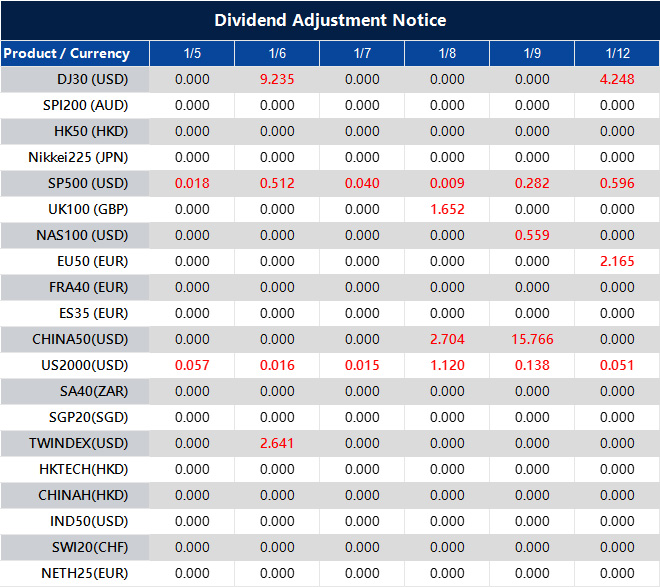
The above data is for reference only, please refer to the MT4/MT5 software for specific data.
If you’d like more information, please don’t hesitate to contact [email protected].
XAU/USD hits around $4,370 after Maduro’s capture by the US amid rising geopolitical tensions
Gold prices have jumped to about $4,370 in early Asian trading. This rise is mainly because of tensions between the US and Venezuela. The geopolitical unrest, sparked by the US’s capture of Venezuelan President Nicolas Maduro without Congress’s approval, is driving up gold prices. Gold is often seen as a safe haven during uncertain times, and this instability enhances its appeal. The US actions have raised concerns across the region.







