Dividend Adjustment Notice – Jan 05 ,2026

Dear Client,

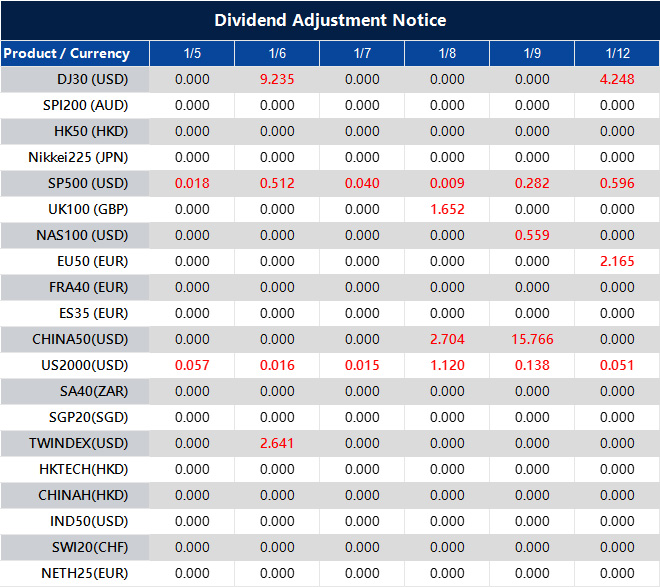
Please note that the dividends of the following products will be adjusted accordingly. Index dividends will be executed separately through a balance statement directly to your trading account, and the comment will be in the following format “Div & Product Name & Net Volume”.

Please refer to the table below for more details:

Dividend Adjustment Notice

The above data is for reference only, please refer to the MT4/MT5 software for specific data.

If you’d like more information, please don’t hesitate to contact [email protected].

XAU/USD hits around $4,370 after Maduro’s capture by the US amid rising geopolitical tensions

Gold prices have jumped to about $4,370 in early Asian trading. This rise is mainly because of tensions between the US and Venezuela. The geopolitical unrest, sparked by the US’s capture of Venezuelan President Nicolas Maduro without Congress’s approval, is driving up gold prices. Gold is often seen as a safe haven during uncertain times, and this instability enhances its appeal. The US actions have raised concerns across the region.

Economic Impact On Gold

The US decision to exert influence over Venezuelan oil has only added to the tensions. Also, expectations that the US Federal Reserve might cut interest rates are helping gold prices. Lower interest rates reduce the opportunity cost of holding gold versus interest-bearing assets. Meanwhile, traders are looking forward to the US ISM Manufacturing PMI report and Nonfarm Payrolls (NFP) data this week. Central banks in countries like China, India, and Turkey have been big buyers of gold, adding 1,136 tonnes in 2022—the largest annual purchase ever. Gold typically rises when the US Dollar and bonds decline, thanks to their inverse relationship. Factors like geopolitical tensions and market dynamics often influence gold prices, reinforcing its role as a hedge during financial uncertainty. The significant jump above $4,350 is a direct reaction to the escalating geopolitical conflict between the US and Venezuela. We can expect high implied volatility in the upcoming weeks, making options strategies important right now. This is not a slow change but rather a shock to the system, so being defensive is essential. We saw a similar trend during early turmoil in Eastern Europe back in 2022 when gold prices rose over 10% in just a few weeks. This historical pattern suggests the current rally may maintain its momentum as the market adjusts to the effects of US control over Venezuelan oil. Traders should be cautious about betting against this strong initial move.

Market Reactions

The geopolitical risk is intensified by the Federal Reserve’s dovish approach, with rate cuts anticipated. Lower interest rates make holding US Treasuries and the dollar less attractive, which boosts gold’s value. The mix of geopolitical worries and supportive monetary policy creates a strong tailwind for precious metals. The upcoming Nonfarm Payrolls report on Friday is significant, with the market predicting only 57,000 new jobs. For context, November 2025’s final report recorded a healthier addition of 150,000 jobs. A large miss in this report could signal economic weakness and likely push gold prices higher. Conversely, a strong job report may lead to a sharp, but likely temporary, drop in prices. Underlying all of this is the ongoing demand for gold from official institutions. Global central banks reportedly added another 337 tonnes to their reserves in the last quarter of 2025, continuing the trend of moving away from the dollar that we’ve seen for years. This steady purchasing creates a solid price floor, limiting the extent of any potential sell-offs. With the prevailing uncertainty and upward trend, buying call options or using bull call spreads may be effective strategies. These approaches allow for participation in further price increases while clearly defining the maximum risk. Such strategies would benefit from either worsening geopolitical conditions or a weak US employment report. Create your live VT Markets account and start trading now.

here to set up a live account on VT Markets now

Geopolitical tensions after Maduro’s capture cause AUD/USD to drop below 0.6700, increasing selling activity

Impact of Geopolitical Tensions

AUD/USD dropped below 0.6700 due to increased geopolitical risks after the US captured Venezuelan President Nicolás Maduro. The currency pair was around 0.6685 in the early Asian session on Monday, as traders focused on upcoming economic data from China and the US. US President Donald Trump announced Maduro’s capture, stating that he and his wife would face justice in the US. Trump also mentioned that American oil companies are planning to invest in Venezuelan crude production, potentially boosting global economic growth by increasing supply and lowering energy prices. Current geopolitical tensions are driving investors to the USD, negatively impacting AUD/USD. However, the Reserve Bank of Australia’s (RBA) potential interest rate hike could reduce the AUD’s losses. RBA Governor Michelle Bullock highlighted ongoing concerns about inflation, keeping discussions of rate hikes alive. Key factors influencing the AUD include RBA interest rates, iron ore prices, the state of China’s economy, and Australia’s trade balance. Higher interest rates and strong iron ore prices can support the AUD, along with a positive trade balance and improvements in China’s economy. Despite this, rising geopolitical risks continue to put pressure on the AUD, although the RBA’s tightening approach may offer some support. The capture of Maduro has sparked a rush to the US Dollar as a safe haven. This geopolitical event has increased expected market volatility, making options strategies that take advantage of higher volatility appealing. Traders are likely considering these strategies to navigate the uncertainty driving AUD/USD below the crucial 0.6700 level.

Market Tensions and Economic Data

The Aussie dollar faces significant pressure as a robust US economy continues to support the Greenback. The US ISM Manufacturing PMI for December 2025 pleasantly surprised at 54.2, reinforcing the view of a strong American economy. This suggests that buying put options or creating bear put spreads on AUD/USD is a logical strategy for those anticipating further weakness. However, it’s important to remember the underlying support for the AUD, which might buffer its decline. Australia’s Q4 2025 CPI data was stronger than expected at 3.9%, putting pressure on the RBA to stay hawkish. Additionally, the recent Chinese Caixin Manufacturing PMI for December, reported at 51.8, indicates steady demand for Australian exports. The decrease in energy prices, with Brent crude near $78 a barrel, stems from the news about Venezuela, slightly easing global inflation concerns. Meanwhile, iron ore prices remain strong above $130 per tonne, offering a solid foundation for the Australian currency. This contrasting situation suggests that while the USD is gaining due to risk sentiment, the AUD’s commodity support remains intact. Given these mixed signals, we anticipate AUD/USD to remain in a tug-of-war, likely leading to range-bound trading in the upcoming weeks rather than a sharp price movement. This environment is ideal for strategies that benefit from time decay and risk management, such as an iron condor. Positioning the wings of this strategy around the 0.6600 and 0.6800 levels could be a wise choice. Create your live VT Markets account and start trading now.

here to set up a live account on VT Markets now

Philadelphia Fed President Anna Paulson discusses job market resilience ahead of upcoming meeting

Philadelphia Federal Reserve President Anna Paulson noted that the job market is “bending not breaking.” She believes the labor market is a better indicator of economic health than GDP data. Potential asset sales could help boost growth but might limit job creation. Tariff adjustments could be finalized in the next six months, and overall, the economic outlook seems positive. Paulson anticipates that inflation will decrease, the job market will stabilize, and GDP will hover around 2%.

Labor Market Risks

Labor market risks are still high, but the Federal Reserve is focused on reducing inflation. The current job market supports the Fed’s easing strategy. Tariffs are keeping inflation above target levels, but it is expected to normalize within a year. The US Dollar Index (DXY) is showing slight gains near 98.50, with the dollar performing strongest against the Australian Dollar today. The heat map illustrates percentage changes among major currencies, with the left column as the base and the top row as the quote. We are being informed that the job market is slowing down without plummeting into a recession. The December 2025 jobs report supports the “bending, not breaking” perspective, indicating a payroll gain of 155,000 and an increase in the unemployment rate to 4.0%. This suggests the Federal Reserve can continue making policy adjustments without worrying too much about the labor market. Inflation is clearly easing, with the most recent Core PCE reading for November 2025 at 2.8%, significantly lower than its peaks in 2024. This trend allowed the Fed to cut interest rates three times in the latter half of last year. It’s expected that inflation will stabilize as tariff-related price pressures decline over the next two quarters.

Lower Interest Rates

Given this environment, it’s wise to prepare for lower interest rates in the upcoming months. Strategies involving Secured Overnight Financing Rate (SOFR) futures that capitalize on a continued easing cycle could be beneficial. We should watch for chances to anticipate further, cautious rate cuts by the Federal Reserve this year. The generally positive economic outlook suggests lower market volatility, which was evident as the VIX index fell in late 2025. This creates a good environment for strategies such as selling options to earn premiums, like selling puts on stock indices. This approach profits from a stable market and the gradual decrease in volatility. Although the US Dollar Index is steady near 98.50, the policy of cutting rates typically weakens a currency. We might see the dollar soften against currencies where central banks are less likely to ease. Positioning for a weaker dollar against the Euro or Swiss Franc could be a significant focus in the first half of the year. This situation feels reminiscent of the soft landing achieved in the mid-1990s when the Fed managed to cool the economy without triggering a major downturn. During that time, stock markets performed well after the shift toward easing. Traders should be ready for a similar scenario if the current outlook continues and labor market risks remain controlled. Create your live VT Markets account and start trading now.

here to set up a live account on VT Markets now

OPEC+ decides to keep oil production steady despite rising geopolitical tensions in a virtual meeting

OPEC+ recently held an online meeting with key members including Saudi Arabia, Russia, and the UAE. They decided to keep oil production at current levels. This decision follows a pause in output during the first quarter due to lower demand over the winter. The meeting took place amid rising tensions between Saudi Arabia and the UAE, and after recent U.S. actions regarding Venezuelan President Nicolás Maduro. What OPEC+ decides about oil output affects global oil markets directly.

WTI Oil Benchmark

WTI Oil is a high-quality crude from the U.S. that acts as a market benchmark. Its price is influenced by supply and demand, as well as external political events and OPEC’s decisions. Reports on weekly inventory from the American Petroleum Institute (API) and the Energy Information Agency (EIA) impact WTI pricing. Changes in inventory levels show shifts in supply and demand, which in turn affect prices. OPEC consists of 12 oil-producing countries that set production quotas, influencing WTI Oil prices. The expanded group, OPEC+, includes Russia and can also adjust market supply, which affects prices by tightening or loosening production. With OPEC+ expected to maintain its production levels, we see this as more of a stable factor rather than a new market driver. This stable supply outlook shifts our attention to geopolitical risks and actual demand signs. OPEC+ provides a baseline, but any price changes in the coming weeks will likely stem from other factors.

Venezuela’s Impact On Crude Output

Venezuela’s political situation brings a significant risk, as it may disrupt the country’s crude production, which has averaged around 850,000 barrels per day recently. This potential supply disruption, coupled with ongoing tensions between Saudi Arabia and the UAE, helps keep oil prices steady. Traders in derivatives should consider a higher risk premium since geopolitical events can escalate quickly and drive prices sharply higher. On the demand side, the situation is less clear, which creates mixed pressures on the market. The latest report from the International Energy Agency projected a slowdown in global demand growth for 2026 to 1.1 million barrels per day, mainly due to weak industrial activity in China. In contrast, U.S. economic data remains strong, including a jobs report for December 2025 that exceeded expectations, indicating strong demand in North America. We will closely watch the upcoming EIA inventory report on January 7th for insights on near-term market direction. The EIA’s final report for 2025 showed a surprising draw of over 4.7 million barrels, suggesting stronger-than-expected end-of-year demand. A significant draw in the next report could indicate that this positive demand trend continues into the new year, potentially outweighing concerns about slower global growth. Given this stable OPEC+ approach and high geopolitical uncertainty, we expect WTI options to see increased implied volatility. Back in early 2022, geopolitical events quickly influenced prices, making them swing dramatically. Traders might find strategies that benefit from this volatility, like long straddles or strangles, wise if they expect sharp price moves. We usually observe oil prices bottoming out in the winter months due to lower demand, as OPEC+ noted. This pattern appeared in the first quarter of 2025 when prices stabilized before rising ahead of the summer driving season. Thus, traders might consider taking long-term positions through call options if prices drop in the next few weeks due to weak demand data, anticipating a seasonal rally in the spring. Create your live VT Markets account and start trading now.

here to set up a live account on VT Markets now

Substantial selling in the S&P 500 and Nasdaq on Friday attracts capital gains interest.

The S&P 500 and Nasdaq saw a decline on Friday, even after recent gains. The drop became worse in the last two hours of trading on Wednesday, particularly when the market hit the 6,936 resistance level right after opening. The current market trends don’t indicate a bad year for stocks. While AI isn’t in a bubble, strong earnings could still drive up stock prices. The financial and retail markets are showing resilience, easing worries about a bear market or a recession.

Market Outlook for 2026

Market conditions are expected to shift, leading to a more cautious outlook for 2026 compared to recent years. A market correction is likely, but the year has just started. We saw major selling pressure at the end of the first week of the year, as traders locked in profits from last year’s gains. The S&P 500 dropped 1.5% on Friday after a remarkable 24% increase in 2025. This suggests that hedging against further losses is a smart move for the short term. In the upcoming weeks, traders should think about buying protective put options on major market indices like the SPX or QQQ. This strategy acts as a hedge if profit-taking continues after the early days of January. Keeping an eye on the VIX is also important, as it has risen to 14.5, indicating an increased demand for market protection.

Evaluating Market Strategies

However, being fully bearish would be a mistake since the fundamentals are strong. As we approach the Q4 2025 earnings season, projections for S&P 500 earnings growth are still around 11%. Thus, selling cash-secured puts at lower strike prices could be a good way to earn premiums while preparing to buy during a potential dip. We aren’t seeing the signs of a true bear market, especially since key sectors are resilient. The Financial Select Sector SPDR Fund (XLF) is still trading close to its 52-week high. Also, the strong retail sales data from December 2025, which showed a 0.8% increase, suggests consumers aren’t collapsing. This strength indicates that any major market drop would likely be limited. The focus on AI continues to support the market, with reasonable growth expectations for key players preventing a repeat of the tech collapse seen in 2022. Given that 2026 is expected to be a leaner year, using collar strategies on current long positions could be wise. This method protects your capital while generating income in what might be a sideways or mildly rising market. Create your live VT Markets account and start trading now.

here to set up a live account on VT Markets now

Substantial selling in the S&P 500 and Nasdaq on Friday attracts capital gains interest.

The S&P 500 and Nasdaq saw a decline on Friday, even after recent gains. The drop became worse in the last two hours of trading on Wednesday, particularly when the market hit the 6,936 resistance level right after opening. The current market trends don’t indicate a bad year for stocks. While AI isn’t in a bubble, strong earnings could still drive up stock prices. The financial and retail markets are showing resilience, easing worries about a bear market or a recession.

Market Outlook for 2026

Market conditions are expected to shift, leading to a more cautious outlook for 2026 compared to recent years. A market correction is likely, but the year has just started. We saw major selling pressure at the end of the first week of the year, as traders locked in profits from last year’s gains. The S&P 500 dropped 1.5% on Friday after a remarkable 24% increase in 2025. This suggests that hedging against further losses is a smart move for the short term. In the upcoming weeks, traders should think about buying protective put options on major market indices like the SPX or QQQ. This strategy acts as a hedge if profit-taking continues after the early days of January. Keeping an eye on the VIX is also important, as it has risen to 14.5, indicating an increased demand for market protection.

Evaluating Market Strategies

However, being fully bearish would be a mistake since the fundamentals are strong. As we approach the Q4 2025 earnings season, projections for S&P 500 earnings growth are still around 11%. Thus, selling cash-secured puts at lower strike prices could be a good way to earn premiums while preparing to buy during a potential dip. We aren’t seeing the signs of a true bear market, especially since key sectors are resilient. The Financial Select Sector SPDR Fund (XLF) is still trading close to its 52-week high. Also, the strong retail sales data from December 2025, which showed a 0.8% increase, suggests consumers aren’t collapsing. This strength indicates that any major market drop would likely be limited. The focus on AI continues to support the market, with reasonable growth expectations for key players preventing a repeat of the tech collapse seen in 2022. Given that 2026 is expected to be a leaner year, using collar strategies on current long positions could be wise. This method protects your capital while generating income in what might be a sideways or mildly rising market. Create your live VT Markets account and start trading now.

<Click here to set up a live account on VT Markets now

As 2026 begins, US stocks show mixed trends, with semiconductors stabilizing the market.

As 2026 starts, US stock markets opened with caution. The S&P 500 and Nasdaq stayed flat, with strong semiconductor performance balancing issues in the tech sector. The Dow Jones stabilized after a brief dip, remaining close to its starting point for the year. Strategists are positive about US stocks in 2026, with an S&P 500 target of 7,629 suggesting the possibility of double-digit growth. It’s expected that market leadership will spread beyond big tech companies to sectors like regional banks, as some high-priced tech stocks might struggle.

Nvidia And Micron’s Continued Gains

Nvidia and Micron are benefiting from the AI-driven boom that started in 2025, while software companies like Salesforce and CrowdStrike experienced declines. Although 2026 began quietly, 2025 wrapped up strongly, with the S&P 500 rising over 16%, the Nasdaq more than 20%, and the Dow around 13%, all reaching record highs. Furniture stocks increased thanks to delays on tariffs for items like upholstered furniture, helping companies such as Wayfair and Williams-Sonoma. However, US manufacturing activity slowed down as new orders dropped, although job growth picked up, suggesting a stable economic outlook. There is some uncertainty about the Federal Reserve’s leadership, which could affect monetary policy. Warren Buffett’s transition of his CEO role at Berkshire Hathaway to Greg Abel is a significant change, even as investors have lingering questions. With the markets starting 2026 flat after a record-breaking 2025, now may be the time to hedge our long equity positions. After the S&P 500 rose over 25% in 2025, using put options on broad market ETFs, like the SPDR Dow Jones Industrial Average ETF (DIA), can help protect profits against any potential downturn. This strategy keeps us open to upside gains while managing our downside risk during these unpredictable early weeks.

Opportunities In Pairs Trading

The clear divide between strong chipmakers and weaker software companies suggests a promising pairs trading opportunity. The semiconductor-tracking SOX index jumped over 60% in 2025, and this trend seems to be continuing. We could profit by buying call options on a semiconductor ETF and simultaneously buying put options on a software ETF, taking advantage of the ongoing shift in the tech sector. Fed Chair Powell’s uncertain future is likely to cause market volatility, so we should be ready. The VIX, which measures market volatility, is currently near historical lows around 13, making call options on it relatively affordable. Buying these VIX calls for the next few months offers a cost-effective way to benefit from any market turmoil tied to the Fed leadership change. The possibility of a new Fed chair by mid-year influences interest rate expectations, opening opportunities in rate-sensitive derivatives. Current market prices, based on Fed Funds futures, suggest only a 40% chance of a rate cut by June, which could change significantly. We can use options on Treasury bond ETFs to prepare for a more aggressive rate-cutting approach if a more dovish Fed chair becomes likely. Specific events, like tariff delays on furniture, create short-term trading chances. The recent surge in stocks like Wayfair (W) highlights their sensitivity to trade policy updates. We can buy call options to benefit from this positive momentum in the short term or consider puts if it seems the tariff delay won’t be extended. Create your live VT Markets account and start trading now.

here to set up a live account on VT Markets now

Markets remain calm as the US dollar stabilizes before important data releases

### Currency Market Overview Currently, in the currency market: – **EUR/USD** is around **1.1740** – **GBP/USD** is near **1.3480** – **USD/JPY** sits at **156.50** – **AUD/USD** has seen a small gain, trading close to **0.6690** Central banks are focused on keeping prices stable. They use interest rates to manage inflation and adjust them based on economic data, which can either loosen or tighten monetary policy. Important economic reports coming up include the **US ISM Manufacturing PMI**, **Germany’s HICP**, and **Australia’s CPI**. Additional releases will feature the **US ADP Employment Change**, **ISM Services PMI**, **Eurozone HICP**, **US Trade Balance**, and **Consumer Credit**. Next week, we will see the **US Nonfarm Payrolls** report and the estimate for the **Michigan Consumer Sentiment Index**. These will likely affect market feelings and central bank strategies. ### The Calm Before the Storm As the new year starts, market activity is low, creating a still atmosphere for derivatives trading. All eyes are on next week’s US employment and inflation data, which will be the first real test of expectations for Federal Reserve rate cuts in 2026. In November 2025, the **Nonfarm Payrolls** report revealed a surprising gain of **199,000** jobs, with the unemployment rate dropping to **3.7%**. This strong labor market raised questions about how quickly the Fed could reduce policy restrictions. The upcoming December NFP report on January 9 will be crucial for confirming this trend. The **US Dollar Index** is steady around **98.40**, but this calm may not last long. A disappointing jobs report could cause the DXY to fall, supporting market bets for a weaker dollar and making options for this scenario appealing. Conversely, a strong report might push the dollar up sharply, forcing out short-dollar positions. Gold is trading near **$4,320**, boosted by the belief that the next Fed move will be a rate cut. However, this also means gold is at risk if next week’s economic data is unexpectedly strong. Traders might consider options to protect their long gold investments against a sudden drop if the NFP report is robust. Recently, equity markets saw a strong rally in the last quarter of 2025, driven by the Fed’s dovish shift in December. This current low volatility may be just the calm before a storm. Derivative traders should be alert for a rise in the **VIX** if next week’s data disrupts the view of a smooth economic slowdown. Create your live VT Markets account and start trading now.

here to set up a live account on VT Markets now

As semiconductor support stabilizes, US equities show caution at the start of 2026

US stocks began 2026 cautiously, with the S&P 500 and Nasdaq staying steady as gains in semiconductor companies offset declines in other tech areas. The Dow Jones stabilized after initial drops, finishing near its starting point for the year’s first trading day. Wall Street experts are optimistic about US stocks in 2026, with an S&P 500 target of 7,629 indicating significant gains ahead. Market leadership is expected to shift from just mega-cap tech stocks to include regional banks and other sectors, while some highly valued tech stocks may struggle.

Chipmaker and Tech Stock Performance

Chipmakers like Nvidia and Micron experienced gains due to increased spending on artificial intelligence, while software companies such as Salesforce saw declines. Tesla affected market sentiment with delivery reports that fell short of expectations. However, 2025 ended positively, with the S&P 500 up over 16%, the Nasdaq over 20%, and the Dow around 13%, all reaching record highs. In non-tech sectors, furniture retailers thrived after President Trump postponed tariff hikes on related products for a year. Companies like Wayfair experienced a boost after reassessing trade-related cost pressures. This shift followed variations in sector performance during 2025, where value-focused retailers succeeded while high-end brands struggled. US manufacturing showed signs of slowing in December, based on the S&P Global PMI, with new orders easing up but job creation growing. The Federal Reserve’s future is uncertain, as Jerome Powell has not confirmed his plans after May, which may affect its direction. In corporate news, Warren Buffett passed the CEO role at Berkshire Hathaway to Greg Abel, ending his 60-year leadership. Abel is viewed favorably, but Berkshire’s shares have struggled since the news, raising concerns about the company’s future.

Trading Strategies and Market Outlook

As the market starts 2026 flat after the big gains of 2025, there’s an opportunity for range-bound trading strategies. Selling iron condors on the SPY could help collect premiums while betting that the market will consolidate before making significant moves. This strategy works best if the market stays within expected price ranges in the coming weeks. The divergence between strong chipmakers and struggling software suggests an ongoing rotation. A similar trend occurred in late 2023 when the equal-weight S&P 500 ETF (RSP) gained over 12%, outperforming the cap-weighted index, indicating broader market participation. To benefit from this, we are considering pairs trades, like buying calls on the regional banking ETF (KRE) while buying puts on a software ETF like IGV. Certain company news is creating clear trading opportunities, such as Tesla’s delivery shortfall and the rise in home goods stocks. For Tesla, where implied volatility often exceeds 60% after bad news, bear put spreads can help limit risk while betting on further weakness. Conversely, bull call spreads on companies like Wayfair (W) can capture upside from the tariff delay while managing the increased option costs after the initial stock surge. The greatest uncertainty stems from the Federal Reserve, with Chair Powell’s term ending in May. The market correction in February 2018 during the last leadership change illustrates how such events can lead to volatility. Buying VIX calls or futures with expirations timed around important Fed meetings could serve as a useful hedge against surprises. Even Berkshire Hathaway is feeling some pressure following the handoff to Greg Abel. Since the stock has underperformed since the announcement, generating income from this position seems prudent. We are considering selling covered calls against long Berkshire (BRK.B) holdings to benefit from potentially steady price movements in the near term. Create your live VT Markets account and start trading now.

here to set up a live account on VT Markets now

Back To Top
server

Hello there 👋

How can I help you?

Chat with our team instantly

Live Chat

Start a live conversation through...

  • Telegram
    hold On hold
  • Coming Soon...

Hello there 👋

How can I help you?

telegram

Scan the QR code with your smartphone to start a chat with us, or click here.

Don’t have the Telegram App or Desktop installed? Use Web Telegram instead.

QR code