



Governor Ueda’s remarks lead to ongoing intraday losses for the Japanese Yen
The Japanese Yen (JPY) is experiencing losses today after comments from Bank of Japan (BoJ) Governor Kazuo Ueda. He indicated that the current loose monetary policy helps the economy recover and that real interest rates will likely stay low. This has lowered expectations for more BoJ rate hikes in 2026, impacting the JPY. Additionally, the positive outlook in equity markets is diminishing the JPY’s appeal as a safe-haven currency, helping the USD regain strength towards the mid-156.00s.
The BoJ recently raised the short-term interest rate by 25 basis points to 0.75%, marking the highest rate in 30 years, but this did not help the JPY. They expressed willingness to raise rates further if the economy performs as expected. Japan’s statistics show that the National Consumer Price Index increased by 2.9% year-on-year in November, with the core CPI steady at 3%, above the BoJ’s goal. Concerns about Japan’s large government debt may also be putting pressure on the JPY.
Germany’s Producer Price Index for November fell to 0% instead of the expected 0.1% month-on-month.
Germany’s Producer Price Index (PPI) for November stayed the same compared to October, showing no change at 0%. This result was below the expected rise of 0.1%.
The PPI tracks the average change in selling prices that domestic producers receive for their products. When the PPI is stable, it means that producers haven’t faced increased costs during this time.
Price Pressures Are Stable
The steady PPI for November indicates that price pressures in Germany’s production sector are stable, based on the latest data. This stability provides clues about the overall economic conditions impacting manufacturers and production costs. These statistics are part of a larger dataset that policymakers and economists study to understand inflation trends and cost pressures in the economy. Changes in producer prices can signal future shifts in consumer prices and inflation rates. Recent data shows that producer prices in Germany were unchanged in November 2025, falling short of the anticipated 0.1% increase. This suggests that inflation pressures at the production level are decreasing more quickly than expected, indicating weakening demand in Europe as we enter the new year.Impact On Interest Rates And Currency
This information offers the European Central Bank more flexibility to pause its interest rate hikes. We can expect derivatives pricing to adjust, reflecting a more cautious ECB stance, with overnight index swaps already indicating a higher chance of a rate cut by mid-2026. Traders might consider futures contracts that benefit from stable or lowering rates, like those linked to EURIBOR. This outlook could put downward pressure on the Euro, particularly against the US dollar, as the Federal Reserve appears more aggressive in its rate policies. The EUR/USD exchange rate has dipped below 1.07 this week, with potential for further declines. In late 2023, low German inflation data often led to a multi-week drop in the currency, making put options on the Euro a more appealing hedge. For equity markets, the possibility of lower borrowing costs could be a positive sign. The German DAX index has been hovering around the 18,000 level for weeks, and this drop in inflation might support a breakout. We could think about purchasing call options on the DAX, as German corporate earnings for Q3 2025 posted a solid 3.5% year-over-year growth, suggesting a robust foundation if financing conditions improve. Create your live VT Markets account and start trading now.UK retail sales excluding fuel grew by 1.2%, falling short of the 1.6% forecast
The Impact of Gold and Cryptocurrency Movements
The Bank of England recently lowered interest rates to 3.75%. This decision was more aggressive than many anticipated, causing the pound to strengthen slightly and market rates to rise. It’s still unclear if more rate cuts will happen in early 2024.
Ethereum is currently priced at $2,920. There are concerns about rising state size, prompting the Ethereum Foundation to propose solutions. Possible options include state expiry, state archiving, and partial statelessness to tackle these concerns.
UK retail sales have fallen short of expectations, highlighting a slowing economy. This is reflected in the recent Bank of England rate cut and a report from the Office for National Statistics showing a 0.2% contraction in UK GDP last quarter. In light of this weakness, we should think about strategies that could benefit from a declining or stable pound, like buying puts on the GBP/USD pair.
Prospects for the US Dollar
Despite soft inflation data, the US Dollar remains strong because traders are focusing on other factors. The US labor market is still robust, as shown by the November 2025 Non-Farm Payrolls report that added 210,000 jobs, keeping unemployment at a low 3.9%. This difference suggests that traders expect the Federal Reserve to maintain a more aggressive stance than other central banks, making it risky to bet against the dollar right now.
The Bank of Japan’s recent decision to raise interest rates marks a major change in policy, even though the yen reacted quietly at first. This decision comes after Japan’s core inflation stayed above the 2% target for 18 months, recently reaching 2.8%. We should prepare for more volatility in yen pairs, making strategies that benefit from increased volatility on USD/JPY compelling.
As we near the end of the year, a risk-averse attitude is prevailing, evident in the recent corrections in Bitcoin and Ethereum. The VIX index, which measures market fear, has been around 22 for the past month—much higher than the calmer sub-20 levels seen for much of 2025. This situation indicates that protecting portfolios against sudden market declines should be a priority in the weeks ahead.
In the currency market, the difference in policies between a dovish European Central Bank and a more resilient Federal Reserve is pushing EUR/USD toward 1.1700. The expectation of this ongoing divergence is likely to continue putting pressure on the euro. We can take advantage of this trend by exploring call options on the US Dollar Index (DXY), which benefits from a stronger dollar.
Create your live VT Markets account and start trading now.
UK retail sales decrease by 0.1% in October, missing expectations
United Kingdom retail sales for November fell by 0.1% from the previous month, missing expectations of a 0.4% rise.
The EUR/NOK exchange rate dropped after the Norges Bank meeting, while the EUR/USD also decreased as the US Dollar gained strength. Despite lower US inflation data, the USD remained robust, affecting both gold and cryptocurrency markets. Gold remained below $4,350, and Bitcoin, Ethereum, and Ripple experienced drops of nearly 3%, 8%, and 10%, respectively.
Bank Of England’s Interest Rate Decision
The Bank of England cut interest rates to 3.75%, which was a surprising decision that strengthened the pound. The future of these rates remains unclear, with potential further cuts likely in early 2024. In related news, Ethereum’s price is at $2,920, raising concerns about its growing state and effects on decentralization. The Ethereum Foundation has proposed solutions such as state expiry and partial statelessness to tackle these issues. Lastly, a selection of top brokers for 2025 has been identified, covering regions like Mena and Latam, and highlighting options for specific trading needs like low spreads, high leverage, and regulated environments.UK Retail Sales Impact
The dip in UK retail sales for November is a bearish sign for the British Pound. It suggests that consumer confidence is declining just before the important holiday season. This could hinder long positions in Sterling, particularly against a strong US dollar. The recent rate cut by the Bank of England to 3.75% was split among members, indicating they are hesitant to make further cuts. With the latest data showing UK CPI inflation at 3.1% in November 2025, still above the Bank’s 2% target, they are limited in their options. This conflict between a slowing economy and stubborn inflation suggests there will be continued volatility, making strategies that profit from GBP/USD price swings appealing in the coming weeks. The US Dollar remains strong even though US inflation data has softened, with November CPI at 2.8%. This suggests that the market is focused on the Federal Reserve’s stance, which remains tighter than its G7 counterparts. As long as this perception continues, the dollar is likely to remain the favored currency. This strength in the dollar is suppressing any rallies in EUR/USD, keeping it around the 1.1700 level. While the possibility of a policy divergence between the Fed and the European Central Bank might support the Euro, the dollar’s dominance is the key story for now. We see better opportunities in selling short-term spikes in the pair rather than betting on a sustained breakout. Additionally, the broader risk-off mood is influenced by the Bank of Japan’s recent rate hike, which was widely anticipated and therefore had a muted market reaction. However, this move signals the end of an era of easy global money, likely placing ongoing pressure on risk assets, including cryptocurrencies. We’ve seen similar market trends in past tightening cycles, particularly during the global rate increases of 2022-2023. Disappointing economic reports from one region often led to that currency underperforming for weeks, regardless of central bank comments. The current situation with weak UK retail sales is reminiscent of those times, supporting a cautious to bearish outlook on Sterling as we approach the start of 2026. Create your live VT Markets account and start trading now.After volatility, GBP/USD stabilizes in the mid-1.3400s but struggles to attract buyers.
The GBP/USD pair remains steady after a turbulent session, trading between 1.3380 and 1.3385, with a slight daily rise of 0.05%. Traders are looking at mixed signals following updates from the Bank of England and recent US inflation data.
The British Pound has gained from a recent rate cut by the Bank of England, which lowered the interest rate by 25 basis points to 3.75%. The decision was nearly split, showing different opinions among committee members in light of surprising inflation figures earlier this week, which influences future expectations regarding aggressive easing.
Inflation Data Influence
In Thursday’s North American session, GBP/USD rose to 1.3410, up 0.28%, after previously dropping to 1.3340. This movement followed the US Consumer Price Index, which increased by 2.7% year-on-year in November, down from 3% in September. This data was affected by challenges in collection due to a government shutdown. The core US inflation rate fell to 2.6%, which was better than expected. However, the extended government shutdown hindered the usual data collection for the report, affecting the overall inflation analysis. Yesterday, the Bank of England announced its rate cut to 3.75% in a very close 5-4 vote. This tight decision indicates significant disagreement among members, suggesting that aggressive cuts early in 2026 are uncertain. This hesitation helps support the Pound against the Dollar. For the US side, the inflation data from yesterday showed a rate of 2.7%, continuing the slow disinflation trend we have observed since the pandemic peaks of 2022. However, it’s important to be cautious since this report may be influenced by the recent 43-day government shutdown, which affected data collection. The questionable nature of this data currently puts pressure on the US Dollar.Potential Market Movements
Due to differences in policy, GBP/USD could rise towards the 1.3500 level in the upcoming weeks. Traders might consider using call options to benefit from this expected move, especially as implied volatility stabilizes after yesterday’s central bank announcements. The main risk lies in any US official downplaying the soft inflation report, which could lead to a rebound in the Dollar. We should also keep in mind that we are approaching the holiday season, when trading volumes typically drop significantly. Historically, during the thin holiday markets of late 2023 and 2024, these conditions can lead to exaggerated price swings on minimal news. Therefore, managing position sizes carefully is crucial to navigate any sudden price changes with low liquidity as we approach the end of the year. Create your live VT Markets account and start trading now.The Bank of Japan raises interest rates as the USD strengthens due to weak inflation conditions.
The US Dollar stayed steady on Friday, even as inflation in the US eased to 2.7% in November. The Japanese Yen showed resilience after the Bank of Japan raised its policy rate by 25 basis points to 0.75%.
Market attention is also on the Bank of England, which made a narrow decision to cut its rate to 3.75%. In contrast, the European Central Bank decided to keep rates unchanged, concentrating on the strength of the Euro.
Economic Indicators and Currency Movements
In the US, weekly Initial Jobless Claims fell to 224,000. Investors are waiting for more economic data, such as existing home sales and the University of Michigan’s Index. In Europe, the Euro steadied above 1.1700 after earlier fluctuations. Gold prices reached a new all-time high but later corrected to $4,320. The exchange rate between the US Dollar and the Japanese Yen rose to around 156.00, gaining 0.3% for the day. The article reviews the roles of central banks and how they target inflation. Central banks aim to keep prices stable by using interest rates to influence the economy. It highlights their independence, structure, and key figures like the chairman, who play vital roles in shaping monetary policy. We see a significant divide in central bank strategies, with the Bank of Japan raising rates and the Bank of England cutting them. This difference creates clear trading opportunities in major currency pairs. Traders dealing in derivatives should prepare for these diverging paths as we head into the new year. Even with the BoJ’s rate hike to 0.75%, the USD/JPY exchange continues to rise toward 156.00, indicating that the market views this move as cautious, not the beginning of an aggressive trend. With US 10-year yields remaining above 4% for much of the last two years, the interest rate gap is substantial. Thus, the yen carry trade remains profitable, likely attracting traders as the holidays approach.Bank of England Rate Cut and Its Impact
The Bank of England’s rate cut, decided by a narrow margin, puts downward pressure on the pound Sterling. We saw similar challenges in the UK economy in 2024, marked by stagnant growth. Recent data from the ONS in late 2025 shows that consumer spending has dropped for two straight quarters. Any rise in GBP/USD toward 1.3450 should be viewed as an opportunity to sell. The US Dollar shows strength despite softer inflation numbers, with the Dollar Index holding above 98.50, highlighting its appeal as a safe haven. This nervousness in the market is also seen in gold prices nearing all-time highs, a typical indicator of traders seeking safety in uncertain times. Given these mixed signals and the thin liquidity during the holidays, we should expect an increase in short-term volatility, making options strategies that benefit from price fluctuations more attractive. Create your live VT Markets account and start trading now.Australian dollar weakens against US dollar as Michigan Consumer Sentiment Index approaches
The Australian Dollar (AUD) fell against the US Dollar (USD), losing its daily gains as the USD strengthened. This happened even with rising expectations for Federal Reserve rate cuts. In November, Private Sector Credit in Australia grew by 0.6% monthly and 7.4% annually, the fastest growth since January 2023. Meanwhile, the US Consumer Price Index (CPI) dropped to 2.7% in November, and the core CPI rose by 2.6%, both below what the market expected.
The US Dollar Index, which tracks the USD against six key currencies, hovered around 98.50. With inflation numbers cooling, the chance of US Federal Reserve rate cuts increased. The CME FedWatch tool indicated a 72.3% probability that rates would stay the same in January, while the likelihood of a 25-basis-point cut rose to 27.7%.
Australian Economic Overview
By February, many believe the Reserve Bank of Australia (RBA) may raise rates, with major banks suggesting earlier tightening due to ongoing inflation. Australia’s unemployment rate held steady at 4.3% in November, despite a drop in employment change. Technical analysis showed a weakening bullish bias for the AUD/USD pair, although some positioning hinted at possible upside momentum. Currently, the AUD remains in a strong support zone against major currencies, influenced by interest rates, trade balance, and the Chinese economy. As of December 19, 2025, the Australian dollar is dipping against the US dollar, but this appears to be a short-term response. The overall outlook for the coming weeks suggests a tension between two different central bank strategies. The US Federal Reserve seems to be easing up, while the Reserve Bank of Australia is taking a firmer stance. The case for a weaker US dollar is strengthening. US inflation for November came in lower than expected at 2.7%, and recent data showed weekly jobless claims shot up to 245,000, much higher than the 220,000 forecast. This indicates a cooling US economy, which may prompt the Fed to consider rate cuts early next year.Market Predictions For Traders
On the other hand, the Australian economy shows signs of ongoing inflation, which supports the Aussie dollar. Consumer inflation expectations recently rose to 4.7%. Strong demand from China, which reported a 6.9% year-over-year increase in industrial production for November, is likely to support Australian commodity exports. This could push the RBA to maintain or even raise rates. The market is already factoring in this divergence. Traders expect at least two rate cuts from the Fed in 2026, while the swaps market suggests a 41% chance of an RBA rate hike by March. This growing gap in interest rate policies is the key theme for trading. For derivatives traders, this environment likely means increased volatility in the AUD/USD pair. The conflicting pressures could cause erratic price movements in the short term, making strategies like buying straddles appealing to profit from significant price swings. The VIX Index, which measures expected market volatility, has been rising, moving from 12.1 in early December to 13.4 this week, indicating that traders are preparing for larger price changes. Considering these fundamentals, the recent dip in the AUD/USD toward the 0.6600 level seems more like a buying opportunity than the beginning of a new downtrend. The hawkish RBA and dovish Fed create strong support for the Australian dollar. We could see the pair test its recent three-month high of 0.6685 in the coming weeks. Create your live VT Markets account and start trading now.EUR/USD pair shows weakness at 1.1720, testing nine-day support after four sessions
EUR/USD might rise towards a two-month high of 1.1804, driven by positive momentum. The 14-day Relative Strength Index sits at 62.11, indicating good upward strength without being overbought. The pair is testing support at the nine-day EMA of 1.1713.
Currently, EUR/USD is weak, trading around 1.1720 during the Asian session on Friday. Technical analysis shows a bullish trend on the daily chart, as the pair remains within an upward channel pattern. It is above the nine- and 50-day EMAs, suggesting that the bullish trend is still strong.
Possible EUR/USD Increase
There’s a chance for EUR/USD to reach 1.1804, and possibly even 1.1850. If the support holds, we could see movement towards the 50-day EMA at 1.1644 or hit a three-week low of 1.1589 noted on December 1. Today, the Euro’s performance varies against other major currencies, showing particular weakness against the US Dollar. The heat map below illustrates percentage changes among major currencies, with the left column as the base currency and the top row as the quote currency. This analysis is enhanced by AI tools and market insights. Since EUR/USD is testing a crucial support level near 1.1713, this could be a good opportunity to consider long positions. The pair remains in a clear upward channel, showing that the underlying trend is still positive despite four days of weakness. This suggests the current dip may just be a temporary pause before moving higher. We might look into buying call options with strike prices around 1.1800, perhaps with an expiry in late January 2026, to take advantage of a potential rebound. This bullish outlook is supported by recent data, which showed Eurozone inflation for November 2025 at 2.7%, slightly above expectations, pressuring the European Central Bank to hold off on rate cuts. We recall a similar situation in late 2023, where persistent inflation helped the Euro against a weakening dollar.Risk Management and Key Levels
If there’s a rebound from the current 1.1700 support area, it will strengthen our bullish view, with an initial target being the recent high of 1.1804. A break above this could move the pair toward the upper channel boundary near 1.1850 in early 2026. The Relative Strength Index at 62.11 demonstrates healthy momentum, with more room to grow before becoming overbought. However, we need to manage our risk if the 1.1700 support fails. This could happen if US economic data, like upcoming December 2025 retail sales figures, come in stronger than expected. A decisive close below the upward channel would suggest we should hedge long positions or start speculative shorts by buying put options. If the 1.1700 support breaks, the next important level to watch would be the 50-day EMA at 1.1644. A drop to this level would indicate a major shift in short-term market sentiment and could bring the three-week low of 1.1589 back into consideration for bearish strategies. Create your live VT Markets account and start trading now.Dividend Adjustment Notice – Dec 19 ,2025
Dear Client,
Please note that the dividends of the following products will be adjusted accordingly. Index dividends will be executed separately through a balance statement directly to your trading account, and the comment will be in the following format “Div & Product Name & Net Volume”.
Please refer to the table below for more details:
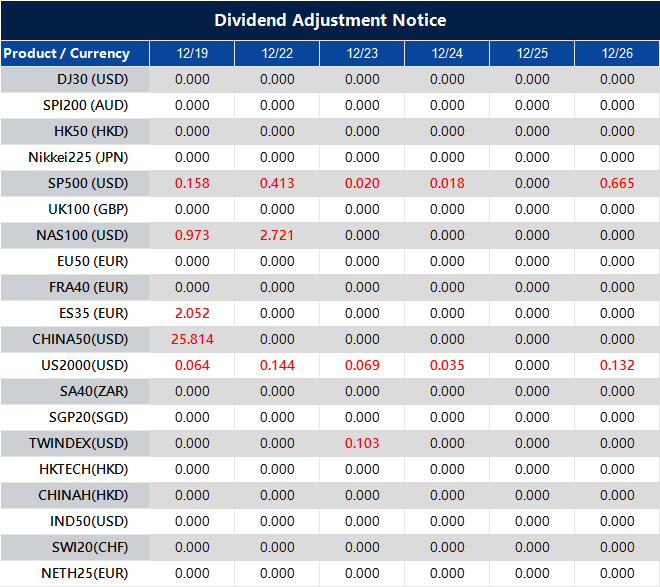
The above data is for reference only, please refer to the MT4/MT5 software for specific data.
If you’d like more information, please don’t hesitate to contact [email protected].
EUR/GBP remains stable near 0.8750 after the Bank of England lowers rates and the ECB maintains policy stability
The EUR/GBP remains close to 0.8750 as the Bank of England (BoE) lowers rates while the European Central Bank (ECB) keeps theirs steady. The BoE’s rate cut of 25 basis points brings the main interest rate down to 3.75%. This move aligns with market expectations after UK inflation decreased recently. Analysts predict another rate cut might happen in early 2026 due to economic trends.
On the other hand, the ECB’s decision to maintain its policy rate meets market expectations. ECB President Christine Lagarde stated that rates will stay unchanged for a long time. Their latest forecast shows stronger economic growth, with inflation expected to reach 2% by 2028, after remaining below this level for the next two years.







