



Micron Technology’s stock rises 13% in a record quarter, despite challenges facing AI stocks
Micron Technology reported strong earnings for the first quarter of its fiscal year, causing its stock price to jump by 13%. So far this year, Micron’s stock has risen by 202%, even as many AI stocks have struggled. This growth is due to its solid valuation metrics, with low P/E and PEG ratios indicating further growth potential.
The company reported record revenue of $13.64 billion for the quarter ending November 27, up 56% from last year and surpassing expectations. Its net income reached $5.2 billion, reflecting a remarkable 175% year-over-year increase.
Micron’s gross margin increased to 56%, a rise from 38.4% last year. A significant driver of this growth was its cloud memory unit, which saw revenue skyrocket by 99% to $5.3 billion. This unit supplies AI memory chips to major companies like Microsoft, Amazon, and Google.
For the second fiscal quarter, Micron anticipates revenue of $18.7 billion, a 37% increase from Q1. The gross margin is expected to rise to 66%, with earnings projected at $8.19 per share. Micron credits its success to technological leadership, a wide range of products, and effective operations.
After the strong 13% increase in stock price following earnings, implied volatility in Micron options has likely dropped. This situation offers a cleaner opportunity for trades over the next few weeks without the high costs typical before earnings reports. It’s an excellent time to consider bullish trades based on the company’s impressive future outlook.
Given the expected 37% revenue growth next quarter, purchasing call options set to expire in February or March 2026 could be a smart move. This would allow time for the market to fully absorb the expected earnings potential indicated by the $8.19 EPS target. Longer-dated options help avoid rapid time decay and still capture the anticipated upward movement.
For those with a more cautious perspective, selling cash-secured puts at strike prices below the current market level is another appealing strategy. With a forward P/E of just 11, we believe there is solid support for Micron’s valuation, making it a strong trade for collecting premium. Alternatively, a bull call spread can limit risks while still taking advantage of the clear upward trend.
Recent industry data support this positive outlook, showing that the high-bandwidth memory (HBM) market is projected to grow by over 150% by 2026. Data center construction, crucial for cloud memory, is also on the rise, with spending increasing nearly 20% year-over-year, according to the latest reports from November 2025. This reinforces that the demand Micron is experiencing is part of a larger, sustainable trend.
We have seen similar cycles before, especially during the semiconductor boom of 2020-2021, when strong demand led to significant and sustained stock price increases. While the semiconductor index (SOX) has risen by 65% this year, Micron’s 202% increase clearly sets it apart as a leader. History shows that leaders often continue to outperform their peers for several quarters.
As we approach the end of the year, trading volume may decrease during the holidays, potentially leading to price stability or a gradual upward trend. This environment is suited for strategies that profit from time decay, such as selling puts or covered calls. However, given the strong growth forecast, caution is advised against limiting upside potential with covered calls unless the premium is exceptionally appealing.
During early European trading, the Euro strengthens, pushing EUR/CAD near 1.6160 ahead of ECB speeches.
EUR/CAD has climbed to around 1.6160 as the Euro gains strength. This increase follows the European Central Bank’s decision to keep interest rates steady, highlighting a data-focused approach for the future.
In the early European trading session on Friday, the EUR/CAD pair neared 1.6160, buoyed by the Euro’s rally. Traders are looking for insights from European Central Bank officials to gauge future interest rate changes.
Economic Forecasts
On Thursday, the ECB confirmed its Deposit Facility Rate at 2% due to uncertainties around inflation. GDP growth forecasts have risen to 1.4% for this year and 1.2% for 2026, driven by anticipated investments. The Canadian Dollar has stabilized after recent gains, with expectations that the Bank of Canada will not cut interest rates soon. This decision is influenced by inflation near the 2% target and improving job market conditions. The Bank of Canada kept rates at 2.25%, noting that economic slack should help ease trade-cost pressures. The spotlight now turns to the Canadian Retail Sales data for October, set to be released at 13:30 GMT, which is expected to show no change after a 0.7% decline in September. Retail Sales, reported monthly by Statistics Canada, reflect the total value of goods sold by retailers. Changes in these sales figures can indicate consumer spending trends across Canada.Potential Market Impact
As EUR/CAD approaches 1.6160, we’re seeing levels not consistently reached since 2020. This high position suggests that while the Euro is strong, the pair may react sharply to any shifts in central bank sentiment. Traders in derivatives should be wary of a possible reversal from these multi-year peaks. The European Central Bank is holding its rate at 2.0%, and today’s remarks from its officials will be closely monitored for any hawkish signals. With the Eurozone’s Harmonised Index of Consumer Prices for November 2025 at 2.3%, slightly over the target, any commentary suggesting persistent inflation could strengthen the Euro further. This makes near-term call options on the Euro an attractive strategy to potentially capitalize on upside movement. Conversely, the Bank of Canada remains steady at 2.25%, backed by an inflation rate around 2.5% and a healthy labor market, as shown by the November 2025 jobs report with unemployment at 5.5%. This robustness in the Canadian economy has prevented the BoC from indicating any cuts to rates, resulting in a narrow interest rate gap between the two currencies, making data releases very impactful. The immediate focus will be on the Canadian Retail Sales data for October 2025, expected to show no growth. If the actual figures turn out negative, indicating a slowdown in consumer spending, we could see the Canadian Dollar weaken, pushing EUR/CAD above the 1.6200 level. Traders may opt for options strategies like straddles to take advantage of the expected volatility around this data release, regardless of the direction. Create your live VT Markets account and start trading now.Consumer confidence in the Netherlands is at -21 for December.
Consumer confidence in the Netherlands hit -21 in December, signaling worries about the economy. This figure highlights how consumers feel about economic conditions.
The US Dollar Index rose above 98.50 ahead of the University of Michigan survey data. At the same time, the NZD/USD pair fell close to 0.5750, despite positive GDP numbers for New Zealand not helping the Kiwi dollar.
GBP/JPY Hits New Highs
The GBP/JPY pair reached new highs above 209.00 due to strong upward momentum. In contrast, UK retail sales dropped by 0.1% in November, while a 0.4% increase was expected. The Japanese Yen continues to weaken after comments from Bank of Japan Governor Ueda. Meanwhile, the EUR/USD pair dipped towards 1.1700 as demand for the US dollar increased. The GBP/USD remains steady below 1.3400 as traders digest updates from the Bank of England and recent US inflation data. Gold prices have remained low, trading below $4,350, even with mixed US CPI data suggesting cooling inflation pressures. Bitcoin, Ethereum, and Ripple are seeing ongoing corrections, influenced by the Bank of Japan’s recent rate decision affecting market sentiment. The Bank of England’s recent rate cut to 3.75% shows a hawkish approach, slightly supporting the sterling. The growing issues with Ethereum are prompting the EF to propose various solutions to address potential centralization risks.Dutch Consumer Confidence and Eurozone Weakness
The Dutch consumer confidence figure of -21 for December highlights a troubling trend in the Eurozone. We’ve seen similar weakness in recent data, like the November S&P Global Eurozone Composite PMI, which showed a contraction at 48.2. This suggests any rallies in European equities may be brief, making put options on indices like the Euro Stoxx 50 a smart hedging strategy in the coming weeks. This weakness in Europe contrasts with the more stable US economy, driving the US Dollar Index above 98.50. The November Non-Farm Payrolls report showed a solid gain of 195,000 jobs, supporting the Federal Reserve’s decision to keep rates steady while others are cutting. We believe that trading USD call options or bull call spreads is a clear strategy to position for continued dollar strength against weaker currencies. The impact of this divide is evident in the EUR/USD pair, which is moving closer to 1.1700. Given the ongoing negative sentiment from Europe, we see this as the easiest path going into the new year. Traders may consider buying put options on the Euro to profit from possible declines. Meanwhile, the GBP/JPY reaching fresh highs above 209.00 reflects interest rate differences rather than UK economic strength. With the Bank of England’s rate at 3.75% after its recent cut and the Bank of Japan’s rate still near zero, traders are borrowing cheap Yen to invest in higher-yielding Sterling. However, this crowded trade is vulnerable, so we recommend using long-dated call options to maintain exposure while limiting potential losses. The decline in cryptocurrencies, alongside a hawkish stance from the Bank of Japan, suggests a broader risk-averse mood in the market. As we near the end of the year, a time known for thin liquidity, this nervousness could lead to increased volatility. We believe buying VIX futures or call options is a wise way to protect portfolios from sudden market changes. Create your live VT Markets account and start trading now.Notification of Server Upgrade – Dec 19 ,2025
Dear Client,
As part of our commitment to provide the most reliable service to our clients, there will be maintenance this weekend.
Maintenance Details:

Please note that the following aspects might be affected during the maintenance:
1. The price quote and trading management will be temporarily disabled during the maintenance. You will not be able to open new positions, close open positions, or make any adjustments to the trades.
2. There might be a gap between the original price and the price after maintenance. The gaps between Pending Orders, Stop Loss, and Take Profit will be filled at the market price once the maintenance is completed. It is suggested that you manage the account properly.
3. During the maintenance period, VT Markets APP will not be available. It is recommended that you avoid using it during the maintenance.
The above data is for reference only. Please refer to the MT4/MT5 software for the specific maintenance completion and marketing opening time.
Thank you for your patience and understanding about this important initiative.
If you’d like more information, please don’t hesitate to contact [email protected]
Nikkei Jumps Following BOJ Rate Increase
The Bank of Japan lifted its policy rate to 0.75% on Friday, marking a decisive step away from its long-standing ultra-accommodative stance.
Although the move had been largely priced in, markets interpreted the hike as a vote of confidence in Japan’s economic momentum, particularly with core inflation steady at 3.0% and export data beating expectations.
In a somewhat counterintuitive response, the yen softened slightly after the announcement. Attention instead shifted to Governor Kazuo Ueda’s remarks, which suggested the eventual terminal rate could fall anywhere between 1.0% and 2.5%.
This guidance has prompted investors to reconsider the outlook for policy tightening, with growing speculation that the BOJ may deliver more than a single rate increase in 2026.
Technology Shares Drive Nikkei Gains
Friday’s rally was led by technology names, with chip equipment maker Advantest climbing 1.59% and robotics specialist Fanuc rising 2.68%. The move tracked ongoing strength in the Nasdaq, which continues to benefit from AI-related optimism and easing US inflation pressures.
A surprise drop in US core CPI to 2.7% further boosted global risk appetite, even as Federal Reserve officials maintained a cautious tone on the timing and pace of rate cuts.
Positive sentiment across the global tech sector also lifted Asian markets more broadly. Equity indices in Taiwan and South Korea both advanced by more than 1%, while Japan’s Topix index edged 0.05% higher.
Technical Analysis
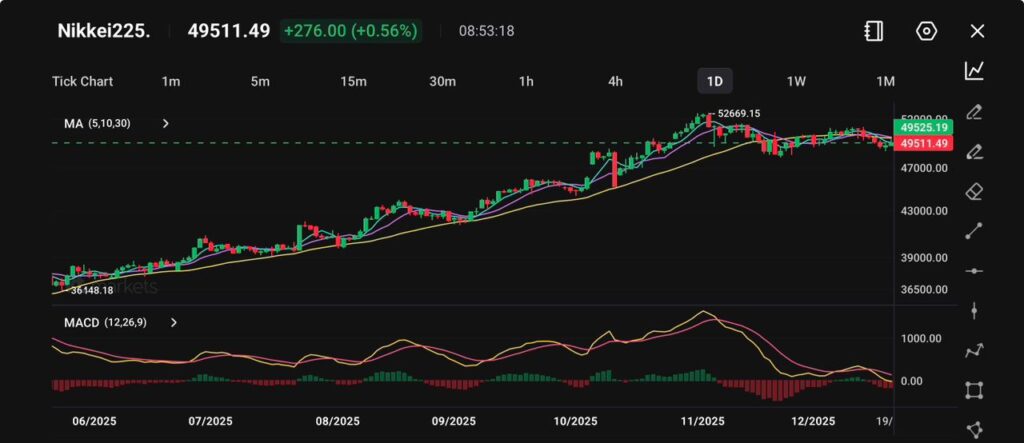
The Nikkei 225 is consolidating around 49,511, up 0.56% on the session. Despite a loss of momentum since peaking at 52,669 in November, the broader bullish structure remains intact.
Prices continue to trade comfortably above longer-term support levels, while the 30-day moving average is still sloping higher, indicating that buyers remain in control of the trend.
However, the MACD is showing early signs of bearish divergence, with weakening histogram bars and the MACD line slipping below its signal line.
The index has largely moved sideways throughout December, and a decisive break above the 50,000 mark may be required to reignite upside momentum.
On the downside, a sustained move below the 47,000–46,500 zone could open the door to a deeper correction into early 2026. For now, traders are likely to remain patient as the market tests the boundaries of its current range.
Bottom Line
What was once viewed as a potential headwind, a BOJ rate hike, is now being interpreted as a signal of orderly policy normalisation rather than economic stress.
With technology stocks providing strong leadership and the Nasdaq offering supportive global cues, the Nikkei appears well placed heading into year-end, particularly if the BOJ’s tightening cycle remains measured.
US Dollar Index remains strong around 98.55 despite easing inflation data in morning sessions
The US Dollar Index (DXY) is on the rise, reaching about 98.55 during early European trading on a Friday. This increase happens even though the US inflation rate, shown by the Consumer Price Index (CPI), was weaker than expected at 2.7% in November, falling short of the predicted 3.1%.
The USD is gaining strength in a cautious market. However, this upward movement might hit obstacles due to anticipated interest rate cuts by the Federal Reserve (Fed) in 2026, considering a slowing US labor market and low inflation.
Talk of Interest Rate Cuts
There’s growing speculation that the US central bank might lower interest rates sooner, which could affect the value of the US dollar. Currently, financial forecasts suggest only a 26.6% chance of a rate cut at the Fed’s next meeting in January. The US Dollar is a dominant currency worldwide, making up over 88% of international foreign exchange transactions. Fed decisions heavily impact the dollar’s value, with interest rate changes being a key way to manage monetary policy. The Fed also uses quantitative easing and tightening to support or lessen the dollar’s strength in different economic situations. We should view the dollar’s rise to 98.55 as a short-term event, likely influenced by year-end caution, rather than a shift in overall trends. The broader picture shows cooling inflation, which has been the main topic since the aggressive rate hikes of 2023-2024. This temporary strength might provide a good opportunity for positioning against renewed dollar weakness in the weeks ahead. The November inflation rate of 2.7% is a considerable drop from over 9% in mid-2022, showing that the Fed’s move towards cutting rates is warranted. With three rate cuts already in 2025, traders could consider strategies benefiting from a weaker dollar, such as buying put options on the US Dollar Index or selling dollar futures contracts set to expire in early 2026.Currency Market Opportunities
This situation makes currencies like the Euro and British Pound appealing compared to the dollar. Looking back at late 2023, when expectations of Fed rate cuts for 2024 caused a similar exodus from the dollar into other major currencies, we see an opportunity. Using call options on EUR/USD or GBP/USD may effectively capitalize on their potential strength as we enter the new year. The market currently assigns only a 26.6% chance of a rate cut in January, which seems low given the weak inflation and labor market figures. This could mean traders are undervaluing the likelihood of the Fed acting quickly to support the economy, presenting an opportunity to position for a surprise that might hasten the dollar’s decline. Create your live VT Markets account and start trading now.USD/CHF improves to 0.7950 as the US Dollar recovers before consumer sentiment data
USD/CHF is trading around 0.7950, recovering from losses earlier. The US Dollar is gaining strength as we await the release of the University of Michigan Consumer Sentiment Index. Recent US inflation data from November hints at possible Federal Reserve rate cuts, which could limit the Dollar’s rise.
In November, the US Consumer Price Index (CPI) fell to 2.7%, lower than the expected 3.1%. Meanwhile, the core CPI increased by 2.6%, the slowest growth since 2021. President Trump expressed a desire for a Federal Reserve Chair who supports lower interest rates.
Switzerland reported a trade surplus of CHF 3,841 million in November. Exports rose by 1.6% from the previous month, while imports dropped by 0.8%, primarily due to decreased purchases of chemicals and pharmaceuticals. The Swiss National Bank is unlikely to reintroduce negative interest rates, as this could negatively affect savers.
Swiss Franc and the Global Market
The Swiss Franc (CHF) is among the top ten traded currencies in the world and is viewed as a safe haven during market uncertainties, thanks to Switzerland’s stable economy. The Swiss National Bank meets every quarter and aims to keep inflation below 2%. Higher interest rates can boost the CHF, while economic data from Switzerland and the Eurozone impacts its value. Switzerland’s economy closely aligns with the Eurozone, with strong correlations between the Euro and Swiss Franc. Looking back to late last year, USD/CHF was near 0.7950, but a weaker US dollar has pushed it down. As of December 19, 2025, the rate is closer to 0.7700. This trend reflects the Federal Reserve’s actions this year, which included two 25-basis-point rate cuts due to slowing growth. The soft US inflation data from November 2024, with CPI at 2.7%, was an early indication of this shift. The US Core PCE, the Fed’s favored inflation measure, has been consistently under 2.5% for the last two quarters of 2025, confirming a lasting disinflationary trend and keeping pressure on the dollar. In contrast, the Swiss National Bank has maintained its policy rate throughout 2025, citing ongoing domestic inflation averaging 2.2% this year. The trade surplus from last November remains strong, with Swiss exports to the Eurozone increasing by 3% year-over-year, according to recent data. This difference in policy between a Fed that’s cutting rates and an SNB that’s holding steady should continue to support the Franc.Investment Strategies Amidst Currency Trends
For derivative traders, this situation suggests it’s smart to position for further declines in USD/CHF. Buying Swiss Franc (CHF) call options or US Dollar (USD) put options with expiration dates in the first quarter of 2026 appears to offer a beneficial risk-reward ratio, allowing traders to take advantage of the expected trend. We should remember the market chaos when the SNB unexpectedly removed the euro peg in 2015. With one-month implied volatility for USD/CHF near multi-year lows of 4.5%, option premiums are currently low for hedging against sudden policy changes. A long straddle or strangle could be a wise choice to safeguard against unexpected movements during the next SNB meeting in March 2026. The Swiss Franc’s status as a safe haven has been significant this year, particularly with rising trade tensions in Asia and uncertainty ahead of next year’s French elections. These global risks reinforce the value of the Franc, regardless of central bank decisions. We believe these factors support a long position in CHF against USD in the weeks ahead. Create your live VT Markets account and start trading now.WTI oil price drops to about $55.80 per barrel as peace deal hopes struggle
WTI Oil is under pressure, now trading at about $55.80 per barrel. Hopes for a peace deal between Russia and Ukraine are influencing prices. US President Trump has indicated that talks are moving forward, which could affect Oil supply and demand.
There is still uncertainty regarding the US promise to block tankers from Venezuela, which accounts for 1% of the world’s Oil supply. Recently, the US Coast Guard seized a Venezuelan Oil tanker, while Venezuela allowed crude carriers to go to China, highlighting tensions in Oil exports.
Sanctions And Energy Supply Dynamics
The US is thinking about stricter sanctions on Russia’s energy sector to support peace efforts. These potential restrictions might risk supply. Despite this, Oil prices have dropped to a five-year low. This decline is due to OPEC+ increasing production and signs of weaker demand in China and the US. WTI Oil is a high-quality Crude oil that serves as a key market benchmark, mainly sourced from the US. Its price is influenced by global growth, political situations, the value of the US Dollar, and decisions made by OPEC. Inventory reports from API and EIA also play a role, with EIA being more reliable. OPEC’s production quotas greatly impact WTI Oil prices, affecting global supply and demand. The market is currently on edge as WTI crude stays below $56 a barrel. Upcoming talks between the US and Russia could be crucial, creating significant risk for prices next week. This uncertainty has led to an increase in implied volatility on short-term options contracts, indicating traders expect large price movements in either direction. A successful outcome from the peace talks could push prices below key support levels, potentially sending them down to the $50 mark—a level not seen since early 2021. Traders expecting this could consider buying put options or setting up bear call spreads to profit from a price drop. With prices already down nearly 20% this year, a diplomatic breakthrough is the main factor that could trigger another decline.Potential Impacts Of Diplomatic Talks
On the other hand, if the talks do not succeed, the market will likely focus again on tightening supply due to sanctions on Venezuela and Russia. The latest report from the Energy Information Administration (EIA) showed an unexpected draw of 2.1 million barrels, indicating demand might be stronger than current sentiment suggests. If diplomacy fails, WTI could quickly rise back to the $60 to $62 range due to renewed supply concerns. It’s important to consider the OPEC+ factor, as prices below $60 per barrel will raise concerns among member countries. Historically, when faced with similar price situations, OPEC+ has responded by signaling or implementing production cuts to support the market. Watch for statements from key OPEC+ members in the coming days, as they could act as a bullish signal. The overall demand situation remains fragile, limiting any potential price increases. For example, China’s latest Caixin Manufacturing PMI at 49.8 points to a slight contraction, which dampens hopes for future energy consumption. Until we see strong signs of economic recovery from major consumers, any price spikes driven by supply may be temporary. Create your live VT Markets account and start trading now.The Bank of Japan’s interest rate decision matches the expected figure of 0.75%
The Bank of Japan (BoJ) has decided to keep its interest rate at 0.75%, a choice that was expected by the market. This move is part of ongoing talks regarding Japan’s monetary policy and its economy.
Interest rate decisions are crucial for the economy and can affect currency values. Analysts closely examine these choices to better understand the central bank’s views on inflation, growth, and future policies.
Central Bank Statements and Global Impact
Now, everyone will be looking for comments from BoJ officials about future economic conditions and potential policy changes. Market participants are eager for hints about any shifts in policy. Decisions made by central banks don’t just influence local markets; they can have a significant effect on global financial systems. Following this decision, we may see more activity and fluctuations in forex and stock markets, especially with currency pairs that include the Japanese yen. Traders are expected to adapt their strategies based on the BoJ’s choices. With the Bank of Japan holding the rate at 0.75%, it signals a cautious stability for now. This decision was widely predicted, so there should be little immediate market shock. In the upcoming weeks, our focus will shift from the decision to the nuanced language that BoJ officials will use in their press conferences. The main focus for currency traders continues to be the large interest rate gap between Japan and the United States, where the Federal Reserve’s rate stands at 3.5%. This difference has kept the yen weak, with the USD/JPY exchange rate close to 158 for much of the fourth quarter of 2025. We believe traders will keep using options to hedge against any major yen strengthening in the short term.Market Conditions and Strategic Implications
While the current policy remains stable, it creates tension underneath, offering opportunities for volatility traders. Japan’s recent core inflation rate is at 2.8%, still above the BoJ’s 2% target. This indicates that the central bank may not be able to keep rates this low forever, making financial strategies like straddles on the yen more appealing as we approach early 2026. In the equity markets, a weak yen benefits Japan’s exporters, helping the Nikkei 225 index stay strong above the 42,000 mark. We expect traders to use Nikkei futures to keep a long position on Japanese stocks, assuming the BoJ won’t announce an unexpected rate hike before its next meeting. Looking back, we saw similar periods of yen weakness in 2023 and 2024, followed by policy changes that triggered sharp market corrections. Therefore, traders should think about using derivatives to protect their investments. Buying far out-of-the-money put options on the USD/JPY could offer cheap insurance against a sudden change in the BoJ’s policies. Create your live VT Markets account and start trading now.The currency pair is trading around 1.3780 and remains subdued amid expectations of a Fed rate cut.
USD/CAD stays below 1.3800 as expectations grow for US Federal Reserve rate cuts, thanks to softer CPI data from November. The pair trades around 1.3780 during Asian hours, as the US Dollar faces challenges. November’s US Consumer Price Index dropped to 2.7%, lower than the expected 3.1%. The core CPI is at 2.6%, marking the slowest rise since 2021.
US President Trump suggests that the next Federal Reserve Chair will support lower interest rates. Meanwhile, Canada’s retail sales showed no change, remaining flat at 0% for October. The Bank of Canada has held interest rates steady at 2.25%, noting that inflation is close to target levels.







