Renewed Rush to Safety as Economic Data Disappoints: Is a Recession Imminent?

Following the release of weaker-than-expected economic data, Wall Street experienced a renewed rush to safety, with bonds surging and equities plummeting. This has rekindled concerns that a recession may be looming, sending shockwaves across the financial markets.

The 10-year Treasury yield tumbled to its lowest point since September, now standing at around 1.5 percentage points below the three-month Treasury bill rate. This widening gap between short-term and long-term yields indicates an impending economic slowdown, which investors are now anticipating.

In response to this uncertain economic climate, investors have shifted their focus to safer investments such as the dollar and the Japanese yen. Gold prices have also soared to a 13-month high, as investors seek a safe haven asset amid the market turbulence.

Several economic indicators have fueled concerns about a potential downturn, including the recent decline in the Institute for Supply Management’s index and the ISM factory survey showing further deterioration. These reports have highlighted the tightening of credit conditions and persistently high interest rates, which could further exacerbate the economic slowdown.

The S&P500 and Nasdaq 100 have both taken a hit, with Consumer Discretionary performing the worst among all groups, dropping by 2.04%. In contrast, the Dow Jones Industrial Average edged higher, but the MSCI world index fell on Wednesday.

As we navigate through these turbulent economic times, it remains uncertain whether a recession is imminent. However, the recent market volatility and economic indicators suggest that we may be headed towards a downturn. As investors seek safe havens, it’s critical to keep a watchful eye on the markets and make informed investment decisions based on the available information.

Technical Analysis

XAUUSD (4-Hour Chart)

Gold prices surged to a new multi-month high of $2,032.03 per ounce on Wednesday before experiencing a downward correction. Despite some profit-taking among traders ahead of the long Easter holiday, the XAU/USD remains steady at around $2,020 and holding onto most of its weekly gains. The weak performance of the US Dollar persists due to lackluster economic data. Though disappointing figures typically prompt risk aversion and boost the Greenback, the focus now is on the US Federal Reserve’s plan to pause rate hikes, which makes the USD less appealing in the long run.

The US recently released the ISM Services PMI, which unexpectedly fell to 51.2 in March from 55.1 in February. The ADP survey on private job creation also revealed a modest gain of 145K in March, missing expectations of 200K and lower than the previous 261K. At the time of typing, price trading at 2020.73 and RSI sits at 67.31.

Examining the 4-hour chart, XAU/USD has lost its bullish momentum, but there are no clear indications of bearishness. Although technical indicators have rotated lower, their downward strength is limited as they are still in overbought territory. Lastly, Gold prices remain well above the bullish moving averages, with the 20 SMA serving as dynamic support at approximately $1,991.20 in the short term.

Resistance: 2,024.90 2,037.85 2,050.00

Support: 2,009.70 1,991.20 1,982.10

Stock Market Rally Ends as Banks Experience Selloff

The stock market’s four-day rally came to a halt as banks experienced a selloff, which pulled down the Dow Jones Industrial Average by 0.6% and the S&P500 by 0.58% on Tuesday. This sudden dip in the market was mainly caused by a drop in major financial institutions such as Wells Fargo & Co. and Citigroup Inc., whose gauge fell by 2%. Even regional lenders like First Republic Bank and Zions Bancorporation didn’t fare well, declining by at least 4.8%.

In contrast to the banks, Treasury prices climbed higher as softer data on job openings led to increased bets that the Federal Reserve may soon conclude its tightening campaign. According to the Labor Department’s Job Openings and Labor Turnover Survey (JOLTS), vacancies at US employers decreased to the lowest level since May 2021. This news caused yields on two-year Treasury notes to fall by 14 basis points to approximately 3.8%. Swap contracts referencing Fed meeting dates lowered the odds of a quarter-point rate hike in May to just under 50%, down from about 60%.

In his annual letter to shareholders, JPMorgan Chase & Co.’s CEO Jamie Dimon warned that the effects of the recent US banking crisis, which caused market turbulence last month, will be felt for years. This gloomy forecast could be one of the reasons why investors chose to sell off bank shares. However, this doesn’t necessarily mean that the overall market will continue to decline in the long run.

Seven out of eleven sectors in S&P500 stayed in the negative territory, as four sectors dropped more than 1% on Tuesday, and Industrials tumbled with 2.25% for the day. This could be due to the news of the banking crisis, as well as other economic uncertainties. Meanwhile, the Nasdaq 100 fell 0.4%, and MSCI world index edged lower with a 0.2% loss on Tuesday.

Main Pairs Movement

On Tuesday, the value of the U.S. dollar dropped to its lowest point in two months due to disappointing economic data. This has led to speculation that the Federal Reserve may be close to the end of its efforts to tighten the economy. Meanwhile, other central banks are expected to raise interest rates to address inflationary pressures.

The DXY index fell below 101.5 after the release of weak JOLTs (Job Openings and Labor Turnover Survey) and Factory Orders data for February. As a result, the EURUSD pair rose by 0.50% and reached a daily high of 1.0973. The GBPUSD pair also climbed to its highest level since June, closing with a 0.70% gain for the day.

Gold prices saw a significant increase, rising by 1.80% on Tuesday due to the weakness of the U.S. dollar. The XAU/USD pair continued to rise following the release of poor U.S. macroeconomic data and eased concerns about central banks resuming aggressive monetary tightening. The pair increased by almost 1.9% during the first half of the American trading session and closed at $2020 on Tuesday.

Technical Analysis

EURUSD (4-Hour Chart)

Recent data from the United States has raised concerns about the labor market, as job openings reported in the JOLTs report dropped by 32,000 in February. This, along with the second consecutive month of declining Factory Orders, may indicate a cooling labor market. More data will be revealed later in the week with ADP Employment figures, Initial Jobless Claims, and the US Nonfarm Payrolls report. Investors are now expecting a possible pause in the tightening cycle of the US Fed at its May 2-3 meeting, with a 57% probability of a Fed pause.

Chart EURUSD by TradingView

The EUR/USD pair has risen above 1.0900 for the second consecutive day, reaching a daily high of 1.0973, supported by broad US Dollar weakness. The pair shows a triple bottom pattern on the daily chart, indicating a potential upward trend with a target of 1.1000. The next resistance levels to watch are 1.0973, 1.1000, and the year-to-date high at 1.1033. On the downside, support levels are at 1.0900 and the 20-day EMA at 1.0788. The EUR/USD pair remains bullish with further upside potential.

Resistance levels: 1.1000, 1.1034

Support levels: 1.0900, 1.0788

XAUUSD (4-Hour Chart)

As of Tuesday’s European session, the price of gold is experiencing slight losses at around $1,980, consolidating the losses from the beginning of the week. The precious metal has been negatively affected by the recent strengthening of the US Dollar and a pessimistic geopolitical headline during a sluggish Asian session. However, the price rallied earlier in the day and touched its highest level in over a year above $2,025 after the release of disappointing US Factory Orders and US JOLTS Job Openings in February. The US Dollar Index is experiencing slight gains around 102.20 after a significant fall on Monday, the largest since March 22. Looking ahead, Gold traders may be interested in the US Factory Orders for February, which are expected to be -0.5% compared to -1.6% previously.

Chart XAUUSD by TradingView

The recent drop in Gold prices from a descending resistance line, hovering around $1,990, could result in further decline towards the $1,968 level. If the price falls below this level, it could reach $1,930 and $1,900. However, a rise above $1,990 is necessary to confirm the buyers’ control. Although the $2,000 level and an upward-sloping resistance line at $2,027 could be a significant challenge for the Gold bulls. Nonetheless, Gold prices are expected to stay stable in the long run, but a short-term pullback cannot be dismissed. The RSI sits at 67.

Resistance: 1996, 2027, 2050

Support: 1960, 1950, 1937

Economic Data

CurrencyDataTime (GMT + 8)Forecast
NZDRBNZ Interest Rate Decision10:005.00%
NZDRBNZ Rate Statement10:00 
GBPComposite PMI (Mar)16:3052.2
GBPServices PMI (Mar)16:3052.8
USDADP Nonfarm Employment Change (Mar)20:15200K
USDISM Non-Manufacturing PMI (Mar)22:0054.5
USDCrude Oil Inventories22:30-1.800M

VT Markets announces charting partnership with TradingView

Sydney, Australia, April 3, 2023 – VT Markets, a global multi-asset broker, has announced its partnership with TradingView, the world’s leading provider of charting and analytical tools with over 50 million users.

The combination of VT Markets’ expertise in the financial industry along with TradingView‘s cutting-edge technological tools ensures that traders have access to the best resources available when making crucial trading decisions. Through this partnership, VT Markets’ clients will be able to benefit from TradingView’s comprehensive market research data and advanced financial visualisation tools. Additionally, TradingView provides a multitude of expert tools for traders, such as multiple chart types, customisable technical indicators, drawing tools, and live market updates.

A wide range of assets, such as Forex, Stocks and CFDs, now can be seamlessly traded on TradingView charts without leaving the VT Markets platform. This integration will allow users to conduct top technical analysis for better investment strategies and enjoy an enhanced trading experience.

A representative of VT Markets said, “We’re delighted to be partnering with TradingView. As a technology-driven broker, we’re always looking for ways to simplify our clients’ trading experience while maximising their trading results. This collaboration further strengthens our commitment towards providing them with access to innovative technologies and premium services that enable them to stay ahead of the market”.

About the Company:

VT Markets is a regulated multi-asset broker with a presence in over 160 countries. The broker has won many international accolades including Best Customer Service and Fastest Growing Broker. Their mission is to make trading an easy, accessible, and seamless experience for everyone.

Website: www.vtmarketsmy.com    

For more information, please contact [email protected] 

Follow them at 

Follow TradingView on social:

Twitter: https://twitter.com/tradingview

Instagram: https://www.instagram.com/tradingview/

Treasury Prices Rise as Factory Activity Gauge Contracts More Than Expected

Treasury prices climbed higher on Monday as a US factory activity gauge contracted more than expected. This news tempered concerns about inflation that were fueled by OPEC+’s surprise decision to cut oil production. Let’s take a closer look at what happened.

In March, the Institute for Supply Management’s gauge of manufacturing activity dropped to 46.3. This was below the median estimate of 47.5 in a Bloomberg survey of economists. Any readings below 50 indicate a contraction, and both measures of new orders and employment decreased. As a result, two-year yields, which are sensitive to policy changes, reversed course after earlier climbing by as much as 11 basis points.

On Friday, the government will release its monthly employment report. This report will provide a more complete picture of the job market. It will be interesting to see how this report affects Treasury prices in the coming days.

Swaps linked to expectations of interest rates from the Federal Reserve indicated that a quarter-point hike in May was more likely than not. This news could also impact Treasury prices in the future.

In the benchmark, energy shares led gains in the S&P 500, with US crude hitting $80 a barrel. Seven out of eleven sectors in the S&P 500 stayed in the positive territory, as energy surged with 4.91% daily gain on Monday.

The Nasdaq 100 underperformed major benchmarks as Tesla Inc. sank on data showing its price cuts barely boosted deliveries. This news is noteworthy, as Tesla is often seen as a bellwether for the tech industry.

Main Pairs Movement

On Monday, the US Dollar experienced a 0.44% decline as investors anticipated a less aggressive stance from the Federal Reserve. The DXY index saw significant selling activity throughout the day, dropping below 102 during the start of the American trading session.

In contrast, the EURUSD pair saw a 0.55% increase in value, with the market mood improving during London’s trading session. The pair continued to rise and surpassed the 1.0900 level during the New York trading session. Similarly, the GBPUSD pair also gained strength following the start of the UK trading hour.

Gold prices rose by 0.78% as the Greenback weakened further after the release of disappointing US economic data. XAUUSD reached a daily high of $1990 before entering a consolidation phase and hovering in a narrow range between $1980 and $1986.

Technical Analysis

EURUSD (4-Hour Chart)

Last Friday, the EUR/USD closed at 1.0836, falling by 0.57% on the daily price range. However, demand for the US Dollar decreased after the opening of London’s trading session on Monday, leading to a recovery of the EUR/USD pair above the 1.07800 threshold, which is the lowest in a week. The pair is currently trading near a daily high of 1.09100 at 1.08891.

US Treasury yields increased ahead of Wall Street’s open, with the 10-year note currently yielding 3.50% and the 2-year note yielding 4.08%. S&P Global released the final estimates of the March Manufacturing PMIs for the Eurozone, with the German figure upwardly revised to 44.7 and the EU figure improving from the preliminary estimate from 47.1 to 47.3. The US official ISM Manufacturing PMIs is 46.3 lower than the forecasted 47.5, leading the Cable up to the daily high of 1.09166.

The 4-hour chart shows that buyers are struggling to regain control. Technical indicators changed course after nearing oversold readings and currently head north above their midlines, but with limited strength. The 100 SMA maintains its bullish slope below the aforementioned daily low, while the EUR/USD pair struggles to overcome a directionless 20 SMA. If the pair breaks through the immediate resistance level of 1.0910, buyers could have better chances. The RSI sits at 63.34.

Resistance levels: 1.0910 1.0950 1.1000

Support levels: 1.0830 1.0790 1.0750

XAUUSD (4-Hour Chart)

On Monday, the price of gold initially fell to around $1,955, but later rebounded and climbed above $1,980. This was due in part to the benchmark 10-year US Treasury bond yield dropping below 3.5% following the release of a negative US ISM Manufacturing PMI report, which helped XAU/USD gather bullish momentum. However, the metal’s gains were limited by concerns that China and Brazil may drop the US Dollar for cross-border trade. At the time of writing, the price of gold was trading at $1985.30.

On the technical side, the bears for gold are hopeful due to the bearish MACD signals and the clear downside break of a two-week-old ascending trend line. The sustained trading below the 200-HMA and 100-HMA confluence also favors the bears. However, the latest recovery remains uncertain unless the quote crosses the $1,960 support-turned-resistance line. Even if it does cross this line, the HMA convergence near $1,970 poses a challenge for the XAU/USD bulls. Furthermore, a downward-sloping resistance line from March 20, currently near $1,987, restricts the short-term upside of the Gold price. RSI sits at 58.12.

Resistance: 1990, 2000

Support: 1957, 1950, 1937

Economic Data

CurrencyDataTime (GMT + 8)Forecast
INRHoliday – Mahavir JayantiAll dayN/A
AUDRBA Interest Rate Decision (Apr)12:303.60%
AUDRBA Rate Statement12:30N/A
USDJOLTs Job Openings (Feb)22:0010.400M

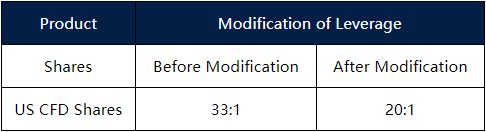
Modifications on US CFD Shares – April 04, 2023

Dear Client,

To provide a favorable trading environment to our clients, VT Markets will modify the trading setting of US Shares on April 10, 2023:

The above data is for reference only, please refer to the MT4/MT5 software for specific data.

Friendly reminders:

All specifications of US Shares stay the same except leverage

If you’d like more information, please don’t hesitate to contact [email protected].

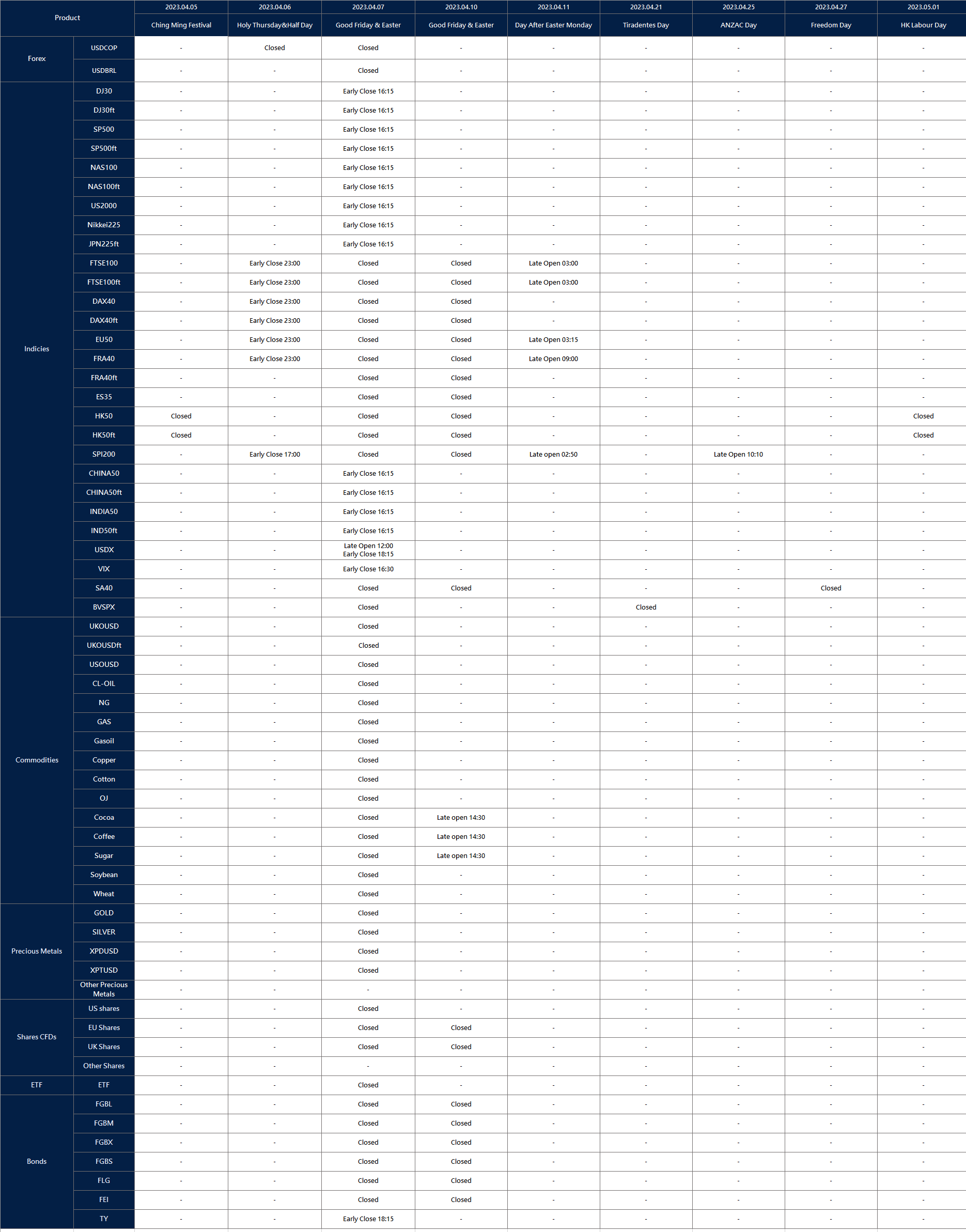
Changes in trading hours for upcoming holidays – April 03, 2023

Dear Client,

Please note that the following instruments’ trading hours will be affected by the upcoming holidays.

Note: The dash sign (-) indicates normal trading hours.

The above data is for reference only, please refer to the MT4/MT5 software for specific data.

If you’d like more information, please don’t hesitate to contact [email protected].

US Technology Shares Rally as Inflation Concerns Ease

US technology shares have continued to rally this week as concerns over inflation have eased following a modest increase in the Fed’s preferred measure of inflation in February. The rise in tech shares coincided with a rise in Treasury prices, which saw the two-year yield fall to around 4.05% while the 10-year maturity dipped to 3.48%. In addition, the US dollar gained strength against major currencies.

The personal consumption expenditures price index, which excludes food and energy, rose by 0.3% in February, slightly below the median estimate. However, the overall PCE price index rose by 5% from a year earlier, which is still above the Fed’s 2% target but down from January’s figures.

In the benchmark, the S&P 500 surged by 1.4% on the day, resulting in a weekly gain of 3.5%, the largest since November. The tech-heavy Nasdaq 100 also increased by 1.7%, enabling it to achieve its highest quarterly gain since June 2020.

All sectors in the S&P 500 stayed in positive territory, with Communication Services, Real Estate, and Consumer Discretionary getting the best performance among all groups, rallying by more than 2% on Friday.

Main Pairs Movement

On Friday, the US dollar strengthened due to slower growth in US consumer spending, leading to hopes that the Federal Reserve will not aggressively increase interest rates. The DXY index gained momentum after positive inflation data and closed at a daily high of 102.59.

Meanwhile, the EURUSD pair weakened and dropped below 1.0900 due to weaker Eurozone inflation numbers, while the US Core PCE Price Index was upbeat, putting pressure on the euro. The GBPUSD also slid by 0.4% on Friday, closing at 1.2329.

Despite the positive US PCE price index report, gold prices fell by 0.56% on Friday. The XAUUSD pair dropped sharply during the American trading session and closed at $1969 by the end of the day.

Technical Analysis

EURUSD (4-Hour Chart)

On Friday, the EUR/USD pair initially dropped to the 1.0870 area following the release of upbeat US Core Consumer inflation data, but later regained some traction and is currently trading at 1.0895 with a 0.08% daily loss. The pair remains in negative territory due to the overall strength of the US Dollar but has rebounded slightly as the greenback trimmed its intraday gains ahead of the US session.

In terms of economic data, the US Personal Consumption Expenditures (PCE) Price Index declined to 5% every year in February, and the annual Core PCE Price Index, which is the Federal Reserve’s preferred inflation gauge, also edged lower to 4.6%. This has fueled speculation that the Fed may pause its rate-hiking cycle in response to the recent turmoil in the banking sector, which has further boosted the US Dollar. Meanwhile, the Eurozone’s Harmonized Index of Consumer Prices (HICP) declined to 6.9% every year in March, but this data was largely ignored by investors.

From a technical perspective, the RSI indicator currently sits at 38, suggesting a loss of bullish momentum as it drops below the mid-line. The Bollinger Bands also indicate downside momentum, with the price falling toward the moving average, indicating that the downside trend may persist. In conclusion, as long as the 1.0874 resistance line holds, the market is likely to remain bearish. A four-hour close below 1.0800 could attract more sellers and push the pair lower to 1.0749.

Resistance: 1.0824, 1.0874

Support: 1.0780, 1.0748

XAUUSD (4-Hour Chart)

On Friday, the XAU/USD pair initially rose to a daily high of around 1,987 level after the release of lower-than-expected Core Personal Consumption Expenditure – Price Index (PCE) data from the US. However, during the US trading session, the pair retreated slightly and is currently trading at 1,976, indicating a 0.19% loss daily. The preliminary PCE price index data showed a slight decline to 4.6% YoY in February, indicating a slow fall in US consumer inflation and raising the possibility that the Fed will not take any action at its May meeting. However, the Fed officials’ statement that more work needs to be done to bring down inflation could act as a headwind for the precious metal Gold. The Fed Funds Future Curve, a market gauge of future Fed policy moves, is currently showing a 58% probability of a 0.25% hike in May versus a 42% probability of no change.

In terms of technical analysis, the RSI indicator is currently at 41, suggesting a bearish bias in the short-term outlook as the RSI is declining towards the mid-line. As for the Bollinger Bands, the price remained under selling pressure and moved lower, indicating the possibility of further downside movements. Overall, the market is expected to be slightly bearish as long as the resistance line at 1,999 holds. If the price move above this resistance level in the four-hour timeframe, it could pave the way for additional gains.

Resistance: 1975, 1988

Support: 1956, 1937

Economic Data

CurrencyDataTime (GMT + 8)Forecast
AUDRetail Sales (MoM)09:300.2%
CNYCaixin Manufacturing PMI (Mar)09:4551.7
EURGerman Manufacturing PMI (Mar)15:5544.4
GBPManufacturing PMI (Mar)16:3048.0
USDISM Manufacturing PMI (Mar)22:0047.5

Market Focus: All eyes on US Jobs Data and RBA Rate Statement

This week marks the start of the second quarter of 2023, and it’s lined up with some major economic events. Keep your eyes on news from the Reserve Bank of Australia and the Reserve Bank of New Zealand on their imminent interest rate announcements. Also, the eagerly-anticipated US jobs report is set to be released this week. It’s a big week all around, with headlines and developments that you won’t want to miss. 

Here are key events to watch out for:

Switzerland Consumer Price Index | 3 April 2023 

Switzerland CPI increased by 0.70% in February 2023 from the previous month.

For March, analysts expect the reading to increase by 0.5%.

US ISM Manufacturing PMI | 3 April 2023 

The US ISM Manufacturing PMI edged higher to 47.7 in February 2023 from 47.4 in January.

For March, analysts expect it to increase to 49.

Reserve Bank of Australia Rate Statement | 4 April 2023 

RBA raised its cash rate by 25bps to 3.60% at its March 2023 meeting, the tenth rate hike since May last year.

Analysts expect the central bank to raise another 25bps to 3.85% at this month’s meeting. 

Reserve Bank of New Zealand Rate Statement | 5 April 2023 

RBNZ raised its official cash rate during its first meeting of the year by 50bps to 4.75%, the highest since January 2009.

For this month, analysts expect RBNZ to increase its interest rates by 25bps to 5%. 

US ADP Non-farm Employment Change | 5 April 2023 

US private businesses unexpectedly created 242,000 jobs in February 2023, well above an upwardly revised 119,000 in January.

For March 2023, analysts expect that ADP Non-Farm Employment Change will add 200,000 jobs.  

US ISM Services PMI | 5 April 2023 

The US ISM Services PMI was at 55.1 in February 2023, slightly lower from 55.2 in January.

For March, analysts expect the index to be at 54. 

Canada Employment Change | 6 April 2023 

The Canadian economy created 21,800 jobs in February 2023, while the unemployment rate stood at 5%. This was close to the record-low of 4.9% observed in June and July 2022.

For March 2023, analysts expect that Canada will add 10,000 jobs, while the unemployment rate is expected at 5.4%

US Employment Change | 7 April 2023 

The US economy unexpectedly created 311,000 jobs in February 2023, following a downwardly revised 504,000 in January. The country’s unemployment rate edged up to 3.6% in February 2023, up from a 50-year low of 3.4% seen in January 2023.

For March 2023, analysts expect the US to add 240,000 jobs, while the unemployment rate will remain at 3.6%.

Federal Reserve Officials Suggest Monetary Tightening, Markets Respond Positively

Recent market gains were heavily influenced by statements from Federal Reserve officials who suggested the need for further monetary tightening, despite recent bank failures. Boston Fed President, Susan Collins, highlighted the importance of tightening policies. Meanwhile, Richmond Fed President, Thomas Barkin, stated that the Fed could increase rates further if inflation risks persist. Minneapolis Fed President, Neel Kashkari, expressed his commitment to bringing inflation back to 2% but also acknowledged that the impact of recent financial-system turmoil is not fully clear.

While some investors anticipated a decrease in US interest rates by around 70 basis points to 4.3% by year-end, some strategists disagree with the market’s expectations of rate cuts this year. Despite financials being under pressure, the S&P 500 benchmark gained 0.6%. The tech-heavy Nasdaq 100 also rose 0.9%, pushing further into a bull market. Ten out of eleven sectors in the S&P 500 remained in positive territory, with the Real Estate sector achieving the best performance among all groups, rising 1.22% for the day. Additionally, the Dow Jones Industrial Average rose 0.4%, while the MSCI world index rallied by 1.2% daily on Thursday.

Main Pairs Movement

The US Dollar experienced a 0.46% daily loss due to data on Thursday showing a moderate increase in Americans filing new claims for unemployment benefits. However, there were no significant signs that tightening credit conditions were impacting the tight US labor market. The DXY index remained weak for the day, with heavy selling during the UK trading session, closing at 102.17 level at the end of the day.

On the other hand, the euro rose to a one-week high against the US dollar on Thursday, boosted by German inflation data and a decrease in concerns over the banking sector. The EURUSD surged by 0.56% on Thursday, reaching the weekly high of 1.0926 level ahead of the American trading hour, and closed at 1.0905 level. Additionally, the GBPUSD also experienced a 0.58% daily gain.

Gold witnessed a significant rally on Thursday, experiencing an 0.80% daily gain and reversing the previous week’s loss ahead of key inflation data from the United States and Eurozone. The XAUUSD saw demand during American trading hours and touched the weekly high of the $1984 mark.

Technical Analysis

EURUSD (4-Hour Chart)

The EUR/USD pair advanced higher on Thursday, extending its daily rally to a daily high around the 1.0920 area but then surrendered some of its daily gains amid the risk-positive market environment. The pair is now trading at 1.09031, posting a 0.55% gain daily. EUR/USD stays in the positive territory amid the weaker US Dollar across the board, as the greenback continued to fall after the US Bureau of Labor Statistics (BLS) revealed unemployment claims. The US Weekly Initial Jobless Claims rise to 198K, coming in worse than the market expectation of 196K. The higher-than-expected Initial Jobless Claims and lower-than-forecast Gross Domestic Product suggest the labor market may be weakening and could encourage the Fed to pause and not hike rates at their next meeting, which exerted bearish pressure on the US Dollar. In the Eurozone, the Euro hits fresh highs following the easing Eurozone inflation data, as the data released on Thursday showed that inflation in Germany, the Consumer Price Index (CPI), declined to 7.4% YoY in March.

For the technical aspect, RSI indicator 68 figures as of writing, suggesting that the pair could witness some short-term corrections as the RSI retreated slightly from the overbought zone. As for the Bollinger Bands, the price dropped after touching the upper band, therefore some downside movements can be expected. In conclusion, we think the market will be slightly bearish as long as the 1.0915 resistance line holds. An upward extension could be expected if the pair break above the 1.0915 level.

Resistance: 1.0915, 1.0990

Support: 1.0831, 1.0748

XAUUSD (4-Hour Chart)

As higher-than-expected Initial Jobless Claims and lower-than-forecast Gross Domestic Product suggest the US Federal Reserve may pause its rate-hiking agenda on Thursday, the pair XAU/USD witnessed fresh buying and advanced sharply to refresh its daily high above the 1,980 mark during the US trading session. The Gold price is trading at 1,982 at the time of writing, rising 0.91% daily. Despite Fed Chairman Jerome Powell saying privately that the Federal Reserve expects one more rate hike this year but markets disagree, as investors estimated that the US Federal Reserve would not hike rates at the May meeting with chances of a 0.25% hike falling slightly to 44%. Meanwhile, demand for safe-haven assets remains subdued as easing concerns about the banking sector’s health underpin the market mood, which further undermined the US Dollar and lifted the Gold price higher. On top of that, the Fed’s preferred gauge for inflation, the US Core Personal Expenditures – Price Index (PCE) for February, will be revealed on Friday.

For the technical aspect, the RSI indicator is 60 figures as of writing, suggesting the bearish tilt in the short-term technical outlook as the RSI has retreated slightly from 60. As for the Bollinger Bands, the price failed to extend the upside traction and edged lower, therefore some downside movements can be expected. In conclusion, we think the market will be slightly bearish as long as the 1,988 resistance line holds. However, technical indicators remain near overbought readings with uneven directional strength, still supporting the bullish bias.

Resistance: 1988, 2003

Support: 1969, 1952

Economic Data

CurrencyDataTime (GMT + 8)Forecast
CNYManufacturing PMI (Mar)09:3051.5
GBPGDP (QoQ) (Q4)14:000.0%
GBPGDP (YoY) (Q4)14:000.4%
EURGerman Unemployment Change (Mar)15:553K
EURCPI (YoY) (Mar)17:007.1%
USDCore PCE Price Index (MoM) (Feb)20:300.4%
CADGDP (MoM) (Jan)20:300.3%
EURECB President Lagarde Speaks23:00 

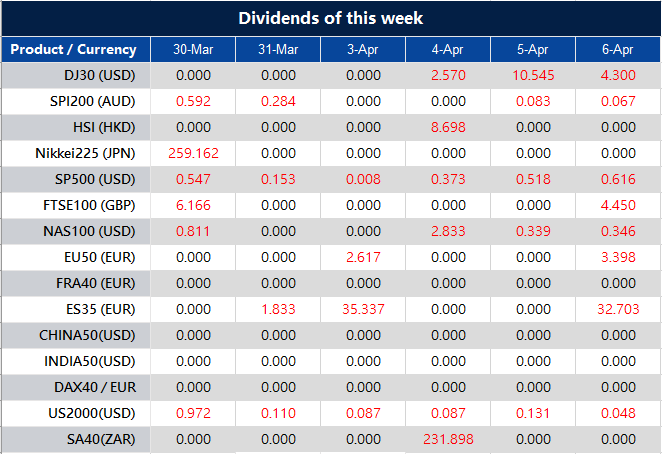
Weekly Dividend Adjustment Notice – March 30, 2023

Dear Client,

Please note that the dividends of the following products will be adjusted accordingly. Index dividends will be executed separately through a balance statement directly to your trading account, and the comment will be in the following format “Div & Product Name & Net Volume ”.

Please refer to the table below for more details:

The above data is for reference only, please refer to the MT4/MT5 software for specific data.

If you’d like more information, please don’t hesitate to contact [email protected]

Back To Top
server

Hai 👋

Bagaimana saya boleh membantu?

Segera berbual dengan pasukan kami

Chat Langsung

Mulakan perbualan secara langsung melalui...

  • Telegram
    hold Ditangguh
  • Akan datang...

Hai 👋

Bagaimana saya boleh membantu?

telegram

Imbas kod QR dengan telefon pintar anda untuk mula berbual dengan kami, atau klik di sini.

Tidak ada aplikasi Telegram atau versi Desktop terpasang? Gunakan Web Telegram sebaliknya.

QR code