
Back

During Asia’s session, USD/CHF eased towards 0.7910 as the Dollar pulled back, with SNB policy watched

USD/CHF slipped to about 0.7910 in Asia on Thursday after rising on Wednesday. The move came as the US Dollar eased, while markets still leaned towards fewer Fed rate cuts this year. The US Dollar Index (DXY) was down 0.14% at about 100.00. CME FedWatch put the probability of the Fed keeping rates at 3.50%–3.75% at 55.2%.

Fed Policy Signal And Market Pricing

On Wednesday, the Fed left rates unchanged for a second meeting in a row. It also indicated policy changes were not suitable given upside inflation risks. Reuters reported Fed Chair Jerome Powell said it was too early to assess price and economic effects from oil-driven inflation expectations linked to Middle East conflict. He also said the Fed is prepared to act as needed. The Swiss Franc traded weaker than some peers before the Swiss National Bank decision due at 08:30 GMT. The SNB was expected to keep its policy rate unchanged at 0%. Market focus remained on whether the SNB could move towards negative rates and whether it might act to limit CHF strength. Earlier this month, the SNB said it was ready to intervene in FX markets to curb rapid and excessive CHF appreciation.

Options Strategy And Rate Divergence

The USD/CHF pair is trading with a firm tone near 0.9150, reflecting a significant policy difference between the Federal Reserve and the Swiss National Bank. This divergence suggests the US Dollar will likely continue to strengthen against the Swiss Franc. Derivative traders should be positioned for further upside in the pair over the coming weeks. Recent data from the United States supports a strong dollar, as the February 2026 jobs report showed a robust addition of over 250,000 jobs. Furthermore, the latest Consumer Price Index (CPI) reading came in at 3.4%, which is still well above the Fed’s target. This persistent inflation makes it very unlikely the Fed will consider cutting interest rates soon. Looking back, we saw this trend building throughout 2025 when markets began to abandon hopes for aggressive rate cuts. As of today, the CME FedWatch Tool shows a greater than 90% probability that the Fed will hold its policy rate steady at its next meeting. The current market pricing suggests the earliest a rate cut could even be considered is late in the third quarter of 2026. Conversely, the Swiss economy is showing much cooler inflation, with the latest figures at just 1.3% year-over-year. This has allowed the Swiss National Bank to take a more dovish path, having already begun to lower its key interest rate. This makes holding the Swiss Franc less attractive compared to the higher-yielding US Dollar. The SNB also remains very sensitive to the Franc’s strength, as we saw with their explicit warnings back in 2025 about their readiness to intervene in currency markets. Any significant or rapid appreciation of the Franc would likely be met with action from the central bank, putting a natural cap on its strength. This reinforces the bearish outlook for the currency. Given this environment, buying USD/CHF call options appears to be a prudent strategy. This allows traders to capitalize on the expected upward movement driven by the policy divergence, while strictly limiting downside risk. The positive carry from being long the higher-yielding USD against the CHF provides an additional tailwind for this position. Create your live VT Markets account and start trading now.

Start trading now – Click here to create your real VT Markets account

EUR/JPY trades near 183.30 after recouping losses, with yen weaker as BoJ holds rates at 0.75%

EUR/JPY recovered losses and traded near 183.30 in Asian hours on Thursday. It stayed firm as the Japanese Yen weakened after the Bank of Japan kept the short-term rate at 0.75%, in line with expectations. The decision was made by an 8–1 vote. Board member Hajime Takata proposed raising the short-term rate to 1.0% from 0.75%, saying the price stability target was largely achieved, but the proposal was rejected.

Focus Turns To Ecb Decision

Focus now turns to the European Central Bank’s rate decision later on Thursday. Rising energy prices are adding to global inflation pressure, which complicates the ECB policy outlook. The ECB is widely expected to keep its “Rate On Deposit Facility” unchanged at 2.0% in March. Market pricing points to a first rate rise by September, with only a 50% chance of another by year-end. Traders have moved away from rate cut bets and are pricing in two rate rises by the end of 2026, according to Bloomberg. The Bank of Japan targets inflation of around 2% and has used QQE, negative rates, and yield control since 2013. In March 2024, the BoJ lifted rates, stepping back from ultra-loose policy. Earlier stimulus weakened the Yen, while higher inflation driven by energy prices and wages supported the shift towards tighter policy.

Looking Back To 2025

Looking back to this time in 2025, we saw the Bank of Japan hold its rate at 0.75% despite some internal pressure to hike further. The European Central Bank was simultaneously holding its own rate at 2.0%, with markets just beginning to price in future tightening. This set the stage for a year of policy divergence that has played out as we expected. Since then, the ECB has moved more decisively, raising its deposit rate to 2.50% to combat stubborn inflation, which recent data from Eurostat shows is still at 2.6%. The Bank of Japan has been more gradual, lifting its short-term rate to only 1.25% as it monitors the economy. This policy gap has helped push the EUR/JPY cross up towards the 190.00 level where it trades today. We are now closely watching the impact of Japan’s spring wage negotiations, with the latest figures showing an average increase of 4.5%, putting more pressure on the BoJ to act. However, Governor Ueda will likely remain cautious, wanting to avoid disrupting the fragile economic recovery. This continued caution from the BoJ should keep the Yen relatively soft in the coming weeks. In contrast, the ECB’s future decisions remain tightly linked to incoming inflation data, especially with Eurozone unemployment holding at a low 6.4%. Markets are now anticipating at least one more rate hike from the ECB by mid-year. This solidifies the policy divergence that favors a stronger Euro over the Yen. Given this outlook, we see opportunities in buying EUR/JPY call options with expirations one to three months out. This strategy allows traders to capitalize on potential further upside in the currency pair driven by the rate differential. It also defines the maximum risk on the position, which is prudent given the potential for central bank surprises. Create your live VT Markets account and start trading now.

Start trading now – Click here to create your real VT Markets account
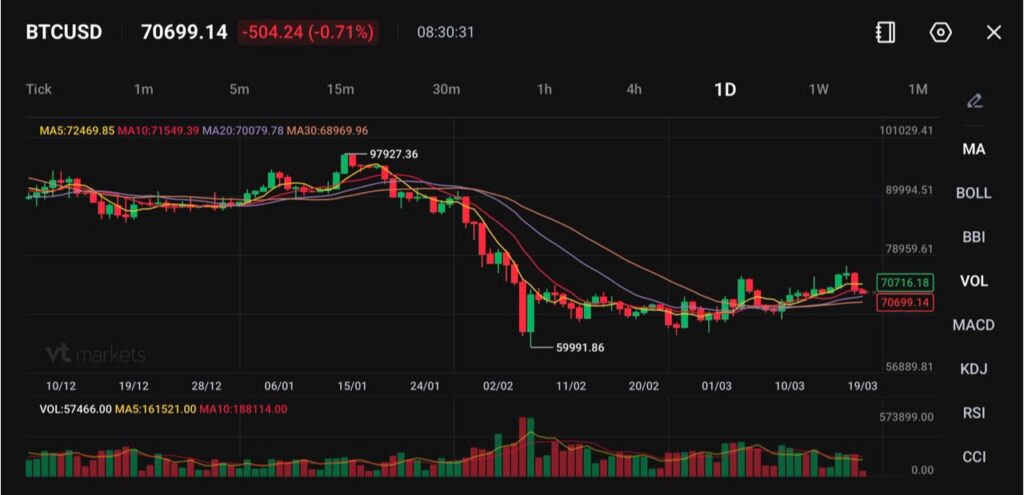
Bitcoin Pulls Back as Macro Pressure Builds

Key Points

  • BTCUSD trades near 70,699, down -504 (-0.71%), after falling over 5% in 24 hours.
  • Over $382 million in long liquidations accelerated downside pressure across crypto markets.
  • The $70,000 level remains critical support, preventing a deeper move toward $60K.

Bitcoin retreated from weekly highs above $74,000, slipping back toward the $70,000 level as macroeconomic conditions weighed on risk assets.

BTCUSD is currently trading near 70,699, reflecting a broader cooling in momentum after a strong earlier rally. The decline comes as traders reassess expectations for monetary policy following hawkish signals from the Federal Reserve.

Despite the pullback, bulls have managed to defend the $70,000 psychological level, preventing a sharper correction.

Holding above $70,000 could stabilise sentiment, while a break lower may open the door toward the $60,000 region.

Hawkish Fed Signals Weigh on Crypto

The primary catalyst behind the selloff has been renewed concerns over inflation and interest rates.

Stronger-than-expected U.S. PPI data, with core inflation rising to 3.9% YoY, reinforced the view that inflation remains sticky. Federal Reserve Chair Jerome Powell echoed this sentiment, highlighting that it is too early to declare victory over inflation.

With headline PCE at 2.8% and core at 3.0%, both above the Fed’s 2% target, markets are now pricing a more cautious approach to rate cuts.

Higher-for-longer interest rates typically weigh on risk assets like cryptocurrencies by tightening liquidity and reducing speculative demand.

If rate-cut expectations continue to fade, Bitcoin may struggle to regain strong upside momentum.

Liquidations Amplify Downside Move

The decline in Bitcoin was intensified by a wave of liquidations across the crypto market.

Over $382 million in long positions were wiped out within 24 hours, with both Bitcoin and Ethereum accounting for more than $150 million each.

These forced liquidations can accelerate price declines, as leveraged positions are unwound rapidly, adding to selling pressure.

The broader crypto market followed suit, with total market capitalisation dropping before stabilising above $2.5 trillion.

Technical Analysis

Bitcoin (BTCUSD) is trading near 70,699, down around 0.71% on the session, as price struggles to build sustained momentum after rebounding from the ~60,000 low. The broader structure suggests a base-building phase following the sharp correction from the 97,927 peak.

Technically, Bitcoin is currently sitting between key moving averages, reflecting indecision. The 5-day MA (72,469) and 10-day MA (71,549) remain above price and are starting to flatten, acting as near-term resistance. Meanwhile, the 20-day MA (70,079) sits just below current levels, offering immediate support, with the 30-day MA (68,969) reinforcing the broader base.

Key levels to watch:

  • Support:70,000 → 68,500 → 60,000 (major structural floor)
  • Resistance:71,500 → 72,500 → 75,000

The recent price action shows higher lows forming since the early February bottom, which is constructive. However, repeated rejection around the 72,000–73,000 zone signals that bulls are not yet in full control.

Volume has also moderated after the heavy sell-off, indicating that selling pressure has eased, but buying conviction remains tentative. This aligns with a consolidation or accumulation phase, rather than a clear trend continuation.

Overall, Bitcoin appears to be range-bound between 70,000 and 73,000 in the near term, with a breakout above resistance needed to confirm bullish continuation. Failure to hold 70,000 could shift sentiment back toward the downside, while a sustained move above 72,500+ would likely reopen upside toward the mid-70,000s and beyond.

Digital Gold Narrative Faces Short-Term Test

Bitcoin’s earlier rally was partly driven by its positioning as “digital gold,” benefiting from geopolitical uncertainty and inflation concerns.

However, the current environment highlights a key divergence. While safe-haven flows support gold, Bitcoin remains more sensitive to liquidity conditions and interest rate expectations.

This dynamic means that even in periods of global uncertainty, crypto markets can face pressure if monetary policy remains restrictive.

What Traders Should Watch Next

Bitcoin now sits at a critical juncture, with both macro and technical factors in play. Key drivers include:

  • Federal Reserve guidance and rate-cut expectations
  • Inflation data and macroeconomic indicators
  • Whether BTC can hold above $70,000
  • Liquidation flows and market positioning

For now, the market appears to be in a healthy consolidation phase, but the next move will depend on whether bulls can defend key support levels amid tightening financial conditions.

Create a live VT Markets account today to access our platform features, including market insights and educational content.

FAQs

Why Did Bitcoin Price Drop Recently?
Bitcoin fell due to a combination of hawkish Federal Reserve signals, stronger-than-expected inflation data, and a large wave of liquidations across leveraged positions.

What Did the Federal Reserve Say That Impacted Bitcoin?
The Fed signalled a cautious approach to rate cuts, emphasising that inflation remains above target and that policy will stay restrictive for longer.

How Do Interest Rates Affect Bitcoin?
Higher interest rates reduce liquidity and make risk assets like Bitcoin less attractive compared to yield-generating investments, often leading to price declines.

What is the Key Support Level for Bitcoin Right Now?
The $70,000 level is the main psychological and technical support currently holding the market.

What Happens if Bitcoin Falls Below $70,000?
A break below $70,000 could trigger further selling pressure and potentially push prices toward the $60,000 range.

Why Did Liquidations Accelerate the Selloff?
Over $382 million in long positions were liquidated, forcing traders to exit positions, which amplified downward momentum.

Is the Crypto Market Still Stable Overall?
Yes, despite the drop, total crypto market capitalisation has stabilised above $2.5 trillion, suggesting underlying resilience.

Start trading now – Click here to create your real VT Markets account

During Asian trading, EUR/USD recoups prior losses, hovering near 1.1490, bearish within a descending channel

EUR/USD traded near 1.1490 in Asian hours on Thursday, after recovering losses from the prior session. The daily chart shows the pair moving lower within a descending channel. The pair remains below the nine-day and 50-day Exponential Moving Averages, with resistance in the mid-1.15s and high-1.16s. The 14-day Relative Strength Index is 37, staying under 50 and pointing to bearish momentum.

Technical Levels And Channel Direction

Support is at the seven-month low of 1.1411, recorded on March 13. Another support level sits near the lower channel boundary around 1.1310. Resistance is first seen at the nine-day EMA around 1.1526, then near the upper channel boundary around 1.1600. If price breaks above the channel, it may test the 50-day EMA at 1.681. The technical analysis was produced with the help of an AI tool. With the EUR/USD hovering around 1.1490, the technical picture remains bearish as the pair continues its trend within a descending channel. We are seeing persistent pressure keeping the price below key moving averages, reinforcing the potential for a downward move. The immediate focus should be on the pair testing the seven-month low of 1.1411. This technical weakness is supported by a growing economic divergence between the Eurozone and the United States. Recent data showed Eurozone inflation cooled to 1.9% in February 2026, increasing bets that the European Central Bank may consider rate cuts sooner than anticipated. In contrast, the latest U.S. jobs report from February revealed a robust gain of over 250,000 jobs, signaling the Federal Reserve has little reason to ease its tighter monetary policy.

Macro Divergence And Trading Implications

We saw a very similar setup back in March of 2025 when the 14-day Relative Strength Index was also near 37. This level shows strong selling momentum but importantly suggests the pair is not yet in deeply oversold territory, leaving more room to the downside. The historical parallel provides a blueprint for how this current move might unfold in the coming weeks. For derivative traders, this suggests buying put options with strike prices at or below 1.1400 could be a viable strategy to capitalize on the expected decline. Watching the nine-day EMA around 1.1526 is crucial; a failure to break above this level would present a strong signal to initiate or add to short positions. This EMA has been acting as a consistent ceiling on any recovery attempts. Should the bearish momentum continue and break the 1.1411 support, the next logical target would be the lower boundary of the descending channel, located near 1.1310. Conversely, a sustained move above the channel’s upper boundary around 1.1600 would be required to invalidate this bearish outlook. Traders should use that 1.1600 level as a point to reconsider short exposures. Create your live VT Markets account and start trading now.

Start trading now – Click here to create your real VT Markets account

RBA cautioned Middle East conflict, including Iran, could trigger a severe shock pushing the global economy into tailspin

The Reserve Bank of Australia (RBA) said conflict in the Middle East could create a shock that pushes the global economy into a tailspin, according to the Guardian. The RBA made the comments in its twice-yearly review of Australia’s financial system. The RBA reported that risks to financial systems have risen in recent weeks. It said a prolonged disruption to oil and other markets would raise the chance of a major shock.

Middle East Risks And Market Stress

It also noted that market volatility has risen sharply and that further shocks could lead to disorderly trading conditions. At the time of writing, AUD/USD was up 0.36% on the day at 0.7048. We remember the Reserve Bank’s concerns from back in 2025 about how a Middle East conflict could shock the global economy. Those risks are now resurfacing as recent escalations in the Strait of Hormuz have pushed Brent crude oil prices up 15% in the last month to over $105 a barrel. This situation mirrors the supply fears we saw after the 2022 energy crisis. This geopolitical tension is feeding directly into market volatility, just as the RBA cautioned could happen. The VIX, a key measure of fear in the markets, has surged from a low of 14 just a few weeks ago to over 26, its highest level in over a year. Further shocks could easily create the disorderly conditions the RBA was worried about. For derivatives traders, this points towards positioning for a weaker Australian dollar, which is highly sensitive to global risk sentiment. Despite high commodity prices, the AUD/USD has slipped to 0.6510, a stark contrast to the 0.7048 level seen when these warnings first emerged. We believe options strategies that profit from further declines should be considered.

Rates Volatility And Hedging Setups

Buying put options on the AUD/USD or on Australian equity indices like the ASX 200 offers a direct way to hedge against a downturn. This strategy provides downside protection while limiting risk to the premium paid for the option. It is a prudent move when the chance of a major shock is rising. We should also watch interest rate markets, as a significant global shock would likely force the RBA to halt its tightening cycle. This increases the appeal of derivatives that bet on interest rates falling later in the year. A flight to safety could quickly change the outlook for the entire yield curve. Create your live VT Markets account and start trading now.

Start trading now – Click here to create your real VT Markets account

BoJ holds rates at 0.75%, pressuring Yen, though USD/JPY dips as Dollar weakens broadly

The Japanese Yen fell against the US Dollar after the Bank of Japan kept its policy rate at 0.75%. Despite this, USD/JPY was 0.14% lower at about 159.70 as the US Dollar weakened against other currencies. The decision matched expectations, as higher oil prices linked to conflict involving the US, Israel, and Iran have raised concerns about Japan’s economic outlook. This was the second consecutive BoJ meeting with rates left unchanged.

Market Focus And Policy Signals

Market attention turned to a press conference by Governor Kazuo Ueda for further guidance. On Tuesday, Ueda said prices and wages should keep rising, and that underlying inflation is expected to move towards the 2% target in the latter half of fiscal 2026 through fiscal 2027. The US Dollar eased after rising on Wednesday following the Federal Reserve decision. The Fed kept rates unchanged at 3.50%–3.75% and said policy changes would depend on inflation showing signs of easing. The BoJ’s mandate is price stability, with an inflation target of around 2%. It used large-scale easing from 2013, added negative rates and yield control in 2016, and raised rates in March 2024, while past policy gaps with other central banks weighed on the Yen in 2022 and 2023. With the Bank of Japan holding its interest rate at 0.75%, the significant gap with the US rate of 3.50%-3.75% remains the dominant factor. This large differential continues to make borrowing yen to buy dollars a fundamentally attractive strategy for traders. The pressure on the yen is therefore likely to persist in the near term.

Intervention Risk And Key Levels

We see the USD/JPY pair trading near 159.70, a level that historically triggered verbal and physical intervention from Japanese authorities back in 2024. Given Japan’s national core inflation for February 2026 came in at 2.7%, well above the 2% target, the government may act to prevent further import-driven price rises. Traders should therefore be extremely cautious of a sudden, sharp reversal if the pair pushes decisively past the 160 level. The current situation, where the BoJ is paused due to external conflicts but signals future hikes, creates significant uncertainty. This environment makes options trading particularly useful for managing risk and positioning for a potential spike in volatility. We believe strategies like buying straddles could be effective, as they profit from a large price move in either direction without needing to guess the trigger. On the US side, the Federal Reserve’s commitment to holding rates steady until inflation eases makes upcoming economic data crucial. US inflation has hovered above 3% for much of the past year, and any upcoming Consumer Price Index (CPI) report showing a significant drop could trigger a rapid sell-off in the dollar. Conversely, another high inflation print would reinforce the dollar’s strength and could test Japan’s resolve at the 160 level. Create your live VT Markets account and start trading now.

Start trading now – Click here to create your real VT Markets account

Bank of Japan holds interest rates at 0.75%, aligning with market expectations and analyst forecasts

The Bank of Japan kept its policy interest rate at 0.75%, matching forecasts. The decision signals no change to the current monetary policy stance at this meeting.

Market Pricing And Volatility Implications

The Bank of Japan’s move to 0.75% was widely expected, so we saw the market fully price this in over the past month. This means we should expect a drop in short-term implied volatility for derivatives on the yen and the Nikkei. The big, immediate price swing is likely behind us. For currency traders, the game now shifts from “if” they will hike to “how many more.” With recent data showing core inflation holding at 2.1% and the yen strengthening to the 138 level against the dollar, selling out-of-the-money call options on USD/JPY could be a way to collect premium. This strategy profits if the yen continues its gradual strengthening or simply stays stable. On the equity side, this predictable central bank action is a positive for the Nikkei 225. It confirms the strength we are seeing in the economy, particularly after the final Shunto wage negotiation results posted a 4.5% average increase, the highest in decades. This stability suggests buying call spreads on the Nikkei to position for further upside as uncertainty is removed. We remember the significant turbulence when the BOJ first signaled a clear end to its negative rate policy back in 2025. Today’s move shows that normalization is now a well-telegraphed process, not a shock. The trade now is to use options to bet on the pace of future hikes, which will be dictated by wage and inflation data in the coming months.

Positioning For The Next Policy Signal

Create your live VT Markets account and start trading now.

Start trading now – Click here to create your real VT Markets account

Following two days of gains, WTI slips to about $97.80 as US permits Venezuela’s state oil trades

WTI fell after two days of gains, trading near $97.80 per barrel during Asian hours on Thursday. Prices eased as supply concerns reduced after the US allowed limited business with Venezuela’s state oil and gas firm following a partial easing of Treasury sanctions. The White House said President Donald Trump would grant a 60-day waiver of Jones Act rules. This allows goods shipped between US ports to use non-US-flagged vessels to improve domestic fuel distribution.

Supply Concerns Ease

Supply worries also eased after crude exports from Iraq’s Kirkuk fields to Turkey’s Ceyhan port resumed via pipeline. The restart followed an agreement between Baghdad and the Kurdistan Regional Government earlier this week. Geopolitical risks continued to support price concerns due to attacks on energy sites in the Middle East. Iran launched missile strikes on a Qatari site hosting the world’s largest LNG export facility after an Israeli attack on Iran’s South Pars gas field. US President Donald Trump said he had prior knowledge of the Israeli strike and urged restraint on further attacks on Iranian energy assets. Saudi Arabia said it stopped an attempted attack on a gas facility, and officials reported four residents injured by falling shrapnel in Riyadh. Missiles intercepted in the UAE were reported to be aimed at a gas facility and an oil field. This added to concerns about wider risks to energy infrastructure.

Volatility Strategy Focus

We are seeing WTI prices ease to around $97.80, which seems at odds with the escalating geopolitical risks in the Middle East. The partial easing of Venezuelan sanctions and the Jones Act waiver are introducing new supply, but these are likely temporary fixes. This creates a highly uncertain environment, perfect for volatility plays in the coming weeks. The latest Energy Information Administration (EIA) report showing a surprise crude inventory draw of 3.1 million barrels complicates the picture, suggesting underlying demand remains strong. This drawdown works against the bearish sentiment from the new supply announcements. For traders, this means any bearish move could be short-lived and face strong support. Given these opposing forces, expecting a clear directional trend is risky, so we should consider strategies that profit from volatility itself. Options strategies like long straddles on front-month contracts could be effective. This approach allows us to capitalize on a large price swing whether it is up or down. Looking back at the events of late 2025, the Iranian missile strikes and attempted attacks in Saudi Arabia are creating a risk premium we have not seen in some time. We recall the 2019 Abqaiq attack, which caused an immediate 15% price spike before production was restored. The current situation feels even more precarious, suggesting any actual supply disruption would have an explosive effect on prices. We should also be skeptical about the immediate impact of the Venezuelan supply, as was the case when sanctions were first eased back in 2025. Reports from February 2026 showed that production is still struggling to exceed 900,000 barrels per day due to years of infrastructure decay. This means the actual barrels hitting the market may be far less than headlines suggest. The 60-day waiver of the Jones Act from the Trump administration in 2025 provides a clear timeline for traders. As we approach the end of that waiver period in the coming weeks, we can anticipate a tightening of domestic fuel logistics. This could create upward pressure on prices, especially for refined products. Create your live VT Markets account and start trading now.

Start trading now – Click here to create your real VT Markets account

After dipping to a month’s low, XAG/USD rebounds above $76, ending a two-day slide

Silver (XAG/USD) rose after holding below the $75.00 level and ending a two-day fall that reached a one-month low. It traded just under the mid-$76.00s, up nearly 1.5% on the day, though the setup remains cautious. Price action follows a break below a short-term rising trend line and a move under the 61.8% Fibonacci retracement of the February–March rise. The MACD (12, 26, close, 9) stays below the signal line and has moved back under zero, pointing to increasing downside momentum.

Technical Indicators Still Lean Bearish

The RSI has lifted slightly from oversold levels but remains below 50, which keeps selling pressure in place. As long as price stays below the former trend-line support area, gains beyond $76.45 (the 61.8% retracement) are described as limited. Support is seen near $75.90, then at $70.96, which matches the 78.6% retracement. A move above $80.30, the 50.0% retracement resistance, would be needed to reduce the bearish tone and suggest buyers are returning. The technical analysis was produced with help from an AI tool. We see a prevailing bearish sentiment for silver, as the recent breakdown below the short-term trend-line remains a significant signal. With the MACD and RSI indicators suggesting sustained selling pressure, any upward movement towards the $76.45 resistance might be an opportunity to initiate short positions. This could involve buying put options or selling call spreads to capitalize on potential further downside.

Macro And Flow Drivers Reinforce Caution

This technical weakness is compounded by macroeconomic factors, with the February 2026 CPI data coming in slightly above expectations at 2.8%. Recent commentary from Federal Reserve officials hints at a continued restrictive stance, which is keeping the US dollar firm. A strong dollar typically creates headwinds for dollar-denominated commodities like silver, reinforcing our cautious outlook. We are also watching for signs of slowing industrial demand, particularly after the record solar panel installations we tracked throughout 2025. Data from the first quarter of 2026 shows a slight moderation in this growth, which could remove a key pillar of support for silver prices. Furthermore, a look at major silver ETFs shows net outflows of over 1.5 million ounces in the last month, a stark contrast to the heavy inflows seen during the rally last spring. Given this outlook, we believe traders could look at purchasing puts with a strike price below the $75.90 support level, targeting a move towards the $70.96 area in the coming weeks. A break and close above the $80.30 resistance would invalidate this bearish perspective and signal a need to reassess our positions. For now, the path of least resistance appears to be to the downside. Create your live VT Markets account and start trading now.

Start trading now – Click here to create your real VT Markets account

EUR/USD falls near 1.1450 as the Dollar gains from hawkish Fed, while ECB decision approaches

EUR/USD falls to about 1.1465 in early Asian trading on Thursday, near 1.1450. The move comes as the US Dollar strengthens after a hawkish Federal Reserve message. The Fed kept interest rates unchanged at 3.5%–3.75% at its March meeting on Wednesday. The Fed indicated a rate cut may occur in 2026.

Fed Message Drives Dollar Strength

Jerome Powell said inflation progress is expected, but less than previously hoped. He also said higher oil prices linked to the Iran war are expected to increase inflation in the near term. Powell said he will stay as Fed chair until an investigation linked to the central bank’s headquarters is completed. He also said he will remain in the role until a successor is officially confirmed. Attention turns to the European Central Bank decision later on Thursday. The ECB is expected to keep its three key interest rates unchanged at its March meeting. Market pricing has moved away from expectations of further ECB rate cuts. Traders are now fully pricing in two rate hikes by the end of 2026, according to Bloomberg.

Volatility Risks And Options Positioning

The Federal Reserve’s hawkish stance, combined with the market now pricing in European Central Bank hikes, is creating a tense tug-of-war for the EUR/USD. We see this as a clear signal to prepare for increased volatility in the coming weeks. Options traders should consider strategies that profit from sharp price swings, as the CBOE EuroCurrency Volatility Index (EUVIX) is likely to climb from its current lows. The dollar’s immediate strength is backed by solid data, with US GDP growth tracking near 2.7% while the Eurozone’s struggles to reach 0.9%. This economic divergence supports the Fed’s decision to hold rates firm, making short-term bearish positions on the EUR/USD, perhaps through buying puts, an attractive play. The US economy’s resilience gives the Fed more room to keep policy tight to combat inflation, which remains stubbornly above 3%. However, the ECB’s upcoming decision is the main event and could quickly reverse the pair’s direction. With Eurozone inflation ticking back up towards 2.8%, if the ECB signals a clear intent to follow through on the two rate hikes markets are expecting, the Euro could rally strongly. This makes buying out-of-the-money EUR/USD call options a viable strategy to position for a potential hawkish surprise. The wild card remains energy prices, a persistent issue since the Iran war began. With Brent crude holding above $110 a barrel, inflationary pressures are a major headache for both central banks, but especially for the energy-importing Eurozone. This sustained price pressure could force the ECB’s hand sooner than expected, further fueling currency volatility. Looking back at 2025, we saw how market sentiment on central bank policy could pivot dramatically within a single quarter. Given the opposing forces at play, the EUR/USD could become range-bound between major support and resistance levels if neither bank makes a decisive move. This scenario would favor traders who sell options premium through strategies like iron condors. Create your live VT Markets account and start trading now.

Start trading now – Click here to create your real VT Markets account

Back To Top
server

Hello there 👋

How can I help you?

Chat with our team instantly

Live Chat

Start a live conversation through...

  • Telegram
    hold On hold
  • Coming Soon...

Hello there 👋

How can I help you?

telegram

Scan the QR code with your smartphone to start a chat with us, or click here.

Don’t have the Telegram App or Desktop installed? Use Web Telegram instead.

QR code

