The US Dollar Index (DXY), which tracks the US dollar against six major currencies, traded near 98.20 in Asian hours on Monday. The level held steady as markets assessed tensions in the Middle East.
US President Donald Trump said the US will start guiding some neutral ships trapped in the Persian Gulf through the Strait of Hormuz from Monday. Bloomberg reported US Navy ships will stay nearby if needed to help prevent attacks on commercial vessels in the Strait.
Strait Of Hormuz Risk
An Iranian official said US action in Hormuz would be treated as a ceasefire violation. The official added that the Strait of Hormuz and the Persian Gulf are not a place for rhetoric.
Markets are also focused on the US employment report for April, due on Friday. Forecasts are for 73K new jobs and an Unemployment Rate of 4.3%.
The US Dollar Index (DXY) is currently trading around 104.50, holding steady as we assess both persistent geopolitical risks and upcoming economic data. The dollar’s role as a safe-haven asset is being tested by new global flashpoints. This creates an environment where derivative traders need to be prepared for sudden moves in volatility.
We see a similar dynamic to the past Strait of Hormuz tensions playing out today with the ongoing shipping disruptions in the Red Sea. Recent data shows cargo volumes through the Suez Canal remain down more than 60% compared to last year, forcing longer and more expensive trade routes. Any escalation here could trigger a flight to safety, directly benefiting the dollar.
Trading Strategies To Watch
For derivative traders, this suggests considering call options on the DXY or related ETFs to profit from a potential geopolitical spike. We saw a similar rush into the dollar during the initial shock of the pandemic in March 2020, when the DXY surged from 95 to over 102 in less than two weeks. Hedging with call options on the VIX could also be a prudent strategy, as it typically rises with market fear.
All eyes are now on this Friday’s US employment report for April, which will heavily influence Federal Reserve policy expectations. We are anticipating the economy to have added around 175,000 jobs, with the unemployment rate expected to hold near 3.8%. A significant miss to the downside could weaken the dollar as it may signal an earlier-than-expected policy easing.
A jobs number coming in below 150,000 could create an opportunity for short-term bearish plays on the dollar. Traders might look at buying put options on the DXY expiring in the coming weeks to capitalize on such a move. Conversely, another strong report above 200,000 would reinforce the dollar’s strength.
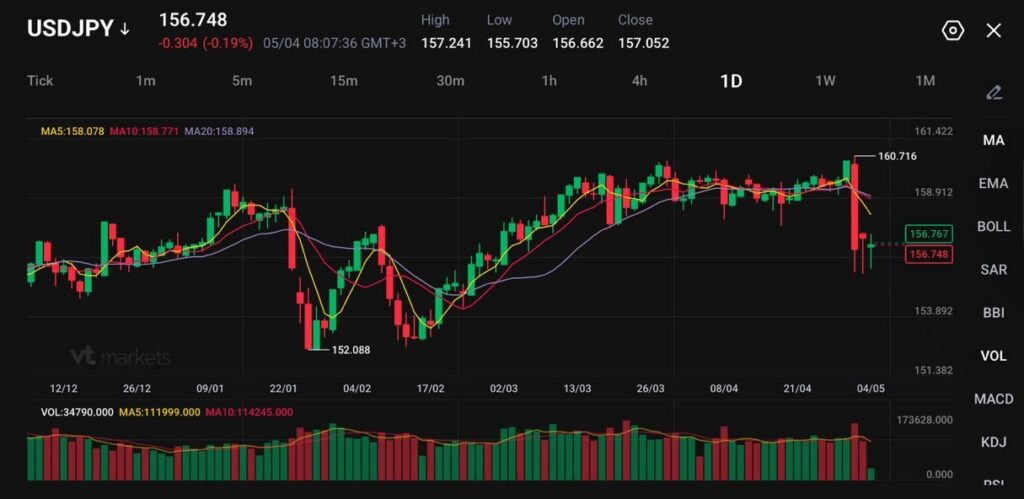
USD/JPY traded at 156.748, down 0.304 points, or 0.19%, after falling as low as 155.703 on the chart.
The yen climbed as much as 0.75% to 155.69, with much of the move coming in nine minutes around midday Singapore time.
The US dollar index fell 0.1% to 98.041 as traders watched Japan, Hormuz, the RBA, and wider risk appetite.
The yen strengthened suddenly against the dollar on Monday as traders stayed alert for possible action from Japanese authorities. The move came after suspected intervention last week, when sources told Reuters that authorities bought yen for the first time in two years. The yen climbed as much as 0.75% to 155.69 during Monday’s move, with much of the appreciation coming in a sharp nine-minute stretch around midday Singapore time.
The yen jumped in Asia on Monday, as traders remained on edge over the potential for Japanese authorities to step back into the market after last week’s intervention to curb declines https://t.co/jNDG7DwKgP
Markets did not receive official confirmation. Ministry of Finance officials did not immediately respond to requests for comment, while Tokyo officials declined to confirm whether they had intervened last week. Still, traders treated the price action as a warning shot.
Japan is closed for the Golden Week holiday, which can thin liquidity and magnify FX moves. Markets will focus on whether further intervention occurs, and more importantly, whether the US joins Japan’s efforts. She added that further yen weakness could raise the chance of bilateral intervention.
Intervention Can Slow The Move, But Rates Still Matter
Japan’s challenge is simple. Intervention can shock USD/JPY lower, but the wider trend still depends on rate spreads. The yen remains vulnerable when US yields stay high, and the Bank of Japan moves slowly. That is why analysts have questioned whether unilateral intervention, the third such effort in the past four years, can create lasting yen strength without support from rate policy or the US.
The Japanese yen surged after top officials signaled readiness for further market intervention, however, analysts say the yen remains under pressure from US-Japan interest rate gaps despite intervention https://t.co/OzHKhoGOUfpic.twitter.com/yY82cTQzdR
The dollar index eased 0.1% to 98.041, which helped the yen, but the move was not broad dollar capitulation. It looked more like targeted caution around USD/JPY after last week’s suspected yen-buying activity.
The cautious forecast is that USD/JPY may stay jumpy while it trades near the 155 to 160 zone. Japan can defend the currency through sudden action, but traders may test the upside again if US yields hold firm and if officials avoid direct confirmation.
Hormuz Headlines Keep Markets Defensive
Markets also opened the week with caution after President Donald Trump said the US would start an effort on Monday morning to free ships stranded in the Strait of Hormuz as a “humanitarian gesture” to help neutral countries in the US-Israeli war with Iran. Trump gave few details on the operation, including whether the US Navy would take part.
Oil prices, conflict in the Middle East, Japan's yen, US jobs data, an Australian rate decision and a UK local election: Here’s what you need to watch in business and finance in the week ahead https://t.co/3S73V5smo2pic.twitter.com/nnfwvQAIze
Hormuz risk continues to affect oil, inflation, trade flows, and safe-haven demand. If the operation helps shipping resume, oil-linked inflation pressure may cool and risk appetite may improve. If it triggers new friction with Iran, traders may move back into defensive positions.
For USD/JPY, the effect can cut both ways. Higher geopolitical stress can support the dollar, but it can also lift the yen when traders seek havens or expect Japanese authorities to lean harder against currency weakness.
Technical Analysis
USDJPY is trading near 156.75, pulling back sharply after a rejection from the 160.70 high, with price now slipping back into the prior range and testing lower support levels. The move lower appears aggressive, suggesting a shift in short-term sentiment after the pair failed to sustain gains above the key 160 zone.
From a technical standpoint, momentum has turned bearish in the near term. Price has broken below the 5-day (158.07) and 10-day (158.77) moving averages, both now rolling over and acting as immediate resistance. The 20-day (158.89) sits just above, reinforcing overhead pressure and indicating that the recent uptrend has lost traction.
Key levels to watch:
Support: 156.70 → 153.90 → 152.10
Resistance: 158.10 → 158.80 → 160.70
Price is now hovering around 156.70 support, a level that is being tested following the sharp sell-off. A break below this zone could extend losses toward 153.90, with deeper downside risk toward 152.10 if selling momentum continues to build.
On the upside, 158.10 is now the first resistance level, aligning with short-term moving averages. A move back above this area would be needed to stabilise price action, though stronger confirmation would likely require a reclaim of 158.80–159.00.
Overall, USDJPY has shifted into a corrective phase after failing at highs, with downside pressure building in the short term. Price action around the 156.70 support zone will be key in determining whether this remains a pullback or develops into a deeper reversal.
Cautious Forecast
USD/JPY may stay under pressure while it holds below 158.078, 158.771, and 158.894. A break below 155.703 would strengthen the downside case and could pull the pair toward 153.892.
A recovery above 158.894 would show that intervention fears are fading and that rate differentials are taking control again. For now, traders may treat rallies toward 158 to 159 as vulnerable while Japan remains on intervention watch and liquidity stays thin during Golden Week.
The yen strengthened after traders grew alert to possible action from Japanese authorities.
USD/JPY fell as low as 155.703 on the chart, while the yen climbed as much as 0.75% to 155.69 in wider market trading. Much of the move came during a sharp nine-minute stretch around midday Singapore time.
Did Japan Intervene To Support The Yen?
Japan has not confirmed fresh intervention.
However, markets suspect authorities may have acted again after sources said Japan bought yen last week for the first time in two years. Traders are watching closely because Tokyo officials have warned against excessive yen weakness.
Why Is Intervention Risk High For USD/JPY?
Intervention risk is high because USD/JPY recently traded near the 160.716 area, where yen weakness can draw pressure from Japanese policymakers.
Officials may want to show that they will not tolerate a disorderly move lower in the yen, especially during thin Golden Week holiday trading.
Can Intervention Strengthen The Yen For Long?
Intervention can trigger sharp yen rebounds, but its longer-term impact depends on interest-rate spreads.
If US yields stay high and the Bank of Japan remains cautious, traders may still buy USD/JPY on dips. A stronger and longer-lasting yen rally may need support from US cooperation or a shift in rate expectations.
Why Does Golden Week Matter For Yen Trading?
Golden Week matters because Japanese markets are partly closed, which can reduce liquidity.
When liquidity is thin, smaller flows can create sharper moves. That makes USD/JPY more exposed to sudden price swings, especially when intervention risk is already high.
Start trading now – Click here to create your real VT Markets account
Silver (XAG/USD) fell after opening with a gap up, but stayed in positive territory and traded near $75.40 per troy ounce during Asian hours on Monday. Daily gains eased as demand for safe-haven assets softened while traders assessed progress in US–Iran peace talks.
Bloomberg reported on Sunday that Donald Trump said the United States will start guiding neutral ships trapped in the Persian Gulf out through the Strait of Hormuz from Monday. The plan aims to help civilian vessels from non-aligned countries leave the area and return to normal operations.
Diplomatic efforts have continued as the conflict in Iran enters its third month. Iran said it is reviewing Washington’s response to its latest 14-point proposal, while Bloomberg reported that Trump said Tehran’s proposal may not meet expectations.
Axios reported, citing sources familiar with the matter, that Iran proposed a one-month deadline for talks. The talks would aim to reopen the Strait of Hormuz and end the US naval blockade, as well as conflicts in Iran and Lebanon.
Silver also faced pressure because the Middle East conflict has pushed energy prices higher and raised inflation risks. This has increased concern that central banks may keep interest rates high for longer or tighten policy.
We remember how silver prices reacted to the US-Iran peace talks this time last year, in 2025. The easing of that conflict saw silver retreat from its peak above $75 as the safe-haven bid faded. Today, with silver trading near $58, the market is far less concerned with an imminent military escalation in the Persian Gulf.
The main headwind for silver has shifted from geopolitics to monetary policy, a dynamic that began with the inflation spike during the 2025 energy crisis. With the Federal Reserve holding rates at 4.75%, the opportunity cost of holding non-yielding silver remains high. However, recent data showing inflation cooling to 2.8% has led markets to price in a greater than 60% chance of a rate cut before the fourth quarter.
This creates an opportunity in the options market where implied volatility seems low compared to the potential for a policy surprise. We believe traders should consider buying long-dated call options to position for a dovish pivot from the Fed later this year. This provides leveraged upside exposure to silver if interest rate expectations shift favorably.
We are also watching the price of WTI crude oil, which has stabilized around $85 a barrel after spiking over $110 during the 2025 blockade. Any renewed disruption to shipping in the Strait of Hormuz would likely see oil prices jump again, reigniting inflation fears and creating complex cross-currents for silver. This makes a pairs trade, such as going long silver futures while buying puts on an oil ETF, an interesting hedge against a sudden risk-off event.
NZD/USD rose above 0.5900 in the Asian session, after dip-buying early in the week. The pair faces resistance at 0.5920–0.5925, with attention on the Middle East crisis.
Donald Trump said the US will guide neutral ships stranded in the Strait of Hormuz under Project Freedom. He said the US would use force if the process is disrupted, while Ebrahim Azizi warned that US interference would be a ceasefire violation.
Geopolitical Risk And Dollar Support
These developments keep geopolitical risk elevated, which can support the US Dollar and weigh on NZD/USD. Minneapolis Fed President Neel Kashkari said a prolonged Iran conflict could raise inflation risks and harm the economy, and he raised the possibility of higher rates.
Support for the New Zealand Dollar comes from expectations that the Reserve Bank of New Zealand may remain cautious or consider tightening to return inflation to the 2% midpoint. With mixed drivers, a clear move above 0.5920–0.5925 may be needed before further gains.
No major US data are due on Monday, leaving the US Dollar sensitive to headlines. Later in the week, the US Nonfarm Payrolls report and New Zealand’s quarterly employment report are expected to guide the pair.
Looking back to 2025, we saw the NZD/USD pair struggle at the 0.5925 resistance level amid significant US-Iran tensions in the Strait of Hormuz. That period of geopolitical risk, combined with hawkish comments from Fed officials like Neel Kashkari, created a strong bid for the safe-haven US dollar. At the time, uncertainty around central bank policy and global security put a firm cap on the kiwi.
That particular geopolitical flare-up eventually de-escalated, but the inflationary pressures it highlighted have persisted into 2026. The Federal Reserve is now contending with recent Q1 2026 core CPI data that printed at a stubborn 3.1%, making further rate hikes a distinct possibility. In contrast, the Reserve Bank of New Zealand is facing a different problem, as New Zealand’s Q1 GDP showed a slight contraction of 0.2%, increasing concerns of stagflation and limiting the RBNZ’s ability to tighten policy further.
Options Strategies For A Bearish Bias
This growing divergence between a hawkish Fed and a constrained RBNZ suggests a path of weakness for the NZD/USD pair. Derivative traders should consider buying NZD/USD put options with expiries in the next one to three months to position for a potential slide towards the 0.5800 level. Current implied volatility seems low given the central bank uncertainty, making puts an attractive strategy for defined-risk exposure to the downside.
Another approach would be to sell out-of-the-money call spreads to capitalize on the pair’s expected inability to rally significantly. For instance, selling a call spread with strikes at 0.6200 and 0.6250 could generate income while betting that the pair will remain capped by a strong US dollar. This strategy benefits from both a falling price and time decay if the pair stagnates below the short strike.
Upcoming economic data, particularly the US Nonfarm Payrolls and New Zealand’s quarterly employment report, will be critical triggers for volatility. We saw similar anticipation for these reports back in 2025, and they remain key drivers today. Traders anticipating a sharp move but uncertain of the direction could consider buying a straddle ahead of these releases to profit from a spike in volatility, regardless of whether the news is positive or negative for the pair.
USD/CAD rose for a second day, trading near 1.3590 in Asian hours on Monday. The move came as the Canadian Dollar weakened alongside falling oil prices.
WTI traded around $98.50 per barrel and stayed in negative territory for a third straight day. Oil prices came under pressure after a Bloomberg report on Sunday said Donald Trump stated the US would start guiding neutral ships trapped in the Persian Gulf out through the Strait of Hormuz from Monday.
Strait Of Hormuz Tensions
Ebrahim Azizi, a former Islamic Revolutionary Guards Corps commander and head of Iran’s parliamentary National Security and Foreign Policy Committee, said US involvement in a new maritime regime in the Strait of Hormuz would be viewed as a ceasefire violation. He also said the Strait of Hormuz and the Persian Gulf are not a place for rhetoric.
USD/CAD gains were described as potentially capped as the US Dollar softened amid lower safe-haven demand and ongoing US–Iran peace efforts. The war in Iran has entered its third month, and Bloomberg reported Trump indicated Tehran’s latest peace proposal may not meet expectations.
Axios, citing sources familiar with the matter, reported Iran proposed a one-month deadline for talks. The aim would be to reopen the Strait of Hormuz and end both the US naval blockade and the conflicts in Iran and Lebanon.
Looking back, we remember the market sentiment in 2025 when USD/CAD was climbing towards 1.3600. At that time, West Texas Intermediate crude was struggling below $100 a barrel due to hopes of de-escalation in the Persian Gulf. The situation today has evolved significantly from that period.
Oil Volatility And Cad Outlook
The fragile peace negotiations discussed last year ultimately broke down, and the proposed one-month deadline for reopening the Strait of Hormuz passed without a resolution. Renewed incidents in the strait over the past year have reintroduced a significant risk premium into energy markets. This has completely reversed the trend we observed in 2025.
As a result, crude oil volatility has spiked, with WTI now trading near $118 a barrel, far from the levels seen when the US was guiding ships. Recent data from the CME Group shows implied volatility on front-month oil options is elevated at 45%, reflecting persistent market anxiety. This is a stark contrast to the easing safe-haven demand we noted last year.
This sustained rally in energy has been a major tailwind for the loonie, causing USD/CAD to fall and currently trade around the 1.2800 handle. The Canadian dollar’s strength, fueled by oil, is overpowering the general safe-haven demand for the US Dollar. The Bank of Canada’s economic outlook has cited higher energy export revenues as a key factor supporting the domestic economy.
Given the ongoing geopolitical uncertainty, traders should consider strategies that benefit from large price swings. Long volatility plays, like buying straddles or strangles on crude oil futures, could be effective in this environment. This allows a trader to profit from a significant price move, regardless of the direction.
For those anticipating continued tension, purchasing call options on WTI provides upside exposure to oil with a defined risk. To complement this, buying put options on USD/CAD is a direct way to speculate on further Canadian Dollar strength. This combination hedges on the core theme of high energy prices driving the currency pair.
RBNZ board member Prasanna Gai said on Monday that pre-emptive tightening needs strong synchronisation and an active coordination mechanism. He said there is no sign of an automatic tightening bias.
He said pre-emptive tightening is only justified when synchronisation is strong and coordination is active. He also said current conditions support a look-through approach under a conventional framework.
Rbnz Signals Rates On Hold
At the time of writing, NZD/USD was trading around 0.5910. It was up 0.20% on the day.
The latest remarks signal the Reserve Bank of New Zealand will keep interest rates on hold for the foreseeable future. This creates a clear policy divergence against other central banks, like the US Federal Reserve, which may maintain a tighter stance. We should therefore view the New Zealand dollar’s recent strength as a selling opportunity.
With New Zealand’s Official Cash Rate (OCR) holding at 5.50% and first-quarter 2026 inflation still elevated at 3.6%, the RBNZ is stuck in a holding pattern. The United States, by contrast, has maintained a federal funds rate of 5.75%, creating a yield differential that favors the US dollar. This fundamental gap continues to attract capital away from New Zealand, putting underlying pressure on the kiwi.
In the coming weeks, we believe traders should consider buying NZD/USD put options to position for a move lower, targeting the 0.5800 level. Selling out-of-the-money call options is another strategy to capitalize on the limited upside potential for the currency. These positions directly reflect the view that the RBNZ’s patient “look-through” approach will continue to weigh on the exchange rate.
Policy Synchronization Matters Most
Looking back, we remember how markets during 2025 were whipsawed by shifting expectations around central bank pivots. The aggressive global hiking cycle of the prior years showed us that policy synchronization is key, and its current absence is telling. This lack of a coordinated tightening mechanism, as mentioned by the board member, reinforces our bearish stance on the New Zealand dollar against its peers.
GBP/USD rose slightly to about 1.3580 in Asian trading on Monday. Further gains may be capped by uncertainty linked to the Middle East, with the US April employment report due on Friday.
US President Donald Trump said the US would begin efforts on Monday morning to free ships stuck in the Strait of Hormuz as a “humanitarian gesture” to help neutral countries during the US-Israeli war with Iran. An Iranian official said US involvement in Hormuz would be treated as a breach of the ceasefire, and said the Strait of Hormuz and the Persian Gulf are not a place for rhetoric.
Hormuz Risk And Market Focus
Iran previously said the US responded to its 14-point plan via Pakistan and that it was reviewing the reply. Trump said the proposal was unlikely to be acceptable.
Renewed tensions can support the US Dollar as a safe-haven and weigh on GBP/USD. Last week, the Bank of England and the US Federal Reserve kept interest rates unchanged.
BoE Governor Andrew Bailey said that if conflict-related price pressures became severe, “forceful tightening” would be needed. He also said the Bank would watch developments and their effect on the UK economy.
We recall a similar situation back in 2025 when tensions in the Strait of Hormuz caused sharp moves in GBP/USD. Today, with growing uncertainty surrounding maritime trade lanes, we are seeing history rhyme. This suggests the pound’s recent stability could be fragile, much like it was then.
Options And Volatility Strategy
In the past, geopolitical stress consistently pushed capital into the US Dollar, creating headwinds for pairs like GBP/USD. With the Cboe FX Volatility Index creeping up by 4% over the last month to 7.9, we see traders already pricing in higher risk. Therefore, buying short-dated US Dollar call options against the pound could be a prudent hedge against a sudden risk-off move.
We remember the Bank of England’s warning in 2025 about a “forceful tightening” if conflict-driven inflation took hold. Given that UK services inflation remains sticky at 3.4%, well above the Bank’s target, any supply chain disruption now could force their hand much faster than the market expects. This makes interest rate futures sensitive to each new headline, offering opportunities for those positioned for a hawkish surprise.
The main takeaway from the 2025 playbook is that uncertainty itself, not just direction, is the primary factor to trade. Instead of picking a direction for GBP/USD, we should consider strategies like long straddles using options, which profit from a large move in either direction. One-month implied volatility for the pair sits at just 6.8%, a level that seems too low given the potential for a sudden breakout in the coming weeks.
The Strait of Hormuz situation then was a direct threat to oil supply, and today’s maritime tensions carry similar risks for energy transport. With Brent crude already trading up 7% this quarter to $89 a barrel, any escalation could quickly test last year’s highs. This would hit the UK, a net energy importer, particularly hard, likely weighing on Sterling’s value against the dollar.
WTI crude rebounded after opening with a bearish gap to about $96.45 on Monday. It traded just above the mid-$98.00s during the Asian session, still down over 1% on the day.
The US said it would begin an effort to free up ships stranded in the Strait of Hormuz. Iran’s parliamentary National Security Commission warned that any US interference would be treated as a ceasefire violation, raising concerns about supply disruption.
Geopolitical Tensions Support Prices
A lack of progress in US-Iran peace talks added to worries about tension in the region. These developments supported crude prices despite the earlier drop.
OPEC+ agreed a third straight monthly output rise, increasing production by 188,000 barrels per day in June for seven members. Oil also faced pressure from US Dollar buying, extending losses to a third day.
Geopolitical uncertainty and renewed expectations of a US Federal Reserve rate rise supported the dollar. This kept traders cautious about calling an end to the pullback from a nearly two-month high reached last Thursday.
The current volatility in WTI, with prices hovering near $85.50, is reminiscent of past periods of uncertainty. We are now watching tensions in the Bab el-Mandeb Strait, but we recall how quickly the Strait of Hormuz situation escalated back in the Trump administration, causing sharp price spikes. This history teaches us that geopolitical headlines can override fundamental data without warning.
Market Risks And Trading Positioning
On the supply side, the recent OPEC+ decision to hold production quotas steady creates an uneasy balance in the market. Looking back at 2025, we saw how their surprise 500,000 bpd cut sent prices soaring past $90, showing their willingness to act decisively. This precedent means traders must be prepared for a sudden policy shift if demand falters.
Demand signals are currently mixed, adding to the confusion for traders. While recent US EIA data showed a surprise crude inventory draw of 2.1 million barrels, China’s crude imports for April 2026 came in at 10.88 million bpd, just below forecasts. This tug-of-war between strong US consumption and softer Asian demand is keeping prices range-bound.
Unlike the clear bets on Fed rate hikes we saw in the past, the central bank’s recent pause has left the US Dollar directionless for now. We remember how the dollar’s steady climb throughout much of 2025 acted as a significant headwind for crude prices. Therefore, any upcoming inflation data that hints at a return to tightening could quickly put downward pressure on oil.
Given these conflicting forces, implied volatility in WTI options has climbed to over 35%. This suggests that instead of making simple directional bets, traders should consider strategies that profit from significant price movement, such as long straddles. Buying protective put options to hedge against a sudden drop on weak economic data also appears to be a sensible move in the coming weeks.
EUR/USD fell after opening with a bullish gap, but stayed in positive territory near 1.1720 during Asian trading on Monday. The move came as the euro faced pressure linked to new US trade actions.
President Donald Trump said the US will raise tariffs on EU cars and trucks to 25% from 15% this week, citing alleged breaches of a trade deal. He also warned that EU-made vehicles would face higher duties unless production shifts to US plants.
Euro Under Renewed Trade Pressure
The European Commission rejected the breach claim and said it is complying with last summer’s agreement. It said it would defend EU interests if the US violates the deal.
The pair also lost ground as the US dollar reduced earlier losses amid higher risk aversion tied to tensions in the Middle East. Bloomberg reported on Sunday that Trump said the US will start guiding some neutral ships trapped in the Persian Gulf out through the Strait of Hormuz starting Monday.
Ebrahim Azizi, a former commander in Iran’s Islamic Revolutionary Guards Corps and head of the parliamentary National Security and Foreign Policy Committee, said US interference in the new maritime regime of the Strait of Hormuz would be seen as a ceasefire violation. He said the Strait of Hormuz and the Persian Gulf are not a place for rhetoric.
We recall the sharp EUR/USD depreciation last year when trade tariff threats and Middle East tensions flared up, pushing the pair around the 1.17 mark. That period of volatility serves as a critical reminder of how quickly geopolitical risk can impact currency markets. With the pair currently trading much lower near 1.08, the memory of that instability should guide our strategy for the coming weeks.
The sudden risk aversion we saw in 2025 caused foreign exchange volatility to surge, with indicators like the MOVE index briefly jumping over 140. This highlights the value of using options to protect against similar unforeseen political headlines. We believe traders should consider buying long-dated puts on EUR/USD to hedge against downside risks, especially as political rhetoric heats up again.
Energy Shock Hedging Considerations
The escalation in the Strait of Hormuz last year also triggered a brief spike in Brent crude prices above $100 a barrel, a pattern we have seen before during regional conflicts. The Eurozone’s heavy reliance on imported energy makes the euro particularly vulnerable to these oil supply shocks. Therefore, holding positions that benefit from higher energy prices, such as call options on WTI or Brent futures, can act as an effective indirect hedge against euro weakness.
While those specific geopolitical shocks have faded, the underlying economic pressure on the euro remains. With the latest April 2026 Eurostat data showing inflation at 2.4% versus a stickier 2.9% in the US, the Federal Reserve has less room to cut rates than the European Central Bank. This fundamental divergence continues to suggest the path of least resistance for EUR/USD is lower, making bearish derivative structures attractive.
Australia’s building permits rose 9% year on year in March.
This compared with a 14% year-on-year rise in the previous period.
We are seeing a significant slowdown in year-on-year building permits, dropping from 14% to 9% growth. This is a strong signal that the high interest rate environment is effectively cooling the housing and construction sectors. This piece of data confirms the restrictive monetary policy is having its intended effect on the economy.
This slowdown strengthens the case for the Reserve Bank of Australia to pause any further rate hikes and pivot towards future cuts. The latest inflation figures from April showed CPI at 3.4%, still above target, but this housing data suggests underlying economic activity is weakening. We should therefore consider trades that will benefit from a more dovish RBA, positioning for interest rates to fall sooner than the market currently expects.
A slowing economy and the prospect of lower interest rates will likely put downward pressure on the Australian dollar. We saw a similar dynamic back in 2023 when the AUD/USD fell significantly as the market priced in a less aggressive RBA compared to the US Federal Reserve. We should explore put options on the AUD or look for opportunities to short the currency against the USD.
For the stock market, this data is negative for specific sectors. We should consider short positions on major homebuilders and real estate investment trusts that will face declining project pipelines. Given that the financial sector, heavily reliant on mortgage lending, makes up about 29% of the ASX 200, any weakness in housing could drag down the entire index.
The growing uncertainty between stubborn inflation and a slowing economy suggests an increase in market volatility is coming. This is not a time for one-sided bets but for strategies that can profit from sharp price movements. We can use options, such as buying straddles on the ASX 200 index, to position for a significant market move without having to predict the exact direction.