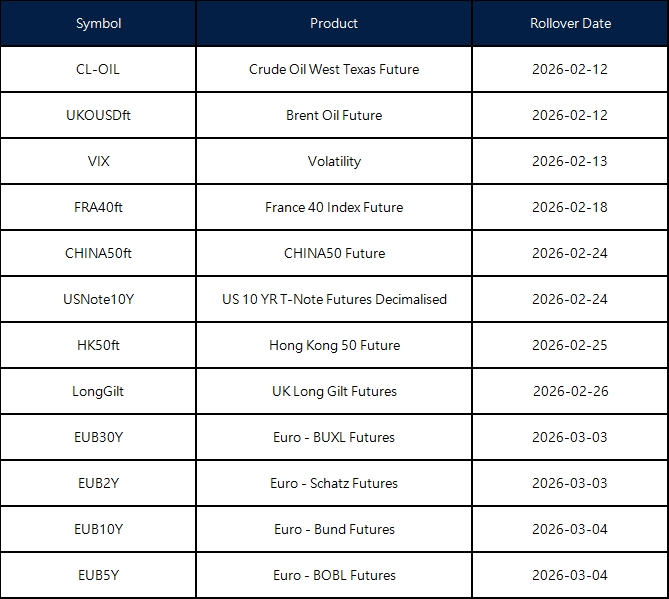
February Futures Rollover Announcement – Feb 09 ,2026

Dear Client,

New contracts will automatically be rolled over as follows:

February Futures Rollover Announcement

Please note:
• The rollover will be automatic, and any existing open positions will remain open.
• Positions that are open on the expiration date will be adjusted via a rollover charge or credit to reflect the price difference between the expiring and new contracts.
• To avoid CFD rollovers, clients can choose to close any open CFD positions prior to the expiration date.
• Please ensure that all take-profit and stop-loss settings are adjusted before the rollover occurs.
• All internal transfers for accounts under the same name will be prohibited during the first and last 30 minutes of the trading hours on the rollover dates.

The above data is for reference only. The actual rollover date shall be subject to the Liquidity Provider’s determination.

If you’d like more information, please don’t hesitate to contact [email protected].

Pound Sterling weakens to about 1.3605 due to expected Bank of England rate cuts

The GBP/USD pair is trading lower, around 1.3605, early on Monday in Europe. A potential interest-rate cut by the Bank of England is affecting the Pound Sterling against the US dollar. The Bank of England was expected to keep interest rates steady at 3.75%. However, not enough Monetary Policy Committee members supported this decision. Last week’s central bank meeting maintained rates at 3.75% but hinted at possible cuts to control inflation at 2% over the medium term.

Speculation About Rate Cuts

GBP/USD fell to about 1.3610 during the early Asian session, driven by speculation about a Bank of England rate reduction. There are also expectations for more insights from the US Federal Reserve. The pair has seen notable swings, losing nearly 200 pips as demand for the US dollar rose. This follows a peak of 1.3869 in January. A shift in focus from overvalued growth assets to value assets has boosted the US dollar, impacting GBP/USD levels. With the Bank of England’s cautious approach, the Pound Sterling is under continued pressure. The market’s current narrative centers around a rate cut in March, suggesting any short-term strength in GBP/USD should be seen as a selling opportunity. Traders might consider buying put options on GBP/USD, with expiration dates after the March BoE meeting. Strike prices around 1.3500 or even 1.3450 could be profitable if the central bank follows through with expected cuts. This strategy helps capitalize on downward momentum while clearly defining maximum risk.

The Strength of the US Dollar

The strength of the US dollar contributes to the bearish outlook for this pair. Recent data indicates that the US economy added a strong 210,000 jobs in January 2026, keeping the unemployment rate low at 3.7%. This starkly contrasts with the UK’s economic situation, highlighting the policy divergence between the Fed and the BoE. In the UK, the latest Consumer Price Index (CPI) numbers show inflation falling to 3.1%, giving the BoE more leeway to ease its policies. This data suggests the central bank is preparing to cut rates to support the economy, making the dollar more attractive than the pound. This marks a significant shift from the strong pound sentiment seen in the latter half of 2025. The recent drop from the 1.3869 high signals a change in market expectations for the pound. Another strategy is to sell GBP/USD futures contracts, betting directly on the price decline. Increased volatility, shown by the recent 200-pip drop, means traders should brace for sharp movements. This trend of capital moving into the safe-haven dollar is likely to continue in the coming weeks. Create your live VT Markets account and start trading now.

here to set up a live account on VT Markets now

Gold prices increased today in Saudi Arabia based on data from various sources.

Gold prices in Saudi Arabia went up on Monday, according to FXStreet data. The price per gram rose to 604.53 Saudi Riyals (SAR) from 597.25 SAR on Friday. The cost per tola increased to SAR 7,051.11 from SAR 6,966.25. The price for a troy ounce was recorded at SAR 18,802.91.

FXStreet Data Update

FXStreet updates international gold prices (USD/SAR) to match the local currency and measurement units. Prices refresh daily but are for reference only, since local rates may vary slightly. Gold is a commonly used store of value and a safe investment. It is considered a good choice during uncertain times and serves as protection against inflation and currency loss. Central banks hold the most gold, adding 1,136 tonnes worth about $70 billion to their reserves in 2022. The largest purchases came from China, India, and Turkey. Gold tends to move opposite to the US Dollar and US Treasuries. Typically, gold prices rise when the Dollar weakens and drop during stock market upswings. The price of gold is affected by geopolitical issues, interest rates, and the strength of the US Dollar. Lower interest rates can drive gold prices up, while a strong Dollar can keep them down.

Factors Influencing Gold Prices

Gold is gaining strength, showing its role as a safe investment during tough times. The increased market volatility since the start of this year is drawing attention to this trend. Traders should see this as a sign that market sentiment may be shifting away from riskier assets. Gold prices are highly tied to interest rates since it does not provide any yield. Recent comments from the Federal Reserve in late January 2026 suggested a potential rate cut in the second quarter due to slowing manufacturing data. A forecast for lower interest rates makes holding gold more appealing in the weeks ahead. We also need to factor in gold’s inverse relationship with the US Dollar. The Dollar Index (DXY) has fallen over 3% since the new year, which usually helps gold prices. A weaker Dollar means gold is cheaper for buyers using other currencies, often leading to higher global demand. Central bank demand offers solid support for the gold market. After historic purchases in 2022, central banks continued to buy heavily through 2025, adding nearly 950 tonnes to their reserves. This ongoing trend of moving away from the Dollar shows strong interest from institutions. Given that major stock indices have become more volatile and the VIX volatility index recently reached 20, gold’s inverse relationship with risk assets is essential. Derivative traders might want to adopt strategies that take advantage of this situation, such as buying call options on gold futures or ETFs, allowing them to benefit from possible price increases with defined risk. This can also act as a hedge against further weakness in the stock market. Create your live VT Markets account and start trading now.

here to set up a live account on VT Markets now

Gold prices in the Philippines increased today, according to data from various sources.

Gold prices in the Philippines have risen. The price increased to 9,416.65 Philippine Pesos per gram, up from 9,306.78. For tola, prices went up to 109,833.90 PHP from 108,552.50 PHP. This information comes from FXStreet, which calculates international gold prices and converts them into local currency and measurements. Price updates reflect current market rates, though there may be slight local differences.

The Role of Gold as a Safe Haven Asset

Gold has always been important in history as a value store and medium of exchange. It is considered a safe-haven asset, especially during economic uncertainty. In 2022, central banks added a total of 1,136 tonnes of gold, worth around $70 billion, to their reserves. Several factors influence gold prices, including geopolitical issues, interest rates, and changes in the US Dollar. Generally, when the US Dollar and stocks decline, gold prices tend to rise. Lower interest rates can also boost gold prices since it is a non-yielding asset. The recent increase in gold prices indicates that it is functioning as a classic safe-haven asset. The ongoing weakness of the US Dollar and expectations that the Federal Reserve will cut rates are mainly driving gold prices above $5,000. Derivative traders should see this as a momentum opportunity driven by broader economic trends. The steady demand from central banks, especially from the People’s Bank of China, creates a strong foundation for gold prices. Historical data shows this trend solidified through 2024 and 2025, after central banks purchased nearly 1,037 tonnes in 2023. This continued demand suggests that price dips may be viewed as buying chances.

Market Implications and Strategies

As a non-yielding asset, gold’s trajectory is largely determined by interest rate expectations. A more dovish Federal Reserve makes gold more appealing. Therefore, long-dated call options could be a good strategy to capitalize on further price increases if rate-cut expectations become solid. The negative correlation with the US Dollar is also crucial. A weaker dollar makes gold cheaper for holders of other currencies, supporting the current price rise. Traders might consider strategies that benefit from both rising gold prices and a falling dollar, such as buying Gold futures while selling US Dollar Index (DXY) futures. Given the high price, implied volatility will be significant, leading to expensive options. Using credit or debit spreads on gold derivatives might be wise. This strategy allows participation in upward trends while controlling risk and managing high options premiums. Create your live VT Markets account and start trading now.

here to set up a live account on VT Markets now

Gold prices rise today in the United Arab Emirates, according to recent data analyses.

Gold prices in the United Arab Emirates increased on Monday to **592.12 AED** per gram, according to FXStreet data. This is up from **584.96 AED** per gram on Friday. In local terms, the price was **6,906.37 AED** per tola, rising from **6,822.84 AED** the previous trading day. FXStreet updates global gold prices (USD/AED) daily, adjusting them based on market trends. Historically, gold has been a safe store of value and a means of exchange. It serves as a refuge during economic instability and guards against inflation and currency decline, as it is not linked to any specific government or issuer. Central banks are the biggest holders of gold, as it helps enhance currency trustworthiness. In 2022, they added **1,136 tonnes** of gold to their reserves to support economic stability, especially during times of currency fluctuation. Gold often moves in the opposite direction of the US Dollar and Treasuries; when these assets drop, gold prices tend to rise. It can also react to global events and changes in interest rates, usually rising with concerns about recessions or falling interest rates. Gold prices reflect changes in the US Dollar since it is priced in global markets. A strong dollar can lower gold prices, while a weak dollar often raises them. Currently, gold prices are stabilizing, indicating a trend that extends beyond today’s increase in the UAE. The US Dollar Index has dropped significantly from its 2025 peak to around **101.5** recently. This inverse relationship is a major factor driving gold’s strength. The market is responding to new data highlighting a slowing US economy. Notably, the January jobs report revealed only **85,000** new jobs added. This has increased speculation that the Federal Reserve may need to consider cutting rates sooner than expected. As an asset that does not yield interest, gold becomes more appealing with lower rates. The latest Consumer Price Index data from January shows inflation stubbornly remains above the Fed’s target at **3.1%**. This combination of slowing growth and ongoing inflation creates market uncertainty, increasing the demand for gold as a hedge against economic difficulties and currency devaluation. Central bank purchases continue to provide strong support for the market, a trend visible throughout 2025. The World Gold Council’s latest report indicated that central banks, especially from emerging markets, added **290 tonnes** in the last quarter of last year. This steady demand suggests a strategic shift toward diversifying reserves away from the dollar. For traders, this environment signals that implied volatility in gold options is likely to rise in the coming weeks. We should expect larger price fluctuations as the market processes mixed economic signals. Bullish strategies, such as buying call options or creating bull call spreads, could help take advantage of potential price increases while managing risk. Given the inverse relationship with risk assets, gold derivatives can also serve as a useful hedge against possible weaknesses in equity markets. Last year, stock indices like the Nikkei 225 reached record highs, and some portfolios may now be overexposed. Using options to safeguard against a market downturn is a wise approach in this environment.

here to set up a live account on VT Markets now

EUR/USD trades above 1.1800 with positive momentum and modest gains during Asian hours

The EUR/USD pair is currently trading near a flat nine-day Exponential Moving Average (EMA), while the 50-day EMA is rising, indicating a positive trend. The 14-day Relative Strength Index (RSI) is at 54, which shows that bullish momentum is growing. If the price drops below the nine-day EMA at 1.1822, it may fall to the 50-day EMA around 1.1746. Right now, the pair is around 1.1820 during Asian trading hours, and if the RSI goes above 60, it could signal stronger bullish control. The daily chart analysis shows that the pair remains on an upward trend by staying above the 50-day EMA. The short-term average is above the medium-term average, which supports this trend. If it breaks above the nine-day EMA at 1.1822, it may gain more ground toward 1.2082, the highest point since June 2021. On the other hand, a drop below the short-term average could shift focus to lower support levels, including a three-month low of 1.1578 from January. Today, the Euro has fluctuated against major currencies, standing strong against the British Pound. The percentage change for the EUR against the USD is -0.02%. A heat map shows these changes, with the Euro showing small gains or losses against various currencies. Currently, the EUR/USD pair is balanced, trading near 1.1820. The flat nine-day average indicates consolidation, while the rising 50-day average at 1.1746 acts as a support level. This suggests a slight upward trend, but traders should be ready for sideways movement before a significant breakout. Recent economic data supports a stronger Euro, hinting at a possible upward move. The latest Eurozone inflation figures for January 2026 show a persistent 2.8% year-over-year rate, which is slightly above expectations. This has caused the European Central Bank to adopt a more hawkish stance. In contrast, the U.S. consumer price index has moderated to 3.0%, suggesting that the Federal Reserve might be close to easing its policies. Given this mix of mild bullish sentiment and technical consolidation, a bull call spread could be a good strategy. You might consider buying a call option with a strike price just above the current level, like 1.1850, while simultaneously selling a call with a higher strike, such as 1.2000, for the same expiration date. This strategy limits your risk and allows you to profit from a gradual rise toward the 1.2082 area. It’s important to remember the price action from the second half of 2025, where similar rallies stalled due to a lack of strong economic support. The sharp decline from the peak in July 2025 is a reminder that these levels can attract sellers. This past resistance emphasizes the importance of using defined-risk option strategies rather than holding unhedged long positions. If you’re worried about a potential drop below the key level of 1.1822, buying put options can act as effective insurance. A break of this support level would first target the 50-day average at 1.1746, with the possibility of a deeper slide toward the January low of 1.1578. Purchasing puts with a strike around 1.1700 is a cost-effective way to protect against this downturn. Currently, implied volatility in the currency pair is low, with the Deutsche Bank FX Volatility Index around 6.5. This makes buying options relatively cheap, favoring strategies like the bull call spread or outright buying puts for hedging. In this environment, paying a small premium for protection or directional bets is more appealing than selling options.

here to set up a live account on VT Markets now

Gold prices in Pakistan increased today according to data from various financial sources.

Gold prices in Pakistan rose on Monday, reaching 44,955.57 Pakistani Rupees (PKR) per gram. This is an increase from 44,399.05 PKR per gram on Friday. The price for one tola of gold went up from 517,861.80 PKR on Friday to 524,353.00 PKR. FXStreet updates gold prices daily, converting international prices into local currency using current market rates. They provide different unit measures as well, with 10 grams priced at 449,567.80 PKR and a troy ounce at 1,398,270.00 PKR. Keep in mind that local rates may vary slightly.

Gold as a Reliable Asset

Gold is viewed as a safe investment during economic downturns. It helps protect against inflation and depreciation of currency. Central banks often hold a lot of gold; in 2022, they added 1,136 tonnes to their reserves. Countries like China, India, and Turkey are increasing their gold reserves quickly. The price of gold usually moves in the opposite direction of the US Dollar and US Treasuries. When the Dollar weakens, gold prices tend to rise, making it a good option during uncertain times. Economic factors like political instability and interest rates also affect gold’s value. With the recent rise in gold prices, this trend seems likely to continue due to a weaker US Dollar and expectations of interest rate cuts by the Federal Reserve. Looking back to 2025, the US Dollar Index (DXY) has consistently fallen from its previous highs and is currently trading in the 97.00 to 98.00 range. Traders should prepare for sustained high prices, as strong fundamentals support gold. This upward pressure is backed not just by speculation but by high physical demand from central banks. Last year, central banks globally added another 1,050 tonnes to their reserves, nearing the record pace of previous years. This steady buying helps set a strong price floor, suggesting limited downside risk. Therefore, buying call options during price dips may be a wise strategy.

Market Signals and Strategies

However, it’s important to note the mixed signals in the broader market. Equity indices like the Nikkei 225 reached all-time highs last week. This difference shows that gold’s rise is mainly driven by geopolitical issues and trends toward de-dollarization, rather than just a general move away from risk. This could increase volatility, making strategies like straddles or strangles appealing for traders expecting significant price movements in either direction. Currently, the market anticipates a high likelihood of a Fed rate cut in the second quarter, especially after last month’s core inflation data dropped to 2.9% annually. As a non-yielding asset, gold becomes more appealing when interest rates fall, lowering its opportunity cost. Therefore, any confirmation that the central bank will soften its stance should be seen as a strong positive signal for gold futures. Create your live VT Markets account and start trading now.

here to set up a live account on VT Markets now

Gold prices in India increased today, according to compiled data.

Gold prices in India went up on Monday, according to FXStreet data. The price per gram rose to 14,628.42 Indian Rupees (INR) from 14,439.99 INR on Friday. The price per tola increased to 170,622.60 INR from 168,425.20 INR. These prices are based on global market rates (USD/INR) and are updated daily.

Gold As A Store Of Value

Gold is often viewed as a safe investment and a reliable option during tough times. It acts as a buffer against inflation and currencies losing value. Central banks hold significant gold reserves to back their currencies. In 2022, they added 1,136 tonnes of gold, worth $70 billion, as reported by the World Gold Council. Major reserves are held by emerging economies, including China and India. Gold typically moves in the opposite direction of the US Dollar and Treasuries. When the Dollar weakens, gold prices often rise. Changes in risk assets can also affect gold’s value, usually leading to price increases during uncertain times. Interest rates and global events can greatly impact gold prices. A strong Dollar tends to lower gold prices, while a weaker Dollar can boost them.

Market Expectations And Gold Trends

The recent rise in gold prices is a trend we’ve expected. This movement ties into broader market changes in monetary policy. Derivative traders should see this as a continuation of a trend that began in the second half of 2025, rather than a temporary increase. Looking back, the interest rate cuts by the US Federal Reserve in 2025 have mainly driven this change. With the benchmark rate now at 4.25%, gold’s appeal as a non-yielding asset has increased significantly. This suggests that call options on gold futures might see more activity and potential value soon. We also need to consider ongoing inflation, which, although lower, has carried over into this year. The most recent US inflation data from January 2026 showed a rate of 3.2%. While this is manageable, it still encourages investors to look for ways to protect their capital, strengthening gold’s attractiveness and supporting a positive outlook. Strong demand from central banks continues to provide a solid price foundation. In 2025, they added another 950 tonnes to their reserves, marking the fourth year of robust buying. This institutional demand, especially from emerging economies, offers stability that may cushion short-term price drops. The recent price trends also reflect a weakening US Dollar. The Dollar Index (DXY) has been declining since the Fed changed its policy in late 2025, creating favorable conditions for gold. Traders can expect this inverse relationship to continue, meaning further Dollar weakness may lead to higher gold prices. Additionally, ongoing trade negotiations create geopolitical uncertainty, driving investors toward safe assets. We saw in 2025 how quickly money moved into gold during market stress. This situation makes holding long positions appealing and suggests that put options could struggle in the current market. Create your live VT Markets account and start trading now.

here to set up a live account on VT Markets now

USD/CAD sees slight increase to around 1.3660 amid mixed Canadian employment figures during early trading

USD/CAD saw some gains near 1.3660 during early European trading on Monday. Canadian employment data showed a loss of 24,800 jobs in January, but the unemployment rate surprisingly dropped to a 16-month low of 6.5%. Federal Reserve Vice Chair Philip Jefferson stated that interest rates are currently neutral. Mary Daly from San Francisco hinted at possible rate cuts. Market watchers are eager for more information from upcoming Fed speeches and the US employment report due on Wednesday. The delayed US employment report is expected to show 70,000 new jobs for January, with the unemployment rate holding steady at 4.4%. The job losses in Canada were mainly in part-time positions, and the lower unemployment rate reduced the chances of aggressive easing by the Bank of Canada, which supported the Canadian Dollar (CAD). The CAD is affected by the Bank of Canada’s interest rates, the price of oil, and overall economic health. Higher oil prices and better economic data usually strengthen the CAD. Bank of Canada’s interest rate decisions also play a crucial role in controlling inflation and affecting credit conditions. Key economic indicators, like GDP and employment data, influence the CAD’s path. Looking back to early 2025, the market faced mixed signals for the USD/CAD pair. The Canadian economy had odd job losses paired with a declining unemployment rate, and Federal Reserve officials disagreed on interest rate policies. This created uncertainty around the 1.3660 level. In 2025, some dovish remarks from Fed members didn’t materialize right away, as persistent services inflation kept the Fed from changing rates until a modest quarter-point cut in late September. US core inflation remained stubborn at about 3.1%, well above the Fed’s target. This environment indicates that expectations for major US rate cuts soon may be too optimistic, supporting the US dollar. On the Canadian front, the Bank of Canada began easing in July 2025 but has been cautious due to housing market inflation concerns. Additionally, WTI crude oil prices struggled to stay above $75 per barrel due to slowing global demand forecasts for 2026. The combination of weaker oil prices and a cautious Bank of Canada limits the potential for the CAD to rise, keeping USD/CAD around 1.3800. With differences in central bank strategies and ongoing uncertainty in energy markets, traders should consider strategies that can profit from significant price movements in either direction. Options like straddles or strangles on USD/CAD could be beneficial, as they profit from a breakout regardless of direction. Implied volatility has been rising ahead of next month’s central bank meetings, highlighting market tension. The upcoming US non-farm payrolls report will be crucial. A strong report showing over 200,000 new jobs could diminish the likelihood of near-term Fed rate cuts. We recall that a surprisingly strong jobs report in summer 2024 led to a rapid 150-pip jump in USD/CAD in a single day. A similar scenario now could push the pair toward the 1.4000 resistance level.

here to set up a live account on VT Markets now

Gold prices increased today in Malaysia according to data from various sources.

Gold prices in Malaysia have gone up, now sitting at 635.22 MYR per gram. This is higher than Friday’s price of 627.32 MYR. The price per tola also increased, moving from 7,316.96 MYR to 7,409.69 MYR. FXStreet determines Malaysian Gold prices by converting international rates to MYR and local measurements. These rates get updated daily and reflect market conditions at the time of publication, though local prices might differ slightly.

Gold As A Safe Haven Asset

Gold is prized as a safe-haven asset and a way to protect against inflation. Central banks, especially those in emerging economies like China, India, and Turkey, have quickly built their Gold reserves, buying 1,136 tonnes worth around $70 billion in 2022. The price of Gold tends to move in the opposite direction of the US Dollar and US Treasuries. Various factors influence Gold prices, including geopolitical tensions, worries about recessions, and interest rates. When the US Dollar weakens, Gold prices often rise. FXStreet offers different market updates, but this content is not meant to serve as investment advice. The team also discusses other financial topics like currency exchange and trends based on economic indicators and market changes.

Recent Market Movements

The recent rise in Gold prices reflects a significant global trend. Gold has just broken through the important psychological barrier of $5,000 per ounce. This shows strong momentum that traders should watch in the coming weeks. Central bank purchases are a key factor driving this market strength. In 2025, we saw these banks add over 1,000 tonnes of Gold. Recent data from the World Gold Council indicates that another 250 tonnes were bought in the last quarter alone. This ongoing demand from official entities supports a solid price floor. Expectations of a dovish Federal Reserve are fueling this rally. The latest January 2026 Consumer Price Index (CPI) data came in softer than expected at 2.1%. As a result, the futures market now sees an 85% chance of a rate cut in the March Federal Open Market Committee (FOMC) meeting. Lower interest rates make Gold, which doesn’t earn interest, more attractive. This trend is strengthened by a noticeable weakness in the US Dollar. The Dollar Index (DXY) has recently fallen below the critical 95.00 support level, a shift from the highs seen in 2024. As long as the Dollar remains weak, it creates favorable conditions for Gold priced in USD. With this strong bullish sentiment, it might be wise to consider buying call options to benefit from potential price increases. Look at contracts for March and April 2026 with strike prices around $5,100 and $5,200. Implied volatility is rising, so getting in now could be beneficial before it becomes more expensive. To manage risk, we could use bull call spreads to limit potential losses. Traders should also stay alert for any changes in Fed signals towards a more hawkish approach. A surprise move by the central bank or a sudden rebound in the Dollar would signal a need to hedge long positions. Create your live VT Markets account and start trading now.

here to set up a live account on VT Markets now

Back To Top
server

Hello there 👋

How can I help you?

Chat with our team instantly

Live Chat

Start a live conversation through...

  • Telegram
    hold On hold
  • Coming Soon...

Hello there 👋

How can I help you?

telegram

Scan the QR code with your smartphone to start a chat with us, or click here.

Don’t have the Telegram App or Desktop installed? Use Web Telegram instead.

QR code