Back

Canadian Dollar strengthens as USD/CAD dips near 1.3655, with Hormuz tensions challenging US-Iran ceasefire confidence

USD/CAD traded lower near 1.3655 in Asian hours on Wednesday. Tensions in the Strait of Hormuz supported the commodity-linked Canadian dollar against the US dollar.

US President Donald Trump said he would extend the ceasefire with Iran until talks progress. He also said the US would keep a blockade on ships travelling to and from Iran in the Strait of Hormuz.

Strait Of Hormuz Tensions

A White House official said US Vice President JD Vance’s trip to Pakistan would not take place on Tuesday. Ongoing uncertainty around US-Iran talks supported the Canadian dollar, as Canada is a major oil exporter and higher crude prices often boost the currency.

US retail data added support for the US dollar. US Retail Sales rose 1.7% month-on-month in March, after a 0.7% rise in February (revised from 0.6%), and above the 1.4% forecast.

On an annual basis, Retail Sales increased 4.0% in March. This matched the 4.0% rate recorded in February.

We are seeing a classic standoff in the currency markets, with strong fundamental data from the US clashing directly with geopolitical risks that favor the Canadian dollar. The powerful US retail sales report for March suggests the American economy is running hot, which typically supports the US dollar. However, the ongoing blockade in the Strait of Hormuz is keeping a firm bid under crude oil, directly benefiting the loonie.

Options And Volatility

The oil situation is critical, with WTI crude recently pushing above $95 per barrel, a level not seen since late last year. Last week’s EIA report showed a surprise inventory draw of over 3 million barrels, much larger than anticipated, suggesting supply is indeed tightening due to the Mideast tensions. This provides a strong tailwind for the Canadian dollar that is difficult to ignore.

On the other side of the trade, the Federal Reserve will be looking closely at the 4.0% annual jump in retail sales. Following the strong jobs report earlier this month, we believe this reduces the probability of any near-term rate cuts and keeps the door open for a more hawkish stance. This fundamental strength is putting a floor under the USD/CAD pair around the 1.3600 level.

Given this uncertainty, implied volatility on USD/CAD options has begun to climb, recently ticking up to over 8.5% for one-month contracts. For derivative traders, this suggests that strategies that profit from a significant price move, regardless of direction, could be attractive. A long straddle or strangle using June expiry options allows a trader to capitalize if either the oil shock or the US economic data forces a breakout from the current range.

For those with a directional bias, we see an opportunity in using options to express a view with defined risk. If we believe the geopolitical oil premium will expand further, buying out-of-the-money CAD call options offers a low-cost way to position for a drop in USD/CAD. Conversely, traders who feel the US economic strength will ultimately win out could consider selling CAD call spreads to collect premium while capping potential losses.

Looking back, we saw a similar dynamic in the summer of 2025 when tensions first flared, but the impact was muted by concerns over a global slowdown. Today’s environment is different because the underlying US economic strength is much clearer. Therefore, we must be prepared for a sharp move and not assume past correlations will hold perfectly.


Create your live VT Markets account and start trading now.

With the US-Iran ceasefire continuing, the Dollar Index hovered near 98.40 after earlier modest gains

The US Dollar Index (DXY), which tracks the US Dollar against six major currencies, steadied after modest gains and traded near 98.40 during Asian hours on Wednesday. It was reported around 98.50 as the session progressed.

The move followed a report that President Donald Trump will extend the US-Iran ceasefire until talks show progress. Earlier the same day, he said, “I expect to be bombing” if Iran did not meet his demands, and said the military was “raring to go.”

Geopolitical Uncertainty And Ceasefire Talks

Uncertainty over the talks remains. The US blockade on Iranian vessels continues, and a planned second round of negotiations did not go ahead.

Reports said Vice President JD Vance cancelled a planned visit to Islamabad after Tehran informed Washington via Pakistan it would not attend. Iran’s military warned of a powerful attack on predetermined targets following repeated threats from Trump.

The US Dollar also took support from US Retail Sales data published on Tuesday. Retail Sales rose 1.7% month-on-month in March versus 0.7% in February, above the 1.4% forecast.

The February gain was revised from 0.6% to 0.7%. Year-on-year Retail Sales increased 4.0% in March, the same as February.

Looking Back To The 2025 Dollar Backdrop

Looking back to this time in 2025, we were watching the US Dollar Index hover near a strong 98.50, propped up by geopolitical tensions and robust retail sales figures. The ceasefire with Iran was the main story, creating day-to-day uncertainty that kept safe-haven demand for the dollar high. The market was pricing in risk from a potential conflict, which overshadowed underlying economic shifts.

The situation today is quite different, with the dollar now trading closer to 96.00 as of this week. While the US-Iran diplomatic channels have stabilized, the economic landscape has softened considerably, with Q1 2026 GDP growth coming in at a revised 0.8% and recent inflation data showing a cooling trend. This contrasts sharply with the strong 1.7% monthly retail sales growth we saw in March of 2025.

This shift suggests that implied volatility on currency pairs like EUR/USD is lower now than during the geopolitical flare-ups of 2025. We believe traders should consider buying options, such as straddles, ahead of next week’s inflation data release, as a drop in volatility has made these strategies cheaper. A downside surprise in the data could significantly weaken the dollar, and these positions would capitalize on the resulting price swing.

With the market now pricing in a greater than 60% chance of a Federal Reserve rate cut by the third quarter, futures traders should be positioned for further dollar weakness. We are seeing increased open interest in short US Dollar Index futures contracts. A break below the key 95.80 support level could trigger a new wave of selling.

Given the calmer geopolitical front, the primary risk is now economic. Hedging long dollar positions with out-of-the-money puts on the DXY offers a cost-effective way to protect against a sharper-than-expected economic slowdown. This is a reversal of last year’s strategy, where a primary hedge was against a sudden military escalation.

Create your live VT Markets account and start trading now.

Australia’s Westpac Leading Index fell 0.1% month-on-month in March, slightly below the previous 0.08% decline

Australia’s Westpac Leading Index fell by 0.1% month-on-month in March. The previous reading was -0.08%.

This shows a small further decline compared with the prior month. The index remained below zero in both months.

Leading Index Signals Slower Growth Ahead

The March leading index has weakened further to -0.1%, continuing the negative trend and signaling a higher probability of economic slowdown for Australia in the second half of the year. For us, this data, released today, April 22, 2026, reinforces a cautious outlook. This trend suggests that the lagged effect of the RBA’s aggressive rate hikes, which we saw throughout 2025, is now clearly dampening forward momentum.

This forecast for slower growth will likely increase pressure on the Reserve Bank of Australia to consider an interest rate cut later this year, despite recent Q1 2026 inflation data showing a still-sticky 3.4% annual rate. We should therefore consider positioning in interest rate futures that would benefit from a more dovish RBA stance. Buying Australian government 3-year bond futures could be a viable strategy to anticipate this potential shift in monetary policy.

A more dovish RBA puts downward pressure on the Australian dollar, especially as other central banks may hold rates higher for longer. The AUD has been trading around the 0.6550 mark against the US dollar, but this economic data could be the catalyst for a break lower. Consequently, we see opportunities in derivatives that profit from a weaker currency, such as buying AUD/USD put options.

For equities, a slowing economy directly threatens corporate earnings and could stall the ASX 200’s recent rally. The latest March 2026 jobs report, which showed the unemployment rate ticking up to 4.2%, already points to softening domestic demand.

Equity Markets And Hedging Considerations

This environment justifies using index derivatives for hedging, such as short-selling SPI 200 futures contracts to protect portfolios against a potential market downturn.

Create your live VT Markets account and start trading now.

Apple Slides on CEO Transition

Key Points

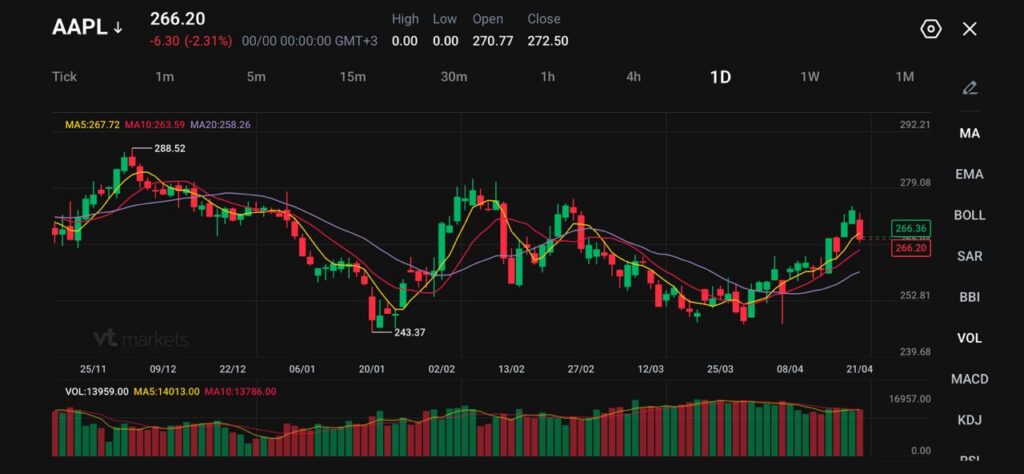
  • AAPL closed at 266.20, down 6.30 (-2.31%), rejecting levels near 270.77–272.50.
  • CEO transition to John Ternus draws mixed reaction as sentiment turns bullish on Stocktwits.

Apple’s latest session reflects a market that is still pricing uncertainty around leadership change, even as the broader narrative leans toward continuity. Shares closed at 266.20, down 6.30 points or -2.31%, after opening at 270.77 and briefly pushing toward a 272.50 close reference zone, before sellers stepped in.

The reaction came as Apple confirmed that John Ternus will take over as CEO on September 1, with Tim Cook moving into an executive chairman role. While major industry figures like Sundar Pichai and Satya Nadella publicly backed the transition, price action suggests traders are taking a more measured stance in the short term.

Wall Street’s response remains split. JPMorgan reiterated an Overweight rating, framing Ternus as a product-driven leader at a time when Apple faces pressure to deliver new hardware categories. At the same time, the stock still closed 2.5% lower on Tuesday, showing that institutional optimism has not fully translated into immediate price support.

Retail sentiment adds a different layer. Stocktwits sentiment flipped from neutral to bullish, hinting at growing confidence beneath the surface. That divergence between retail optimism and price weakness often creates a short-term tension in positioning.

Strategic Context Still Supportive

Beyond the chart, Apple’s long-term positioning remains anchored by strong fundamentals built during Cook’s tenure. Over the past 15 years, Apple’s market capitalisation has climbed by over 1,000% to nearly $4 trillion, while annual revenue has nearly tripled.

Strategically, Apple continues to deepen its ecosystem ties. The company earns upwards of $20 billion annually from keeping Google as the default search engine across its devices, and its late 2025 deal to integrate Google’s Gemini AI signals a push into next-generation features.

These developments matter because they reinforce the idea that Ternus inherits a well-established machine rather than needing to reinvent the business. However, markets tend to price execution risk early, especially when leadership changes coincide with major product cycles and AI competition.

Technical Outlook: Price Rejected at Highs

AAPL is trading near 266.20, pulling back slightly after a recent push higher that saw price test the upper end of its short-term range. Despite this latest dip, the broader structure has improved, with the stock recovering from the 243.37 low and building a sequence of higher lows.

From a technical standpoint, the bias is cautiously bullish in the near term. Price remains above the 20-day moving average (258.26), which has started to turn upward, suggesting a shift in momentum. The 5-day (267.72) and 10-day (263.59) are now clustered around current price, acting as immediate dynamic levels and reflecting short-term consolidation rather than a clear directional push.

Key levels to watch:

  • Support: 263.50 → 258.20 → 252.80
  • Resistance: 270.00 → 279.00 → 288.50

The stock is currently consolidating just below the 270 resistance zone, which has capped recent upside attempts. A clean break above this level could open the path toward 279.00, with further upside potential if momentum strengthens.

On the downside, 263.50 is acting as immediate support. A break below this level may lead to a deeper pullback toward the 258.20 area, though this would likely remain corrective as long as price holds above the rising 20-day average.

Overall, AAPL is transitioning into a recovery phase, with improving structure and higher lows supporting the case for further upside. The near-term focus is on whether price can clear 270 to confirm continuation, or if it remains range-bound while building a stronger base.

What Traders Should Watch Next

In the near term, the key question is whether Apple can reclaim the 270–272 zone or if this rejection develops into a deeper pullback.

A sustained move back above 267.72 (MA5) would signal that buyers are stepping back in quickly, keeping momentum intact. Failure to do so opens the door for a test of the 263.59 (MA10) and potentially the 258.26 (MA20) area.

If price holds above these moving averages, the broader uptrend remains intact, with buyers likely to attempt another push toward recent highs. If those levels break, it shifts focus toward a wider consolidation range, with 243.37 as the deeper support anchor.

The market is now balancing two forces: a structurally strong company entering a new leadership phase, and a chart that is pausing after a sharp recovery. How price behaves around these near-term levels will shape whether this becomes a continuation or a consolidation.

Create a live VT Markets account today to access our platform features, including market insights and educational content.

Trader Questions

Why did Apple stock fall despite positive CEO transition news?

Apple shares fell 2.31% to 266.20 as traders reacted to near-term uncertainty around leadership change. Even with strong backing for John Ternus, the stock rejected resistance near 270.77–272.50, suggesting profit-taking and cautious positioning.

Is John Ternus seen as a positive choice for Apple’s future?

Markets largely view Ternus as a continuity candidate. JPMorgan maintained its Overweight rating, highlighting his product focus as Apple faces pressure to deliver new hardware and AI-driven innovation.

What does the shift in retail sentiment mean for AAPL?

Stocktwits sentiment moved from neutral to bullish, indicating rising retail confidence. This can support price over time, but it does not always lead immediate market direction, especially when institutional flows remain cautious.

What key levels should traders watch for AAPL next?

Traders are watching whether price can reclaim the 270–272 zone. On the downside, support sits at 263.59 (MA10) and 258.26 (MA20). A deeper move could bring 243.37 back into focus.

How important is Apple’s partnership with Google?

Apple earns over $20 billion annually from keeping Google as the default search engine. Its 2025 Gemini AI deal also shows how central this relationship is for future product development and AI integration.

Start trading now – Click here to create your real VT Markets account

During early Asian trading, EUR/USD slips towards 1.1750 as US-Iran ceasefire and Hormuz fears persist

EUR/USD edged lower to near 1.1750 in early Asian trading on Wednesday. The Euro weakened against the US Dollar amid the US-Iran conflict and uncertainty over a possible Strait of Hormuz blockade.

US President Donald Trump said late Tuesday that he would extend a ceasefire with Iran indefinitely. The ceasefire had been due to expire the next day, while plans for fresh negotiations between the two countries collapsed.

Geopolitical Tensions Drive Safe Haven Flows

An aide to Iran’s top negotiator said the move was a “ploy to buy time”. Iran’s military warned of a powerful attack on predetermined targets, citing repeated threats by Trump.

Ongoing uncertainty around US-Iran talks may support demand for the US Dollar as a safe-haven currency. This could keep pressure on EUR/USD in the near term.

Markets are watching preliminary HCOB Purchasing Managers’ Index (PMI) readings from the Eurozone and Germany, due on Thursday. US S&P Global PMI data for April is also scheduled for release on Thursday.

Looking back at this time in 2025, we saw the EUR/USD pair under pressure near 1.1750 due to geopolitical tensions in the Middle East. That event served as a reminder of the US dollar’s status as a primary safe-haven asset during global uncertainty. The market’s focus at that point was on short-term risk, which temporarily overshadowed economic data.

Shifting Focus To Growth And Policy Divergence

The landscape has changed significantly over the past year. Those specific geopolitical risks have faded, and the market’s attention has pivoted to the starkly different economic paths of the US and the Eurozone. For instance, the US economy posted a resilient 2.1% annualized growth in the first quarter of 2026, while the Eurozone’s economy expanded by a mere 0.5% in the same period.

This economic divergence is now heavily influencing central bank policy and interest rate expectations. The US Federal Reserve is signaling it will hold rates higher for longer to combat persistent services inflation, especially after the latest jobs report showed a robust 260,000 positions added last month. In contrast, weaker inflation figures in the Eurozone have the European Central Bank openly discussing potential rate cuts before the end of the summer.

Given the current EUR/USD spot price around 1.0720, we should consider buying put options expiring in the next two to three months. This strategy allows us to profit from a continued decline in the pair, driven by the widening interest rate differential between the US and Europe. The next major technical support level we are watching is near 1.0600.

Furthermore, implied volatility in the currency markets is much lower now than during the geopolitical flare-up in 2025. The Cboe EuroCurrency Volatility Index (EVZ) is currently hovering near 5.8, a significant drop from the levels above 9 we saw during last year’s tensions. This low-volatility environment makes strategies like selling out-of-the-money call spreads on the EUR/USD attractive for earning premium while maintaining a bearish outlook.

We must remain vigilant for upcoming data releases that could alter this view. The next US Core PCE inflation report will be critical, as a higher-than-expected number would reinforce the Fed’s hawkish stance and likely accelerate the Euro’s decline. Conversely, any sudden signs of weakness in the US labor market could provide temporary relief for the shared currency.

Create your live VT Markets account and start trading now.

Japan’s adjusted merchandise trade balance swung to a ¥90.7B surplus, reversing February’s ¥374.2B deficit

Japan’s adjusted merchandise trade balance was ¥90.7bn in March. This was an improvement from ¥-374.2bn in the previous period.

The balance moved from a deficit to a surplus. This indicates imports and exports shifted in March compared with the prior period.

Implications For The Yen

We are seeing a major reversal in Japan’s trade balance, shifting from a large deficit of ¥374.2 billion to a ¥90.7 billion surplus for March. This is a powerful, unexpected signal that points to a stronger Japanese Yen. Derivative traders should prepare for significant upward pressure on the currency in the coming weeks.

Given this data, we would consider positioning for a lower USD/JPY exchange rate. Purchasing put options on USD/JPY offers a clear way to capitalize on a potential decline. For those with a more neutral-to-bearish outlook, selling out-of-the-money call options could be an effective strategy to collect premium while betting that the pair’s upside is now limited.

This trade surplus is supported by recent industry data showing Japanese auto exports rose 6.5% year-over-year, reflecting resilient global demand. At the same time, the cost of imports has been tempered by energy prices, with benchmark crude oil futures holding steady below $85 a barrel, a contrast to the price spikes we saw in early 2025. This combination of strong exports and manageable import costs provides a solid foundation for the yen.

Looking back, we can recall the market volatility in 2025 when even minor hints of policy normalization from the Bank of Japan triggered sharp yen rallies. This strong economic data could force the central bank’s hand, bringing forward expectations of a policy shift away from its ultra-loose stance. Such a move would act as a strong catalyst for further yen appreciation, a risk that option pricing may not yet fully reflect.

Nikkei Options And Hedging

For equity derivatives, the outlook for the Nikkei 225 is now more complex. A strengthening yen directly pressures the earnings of Japan’s large export-oriented corporations, which could create headwinds for the index. We might consider using options to hedge long equity positions or initiate strategies like a long put spread on Nikkei 225 futures to protect against a potential downturn driven by currency strength.

Create your live VT Markets account and start trading now.

Japan’s year-on-year imports rose 10.9% in March, beating the forecast 7.1% increase

Japan’s year-on-year imports rose by 10.9% in March. The increase was above the expected 7.1%.

This compares the value of goods brought into Japan with the same month a year earlier. The March outcome was 3.8 percentage points higher than the forecast.

Implications For Domestic Demand And Inflation

This significant jump in imports, well above what was anticipated, suggests Japan’s domestic economy might have more strength than we previously priced in. We should consider that this could be driven by either robust consumer and business demand or, more likely, the rising cost of goods due to the yen’s prolonged weakness. This unexpected figure introduces uncertainty, which typically leads to higher market volatility.

For currency traders, this data complicates the outlook for the yen. While a strong economy would normally support the currency, the yen’s value has remained stubbornly low, with USD/JPY hovering above 158 for most of the past year in 2025. This import data could be seen as evidence that the weak yen is now fueling significant imported inflation, putting pressure on the Bank of Japan to act more decisively.

The Bank of Japan has been extremely cautious, having only raised rates once since ending its negative interest rate policy back in 2024. With core inflation figures recently ticking up to 2.4%, this import surprise will increase speculation that another rate hike may come before the third quarter. We should watch for shifts in options pricing that reflect a higher probability of the BoJ tightening policy sooner than guided.

This creates a mixed signal for equity derivatives focused on the Nikkei 225. On one hand, strong domestic demand is a positive for corporate earnings and could support stock prices. On the other hand, the prospect of a more aggressive central bank tightening policy to combat inflation could put a ceiling on any rally. Therefore, we should prepare for a period of range-bound trading or increased choppiness in index futures.

Trading Considerations For Nikkei And FX Volatility

Create your live VT Markets account and start trading now.

In March, Japan’s annual exports rose 11.7%, exceeding the 11% forecast, according to reported figures

Japan’s exports rose 11.7% year on year in March. This was above the forecast of 11%.

The result indicates export growth was 0.7 percentage points higher than expected. The figures compare the same month in the prior year.

Implications For The Japanese Yen

The stronger-than-expected March export growth of 11.7% points to continued strength in the Japanese economy. This positive signal may lead to an appreciation of the Japanese Yen against other major currencies. We should consider positions that benefit from a stronger Yen, such as buying JPY call options or selling USD/JPY futures.

This export data is a significant tailwind for Japanese corporate earnings, especially for large manufacturers that dominate the Nikkei 225 index. With the Nikkei already having climbed over 7% year-to-date to break the 42,000 level, this news could fuel further upward momentum. We see this as an opportunity to purchase Nikkei 225 call options expiring in the next quarter.

However, this robust economic activity puts pressure on the Bank of Japan to consider tightening its monetary policy, especially with core inflation holding at 2.1%. Any hawkish commentary from the BoJ could spark significant volatility in the currency markets. Therefore, buying straddles on the USD/JPY pair could be a prudent strategy to profit from a large price move in either direction.

We must remember this export performance is directly linked to the Yen’s significant weakness throughout 2025, when it frequently traded above 155 to the dollar. That depreciation provided a powerful boost to the value of overseas sales when converted back into yen.

Key Risk To The Trade

A reversal of that currency trend is now the primary risk to this entire trade.

Create your live VT Markets account and start trading now.

On Tuesday, USD/JPY gained 0.37%, ending near 159.40 after peaking at 159.65 in US trade

USD/JPY rose 0.37% on Tuesday to about 159.40, after reaching 159.65 in the US session. It has traded in a range of roughly 158.55 to 159.65 over recent sessions.

President Trump extended a deadline for direct talks with Iran after Tehran did not attend new discussions. This reduced near-term worry about disruption in the Strait of Hormuz, while risk assets firmed and the US Dollar Index slipped.

Market Drivers And Macro Backdrop

US March Retail Sales rose 1.7% month-on-month versus a 1.4% forecast. Fed Chair-designate Kevin Warsh gave hawkish testimony to Congress.

Japan’s adjusted March trade figures are due late Tuesday. National CPI is due Thursday, with consensus at 1.8% year-on-year for the ex-fresh food measure versus 1.6% previously.

On the 15-minute chart, USD/JPY traded at 159.41, above the day’s open at 158.88. Stochastic RSI was near 36, with support around 159.41 and then 158.88.

On the daily chart, USD/JPY traded at 159.41, above the 50-day EMA at 158.20 and the 200-day EMA at 154.64. Stochastic RSI was near 27, with support near 159.40, then 158.20 and 154.64.

Technical Levels And Policy Focus

Looking back to April 2025, we saw USD/JPY consolidating below the 160 level as the market reacted to easing tensions with Iran and strong US data. Today, the situation has evolved significantly, with the pair having tested levels near 170 earlier this month, making direct intervention from Japanese authorities the primary market focus. The core drivers have shifted from broad risk sentiment to a direct standoff between currency speculators and the Ministry of Finance.

While the specific geopolitical concerns of 2025 have faded, the Yen has failed to benefit from its traditional safe-haven status amid other global uncertainties. The currency’s weakness is now overwhelmingly driven by the interest rate differential between Japan and the United States. This gap remains substantial, with the carry trade continuing to pressure the Yen despite the Bank of Japan’s historic policy shift.

The Bank of Japan did exit its negative interest rate policy earlier this year, a major move we were anticipating back in 2025, but it has not been enough to reverse the trend. With the US Federal Reserve holding rates firm and the 10-year US Treasury yield sitting near 4.5%, the roughly 3.6 percentage point gap over Japanese government bonds makes selling the Yen attractive. This fundamental picture suggests that any dips in USD/JPY will likely be seen as buying opportunities by many market participants.

Japan’s recent national CPI data, which came in at 2.5%, remains above the BoJ’s target but hasn’t signaled the kind of aggressive inflation that would force rapid rate hikes. This leaves currency intervention as the main tool for authorities to combat Yen weakness, creating significant event risk. We believe Japanese officials are highly likely to act should the pair make another concerted push toward the 170.00 level.

Given the high risk of a sudden, sharp reversal caused by intervention, holding long spot positions is dangerous. For derivative traders, buying downside protection through JPY call options (USD/JPY puts) is a prudent strategy to hedge against or speculate on a sharp drop. Although implied volatility has increased, making options more expensive, they provide a defined-risk method to position for a government-induced correction in the coming weeks.

Create your live VT Markets account and start trading now.

OCBC analysts warn USD/TWD’s declining wedge may reverse, as equities, inflows and tech exports bolster TWD

USD/TWD has been edging lower in recent sessions. This move has coincided with strong Taiwan equities, foreign inflows, and firm technology exports.

The Taiwan Dollar (TWD) has been moving more in line with the technology cycle again. TWD has also been supported by portfolio inflows and external trade fundamentals.

On the daily chart, bearish momentum remains in place. The Relative Strength Index (RSI) is near oversold levels.

Price action shows a falling wedge pattern, which is often linked to a bullish reversal. Support is seen around 31.40–31.50, where a bounce could occur.

The USD/TWD pair is grinding towards a critical support level between 31.40 and 31.50. This downward pressure is fueled by a strong Taiwanese technology cycle and significant foreign money flowing into local stocks. Fundamentally, the Taiwan Dollar appears well-supported by these factors.

We’ve seen data confirming this strength, as Taiwan’s exports for March 2026 surged 12% year-over-year on the back of incredible demand for AI-related semiconductors. Foreign investors also added a net $5.2 billion to Taiwanese equities in the first quarter of 2026, the highest level for that period in three years. This shows the fundamental story is currently very strong.

However, the chart is telling us to be cautious as the downward move may be exhausted. A falling wedge pattern is forming, which often signals a bullish reversal for the US dollar. The Relative Strength Index is also nearing oversold levels, suggesting the selling pressure could soon ease.

Given this conflict between strong fundamentals and stretched technicals, buying short-dated USD/TWD call options is a prudent strategy. This allows for participation in a potential rebound from the 31.40 support level. The risk is limited to the premium paid for the options, protecting from a continued slide if fundamentals win out.

For traders who believe the tech story will overwhelm the chart patterns, put options can be used to position for a break below the 31.40 support. This provides a leveraged bet on the trend continuing. A straddle, buying both a call and a put, could also be used to trade the potential for a sharp move in either direction.

We remember a similar situation back in late 2024, when strong fundamentals clashed with technical indicators suggesting a bounce. The pair traded sideways for weeks before robust export numbers eventually confirmed the trend and pushed the USD/TWD lower. This past price action suggests the fundamental story may ultimately prevail, but not without a potential period of consolidation first.

Back To Top
server

Hello there 👋

How can I help you?

Chat with our team instantly

Live Chat

Start a live conversation through...

  • Telegram
    hold On hold
  • Coming Soon...

Hello there 👋

How can I help you?

telegram

Scan the QR code with your smartphone to start a chat with us, or click here.

Don’t have the Telegram App or Desktop installed? Use Web Telegram instead.

QR code