

Week Ahead: AI Capital Spending Steers Risk Appetite

Artificial intelligence remains the dominant theme in equity markets, but the narrative is evolving. Investor focus has shifted away from lofty expectations around productivity gains and towards the underlying economics of the AI build-out.

This stage of the cycle is increasingly about infrastructure: data centres, energy demand, and chip supply, rather than software breakthroughs or headline innovation.

Large US technology firms are set to spend more than $400 billion this year on AI-related hardware, facilities, and power capacity, even as the revenue generated directly from AI remains relatively modest.

That gap has left valuations more exposed to earnings guidance and capital expenditure discipline. Traders are growing more cautious, mindful that AI adoption could take longer to translate into profits than current share prices suggest.

This backdrop goes some way towards explaining why US equity indices have struggled to hold breakouts.

The S&P 500 recently notched a fresh record high before retreating, signalling rising hesitation rather than a clear shift into risk aversion. Momentum is still positive, but tolerance for disappointment is narrowing.

For traders, AI continues to underpin the broader equity trend, while also acting as a potential volatility catalyst when expectations are revised lower.

Dollar Weakness Builds Ahead Of Key US Data

The US dollar starts the week under pressure, with the Dollar Index finding a base around the 97.90 area. Recent price action reflects growing confidence that the Federal Reserve may need to deliver further easing as labour market conditions cool.

This week’s Non-Farm Employment Change is expected to come in at 50K, down sharply from the previous 119K, while the unemployment rate is forecast to edge up to 4.5% from 4.4%.

An outcome close to these projections would reinforce concerns about slowing US growth and could extend downside pressure on the dollar.

While a softer dollar continues to support selected risk assets, traders remain hesitant to chase moves ahead of firm data confirmation.

Central Banks Add Cross-Currents To FX Markets

Monetary policy decisions elsewhere are adding complexity to currency markets. The Bank of England is widely expected to cut its Official Bank Rate to 3.75% from 4.00%, placing the emphasis on forward guidance rather than the decision itself.

Sterling’s reaction is likely to hinge on whether policymakers open the door to further easing in early 2026.

In Japan, the Bank of Japan is forecast to lift its policy rate to 0.75% from 0.50%. Any signal that policy normalisation will continue could support the yen and limit upside in USDJPY, particularly if US economic data disappoints.

Market Movements Of The Week

SP500
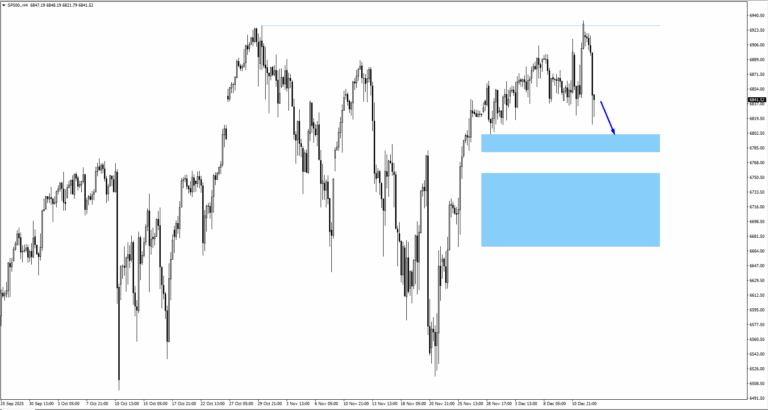
– The index made a fresh all-time high before pulling back sharply.
– AI-heavy stocks continue to drive direction, but valuations face tighter scrutiny.
– A sustained hold above 6,790 keeps upside open; failure may accelerate profit-taking.

Gold (XAUUSD)
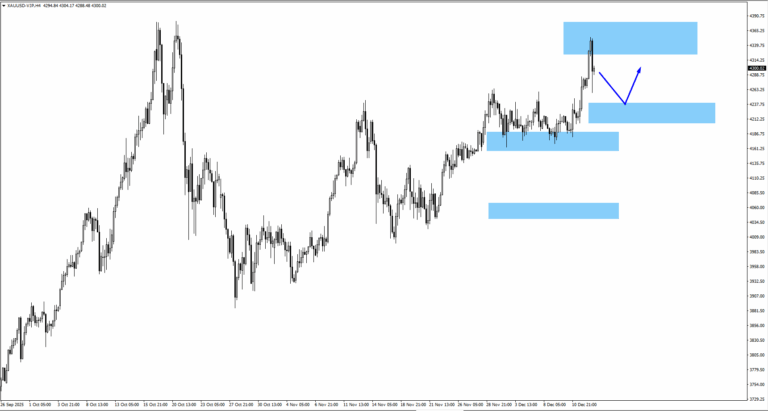
– Gold retreated from 4,360 and now consolidates near 4,220.
– Holding above this zone may open a move back toward 4,300.
– US data remains the primary short-term catalyst.

US Dollar Index (USDX)
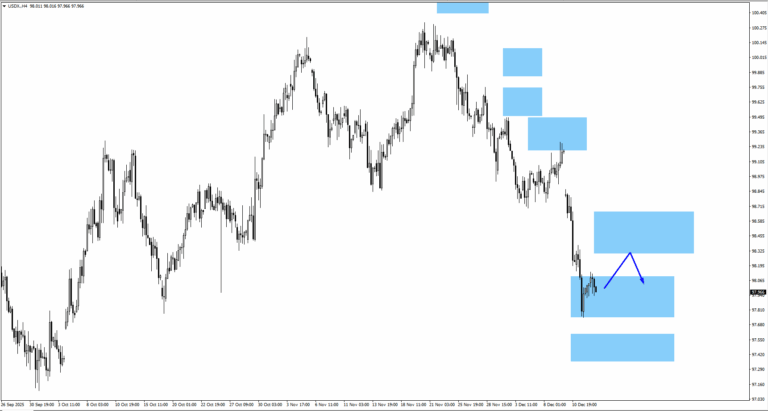
– USDX found support near 97.90 after last week’s decline.
– Resistance sits near 98.30 and 98.55.
– Weak labour data could expose the 97.40 area.

Bitcoin (BTCUSD)
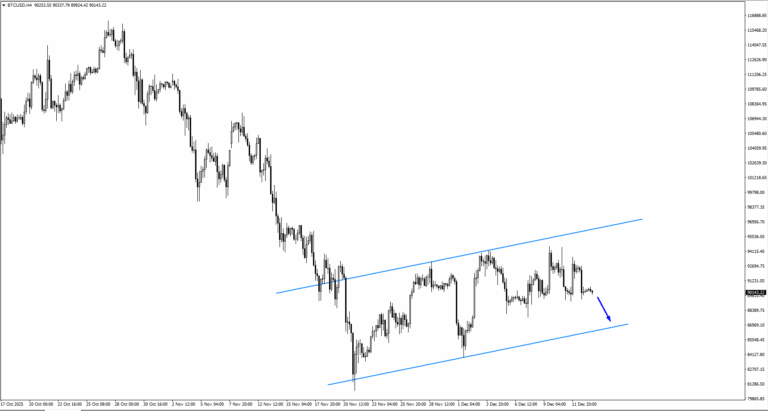
– Bitcoin continues to consolidate within a descending channel.
– A close below 87,712 could expose lower levels near the 70K handle.
– Recovery attempts depend on stabilising risk sentiment.

Key Events Of The Week

16 December

1. US Non-Farm Employment Change, Forecast: 50K, Previous: 119K

Soft data may extend USD weakness.

2. US Unemployment Rate, Forecast: 4.50%, Previous: 4.40%

Rising unemployment supports easing expectations.

18 December

1. UK Official Bank Rate, Forecast: 3.75%, Previous: 4.00%

Focus on BoE guidance beyond the cut.

2. US CPI y/y, Forecast: 3.00%, Previous: 3.00%

Stable inflation keeps policy outlook unchanged.

19 December

1. JP BOJ Policy Rate, Forecast: 0.75%, Previous: 0.50%

Hawkish signals may strengthen JPY.

Bottom Line

AI continues to provide a structural tailwind for US equities, but investors are becoming more selective as infrastructure costs rise and earnings expectations come under closer scrutiny.

Upcoming US labour and inflation data, alongside key central bank decisions, will be critical in determining whether current easing expectations remain justified.

A run of softer data could keep the dollar on the back foot while supporting gold and risk assets, whereas any upside surprise may trigger sharper pullbacks as positioning adjusts.


Create your live VT Markets account and start trading now.

In November, China saw a 1.3% increase in retail sales and a 4.8% rise in industrial production.

In November, China’s Retail Sales rose by 1.3% compared to last year, falling short of the expected 2.9% and matching October’s figures. Industrial Production increased by 4.8%, slightly below the predicted 5.0% but up from 4.9% in October. Fixed Asset Investment for November showed a year-to-date drop of 2.6%, worse than the expected -2.3% and down from -1.7% in October. This data had little effect on the Australian Dollar, which edged up by 0.03% against the US Dollar.

Australian Dollar Performance

The Australian Dollar performed differently against major currencies, weakening significantly against the Japanese Yen. If Chinese economic data exceeds expectations, the AUD/USD pair could rise, facing resistance at 0.6680 and 0.6707. The Australian Dollar’s value is influenced by the Reserve Bank of Australia’s interest rates, prices of resource exports like Iron Ore, and China’s economic health. A positive Trade Balance and good market sentiment can also boost the AUD. The Chinese economic data for November was weaker than expected, especially in consumer spending. Usually, this would suggest caution for the Australian Dollar due to Australia’s close trade ties with China. However, the market is currently more focused on other global factors. The Australian Dollar is stable mainly because the US Dollar is losing strength. There are widespread expectations that the US Federal Reserve will start to lower interest rates next year, a view that has dominated the markets recently. This situation creates a conflict for the AUD, balancing weak local data against a favorable global monetary policy outlook.

Iron Ore and Interest Rate Dynamics

Iron ore futures have been strong, recently trading above $130 per tonne on the Singapore Exchange, providing support for the Aussie currency. The Reserve Bank of Australia kept its cash rate steady at its meeting on December 2nd, signaling no new dovish stance. This stability at the RBA contrasts with the potential for the Fed to cut rates, currently supporting the AUD/USD pair. We have seen this situation before, particularly in late 2024. At that time, concerns about China’s economy were often overshadowed by the market’s focus on changing interest rate policies in the US and Europe. This pattern suggests that global central bank actions can temporarily overshadow local economic data. For traders of derivatives, this mix of signals suggests that range-trading or increased volatility may happen in the next few weeks. Weak Chinese data could limit the AUD/USD’s upside, while the likelihood of US rate cuts provides good support. This creates opportunities for strategies that profit from either a stable market or sudden breakouts, like selling strangles or buying straddles. Given this outlook, it’s wise to use options to manage risk during the holiday period. Buying AUD/USD put options with a strike price around 0.6600 could be a smart way to protect against rising concerns over China’s slowing growth. This approach provides downside protection if market sentiment shifts. In the future, we should closely watch upcoming US inflation and employment figures, as any changes in these could significantly impact currency pairs like AUD/USD. We will also keep an eye out for any new stimulus from Beijing, as major policy moves could quickly alter the outlook. Create your live VT Markets account and start trading now.

here to set up a live account on VT Markets now

China’s industrial production for November was 4.8%, below the 5% forecast

China’s industrial production rose by 4.8% in November compared to last year, which is below the expected 5% growth. This suggests that industrial growth is slowing more than anticipated. In other news, the market saw a mix of trends. The GBP/USD pair stayed stable in the mid-1.3300s, while gold prices climbed to $4,330 as investors anticipated important US economic data.

Cryptocurrency Market Developments

In the cryptocurrency world, Solana’s price is nearing a potential breakout, thanks to nearly $1 billion in spot ETF inflows from institutional investors. Aave (AAVE) also looks like it might break out, trading above $204. The S&P 500 rose following a US Federal Reserve rate cut earlier in the week, which many viewed as cautious. This helped boost non-tech sectors of the market. Investors should thoroughly research before making decisions, as there are risks and emotional stress involved. FXStreet and its authors do not offer personalized investment advice; all information should be reviewed carefully. China’s industrial production growth for November was at 4.8%, lower than the 5% expected, indicating ongoing economic slowdowns. This marks the third month of slowing growth, which could negatively impact industrial commodities. It’s a good time to consider buying put options on commodity-linked assets, like Australian dollar futures or major mining stocks, to hedge against further declines.

Federal Reserve Rate Cut and Market Impact

The recent Federal Reserve rate cut has pushed the S&P 500 up, but this increase could be fragile amid signs of a global slowdown. The US 2-year yield is around 3.50%, and derivatives markets suggest a 65% probability of another rate cut by March 2026, signaling the Fed’s concerns about growth. Traders should prepare for higher volatility by buying VIX call options or using index option straddles for potential sharp moves in either direction. There’s a significant split in the commodities market that traders can take advantage of. WTI crude oil is struggling to stay above $57 a barrel, reflecting weak manufacturing data from China, while gold has surged past $4,300 an ounce. This difference suggests a stagflationary environment, and a pair trade of long gold futures against short crude oil futures might be a smart strategy in the coming weeks. In currency markets, the weakness of the Japanese Yen is a major factor, supporting pairs like AUD/JPY even as Australia faces challenges from China. The Bank of Japan’s commitment to its loose monetary policy, confirmed in November 2025, continues to burden the Yen. Therefore, using options to establish a bearish position on the Yen against a basket of currencies could provide opportunities, despite slowdowns in other markets. Create your live VT Markets account and start trading now.

here to set up a live account on VT Markets now

China’s retail sales for November grew by 1.3%, below the expected 2.9% increase.

**As A Global Economic Influencer** This important development could affect global markets and trading strategies. Changes may be needed, especially in the consumer goods and services sectors. The retail sales data indicates a call for economic reforms and possible stimulus measures to encourage consumer spending and support growth in China. The November 2025 retail sales figure of 1.3% is a significant disappointment and is much lower than the expected 2.9%. This poor data highlights our growing worries about the fragile state of China’s consumer recovery. As a result, we are preparing for increased downside risk in assets tied to China over the next few weeks. **Recent Economic Indicators** This cautious outlook is backed by other recent numbers. China’s Producer Price Index for November 2025 also showed a year-over-year drop of 0.8%. With the CSI 300 index trading below its 50-day moving average at around 3,450, it may be wise to consider buying put options on major China-focused ETFs. These options can protect against market declines or serve as a direct bet on falling prices. This situation reminds us of the ongoing economic sluggishness we saw in 2023 and 2024, where optimism for recovery was frequently met with disappointing domestic data. During that time, government stimulus often had a limited and short effect on market outlook. This history warns us to be cautious about expecting a quick recovery driven by policy changes this time. We also need to rethink our views on industrial commodities, as China is the largest consumer globally. Iron ore futures, currently around $105 per tonne, face challenges due to a potential slowdown in construction and manufacturing. Traders might consider using short futures positions or buying puts on key mining stocks. This economic weakness may push the People’s Bank of China to pursue further monetary easing, which could weaken the yuan. The USD/CNH currency pair has already risen to 7.31 in response to the data. We see an opportunity in buying call options on USD/CNH to benefit from any further depreciation of the Chinese currency as we enter the new year. With the possibility of unexpected policy announcements from Beijing, we predict increased market volatility. Implied volatility on Hang Seng options has already increased by 2% this morning. This environment is suitable for strategies like long straddles, which can profit from significant market shifts in either direction without making specific predictions. Create your live VT Markets account and start trading now.

here to set up a live account on VT Markets now

China’s year-to-date fixed asset investment in November decreased by 2.6%, missing expectations.

In November, China’s fixed asset investment for the year was down 2.6% compared to last year, which was worse than the expected drop of 2.3%. This measure includes investments in infrastructure like roads, bridges, factories, and utilities, highlighting ongoing economic difficulties in the country.

Investment Trends and Economic Challenges

These numbers give us insight into the overall economic landscape and suggest issues such as reduced industrial activity. Changes in investment may be a response to market conditions or policy changes. Studying this data helps us understand the investment situation in China and can provide clues about future infrastructure and industrial projects. These statistics are important for policymakers and companies involved in large construction projects. The disappointing investment figure confirms our concerns about a significant economic slowdown. The November 2025 report shows that government efforts to boost the economy have not been effective. We should prepare for ongoing weakness in Chinese assets and those linked to China. The main issue lies in the property sector, which has seen over thirty months of declining investments, negatively affecting the overall numbers. Recent statistics from the National Bureau of Statistics indicate that new home prices dropped 1.2% year-over-year, the biggest fall since the property crisis began in 2022. This instability in the housing market is hurting confidence among businesses and consumers.

Strategic Moves for Traders

For derivatives traders, this is a chance to short industrial metals futures, especially copper and iron ore. We might also look into buying put options on commodity-linked currencies like the Australian dollar (AUD). This situation is similar to the global commodity downturn in 2015, also driven by worries over China’s growth. In the equity markets, buying puts on broad China ETFs like the FXI is a straightforward move. The CBOE China ETF Volatility Index (VXFXI), which was around 22 last week, is likely to rise sharply. This makes long volatility strategies, like buying VIX call options, a smart hedge against wider global issues. We expect the People’s Bank of China to cut its key lending rates again in the first quarter of 2026. However, with youth unemployment still high at about 14%, the effects of additional monetary easing may be limited. Any rallies from stimulus efforts should be seen as opportunities to create short positions. Create your live VT Markets account and start trading now.

here to set up a live account on VT Markets now

Futures on Nasdaq show a positive outlook as they navigate past price movements over previous sessions.

Nasdaq futures show a positive trend, indicating a period of stability after a prior rise. Understanding market structure and pricing is essential as global trading unfolds. From a daily viewpoint, Nasdaq December futures are following the main structure since the low in April. The recent dip is viewed as a brief pause in the upward trend, not a sign of weakness.

Upper Supply Reference Region

The upper supply reference region is important in the current risk scenario. If the price drops below this level, we might see a deeper correction, but it’s likely just a temporary setback. On a 15-minute chart, Nasdaq futures have maintained a clear intraday pattern since late November. Attempts to move above the upper structure faced rejection, showing that the market is still balanced. A key pivot point influences daily trading. Staying above this level keeps prices in the upper range, while dropping below could signal a downward rotation. If prices stabilize above the pivot, a test of the upper structure might occur. Our main concern is price behavior around these levels, rather than trying to predict market direction. Consolidations and rotations are normal after periods of growth, providing signals for future moves.

Overall Uptrend

Nasdaq futures are clearly in a strong uptrend, and the recent sideways movement seems more like a healthy break rather than a reason for concern. Recent economic data supports this view. The November 2025 jobs report showed the creation of 185,000 jobs, and the latest CPI data indicates inflation has moderated to a 2.8% annual rate. This suggests the market is digesting its gains before moving forward. Looking at the bigger picture, the bullish trend that started from the April 2025 low is still intact. The recent pullback from near 22,500 is a typical response after a strong rally, similar to pauses we observed during the 2023 growth. As long as critical long-term support holds, we see any dips as opportunities rather than a shift in the main trend. For traders, the recent high around 22,500 is a key level to monitor, acting as a supply area. If this level can’t be broken and maintained, we may see a deeper but still corrective drop toward established demand areas from early autumn. This would signal a structural rotation and offer better entry points for those following the larger uptrend. In the short-term, the market is balanced, trading within a defined range for the last couple of weeks. This consolidation has reduced implied volatility, with the VIX settling at a calm 14, indicating less apprehension about a significant decline. Such balanced trading typically follows periods of strong price movement. The important intraday level is the pivot point that separates the upper range from the lower one. Staying above this pivot keeps chances alive for another test of the highs. If it fails to hold, we may rotate down to the lower end of the range, potentially providing a good entry for long positions. Ultimately, we should pay attention to how the market reacts to these established levels rather than trying to forecast direction. These consolidation phases are part of finding the right price. As traders, we can use this framework to manage risk and spot opportunities as they come up. Create your live VT Markets account and start trading now.

here to set up a live account on VT Markets now

In November, China’s House Price Index fell to -2.4%, down from -2.2% before.

Currency Market Trends

In currency markets, the EUR/USD is trading around 1.1730, slightly down but still near its highest level since early October. The GBP/USD is stable, staying above the mid-1.3300s and remaining above the 200-day Simple Moving Average. Cryptocurrencies are down, with Dash, SPX6900, and Pudgy Penguins among the biggest losers. The market is cautious ahead of important economic data releases, such as the US Nonfarm Payroll report and CPI data. The S&P 500 has risen while the US 2-year yield is around 3.50%, following a recent dovish rate cut by the Federal Reserve. This rate cut has especially helped non-tech sectors in the market.

Market Dynamics and Strategies

China’s property market shows ongoing weakness, with the house price index dropping to -2.4%. This suggests continued pressure on industrial commodities, making it wise to consider buying puts on copper and iron ore futures. This decline is part of a trend we’ve seen since major developer defaults in 2023 and 2024. Gold is approaching $4,350, driven by expectations of more Federal Reserve rate cuts and strong demand for safe-haven assets. We are seeing large inflows into gold-backed ETFs, pushing assets under management to a two-year high, similar to the surge during the pandemic in 2020. Buying call options on gold futures or major mining companies in the coming months seems like a solid move. The gap between a dovish Fed and a hawkish Bank of Japan is becoming a key trading opportunity. The Fed has begun cutting rates, while the market anticipates nearly an 80% chance of the BoJ hiking rates in the first quarter, continuing their normalization process that started in 2024. This creates an attractive opportunity to short the USD/JPY pair, either through futures or by buying put options. The S&P 500 is positively influenced by the Fed’s recent rate cut, with gains mostly in non-tech sectors. Looking at options market data, we see that implied volatility for the tech-heavy Nasdaq 100 is high compared to the industrial and financial sectors, suggesting caution. Therefore, we should consider buying call options on industrial ETFs while also purchasing protective puts on large-cap tech stocks as a hedge. Create your live VT Markets account and start trading now.

here to set up a live account on VT Markets now

GBP/USD stays strong above 1.3300 as traders await key data and BoE insights

The GBP/USD pair is stable, staying above the mid-1.3300s. It is currently trading around 1.3360, with no signs of a significant drop. The US Dollar has recently risen slightly from a two-month low, leading to cautious trading for GBP/USD. A weaker global risk sentiment is supporting the US Dollar as a safe-haven option. Expectations for a dovish Federal Reserve are limiting sharp moves in the dollar. Although the US labor market shows signs of weakening, leading to possible interest rate cuts, traders are being cautious. This week will see important macroeconomic data such as UK employment figures, US Nonfarm Payrolls, UK inflation reports, and the Bank of England’s interest rate decision. The BoE’s decision on Thursday is key, with expectations set at 3.75%, down from the previous 4%.

Influence Of BoE And US Inflation Data

The BoE’s view on inflation could greatly affect GBP values. Additionally, the US consumer inflation data released Thursday will influence the immediate direction of the GBP/USD pair. Markets are currently awaiting these results for further guidance. As of December 15th, 2025, GBP/USD holds critical support just above the mid-1.3300s. This week’s focus is on the heap of economic data leading up to the Bank of England’s rate decision on Thursday. The anticipation is causing a tense market environment. The main highlight is the Bank of England, expected to cut interest rates from 4% to 3.75%. This change has been anticipated as UK inflation has steadily decreased, reaching 4.1% in November 2025, down from the highs of 2022. Traders should prepare for potential Sterling weakness, as interest rate cuts generally lead to currency declines. However, any decline in the pound is being supported by expectations of a weaker US dollar. With the US unemployment rate rising to 4.2%, markets are considering the possibility of two Federal Reserve rate cuts in 2026. This dovish outlook for the Fed is limiting the dollar’s ability to gain strength and providing some support for the GBP/USD pair.

Potential Trading Strategies In Volatile Markets

With significant events in both the UK and the US this week, implied volatility is expected to rise. This indicates that options strategies, like buying straddles or strangles, could be useful for traders anticipating a strong price movement without knowing the direction. These strategies would benefit from a large breakout after the data releases, whether the pair moves up or down. We are closely monitoring the 200-day Simple Moving Average, which is currently acting as important support. A strong break below this level, especially after the BoE’s announcement, could indicate a new bearish trend and trigger further selling. On the other hand, if this level holds despite a dovish rate cut, it would suggest underlying strength in the pair. In the weeks ahead, attention will be on the differences in policy between the Bank of England and the US Federal Reserve. Traders should consider the guidance both central banks will provide following their announcements. The narrative about future rate paths will likely set the main trend for GBP/USD as we move into early 2026. Create your live VT Markets account and start trading now.

here to set up a live account on VT Markets now

PBOC sets USD/CNY central rate at 7.0656, an increase from 7.0638

The People’s Bank of China (PBOC) set the USD/CNY reference rate at 7.0656 on Monday, slightly up from Friday’s rate of 7.0638. As China’s central bank, the PBOC’s goals include maintaining price stability, promoting economic growth, and pursuing financial reforms. The PBOC is state-owned and influenced by the Chinese Communist Party. The State Council chairman nominates the committee secretary, who plays a significant role in guiding the bank. Currently, Mr. Pan Gongsheng holds these key positions at the PBOC.

PBOC Policy Tools

To meet its goals, the PBOC uses several policy tools, including the Reverse Repo Rate, Medium-term Lending Facility, foreign exchange interventions, and the Reserve Requirement Ratio. The Loan Prime Rate (LPR) serves as China’s benchmark interest rate, affecting loan and mortgage rates, savings interest, and the Renminbi exchange rate. China allows private banks to operate, with 19 currently in the sector, including digital lenders WeBank and MYbank, which are backed by Tencent and Ant Group. In 2014, China permitted domestic lenders funded by private capital to join its mainly state-run financial system. The recent weaker yuan fixing at 7.0656 suggests a subtle but important signal from the PBOC. This indicates an official acceptance of a gradual depreciation of the currency. The move likely responds to recent economic data showing a slowdown. This policy makes sense in light of disappointing export data from November 2025, which reported only a 1.2% year-over-year increase, falling short of market expectations. A weaker yuan can help make Chinese goods more affordable for international buyers, boosting the manufacturing sector as the new year approaches. This is a classic strategy the PBOC uses to support economic growth.

Market Implications

Conversely, the recent strength of the US dollar plays a role, fueled by unexpectedly strong US retail sales figures from November, which rose by 0.8%. This raises speculation that the US Federal Reserve may be slower to cut interest rates in 2026, allowing the PBOC some leeway to guide the yuan lower without appearing to devalue it significantly. This situation recalls the economic sluggishness of 2023 during the post-pandemic recovery. At that time, Chinese authorities also used monetary easing and managed currency depreciation to support the economy. We are witnessing a similar approach now, especially following a 25 basis point cut to the Reserve Requirement Ratio in late November. For derivative traders, this hints that implied volatility on the yuan may increase in the coming weeks. Buying CNH put options, which benefit from further weakening of the yuan, could be a smart strategy to hedge against or speculate on this trend. Currently, these options do not reflect a sharp move, offering an attractive risk-reward profile. Given this easing bias, traders should also consider forward contracts. They might prepare for a higher USD/CNY rate in the first quarter of 2026, targeting levels above 7.10. The combination of weak domestic data and a strong dollar suggests a clear path for continued managed depreciation. Create your live VT Markets account and start trading now.

here to set up a live account on VT Markets now

USD recovery leads to slight decline in EUR/USD pair near 1.1730

EUR/USD has dipped slightly as the USD improves during the Asian session. The currency pair is trading around 1.1730, down less than 0.10% today. Despite this drop, it’s still near the highest point since early October, reached last Thursday. The US Dollar is bouncing back from a two-month low, which affects the EUR/USD pair. However, this uptick in the USD lacks strong support and is limited by cautious expectations for the Federal Reserve. After three interest rate cuts this year, the Fed has shown a careful approach. Market players now expect two more cuts next year due to a slowing labor market.

Speculation on Fed Leadership

President Trump is considering candidates to replace Jerome Powell as Fed Chair, which could lead to further interest rate cuts. This speculation is keeping aggressive USD buying in check and providing some support for EUR/USD. At the same time, the Euro benefits from the belief that the ECB has stopped its rate cuts. Traders are being cautious ahead of this week’s important ECB meeting and the US Nonfarm Payrolls report. The US Dollar is moving in various directions against major currencies, with its strongest performance against the Australian Dollar, as indicated by percentage tables and heat maps showing its changes against other currencies. Looking back at previous analysis when EUR/USD was near 1.1730, we see a stark contrast to its current level around 1.0950. The key issue then, as now, is the policy differences between the Federal Reserve and the European Central Bank. Right now, the Fed is keeping a tight policy, while signs of economic weakness in the Eurozone are increasing. The focus on potential Fed rate cuts mirrors our current situation, but the context is different after years of battling inflation. The Fed funds rate remains above 4.5%, and futures markets are predicting about a 60% chance of a rate cut by the second quarter of 2026. The disappointing November jobs report, with a gain of only 160,000 jobs, adds to this speculation.

Opportunities in the Derivatives Market

Historically, the ECB was thought to be done with rate cuts, but now the scenario has changed. After a tightening period, recent Eurozone manufacturing PMI figures have been below 50 for several months, indicating a contraction. This weak data hints that the ECB may have to consider easing policy sooner than the Fed, which could weaken the euro. For traders, this difference creates opportunities in the derivatives market, especially with lower currency volatility. Implied volatility on EUR/USD options has dropped to multi-month lows, making strategies like buying straddles or simple puts cheaper before key data releases. This allows positioning for a potential decline in the pair if the ECB hints at a more dovish approach. Attention is now on the upcoming US CPI data and the central bank meetings in early 2026. Any surprising inflation data could significantly affect the timeline for expected rate cuts and bring volatility back into the market. Thus, we need to stay alert to the downside risks in EUR/USD, even if they seem limited for now. Create your live VT Markets account and start trading now.

here to set up a live account on VT Markets now

Back To Top
server

Hello there 👋

How can I help you?

Chat with our team instantly

Live Chat

Start a live conversation through...

  • Telegram
    hold On hold
  • Coming Soon...

Hello there 👋

How can I help you?

telegram

Scan the QR code with your smartphone to start a chat with us, or click here.

Don’t have the Telegram App or Desktop installed? Use Web Telegram instead.

QR code

