Stocks take a breather, currency markets adjust

This week witnessed a modest retreat in stock markets, with key indices like the Dow Jones, S&P 500, and Nasdaq Composite pulling back from recent record highs, while the currency market saw nuanced movements amid varying global fiscal policies and geopolitical tensions. Intel and United Airlines faced declines due to regulatory and operational headwinds, respectively, slightly dampening the otherwise strong momentum driven by tech enthusiasm and Federal Reserve policies. Meanwhile, the dollar index experienced a slight dip, influenced by a mix of foreign exchange interventions, regulatory actions in China, and shifts in bond yields that affected major currency pairs such as EUR/USD and USD/JPY. As investors gear up for the release of the U.S. core PCE data, the market remains attuned to potential signals on inflation and monetary policy directions, balancing optimism with caution amid ongoing economic developments.

Stock market updates

Stocks experienced a slight downturn on Monday, initiating a subdued start to the trading week and momentarily pausing the upward trajectory that had propelled Wall Street to unprecedented highs. The Dow Jones Industrial Average retreated by 162.26 points, or 0.41%, to close at 39,313.64. The S&P 500 also witnessed a minor pullback, dropping 0.31% to end the day at 5,218.19. Similarly, the Nasdaq Composite edged lower by 0.27%, finishing at 16,384.47. Contributing to the market’s tepid performance, Intel’s shares fell by 1.7% following reports from the Financial Times about China’s new guidelines that could potentially restrict the use of the company’s chips in government servers. United Airlines saw a more significant decline, dropping 3.4% after announcements of increased scrutiny from the Federal Aviation Administration due to recent safety concerns.

Despite the day’s losses, the broader market remains on a robust growth path, marking its fifth consecutive month of gains and reaching new all-time highs last week. Last week’s rally was particularly strong, with the S&P 500, Dow, and Nasdaq Composite rising by approximately 2.3%, 2%, and 2.9%, respectively. This surge was buoyed by the Federal Reserve’s reaffirmation of its rate-cutting timeline and a sustained interest in tech stocks, driven partly by the enthusiasm for AI technologies. Market sentiment has remained resiliently optimistic, as evidenced by the American Association of Individual Investors sentiment survey, which continues to reflect a positive outlook above historical averages.

However, some market participants expressed concerns over the sustainability of the rally and the prospect of enduring high-interest rates. With the S&P 500 trading at a 33% premium over its 20-year average price-to-earnings ratio, the stage is set for cautious observation. Investors are keenly awaiting the release of the February personal consumption expenditures price index, the Fed’s preferred inflation gauge, for further clues about inflation’s trajectory. Despite expectations of a muted response to the PCE data, the market’s anticipation underscores the ongoing scrutiny of inflationary pressures and their implications for future monetary policy.

Currency market updates

In the currency markets, the dollar index saw a modest decline of 0.19%, as the EUR/USD pair experienced a rebound of 0.27%. This movement came after the pair managed to recoup some of its previous losses, tracing back to a significant Fibonacci retracement level. Contributing factors to the dollar’s pullback included a temporary dip in USD/JPY after Japan’s Ministry of Finance intensified its rhetoric on foreign exchange intervention and measures by Chinese authorities to stabilize the yuan following a sharp drop. Additionally, reports indicated that Chinese regulators are urging banks to expedite loan approvals for private property developers, adding a layer of complexity to the currency dynamics.

The British pound found its footing and began the week on a stronger note after bouncing off a key Fibonacci support level. Meanwhile, currency markets were also influenced by movements in bond yields, particularly as energy prices continued to climb amid geopolitical tensions and Russia’s compliance with OPEC+ production cuts. The interplay between Treasury and JGB yields, alongside speculation about Japan’s monetary policy, offered a nuanced backdrop for the USD/JPY pair, which remained a focal point of investor attention due to potential interventions and the broader implications for yen valuations.

As the week progresses, market participants are bracing for the release of the U.S. core personal consumption expenditures (PCE) data, with anticipations of how it might influence the Federal Reserve’s policy stance. The timing of the data release, coupled with month-end and fiscal year-end flows, especially for the yen, suggests the potential for heightened volatility in currency markets. The prospect of hawkish signals from the PCE data could embolden USD/JPY bulls, despite looming intervention threats. This week also features several Federal Reserve speakers, whose remarks will be closely monitored for any shifts in the central bank’s outlook, particularly in light of recent economic indicators.

Picks of the Day Analysis
EUR/USD (4 Hours)

EUR/USD rebounds amid mixed sentiments and central bank speculations

As the week commenced, the US Dollar’s (DXY) bullish trajectory moderated, leading to a slight retreat to the low 104.00s, despite rising US yields. This adjustment in momentum coincided with a renewed interest in riskier assets, providing the Euro with an opportunity to recover from its approach to 1.0800. Despite the Federal Reserve’s stance on maintaining interest rates to combat inflation, with an eventual rate cut forecasted for 2025, market sentiment, as indicated by the FedWatch Tool, leans towards expecting three rate cuts within the year, potentially starting in June. This outlook is somewhat countered by Federal Reserve officials’ cautious views on rate adjustments, highlighting a complex landscape of inflation control and economic stimulation. With both the Fed and the European Central Bank (ECB) on the brink of initiating easing cycles, possibly in parallel, the medium-term forecasts suggest a stronger Dollar. Yet, the EUR/USD pairing shows resilience, hinting at a complex interplay of economic fundamentals, central bank policies, and investor sentiment, possibly leading to significant currency fluctuations soon.
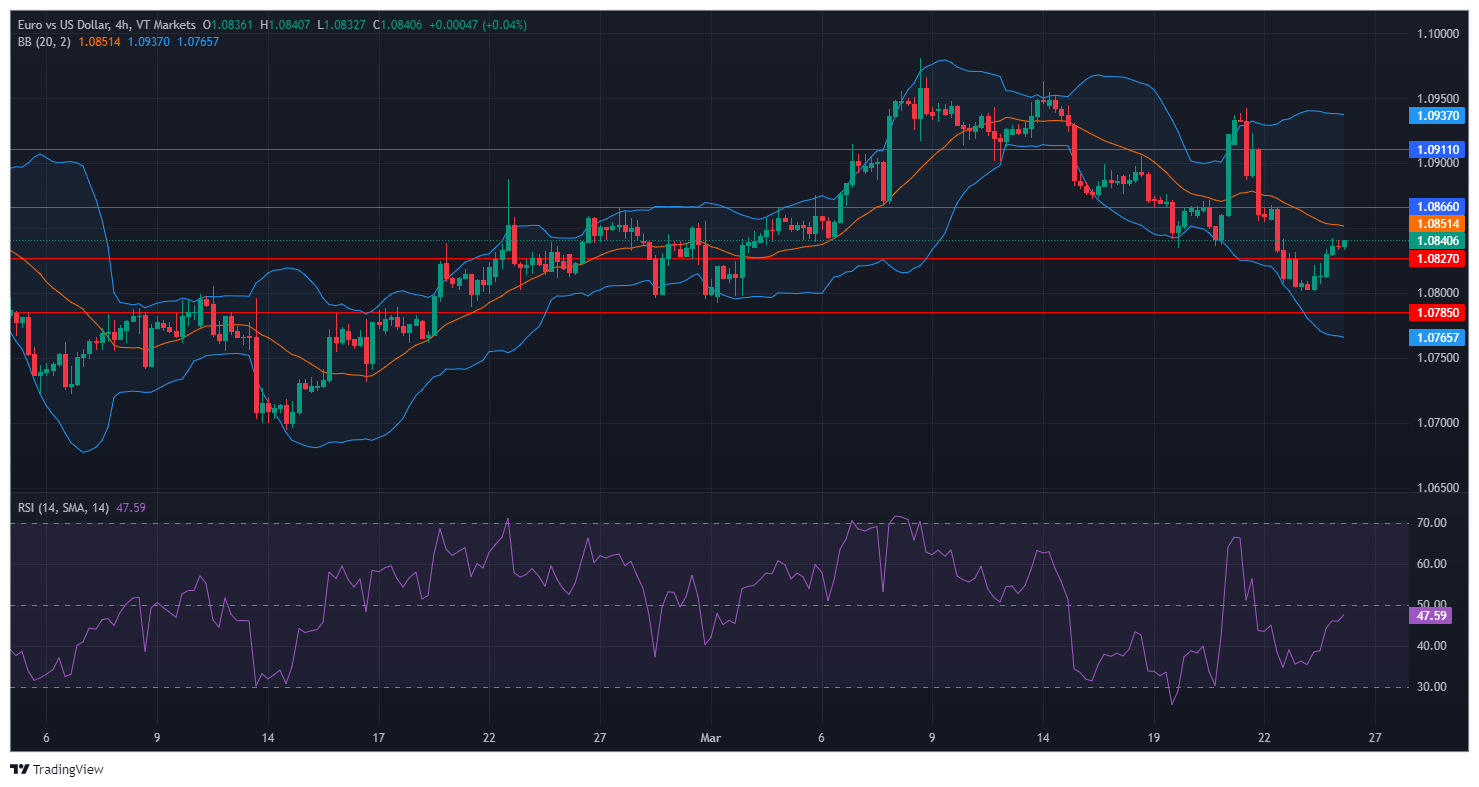
Chart EUR/USD by TradingView

On Monday, the EUR/USD moved higher, able to reach near the middle band of the Bollinger Bands. Currently, the price is moving slightly below the middle band, suggesting a potential slight upward movement to reach the lower band. Notably, the Relative Strength Index (RSI) maintains its position at 47, signaling a neutral outlook for this currency pair.

Resistance: 1.0866, 1.0911

Support: 1.0827, 1.0785

 Economic Data
CurrencyDataTime (GMT + 8)Forecast
USDCB Consumer Confidence22:00106.9

Adjustment on Turkey TRY Forex Notice – March 25, 2024

Dear Client,

In response to the upcoming high market volatility for TRY Forex during the Turkish election, there will be adjustments for the products on March 28, 2024. Please check the details below:

1. EURTRY and USDTRY leverage will be adjusted from 20:1 to 5:1

2. EURTRY and USDTRY will be set to close only effective on March 28, 2024

Friendly reminders:

1. All product settings stay the same except for the above adjustments.

2. The margin requirement of the trade may be affected by this adjustment. Please make sure the funds in your account are sufficient to hold the position before this adjustment.

If you’d like more information, please don’t hesitate to contact [email protected].

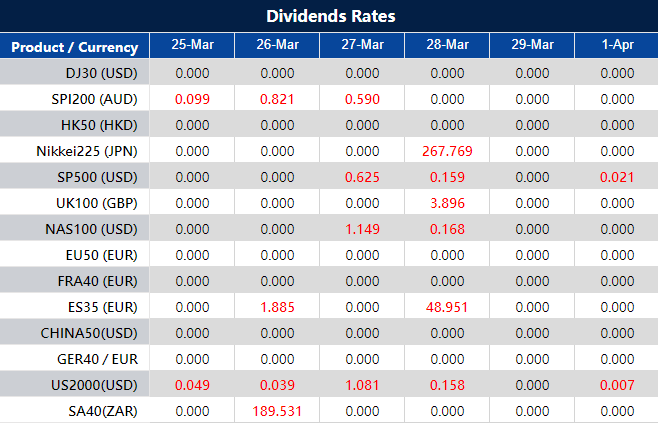
Dividend Adjustment Notice – March 25, 2024

Dear Client,

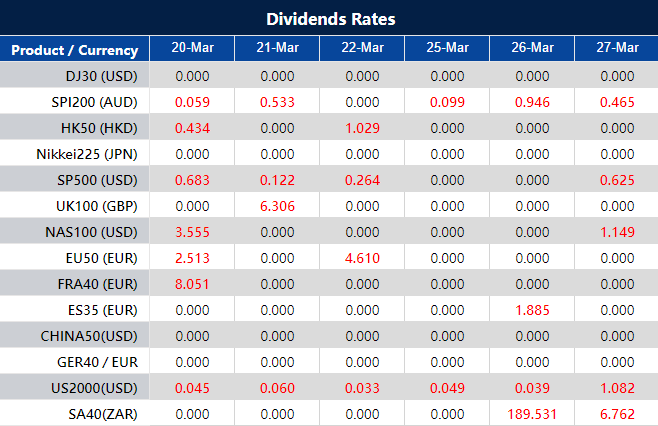
Please note that the dividends of the following products will be adjusted accordingly. Index dividends will be executed separately through a balance statement directly to your trading account, and the comment will be in the following format “Div & Product Name & Net Volume ”.

Please refer to the table below for more details:

The above data is for reference only, please refer to the MT4/MT5 software for specific data.

If you’d like more information, please don’t hesitate to contact [email protected].

Week ahead: Markets focus on US core PCE price index

As we approach the end of March 2024, the world’s economic eyes are set on key indicators that are poised to shed light on the health and direction of major economies, including Australia, Canada, and the United States. These indicators, ranging from consumer prices and GDP growth to housing market dynamics and core inflation rates, are critical barometers for financial markets and policy decision-making. Here’s a brief overview of what’s expected in the coming days.

Australia’s Consumer Price Index Holds Steady

On the Australian front, the Consumer Price Index (CPI), a measure of inflation reflecting the annual price change of goods and services, remained stable at 3.4% in the year to January 2024, mirroring the figure from the previous month. This steadiness suggests a consistent economic environment down under. However, eyes are now on the upcoming CPI release for February 2024, anticipated on 27 March, with analysts forecasting a slight uptick to 3.6%. Such an increase, if realized, could signal mounting inflationary pressures within the Australian economy.

Canada’s Economic Growth: A Subtle Uptick Expected

Moving to Canada, the Gross Domestic Product (GDP), the broadest measure of economic activity, showed no growth in December, falling short of the preliminary estimates that had predicted a 0.3% advance. This stagnation has placed increased importance on the upcoming January 2024 GDP figures, expected to be disclosed on 28 March 2024. Analysts remain optimistic, projecting a modest growth of 0.2%, which could mark a turnaround for the Canadian economy if achieved.

U.S. Economic Performance and Housing Market Dynamics

In the United States, the final GDP numbers for Q4 2023 revealed a 3.2% annualized growth rate, slightly below the advance estimate of 3.3% but following a robust 4.9% growth rate in Q3. The focus now shifts to the first quarter of 2024, with the GDP figures due on 28 March 2024. Analysts are aligning their forecasts with the previous quarter’s performance, expecting a 3.2% growth rate.

Simultaneously, the U.S. housing market seems to be experiencing turbulence. January 2024 saw a significant 4.9% drop in pending home sales, marking the largest decline since August 2023. The forecast for February, however, suggests a potential rebound, with a 1.5% increase in pending home sales anticipated when the data is released on 28 March 2024.

Core Inflation in the U.S.: A Close Watch

Lastly, the U.S. core Personal Consumption Expenditures (PCE) price index, which excludes volatile food and energy prices and is closely watched by the Federal Reserve, increased by 0.4% from the previous month in January 2024. This uptick was the most significant since February 2023. The upcoming release on 29 March 2024, for February’s figures, is predicted to show a slightly lower growth rate of 0.3%. This slight deceleration could signal easing inflationary pressures, a development likely to be closely scrutinized by policymakers and investors alike.

As we await these economic indicators, their collective outcomes will not only reflect the current state of affairs but also hint at the global economic trajectory for the months ahead.

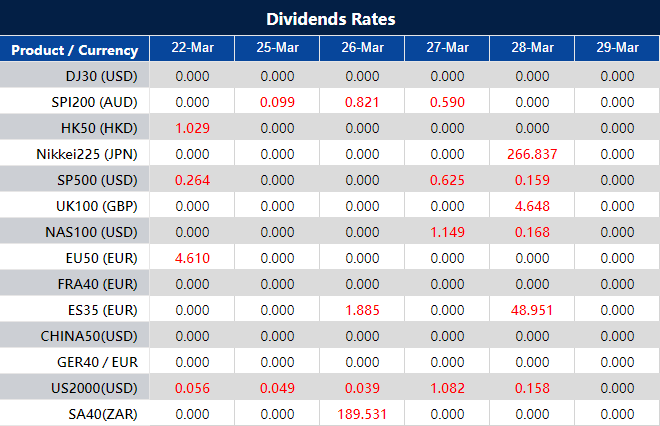
Dividend Adjustment Notice – March 22, 2024

Dear Client,

Please note that the dividends of the following products will be adjusted accordingly. Index dividends will be executed separately through a balance statement directly to your trading account, and the comment will be in the following format “Div & Product Name & Net Volume ”.

Please refer to the table below for more details:

The above data is for reference only, please refer to the MT4/MT5 software for specific data.

If you’d like more information, please don’t hesitate to contact [email protected].

Market Optimism Fuels Record Highs Amid Anticipated Rate Cuts

On Thursday, financial markets witnessed significant gains, with major stock indices reaching new record highs, fueled by optimism over anticipated Federal Reserve interest rate cuts. The Dow Jones, S&P 500, and Nasdaq all advanced, driven by strong performances in the technology sector, notably from Micron Technology and Nvidia, and industrial stocks like Stanley Black & Decker. Despite some caution from analysts about overenthusiasm for multiple rate cuts, investor sentiment remained buoyed by the Fed’s recent indications of a dovish turn in monetary policy. Concurrently, currency markets reacted to central bank movements, with the dollar strengthening against major counterparts as traders adjusted their expectations for rate cuts across the Fed, ECB, and BoE, following dovish signals and economic data releases.

Stock Market Updates

Stocks experienced a notable uptick on Thursday, extending gains from the previous session and propelling major indices to record-breaking closing highs. The Dow Jones Industrial Average saw a significant rise, jumping 269.24 points or 0.68%, to close at 39,781.37. Similarly, the S&P 500 and the Nasdaq Composite advanced, with the S&P increasing by 0.32% to settle at 5,241.53, and the Nasdaq inching up by 0.20% to finish the day at 16,401.84. This bullish sentiment was largely fueled by optimism surrounding the Federal Reserve’s monetary policy, with investors anticipating upcoming interest rate cuts, according to Jay Woods, chief global strategist at Freedom Capital Markets.

The technology sector, particularly semiconductors, showcased remarkable strength, buoyed by Micron Technology’s impressive 14% surge following robust earnings, marking its best performance since December 2011. This positive momentum spread across the sector, lifting peers like Nvidia, Marvell Technology, Taiwan Semiconductor, the VanEck Semiconductor ETF, and Broadcom, with gains exceeding 1% for most and reaching up to 5.6% for Broadcom. Meanwhile, megacap tech stocks such as Microsoft and the newly public Reddit also contributed to the market’s upward trajectory, although Apple faced a setback, dropping 4% amid antitrust lawsuit concerns by the Justice Department.

Industrial stocks weren’t left behind, playing a significant role in the day’s gains and underlining the breadth of the rally across sectors. Companies like Stanley Black & Decker, Pentair, and Rockwell Automation stood out with approximately 3% jumps each, reflecting overall optimism in the market. This optimism was echoed by the Federal Reserve’s recent communication, hinting at potential interest rate cuts, which has kept investor sentiment buoyant. Despite the excitement, experts like Julie Biel from Kayne Anderson Rudnick urge caution, noting that the expectation for multiple rate cuts isn’t guaranteed. Looking forward, Wall Street’s focus will shift to upcoming earnings reports from major companies like FedEx and Nike, potentially influencing market directions.

Currency Market Updates

The currency market witnessed significant movements as the dollar index climbed by 0.77%, propelled by a 1% decline in sterling and a 0.59% retreat in EUR/USD. These shifts came in the wake of dovish signals from central bank meetings, including the Fed, ECB, and BoE, aligning market expectations for rate cuts across these major economies in June. The Swiss National Bank’s unexpected rate cut further fueled speculation about a broader shift towards easing monetary policy, impacting currency pairs like USD/CHF and EUR/CHF, which saw increases of 1.27% and 0.7%, respectively.

The anticipation of rate cuts has recalibrated market probabilities, with about a 70% chance of June cuts from the Fed, ECB, and BoE now priced in. However, the U.S. economy’s relative resilience compared to its European counterparts could influence these dynamics. Key upcoming U.S. data, including the core PCE report, early April’s ISMs, and employment reports, will be crucial in shaping Fed expectations and dollar demand. The currency market’s response to initial jobless claims and mixed flash PMIs in the U.S. contrasts with the euro zone’s near-stagnant growth, highlighting the nuanced interplay between economic indicators and currency valuations.

In particular, sterling’s performance was noteworthy, breaking a recent uptrend and hitting a low not seen since early March, influenced by yield spreads and the market’s reaction to central bank policies. The USD/JPY pair also drew attention, potentially setting the stage for further yen intervention by Japan’s Ministry of Finance, especially in light of upcoming inflation data. As central banks navigate through these uncertain times, the interplay between policy shifts, economic data, and market sentiment will continue to drive currency market dynamics, underscoring the global interconnectedness of monetary policy and financial markets.

Picks of the Day Analysis
EUR/USD (4 Hours)

Greenback Gains Momentum as EUR/USD Faces Downward Pressure Amid Divergent Central Bank Paths

The US Dollar Index (DXY) surged past the 104.00 mark, recovering from its previous dip following Federal Reserve Chair Powell’s dovish remarks, which temporarily halted the dollar’s ascent. This reversal in the dollar’s fortunes coincided with a risk-off sentiment that saw the EUR/USD pair retreating to the mid-1.0800s, exacerbated by disappointing PMI data from Germany. Despite the Federal Reserve’s projections of a gradual approach to interest rate cuts aimed at reaching a 2% inflation target, market sentiment, fueled by the FedWatch Tool, anticipates more aggressive rate reductions beginning as early as June. This speculation, along with the expectation of both the Fed and the European Central Bank (ECB) initiating their easing cycles simultaneously, albeit at potentially different paces, has cast the EUR/USD in a light of vulnerability. The pair now faces the prospect of a pronounced correction, with initial sights set on the year-to-date low around 1.0700, and potentially extending to lows not seen since late 2023, around the 1.0500 mark, underscoring a medium-term outlook favoring a stronger dollar against a backdrop of divergent central bank strategies and the euro area’s sluggish economic fundamentals.

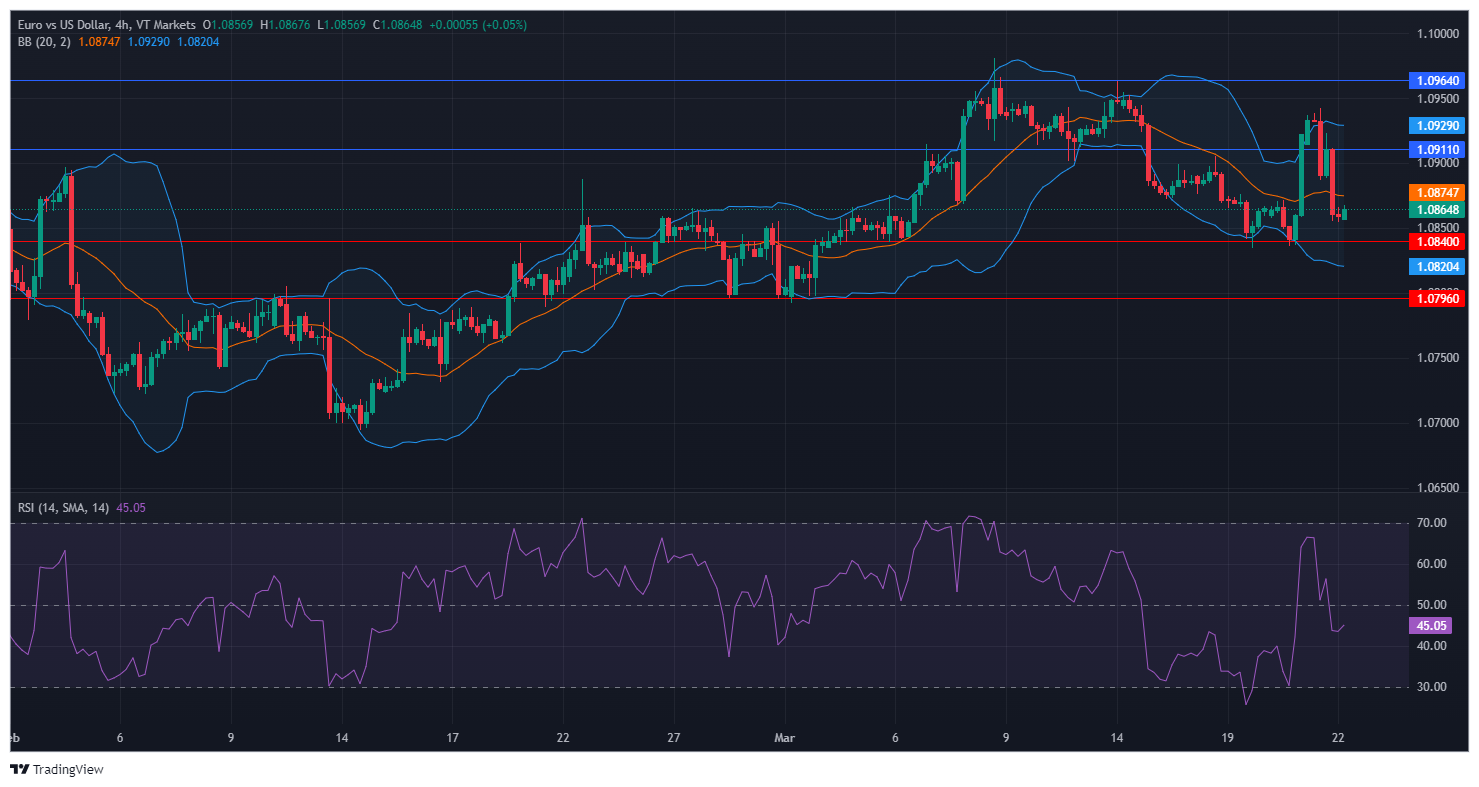
Chart EUR/USD by TradingView

On Thursday, the EUR/USD moved lower, able to reach below the middle band of the Bollinger Bands. Currently, the price is moving slightly below the middle band, suggesting a potential slight downward movement to reach the lower band. Notably, the Relative Strength Index (RSI) maintains its position at 45, signaling a neutral outlook for this currency pair.

Resistance: 1.0911, 1.0964

Support: 1.0840, 1.0796

 Economic Data
CurrencyDataTime (GMT + 8)Forecast
GBPRetail Sales m/m15:00-0.4%
EUREuro SummitAll Day

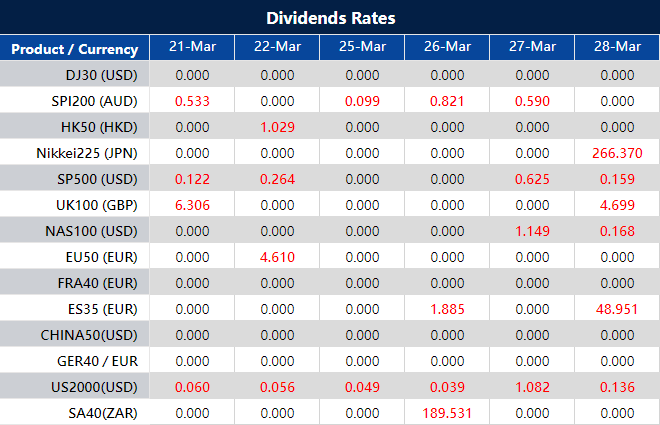
Dividend Adjustment Notice – March 21, 2024

Dear Client,

Please note that the dividends of the following products will be adjusted accordingly. Index dividends will be executed separately through a balance statement directly to your trading account, and the comment will be in the following format “Div & Product Name & Net Volume ”.

Please refer to the table below for more details:

The above data is for reference only, please refer to the MT4/MT5 software for specific data.

If you’d like more information, please don’t hesitate to contact [email protected].

MT5 Software Important Notice – March 21, 2024

Dear Client,

As part of our commitment to provide the most reliable service to our clients, we have completed the MT5 maintenance and upgrade on 16th March, 2024.

If you have login issue on the MT5 software, please follow the instructions below to ensure successful login of your PC and Mobile version of MT5 live and demo accounts:

1. To make sure the new version of MT5 can work successfully, please completely uninstall the original MT5 software.

2. Install the latest version of MT5 from our official website or via the installation package after the uninstallation of the old version:
PC: https://download.mql5.com/cdn/web/vt.markets.pty/mt5/vtmarkets5setup.exe
iOS: https://download.mql5.com/cdn/mobile/mt5/ios?server=VTMarkets-Demo,VTMarkets-Live
Android: https://download.mql5.com/cdn/mobile/mt5/android?server=VTMarkets-Demo,VTMarkets-Live

3. After successful installation of new MT5, log into your live trading account with your current Master Password and follow the MT5’s system instructions to reset the Master Password.

4. If you forget the current Master Password, you can log into the Client Portal to reset your Master Password first. However, you will still need to again reset the Master Password after logging into MT5.

5. Your MT5 Demo account is set to expire. Should you require continued access, kindly create a new MT5 demo account through the client portal.

6. MT4 trading software is not affected by the above and can maintain the original master password.

Thank you for your patience and understanding about this important initiative.

If you’d like more information, please don’t hesitate to contact [email protected].

Markets Surge on Fed’s Rate Decision

Wednesday witnessed a significant rally in the stock market, with the Dow Jones, S&P 500, and Nasdaq Composite all reaching all-time highs after the Federal Reserve decided to maintain interest rates at their highest in 23 years while signaling three rate cuts by the end of 2024. This decision was met with optimism, particularly within the financial and technology sectors, leading to notable gains across various stocks. In the currency market, the dollar experienced volatility, eventually declining as the Fed remained cautious but committed to adjusting its policy in response to inflation trends, impacting Treasury yields and currency pair values significantly.

Stock Market Updates

On Wednesday, stock markets experienced a significant uplift, with the three major averages reaching new all-time highs. This surge came in the wake of the Federal Reserve’s decision to maintain interest rates at their highest level in 23 years while signaling three potential rate cuts by the end of 2024. The Dow Jones Industrial Average soared by 401.37 points or 1.03%, closing at 39,512.13. The S&P 500 followed suit, gaining 0.89% to end the day at 5,224.62 — crossing the 5,200 threshold for the first time. Meanwhile, the Nasdaq Composite experienced a 1.25% jump, settling at 16,369.41.

The Federal Reserve’s announcement to keep rates steady was accompanied by plans for future cuts, echoing its previous forecasts from December. Despite leaving rates unchanged, the central bank expressed the need for more substantial evidence of inflation easing before considering a reduction in rates. The statement from the Fed underscored its cautious approach, emphasizing the need for greater confidence in inflation trending sustainably towards its 2% target before adjusting the target range for rates. This stance came amid investor concerns that recent spikes in inflation could lead to fewer-than-expected rate cuts.

In the financial sector, stocks rose on hopes that the anticipated rate cuts would spur continued economic growth. American Express and the SPDR S&P Regional Banking ETF saw gains of 2.8% and over 3%, respectively. Technology giants, often seen as beneficiaries of lower rates, also experienced an upswing, with companies like Alphabet, Amazon, Microsoft, and Nvidia each gaining around 1%. Meta Platforms outperformed with a 1.9% increase, while Apple and Tesla advanced by 1.5% and 2.5%. Other notable movements included Chipotle Mexican Grill, which climbed 3.5% following an announcement of a stock split, and Paramount Global, which surged 11.8% amid reports of a significant acquisition offer from Apollo Global Management.

Currency Market Updates

In the currency markets, the dollar index saw a reversal from early gains to losses on Wednesday. This shift was largely attributed to the Federal Reserve’s decision to maintain its projection for three rate cuts in 2024 without reducing the number despite updating its GDP and inflation forecasts. Fed Chair Jerome Powell underscored the central bank’s commitment to achieving its inflation goals and the importance of being adaptive in its policy approach, also highlighting a cautious stance to avoid repeating past mistakes in quantitative tightening.

Although the Fed kept its rates unchanged and the median expectation for rate cuts in 2024 stayed consistent, the actual number of policymakers supporting this projection slightly decreased. This development influenced market dynamics, with two-year Treasury yields dropping and the probability of a June rate cut increasing. Furthermore, the Fed’s upward revision of its GDP growth and core PCE inflation expectations for 2024 contributed to these market movements.

Currency pairs reacted to the Fed’s announcements and broader market sentiment. The EUR/USD pair rose by 0.45%, effectively recovering from earlier losses, supported by strong demand at key technical levels. The USD/JPY pair retreated from its pre-Fed gains, touching levels close to recent peaks before a slight rebound. Meanwhile, the British pound achieved a 0.5% gain against the dollar, buoyed by significant declines in UK inflation rates for February, marking a notable intraday reversal from earlier losses.

Picks of the Day Analysis
EUR/USD (4 Hours)

EUR/USD Surges Amid Dovish Fed Outlook and Interest Rate Speculations

In a marked shift, the EUR/USD pair breached the 1.0900 mark, reaching four-day highs following a dovish stance from Federal Reserve Chair Powell, who hinted at potential interest rate cuts amidst a backdrop of a robust U.S. economy but hindered business investment due to high interest rates. Despite the Federal Reserve’s decision to maintain rates, with a long-term view of reducing them to achieve a 2% inflation target, the dollar saw a pullback as Powell emphasized the need for sustained confidence in inflation reduction before enacting rate cuts. This dovish outlook, coupled with anticipations of both the Federal Reserve and the European Central Bank beginning their easing cycles by mid-year, has fueled speculations, impacting the EUR/USD dynamics and suggesting a possible stronger dollar in the medium term, with eyes on future rate movements and economic indicators.

Chart EUR/USD by TradingView

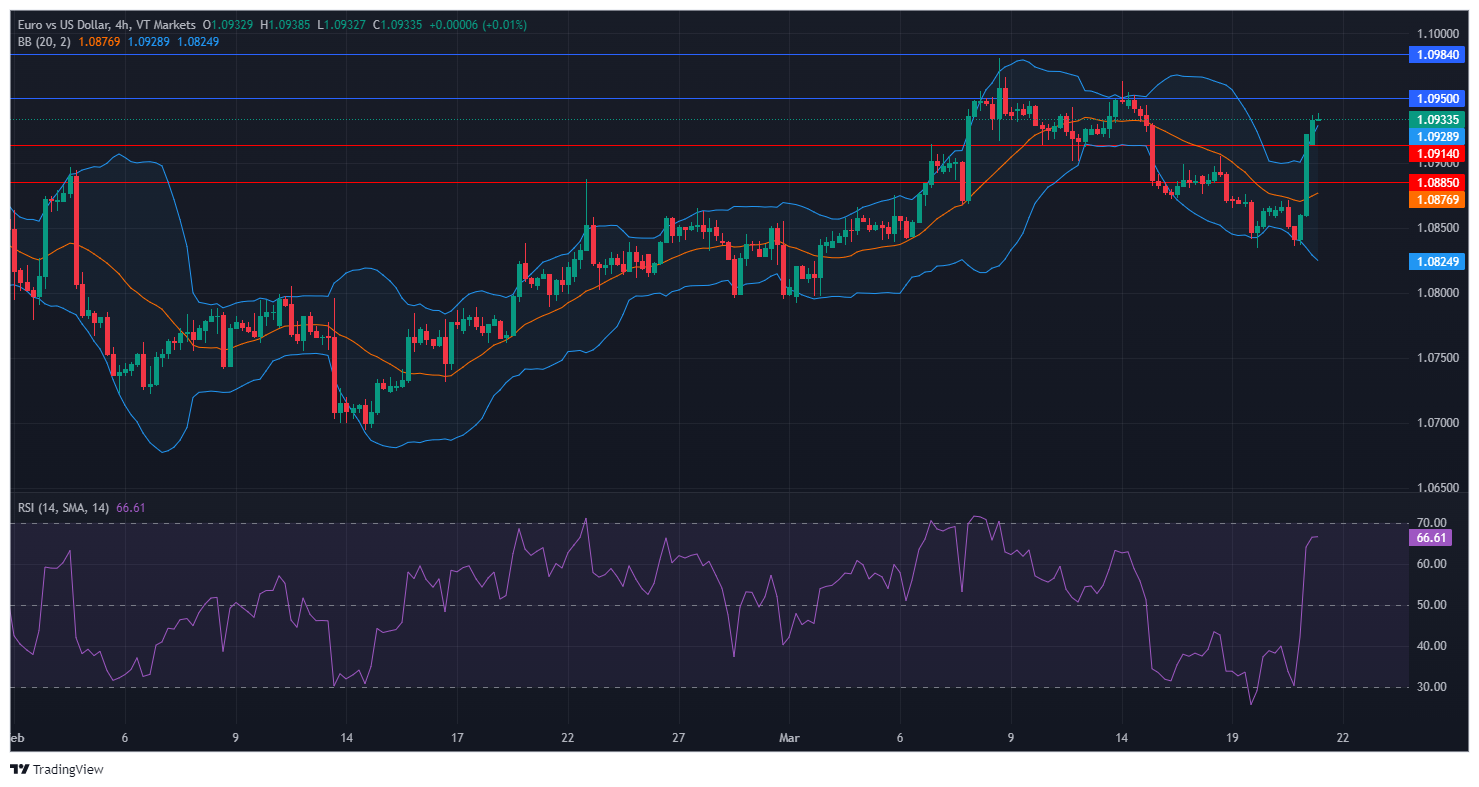
On Wednesday, the EUR/USD moved strongly higher affected by the dovish statement from the Fed, able to create some push to the upper band of the Bollinger Bands. Currently, the price is moving slightly above the upper band, suggesting a potential slight upward movement to reach the resistance levels. Notably, the Relative Strength Index (RSI) maintains its position at 66, signaling a bullish outlook for this currency pair.

Resistance: 1.0950, 1.0984

Support: 1.0914, 1.0885

 Economic Data
CurrencyDataTime (GMT + 8)Forecast
EURFrench Flash Manufacturing PMI16:1547.5
EURFrench Flash Services PMI16:1548.8
CHFSNB Monetary Policy Assessment16:30
CHFSNB Policy Rate16:301.75%
EURGerman Flash Manufacturing PMI16:3043.1
EURGerman Flash Services PMI16:3048.8
CHFSNB Press Conference17:00
GBPFlash Manufacturing PMI17:3047.9
GBPFlash Services PMI17:3053.8
GBPMonetary Policy Summary20:00
GBPMPC Official Bank Rate Votes20:000-1-8
GBPOfficial Bank Rate20:005.25%
USDUnemployment Claims20:30212K
USDFlash Manufacturing PMI21:4551.8
USDFlash Services PMI21:4552.0

Dividend Adjustment Notice – March 20, 2024

Dear Client,

Please note that the dividends of the following products will be adjusted accordingly. Index dividends will be executed separately through a balance statement directly to your trading account, and the comment will be in the following format “Div & Product Name & Net Volume ”.

Please refer to the table below for more details:

The above data is for reference only, please refer to the MT4/MT5 software for specific data.

If you’d like more information, please don’t hesitate to contact [email protected].

Back To Top
server

Hai 👋

Bagaimana saya boleh membantu?

Segera berbual dengan pasukan kami

Chat Langsung

Mulakan perbualan secara langsung melalui...

  • Telegram
    hold Ditangguh
  • Akan datang...

Hai 👋

Bagaimana saya boleh membantu?

telegram

Imbas kod QR dengan telefon pintar anda untuk mula berbual dengan kami, atau klik di sini.

Tidak ada aplikasi Telegram atau versi Desktop terpasang? Gunakan Web Telegram sebaliknya.

QR code