Netflix’s Record-Breaking Subscribers Propel Tech Stocks, Nasdaq Futures Surge in 2024

After Netflix’s stellar fourth-quarter performance, Nasdaq 100 futures experienced a significant boost in Tuesday evening trading. Fueled by Netflix’s impressive subscriber growth of 13 million, reaching a record 260.8 million, tech-heavy Nasdaq 100 futures rose by 0.28%, contributing to the broader strength of mega-cap tech stocks and propelling the S&P 500 to record highs. While the Dow Jones Industrial Average futures showed a more restrained response, Netflix’s positive performance extended beyond subscriber gains, with an 8.6% surge in extended trading. The article delves into the factors driving Netflix’s success and the resilience of tech stocks amid mixed market performances, offering insights into currency market dynamics and the potential impact on various economies, particularly Japan, as they navigate higher rates and potential rate cuts. The narrative also previews upcoming economic data, emphasizing the market’s focus on the European Central Bank meeting, U.S. Q4 GDP, and core PCE readings for further guidance on Fed and dollar pricing.

Stock Market Updates

In the wake of Netflix’s strong fourth-quarter performance, futures linked to the Nasdaq 100 experienced a notable uptick during Tuesday evening trading. The tech-heavy Nasdaq 100 futures rose by 0.28%, driven by Netflix’s robust results, which revealed a record-breaking subscriber count of 260.8 million, an increase of over 13 million in the last quarter. The streaming giant’s impressive gains contributed to the broader strength of mega-cap tech stocks in 2024, propelling the S&P 500 to record highs and confirming the onset of a new bull market. However, the Dow Jones Industrial Average futures only edged up by 0.05%, with a marginal increase of 19 points, reflecting a more subdued response possibly influenced by disappointing earnings and guidance from certain blue-chip companies during the main trading session.

Netflix’s positive performance extended beyond subscriber growth, as its shares surged by 8.6% in extended trading. The company not only exceeded revenue expectations but also provided optimistic earnings guidance for the current quarter, surpassing Wall Street forecasts. Analysts attribute Netflix’s success to the strength of its ad-tier business scaling, particularly in the latter part of the previous year, and its efforts to curb password sharing. As traders keep an eye on upcoming economic data, including U.S. manufacturing and services statistics for January and fourth-quarter gross domestic product figures, the broader market dynamics underscore the resilience of tech stocks amid mixed performances in other sectors, as exemplified by the Dow’s slight retreat during the main trading session.
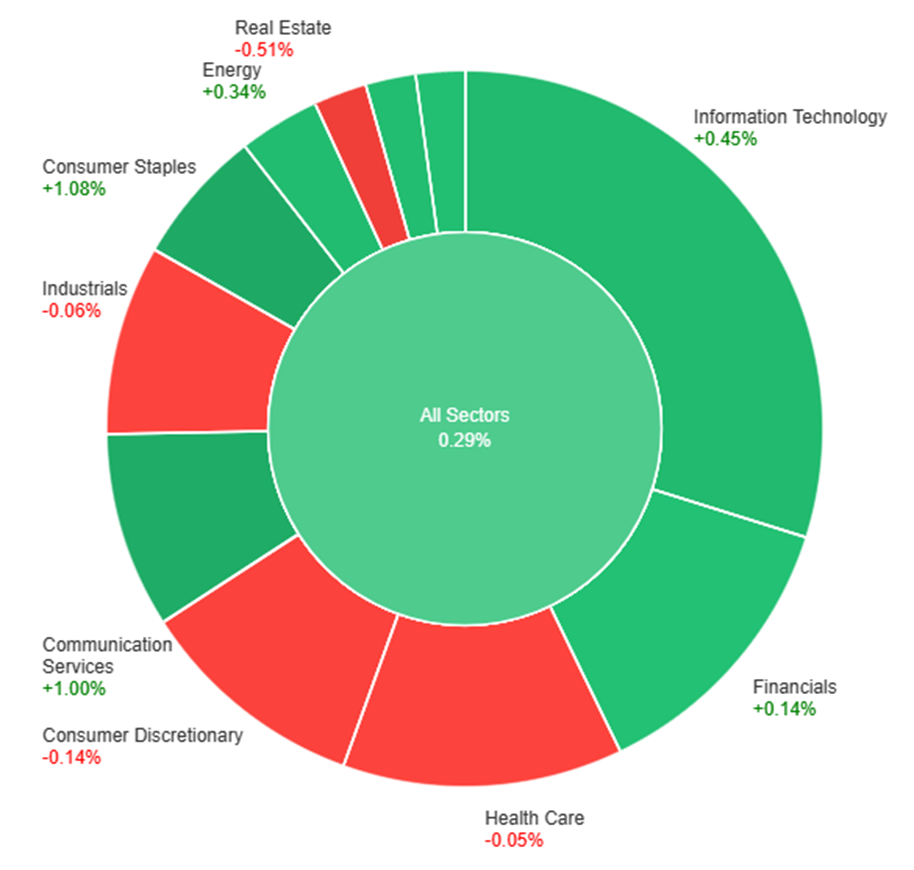
Data by Bloomberg

On Tuesday, the overall market experienced a modest gain of 0.29%. Noteworthy performances were observed in the Consumer Staples (+1.08%), Communication Services (+1.00%), and Information Technology (+0.45%) sectors, contributing positively to the overall uptrend. However, the healthcare sector showed a slight decline with -0.05%, while Industrials (-0.06%), Consumer Discretionary (-0.14%), and Real Estate (-0.51%) sectors exhibited marginal losses, indicating a mixed day for different segments of the market. The Financials (+0.14%), Energy (+0.34%), and Materials (+0.32%) sectors also contributed to the overall positive sentiment with modest gains.

Currency Market Updates

In Tuesday’s currency market updates, the dollar index exhibited a 0.36% increase, recovering from earlier losses spurred by a brief yen rise following a somewhat more hawkish Bank of Japan (BoJ) meeting. The EUR/USD pair broke below key support from the previous week as Treasury yields outpaced bund yields. Despite the BoJ expressing confidence in ending its negative rates policy later in the year and the market leaning towards a 10-basis point June hike to zero, 2-year Japanese Government Bond (JGB) yields only rose to 0.06%. The article highlights how various economies, particularly Japan, can manage higher rates or a gradual retreat from previous rate hikes. The U.S. appears more resilient, having raised rates more than other major central banks, with futures markets not fully pricing in a Federal Reserve rate cut until May.

EUR/USD experienced a 0.45% decline, breaking key technical supports such as the daily cloud top and the 200-day moving average. USD/JPY initially dropped to 146.99 lows in response to the BoJ meeting but found support near the 10-day moving average and 147, leading to a 0.3% increase on the day. The article points out the potential challenge of testing the Ministry of Finance’s desire to prevent the yen from falling below 2022/23 lows at 151.94/92 if U.S. data continues to suggest fewer Fed rate cuts. Meanwhile, sterling fell 0.35%, despite rising Gilt-Treasury yield spreads, and is closely watched ahead of the Bank of England’s meeting on February 1. The focus for the rest of the week includes the European Central Bank meeting, U.S. Q4 GDP, and Friday’s core PCE for further Fed and dollar pricing guidance, with the flash January PMI readings as a key data feature on Wednesday.

Picks of the Day Analysis
EUR/USD (4 Hours)

EUR/USD Hits Multi-Week Lows as Greenback Gains Strength Amid ECB Caution

On Tuesday, the EUR/USD pair extended its decline, reaching fresh multi-week lows in the 1.0820 zone as the selling bias persisted in the risk complex. The USD Index (DXY) soared to a new yearly high of 103.80, driven by a robust buying bias in the greenback, higher US yields, and an overarching risk-off sentiment. The upcoming ECB event is marked by a growing debate between market participants and rate-setters regarding the timing of potential rate cuts, with President Lagarde hinting at a possible move in the summer. Despite inflation surpassing the ECB target, cautious policymaking in the face of weak economic fundamentals continues to limit the Euro’s potential for strengthening.
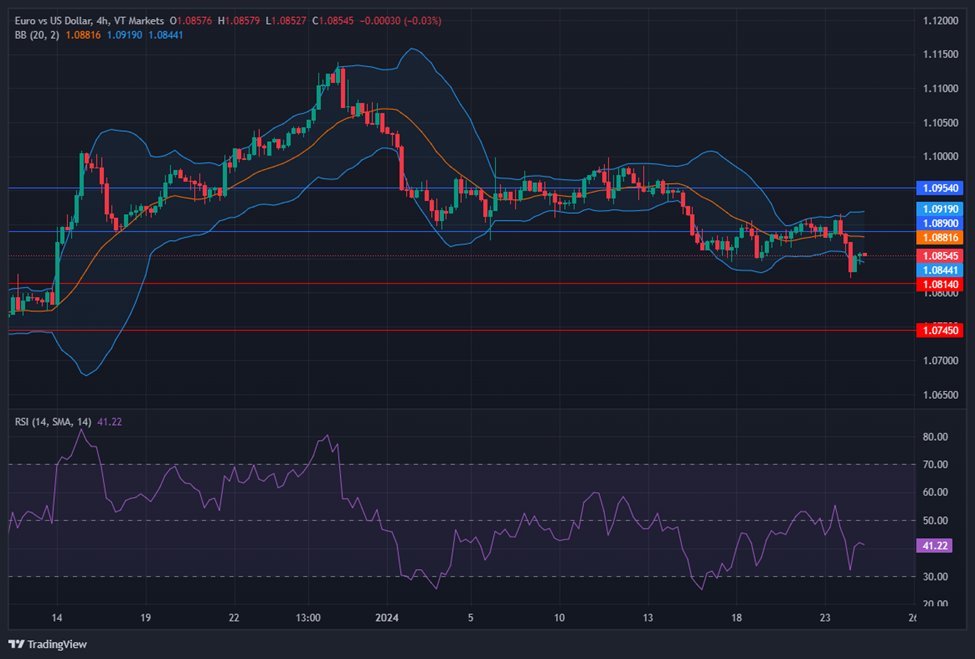
Chart EUR/USD by TradingView

On Tuesday, the EUR/USD moved lower, able to reach the lower band of the Bollinger Bands. Currently, the price is moving just above the lower band, suggesting a potential upward movement to reach the middle band. Notably, the Relative Strength Index (RSI) maintains its position at 41, signaling a neutral but bearish outlook for this currency pair.

Resistance: 1.0890, 1.0954

Support: 1.0814, 1.0745

XAU/USD (4 Hours)

XAU/USD Holds Steady Above $2,020 Amidst Market Volatility and Economic Indicators

Gold (XAU/USD) maintained a tight trading range just above $2,020 per troy ounce on Tuesday, propelled initially by a weakening US Dollar in response to record highs in the S&P 500 and Dow Jones Industrial Average. The precious metal’s rally in the first half of the day was influenced by market optimism regarding a potential interest rate cut by the Federal Reserve. However, the USD regained strength later in the day as equities faced losses, driven by caution ahead of earnings reports and concerns about macroeconomic events in the coming days. Despite disappointing US data, gold remained resilient, with attention turning to the Bank of Canada’s upcoming monetary policy decision.
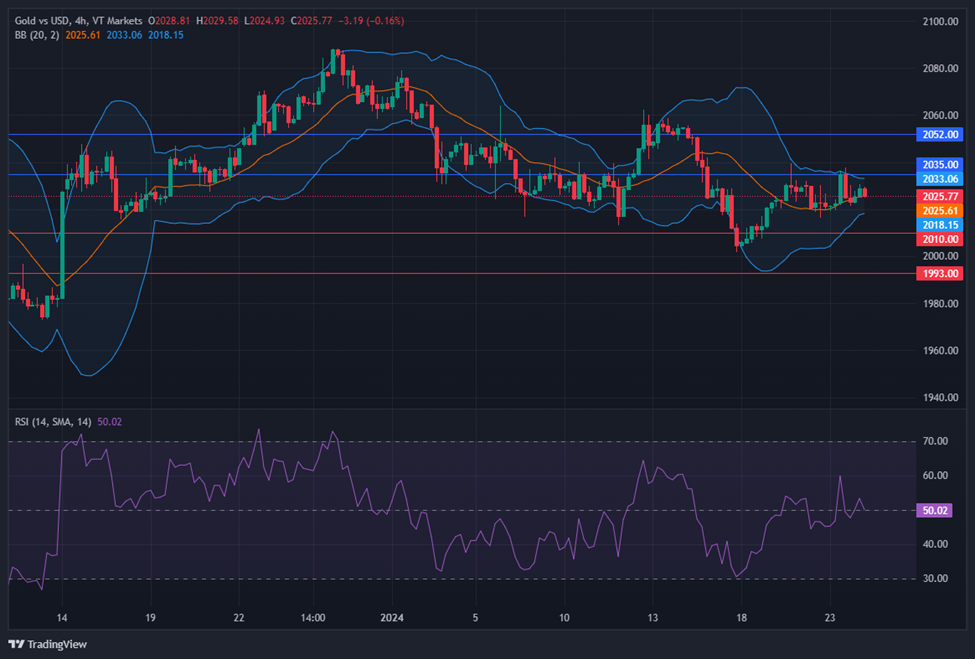
Chart XAU/USD by TradingView

On Tuesday, XAU/USD moved higher and was able to reach the upper band of the Bollinger Bands. Currently, the price is moving just above the middle band suggesting a potential upward movement to reach the upper band. The Relative Strength Index (RSI) stands at 50, signaling a neutral outlook for this pair.

Resistance: $2,035, $2,052

Support: $2,010, $1,993

Economic Data
CurrencyDataTime (GMT + 8)Forecast
EURFrench Flash Manufacturing PMI16:1542.5
EURFrench Flash Services PMI16:1546.1
EURGerman Flash Manufacturing PMI16:3043.7
EURGerman Flash Services PMI16:3049.3
GBPFlash Manufacturing PMI17:3046.7
GBPFlash Services PMI17:3053.1
CADBOC Monetary Policy Report22:45 
CADBOC Rate Statement22:45 
CADOvernight Rate22:455.00%
USDFlash Manufacturing PMI22:4547.6
USDFlash Services PMI22:4551.4
CADBOC Press Conference23:30 

Dividend Adjustment Notice – January 23, 2024

Dear Client,

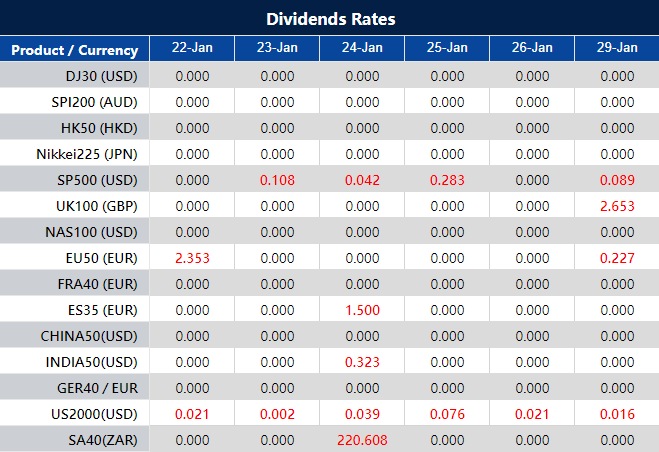
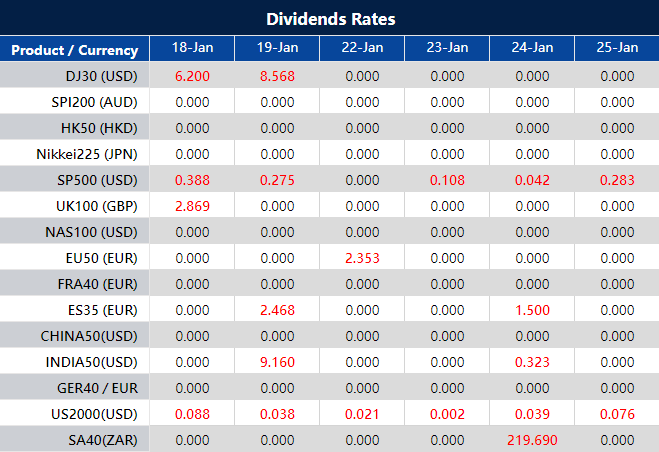
Please note that the dividends of the following products will be adjusted accordingly. Index dividends will be executed separately through a balance statement directly to your trading account, and the comment will be in the following format “Div & Product Name & Net Volume ”.

Please refer to the table below for more details:

The above data is for reference only, please refer to the MT4/MT5 software for specific data.

If you’d like more information, please don’t hesitate to contact [email protected].

Dow Surges Past 38,000, United Airlines’ Stock Soars After Q4 Results

On Monday, the Dow Jones Industrial Average achieved a historic high above 38,000, accompanied by a surge in United Airlines’ stock following strong fourth-quarter results. However, concerns about the grounding of Boeing 737 Max 9 planes led to an anticipated first-quarter loss for the airline. The broader market witnessed milestones, with the S&P 500 and Nasdaq Composite reaching all-time highs. Despite the bullish trend, investors remain cautious, especially amid a tech-focused rally. Currency markets showed calm consolidation, and Treasury yields led to a bull yield curve steepening. Market attention turned to the BoJ’s policy meeting, upcoming economic events, and central bank decisions impacting major currencies. The week’s developments include expectations for the Fed’s role in USD/JPY dynamics and varying rate cut predictions for the BoE and ECB, influencing currency performance.

Stock Market Updates

U.S. stock futures showed minimal movement on Monday night, with the Dow Jones Industrial Average reaching a historic high above 38,000. Notably, United Airlines experienced a more than 6% surge in extended trading following robust fourth-quarter results but anticipated a first-quarter loss due to the grounding of Boeing 737 Max 9 airplanes involved in a recent emergency. Other airline stocks, including American Airlines and Southwest Airlines, rose around 3%, while Alaska Air Group and Delta Air Lines climbed approximately 2%.

Monday’s trading session marked significant milestones as the Dow advanced over 100 points, closing above 38,000 for the first time, and both the S&P 500 and Nasdaq Composite reached new all-time highs. Despite the bullish trend, investors are cautious about the sustainability of gains, particularly as the tech-focused rally contrasts with lackluster broader market participation. The ongoing corporate earnings season adds to market scrutiny, with notable reports expected from Johnson & Johnson, Procter & Gamble, Lockheed Martin before the open, and Netflix after the close on Tuesday.

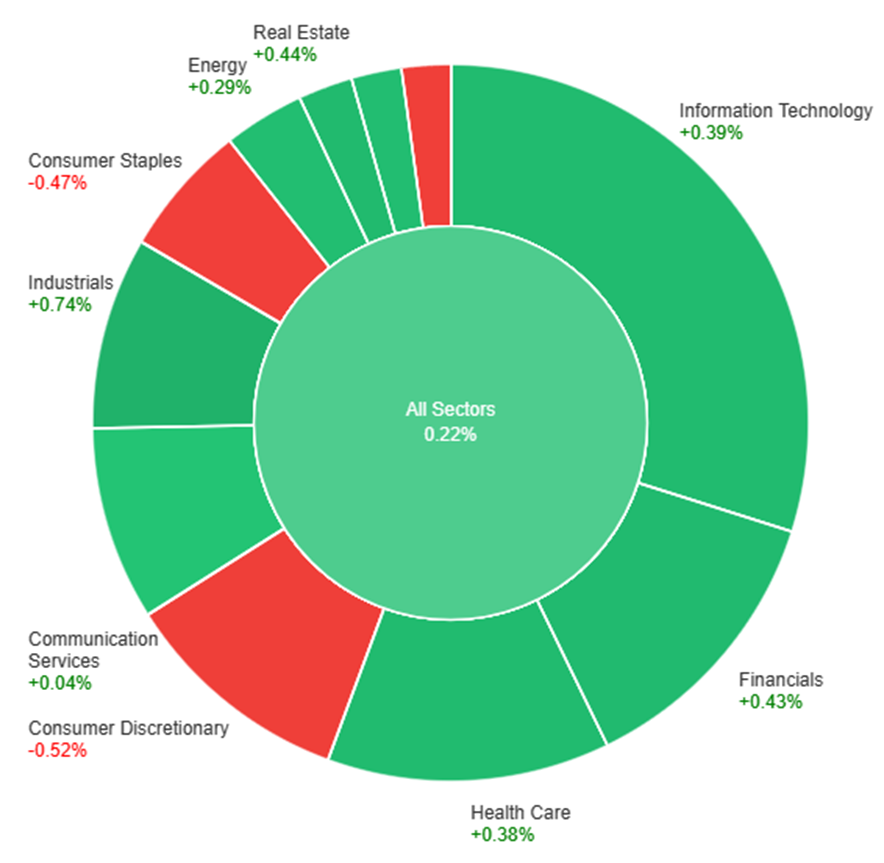
Data by Bloomberg

On Monday, the overall market saw a modest gain of 0.22%. Several sectors contributed positively, with Industrials leading the way with a notable increase of 0.74%, followed by Real Estate (+0.44%), Financials (+0.43%), Information Technology (+0.39%), and Health Care (+0.38%). Materials and Energy also experienced slight upticks of 0.30% and 0.29%, respectively. However, not all sectors fared well, as Consumer Staples (-0.47%), Utilities (-0.52%), and Consumer Discretionary (-0.52%) witnessed declines, dragging down the overall market performance. Communication Services showed a marginal decrease of 0.04%.

Currency Market Updates

In the currency markets, the dollar, euro, and sterling showed a calm consolidation at the beginning of the week, with profit-taking observed on stretched short yen trades ahead of the BoJ meeting on Tuesday. The dollar index remained flat, EUR/USD held steady, USD/JPY experienced a slight dip of 0.1%, and sterling saw a 0.14% increase. Treasury yields led a broader bull yield curve steepening and a risk-on trend in major government bond and equity markets, except for China. The market’s expectations for a March Fed cut decreased to a 42% probability, down from being fully discounted at the turn of the year, and the expected 150bp of Fed cuts in 2024 was adjusted to 135bp.

The focus turned to the BoJ’s two-day policy meeting concluding on Tuesday, where no significant rate hike expectations were priced in. Modest policy normalization expectations for the yen may be revised lower, leaving Fed policy as the primary driver for USD/JPY. Additionally, upcoming events such as U.S. Q4 GDP, jobless claims, and the Fed’s favored PCE on Friday, as well as the ECB meeting on Thursday, added to the week’s potential market impact. EUR/USD continued to consolidate below key levels, while USD/JPY followed Treasury yields lower but held above crucial support. Sterling outperformed the euro, influenced by the expectation that the BoE would cut rates less than the ECB in the coming year. The yuan remained supported amid a 2.7% dive in the Shanghai Composite, affecting AUD/USD negatively.

Picks of the Day Analysis
EUR/USD (4 Hours)

EUR/USD Navigates Indecision Amidst Diverging Central Bank Sentiments

The new trading week for EUR/USD opened with uncertainty and fluctuating price action tied to the U.S. dollar, accompanied by low volatility on Monday. As market participants anticipate around 120 basis points in rate cuts for the year, a debate ensues between them and the ECB’s rate-setters regarding the timing of the central bank’s decision to reduce the region’s policy rate. Despite inflation surpassing the bank’s target, European policymakers appear inclined to maintain a restrictive stance, hindered by weak fundamentals in the bloc, limiting the upside potential for the European currency. Meanwhile, across the Atlantic, investors are assigning just over a 40% probability to a Federal Reserve rate cut at the March 20 meeting, according to the FedWatch Tool tracked by CME Group.

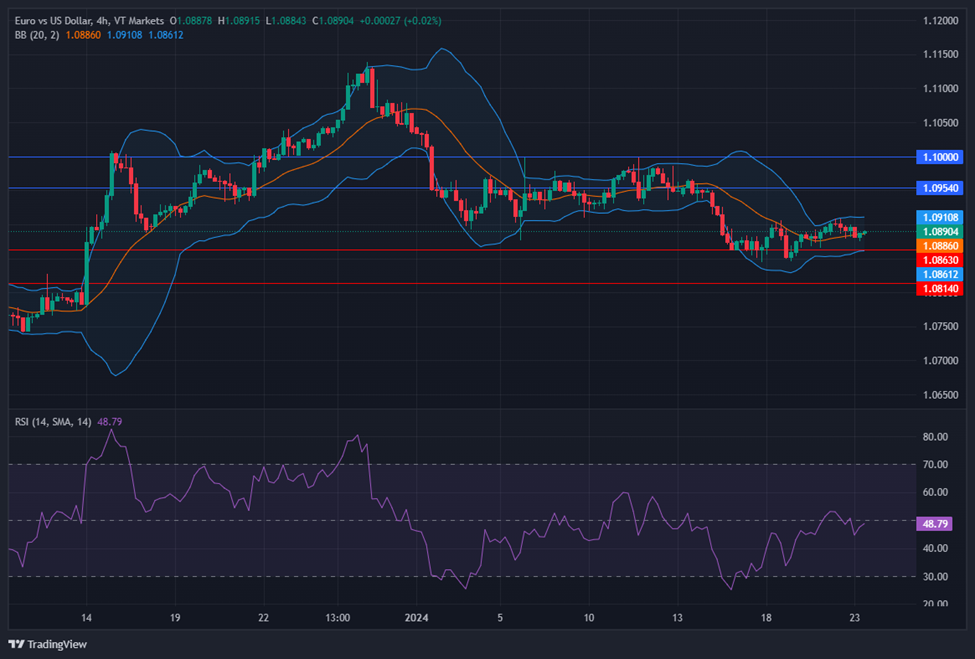
Chart EUR/USD by TradingView

On Monday, the EUR/USD moved in consolidation, able to reach the middle band of the Bollinger Bands. Currently, the price moving just above the middle band, suggesting a potential upward movement to reach the upper band. Notably, the Relative Strength Index (RSI) maintains its position at 48, signaling a neutral outlook for this currency pair.

Resistance: 1.0954, 1.1000

Support: 1.0863, 1.0814

XAU/USD (4 Hours)

XAU/USD Retreats Amidst Dollar Weakness and Cautious Market Sentiment

Spot Gold experienced a shift in trajectory, rebounding from an early dip to $2,016.42 to trade around $2,024 during the American session, showcasing modest intraday losses. The weakened demand for the US Dollar, influenced by the strength in global indexes and Wall Street’s positive momentum fueled by robust earnings reports, played a pivotal role. However, market participants remain cautious as the upcoming week brings critical economic data releases, including the preliminary estimate of the Q4 Gross Domestic Product (GDP) in the United States. With various central banks revealing their monetary policy decisions, Gold faces a dynamic landscape, navigating uncertainties surrounding economic indicators and inflationary pressures.

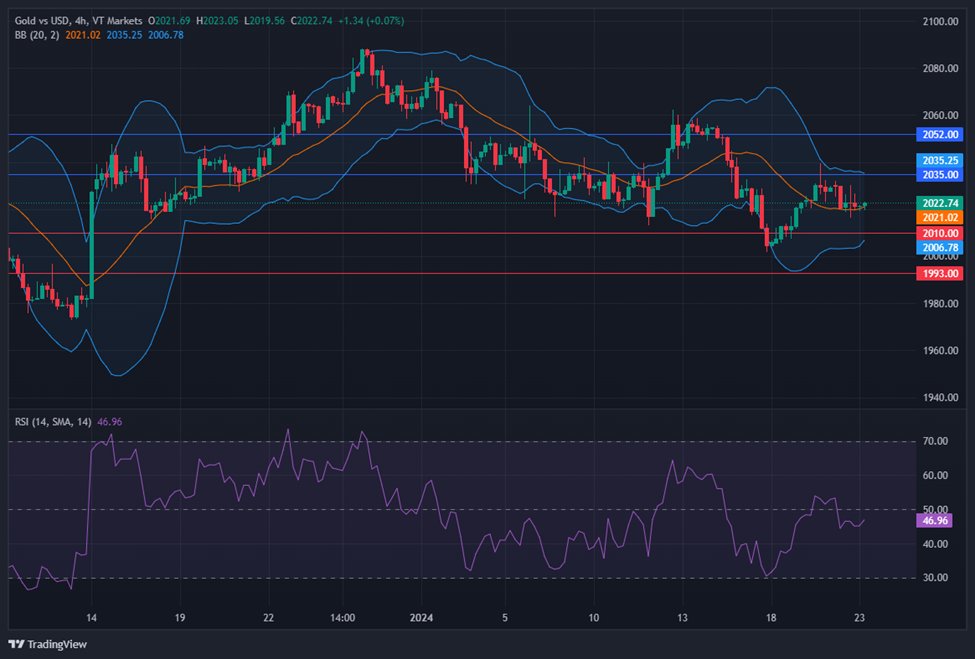
Chart XAU/USD by TradingView

On Monday, XAU/USD moved lower and was able to reach the middle band of the Bollinger Bands. Currently, the price moving just above the middle band suggesting a potential upward movement to reach the upper band. The Relative Strength Index (RSI) stands at 46, signaling a neutral outlook for this pair.

Resistance: $2,035, $2,052

Support: $2,010, $1,993

Economic Data
CurrencyDataTime (GMT + 8)Forecast
JPYBOJ Policy RateTentative-0.10%
JPYMonetary Policy StatementTentative 
JPYBOJ Press ConferenceTentative 

Dividend Adjustment Notice – January 22, 2024

Dear Client,

Please note that the dividends of the following products will be adjusted accordingly. Index dividends will be executed separately through a balance statement directly to your trading account, and the comment will be in the following format “Div & Product Name & Net Volume ”.

Please refer to the table below for more details:

The above data is for reference only, please refer to the MT4/MT5 software for specific data.

If you’d like more information, please don’t hesitate to contact [email protected].

Week Ahead: Markets to Focus on Rate Statements from Three Central Banks

Recent decisions by central banks have significantly influenced global markets. In December 2023, the Bank of Japan (BoJ) and the Bank of Canada maintained key interest rates, while the European Central Bank (ECB) sustained multi-year high rates to combat inflation. Analysts expect these measures to continue. Key economic indicators, including manufacturing and services sector data, GDP, and inflation figures, will provide insights into the near-term market outlook.

Bank of Japan Rate Statement (23 January 2024)

In the final meeting of the year, the Bank of Japan (BoJ) unanimously decided to maintain its key short-term interest rate at -0.1% and 10-year bond yields at around 0%. Analysts are anticipating that the central bank will continue with the current interest rate levels in its upcoming meeting on January 23, 2024.

Bank of Canada Rate Statement (24 January 2024)

In December 2023, the Bank of Canada kept the overnight rate at 5%, marking the third consecutive meeting with unchanged rates. Analysts project a continuation of the current levels.

European Central Bank Rate Statement (25 January 2024)

In the European Union, the European Central Bank (ECB) sustained interest rates at multi-year highs for the second consecutive meeting in December 2023. This included signaling an early conclusion to its remaining bond purchase scheme as part of efforts to combat high inflation. Analysts are expecting a continuation of these interest rate levels at the ECB’s upcoming meeting on January 25, 2024.

Flash Manufacturing PMI (24 January 2024)

Turning to economic indicators, Germany’s manufacturing Purchasing Managers’ Index (PMI) increased from 42.6 to 43.3 between November and December 2023. In contrast, the UK and the US saw decreases in manufacturing PMIs, from 47.2 to 46.2 and 49.40 to 47.90, respectively. Forecasts for January 24, 2024, indicate anticipated manufacturing PMIs of 43.7 for Germany, 46.7 for the UK, and 47.6 for the US.

Flash Services PMI (24 January 2024)

Shifting to the services sector, Germany experienced a decline in its PMI from 49.6 to 49.3 between November and December 2023. In the same period, the UK’s services PMI increased from 50.9 to 53.4, and the US witnessed a rise in its services PMI from 50.8 to 51.4. Forecasts for January 24, 2024, suggest expected services PMIs of 49.1 for Germany, 53.0 for the UK, and 51.0 for the US.

US Advance GDP (25 January 2024)

In the United States, the American economy expanded at an annualised rate of 4.9% in the third quarter of 2023, slightly below the 5.2% second estimate but matching the initially reported 4.9% in the advance estimate. Looking ahead to the advance GDP release for the fourth quarter on January 25, 2024, analysts expect a slower growth rate of 2%.

US Core PCE Price Index (26 January 2024)

Finally, in the realm of inflation, Core PCE prices in the U.S., excluding food and energy, recorded a 0.1% increase from the previous month in November 2023. With data for December 2023 set to be released on January 26, 2024, analysts are forecasting a growth of 0.2%.

Dividend Adjustment Notice – January 19, 2024

Dear Client,

Please note that the dividends of the following products will be adjusted accordingly. Index dividends will be executed separately through a balance statement directly to your trading account, and the comment will be in the following format “Div & Product Name & Net Volume ”.

Please refer to the table below for more details:

The above data is for reference only, please refer to the MT4/MT5 software for specific data.

If you’d like more information, please don’t hesitate to contact [email protected].

Tech Rally Propels Stock Market Rebound as Apple Surges

On Thursday, a positive turnaround in the stock market was driven by strong performances from tech companies, notably Apple, following a buy rating upgrade from Bank of America. The Dow Jones Industrial Average gained 201.94 points, the Nasdaq surged by 1.35%, and the S&P 500 climbed 0.88%. The 10-year Treasury yield rose to 4.14% amid tight labor market conditions, leading to concerns about fewer expected rate cuts by the Federal Reserve. In currency markets, the USD index rebounded, affecting pairs like EUR/USD and USD/JPY. GBP/USD held gains, supported by robust UK data. Commodity-centric currencies rose, while Bitcoin declined 2.75% due to higher global yields, contrasting its recent high on January 11.

Stock Market Updates

On Thursday, the stock market experienced a positive turnaround, with tech companies, particularly Apple, leading the way. The Dow Jones Industrial Average rebounded from an earlier loss, gaining 201.94 points or 0.54%, closing at 37,468.61. The Nasdaq Composite surged by 1.35%, reaching 15,055.65, while the S&P 500 climbed 0.88% to end at 4,780.94, just 0.33% away from its closing record. Apple’s shares saw a significant increase of around 3.3% after Bank of America upgraded the stock to a buy rating, predicting over 20% upside over the next 12 months. Other tech-related stocks, such as Taiwan Semiconductor Manufacturing Co., also contributed to the positive momentum, with the VanEck Semiconductor ETF reaching an all-time high, boosted by strong earnings and revenue results.

Additionally, the 10-year Treasury yield rose to 4.14% as fresh jobs data indicated tightness in the labor market, with first-time unemployment insurance filings coming in at 187,000 for the week ended Jan. 13. This stronger-than-expected labor market, combined with robust consumer spending, has raised concerns among investors about potential fewer rate cuts from the Federal Reserve than anticipated. The market is currently pricing in a roughly 56% chance of a quarter percentage point rate cut in March, according to the CME FedWatch Tool. Atlanta Fed President Raphael Bostic’s statement that he expects the central bank to start reducing rates in the third quarter contributed to the market’s uncertainty, as it deviates from the market’s expectations for a faster rate cut.

Data by Bloomberg

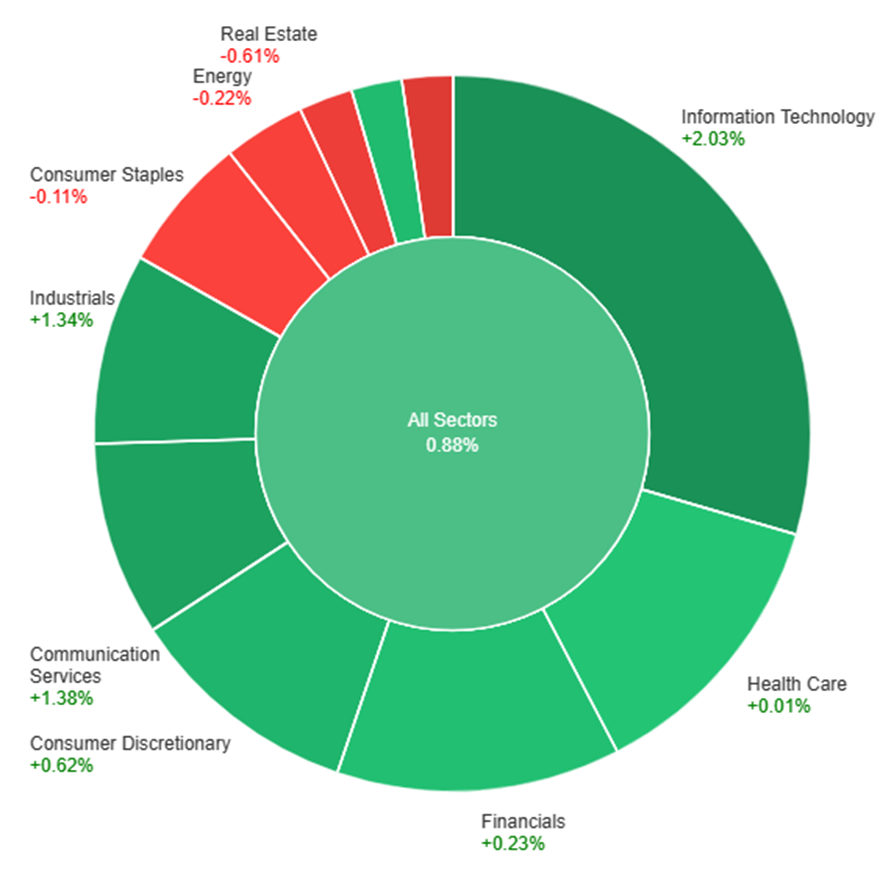
On Thursday, the overall market showed positive performance with a gain of 0.88%. The Information Technology sector led the way with a notable increase of 2.03%, followed by Communication Services and Industrials, which rose by 1.38% and 1.34%, respectively. Consumer Discretionary and Materials also saw modest gains at 0.62% and 0.39%. However, some sectors experienced declines, including Consumer Staples (-0.11%), Energy (-0.22%), Real Estate (-0.61%), and Utilities (-1.05%). Health Care showed minimal movement with a marginal increase of 0.01%. Overall, the day reflected a mixed performance across various sectors in the market.

Currency Market Updates

In the currency markets, the USD index rebounded from early lows during the North American trading session, gaining 0.23% in the U.S. afternoon. The surge came after jobless claims data came in below expectations, reducing the likelihood of a March rate cut by the Federal Reserve to 60%. This development suggested that the U.S. economy might not be slowing as initially thought. Meanwhile, the EUR/USD pair fell by 0.22% to 1.0858, with traders closely monitoring declining eurozone growth. USD/JPY reversed its overnight low-yield-related weakness, rising to 148.30 after the positive claims data, although it fell short of breaking Wednesday’s high of 148.53. Traders adopted a defensive stance ahead of Japan’s CPI release on Friday, lightening recent long positions in anticipation, even though expectations for the data prompting a shift to higher rates by the Bank of Japan remained low.

In contrast, GBP/USD held a slight gain, increasing by 0.14% to 1.2692 during New York afternoon trading. Despite facing resistance around the 1.27 level, the inability of bears to build on gains above this threshold hinted at an underlying bid near 1.26. The diminished expectations of a Fed rate cut were underscored by UK data, including Wednesday’s CPI, which exceeded forecasts, indicating that the Bank of England was unlikely to pivot to rate cuts in the near term. Other currency pairs, such as AUD/USD, rose by 0.15% to 0.6561, while USD/CAD remained flat at 1.3504. The latter was supported by rising oil and copper prices, benefiting commodity-centric currencies. In the cryptocurrency space, Bitcoin experienced a 2.75% decline, reaching a new one-month low at $41.3k, following its 21-month high at $49k on January 11. The dip in Bitcoin’s value was attributed to higher global yields, which did not bode well for crypto holders despite the coin being only down 1% year-to-date.

Picks of the Day Analysis
EUR/USD (4 Hours)

EUR/USD Holds Near Year-to-Date Lows as Greenback Gains Momentum Amidst Robust US Economic Indicators and Fed Uncertainty

On Thursday, the EUR/USD pair maintained a selling bias, settling around year-to-date lows near 1.0840 before experiencing a slight recovery. The uptrend in the US dollar was fueled by strong labor market results and a rebound in the Philly Fed Manufacturing Index. The USD Index (DXY) retained its bullish stance, supported by comments from Atlanta Fed President R. Bostic, hinting at potential rate cuts before July if inflation slows more rapidly than anticipated. Despite a baseline plan for rate reductions in the third quarter, caution is emphasized to avoid premature cuts. The market currently places a 55% probability of a Fed rate cut in March.

Meanwhile, ECB President C. Lagarde hinted at possible rate reductions in the summer. As US yields retreated slightly on the short end, German 10-year bund yields rose beyond 2.30%.

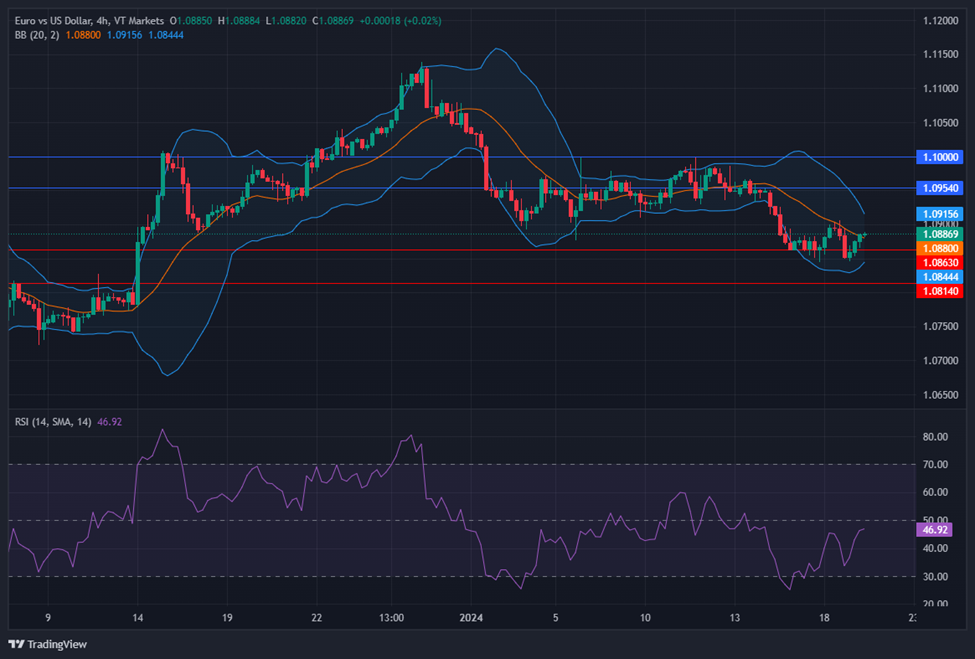
Chart EUR/USD by TradingView

On Thursday, the EUR/USD moved slightly higher, able to reach the middle band of the Bollinger Bands. Currently, the price moving just above the middle band, suggesting a potential upward movement to reach the upper band. Notably, the Relative Strength Index (RSI) maintains its position at 46, signaling a neutral outlook for this currency pair.

Resistance: 1.0954, 1.1000

Support: 1.0863, 1.0814

XAU/USD (4 Hours)

XAU/USD Stabilizes Above $2,000 Amid Economic Uncertainties and Mixed Data

Gold (XAU/USD) has found a foothold around $2,015 per troy ounce after hitting a multi-week low of $2,001.68 earlier in the week. The precious metal rebounded as market sentiment improved slightly, countering the impact of a positive US Dollar driven by concerns over the housing sector and lackluster growth-related data. Despite initial pessimism from Asian shares, optimism grew on Wall Street with better-than-expected US data, including housing starts, building permits, and lower-than-anticipated jobless claims. Federal Reserve officials provided no fresh insights into future monetary policy, leaving investors navigating a landscape of economic uncertainties.

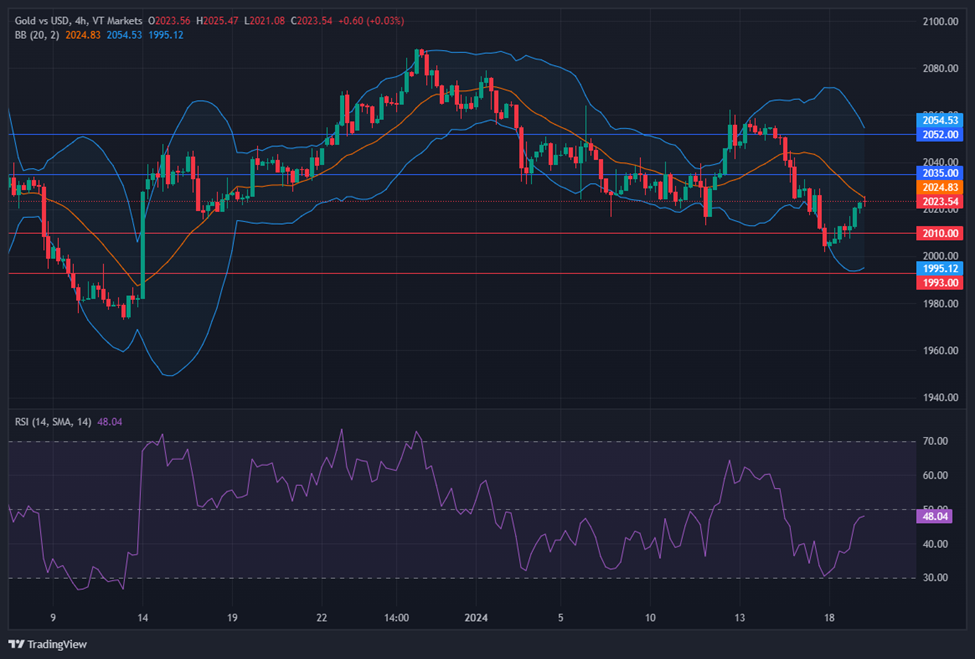
Chart XAU/USD by TradingView

On Thursday, XAU/USD moved higher and reached the middle band of the Bollinger Bands. Currently, the price moving just below the middle band suggesting a potential upward movement to reach above the middle band. The Relative Strength Index (RSI) stands at 48, signaling a neutral outlook for this pair.

Resistance: $2,035, $2,052

Support: $2,010, $1,993

Economic Data
CurrencyDataTime (GMT + 8)Forecast
GBPRetail Sales m/m15:00-0.5%
USDPrelim UoM Consumer Sentiment23:0069.8

Notification of Server Upgrade – January 18, 2023

Dear Client,

As part of our commitment to provide the most reliable service to our clients, there will be server maintenance this weekend.

Maintenance Hours :
20th of January 2024 (Saturday) 02:00-00:00 (GMT+2)

Please note that the following aspects might be affected during the maintenance:

1. The price quote and trading management will be temporarily disabled on MT5 during the maintenance. You will not be able to open new positions, close open positions, or make any adjustments to the trades.

2. There might be a gap between the original price and the price after maintenance. The gaps between Pending Orders, Stop Loss and Take Profit will be filled at the market price once the maintenance is completed. If you don’t want to hold any open positions during the maintenance, it is suggested to close the position in advance.

3. Please refer to MT5 for the latest update on the completion and market opening time. Our services will be back online once the maintenance is completed.

Thank you for your patience and understanding about this important initiative.

If you’d like more information, please don’t hesitate to contact [email protected]

Dividend Adjustment Notice – January 18, 2024

Dear Client,

Please note that the dividends of the following products will be adjusted accordingly. Index dividends will be executed separately through a balance statement directly to your trading account, and the comment will be in the following format “Div & Product Name & Net Volume ”.

Please refer to the table below for more details:

The above data is for reference only, please refer to the MT4/MT5 software for specific data.

If you’d like more information, please don’t hesitate to contact [email protected].

Stocks Decline as Treasury Yields Surge, Dollar Hits 2024 Highs

On Wednesday, the stock market saw a downturn driven by increasing Treasury yields influenced by robust U.S. economic data. The Dow Jones Industrial Average posted its third consecutive day of losses, dropping by 0.25%, while the S&P 500 and Nasdaq Composite slid 0.56% and 0.59%, respectively. Notable stock movements included a 1.3% drop for Charles Schwab and a 1.3% gain for Boeing. The market reaction was shaped by stronger-than-expected December retail sales data, casting doubt on the need for aggressive rate cuts by the Federal Reserve. The 10-year Treasury yield rose to 4.102%, and traders are estimating a 57% chance of rate cuts in March. In the currency market, the Greenback showed strength, impacting currency pairs like EUR/USD, GBP/USD, and USD/JPY. Gold and Silver prices declined due to the intense dollar rally, while WTI prices rose above $72.00 per barrel amid OPEC’s optimistic report. Traders are eagerly anticipating the EIA’s weekly report on U.S. crude oil inventories for further market cues.

Stock Market Updates

Stocks experienced a decline on Wednesday, influenced by rising Treasury yields following robust U.S. economic data. The Dow Jones Industrial Average marked its third consecutive day of losses, falling by 0.25%, while the S&P 500 and Nasdaq Composite slid 0.56% and 0.59%, respectively. Notable stock movements included a 1.3% drop for Charles Schwab due to mixed quarterly results, while Boeing saw a 1.3% gain, countering recent losses and positioning itself as one of the Dow’s leading gainers.

The market reaction was partly shaped by stronger-than-expected December retail sales data, suggesting a resilient consumer and casting doubt on the need for aggressive rate cuts by the Federal Reserve. Retail sales increased by 0.6% from November, exceeding economist estimates, potentially influencing the Fed’s monetary policy decisions. The 10-year Treasury yield rose to 4.102%, driven by Federal Reserve Governor Christopher Waller’s caution about a slower-than-anticipated easing of monetary policy. Traders, as reflected in CME Group’s FedWatch tool, are currently estimating a 57% chance of the Federal Reserve initiating rate cuts in March.

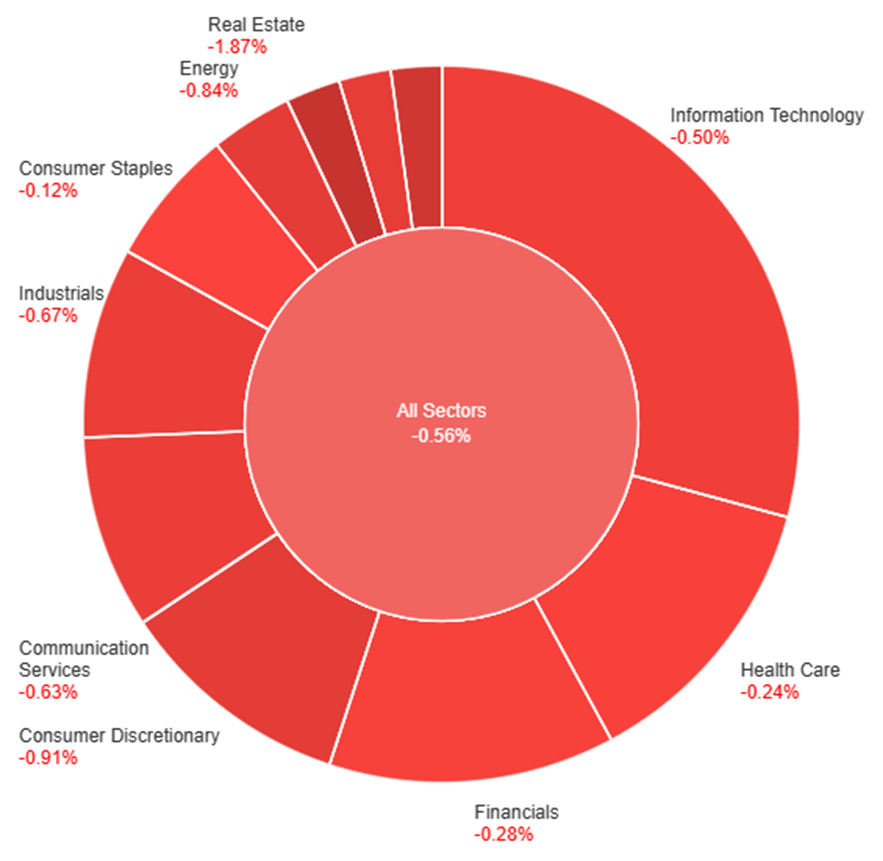
Data by Bloomberg

On Wednesday, across various sectors, the market experienced a downward trend, with the overall performance showing a decline of 0.56%. Notably, Utilities and Real Estate were the hardest hit, witnessing substantial decreases of 1.52% and 1.87%, respectively. Other sectors, including Consumer Discretionary, Energy, and Materials, also faced notable declines ranging from 0.80% to 0.91%. The weakest performers among the major sectors were Communication Services (-0.63%), Industrials (-0.67%), and Information Technology (-0.50%). The day saw a broad-based negative impact on the market, reflecting a cautious sentiment across various industries.

Currency Market Updates

In the currency market updates, the Greenback exhibited notable strength, propelling the USD Index to new 2024 peaks around 103.70, fueled by rising US yields across various maturities. The EUR/USD pair faced downward pressure, reaching multi-week lows near 1.0840, influenced by persistent dollar strength and ECB officials downplaying expectations of interest rate cuts in H1 2024. Meanwhile, GBP/USD saw support from higher-than-expected UK inflation figures, leading to decent gains, while USD/JPY surpassed the 148.00 barrier, driven by the dollar’s upward momentum and robust US yields. However, the Australian dollar faced continued selling pressure, with AUD/USD sinking to six-week lows near 0.6520, impacted by general dollar dynamics and discouraging results from the Chinese docket.

In the broader market, the intense dollar rally, coupled with rising US yields, adversely affected both Gold and Silver prices. The negative sentiment around Silver was exacerbated by disappointing Chinese data releases. On the energy front, WTI prices rose above $72.00 per barrel, partially reversing recent weakness following an optimistic report from OPEC. Despite challenges from China and a stronger dollar, traders are attentively awaiting the EIA’s usual weekly report on US crude oil inventories for further market cues.

Picks of the Day Analysis
EUR/USD (4 Hours)

EUR/USD Faces Downward Pressure Amid Greenback’s Uptrend and Divergent ECB Signals

In Wednesday’s trading session, EUR/USD encountered downward pressure, briefly touching multi-week lows before rebounding. The prevailing uptrend in the US dollar, fueled by robust December Retail Sales, tempered expectations of a Fed rate cut in March. CME Group’s FedWatch Tool indicated a shift, with the probability dropping to just above 50%. Meanwhile, ECB officials, including Knot and Vasle, highlighted market expectations for rate cuts, emphasizing alignment for a 2% inflation target by 2025. Lagarde hinted at a potential rate cut in the summer. Bond yield increases globally, particularly German 10-year bunds and rising US yields, contributed to the euro’s weakness. Poor Chinese fundamentals added to concerns about delayed economic recovery.

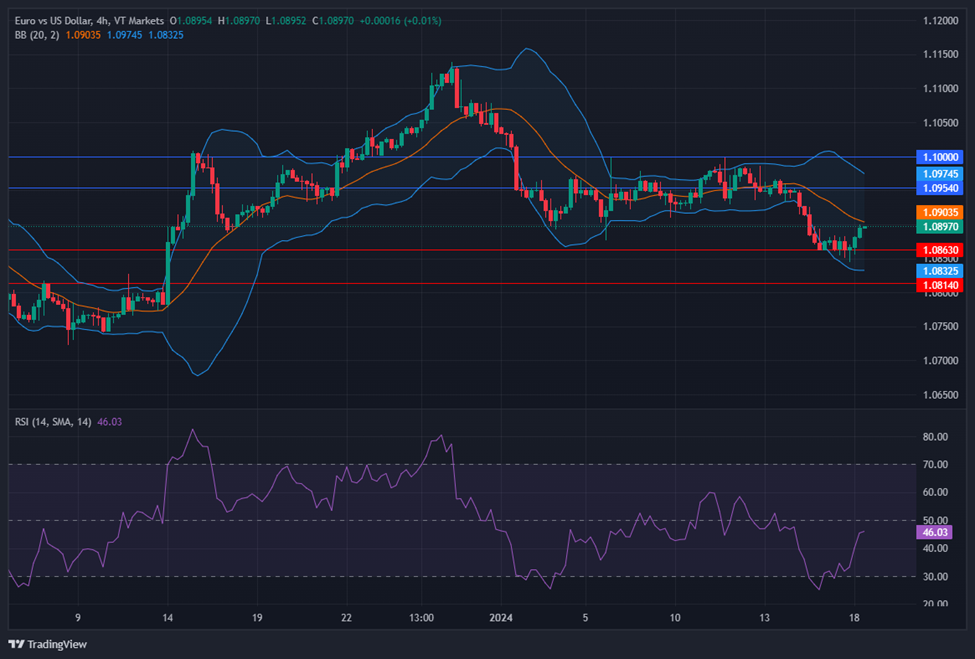
Chart EUR/USD by TradingView

On Wednesday, the EUR/USD moved slightly higher, trying to reach the middle band of the Bollinger Bands. Currently, the price moving just below the middle band, suggesting a potential upward movement to reach above the middle band. Notably, the Relative Strength Index (RSI) maintains its position at 46, signaling a neutral outlook for this currency pair.

Resistance: 1.0954, 1.1000

Support: 1.0863, 1.0814

XAU/USD (4 Hours)

XAU/USD Slumps to Mid-December Lows as Dollar Surges Amidst Global Stock Decline

Spot gold, represented by XAU/USD, experiences a downturn, reaching its lowest point since mid-December. The decline is attributed to the strengthening US Dollar, which advances as global stocks continue to fall. Investors are scaling back expectations for a Federal Reserve rate cut in March, evident in the decreasing probability from 70% to 52% according to the CME FedWatch Tool. Mixed US data, including positive Retail Sales and Industrial Production figures, alongside hawkish sentiments from Fed officials, contribute to the diminishing likelihood of a March cut. Rising government bond yields and a continued slump in Wall Street further compound the challenges for gold in this market environment.

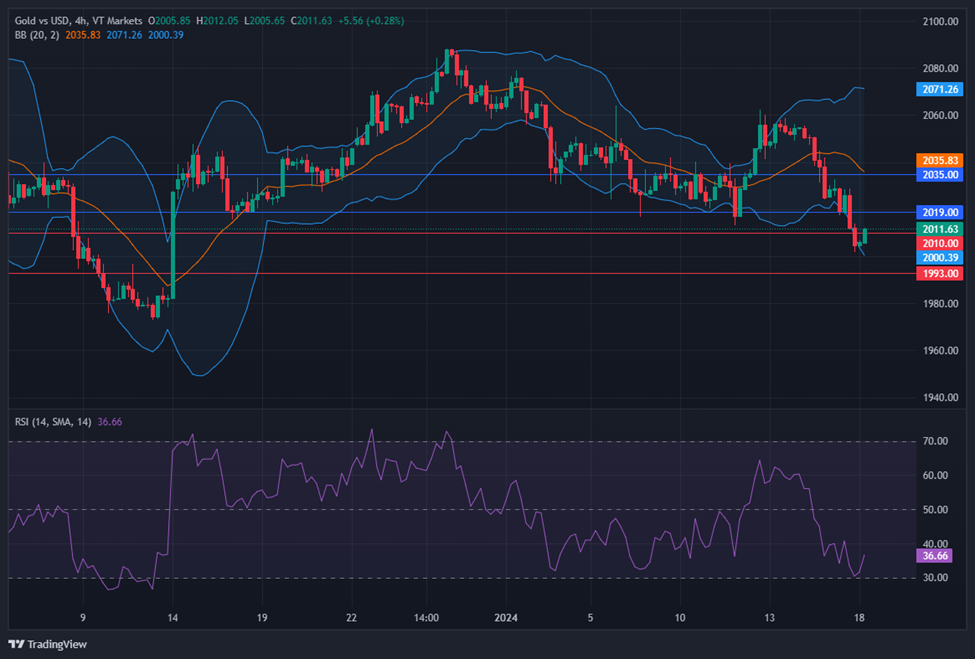
Chart XAU/USD by TradingView

On Wednesday, XAU/USD moved lower and was able to create a lower push to the lower band of the Bollinger Bands. Currently, the price moving just above the lower band suggesting a potential downward movement to create another lower push to the lower band. The Relative Strength Index (RSI) stands at 36, signaling a bearish outlook for this pair.

Resistance: $2,019, $2,035

Support: $2,010, $1,993

Economic Data
CurrencyDataTime (GMT + 8)Forecast
AUDEmployment Change08:30-65.1K (Actual)
AUDUnemployment Rate08:303.9% (Actual)
USDUnemployment Claims21:300.2%
Back To Top
server

Hai 👋

Bagaimana saya boleh membantu?

Segera berbual dengan pasukan kami

Chat Langsung

Mulakan perbualan secara langsung melalui...

  • Telegram
    hold Ditangguh
  • Akan datang...

Hai 👋

Bagaimana saya boleh membantu?

telegram

Imbas kod QR dengan telefon pintar anda untuk mula berbual dengan kami, atau klik di sini.

Tidak ada aplikasi Telegram atau versi Desktop terpasang? Gunakan Web Telegram sebaliknya.

QR code