US Stock Market Sees Mixed Performance Amidst Government Shutdown Concerns and Rising Bond Yields

In Monday’s stock market update, the Dow Jones Industrial Average dipped by 0.22%, while the S&P 500 made marginal gains and the Nasdaq Composite continued its winning streak. Notably, the small-cap Russell 2000 turned negative for the first time in 2023, reflecting challenges among smaller businesses. Rising bond yields, with the 10-year Treasury yield reaching its highest level since October 2007, influenced the market’s performance. The US dollar also gained strength, driven by higher interest rate commitments and divergence in Purchasing Managers’ Index (PMI) data between the US and Europe. Risk aversion and declining oil and copper prices further supported the dollar’s rise, impacting currency markets. Looking ahead, key data releases will continue to influence market dynamics.

Stock Market Updates

In the stock market update, on Monday, the Dow Jones Industrial Average experienced a 0.22% decline, closing at 33,433.35 points. This dip occurred despite a short-term agreement reached by U.S. legislators to prevent a government shutdown. The S&P 500, on the other hand, saw marginal gains of 0.01%, finishing at 4,288.39 points, while the Nasdaq Composite had a more positive day, adding 0.67% to reach a closing value of 13,307.77 points. Notably, this marked the fourth consecutive day of gains for the Nasdaq. However, the Russell 2000, a small-cap index, suffered a 1.6% decline on Monday, resulting in a year-to-date decrease of 0.3%. This marked the first time in 2023 that the Russell 2000 turned negative, reflecting challenges among smaller businesses. The Russell 2000 is often regarded as a valuable indicator of the overall economy’s health due to its focus on small enterprises.

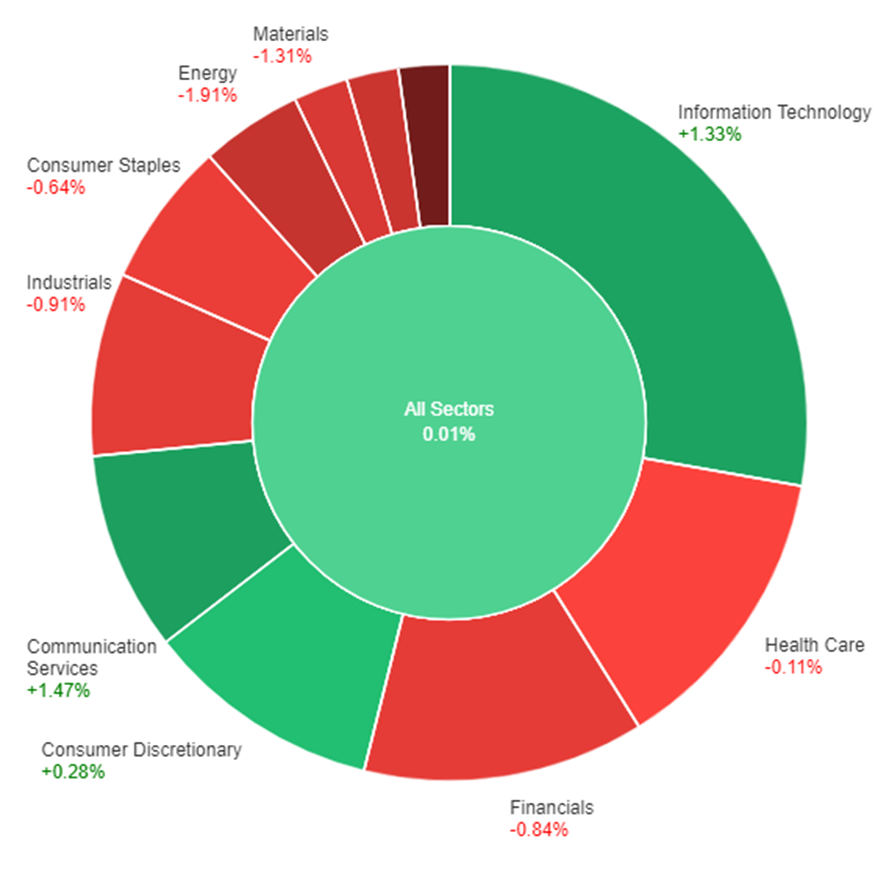
The market’s performance occurred against the backdrop of rising bond yields, with the 10-year Treasury yield reaching a high of 4.7%, its highest level since October 2007. In terms of individual stock movements, Discover emerged as the top gainer in the S&P 500, with its shares rising by nearly 5%. Medical device manufacturer Insulet saw a 3.5% increase in its stock value, while chipmaker Nvidia rose by almost 3%. Among the various sectors, technology, communications services, and consumer discretionary were the only ones that recorded positive gains. Communication services added 1.5%, the tech sector traded 1.3% higher, and consumer discretionary gained 0.3%. The Senate’s recent passage of a continuing resolution, signed into law by President Joe Biden, ensured that the government would remain open until mid-November. Historically, stock markets have shown little concern for government shutdowns, with the S&P 500’s performance during such periods remaining relatively flat. Analysts emphasized that other economic conditions, such as housing, manufacturing, and labor, are more critical factors to watch as the year progresses.
Data by Bloomberg

On Monday, the performance of various sectors in the market showed mixed results. The overall market, represented by “All Sectors,” had a minimal increase of 0.01%. Notable gainers included Communication Services (+1.47%) and Information Technology (+1.33%), which experienced significant positive growth. On the other hand, some sectors faced losses, with Utilities being the most affected, plummeting by -4.72%. Real Estate (-1.75%), Energy (-1.91%), and Materials (-1.31%) also saw substantial declines. Additionally, Health Care (-0.11%), Consumer Staples (-0.64%), Financials (-0.84%), Industrials (-0.91%), and Consumer Discretionary (+0.28%) experienced relatively smaller fluctuations in their values.

Currency Market Updates

In the opening of the fourth quarter, the US dollar demonstrated resilience and strength, marking a 0.6% rise in the dollar index. This surge was primarily driven by an uptick in Treasury yields following the temporary resolution of a suspected US government shutdown. Additionally, the divergence in Purchasing Managers’ Index (PMI) data between the US and Europe favored the US dollar. The robust performance of the US currency was further supported by a commitment from Federal Reserve speakers to maintain higher interest rates for an extended period. This, in turn, triggered risk aversion, causing high-beta currencies like the Australian dollar and South African Rand to weaken. The dollar’s upward momentum was also aided by declines in oil and copper prices, which prompted derisking flows, alongside rising yields across Europe. As a result, the EUR/USD pair experienced a 0.76% decline, though it managed to hold above key support levels, raising questions about the sustainability of a recent rebound.

Looking ahead, the US dollar’s performance is expected to hinge on several key data releases, including the US JOLTS report, the ISM non-manufacturing data, and the employment report scheduled for Friday. Notably, the ISM manufacturing data exceeded expectations, while prices paid decreased, which might influence the dollar’s direction. In the currency market, USD/JPY saw a 0.27% increase, approaching the psychologically significant 150 level. Market participants are closely monitoring this level, as it is seen as a potential trigger point for intervention by the Japanese Ministry of Finance (MoF). The BoJ’s discussions on policy normalization are anticipated to be more active in Q1 2024, coinciding with wage negotiations, while the bank recently announced additional Japanese Government Bond (JGB) purchases in response to rising yields, which are nearing the bank’s 1% hard cap. Meanwhile, the British pound experienced a 0.79% decline, reaching its lowest point since March, due to a combination of risk-off sentiment and disappointing UK PMI data.

Picks of the Day Analysis
EUR/USD (4 Hours)

EUR/USD Drops Below 1.0500 Amid Strong US Dollar and Resilient Economic Data

The EUR/USD pair experienced a substantial decline, falling below 1.0500 as the US Dollar maintained its strength due to global risk-off sentiment and rising yields. The US Dollar Index (DXY) edged closer to 107.00, supported by positive economic data and Federal Reserve officials’ comments on the economy’s resilience. Meanwhile, the Eurozone reported a drop in unemployment and a confirmed Manufacturing PMI reading. The coming week’s key events, including the JOLTS and ADP reports, along with the Nonfarm Payrolls data, will likely influence the future direction of the EUR/USD pair, with the US Dollar’s strength hanging in the balance.
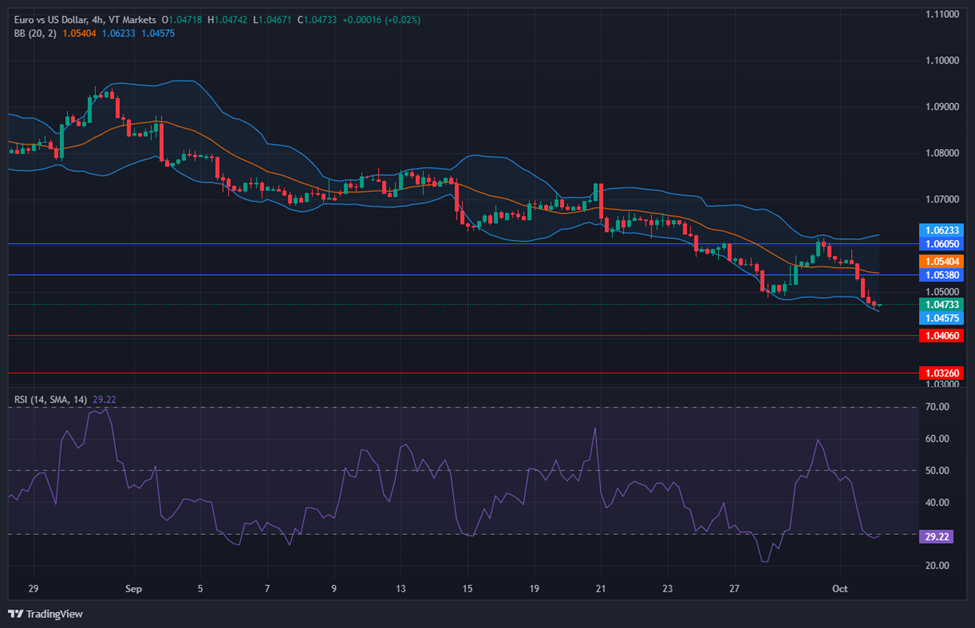
Chart EURUSD by TradingView

According to technical analysis, EUR/USD moved lower on Monday, reaching the lower band of the Bollinger Bands. It is currently trading above the lower band, suggesting the potential for further losses. The Relative Strength Index (RSI) is at 29, indicating that EUR/USD is now in bearish bias.

Resistance: 1.0538, 1.0605

Support: 1.0406, 1.0326

XAU/USD (4 Hours)

XAU/USD Hit Multi-Month Low Amid Shifting Economic Tides and Strong US Dollar Demand

Spot Gold recently plunged to a multi-month low of $1,827.11 per troy ounce, primarily driven by resurging US Dollar demand. Encouraging economic data from China and the United States initially boosted sentiment, with China’s Producer Manager Indexes indicating economic resilience and the US Congress extending the debt ceiling to avoid a government shutdown. However, as the day progressed, market sentiment turned sour due to global economic struggles, despite some positive signs such as an improvement in the US ISM Manufacturing PMI. Rising government bond yields, with the 10-year Treasury note hitting its highest since 2007, fueled demand for the US Dollar.
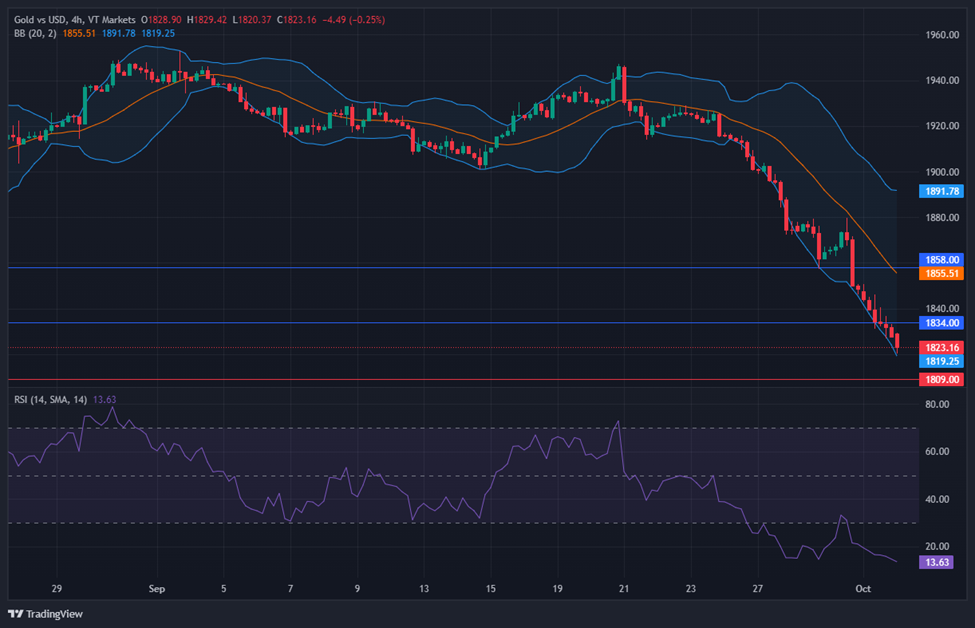
Chart XAUUSD by TradingView

According to technical analysis, XAU/USD moved lower on Monday, creating downward pressure on the lower band of the Bollinger Bands. Currently, the price is consolidating above the lower band, suggesting potential consolidation for today. The Relative Strength Index (RSI) is currently at 13, signifying a bearish bias for the XAU/USD pair.

Resistance: $1,834, $1,858

Support: $1,809, $1,777

Economic Data
CurrencyDataTime (GMT + 8)Forecast
AUDCash Rate11:304.10%
AUDRBA Rate Statement11:30 
CHFCPI m/m14:300.0%
USDJOLTS Job Openings22:008.81M

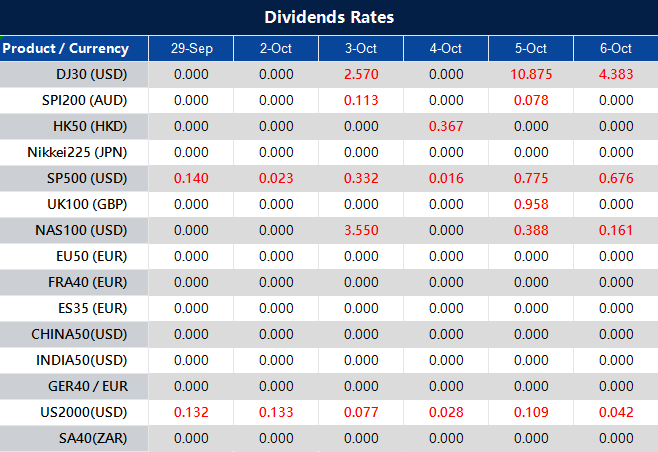
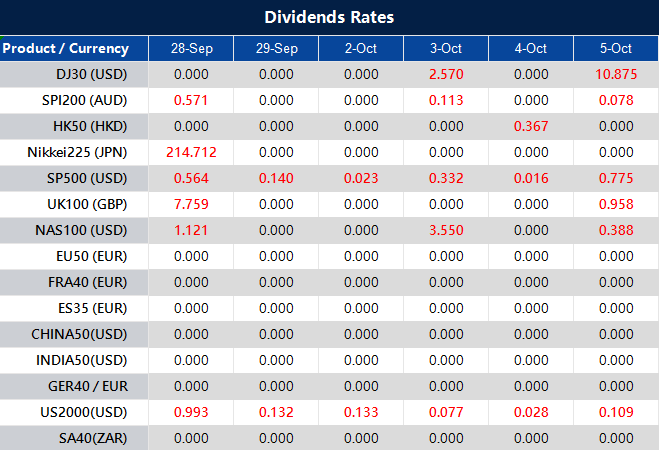
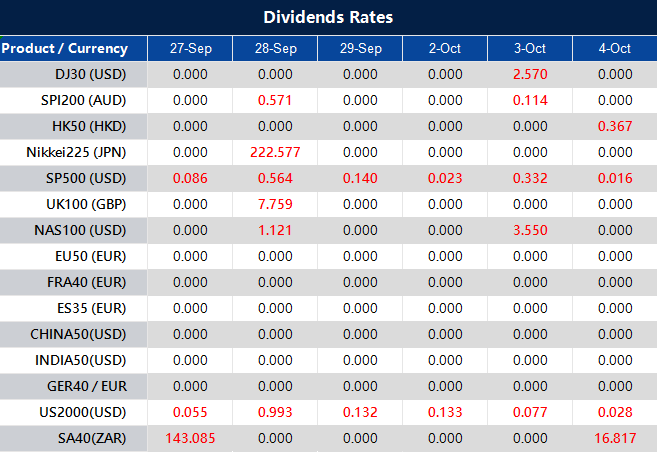
Dividend Adjustment Notice – October 2, 2023

Dear Client,

Please note that the dividends of the following products will be adjusted accordingly. Index dividends will be executed separately through a balance statement directly to your trading account, and the comment will be in the following format “Div & Product Name & Net Volume ”.

Please refer to the table below for more details:

The above data is for reference only, please refer to the MT4/MT5 software for specific data.

If you’d like more information, please don’t hesitate to contact [email protected].

Week Ahead: Markets to Focus on US Jobs Report, RBA Rate Statement, and RBNZ Rate Statement

Several key economic releases are expected to impact the financial markets this week. Notably, attention will be on the US Jobs Report, the rate statement from the Reserve Bank of Australia (RBA), and the rate statement from the Reserve Bank of New Zealand (RBNZ). Given the potential for heightened market volatility, we advise traders to approach their trading activities with caution.

Here are some of the notable market highlights for this week:

Reserve Bank of Australia Rate Statement (3 October 2023) 

The Reserve Bank of Australia (RBA) maintained its cash rate at 4.1% during its final meeting under Governor Philip Lowe in September 2023, extending the rate pause for the third successive month. 

Under the new Governor Michele Bullock, analysts predict that the RBA will keep its cash rate at 4.1% following its next meeting on 3 October.

Reserve Bank of New Zealand Rate Statement (4 October 2023) 

The Reserve Bank of New Zealand (RBNZ) maintained its official cash rate (OCR) at 5.5% during its August 2023 meeting, extending its rate pause for the second consecutive month.

Analysts expect the OCR to remain at 5.5% following the central bank’s upcoming meeting on 4 October.

US ISM Services PMI (4 October 2023)

The US Institute of Supply Management (ISM) Services PMI jumped from 52.7 in July 2023 to 54.5 in August 2023, the largest growth in the services sector in six months.

Updated data will be released on 4 October, with analysts expecting the index to be lowered to 53.6.

Canada Employment Change (6 October 2023) 

39,900 jobs were added to the Canadian economy in August 2023. Meanwhile, the unemployment rate held steady at 5.5%, maintaining its level from the previous month.

The figures for September are scheduled for release on 6 October, with analysts anticipating the addition of 17,000 new jobs. However, the unemployment rate is expected to rise slightly to 5.6%.

US Jobs Report (6 October 2023) 

187,000 jobs were added to the US economy in August 2023. However, the unemployment rate rose to 3.8%, the highest level since February 2022.

The figures for September 2023 are set to be released on 6 October. Analysts anticipate the addition of 163,000 jobs. Additionally, the unemployment rate is expected to decrease slightly to 3.7%.

Dividend Adjustment Notice – September 29, 2023

Dear Client,

Please note that the dividends of the following products will be adjusted accordingly. Index dividends will be executed separately through a balance statement directly to your trading account, and the comment will be in the following format “Div & Product Name & Net Volume ”.

Please refer to the table below for more details:

The above data is for reference only, please refer to the MT4/MT5 software for specific data.

If you’d like more information, please don’t hesitate to contact [email protected].

Stocks Show Signs of Recovery Amidst Challenging Month as Treasury Yields Ease

On Thursday, the stock market witnessed a rebound as Wall Street aimed to recover from recent losses. The Dow Jones Industrial Average and Nasdaq Composite posted gains of 0.35% and 0.83%, respectively, while the S&P 500 came close to reaching the 4,300 marks with a 0.59% increase. Despite the challenging month and quarter, optimism returned due to a decrease in Treasury yields from multiyear highs and positive economic data showing a resilient labor market. The US dollar also faced a decline, largely influenced by a rebound in the EUR/USD currency pair and evolving monetary policies from the European Central Bank and the US Federal Reserve. Amid these factors, concerns over fiscal difficulties and potential government shutdowns persist.

Stock Market Updates

In the stock market update, on Thursday, stocks showed signs of recovery as Wall Street attempted to bounce back from the steep losses experienced earlier in the month. The Dow Jones Industrial Average rose by 116.07 points, or 0.35%, reaching 33,666.34, while the S&P 500 added 0.59%, just falling short of the key 4,300 level, closing at 4,299.70. The Nasdaq Composite saw a significant gain of about 0.83%, closing at 13,201.28. However, it’s worth noting that stocks have faced a challenging month and quarter, with the Dow expected to end September down 3% and the quarter down more than 2%. The S&P 500 is slated to finish the month with a 4.6% decline and the quarter with a 3.4% decrease, while the Nasdaq is on track to end both the month and quarter lower by 5.9% and 4.3%, respectively.

One key factor influencing market sentiment is the movement in Treasury yields, which have been rising. Investors have been concerned about the potential for higher interest rates and the impact on equities. However, on the positive side, Treasury yields eased from multiyear highs, providing some relief to the stock market. Additionally, positive economic data showing a resilient labor market with lower-than-expected jobless claims helped bolster market confidence. Investors are also keeping an eye on inflation metrics, particularly the personal consumption expenditures price index, which is the Federal Reserve’s preferred gauge of inflation. Moreover, political developments in Washington, specifically negotiations on a U.S. spending bill, are being closely monitored, as they could impact market dynamics in the near term.

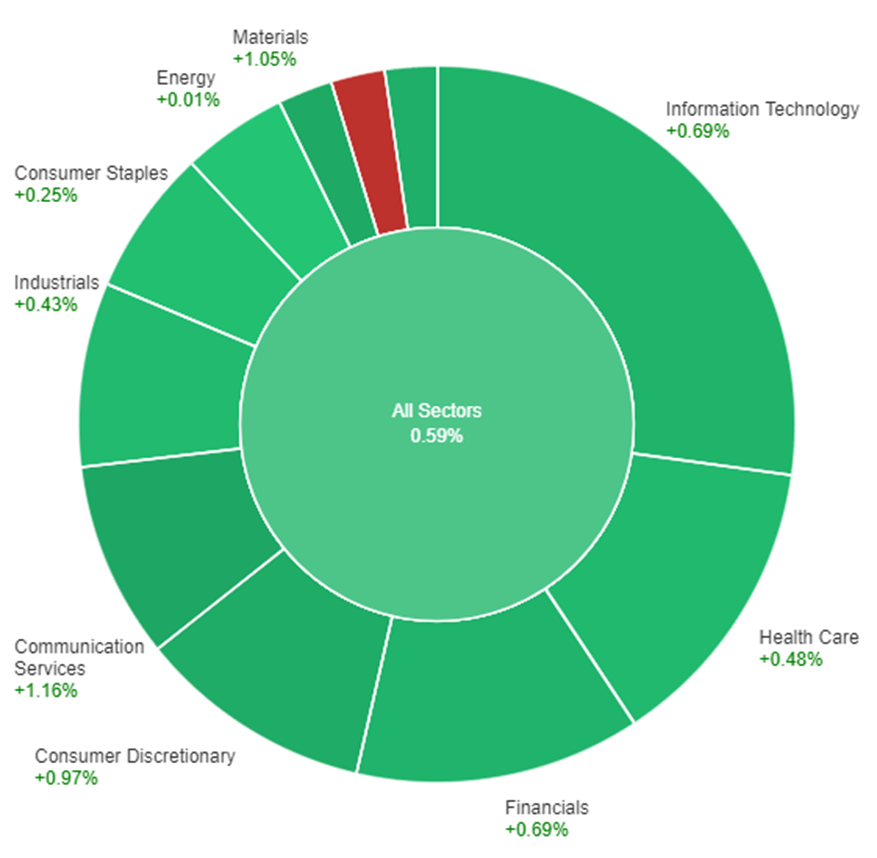
Data by Bloomberg

On Thursday, across all sectors, there was a modest increase in the market, with a gain of 0.59%. Notably, Communication Services, Materials, and Consumer Discretionary sectors saw even stronger performance, with gains of 1.16%, 1.05%, and 0.97% respectively. The Real Estate, Financials, and Information Technology sectors also experienced positive growth, with gains of 0.85%, 0.69%, and 0.69%. Health Care and Industrials sectors had more moderate increases, with gains of 0.48% and 0.43%. However, Consumer Staples saw a smaller gain of 0.25%. The Energy sector only saw a minimal increase of 0.01%. In contrast, the Utilities sector faced a significant decline, with a loss of -2.19% on Thursday.

Currency Market Updates

In the latest currency market updates, the US dollar faced a notable decline, with the dollar index slipping by 0.37%. A significant contributor to this fall was the impressive 0.5% rebound in the EUR/USD currency pair, which had been deeply oversold. The pair found crucial support at the 1.0482 low from January 6, 2023, particularly toward the end of the month. This recovery was bolstered by a substantial rise in bund-Treasury yield spreads. Interestingly, the European Central Bank (ECB), despite German CPI figures coming in slightly below forecasts and reaching their lowest levels since the Russian invasion of Ukraine, indicated that it might not raise interest rates further. Instead, the ECB is in the process of unwinding its previous quantitative easing and bank-supportive policies, while fiscal policymakers in the region are grappling with rising costs. On the US front, concerns loom over potential fiscal difficulties, including the possibility of a government shutdown. The Federal Reserve’s commitment to maintaining higher interest rates for an extended period was also questioned by some, including Fed’s Austan Goolsbee. Though US jobless claims remained slightly below forecast, the pending home sales plummeted by 7.1% from July to August, hinting at a potential drop in September’s existing home sales, which could reach their lowest point in over a decade.

Moreover, in the context of the currency market, USD/JPY experienced a 0.2% decline due to a minor drop in Treasury-JGB yield spreads. Nevertheless, despite the promising yield spreads, the primary factor holding back USD/JPY’s advance is the fear of Japanese foreign exchange intervention. While most of the market’s attention is on the 150 level as a potential intervention trigger point, it could potentially break out above 2023’s channel top towards 2022’s 32-year high at 151.94, mirroring the scenario that triggered interventions in October 2022. Japanese officials have stated that they do not defend specific currency levels but rather respond to excessive volatility. However, recent price action has not been notably volatile. Additionally, the British pound rose by 0.46% following a recent low, which marked an 8% slide since its highs in July. This rebound was supported by the recovery of two-year gilts-Treasury yield spreads. Furthermore, the slight drop in Treasury yields, combined with a rebound in risk sentiment and pullbacks in both the dollar and oil prices, contributed to a 1.1% rise in AUD/USD and a 0.35% fall in USD/CNY. Upcoming data releases are set to include Tokyo CPI, Japan’s job market indicators, industrial production, and retail sales, as well as eurozone CPI figures, followed by the release of U.S. core PCE data, income and spending metrics, Michigan sentiment numbers, and Chicago PMI data.

Picks of the Day Analysis
EUR/USD (4 Hours)

EUR/USD Rebounds as US Dollar Correction Pauses Amidst Robust Economic Data

In a notable Thursday surge, the EUR/USD pair made a strong comeback from recent monthly lows, nearing the 1.0600 level, thanks to a brief halt in the US Dollar’s bullish streak driven by positive US economic indicators. While the US economy continued to show signs of strength, including a 2.1% annualized Q2 GDP growth rate and lower-than-expected Initial Jobless Claims, market sentiment weighed on the greenback. The Euro’s performance appeared relatively unaffected by the European Central Bank’s current stance, with market expectations leaning towards no October rate hike. Though comments from ECB members had limited influence, data, such as Germany’s falling annual inflation rate and resilient business and consumer sentiment indicators, helped bolster the Euro’s position, with Friday’s Eurozone inflation figures eagerly awaited.

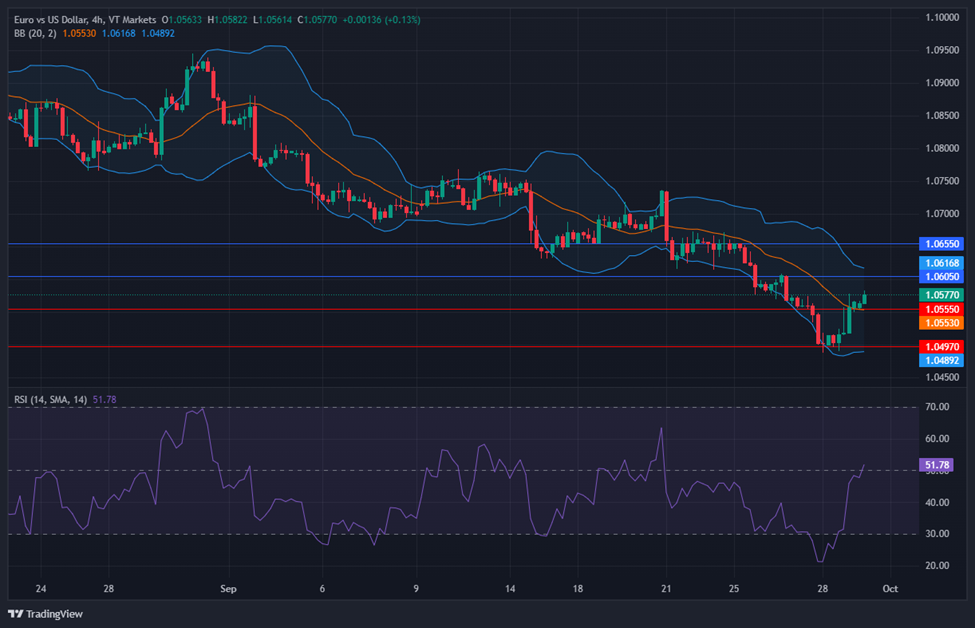
Chart EURUSD by TradingView

According to technical analysis, EUR/USD moved higher on Thursday, reaching the middle band of the Bollinger Bands. It is currently trading above the middle band, suggesting the potential for further gains to reach the upper band. The Relative Strength Index (RSI) is at 51, indicating that EUR/USD is attempting to return to a neutral stance.

Resistance: 1.0547, 1.0605

Support: 1.0488, 1.0440

XAU/USD (4 Hours)

XAU/USD Hits Six-Month Low as US Dollar Gains Amid Positive Economic Data

On Thursday, the price of gold continued its decline, reaching $1,857.66 per troy ounce, its lowest point since early March. The US Dollar strengthened against gold due to improved market sentiment driven by positive macroeconomic data, including the confirmation of a 2.1% Q2 Gross Domestic Product (GDP) and better-than-expected Initial Jobless Claims. Additionally, government bond yields retreated from recent highs, with the 10-year Treasury note at 4.61% and the 2-year bond at 5.08%, down 12 basis points from recent highs following the Federal Reserve’s monetary policy announcement. Investors now await the latest US inflation data, particularly the August Personal Consumption Expenditures (PCE) Price Index, with the core annual reading expected to be 3.9%, slightly below July’s 4.2%.

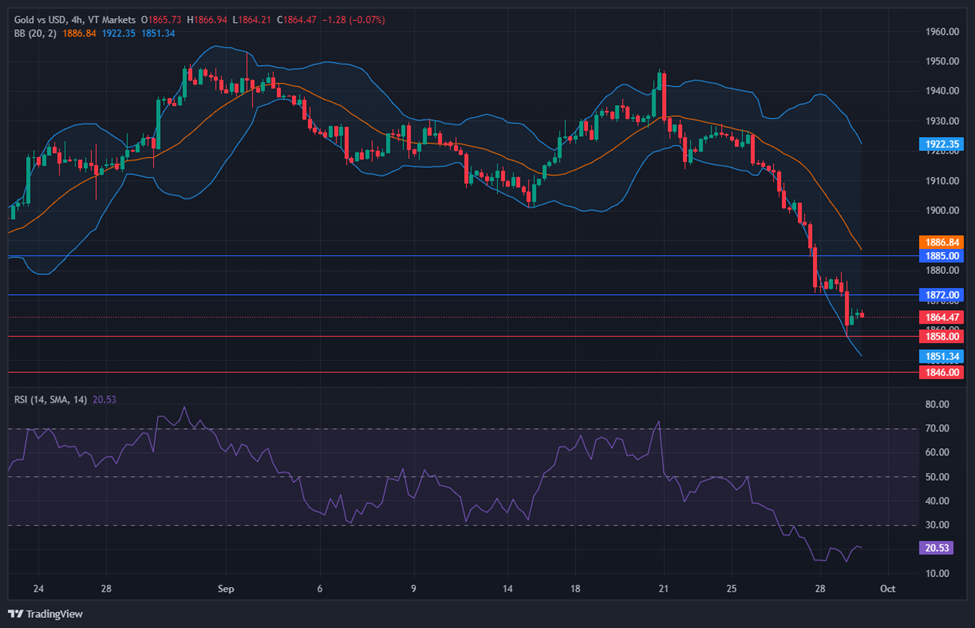
Chart XAUUSD by TradingView

According to technical analysis, XAU/USD moved lower on Thursday, creating downward pressure on the lower band of the Bollinger Bands. Currently, the price is consolidating above the lower band, suggesting potential consolidation for today. The Relative Strength Index (RSI) is currently at 20, signifying a bearish bias for the XAU/USD pair.

Resistance: $1,872, $1,885

Support: $1,858, $1,846

Economic Data
CurrencyDataTime (GMT + 8)Forecast
CADGDP m/m20:300.1%
USDCore PCE Price Index m/m20:300.2%
USDRevised UoM Consumer Sentiment22:0067.7

Notification of Trading Adjustment in Holiday – September 28, 2023

Dear Client,

Please note that the following instruments’ trading hours will be affected by the upcoming holidays.

Note: The dash sign (-) indicates normal trading hours.

The above data is for reference only, please refer to the MT4/MT5 software for specific data.

If you’d like more information, please don’t hesitate to contact [email protected].

Dividend Adjustment Notice – September 28, 2023

Dear Client,

Please note that the dividends of the following products will be adjusted accordingly. Index dividends will be executed separately through a balance statement directly to your trading account, and the comment will be in the following format “Div & Product Name & Net Volume ”.

Please refer to the table below for more details:

The above data is for reference only, please refer to the MT4/MT5 software for specific data.

If you’d like more information, please don’t hesitate to contact [email protected].

Dow Jones Slips on Oil and Treasury Yields, USD Gains Amid Eurozone Concerns

On Wednesday, the Dow Jones Industrial Average fell by 0.20% as increasing Treasury yields and surging oil prices weighed on investor sentiment, with the S&P 500 approaching a critical support level. The energy sector outperformed, while concerns about inflation and disappointing economic data continued to impact the market. The US dollar strengthened, driven by a contrast in economic data between the United States and the Eurozone, posing challenges for EUR/USD speculators. The USD/JPY pair approached a significant level, with implications for foreign exchange interventions, while sterling and the Australian dollar faced their own challenges. Upcoming economic data releases are expected to maintain market volatility.

Stock Market Updates

The Dow Jones Industrial Average experienced further losses, falling 0.20% on Wednesday, largely due to increased Treasury yields and rising oil prices, which negatively impacted investor sentiment. The Dow closed at 33,550.27, shedding 68.61 points, despite briefly surging by 112.77 points earlier in the session. On the other hand, the S&P 500 showed marginal gains of 0.02%, closing at 4,274.51, while the Nasdaq Composite ended the session 0.22% higher at 13,092.85. The increase in Treasury yields and a 3% spike in U.S. crude oil futures to $93.68 per barrel were key factors contributing to the market’s downward trajectory. The energy sector emerged as the best performer, rising by 2.5%, with notable companies like Marathon Oil and Devon Energy both posting gains of over 4%.

The recent market turbulence can be attributed to concerns regarding inflation, as rising rates and disappointing economic data have weighed on investor sentiment. The S&P 500 slipped below the crucial 4,300 level for the first time since June, and the Dow recorded its most significant one-day loss since March, closing below its 200-day moving average for the first time since May. September, known as a seasonally weak month for stocks, has seen the S&P 500 down by 5%, the Dow down by more than 3%, and the Nasdaq performing the worst, with a loss exceeding 6% for the month. Investors anticipate continued volatility in the coming weeks but remain hopeful for strong buying opportunities leading up to the year-end, particularly in October.

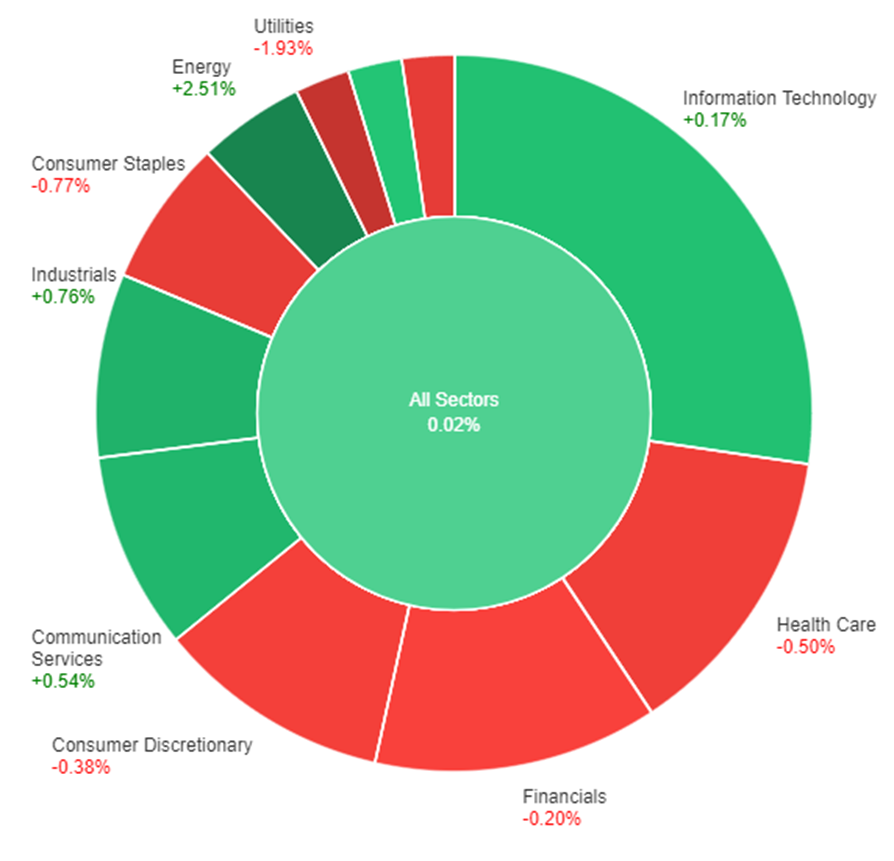
Data by Bloomberg

On Wednesday, across all sectors, the market saw a minimal increase of 0.02%. Energy performed exceptionally well with a substantial gain of 2.51%, while Industrials and Communication Services showed moderate increases of 0.76% and 0.54%, respectively. Information Technology also saw a slight gain of 0.17%. On the flip side, several sectors experienced declines, with Utilities being the most impacted, showing a significant decrease of 1.93%. Real Estate, Consumer Staples, and Health Care also had notable declines of 0.83%, 0.77%, and 0.50%, respectively. Financials and Consumer Discretionary had smaller losses of 0.20% and 0.38%, respectively.

Currency Market Updates

The US dollar showed significant strength in the currency market, with the dollar index surging by 0.55% on Wednesday. This increase was driven by the EUR/USD pair falling by 0.75% below the 1.0500 mark and approaching the 2023 low of 1.0482. The dollar’s gains were primarily attributed to a contrast between better-than-expected economic data from the United States and rising concerns of a recession in the Eurozone, compelling short positions on the dollar to seek cover. Notably, Eurozone money supply contracted at a historic rate in August, with loans to households and businesses falling well short of forecasts. Additionally, deteriorating German consumer sentiment raised doubts about a recovery this year. The USD’s recent gains, totaling approximately 7% against the euro since July, are likely to be concerning for speculators who entered long positions earlier in the year, as the EUR/USD pair hovers near its 2023 low.

In the meantime, the USD/JPY pair is approaching the significant level of 150, which many speculate the Japanese Ministry of Finance might defend, either through verbal interventions or actual foreign exchange interventions. Surpassing 150 could lead to a defense of the 32-year peak reached last year at 151.94 on EBS, potentially signaling an overdue correction. The trajectory of 10-year Treasury yields in the United States, which rose by 7 basis points to levels not seen since 2007, is crucial for USD/JPY. While US yields surge, 10-year Japanese Government Bond (JGB) yields remain at a much lower level of around 0.75%, setting the stage for further developments in this currency pair. This currency market update also revealed that sterling fell by 0.35% due to concerns about the Bank of England’s ability to combat inflation effectively, with the pound inching closer to the 2023 low of 1.1805 after an almost 8% decline from its July highs. Other notable movements in the market include the Australian dollar (AUD/USD) falling by 0.9% due to risk aversion related to issues in China and limited expectations of an interest rate hike by the Reserve Bank of Australia (RBA). The US dollar also made gains against the Norwegian krone (USD/NOK) by 0.56% in response to rising crude oil prices, particularly as Brent crude approached the $100 mark. The market anticipates more economic data releases on Thursday, including German Consumer Price Index (CPI), US jobless claims, Q2 GDP revisions, and pending home sales, with a heavier slate of releases scheduled for Friday.

Picks of the Day Analysis
EUR/USD (4 Hours)

EUR/USD Hits 2023 Lows, ECB’s Focus on Inflation, and USD Strength Dominates Markets

The EUR/USD has experienced a seven-day decline, plummeting to its lowest point since January, falling below 1.0500. The prevailing market sentiment is bearish, with no correction in sight, and the European Central Bank (ECB) closely watching upcoming inflation data from Spain and Germany. ECB members’ comments have had minimal impact, as the bank awaits crucial inflation figures this week. Spain expects a rebound in consumer inflation, while Germany anticipates a sharp decline in CPI. The US Dollar continues to strengthen, reaching new highs with the US Dollar Index nearing 107.00. Despite declining equities, US Treasury yields remain high, and economic data, including Durable Goods Orders and Jobless Claims, is closely monitored.

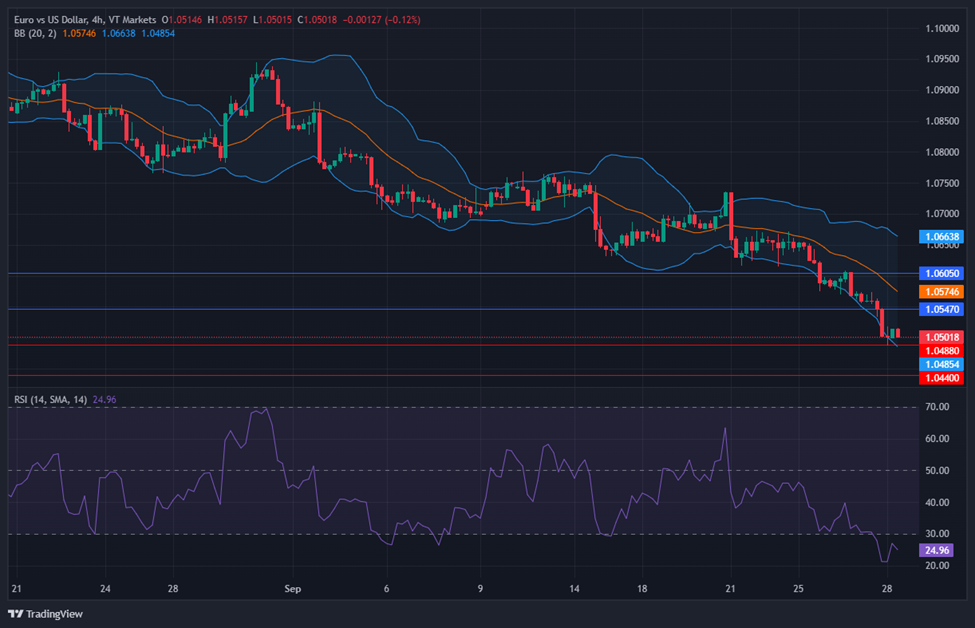
Chart EURUSD by TradingView

According to technical analysis, the EUR/USD moved lower on Wednesday and created downward pressure on the lower band of the Bollinger Bands. This movement suggests the possibility of further losses in EUR/USD. The Relative Strength Index (RSI) is currently at 24, indicating a bearish bias for the EUR/USD.

Resistance: 1.0547, 1.0605

Support: 1.0488, 1.0440

XAU/USD (4 Hours)

XAU/USD Slumps Below $1,880 as Dollar Surges Amidst U.S. Funding and Rate Hike Concerns

Spot Gold’s decline deepened as it slipped below the $1,880 threshold, driven by a strengthening U.S. Dollar in a risk-averse climate, while financial markets closely monitored developments in the United States, where a federal shutdown loomed due to political disagreements over funding. Simultaneously, global stock markets extended their bearish trends on concerns that central banks might prolong higher interest rates, elevating the risk of economic downturns. Government bond yields spiked, with the 10-year Treasury note hitting a 15-year high at 4.59%, and the 2-year note offering 5.11%, nearing levels not seen since the Federal Reserve’s monetary policy announcement.

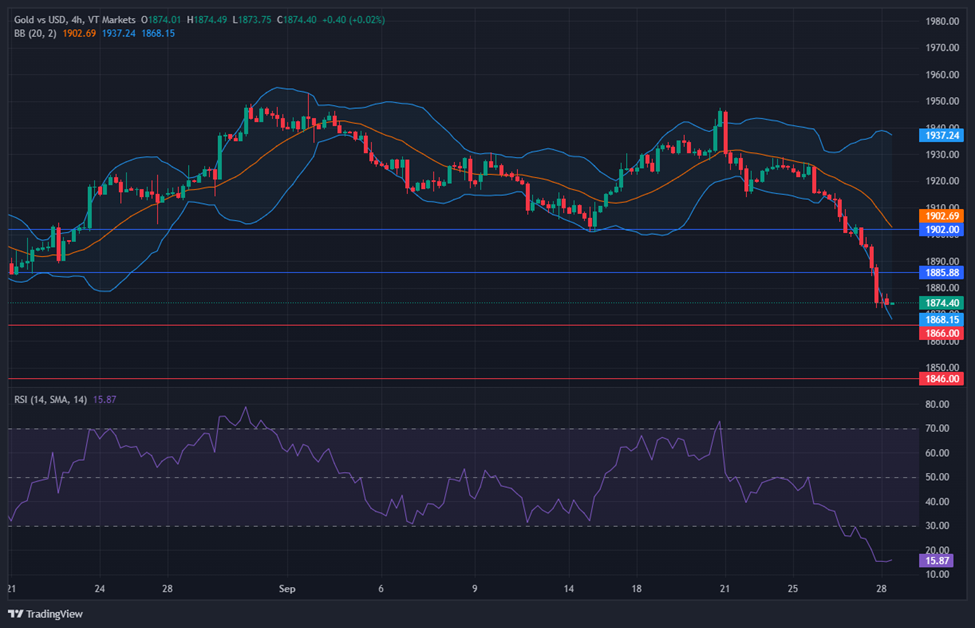
Chart XAUUSD by TradingView

According to technical analysis, XAU/USD moved lower on Wednesday, creating downward pressure on the lower band of the Bollinger Bands. Currently, the price is hovering just above the lower band, suggesting a potential further decline for XAU/USD. The Relative Strength Index (RSI) is currently at 15, signifying a bearish bias for the XAU/USD pair.

Resistance: $1,885, $1,902

Support: $1,866, $1,846

Economic Data
CurrencyDataTime (GMT + 8)Forecast
EURGerman Prelim CPI m/mAll Day0.3%
EURSpanish Flash CPI y/y15:003.5%
USDFinal GDP q/q20:302.2%
USDUnemployment Claims20:30214K
USDFed Chair Powell Speaks04:00 (29th) 

October Futures Rollover Announcement – September 28, 2023

Dear Client,

New contracts will automatically be rolled over as follows:

Please note:

• The rollover will be automatic, and any existing open positions will remain open.

• Positions that are open on the expiration date will be adjusted via a rollover charge or credit to reflect the price difference between the expiring and new contracts.

• To avoid CFD rollovers, clients can choose to close any open CFD positions prior to the expiration date.

• Please ensure that all take-profit and stop-loss settings are adjusted before the rollover occurs.

• All internal transfers for accounts under the same name will be prohibited during the first and last 30 minutes of the trading hours on the rollover dates.

If you’d like more information, please don’t hesitate to contact [email protected].

Dividend Adjustment Notice – September 27, 2023

Dear Client,

Please note that the dividends of the following products will be adjusted accordingly. Index dividends will be executed separately through a balance statement directly to your trading account, and the comment will be in the following format “Div & Product Name & Net Volume ”.

Please refer to the table below for more details:

The above data is for reference only, please refer to the MT4/MT5 software for specific data.

If you’d like more information, please don’t hesitate to contact [email protected].

Back To Top
server

Hai 👋

Bagaimana saya boleh membantu?

Segera berbual dengan pasukan kami

Chat Langsung

Mulakan perbualan secara langsung melalui...

  • Telegram
    hold Ditangguh
  • Akan datang...

Hai 👋

Bagaimana saya boleh membantu?

telegram

Imbas kod QR dengan telefon pintar anda untuk mula berbual dengan kami, atau klik di sini.

Tidak ada aplikasi Telegram atau versi Desktop terpasang? Gunakan Web Telegram sebaliknya.

QR code