U.S. Equity Futures Edge Higher Ahead of Key Economic Data and Earnings Season

Investors are eyeing key inflation data and the start of the first-quarter earnings season as U.S. equity futures edge up slightly on Sunday evening. Let’s take a closer look at the latest market developments and economic data reports to determine their potential impact on the market.

Futures tied to the S&P 500 rose 0.2%, and Dow Jones Industrial Average futures edged up 62 points or 0.2%, while Nasdaq 100 futures remained flat. The market’s performance last week was volatile, with the Dow being the only index to post a weekly gain of 0.6%. On the other hand, the S&P 500 and Nasdaq Composite ended lower by 0.1% and 1.1%, respectively.

The March jobs report released on Friday showed that the nonfarm payrolls grew by 236,000 for the month, slightly lower than the Dow Jones estimate of 238,000. The unemployment rate also fell to 3.5%, as expected. However, the data revealed a weakening labor market and the potential of a slow-moving recession unfolding in the U.S. The latest economic data has not resolved the inflation concerns. As such, the odds of another quarter-point rate hike in May should increase as the data does not appear to justify a Fed pause.

Investors can expect a busy week ahead with a flurry of economic data and the start of the first-quarter earnings season. The latest consumer price index and producer price index data will be key in determining if or when the Fed will pause or put an end to its rate-hiking campaign. The first batch of companies reporting their first-quarter financial results will also be released, with Tilray Brands kicking things off on Monday, followed by the major banks – JPMorgan Chase, Wells Fargo, and Citigroup – reporting on Friday.

Today’s Early Market Pair Movement

  • The US dollar index remained stable at 102.06 on Monday morning.
  • The EUR/USD currency pair was unchanged at 1.0917.
  • The GBP/USD currency pair stabilized at 1.2439 after experiencing a three-session fall.
  • USD/JPY remained at elevated levels above 132.00.
  • AUD/USD continued to lack upward momentum, trading at 0.6672.
  • USD/CHF remained subdued at 0.9043.
  • USD/CAD continued its recent rebound and traded at 1.3505 after Canada’s jobless rate remained steady at 5.0% in March, versus the expected 5.2%.
  • Bitcoin rebounded and traded above $28,300.

Technical Analysis

EUR/USD (4 Hours)

The EUR/USD pair retreats from its intraday high to 1.0900, although the bulls remain defensive as they look for fresh clues to continue the four-week uptrend in early Monday trading. The pair is reflecting the holiday mood of Easter Monday, as well as anxiety ahead of the top-tier data/events this week. The optimism in the options market for the EUR/USD prices is due to fears surrounding the reserve currency status of the US dollar and relatively more hawkish comments from the European Central Bank (ECB) compared to the Federal Reserve (Fed).

Although the Easter Monday holiday may limit the movements of EUR/USD, the US Consumer Price Index (CPI) data, and the latest Federal Open Market Committee (FOMC) Monetary Policy Meeting Minutes will be crucial in providing clear directions for the pair.

From a technical perspective, the current movement of EUR/USD is at 1.0901, which is below the middle band in the Bollinger Band. This suggests there is still a possibility of the EUR/USD moving lower. Additionally, the RSI indicator is at 49, just below the mid-level, which also supports the potential for a lower movement. However, since there is a bank holiday in the EU today, we can expect that there won’t be much movement in the EUR/USD.

XAU/USD (4 Hours)

The price of gold (XAU/USD) initially saw a sharp decline at the opening but managed to recover due to responsive buyers at lower levels. It fell below the psychological support level of $2,000.00 as the chances for another 25-basis point rate hike increased significantly. However, it managed to climb back above the $2,000.00 resistance level. The CME Fedwatch tool shows a sudden increase in the likelihood of a 25-basis point rate hike by more than 65%.

The rock-bottom unemployment rate in the US economy has raised expectations of a consecutive 25 basis point rate hike by the Federal Reserve (Fed). The jobless rate was reported at 3.5% on Friday, which was lower than expected than the previous release of 3.6%. The US Nonfarm Payrolls (NFP) data remained subdued, with the US economy adding slightly fewer jobs in March at 236k than the consensus of 240k.

From a technical perspective, Gold experienced a decline after a strong US jobs report on Friday, which is a typical reaction. Currently, Gold is trading at $1,998, breaking below the $2,000 barrier. Today, some bank holidays may affect the movement of Gold. However, it is expected that Gold will rise today as investors may turn to Gold while waiting for tomorrow’s US inflation data.

Economic Data

CurrencyDataTime (GMT + 8)Forecast
NZDBank Holiday
AUDBank Holiday 
CHFBank Holiday
GBPBank Holiday
EURFrench Bank Holiday
EURGerman Bank Holiday
EURItalian Bank Holiday

Week ahead: Markets to Focus on US CPI, PPI and Retail Sales and Bank of Canada Rate Statement

As we begin a new week, the financial world is buzzing with anticipation of some economic reports. All eyes will be on the Bank of Canada Rate Statement and FOMC Meeting Minutes, alongside the eagerly awaited CPI, PPI and Retail Sales data release in the US. These reports are crucial for traders navigating the markets and making informed decisions. 

Here are key events to watch out for:

Consumer Price Index (CPI) | US (April 12)

The CPI in the US rose 0.4% month-on-month in February 2023, after rising 0.5% in January.

For March, analysts expect the reading to increase by 0.3%

Bank of Canada Rate Statement | (April 12) 

As previously signalled, the Bank of Canada kept its overnight rate target steady at 4.5% during its March 2023 meeting.

The central bank stated that it intends to maintain the current rate if the economic conditions align with the latest Monetary Policy Report’s expectations. 

FOMC Meeting Minutes | US (April 13)

The Fed raised the fed funds rate by 25bps to 4.75%-5% in March 2023, matching the February increase, and pushing borrowing costs to new highs since 2007, as inflation remains elevated.

The decision came in line with expectations from most investors, although some believed the central bank should pause the tightening cycle to shore up financial stability.

Employment Change | Australia (April 13)

Employment in Australia created an additional 64,600 jobs to reach 13.83 million in February 2023, surpassing market predictions of 48,500, following a downward revision of 10,900 jobs in the previous month.

Analysts expect employment will add 20,000 jobs in March 2023.

Gross Domestic Product (GDP) | UK (April 13)

The British economy expanded 0.3% month-on-month in January 2023, partially bouncing back from a 0.5% contraction in December when strikes halted business activities.

For February 2023, analysts expect the UK GDP to expand further by 0.2%.

Producer Price Index (PPI) | US (April 13)

Producer prices for final demand in the US fell 0.1% month-on-month in February 2023.

For March, analysts expect the US PPI to go up by 0.1%. 

Retail Sales | US (April 14)

Retail sales in the US were down 0.4% month-on-month in February 2023, following an upwardly revised 3.2% surge in January.

For March 2023, analysts expect US Retail Sales to contract by 0.4%.

Prelim University of Michigan Consumer Sentiment (April 14)

The University of Michigan revised the US consumer sentiment downwards to 62 in March 2023 from the preliminary figure of 67. This marks the first decrease in sentiment in four months, as consumers anticipate an upcoming recession.

For April 2023, analysts the data to stand at 62.7.

周末升级维护通知 – 2023年04月06日

尊敬的用户:

您好!为进一步提供更优质且稳定的客户体验,我们将于本周末进行升级维护。

维护时段:2023 年 04 月 08 日 (星期六) 06:30 至 04 月 09 日 (星期日) 18:00
上述时段采用 GMT+8 时区

请您务必留意下列事项:

1. 维护期间,客户后台及 VT Markets App 将无法登录,所有功能都将暂停开放。

2. 若您于维护期间有交易需求,请透过 MT4/5 进行操作。

3. 建议您及早留意账户持仓状况并确保账户内资金充足。

望您谅解因此次升级维护为您所带来的不便,我们将继续为您提供更优质的服务。

如您有任何疑问,我们的团队将十分乐意为您解答。
请留言或发邮件至 [email protected] 或联系在线客服。

Renewed Rush to Safety as Economic Data Disappoints: Is a Recession Imminent?

Following the release of weaker-than-expected economic data, Wall Street experienced a renewed rush to safety, with bonds surging and equities plummeting. This has rekindled concerns that a recession may be looming, sending shockwaves across the financial markets.

The 10-year Treasury yield tumbled to its lowest point since September, now standing at around 1.5 percentage points below the three-month Treasury bill rate. This widening gap between short-term and long-term yields indicates an impending economic slowdown, which investors are now anticipating.

In response to this uncertain economic climate, investors have shifted their focus to safer investments such as the dollar and the Japanese yen. Gold prices have also soared to a 13-month high, as investors seek a safe haven asset amid the market turbulence.

Several economic indicators have fueled concerns about a potential downturn, including the recent decline in the Institute for Supply Management’s index and the ISM factory survey showing further deterioration. These reports have highlighted the tightening of credit conditions and persistently high interest rates, which could further exacerbate the economic slowdown.

The S&P500 and Nasdaq 100 have both taken a hit, with Consumer Discretionary performing the worst among all groups, dropping by 2.04%. In contrast, the Dow Jones Industrial Average edged higher, but the MSCI world index fell on Wednesday.

As we navigate through these turbulent economic times, it remains uncertain whether a recession is imminent. However, the recent market volatility and economic indicators suggest that we may be headed towards a downturn. As investors seek safe havens, it’s critical to keep a watchful eye on the markets and make informed investment decisions based on the available information.

Technical Analysis

XAUUSD (4-Hour Chart)

Gold prices surged to a new multi-month high of $2,032.03 per ounce on Wednesday before experiencing a downward correction. Despite some profit-taking among traders ahead of the long Easter holiday, the XAU/USD remains steady at around $2,020 and holding onto most of its weekly gains. The weak performance of the US Dollar persists due to lackluster economic data. Though disappointing figures typically prompt risk aversion and boost the Greenback, the focus now is on the US Federal Reserve’s plan to pause rate hikes, which makes the USD less appealing in the long run.

The US recently released the ISM Services PMI, which unexpectedly fell to 51.2 in March from 55.1 in February. The ADP survey on private job creation also revealed a modest gain of 145K in March, missing expectations of 200K and lower than the previous 261K. At the time of typing, price trading at 2020.73 and RSI sits at 67.31.

Examining the 4-hour chart, XAU/USD has lost its bullish momentum, but there are no clear indications of bearishness. Although technical indicators have rotated lower, their downward strength is limited as they are still in overbought territory. Lastly, Gold prices remain well above the bullish moving averages, with the 20 SMA serving as dynamic support at approximately $1,991.20 in the short term.

Resistance: 2,024.90 2,037.85 2,050.00

Support: 2,009.70 1,991.20 1,982.10

Stock Market Rally Ends as Banks Experience Selloff

The stock market’s four-day rally came to a halt as banks experienced a selloff, which pulled down the Dow Jones Industrial Average by 0.6% and the S&P500 by 0.58% on Tuesday. This sudden dip in the market was mainly caused by a drop in major financial institutions such as Wells Fargo & Co. and Citigroup Inc., whose gauge fell by 2%. Even regional lenders like First Republic Bank and Zions Bancorporation didn’t fare well, declining by at least 4.8%.

In contrast to the banks, Treasury prices climbed higher as softer data on job openings led to increased bets that the Federal Reserve may soon conclude its tightening campaign. According to the Labor Department’s Job Openings and Labor Turnover Survey (JOLTS), vacancies at US employers decreased to the lowest level since May 2021. This news caused yields on two-year Treasury notes to fall by 14 basis points to approximately 3.8%. Swap contracts referencing Fed meeting dates lowered the odds of a quarter-point rate hike in May to just under 50%, down from about 60%.

In his annual letter to shareholders, JPMorgan Chase & Co.’s CEO Jamie Dimon warned that the effects of the recent US banking crisis, which caused market turbulence last month, will be felt for years. This gloomy forecast could be one of the reasons why investors chose to sell off bank shares. However, this doesn’t necessarily mean that the overall market will continue to decline in the long run.

Seven out of eleven sectors in S&P500 stayed in the negative territory, as four sectors dropped more than 1% on Tuesday, and Industrials tumbled with 2.25% for the day. This could be due to the news of the banking crisis, as well as other economic uncertainties. Meanwhile, the Nasdaq 100 fell 0.4%, and MSCI world index edged lower with a 0.2% loss on Tuesday.

Main Pairs Movement

On Tuesday, the value of the U.S. dollar dropped to its lowest point in two months due to disappointing economic data. This has led to speculation that the Federal Reserve may be close to the end of its efforts to tighten the economy. Meanwhile, other central banks are expected to raise interest rates to address inflationary pressures.

The DXY index fell below 101.5 after the release of weak JOLTs (Job Openings and Labor Turnover Survey) and Factory Orders data for February. As a result, the EURUSD pair rose by 0.50% and reached a daily high of 1.0973. The GBPUSD pair also climbed to its highest level since June, closing with a 0.70% gain for the day.

Gold prices saw a significant increase, rising by 1.80% on Tuesday due to the weakness of the U.S. dollar. The XAU/USD pair continued to rise following the release of poor U.S. macroeconomic data and eased concerns about central banks resuming aggressive monetary tightening. The pair increased by almost 1.9% during the first half of the American trading session and closed at $2020 on Tuesday.

Technical Analysis

EURUSD (4-Hour Chart)

Recent data from the United States has raised concerns about the labor market, as job openings reported in the JOLTs report dropped by 32,000 in February. This, along with the second consecutive month of declining Factory Orders, may indicate a cooling labor market. More data will be revealed later in the week with ADP Employment figures, Initial Jobless Claims, and the US Nonfarm Payrolls report. Investors are now expecting a possible pause in the tightening cycle of the US Fed at its May 2-3 meeting, with a 57% probability of a Fed pause.

Chart EURUSD by TradingView

The EUR/USD pair has risen above 1.0900 for the second consecutive day, reaching a daily high of 1.0973, supported by broad US Dollar weakness. The pair shows a triple bottom pattern on the daily chart, indicating a potential upward trend with a target of 1.1000. The next resistance levels to watch are 1.0973, 1.1000, and the year-to-date high at 1.1033. On the downside, support levels are at 1.0900 and the 20-day EMA at 1.0788. The EUR/USD pair remains bullish with further upside potential.

Resistance levels: 1.1000, 1.1034

Support levels: 1.0900, 1.0788

XAUUSD (4-Hour Chart)

As of Tuesday’s European session, the price of gold is experiencing slight losses at around $1,980, consolidating the losses from the beginning of the week. The precious metal has been negatively affected by the recent strengthening of the US Dollar and a pessimistic geopolitical headline during a sluggish Asian session. However, the price rallied earlier in the day and touched its highest level in over a year above $2,025 after the release of disappointing US Factory Orders and US JOLTS Job Openings in February. The US Dollar Index is experiencing slight gains around 102.20 after a significant fall on Monday, the largest since March 22. Looking ahead, Gold traders may be interested in the US Factory Orders for February, which are expected to be -0.5% compared to -1.6% previously.

Chart XAUUSD by TradingView

The recent drop in Gold prices from a descending resistance line, hovering around $1,990, could result in further decline towards the $1,968 level. If the price falls below this level, it could reach $1,930 and $1,900. However, a rise above $1,990 is necessary to confirm the buyers’ control. Although the $2,000 level and an upward-sloping resistance line at $2,027 could be a significant challenge for the Gold bulls. Nonetheless, Gold prices are expected to stay stable in the long run, but a short-term pullback cannot be dismissed. The RSI sits at 67.

Resistance: 1996, 2027, 2050

Support: 1960, 1950, 1937

Economic Data

CurrencyDataTime (GMT + 8)Forecast
NZDRBNZ Interest Rate Decision10:005.00%
NZDRBNZ Rate Statement10:00 
GBPComposite PMI (Mar)16:3052.2
GBPServices PMI (Mar)16:3052.8
USDADP Nonfarm Employment Change (Mar)20:15200K
USDISM Non-Manufacturing PMI (Mar)22:0054.5
USDCrude Oil Inventories22:30-1.800M

美股产品交易设置调整通知 – 2023年04月04日

尊敬的用户:

您好!

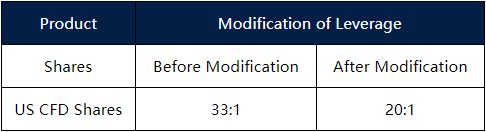
因应近期日渐波动的美股市场风险,VT Markets 将于2023 年 4月 10日调整美股产品的部份交易设置,详请参考如下:

注意:以上数据仅供参考,实际执行数据有可能会有变动,具体请依据MT4/MT5软件为准。

温馨提醒:本次调整除杠杆之外,美股产品的其他所有交易细则维持不变

如您有任何疑问,我们的团队将十分乐意为您解答。
请留言或发邮件至 [email protected] 或联系在线客服。

Treasury Prices Rise as Factory Activity Gauge Contracts More Than Expected

Treasury prices climbed higher on Monday as a US factory activity gauge contracted more than expected. This news tempered concerns about inflation that were fueled by OPEC+’s surprise decision to cut oil production. Let’s take a closer look at what happened.

In March, the Institute for Supply Management’s gauge of manufacturing activity dropped to 46.3. This was below the median estimate of 47.5 in a Bloomberg survey of economists. Any readings below 50 indicate a contraction, and both measures of new orders and employment decreased. As a result, two-year yields, which are sensitive to policy changes, reversed course after earlier climbing by as much as 11 basis points.

On Friday, the government will release its monthly employment report. This report will provide a more complete picture of the job market. It will be interesting to see how this report affects Treasury prices in the coming days.

Swaps linked to expectations of interest rates from the Federal Reserve indicated that a quarter-point hike in May was more likely than not. This news could also impact Treasury prices in the future.

In the benchmark, energy shares led gains in the S&P 500, with US crude hitting $80 a barrel. Seven out of eleven sectors in the S&P 500 stayed in the positive territory, as energy surged with 4.91% daily gain on Monday.

The Nasdaq 100 underperformed major benchmarks as Tesla Inc. sank on data showing its price cuts barely boosted deliveries. This news is noteworthy, as Tesla is often seen as a bellwether for the tech industry.

Main Pairs Movement

On Monday, the US Dollar experienced a 0.44% decline as investors anticipated a less aggressive stance from the Federal Reserve. The DXY index saw significant selling activity throughout the day, dropping below 102 during the start of the American trading session.

In contrast, the EURUSD pair saw a 0.55% increase in value, with the market mood improving during London’s trading session. The pair continued to rise and surpassed the 1.0900 level during the New York trading session. Similarly, the GBPUSD pair also gained strength following the start of the UK trading hour.

Gold prices rose by 0.78% as the Greenback weakened further after the release of disappointing US economic data. XAUUSD reached a daily high of $1990 before entering a consolidation phase and hovering in a narrow range between $1980 and $1986.

Technical Analysis

EURUSD (4-Hour Chart)

Last Friday, the EUR/USD closed at 1.0836, falling by 0.57% on the daily price range. However, demand for the US Dollar decreased after the opening of London’s trading session on Monday, leading to a recovery of the EUR/USD pair above the 1.07800 threshold, which is the lowest in a week. The pair is currently trading near a daily high of 1.09100 at 1.08891.

US Treasury yields increased ahead of Wall Street’s open, with the 10-year note currently yielding 3.50% and the 2-year note yielding 4.08%. S&P Global released the final estimates of the March Manufacturing PMIs for the Eurozone, with the German figure upwardly revised to 44.7 and the EU figure improving from the preliminary estimate from 47.1 to 47.3. The US official ISM Manufacturing PMIs is 46.3 lower than the forecasted 47.5, leading the Cable up to the daily high of 1.09166.

The 4-hour chart shows that buyers are struggling to regain control. Technical indicators changed course after nearing oversold readings and currently head north above their midlines, but with limited strength. The 100 SMA maintains its bullish slope below the aforementioned daily low, while the EUR/USD pair struggles to overcome a directionless 20 SMA. If the pair breaks through the immediate resistance level of 1.0910, buyers could have better chances. The RSI sits at 63.34.

Resistance levels: 1.0910 1.0950 1.1000

Support levels: 1.0830 1.0790 1.0750

XAUUSD (4-Hour Chart)

On Monday, the price of gold initially fell to around $1,955, but later rebounded and climbed above $1,980. This was due in part to the benchmark 10-year US Treasury bond yield dropping below 3.5% following the release of a negative US ISM Manufacturing PMI report, which helped XAU/USD gather bullish momentum. However, the metal’s gains were limited by concerns that China and Brazil may drop the US Dollar for cross-border trade. At the time of writing, the price of gold was trading at $1985.30.

On the technical side, the bears for gold are hopeful due to the bearish MACD signals and the clear downside break of a two-week-old ascending trend line. The sustained trading below the 200-HMA and 100-HMA confluence also favors the bears. However, the latest recovery remains uncertain unless the quote crosses the $1,960 support-turned-resistance line. Even if it does cross this line, the HMA convergence near $1,970 poses a challenge for the XAU/USD bulls. Furthermore, a downward-sloping resistance line from March 20, currently near $1,987, restricts the short-term upside of the Gold price. RSI sits at 58.12.

Resistance: 1990, 2000

Support: 1957, 1950, 1937

Economic Data

CurrencyDataTime (GMT + 8)Forecast
INRHoliday – Mahavir JayantiAll dayN/A
AUDRBA Interest Rate Decision (Apr)12:303.60%
AUDRBA Rate Statement12:30N/A
USDJOLTs Job Openings (Feb)22:0010.400M

节假日可交易时间变更通知 – 2023年04月03日

尊敬的用户:

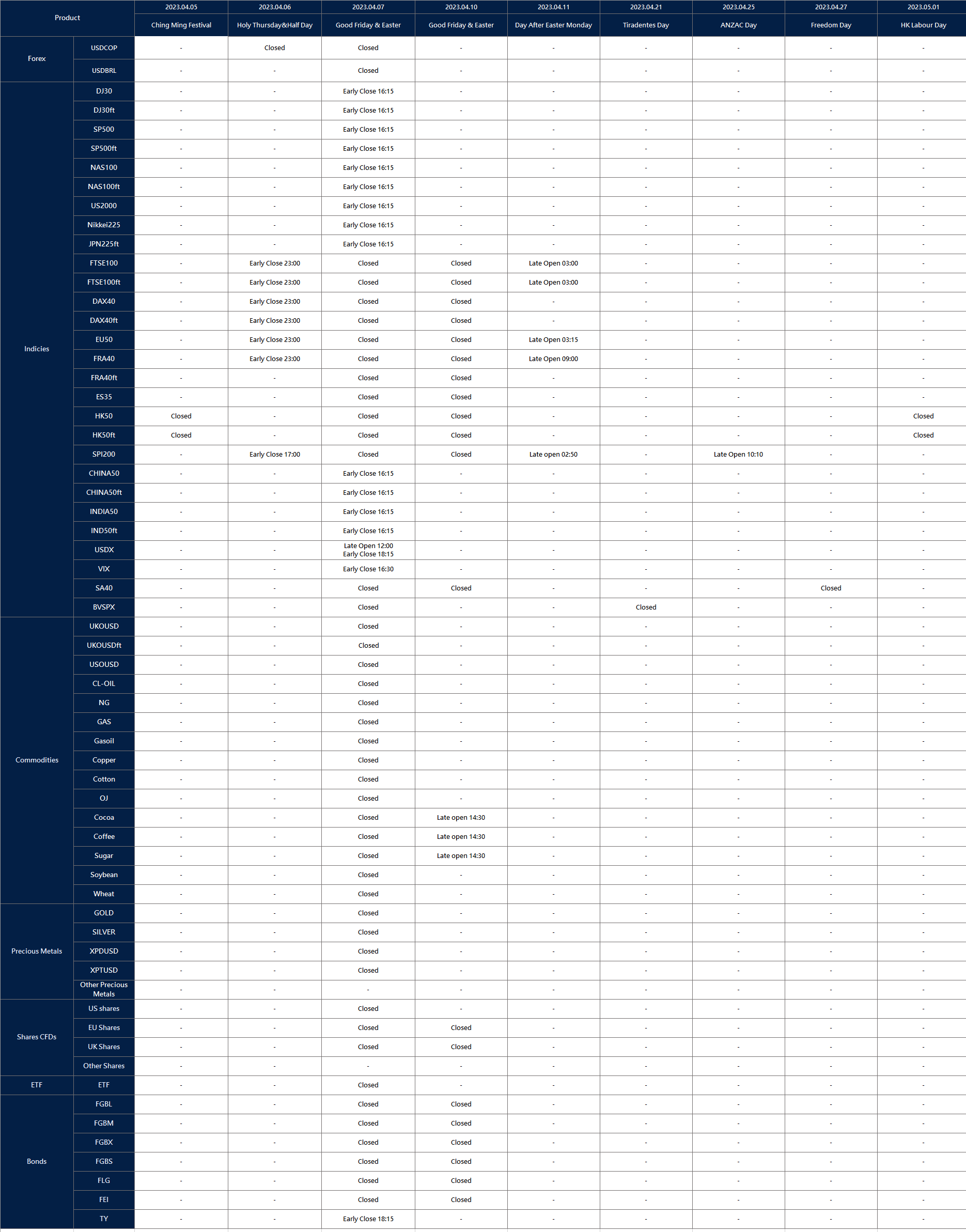
您好!受到国际节假日影响,VT Markets 部分产品交易时间将有所调整,详情请查看如下:

注:”-” 符号表示正常交易時間。

注意:以上数据仅供参考,实际执行数据有可能会有变动,具体请依据MT4/MT5软件为准。

如您有任何疑问,我们的团队将十分乐意为您解答。
请留言或发邮件至 [email protected] 或联系在线客服。

US Technology Shares Rally as Inflation Concerns Ease

US technology shares have continued to rally this week as concerns over inflation have eased following a modest increase in the Fed’s preferred measure of inflation in February. The rise in tech shares coincided with a rise in Treasury prices, which saw the two-year yield fall to around 4.05% while the 10-year maturity dipped to 3.48%. In addition, the US dollar gained strength against major currencies.

The personal consumption expenditures price index, which excludes food and energy, rose by 0.3% in February, slightly below the median estimate. However, the overall PCE price index rose by 5% from a year earlier, which is still above the Fed’s 2% target but down from January’s figures.

In the benchmark, the S&P 500 surged by 1.4% on the day, resulting in a weekly gain of 3.5%, the largest since November. The tech-heavy Nasdaq 100 also increased by 1.7%, enabling it to achieve its highest quarterly gain since June 2020.

All sectors in the S&P 500 stayed in positive territory, with Communication Services, Real Estate, and Consumer Discretionary getting the best performance among all groups, rallying by more than 2% on Friday.

Main Pairs Movement

On Friday, the US dollar strengthened due to slower growth in US consumer spending, leading to hopes that the Federal Reserve will not aggressively increase interest rates. The DXY index gained momentum after positive inflation data and closed at a daily high of 102.59.

Meanwhile, the EURUSD pair weakened and dropped below 1.0900 due to weaker Eurozone inflation numbers, while the US Core PCE Price Index was upbeat, putting pressure on the euro. The GBPUSD also slid by 0.4% on Friday, closing at 1.2329.

Despite the positive US PCE price index report, gold prices fell by 0.56% on Friday. The XAUUSD pair dropped sharply during the American trading session and closed at $1969 by the end of the day.

Technical Analysis

EURUSD (4-Hour Chart)

On Friday, the EUR/USD pair initially dropped to the 1.0870 area following the release of upbeat US Core Consumer inflation data, but later regained some traction and is currently trading at 1.0895 with a 0.08% daily loss. The pair remains in negative territory due to the overall strength of the US Dollar but has rebounded slightly as the greenback trimmed its intraday gains ahead of the US session.

In terms of economic data, the US Personal Consumption Expenditures (PCE) Price Index declined to 5% every year in February, and the annual Core PCE Price Index, which is the Federal Reserve’s preferred inflation gauge, also edged lower to 4.6%. This has fueled speculation that the Fed may pause its rate-hiking cycle in response to the recent turmoil in the banking sector, which has further boosted the US Dollar. Meanwhile, the Eurozone’s Harmonized Index of Consumer Prices (HICP) declined to 6.9% every year in March, but this data was largely ignored by investors.

From a technical perspective, the RSI indicator currently sits at 38, suggesting a loss of bullish momentum as it drops below the mid-line. The Bollinger Bands also indicate downside momentum, with the price falling toward the moving average, indicating that the downside trend may persist. In conclusion, as long as the 1.0874 resistance line holds, the market is likely to remain bearish. A four-hour close below 1.0800 could attract more sellers and push the pair lower to 1.0749.

Resistance: 1.0824, 1.0874

Support: 1.0780, 1.0748

XAUUSD (4-Hour Chart)

On Friday, the XAU/USD pair initially rose to a daily high of around 1,987 level after the release of lower-than-expected Core Personal Consumption Expenditure – Price Index (PCE) data from the US. However, during the US trading session, the pair retreated slightly and is currently trading at 1,976, indicating a 0.19% loss daily. The preliminary PCE price index data showed a slight decline to 4.6% YoY in February, indicating a slow fall in US consumer inflation and raising the possibility that the Fed will not take any action at its May meeting. However, the Fed officials’ statement that more work needs to be done to bring down inflation could act as a headwind for the precious metal Gold. The Fed Funds Future Curve, a market gauge of future Fed policy moves, is currently showing a 58% probability of a 0.25% hike in May versus a 42% probability of no change.

In terms of technical analysis, the RSI indicator is currently at 41, suggesting a bearish bias in the short-term outlook as the RSI is declining towards the mid-line. As for the Bollinger Bands, the price remained under selling pressure and moved lower, indicating the possibility of further downside movements. Overall, the market is expected to be slightly bearish as long as the resistance line at 1,999 holds. If the price move above this resistance level in the four-hour timeframe, it could pave the way for additional gains.

Resistance: 1975, 1988

Support: 1956, 1937

Economic Data

CurrencyDataTime (GMT + 8)Forecast
AUDRetail Sales (MoM)09:300.2%
CNYCaixin Manufacturing PMI (Mar)09:4551.7
EURGerman Manufacturing PMI (Mar)15:5544.4
GBPManufacturing PMI (Mar)16:3048.0
USDISM Manufacturing PMI (Mar)22:0047.5

Market Focus: All eyes on US Jobs Data and RBA Rate Statement

This week marks the start of the second quarter of 2023, and it’s lined up with some major economic events. Keep your eyes on news from the Reserve Bank of Australia and the Reserve Bank of New Zealand on their imminent interest rate announcements. Also, the eagerly-anticipated US jobs report is set to be released this week. It’s a big week all around, with headlines and developments that you won’t want to miss. 

Here are key events to watch out for:

Switzerland Consumer Price Index | 3 April 2023 

Switzerland CPI increased by 0.70% in February 2023 from the previous month.

For March, analysts expect the reading to increase by 0.5%.

US ISM Manufacturing PMI | 3 April 2023 

The US ISM Manufacturing PMI edged higher to 47.7 in February 2023 from 47.4 in January.

For March, analysts expect it to increase to 49.

Reserve Bank of Australia Rate Statement | 4 April 2023 

RBA raised its cash rate by 25bps to 3.60% at its March 2023 meeting, the tenth rate hike since May last year.

Analysts expect the central bank to raise another 25bps to 3.85% at this month’s meeting. 

Reserve Bank of New Zealand Rate Statement | 5 April 2023 

RBNZ raised its official cash rate during its first meeting of the year by 50bps to 4.75%, the highest since January 2009.

For this month, analysts expect RBNZ to increase its interest rates by 25bps to 5%. 

US ADP Non-farm Employment Change | 5 April 2023 

US private businesses unexpectedly created 242,000 jobs in February 2023, well above an upwardly revised 119,000 in January.

For March 2023, analysts expect that ADP Non-Farm Employment Change will add 200,000 jobs.  

US ISM Services PMI | 5 April 2023 

The US ISM Services PMI was at 55.1 in February 2023, slightly lower from 55.2 in January.

For March, analysts expect the index to be at 54. 

Canada Employment Change | 6 April 2023 

The Canadian economy created 21,800 jobs in February 2023, while the unemployment rate stood at 5%. This was close to the record-low of 4.9% observed in June and July 2022.

For March 2023, analysts expect that Canada will add 10,000 jobs, while the unemployment rate is expected at 5.4%

US Employment Change | 7 April 2023 

The US economy unexpectedly created 311,000 jobs in February 2023, following a downwardly revised 504,000 in January. The country’s unemployment rate edged up to 3.6% in February 2023, up from a 50-year low of 3.4% seen in January 2023.

For March 2023, analysts expect the US to add 240,000 jobs, while the unemployment rate will remain at 3.6%.

Back To Top
server

您好 👋

我能帮您什么吗?

立即与我们的团队聊天

在线客服

通过以下方式开始对话...

  • Telegram
    hold 维护中
  • 即将推出...

您好 👋

我能帮您什么吗?

telegram

用手机扫描二维码即可开始与我们聊天,或 点击这里.

没有安装 Telegram 应用或桌面版?请使用 Web Telegram .

QR code