Market awaits US PPI data

U.S. equities bounced back as the Initial Jobless Claims showed higher than the previous number, which is a sign that the inflationary pressures are still around, and the Fed may keep rates higher. On Friday, the data releases include producer prices and the University of Michigan’s consumer sentiment reading will be the turning point for the stock market of this week. The Dow Jones Industrial Average has raised 0.55% to close at 33781.48. The S&P 500 raised 0.75% to close at 3963.51.

The tech-heavy Nasdaq Composite raised 1.13% to close at 11082. The Dow rose was due to tech rebounded, shrugging off a climb in Treasury yields as investors looked ahead to data due Friday expected to show a further easing in inflation. Treasury yields rose, U.S. 10-year treasury yield sits at around 3.485%. The policy-sensitive 2-year treasury yield sits at 4.315%.

This Friday, after US shares, posted their first gain this month, with traders awaiting key inflation figures in China and the US. Oil rose at the open in Asia after tapping a fresh one-year low in a volatile session on Thursday. 

The CPI, PPI, NFP, and Pre-Fed sentiment keeps DXY bulls hopeful even as downbeat US data since mid of November, risk-on mood favour bears. The dollar remained lower versus its major counterparts as the geopolitics-driven appetite for haven investments faded. The Australian and New Zealand dollars held gains from overnight in early Asian trading. However, the greenback’s gauge versus the six major currencies braces for the first weekly gain in three ahead of the key US consumer-centric data.

Main Pairs Movement

The US dollar’s consecutive losses since Wednesday, the release of U.S. Initial Jobless Claims on Thursday adds another resistance on the hawkish side, though the number was too high and overestimated, it is still higher than the previous, which is taken as negative/bearish for the USD. Meanwhile, the consensus is for China’s inflation indexes to have headed down last month, though the market investors expect a pickup as the economy reopens.

EUR/USD continues its strength and keeps winning, and this pair is eying more upside towards a weekly high at 1.0600 amid a cheerful market mood. EUR/USD is eying more upside towards a weekly high at 1.0600 amid a cheerful market mood and looking for stability at this point.

The Gold price extends a three-day uptrend, thanks to the firmer sentiment, and downbeat United States statistics weighed on the US Dollar. Not only due to the Fed policy and statement, China is one of the world’s key Gold consumers, with its new rules about coronavirus, but the China Consumer Price Index (CPI) is also looking optimistic, the gold price is with the scheduled top-tier readings from China and the United States.

Technical Analysis

EURUSD (4-Hour Chart)

EURUSD continued its rallying trend from a low of 1.0458 this week to a high of 1.0563 on the day. The rising trend came from the diminishing expectations for the Fed to keep raising interest rates at the same aggressive pace. Weekly initial jobless claims rose to 230K, as expected, continuing claims, however, jumped to 1.671M, exceeding the forecast of 1.6M.  The initial jobless claims reports showed signs that the labour market is slowing down. The European Central Bank is set to announce interest rate decisions next week and is expected to fight against stubbornly high inflation. “At the next week’s meeting, we expect the ECB to deliver a 50bp rate hike with a hawkish twist. Specially, we expect the ECB to present key principles of the end to reinvestments under the Asset Purchase Program process and an open-ended wording for more rate hikes to come. This will be a compromise, which we believe will be palatable to both hawks and doves.” analysts at Danske Bank said.

While on the front side of the daily trendline, EUR/USD bulls are firming from near 1.0480 support and are taking on resistance around 1.0570. A break there opens the risk of a move in EUR/USD beyond 1.0600. A move in EUR/USD below the trendline, however, will expose supports near 1.0490 and 1.0440 and open prospects of a deeper correction towards 1.0400.  Bulls are defending the downside at around 1.0490, with little chance of a bearish breakout at the time. The following support positions will head south to around 1.031.

Resistance: 1.06

Support: 1.031, 1.0265

GBPUSD (4-Hour Chart)

GBPUSD has extended its gains from the previous trading day and traded higher again throughout Thursday’s trading. Cable is expected to ebb around the 1.2 price region ahead of next week’s major monetary policy decisions by the two central banks. The Fed FOMC will announce its interest rate decision during the late American trading session on the 14th; whereas, the Bank of England will announce their interest rate decision during the late European trading session on the 15th. Both countries also have CPI data scheduled to be released next week. U.S. equities have turned positive throughout Thursday’s trading, thus allowing the Dollar to retreat slightly and pushing the British Pound higher against the Greenback.

On the technical side, GBPUSD continues to float slightly below our previously estimated resistance level of 1.23. Near term support level for the pair remains at 1.177. Any upside or downside shock from the BoE or FOMC next week could quickly destroy the recovery path of Cable, which began around late September. RSI for the pair sits at 63.36, as of writing. On the four-hour chart, GBPUSD currently trades above its 50, 100, and 200-day SMA.

Resistance: 1.2400, 1.2600

Support: 1.2154, 1.1927, 1.1765

XAUUSD (4-Hour Chart)

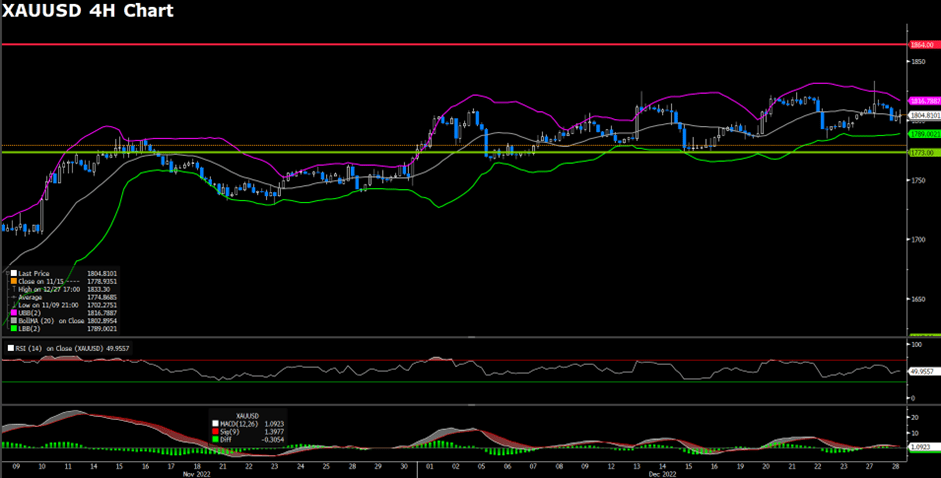
Gold has entered its third straight day of gains amid a broadly weaker U.S. Dollar. Risk on sentiment across equity markets on Thursday weighed on the U.S. Greenback and allowed the Dollar-denominated Gold to climb higher. Sideways trading of the precious metal is expected for the yellow metal as market participants will be heavily invested in next week’s FOMC interest rate decision and how the decision will impact the Greenback. Geopolitical tensions around the world continue to buoy Gold at above the $1700 per ounce price level. Despite winter nearing, Russia’s invasion of Ukraine shows no signs of slowing down. The Kremlin has engaged in a 1-to-1 prisoner swap with the U.S. government to regain one of the more influential arms dealers—Victor Bout.

On the technical side, XAUUSD currently hovers slightly below our previously estimated short-term resistance level of $1800 per ounce. The short-term support level for Gold settles around the 61.8% Fibonacci retracement level of $1783 per ounce. RSI for the pair sits at 56.78, as of writing. On the four-hour chart, XAUUSD currently trades above its 50, 100, and 200-day SMA.

Resistance: $1800

Support: $1766, $1735

Economic Data

CurrencyDataTime (GMT + 8)Forecast
EURECB President Lagarde Speaks02:00
USDPPI (Nov)21:300.2%

服务器升级维护通知 – 2022年12月08日

尊敬的用户:

您好!VT Markets 致力于为客户提供更快速且稳定的交易环境,我们将于周末进行 (MT4/MT5) 升级维护。

维护时段:

• 2022 年 12 月 10 日 (星期六) 08:00 至 13:00

• 2022 年 12 月 10 日 (星期六) 19:00 至 24:00

*上述时段采用 GMT+8 时区

请您务必留意下列事项:

本周末维护期间,客户仍可照常参与交易。但产品报价的稳定及市场流动性将可能受影响而降低,我们建议客户谨慎操作。 望您谅解因此次升级维护为您所带来的不便,我们将继续为您提供更优质的服务。

如您有任何疑问,我们的团队将十分乐意为您解答。
请留言或发邮件至 [email protected] 或联系在线客服。

Gold moves higher as US stocks falling

U.S. equities kept falling as Gold seemed as a hedge currency, S&P 500 is starting to turn more decisively lower and the gold price raised 0.86%. The Dow Jones Industrial Average has little raise to close at 33597.92. The S&P 500 dropped 0.19% to close at 3933.92. The tech-heavy Nasdaq Composite dropped 0.51% to close at 10958.55. After a result, the risk-off factor came from Moscow, mid-US session. Russian President Vladimir Putin warned that the threat of a nuclear war is rising, coming with the news, yields finished the day in the red, as demand for government bonds resurged. U.S. 10-year treasury yield sits at around 3.438%.  The policy-sensitive 2-year treasury yield sits at 4.26%.

The dollar index slipped on Wednesday, reversing the bounce of the past two days after it repeatedly failed to clear strong resistance at $105.57.Although fundamentals are getting mixed for the dollar, deflated since October by speculations that the Fed would slow the pace of its aggressive policy tightening, as the latest economic data signal that the US economy remains quite robust and less harmed by a strong rise in interest rates than initially anticipated.

Besides, earlier in the day, China announced a series of measures relaxing coronavirus restrictions, moving away from the zero-Covid policy and the US Dollar finished Wednesday with losses against most of its major rivals, despite a dismal market mood. The decline was contained, but it’s clear that the tie has changed for the American currency and more declines are now on the docket.

Main Pairs Movement

The US dollar finished with losses on Wednesday, after a consecutive rise since the beginning of the week. Earlier in the day, China announced a series of measures relaxing coronavirus restrictions, moving away from the zero-Covid policy, and another risk-off factor came from Moscow, mid-US session. Russian President Vladimir Putin warned that the threat of a nuclear war is rising, adding that nuclear weapons could be used to defend itself and its allies.

EUR/USD was up for the day but off high on Wednesday, the pair had fallen to below  1.05 following the warns by Russian President Putin about the increasing nuclear war risks, however, after two consecutive daily losses, recovering from the three-day lows, the primary trend remains bullish and is aiming the resistance at 1.0600.

The gold price rose and broke the $1780, thanks to the optimism surrounding China and the risk from  Russia’s nuclear threat, also with the United States Treasury bond prices rallied, together with the Gold price, which in turn drowned the bond yields and the US Dollar, the benchmark 10-year Treasury bond yields dropped to the lowest levels since early September by losing 3.30% in a day to 3.42% level at the latest. Further, the politic-sensitive two-year counterpart dropped 2.54% to the 4.26% mark.

Technical Analysis

EURUSD (4-Hour Chart)

EURUSD traded 0.41% higher throughout yesterday’s trading. The Euro found ample bidding at the start of the European trading session; however, as soon as the American trading session began, the Euro came under immense selling pressure as market participants bid up the Greenback. Market participants will now turn their attention to ECB president Lagarde’s speech, which is scheduled during the late European trading session. The U.S. will be releasing weekly initial jobless claims figures at the start of the American trading session. The falling U.S. treasury yield has acted as a tailwind for the Euro during recent months. As U.S. interest rate expectations fall short-term yields are expected to continue to fall; however, a definitive pivot from the Fed should not be expected at the December FOMC interest rate decision.

On the technical side, EURUSD has failed to break above our previously estimated resistance level of 1.0595. The short-term support level for the pair remains at around the 1.031 price region. The 61.8% Fibonacci retracement level of 1.0265 presents itself as a secondary support level for the pair. RSI for EURUSD sits at 52.08, as of writing. On the four-hour chart, EURUSD currently trades above its 50, 100, and 200-day SMA.

Resistance: 1.06

Support: 1.031, 1.0265

GBPUSD (4-Hour Chart)

GBPUSD snapped its two-day losing streak and headed higher throughout Wednesday’s trading. Risk-averse market sentiment sent the U.S. Greenback higher on Tuesday, but the Dollar retreated over Wednesday as U.S. treasury yields also fell lower. The most recent speech by Fed Chair Jerome Powell has convinced a majority of market participants that a pivot on the Fed’s stance on monetary policy is just around the corner; however, what these market participants fail to consider is the fact that inflation has been running at more than 9% since early 2021. The Fed’s ultimate goal of price stability and bringing inflation back down to normal levels will continue to require higher interest rates and slower growth of the economy. On the economic dockets, the U.S. will release initial jobless claims figures on Thursday and PPI data on Friday.

On the technical side, GBPUSD has failed to break above our previously estimated resistance level of 1.2349. The short-term support level for Cable exists at around the 1.177 price region. RSI for the pair sits at 55.82, as of writing. On the four-hour chart, GBPUSD currently trades above its 50, 100, and 200-day SMA.

Resistance: 1.2400, 1.2600

Support: 1.2154, 1.1927, 1.1765

XAUUSD (4-Hour Chart)

After suffering a 1.61% drop on the first trading day of the week, Gold rebounded strongly throughout Wednesday’s trading. The precious metal found relief as the U.S. Greenback retreated over falling treasury yields. Several factors could undermine the recent rally of the yellow metal, however, including China finally easing Covid-19 restrictions and the all-important FOMC meeting scheduled for December 13th to the 14th. Geopolitical tensions worldwide continue to be the central pillar supporting Dollar-denominated Gold. The prolonged war between Russia and Ukraine continues to plague the world economy and provides optimism for Gold bulls.

On the technical side, XAUUSD has consolidated around the $1770 per ounce price region and is on its way to our previously estimated resistance level of $1800 per ounce. The short-term support level for the yellow metal sits at around the $1766 per ounce price region. RSI for Gold sits at 56.04, as of writing. On the four-hour chart, XAUUSD currently trades above its 50, 100, and 200-day SMA.

Resistance: $1800

Support: $1766, $1735

Economic Data

CurrencyDataTime (GMT + 8)Forecast
JPYGDP (Q3)07:50-0.3%
EURECB President Lagarde Speaks20:00
USDInitial Jobless Claims21:30230K

USD still on market hawkish pressure

U.S. equities hit their peak and kept falling after the speech of Fed Chair Powell on 12/1. There was a rebound on 12/2 because of the release of nonfarm payrolls, but the pressure from hawkishness is on the cards. The Dow Jones Industrial Average dropped 1.03% to close at 33596.34. The S&P 500 dropped 1.44% to close at 3941.26. The tech-heavy Nasdaq Composite dropped 2% to close at 11014.89. After all, a step down to 50 basis points in December would be an unambiguous signal that a specific deceleration in policy tightening should benefit long equities and USD shorts so long as US corporates can ward off an earnings recession, keeping risk on an even keel. The dollar falls, and short-term Treasury rates fall. The 10-year Treasury yield in the United States is still hovering around 3.539%. The yield was last seen trading over 3.7% at the end of November. The policy-sensitive 2-year Treasury yield sits at 4.34%.

Although the US dollar has weakened precipitously since the beginning of December, the S&P 500 has struggled to break higher ground, then the NFP saved the DXY, and now investors find themselves torn between trading the downturn in inflation vs. the negative impact on growth due to the aggressive hiking cycle. In the meantime, DXY hits its resistance at $105.5.

Besides, with CPI, PPI, and, most importantly, the core PCE deflator pointing to weakening price pressures, the Federal Reserve’s hawkish messaging will unquestionably be challenged by the market via cycle compression. Play the short dollar card and aim for the rising potential stock market for the best risk/reward.

Main Pairs Movement

The US dollar ended Tuesday with modest gains of 0.26% daily. In the absence of an economic calendar, the safe-haven greenback attracted some risk-aversion flow during the US trading session, managing to rebound from a daily low of 104.9 to around 105.5. Now, investors are seeking safety amid gloomy economic warnings from bank chiefs at a time when concerns about the impacts of Federal Reserve policy on growth and corporate earnings are running rampant.

The GBPUSD fell 0.47% daily, as mixed market sentiment and a lack of major data, as well as optimism surrounding China and the pre-Fed blackout, allowed the GBP/USD to remain firmer. However, the pair was dropping below the 1.2140 level at the late American trading hour as the US Dollar successfully found some positive traction. In the meantime, the EURUSD fell below the 1.0470 level and recorded 0.23% losses on Tuesday.

The XAUUSD was slightly moving up with a 0.13% daily gain for the day, struggling to find a decisive direction in the absence of clues about the Federal Reserve’s rate hike policy. During the late UK trading session, gold broke through the $1780 mark, but faced heavy selling and fell below the $1770 mark during the American trading hours.

Technical Analysis

EURUSD (4-Hour Chart)

The EURUSD traded 0.45% lower throughout Monday’s trading. The Dollar Index, which tracks the U.S. Dollar against a basket of foreign currencies, rose 0.75% throughout yesterday’s trading. Without major economic data releases, EURUSD retraced higher throughout the 6th. Observing the pair since September, EURUSD has been on a steady rise, and the pair was further stimulated after the ECB hiked rates by 75 basis points in late October. The increasingly hawkish ECB and the gradually dovish Fed could soon create a sentiment differential between the two central banks; however, compared to the EU, the economic outlook for the U.S. remains more upbeat—evident from the upward surprise of the nonfarm payrolls figure released last week.

On the technical front, the EURUSD hit our previously estimated short-term resistance in the 1.06 price range during yesterday’s trading. Short-term support for the pair remains around the 1.035 price region. The 76.4% Fibonacci retracement of 1.0391 presents itself as a short-term entry opportunity for the recovering euro. RSI for the pair sits at 53.9, as of writing. On the four-hour chart, EURUSD currently trades above its 50, 100, and 200-day SMAs.

Resistance: 1.06

Support: 1.0391, 1.035

GBPUSD (4-Hour Chart)

GBPUSD traded 0.82% lower throughout Monday’s trading. On Monday, the British pound fell against the dollar as market participants saw a dip in buying opportunities for the US currency. On Tuesday, the U.K. released its November construction PMI figure, which came in at 50.4, a downward surprise from the market consensus of 52. The lower PMI figure from the U.K. is a confident signal for the BoE as the central bank hikes interest rates by 75 basis points in November. Slowing price pressure from the manufacturing sector is a long-awaited sign for the BoE as the central bank suffers from running out of measures to tame inflation in a quickly contracting British economy. On the economic docket, the U.S. will release jobless claims figures on the 8th and November PPI on the 9th.

On the technical side, GBPUSD has continued to challenge our previously estimated resistance level at around the 1.23 price region. Cable has yet to break out of this resistance level, but the weakening U.S. dollar will present pound bulls with ample opportunity. RSI for the pair sits at 55.3, as of writing. On the four-hour chart, GBPUSD currently trades above its 50, 100, and 200-day SMAs.

Resistance: 1.2400, 1.2600

Support: 1.2154, 1.1927, and 1.1765

XAUUSD (4-Hour Chart)

XAUUSD retreated 1.67% throughout Monday’s trading. The precious metal met heavy selling pressure as the U.S. dollar rebounded. The momentum behind the recovering dollar was further boosted by the rise in short-term U.S. treasury yields. The benchmark U.S. 10-year Treasury yield has recovered above 3.5% and was last seen trading at 3.551%. The upward surprise of the U.S. ISM PMI index released on Monday rattled market participants, who had falsely bought into the narrative of a Fed pivot and potential slowing of interest rate hikes. Gold, however, remains attractive as global geopolitical tensions continue to rise. The Russian-Ukrainian war continues to rage on in Eastern Europe, while China’s “zero CO2” policy has sparked protests across the country.

On the technical side, XAUUSD continues to retrace from our previously estimated resistance level of $1800 per ounce. Our short-term support level estimate remains at $1735 per ounce. The 50% Fibonacci retracement level of $1769 per ounce also acts as short-term support for the yellow metal. On the four-hour chart, XAUUSD currently trades above its 50, 100, and 200-day SMAs.

Resistance: $1800

Support: $1769, $1735

Economic Data

CurrencyDataTime (GMT + 8)Forecast
USDEIA Short-Term Energy Outlook01:00
AUDGDP (Q3)08:300.7%
INRInterest Rate Decision12:306.25%
CADBoC Interest Rate Decision23:004.25%
USDCrude Oil Inventories23:30-3.884M

西德州原油现货优化通知 – 2022年12月06日

尊敬的用户:

您好!VT Markets 为提供客户更优质的交易环境,我们将于 2022 年 12 月 08 日 (周四) 优化 USOUSD(西德州原油)的产品设置。

温馨提醒:

1. 若您于优化期间持有 USOUSD 仓位,将产生相应的费用扣补,以此反映优化前后的价差。

2. 当有费用扣补产生时,您将在账户历史中查看到包含「Cash Adjustment-Rollover – USOUSD」注释的调整记录。

3. 此次优化仅针对 USOUSD,对应的期货合约 USOUSDft 不受影响。

4. 仓位的止盈、止损设置不会随优化自动更新,请留意调整相应设置。

5. 所有持仓中的仓位将可继续持有。若您不希望仓位受到此次优化影响,建议您及时平仓。

如您有任何疑问,我们的团队将十分乐意为您解答。
请留言或发邮件至 [email protected]. 或联系在线客服。

US services indicator unexpectedly climbed, Fed may keep tighten policy to manage high inflation

The equities market kicked off the week with losses and bond yields climbed as a US services gauge unexpectedly rose, fueling speculation the Federal Reserve will keep its policy tight to tame stubborn inflation. In the meantime, treasuries slumped across the curve, driving 10-year yields to 3.6%. Swaps showed higher expectations on where the Fed terminal rate will be, with the market indicating a peak above 5% in the middle of 2023.

A majority of 291 respondents to the latest MLIV Pulse survey said leveraged loans would be the canary in the coal mine to indicate that corporate credit quality is getting worse. About 28% of survey respondents expect defaults to jump significantly if US rates peak at or below 5%. Now, market participants are also anxiously awaiting Friday’s report on US producer prices – one of the final pieces of data Fed officials will see before their Dec.13-14 policy meeting. Inflation numbers over the past month have indicated pressures are slowly cooling, but remain very elevated.

The benchmark, the sell spread throughout all major S&P 500 sectors, with about 95% of the gauge’s companies in the red. The S&P 500 tumbled by 1.79% daily, as all eleven sectors stayed in the negative territory. Especially since the Consumer Discretion sector was performing the worst among all groups, falling 2.95% for the day. Meanwhile, the Nasdaq 100 fell by 1.7%, Dow Jones Industrial Average declined by 1.4%, and the MSCI World index dropped by 1.2% on Monday.

Main Pairs Movement

The US dollar bounced back on Monday after the release of the ISM Services PMI, rising to 56.5 in November from 54.4 in October, which is higher than the market expectation of 53.1, also with the robust Nonfarm Payrolls report, the US Dollar gathered strength against its rivals with the initial reaction and the US Dollar Index rised 0.71% on the day at 105.292 .

US Dollar dropped to over a five-month low at $104.113, the higher-than-expected index may lose the pressure of aggressive policy tightening by the US central bank and release the downward pressure on the greenback. Besides, China’s easing Covid restrictions slow the buying pressure, the EURUSD has dropped lower than 1.05084, and the EUR/USD path of least resistance is downward biased. Therefore, the EUR/USD first support would be the November 22 daily low of 1.022.

The gold price break fell below the cushion of $1,770.0 after surrendering the $1,780.0 support on Monday, the market mood goes soured after the release of the stronger-than-projected US ISM Services PMI data, which triggered a sell-off in the risk-perceived currencies, besides, the upbeat US Nonfarm Payrolls (NFP) data released last week cleared that labour demand is stellar led by strong demand from households. However, the market ignored the surprise rise in employment data and supported Gold prices further.

Technical Analysis

EURUSD (4-Hour Chart)

The Euro Dollar pair witnessed a turbulent trading session on December 2nd. The U.S. nonfarm payrolls for November came in at 263K, above market expectations of 200K. The rather hot payrolls print induced a sell-off in U.S. equity markets and raised interest rate expectations, despite Fed Chair Jerome Powell’s dovish tone on December 1st. On the other hand, Euro bulls have continued to take advantage of the recent Dollar pullback. The surprising dovish signal released by Fed Chair Jerome Powell has continued to put downward pressure on the Dollar. The ECB is expected to hike rates by 50 basis points for December. On the economic docket, ECB president Lagarde is scheduled to speak on the 8th and the 9th.

On the technical side, EURUSD has hit its short-term resistance of 1.06. Short-term support for the pair rests at around 1.035. The 76.4% Fibonacci retracement level of 1.0391 sets another short-term support for EURUSD. RSI for the pair sits at 54.22, as of writing. On the four-hour chart, EURUSD currently trades above its 50, 100, and 200-day SMA.

Resistance: 1.06

Support: 1.0391, 1.035

GBPUSD (4-Hour Chart)

GBPUSD snapped its three-day winning streak on the first trading day of the week. The Dollar index’s drop below 105 induced dip buying, which buoyed the U.S. Dollar on the first trading day of the week. U.K. PMI data, released during the European trading session, came in at 48.2, lower than market expectations of 48.3. The lower-than-expected U.K. PMI data has deterred any momentum for Pound bulls. On the economic docket, there are no impactful economic data releases from the U.K. this week. The U.S. will release initial jobless claims and PPI figures on Thursday and Friday, respectively.

On the technical side, GBPUSD has hit its short-term resistance at 1.225. Near-term support for Cable sits at 1.15 and 1.091. The 23.6% Fibonacci retracement also indicates short-term support for Cable. RSI for the pair sits at 49.69, as of writing. On the four-hour chart, GBPUSD currently trades below its 50-day SMA, but above its 100 and 200-day SMA.

Resistance: 1.2400, 1.2600

Support: 1.2154, 1.1927, 1.1765

XAUUSD (4-Hour Chart)

Gold extends its losses from last Friday after the U.S. nonfarm payroll data was released. The higher-than-expected nonfarm payrolls figure immediately sparked a rise in the Dollar index and a drop in the Dollar-denominated Gold. Despite market participants expecting a pivot from the Fed, Fed Chair Jerome Powell continues to reiterate that inflation continues to pose a threat to price stability and it is ultimately the central bank’s goal to bring inflation back down to the 2% mark. However, Fed Chair Jerome Powell’s statement regarding a possible “soft landing” of the economy, still instilled optimism across markets. Gold’s drop throughout today’s trading is mainly due to the higher-than-expected PMI data and the resulting stronger Dollar.

On the technical side, XAUUSD has reversed course from its short-term resistance level of around $1800 per ounce. Short-term support for the yellow metal sits at around the $1740 per ounce price region. RSI for Gold sits at 59.63, as of writing. On the four-hour chart, XAUUSD currently trades above its 50, 100, and 200-day SMA.

Resistance: 1814

Support: 1740, 1706, 1671

Economic Data

CurrencyDataTime (GMT + 8)Forecast
AUDRBA Interest Rate Decision (Dec)11:303.1%
AUDRBA Rate Statement11:30
GBPConstruction PMI (Nov)17:3052
CADIvey PMI (Nov)23:0051

Week ahead: Will RBA and BoC further raise interest rates?

The Reserve Bank of Australia and the Bank of Canada are expected to further raise interest rates this month. Investors are watching for signs that suggest policymakers will follow through with another hike.

Here are some of the market events to watch this week:

US ISM Services PMI (5 December)

The ISM Services PMI index in the US fell from 56.7 in September to 54.4 in October, missing market expectations of 55.5. This points to a slowdown in the growth of the services sector since May 2020.

Analysts expect another decline in the index, to 53.9 in November.

RBA Rate Statement (6 December)

The Reserve Bank of Australia (RBA) raised the cash rate by 25bps to 2.85% at its November meeting. The board cited concerns over rising inflation in Australia and signalled that further increases were likely necessary.

Analysts predict that RBA will raise interest rates by 25bps to 3.10% this month.

Australian Gross Domestic Products Q/Q (7 December)

Australian gross domestic product (GDP) grew by 0.9% in Q2 of 2022. However, some economists forecast that Australia may enter a recession by 2023 with an unemployment rate of 4.5%.

For Q3, analysts expect GDP to rise to 1.1%.

BOC Rate Statement (7 December)

In October, the Bank of Canada increased its overnight rate by 50bps to 3.75%. This was below the market expectations of an aggressive 75bps hike. Such a move has led to borrowing costs hitting their highest levels since 2008, and added to the 350bps increase in interest rates over the current tightening cycle.

Analysts expect BoC to raise interest rates further by 25bps to 4% this month.

US PPI (9 December)

The PPI for final demand in the US increased 0.2% in October. This was the same as the downwardly revised 0.2% increase in September.

Analysts expect another increase in the US PPI of 0.3% in November.

US Prelim UoM Consumer Sentiment (9 December)

The University of Michigan’s Consumer Sentiment index for the US in November was revised to 56.8, up from a preliminary reading of 54.7.

The December index is expected to be 55.

NFP add more jobs on Friday, what next for the FED?

US stocks edged lower on Friday, as a hot jobs report fueled bets the Federal Reserve will keep tightening even if officials downshift the pace of hikes this month.

Now, the equities and bonds market faced a lot of instability, with the surge in 10-year yields fizzling out while two-year rates remained higher. US employers added more jobs than forecast and wages surged by the most in nearly a year. Nonfarm Payroll increased by 263K in November, while the unemployment rate held at 3.7%. Average hourly earnings rose twice as much as predicted. The resilient labour market is heaping pressure on the Federal Reserve to continue raising rates.

Market participants are all keeping eye on the dot plot, which the central bank uses to signal its outlook for the path of policy. According to Bank of America Corp. strategists, stock investors’ optimism around a cooling labour market and a Fed pivot are overdone.

The benchmarks, S&P 500 and Dow Jones Industrial Average both little changed on Friday, as the S&P 500 almost erased a slide that earlier topped 1% and slid 0.12% daily. Six out of eleven sectors on the S&P 500 stayed in negative territory as the Energy sector is performing the worst among all groups, losing 0.60% for the day. It’s also worth noting that the Materials and Industrials sectors got the best performance on Friday with 1.10 % and 0.62% gain, respectively, daily. Meanwhile, the Nasdaq 100 fell 0.4% on Friday and the MSCI World index slid 0.2% for the day.

Main Pairs Movement

The US dollar edged lower on Friday, with a 50 basis point rate hike remaining favoured despite the full Nonfarm Payrolls report. The US economy added 263K jobs during the last month and the unemployment rate remained at 3.7%, while Average Hourly Earnings rose more than expected by 0.6% MoM and 5.1% from a year earlier. The DXY index was moving a little lower in the first half of Friday but underpinning by a better-than-forecast jobs report. However, the US Dollar failed to hold its ground and dropped to a level of around 104.5.

GBP/USD records modest growth with a 0.27% gain daily following dropping to a daily low of 1.2134 level. The pair ended at the 1.2288 level on Friday, with investors betting more on 50 bps rate hikes in December despite a better-than-expected jobs report. Meanwhile, the EURUSD also confronted heavy selling pressure when the release of the US NFP, dropped to a daily low of 1.0428 level. However, the pair managed to rebound back above the 1.0500 level and rallied by 0.14% for the day.

Gold declined by 0.30 % for the day, witnessing strong selling transactions when the US Payrolls report was released. The XAUUSD managed to stand firmly above the $1795 mark during the late American trading session following a daily low of $1778 marks ahead of the US trading hour.

Technical Analysis

EURUSD (4-Hour Chart)

The EURUSD managed to stage a modest rebound after dropping below 1.0450 with the data from the US showing that Nonfarm Payrolls rose by 263K in November.  The pair was climbing back above 1.0500 at the moment of writing.  The US. Nonfram Payrolls, measuring the change in the number of people employed without the farming industry during the previous month, printed a surprising 263K figure compared to market forecast of 200K. This report showed that the US labor market remain highly resilient, despite a series of big techs have announced massive layoffs. Further data saw the Unemployment Rate unchanged at 3.7% and the key Average Hourly Earnings, a proxy for inflation via wages, rise 0.6% MoM and 5.1% from a year earlier.

From the technical perspective, the four-hour scale RSI indicator rebounded to 63 figures as of writing, suggesting that the pair was surrounded by strong upside traction. As for the Bollinger Bands, the euro was stably trading above the 20-period moving average, and the size between the upper and lower bands became larger. As a result, we think the pair’s positive tendency would persist shortly.

Resistance: 1.0605, 1.0773

Support: 1.0315, 1.0228, 0.9961

GBPUSD (4-Hour Chart)

The GBPUSD has erased its losses from the early American trading session after diving around 100 pips caused by a better-than-foreseen labour market report in the United States (US). The Department of Labor (DoL) report showed November US Nonfarm Payrolls rose by 263K following an upward revision of 284K jobs added in October. Delving into the information, the Unemployment Rate stood at 3.7%, while Average Hourly Earnings put upward pressure on inflation, jumping 5.1% YoY, vs. 4.6%, consensus. Given that Federal Reserve (Fed) policymakers agreed that moderating the pace of rate hikes is appropriate, how Fed officials look into this would be critical. Apart from this, a weaker Institute for Supply Management (ISM) Manufacturing PMI report for November on Thursday flashed signs of activity contraction, shifted sentiment sour, spurring flows towards safety, except for the US Dollar (USD).

From the technical perspective, the four-hour scale RSI indicator changed its direction suddenly and climbed to 65 figures as of writing, suggesting the pair amid strong bullish momentum. As for the Bollinger Bands, the pair continued to trade in the upper area, meaning the upside traction would persist. As a result, we think if the pound could successfully break through the psychological 1.2400 level, the bulls have a chance to target 1.2600.

Resistance: 1.2400, 1.2600

Support: 1.2154, 1.1927, 1.1765

XAUUSD (4-Hour Chart)

The Gold managed to rebound to above the $1795 mark following a sharp retreat caused by upbeat jobs data. The closely-watched Nonfarm Payroll (NFP) from the United States showed that the economy added 263K new jobs in November, beating consensus estimates pointing to a reading of 200K. Adding to this, the previous month’s print was also revised higher to show an addition of 284K vacancies as compared to the 261K reported initially. Meanwhile, the unemployment rate held steady at 3.7% during the reported month, the same as market expectations. Furthermore, additional details of the report showed that Average Hourly Earnings grew 0.6% in November and 5.1% YoY rate, suggesting a further rise in inflationary pressures. The data validates Federal Reserve Chair Jerome Powell’s forecast that the peak rate will be higher than expected, which triggers a sharp rise in the US Treasury bond yields. This, in turn, prompts an aggressive US Dollar short-covering move and weighs heavily on the Dollar-denominated Gold price.

From the technical perspective, the four-hour scale RSI indicator 63 figured as of writing, suggesting that the gold regained positive strength. As for the Bollinger Bands, the pair held its ground above the 20-period moving average, meaning the upside tendency is more favoured in the near term.

Resistance: 1814

Support: 1740, 1706, 1671

Economic Data

CurrencyDataTime (GMT + 8)Forecast
EURECB President Lagarde Speaks09:45 
GBPComposite PMI17:3048.3
GBPServices PMI (Nov)17:3048.8
USDISM Non-Manufacturing PMI (Nov)23:0053.1

Market awaits US Nonfarm Payrolls

US stocks declined higher on Thursday, struggling for direction and saw a lot of instability near a key technical level as traders awaited the all-important jobs report for clues on the Federal Reserve’s next policy steps. The persistent optimism and tepid US data continued to support the Federal Reserve’s monetary policy pivot and dragged the US Dollar to multi-month lows.

The dovish bias of the Federal Reserve (Fed) Chairman Jerome Powell, as well as downbeat comments from US Treasury Secretary Janet Yellen, initially raised hopes of easy rate hikes. Additionally, some Chinese cities announced they are easing their testing and control coronavirus-related policies, which acted as a tailwind for the equity markets.

On Friday, the US will publish the Nonfarm Payrolls report, which might provide fresh impetus. On the Eurozone front, investors are waiting for the speech from European Central Bank (ECB) President Christine Lagarde.

The benchmarks, S&P 500 and Dow Jones Industrial Average both little changed on Thursday as the S&P 500 closed mixed but the US 10-year Treasury bond yields plummeted to a four-month low. The S&P 500 was down 0.09% daily and the Dow Jones Industrial Average dropped lower with a 0.6% gain for the day. Eight out of eleven sectors in the S&P 500 stayed in negative territory as the Financials sector and the Consumer Staples sector is the worst performing among all groups, losing 0.71% and 0.47%, respectively. The Nasdaq 100 meanwhile was little changed with a 0.1% gain on Thursday and the MSCI World index was up 0.8% for the day.

Main Pairs Movement

The US dollar slumped sharply on Wednesday, suffering from daily losses and dropped towards the 104.70 level amid expectations for the Federal Reserve’s monetary policy pivot. The dovish comments from Fed policymakers favouring a 50 bps Fed rate hike in December allowed the US Treasury bond yields to refresh a four-month low amid receding market pessimism and a rush toward the riskier assets. The focus will then shift to the release of the closely-watched US monthly jobs report – popularly known as NFP.

GBP/USD surged higher on Thursday with a 1.57% gain after jumping above the 1.2030s area as the US Dollar struggles to gain any meaningful traction. On the UK front, the overnight dovish remarks by Bank of England (BoE) Chief Economist Huw Pill failed to drag the cable lower. Meanwhile, EUR/USD regained upside traction and grinds near a five-month high past 1.0500 amid a weaker US dollar across the board. The pair was up almost 1.10% for the day.

Gold rallied sharply with a 1.96% gain for the day after refreshing a four-month high above the $1,800 mark during the US trading session, as the hopes of slower Federal Reserve rate hikes provided strong support to the precious metal. Meanwhile, WTI Oil advanced sharply with a 0.83% gain for the day.

Technical Analysis

EURUSD (4-Hour Chart)

The EURUSD extends its rally above the 1.0500 level following the release of US annual PCE inflation data and the ISM Manufacturing PMI.  The data from the US showed the annual Core PCE Price Index declined to 6% in October and the ISM Manufacturing PMI dropped to 49.0 compared to the previous 50.2, triggering a fresh leg of US dollar selloff.  Moreover, the US Federal Reserve Chair Jerome Powell dropped the hawkish rhetoric on monetary policy at a private event. Powell acknowledged that moderating the pace of rate hikes is the path to take and may come as soon as December, as progress towards “sufficiently restrictive” police has already been made. The dovish speech undermined the US Dollar situation, which, in turn, provide support for the pair. In the eurozone, German Retail Sales fell by 2.8% MoM in October, much worse than anticipated. Additionally, S&P Global released the final version of its November Manufacturing PMIs, which were downwardly revised. The German index was confirmed at 46.2, while the Euro Area one came down to 47.1 from the previously estimated 47.3. Despite discouraging news for the EUR, the upbeat mood keeps the pair afloat.

From the technical perspective, the four-hour scale RSI indicator surged to 68 figures as of writing, suggesting that the pair was surrounded upbeat market mood. As for the Bollinger Bands, the euro was pricing along with the upper band, and the size between upper and lower bands became larger, which is a signal that the pair would persist in its positive traction in the near term.

Resistance: 1.0604, 1.0774

Support: 1.0315, 1.0228, 0.9961

GBPUSD (4-Hour Chart)

The GBPUSD has preserved its upside traction and was trading around the 1.2250 level as of writing, with the softer-than-expected PCE inflation data and the disappointing ISM Manufacturing PMI weighing heavily on the US Dollar, fueling the pair’s upside. The monthly Core PCE price index declined to 0.3% in October and the annual fell to 6%, compared to the previous of 0.5% and 6.3%. Moreover, the ISM Manufacturing PMI in November fell below the 50 figure to 49.0. The economic data released on Thursday showed easing inflation signs and weakening conditions in the Manufacturing sector, which triggered mounting speculation about less hawkish rate hikes, pushing the greenback further lower. Apart from this, after the FOMC Chairman, Jerome Powell, reaffirmed that smaller rate hikes could come as early as December, the CME FedWatch Tool’s probability of a 50 basis points rate hike at the next policy meeting jumped to 80% from 66%. Powell further added that they have made substantial progress toward a “sufficiently restrictive policy,” further weighing on the USD. The US Dollar index was trading at 104.8 at the moment of writing.

From the technical perspective, the four-hour scale RSI indicator jumped to 70 figured as of writing, which has entered into an overbought zone, suggesting that a corrective pullback could be expected in the near term. As for the Bollinger Bands, the pair was priced above the upper band, and the size between the upper and lower bands get larger, meaning the bullish momentum would persist shortly.

Resistance: 1.2400, 1.2600

Support: 1.2154, 1.1927, 1.1765

XAUUSD (4-Hour Chart)

The XAUUSD jumped above a critical psychological level of $1800, the highest since early August. The precious metal benefited from an extended USD sell-off as US macroeconomic figures fueled Powell’s triggered slump. On Wednesday, the Dollar fell on the back of a dovish message from Fed’s Powell.

The US Dollar remained under pressure throughout all day, extending its losses during the US trading session. On the one hand, the Personal Consumption Expenditures (PCE) Price Index rose by 6% YoY in October, easing from 6.3% in the previous month. In addition, core PCE inflation came in at 5% in the same period, down from 5.2% in September. On the other, the ISM Manufacturing PMI fell to 49 in November, down from the previous 50.2, being the first time the indicator signals contraction since the early stages of the pandemic. The events reflect the high risk of an economic setback after the US central bank aggressively hiked rates to tame inflation. Price pressures give signs of receding, although the risk of an economic downturn has increased.

From the technical perspective, the four-hour scale RSI indicator rose above 75 figures as of writing, suggesting that the pair was surrounded by strong upside momentum and the market mood. As for the Bollinger Bands, the pair was priced above and along with the upper band, and the gap between upper and lower bands became larger, signalling that the pair was more favoured to the upside path shortly.

Resistance: 1785, 1800

Support: 1740, 1704, 1671

Economic Data

CurrencyDataTime (GMT + 8)Forecast
AUDRetail Sales (MoM)08:30-0.2%
EURECB President Lagarde Speaks10:40 
NZDRBNZ Gov Orr Speaks12:30 
USDNonfarm Payrolls (Nov)21:30200K
CADEmployment Change (Nov)21:305.0K
USDUnemployment Rate (Nov)21:303.7%

十二月期货合约展期通知 – 2022年12月01日

尊敬的用户:

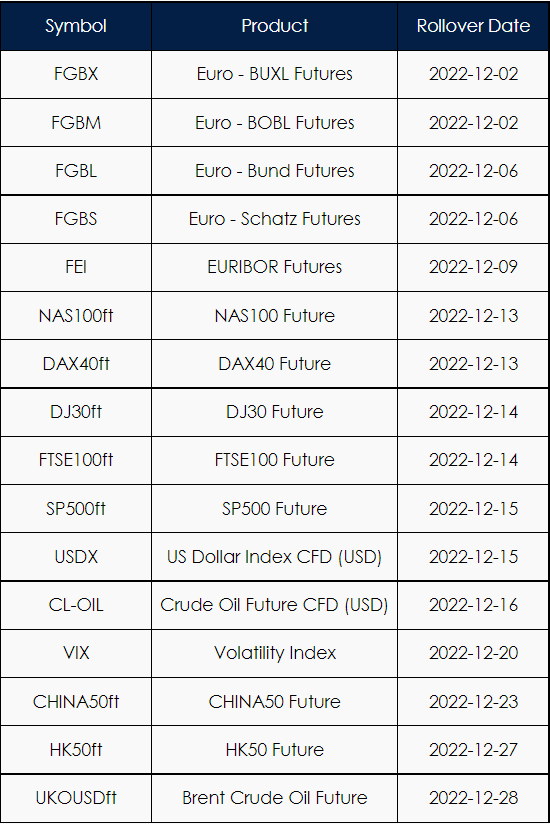
VT Markets 平台的期货产品即将于以下时间展开新合约,如持仓过夜将会收取展期费用。

由于并非市场因素所造成的价格波动,若投资者的仓位于合约切换期间包含期货原油的未平仓头寸,将依据展期方向产生相应的费用扣补,以此反映新旧合约之间的价差。

请留意:

• 展期时,合约将自动切换,所有持仓中的订单将可继续持有。

• 展期日未平仓的订单将通过展期费进行调整,以反映到期合约和新合约之间的价格差异。

• 为避免差价合约展期,客户可以选择在展期日之前关闭任何未平仓的订单。

• 投资者应在展期前妥善控制仓位或调整相应的止盈止损设置。

• 同时,由于展期需做调整,在展期当天开盘前后半小时,我们会禁止所有同名账户内部转账。

如您有任何疑问,我们的团队将十分乐意为您解答。
请留言或发邮件至 [email protected] 或联系在线客服。

Back To Top
server

您好 👋

我能帮您什么吗?

立即与我们的团队聊天

在线客服

通过以下方式开始对话...

  • Telegram
    hold 维护中
  • 即将推出...

您好 👋

我能帮您什么吗?

telegram

用手机扫描二维码即可开始与我们聊天,或 点击这里.

没有安装 Telegram 应用或桌面版?请使用 Web Telegram .

QR code