Tech Rally Propels Stock Market Rebound as Apple Surges

On Thursday, a positive turnaround in the stock market was driven by strong performances from tech companies, notably Apple, following a buy rating upgrade from Bank of America. The Dow Jones Industrial Average gained 201.94 points, the Nasdaq surged by 1.35%, and the S&P 500 climbed 0.88%. The 10-year Treasury yield rose to 4.14% amid tight labor market conditions, leading to concerns about fewer expected rate cuts by the Federal Reserve. In currency markets, the USD index rebounded, affecting pairs like EUR/USD and USD/JPY. GBP/USD held gains, supported by robust UK data. Commodity-centric currencies rose, while Bitcoin declined 2.75% due to higher global yields, contrasting its recent high on January 11.

Stock Market Updates

On Thursday, the stock market experienced a positive turnaround, with tech companies, particularly Apple, leading the way. The Dow Jones Industrial Average rebounded from an earlier loss, gaining 201.94 points or 0.54%, closing at 37,468.61. The Nasdaq Composite surged by 1.35%, reaching 15,055.65, while the S&P 500 climbed 0.88% to end at 4,780.94, just 0.33% away from its closing record. Apple’s shares saw a significant increase of around 3.3% after Bank of America upgraded the stock to a buy rating, predicting over 20% upside over the next 12 months. Other tech-related stocks, such as Taiwan Semiconductor Manufacturing Co., also contributed to the positive momentum, with the VanEck Semiconductor ETF reaching an all-time high, boosted by strong earnings and revenue results.

Additionally, the 10-year Treasury yield rose to 4.14% as fresh jobs data indicated tightness in the labor market, with first-time unemployment insurance filings coming in at 187,000 for the week ended Jan. 13. This stronger-than-expected labor market, combined with robust consumer spending, has raised concerns among investors about potential fewer rate cuts from the Federal Reserve than anticipated. The market is currently pricing in a roughly 56% chance of a quarter percentage point rate cut in March, according to the CME FedWatch Tool. Atlanta Fed President Raphael Bostic’s statement that he expects the central bank to start reducing rates in the third quarter contributed to the market’s uncertainty, as it deviates from the market’s expectations for a faster rate cut.
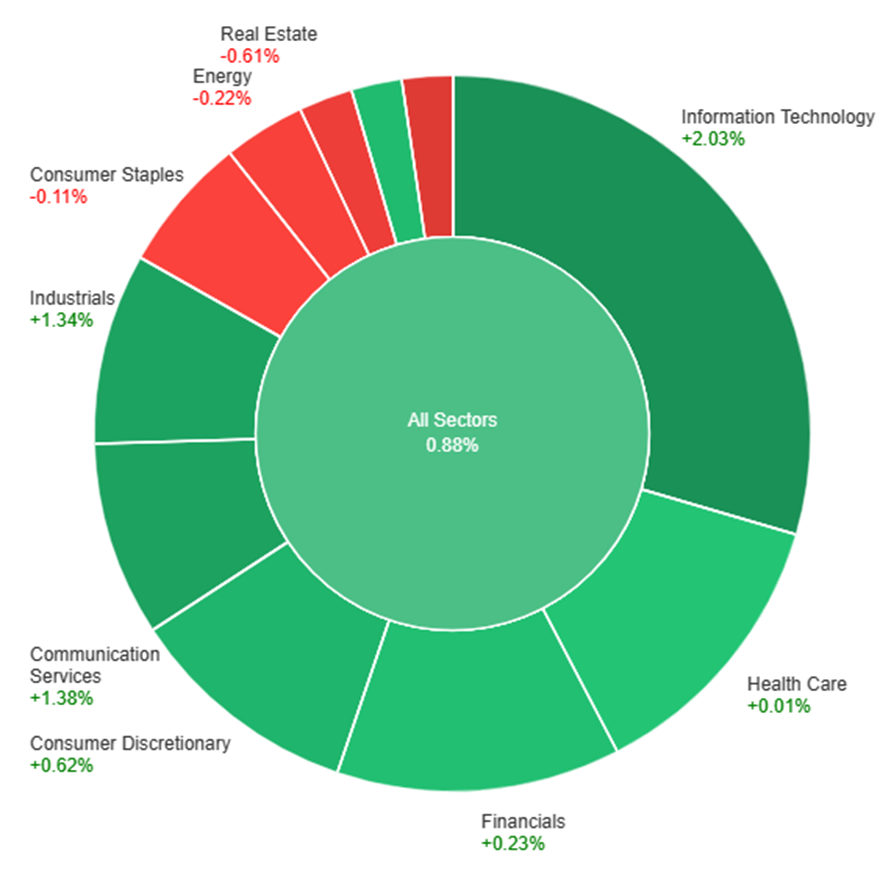
Data by Bloomberg

On Thursday, the overall market showed positive performance with a gain of 0.88%. The Information Technology sector led the way with a notable increase of 2.03%, followed by Communication Services and Industrials, which rose by 1.38% and 1.34%, respectively. Consumer Discretionary and Materials also saw modest gains at 0.62% and 0.39%. However, some sectors experienced declines, including Consumer Staples (-0.11%), Energy (-0.22%), Real Estate (-0.61%), and Utilities (-1.05%). Health Care showed minimal movement with a marginal increase of 0.01%. Overall, the day reflected a mixed performance across various sectors in the market.

Currency Market Updates

In the currency markets, the USD index rebounded from early lows during the North American trading session, gaining 0.23% in the U.S. afternoon. The surge came after jobless claims data came in below expectations, reducing the likelihood of a March rate cut by the Federal Reserve to 60%. This development suggested that the U.S. economy might not be slowing as initially thought. Meanwhile, the EUR/USD pair fell by 0.22% to 1.0858, with traders closely monitoring declining eurozone growth. USD/JPY reversed its overnight low-yield-related weakness, rising to 148.30 after the positive claims data, although it fell short of breaking Wednesday’s high of 148.53. Traders adopted a defensive stance ahead of Japan’s CPI release on Friday, lightening recent long positions in anticipation, even though expectations for the data prompting a shift to higher rates by the Bank of Japan remained low.

In contrast, GBP/USD held a slight gain, increasing by 0.14% to 1.2692 during New York afternoon trading. Despite facing resistance around the 1.27 level, the inability of bears to build on gains above this threshold hinted at an underlying bid near 1.26. The diminished expectations of a Fed rate cut were underscored by UK data, including Wednesday’s CPI, which exceeded forecasts, indicating that the Bank of England was unlikely to pivot to rate cuts in the near term. Other currency pairs, such as AUD/USD, rose by 0.15% to 0.6561, while USD/CAD remained flat at 1.3504. The latter was supported by rising oil and copper prices, benefiting commodity-centric currencies. In the cryptocurrency space, Bitcoin experienced a 2.75% decline, reaching a new one-month low at $41.3k, following its 21-month high at $49k on January 11. The dip in Bitcoin’s value was attributed to higher global yields, which did not bode well for crypto holders despite the coin being only down 1% year-to-date.

Picks of the Day Analysis
EUR/USD (4 Hours)

EUR/USD Holds Near Year-to-Date Lows as Greenback Gains Momentum Amidst Robust US Economic Indicators and Fed Uncertainty

On Thursday, the EUR/USD pair maintained a selling bias, settling around year-to-date lows near 1.0840 before experiencing a slight recovery. The uptrend in the US dollar was fueled by strong labor market results and a rebound in the Philly Fed Manufacturing Index. The USD Index (DXY) retained its bullish stance, supported by comments from Atlanta Fed President R. Bostic, hinting at potential rate cuts before July if inflation slows more rapidly than anticipated. Despite a baseline plan for rate reductions in the third quarter, caution is emphasized to avoid premature cuts. The market currently places a 55% probability of a Fed rate cut in March.
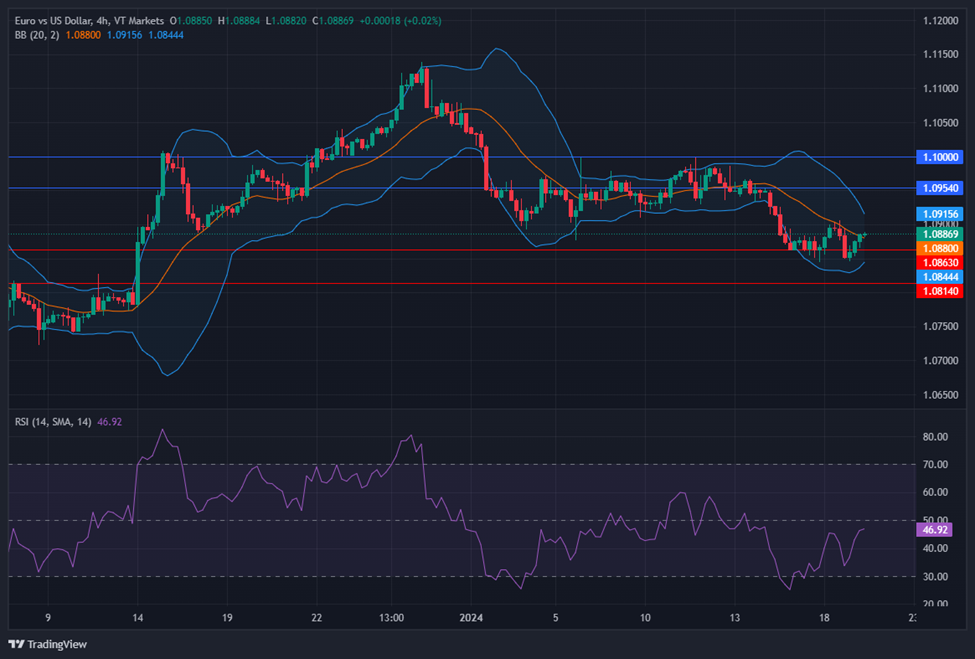
Meanwhile, ECB President C. Lagarde hinted at possible rate reductions in the summer. As US yields retreated slightly on the short end, German 10-year bund yields rose beyond 2.30%.

Chart EUR/USD by TradingView

On Thursday, the EUR/USD moved slightly higher, able to reach the middle band of the Bollinger Bands. Currently, the price moving just above the middle band, suggesting a potential upward movement to reach the upper band. Notably, the Relative Strength Index (RSI) maintains its position at 46, signaling a neutral outlook for this currency pair.

Resistance: 1.0954, 1.1000

Support: 1.0863, 1.0814

XAU/USD (4 Hours)

XAU/USD Stabilizes Above $2,000 Amid Economic Uncertainties and Mixed Data

Gold (XAU/USD) has found a foothold around $2,015 per troy ounce after hitting a multi-week low of $2,001.68 earlier in the week. The precious metal rebounded as market sentiment improved slightly, countering the impact of a positive US Dollar driven by concerns over the housing sector and lackluster growth-related data. Despite initial pessimism from Asian shares, optimism grew on Wall Street with better-than-expected US data, including housing starts, building permits, and lower-than-anticipated jobless claims. Federal Reserve officials provided no fresh insights into future monetary policy, leaving investors navigating a landscape of economic uncertainties.
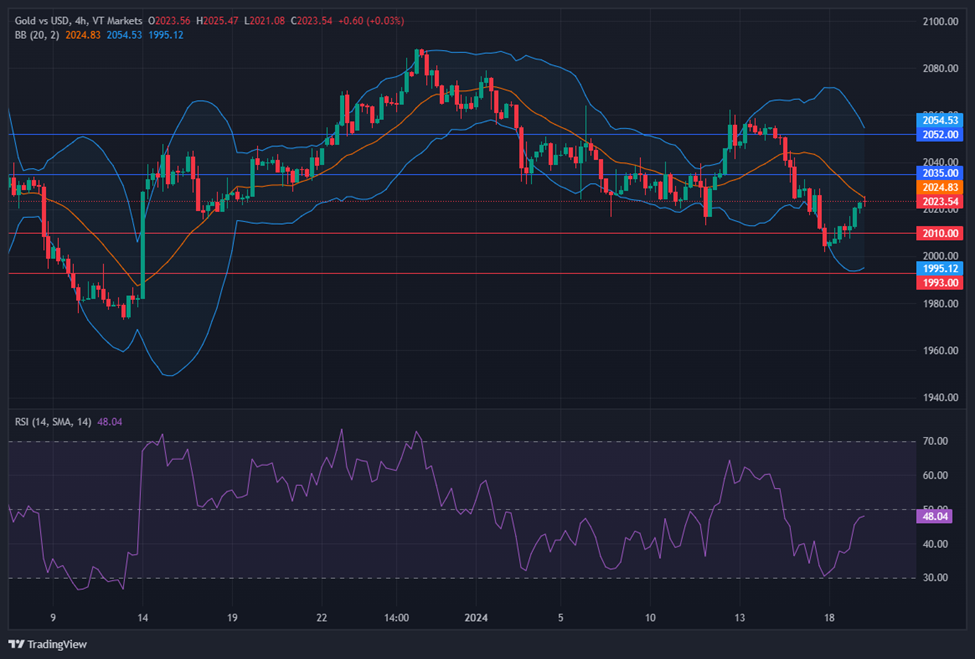
Chart XAU/USD by TradingView

On Thursday, XAU/USD moved higher and reached the middle band of the Bollinger Bands. Currently, the price moving just below the middle band suggesting a potential upward movement to reach above the middle band. The Relative Strength Index (RSI) stands at 48, signaling a neutral outlook for this pair.

Resistance: $2,035, $2,052

Support: $2,010, $1,993

Economic Data
CurrencyDataTime (GMT + 8)Forecast
GBPRetail Sales m/m15:00-0.5%
USDPrelim UoM Consumer Sentiment23:0069.8

服务器升级维护通知 – 2024年1月18日

尊敬的用户:

您好! VT Markets 致力于为客户提供更快速且稳定的交易环境,我们将于周末进行服务器 (MT5) 升级维护。

维护时段:
2024 年 01 月 20 日 (星期六) 08:00 至 2024 年 01 月 21 日 (星期日) 06:00

上述时段采用 GMT+8

维护期间请您务必留意下列事项:

1. MT5 服务器报价将会暂停,客户将无法建立新仓位或是关闭既有持仓。若您不希望在维护时段有任何持仓,建议您可先行平仓。

2. 维护前后的市场价格可能发生跳空,在跳空范围内的挂单或止损/止盈设置将在维护结束后的市场价格成交。

3. 具体维护完毕与开盘时间请依据 MT5 软件为准。

望您谅解因此次升级维护为您所带来的不便,我们将继续为您提供更优质的服务。

如您有任何疑问,我们的团队将十分乐意为您解答。
请留言或发邮件至 [email protected] 或联系在线客服。

Stocks Decline as Treasury Yields Surge, Dollar Hits 2024 Highs

On Wednesday, the stock market saw a downturn driven by increasing Treasury yields influenced by robust U.S. economic data. The Dow Jones Industrial Average posted its third consecutive day of losses, dropping by 0.25%, while the S&P 500 and Nasdaq Composite slid 0.56% and 0.59%, respectively. Notable stock movements included a 1.3% drop for Charles Schwab and a 1.3% gain for Boeing. The market reaction was shaped by stronger-than-expected December retail sales data, casting doubt on the need for aggressive rate cuts by the Federal Reserve. The 10-year Treasury yield rose to 4.102%, and traders are estimating a 57% chance of rate cuts in March. In the currency market, the Greenback showed strength, impacting currency pairs like EUR/USD, GBP/USD, and USD/JPY. Gold and Silver prices declined due to the intense dollar rally, while WTI prices rose above $72.00 per barrel amid OPEC’s optimistic report. Traders are eagerly anticipating the EIA’s weekly report on U.S. crude oil inventories for further market cues.

Stock Market Updates

Stocks experienced a decline on Wednesday, influenced by rising Treasury yields following robust U.S. economic data. The Dow Jones Industrial Average marked its third consecutive day of losses, falling by 0.25%, while the S&P 500 and Nasdaq Composite slid 0.56% and 0.59%, respectively. Notable stock movements included a 1.3% drop for Charles Schwab due to mixed quarterly results, while Boeing saw a 1.3% gain, countering recent losses and positioning itself as one of the Dow’s leading gainers.

The market reaction was partly shaped by stronger-than-expected December retail sales data, suggesting a resilient consumer and casting doubt on the need for aggressive rate cuts by the Federal Reserve. Retail sales increased by 0.6% from November, exceeding economist estimates, potentially influencing the Fed’s monetary policy decisions. The 10-year Treasury yield rose to 4.102%, driven by Federal Reserve Governor Christopher Waller’s caution about a slower-than-anticipated easing of monetary policy. Traders, as reflected in CME Group’s FedWatch tool, are currently estimating a 57% chance of the Federal Reserve initiating rate cuts in March.

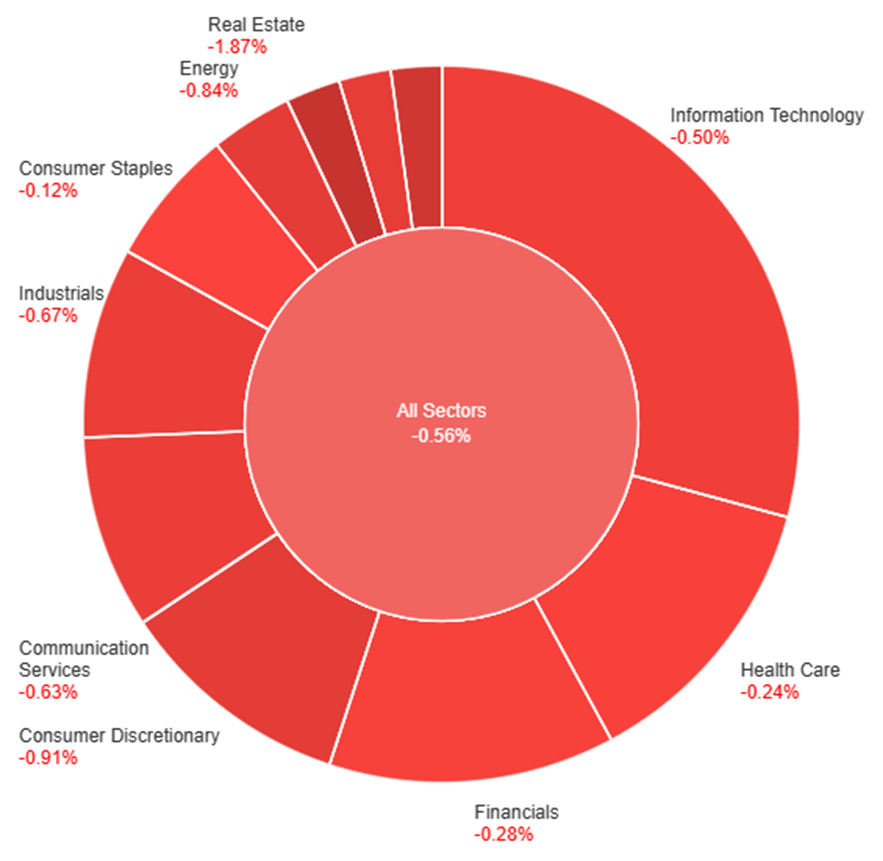
Data by Bloomberg

On Wednesday, across various sectors, the market experienced a downward trend, with the overall performance showing a decline of 0.56%. Notably, Utilities and Real Estate were the hardest hit, witnessing substantial decreases of 1.52% and 1.87%, respectively. Other sectors, including Consumer Discretionary, Energy, and Materials, also faced notable declines ranging from 0.80% to 0.91%. The weakest performers among the major sectors were Communication Services (-0.63%), Industrials (-0.67%), and Information Technology (-0.50%). The day saw a broad-based negative impact on the market, reflecting a cautious sentiment across various industries.

Currency Market Updates

In the currency market updates, the Greenback exhibited notable strength, propelling the USD Index to new 2024 peaks around 103.70, fueled by rising US yields across various maturities. The EUR/USD pair faced downward pressure, reaching multi-week lows near 1.0840, influenced by persistent dollar strength and ECB officials downplaying expectations of interest rate cuts in H1 2024. Meanwhile, GBP/USD saw support from higher-than-expected UK inflation figures, leading to decent gains, while USD/JPY surpassed the 148.00 barrier, driven by the dollar’s upward momentum and robust US yields. However, the Australian dollar faced continued selling pressure, with AUD/USD sinking to six-week lows near 0.6520, impacted by general dollar dynamics and discouraging results from the Chinese docket.

In the broader market, the intense dollar rally, coupled with rising US yields, adversely affected both Gold and Silver prices. The negative sentiment around Silver was exacerbated by disappointing Chinese data releases. On the energy front, WTI prices rose above $72.00 per barrel, partially reversing recent weakness following an optimistic report from OPEC. Despite challenges from China and a stronger dollar, traders are attentively awaiting the EIA’s usual weekly report on US crude oil inventories for further market cues.

Picks of the Day Analysis
EUR/USD (4 Hours)

EUR/USD Faces Downward Pressure Amid Greenback’s Uptrend and Divergent ECB Signals

In Wednesday’s trading session, EUR/USD encountered downward pressure, briefly touching multi-week lows before rebounding. The prevailing uptrend in the US dollar, fueled by robust December Retail Sales, tempered expectations of a Fed rate cut in March. CME Group’s FedWatch Tool indicated a shift, with the probability dropping to just above 50%. Meanwhile, ECB officials, including Knot and Vasle, highlighted market expectations for rate cuts, emphasizing alignment for a 2% inflation target by 2025. Lagarde hinted at a potential rate cut in the summer. Bond yield increases globally, particularly German 10-year bunds and rising US yields, contributed to the euro’s weakness. Poor Chinese fundamentals added to concerns about delayed economic recovery.

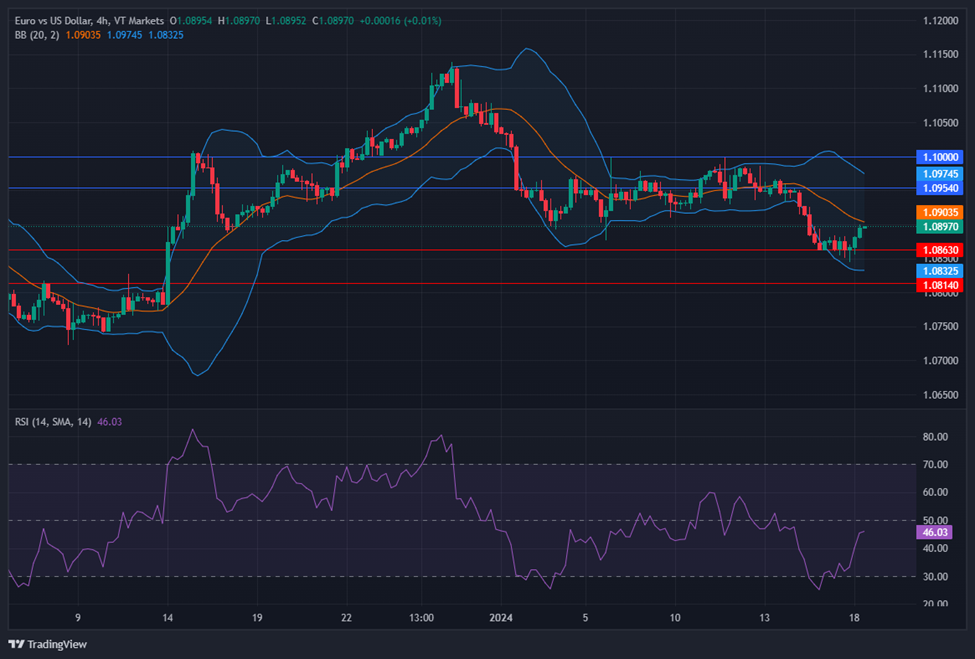
Chart EUR/USD by TradingView

On Wednesday, the EUR/USD moved slightly higher, trying to reach the middle band of the Bollinger Bands. Currently, the price moving just below the middle band, suggesting a potential upward movement to reach above the middle band. Notably, the Relative Strength Index (RSI) maintains its position at 46, signaling a neutral outlook for this currency pair.

Resistance: 1.0954, 1.1000

Support: 1.0863, 1.0814

XAU/USD (4 Hours)

XAU/USD Slumps to Mid-December Lows as Dollar Surges Amidst Global Stock Decline

Spot gold, represented by XAU/USD, experiences a downturn, reaching its lowest point since mid-December. The decline is attributed to the strengthening US Dollar, which advances as global stocks continue to fall. Investors are scaling back expectations for a Federal Reserve rate cut in March, evident in the decreasing probability from 70% to 52% according to the CME FedWatch Tool. Mixed US data, including positive Retail Sales and Industrial Production figures, alongside hawkish sentiments from Fed officials, contribute to the diminishing likelihood of a March cut. Rising government bond yields and a continued slump in Wall Street further compound the challenges for gold in this market environment.

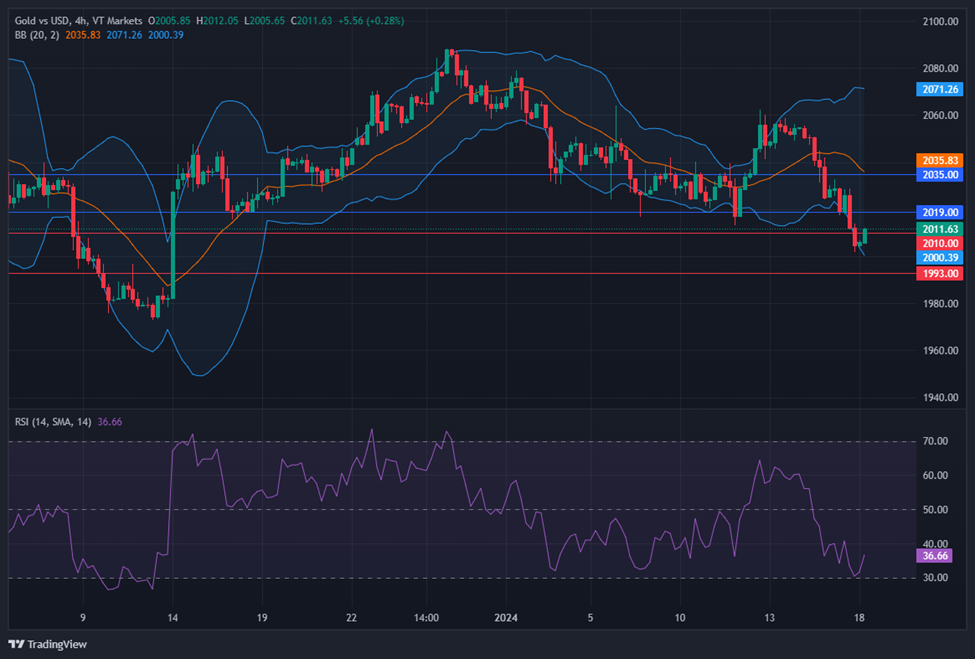
Chart XAU/USD by TradingView

On Wednesday, XAU/USD moved lower and was able to create a lower push to the lower band of the Bollinger Bands. Currently, the price moving just above the lower band suggesting a potential downward movement to create another lower push to the lower band. The Relative Strength Index (RSI) stands at 36, signaling a bearish outlook for this pair.

Resistance: $2,019, $2,035

Support: $2,010, $1,993

Economic Data
CurrencyDataTime (GMT + 8)Forecast
AUDEmployment Change08:30-65.1K (Actual)
AUDUnemployment Rate08:303.9% (Actual)
USDUnemployment Claims21:300.2%

Forex Market Analysis: US Dollar Dynamics & Rate Speculations 18 Jan 2024

Forex Daily Analysis: Currency Strength & Stock Market Shifts

CURRENCIES:

Overview:

  • The U.S. dollar regained strength against major counterparts on Tuesday.
  • Supported by higher U.S. Treasury yields, market expectations for a March interest rate cut fell below 59%, down from 77% just one day prior.

Fed Governor’s Comments:

  • Fed Governor Christopher Waller’s statement suggested a cautious approach, indicating that the Federal Open Market Committee (FOMC) doesn’t need to ease its stance as rapidly as in the past.
  • This stance contributed to the strengthening of the U.S. dollar.

Currency Performance:

  • Euro, British pound, and Australian dollar experienced sharp declines against the U.S. dollar.
  • Notable thresholds were breached during this pullback.

Fed March Meeting Probabilities:

  • The probability chart from CME Group highlights the diminishing likelihood of a rate cut in March.

EUR/USD Technical Analysis:

  • EUR/USD exhibited a decline, breaking the lower boundary of a short-term rising channel at 1.0930.
  • The pair moved towards the 200-day simple moving average, a crucial support at just above 1.0840.
  • Maintenance of this support is imperative; failure may lead to a retracement towards 1.0770.
  • If downward pressure eases and prices rebound, technical resistance is anticipated at 1.0930, followed by 1.1020.
  • Further strength could shift focus to 1.1075/1.1095 and subsequently 1.1140.

STOCK MARKET ANALYSIS:

Market Overview:

  • US stocks encountered challenges on Tuesday as investors remained attentive to the trajectory of interest rates.
  • The lackluster start to the earnings season, particularly with big bank results, influenced market sentiment.

Performance Indicators:

  • Dow Jones Industrial Average (^DJI) concluded the session down 230 points, influenced notably by Boeing’s (BA) negative performance (-7.89%).
  • S&P 500 (^GSPC) experienced a 0.4% decline.
  • Nasdaq (^IXIC) closed slightly lower despite intermittent shifts into positive territory, driven by movements in chipmakers Nvidia (NVDA) and Advanced Micro Devices (AMD).

Key Stock Movements:

  • Goldman Sachs (GS) stock edged slightly higher following a reported fourth-quarter earnings increase of 51% year over year.
  • Morgan Stanley (MS) shares dipped up to 4% during the session but posted fourth-quarter revenue that exceeded Wall Street expectations.

Upcoming Retail Sales Report:

  • Investors await Wednesday’s retail sales report, anticipating its impact on the Federal Reserve’s data-driven policy decisions.
  • Last week’s unexpected cooling in US wholesale inflation increased hopes for a potential interest rate cut in March.

Fed Governor’s Perspective:

  • Fed Governor Chris Waller expressed belief in the Fed’s ability to lower interest rates in the coming year, contingent on inflation remaining in check.
  • He emphasized that the timing and extent of rate cuts will hinge on incoming economic data.

Corporate Developments:

  • A federal judge intervened in the merger deal between Spirit Airlines (SAVE) and JetBlue (JBLU) due to antitrust concerns.
  • Spirit Airlines faced a significant 47% drop in its stock value following the news of the blocked merger.

Overall Sentiment:

  • The market remains cautious and attentive to various factors, including corporate earnings, interest rate expectations, and economic data, influencing trading decisions and overall sentiment.

Join VT Markets to trading CFDs and gain market insights with expert analysis.

From stocks to share CFDs: Your roadmap to profitable trading 

In the shadows of the 17th-century Amsterdam, a groundbreaking financial experiment unfolded, forever altering the course of economic history. The year 1602 saw the birth of the Amsterdam Stock Exchange, a brainchild of the Dutch East India Company, marking the world’s inaugural official stock exchange. 

The Amsterdam Stock Exchange
source: The Low Countries

Under the canopy of a buttonwood tree on Wall Street, 24 stockbrokers laid the groundwork for organised securities trading, introducing the novel concept of issuing shares to the public. 

Fast forward to today, where the once humble origins have burgeoned into a global financial behemoth. With a staggering size surpassing $100 trillion, the modern stock market stands as a testament to the enduring legacy of those early investors and the evolution of financial markets through centuries. 

Whether you’re a novice or a seasoned investor, understanding the basics is key to navigating the complexities of the stock market. In this comprehensive guide, we’ll delve into the essentials of stocks and Share CFDs, with a special focus on popular trading strategies. 

source: ABC News

Stocks: Unlocking Ownership and Dividend Potential 

At its core, a stock symbolises ownership in a company, with popular names like Apple (AAPL), Microsoft (MSFT), Amazon (AMZN), and Google’s Alphabet (GOOGL) exemplifying this ownership’s profound impact. Investors holding these stocks actively participate in globally influential companies. 

Beyond theoretical ownership, shareholders hold significant rights. This includes voting on corporate decisions and attending pivotal annual shareholder meetings, allowing active engagement in corporate governance. 

Stock ownership’s allure extends to the potential for dividends, a feature prominent in dividend-paying stocks like Johnson & Johnson (JNJ), Coca-Cola (KO), Procter & Gamble (PG), and McDonald’s (MCD). These stocks appeal to investors seeking a steady income stream, enhancing the overall return on investment. 

In essence, owning stocks aligns investors with a company’s success and prosperity. It’s not just financial; it’s a connection to brands and businesses shaping our daily lives. Investors in these well-known companies become integral contributors to ongoing success and innovation in the business world. 

Stock Exchanges: The Pulsating Heart of Global Trading 

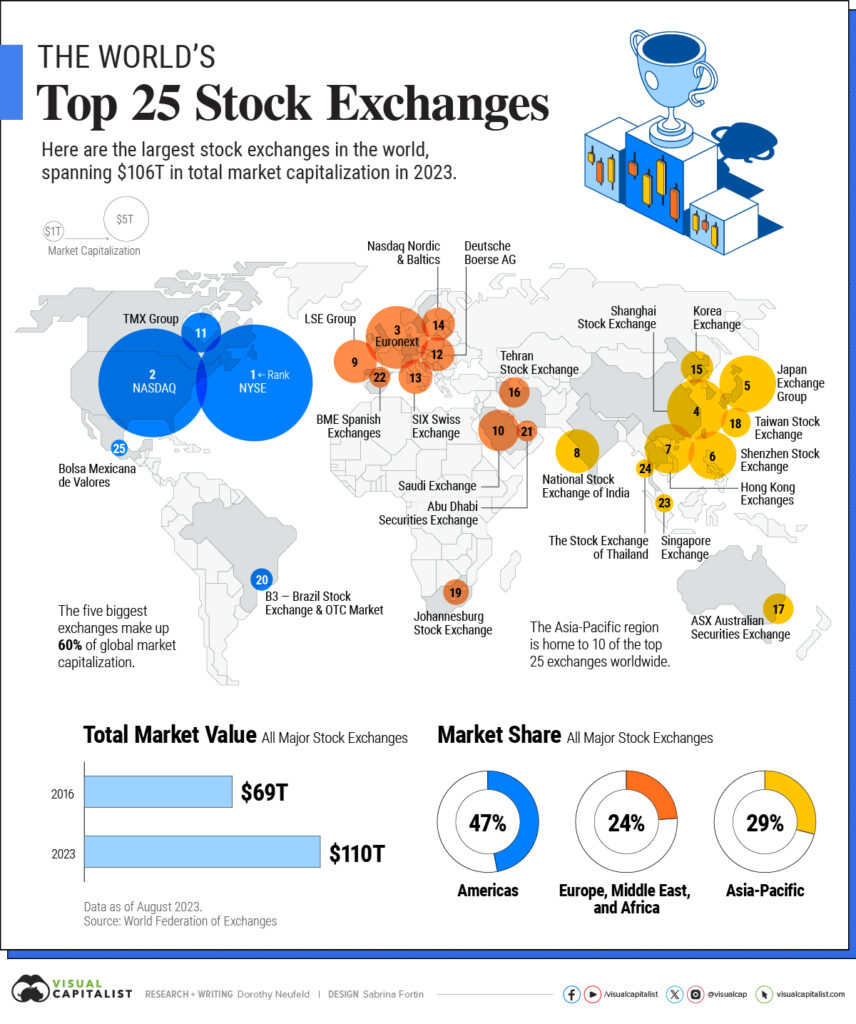
Major stock exchanges worldwide serve as the epicentres where the world’s most influential stocks are bought and sold, shaping the landscape of global finance. Two giants stand out in this domain – the New York Stock Exchange (NYSE) and NASDAQ. 

The Largest Stock Exchanges in the World 2023
source: Visual Capitalist

The New York Stock Exchange (NYSE), located on Wall Street in New York City, is the largest and most prestigious stock exchange globally. It boasts a rich history dating back to 1792, providing a platform for some of the most prominent and established companies. 

NASDAQ, on the other hand, is renowned for its technology-focused listings and electronic trading platform. Born in 1971, it has become synonymous with innovation and hosts many of the world’s leading technology companies. 

In Europe, the London Stock Exchange (LSE) stands as a financial powerhouse, hosting a diverse array of companies. Meanwhile, the Euronext group, spanning Amsterdam, Brussels, Dublin, Lisbon, Milan, and Paris, plays a pivotal role in European trading. 

Turning our attention to Asia, the Tokyo Stock Exchange (TSE) in Japan and the Hong Kong Stock Exchange (HKEX) command significant influence. These exchanges contribute to the vibrancy and dynamism of the Asian financial markets. 

These exchanges are more than mere facilitators; they are the driving forces shaping stock prices globally. The dynamic interplay of supply and demand on these platforms directly influences the valuation of stocks. 

Understanding the mechanics of stock exchanges, particularly the NYSE and NASDAQ, is essential for investors seeking to decipher the intricate forces that shape market trends and individual stock prices. As investors, being attuned to the activities on these exchanges equips us to navigate the complexities of the global financial arena. 

Stocks and Other Financial Instruments: Navigating the Financial Landscape 

In the expansive realm of financial instruments, it’s vital to differentiate between various assets. Beyond stocks, investors encounter bonds and Exchange-Traded Funds (ETFs), each with its unique characteristics. 

Bonds, in contrast to stocks, represent debt rather than ownership. When an investor buys a bond, they are essentially lending money to a company or government entity. In return, the bondholder receives periodic interest payments and the eventual return of the principal amount. 

Exchange-Traded Funds (ETFs), on the other hand, are investment funds that trade on stock exchanges. ETFs offer a diversified investment approach by bundling together a collection of stocks, bonds, or other assets. They provide investors with a way to gain exposure to a broad market or sector without directly owning individual securities. 

Understanding these financial instruments allows investors to tailor their portfolios to match their risk tolerance, investment goals, and preferences. 

Stocks vs Share CFDs: Navigating Investment Avenues 

Share CFDs, or Contracts for Difference, are financial derivatives that allow traders to speculate on the price movements of underlying stocks without actually owning the shares. 

Unlike traditional stock trading, where investors physically buy and own shares in a company, CFDs are contracts between traders and brokers. 

The derivative nature of CFDs lies in their ability to derive their value from the underlying asset, in this case, stocks. This derivative structure opens up a world of advantages for traders, enabling them to profit from both rising and falling markets. 

Advantage 1: Leverage 

One of the key advantages of share CFDs is the ability to trade with leverage. Leverage allows traders to control a larger position size with a smaller amount of capital. While this magnifies potential profits, it’s crucial to note that it also amplifies potential losses. This feature makes CFDs an attractive choice for traders seeking to maximise their market exposure without the need for a substantial upfront investment. 

Advantage 2: Short Selling 

Share CFDs provide a unique opportunity for traders to profit from falling prices through short selling. In traditional stock trading, short selling is often complex and may involve borrowing shares, but with CFDs, this process is streamlined. Traders can take advantage of market downturns by selling CFDs on stocks they anticipate will decline in value, potentially yielding profits even in bearish market conditions. 

Advantage 3: Diversification 

Diversification is a cornerstone of sound investment strategy, and share CFDs offer a compelling way to achieve it. With CFDs, traders can access multiple assets with a smaller capital requirement compared to traditional stock trading. This not only enhances risk management but also provides the flexibility to explore diverse markets and sectors. 

If you’re an active, short-term trader seeking flexibility and leverage, share CFDs are ideal. Designed for day and swing traders comfortable with increased risk, CFDs allow you to profit in both rising and falling markets. With 24/5 trading, global market exposure, and lower transaction costs, they suit those wanting diverse opportunities. 

Share CFDs Trading Tips: A Strategic Approach 

Engaging in share CFDs trading demands a strategic mindset. To streamline your approach, focus on these five essential tips: 

1. Thorough Research: Prioritise in-depth research on underlying assets, staying informed about market trends, company performance, and global economic factors. 

2. Effective Risk Management: Set clear stop-loss and take-profit levels to manage risks diligently. Discipline in risk management is crucial in the unpredictable world of CFD trading. 

3. Understand Leverage: Use leverage judiciously, considering its impact on both profits and potential losses. Avoid excessive leverage to mitigate significant financial risks. 

4. Stay Informed: Regularly check economic calendars and major market events. Earnings reports, economic indicators, and geopolitical developments can significantly influence asset prices. 

5. Continuous Learning: Embrace ongoing education to stay current on market trends, trading strategies, and industry developments. A commitment to learning enhances trading proficiency and adaptability over time. 

Incorporating these key tips into your trading strategy will provide a solid foundation for navigating the dynamic landscape of Share CFDs with confidence. 

Trading Share CFDs with VT Markets 

Discover a wealth of share CFDs trading opportunities with VT Markets, offering access to over 800 leading companies from the US, UK, EU, and Hong Kong. 

Leverage up to 20:1 to maximise your trading potential, taking both long and short positions for as low as $0 per trade. This flexibility empowers you to profit from fluctuations in share prices, whether they rise or fall. 

Ready to embark on live trading? Open a live trading account with VT Markets for real-time market access. If you’re still refining your strategies, take advantage of the risk-free demo account. Test your approaches and get acquainted with the platform before committing real capital. 

VT Markets provides a user-friendly experience for traders of all levels, ensuring you have the tools needed to navigate the dynamic world of share CFDs with confidence. 

In conclusion, success in trading stocks and share CFDs demands a strategic approach, disciplined risk management, and continuous learning. Whether you prefer traditional stocks or the flexibility of CFDs, confidence stems from knowledge and a well-crafted strategy. Happy trading! 

Dow Jones Declines, Boeing Slumps, and Currency Markets React to Fed’s Rate Hints

On Tuesday, the Dow Jones Industrial Average faced a 0.62% dip, closing at 37,361.12, influenced by increased bond yields and mixed fourth-quarter earnings. Boeing shares plummeted 7.9% due to a Wells Fargo downgrade, while AMD soared 8.3% on a positive semiconductor demand outlook. Goldman Sachs outperformed profit expectations, boosting its shares, while Morgan Stanley saw a 4% decline despite revenue beats. The USD index rose by 0.75%, driven by higher U.S. Treasury yields and shifting Fed rate expectations. Currency pairs experienced notable movements, with EUR/USD dropping 0.76%, USD/JPY rising by 1%, and GBP/USD weakening. In the cryptocurrency landscape, BTC rose 1.4%, ETH increased by 2.2%, and gold fell 1% following SEC approval of spot ETFs and market focus on ether spot ETF approvals.

Stock Market Updates

The stock market experienced a decline on Tuesday, with the Dow Jones Industrial Average dropping 0.62%, closing at 37,361.12. Bond yields increased, contributing to the negative sentiment as investors examined fourth-quarter earnings. Boeing shares fell sharply by 7.9% following a downgrade by Wells Fargo, citing ongoing issues with its 737 Max 9 model. On a positive note, AMD shares surged 8.3% due to optimistic analyst commentary on semiconductor demand. The benchmark 10-year Treasury note yield rose over 11 basis points to 4.064% after Federal Reserve Governor Christopher Waller hinted at a slower-than-expected easing of monetary policy.

In the banking sector, Goldman Sachs reported better-than-expected profit and revenue, causing a slight increase in its shares, while Morgan Stanley posted a revenue beat but saw a decline of over 4%. Overall, 78% of the roughly 30 S&P 500 companies reporting fourth-quarter results have exceeded earnings expectations. Investors are now anticipating December retail sales data, set to be released on Wednesday, which could impact market sentiment based on U.S. consumer spending trends and concerns about economic growth.

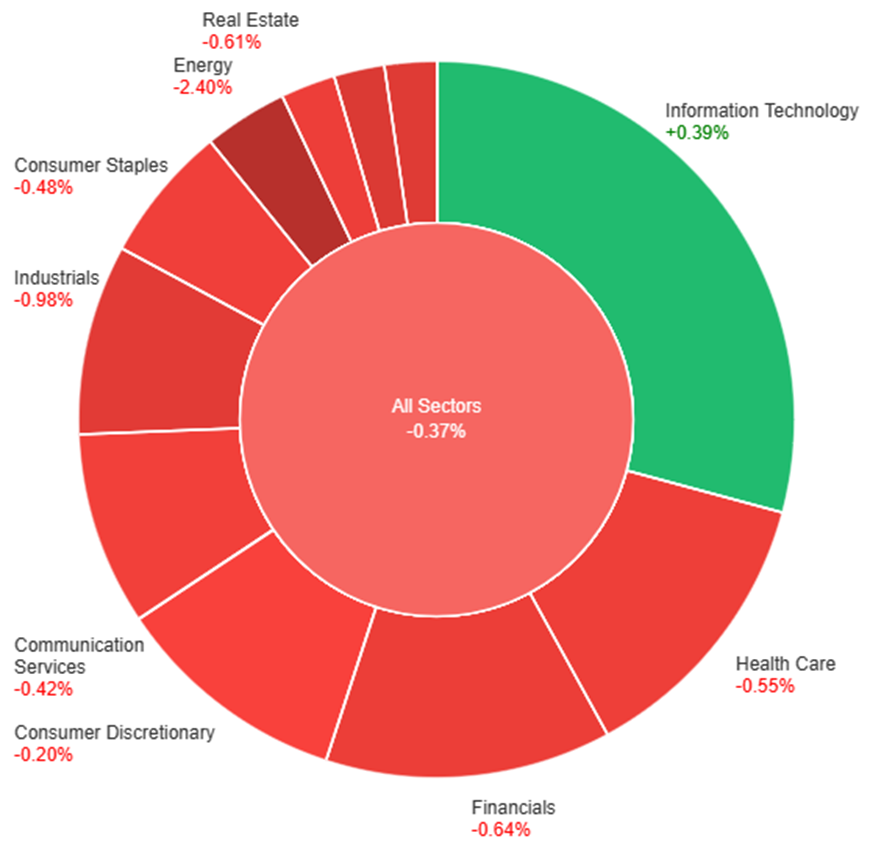
Data by Bloomberg

On Tuesday, the overall market experienced a slight decline of 0.37%. The Information Technology sector saw a positive movement with a gain of 0.39%, while Consumer Discretionary showed a modest decrease of 0.20%. Communication Services and Consumer Staples both experienced declines of 0.42% and 0.48%, respectively. Health Care, Real Estate, and Financials also saw negative trends with decreases of 0.55%, 0.61%, and 0.64%, respectively. Industrials faced a more significant downturn with a decline of 0.98%. The Utilities and Materials sectors both exhibited larger decreases of 1.05% and 1.19%, respectively. Energy witnessed the most substantial decline among all sectors, with a notable decrease of 2.40%.

Currency Market Updates

In the latest currency market updates, the USD index surged by 0.75%, driven by rising U.S. Treasury yields and a shift in Fed rate expectations. Governor Christopher Waller’s comments acknowledging the potential for rate cuts tempered extreme dovish sentiments, contributing to the rally. The 5-30-year Treasury yields rose, bolstering the dollar, while less-dovish ECB comments and higher Canada CPI played roles in shaping the session. Despite the increase in long-end Treasury yields, there remains a 68% chance of a 25bp Fed cut in March, indicating a nuanced market sentiment. Notably, the EUR/USD pair declined by 0.76% to 1.0870, reflecting the impact of less-dovish ECB central bank comments on the euro, amidst concerns about euro zone growth.

In parallel, other currency pairs saw notable movements. USD/JPY rose by 1% to 147.25, driven by higher Fed rate expectations and a consistently low BoJ rate outlook. GBP/USD weakened due to the less-dovish Fed rate view, although the impact was relatively muted given higher UK inflation and rate expectations. Focus now shifts to the UK CPI data, with potential implications for the BoE’s rate decisions. USD/CAD rose by 0.43%, reaching 1.3484, but gains were tempered by stronger-than-expected Canada CPI, diminishing expectations for an early BoC rate cut. Additionally, AUD/USD fell by 1.2%, influenced by higher rates and concerns about global growth amid doubts regarding China’s recovery. In the broader financial landscape, BTC rose by 1.4% to $43.3k, ETH increased by 2.2%, and gold fell 1% to $2,035, reflecting market responses to SEC approval of spot ETFs and shifting focus to ether spot ETF approvals.

Picks of the Day Analysis
EUR/USD (4 Hours)

EUR/USD Suffers Sharp Decline as USD Gains Momentum Amidst Divergent Central Bank Signals and Strong US Yields

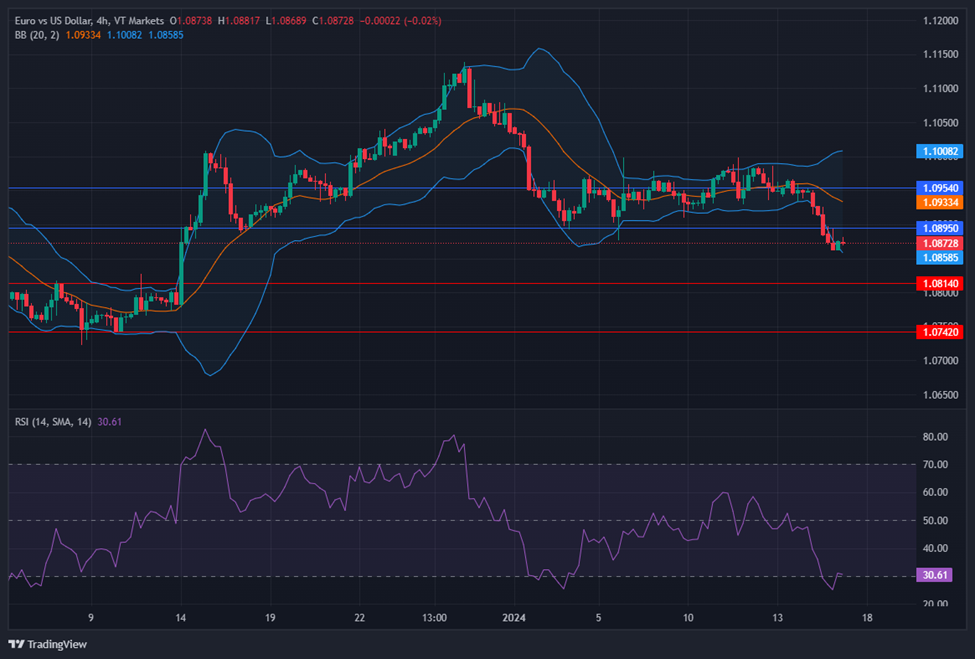
EUR/USD extended its bearish trend, breaking below the critical support level at 1.0900 and hitting a new yearly low near 1.0860. The upward momentum of the US Dollar, driven by a surge in the USD Index to 2024 peaks beyond 103.00, was reinforced by robust US yields as traders returned from the MLK holiday. ECB officials’ comments, though leaning towards rate cuts, clashed with market expectations, leading to a subdued EUR. Despite positive Economic Sentiment indicators in Germany and the Eurozone, the Euro failed to find support, and the probability of a Fed rate cut in March, as indicated by CME Group’s FedWatch Tool, decreased slightly. The decline in the Euro was set against the backdrop of rising yields in both German bunds and US Treasuries.

Chart EUR/USD by TradingView

On Tuesday, the EUR/USD moved lower, able to reach the lower band of the Bollinger Bands. Currently, the price is moving just above the lower band, suggesting a potential upward movement to reach the middle band. Notably, the Relative Strength Index (RSI) maintains its position at 30, signaling an oversold outlook for this currency pair.

Resistance: 1.0895, 1.0954

Support: 1.0814, 1.0742

XAU/USD (4 Hours)

XAU/USD Faces Sell-Off Amid Interest Rate Uncertainty and Inflation Dynamics

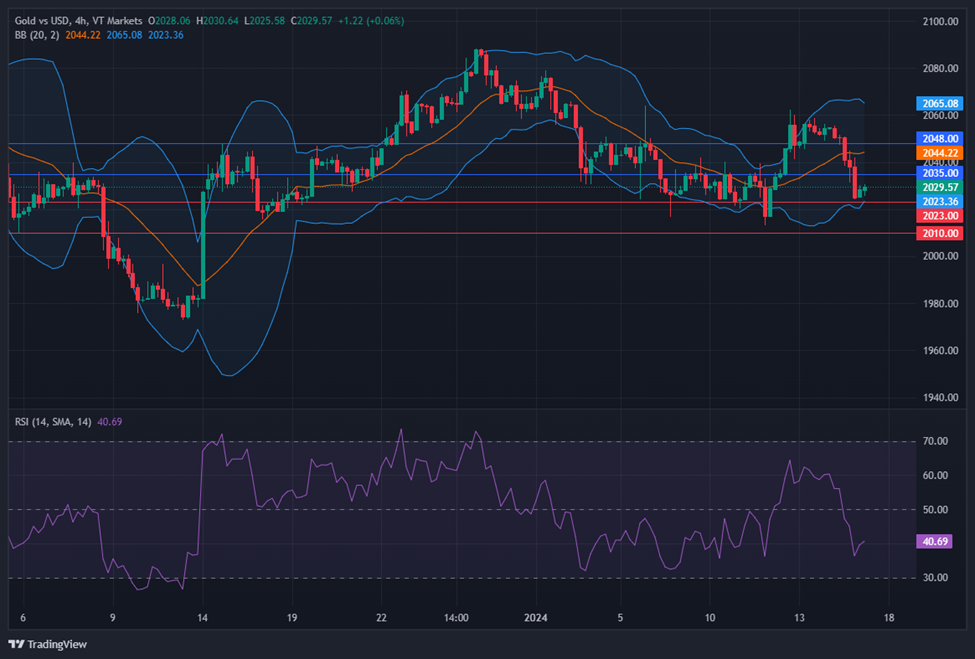
Gold prices (XAU/USD) experienced a decline as attempts to surpass the weekly high of $2,060 fell short. This setback was triggered by investors reassessing the Federal Reserve’s potential interest rate adjustments. The release of the December Consumer Price Index (CPI) report, coupled with hawkish statements from European Central Bank (ECB) officials, influenced market sentiment. While expectations for a rate cut in March persist, the Federal Reserve remains cautious, considering the robust consumer price inflation in the U.S. economy, steady labor demand, and low recession risks. As markets await cues from upcoming data such as monthly U.S. Retail Sales, Industrial Production, and the Fed’s Beige Book, the trajectory of gold prices hinges on evolving interest rate outlooks.

Chart XAU/USD by TradingView

On Tuesday, XAU/USD moved lower and tried to reach the lower band of the Bollinger Bands. Currently, the price moving just above the lower band suggesting a potential upward movement to reach the middle band. The Relative Strength Index (RSI) stands at 40, signaling a neutral but bearish outlook for this pair.

Resistance: $2,035, $2,048

Support: $2,023, $2,010

Economic Data
CurrencyDataTime (GMT + 8)Forecast
GBPConsumer Price Index y/y15:003.8%
USDRetail Sales m/m21:300.4%
USDCore Retail Sales m/m21:300.2%

新品重磅上线 – 2024年1月16日

尊敬的用户:

您好!

VT Markets 为进一步丰富广大客户的投资选择,我们预计将于 2024 年 01 月 22 日 (周一) 新增 3 只商品。

您现在可以在 Meta Trader 4、5 上交易以下新产品,交易细则如下:

注意:以上数据仅供参考,具体请依据 MT4 / MT5 软件为准。

温馨提醒:

1. BTCJPY、ETHJPY 隔夜库存费将以每日为单位进行收取,无 3 日库存费。

2. 具体隔夜库存费费率请依据 MT4 / MT5 软件为准。

如您有任何疑问,我们的团队将十分乐意为您解答。
请留言或发邮件至 [email protected] 或联系在线客服。

Forex Market Analysis: GBP/USD Focus & Market Trends 16 Jan 2024

TOP FX NEWS: 16 Jan 2024

CURRENCIES:

GBP/USD Analysis and Charts:

  • Falling UK wages provide optimism for the Bank of England.
  • Cable faces pressure due to USD strength.

Key Points from ONS Labour Market Overview:

  • UK wage growth decelerated in November.
  • Unemployment rate remained unchanged.
  • Despite slowing wage growth, it remains high enough to deter an immediate UK rate cut.

Latest UK Implied Rates:

  • First UK Base Rate cut anticipated in May.
  • Predictions indicate a total of 131 basis points in cuts for the upcoming year.

US Dollar Strength:

  • The US dollar shows strength after a long weekend.
  • US dollar index reaches a 10-day high.
  • Factors include slightly higher US Treasury bond yields and geopolitical concerns in Ukraine and the Red Sea.

GBP/USD Technical Levels:

  • Cable approaches a support level at 1.2667.
  • Potential breakdown may target the 38.2% Fibonacci level at 1.2628, prior lows cluster around 1.2610/15, and the 50-day simple moving average at 1.2608.
  • Upside movement may face resistance at 1.2742, with further hurdles near recent highs up to just under 1.2800.

STOCK MARKET:

Market Overview:

  • European stocks and US futures decline.
  • Dollar reaches a one-month high, impacting various market sectors.
  • Bonds experience a fall as central bank officials resist aggressive interest rate cut expectations.

Stock and Futures Movement:

  • Stoxx Europe 600 index heads for a five-week low, led by declines in retailers and banks.
  • S&P 500 futures slip by 0.6%, Nasdaq 100 contracts drop by up to 0.9%.
  • Treasuries decline across the curve, with ten-year yields and the 2-year debt rising about six basis points each.

Central Bank Comments and Rate Cut Expectations:

  • European Central Bank Governing Council member Francois Villeroy de Galhau emphasizes it’s too early to declare victory on inflation.
  • Traders await Federal Reserve Governor Christopher Waller’s speech for cues on the timing of a Fed rate cut, with a two-in-three chance seen in March.
  • ECB Governing Council member Robert Holzmann and President Christine Lagarde express uncertainty about assured rate cuts, citing lingering inflation and geopolitical risks.

UK Economic Data:

  • Economic data in the UK supports the case for Bank of England rate cuts.
  • Wage growth cools at one of the fastest paces on record, leading to a weakening of the pound against the dollar.

Corporate Results:

  • Morgan Stanley and Goldman Sachs Group Inc. expected to report continued lull in investment banking activity.
  • High borrowing costs, geopolitical tensions, and recessionary risks dampen deal-making.

Global Economic Outlook and Oil Prices:

  • Oil prices remain steady amidst Houthi attacks in the Red Sea, contributing to tensions in the Middle East.
  • Global benchmark Brent holds around $78 a barrel, while West Texas Intermediate trades below $73.

MSCI Asia Pacific Index:

  • Slides 1.3%, halting a three-day rally.
  • Hang Seng Index faces the worst day in about two months due to property-sector funding plans impacting bank shares.

Upcoming Market Events:

  • Key events this week include Germany ZEW survey expectations, US Empire Manufacturing, and earnings reports from Goldman Sachs Group Inc. and Morgan Stanley.
  • Federal Reserve Governor Christopher Waller is scheduled to speak on Tuesday.

Stay tuned to VT Markets Daily Analysis for all your daily CFD updates.

Global Markets Navigate Challenges as World Economic Forum Commences in Davos

European stocks faced a subdued start as U.S. markets remained closed, and the Stoxx 600 index ended down 0.5%, with travel stocks climbing 0.9% and household goods falling 1%. The German economy contracted by 0.3% in 2023 due to factors like high inflation and weakened demand. Meanwhile, the World Economic Forum in Davos, themed “Rebuilding Trust,” brought together global leaders to discuss pressing issues. The currency market saw the US dollar strengthen, impacting the DXY and influencing the EUR/USD pair, while GBP/USD maintained a selling bias. The Japanese yen experienced a reversal, and AUD/USD faced downward pressure. USD/CAD registered gains amid risk-off sentiment. Geopolitical concerns supported modest gains in Gold and Silver. Tuesday’s focus includes Germany’s economic releases and critical Canadian inflation figures.

Stock Market Updates

U.S. markets were closed on Monday, contributing to a subdued start for European stocks as investors geared up for the World Economic Forum in Davos, Switzerland. The Stoxx 600 index ended down 0.5%, with major bourses and most sectors in negative territory. Travel stocks, however, climbed 0.9% while household goods fell 1%. The German economy contracted by 0.3% in 2023, attributed to factors such as high inflation, rising interest rates, and weakened domestic and foreign demand, according to initial figures from the National Statistics Agency. Meanwhile, China’s market rebounded as the central bank kept its medium-term policy loan rate unchanged.

This year’s World Economic Forum, themed “Rebuilding Trust,” is scheduled from Jan. 14-19. The global summit in Davos will bring together business and political leaders to discuss pressing economic and geopolitical issues. Key topics expected to top the agenda include global trade, inflation, supply chains, technological change, and conflicts in the Middle East and Ukraine. Notable attendees include China’s second-in-command Li Qiang and French President Emmanuel Macron, both set to deliver special addresses during the event.

Data by Bloomberg

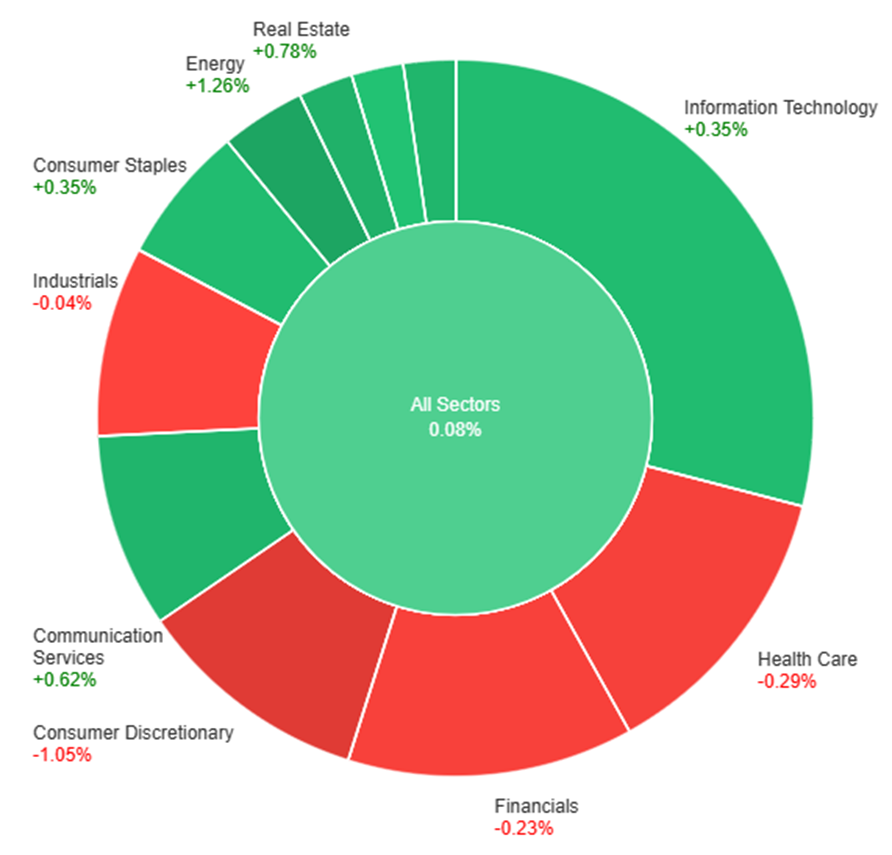
As the US market closed on Monday, the latest updates were from Friday, revealing a modest overall market increase of 0.08%. The Energy sector performed notably well with a gain of 1.26%, followed by Real Estate at 0.78%, and Communication Services at 0.62%. Utilities and Information Technology both contributed positively with increases of 0.59% and 0.35%, respectively. However, some sectors experienced declines, with Consumer Discretionary leading the losses at -1.05%, followed by Health Care at -0.29%. Industrials and Financials also dipped slightly with decreases of -0.04% and -0.23%, respectively. Overall, the market displayed a mixed performance across sectors on Friday.

Currency Market Updates

The currency market experienced notable developments as the demand for the US dollar (USD) strengthened, propelling the USD Index (DXY) upward due to renewed risk aversion influenced by geopolitical concerns, particularly in the Middle East. The DXY continued its consolidative trend since the beginning of the year. Meanwhile, the EUR/USD pair saw a rebound from daily lows near 1.0930 to settle around 1.0950, supported by marginal gains and a recovery in German yields. ECB policymakers’ comments ruling out near-term rate cuts contributed to the bounce in the Euro. Germany’s upcoming releases of the final December CPI, Economic Sentiment by the ZEW Institute, and a speech by the Bundesbank’s J. Nagel are anticipated to play a pivotal role in the currency’s movements.

In contrast, GBP/USD maintained a selling bias amid a greenback rebound, with a focus on the impending key labor market report and a speech by BoE Governor A. Bailey. The Japanese yen (JPY) experienced a reversal in USD/JPY as it revisited the proximity of the 146.00 barrier after two sessions of losses. The Australian dollar (AUD/USD) faced persistent downward pressure, testing the crucial zone around 0.6650. In the Asian trading hours, Westpac’s release of the monthly gauge of Consumer Confidence for January is expected to impact the AUD/USD pair. USD/CAD registered its third consecutive session of gains, reaching a new five-week high near 1.3450, driven by the risk-off sentiment in the USD and the bearish tone in crude oil prices. The Canadian Dollar is anticipated to take center stage on Tuesday with critical inflation figures for December. Lastly, modest gains in Gold and Silver were supported by heightened geopolitical concerns and the resulting risk-off sentiment.

Picks of the Day Analysis
EUR/USD (4 Hours)

EUR/USD Faces Uncertainty Amidst Geopolitical Tensions and ECB Debate on Interest Rates

The EUR/USD started the trading week with indecision, marked by reduced volatility and thin trade conditions due to the US markets’ inactivity post-Martin Luther King Jr. holiday. The pair rebounded from daily lows near 1.0930, supported by a positive session for the greenback amid a risk-off sentiment tied to geopolitical developments, especially in the Middle East. The European currency found some backing from hawkish comments by ECB officials, countering premature speculation about potential interest rate cuts. A debate between market participants and ECB rate-setters on the timing of rate reduction ensues, with the central bank leaning towards a restrictive stance due to persistent inflation. Meanwhile, data from Europe reveals mixed economic indicators, contributing to the uncertainty in EUR/USD movements.

Chart EUR/USD by TradingView

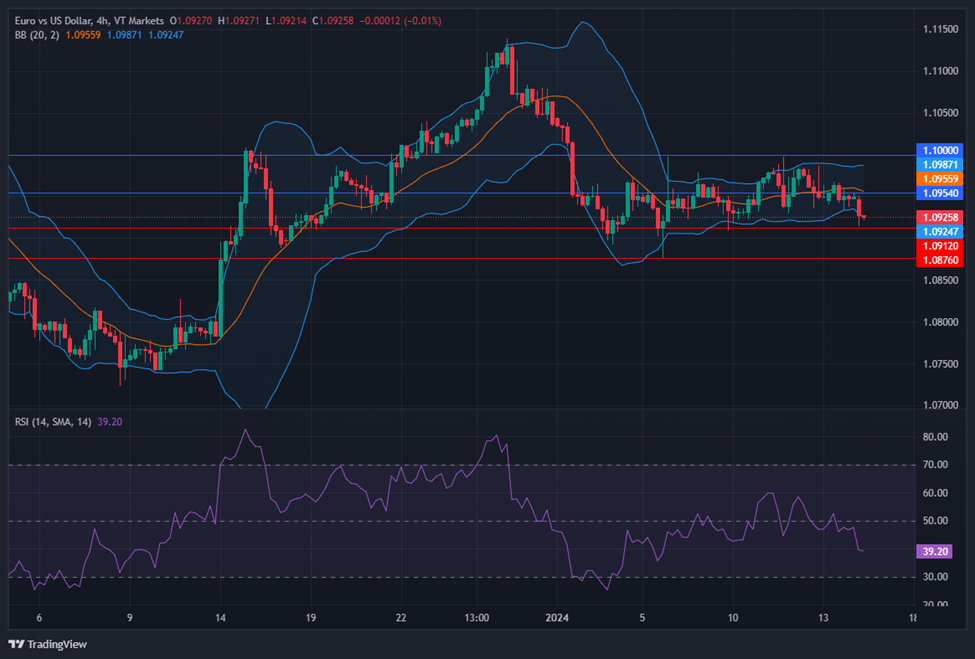
On Monday, the EUR/USD moved lower, able to reach the lower band of the Bollinger Bands. Currently, the price moving just around the lower band, suggesting another potential downward movement. Notably, the Relative Strength Index (RSI) maintains its position at 39, signaling a bearish outlook for this currency pair.

Resistance: 1.0954, 1.1000

Support: 1.0912, 1.0876

XAU/USD (4 Hours)

XAU/USD Holds Steady Near $2,058.55 Amid Quiet US Markets on Martin Luther King Day

Gold (XAU/USD) maintains its upward momentum, hovering above $2,050 per troy ounce in the absence of U.S. market activity due to the Martin Luther King Day Holiday. The week began optimistically, with Asian shares reflecting positive sentiment; however, European trading hours saw a decline in optimism as tepid local data weighed on EU indexes. The US Dollar exhibited mixed performance, particularly gaining strength against commodity-linked currencies. Looking ahead, the focus shifts to inflation updates from Canada, the United Kingdom, Germany, and the Eurozone, while the World Economic Forum in Davos will attract attention with speeches from major central bankers and authorities. The U.S. macroeconomic calendar remains relatively quiet this week, with December Retail Sales and the preliminary estimate of the January Michigan Consumer Sentiment Index slated for release later.

Chart XAU/USD by TradingView

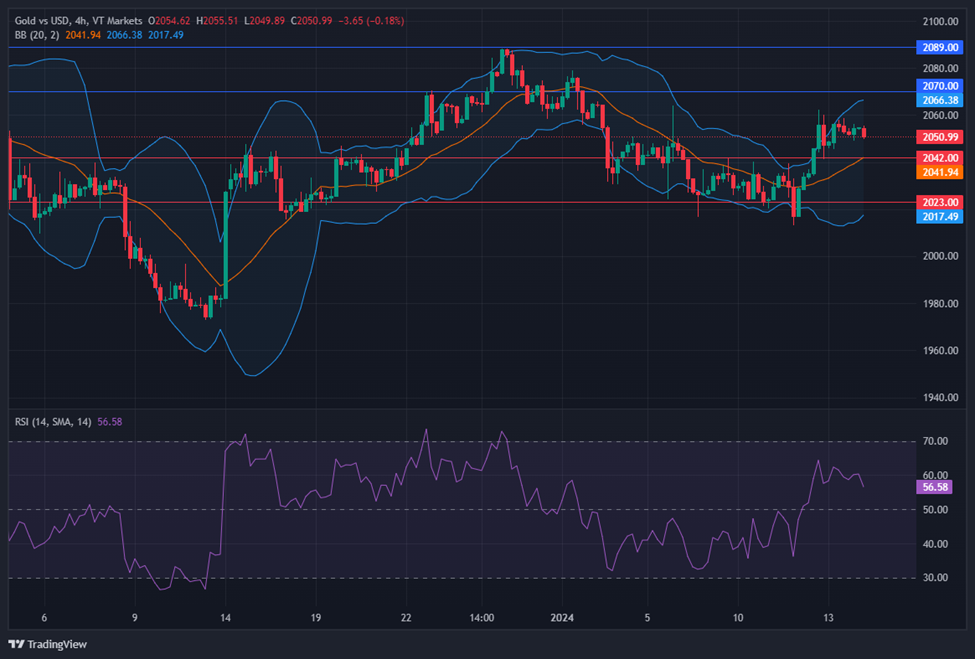
On Monday, XAU/USD moved flat and stayed between the middle and upper bands of the Bollinger Bands. Currently, the price moving between the middle and upper bands. The Relative Strength Index (RSI) stands at 56, signaling a neutral outlook for this pair.

Resistance: $2,070, $2,089

Support: $2,042, $2,023

Economic Data
CurrencyDataTime (GMT + 8)Forecast
GBPClaimant Count Change15:0018.1K
CADConsumer Price Index m/m21:30-0.3%
USDEmpire State Manufacturing Index21:30-4.9

Forex Market Analysis: Global Market Insights: US Dollar, Stocks, and Geopolitical Dynamics

Forex Market Analysis: Monday 15 Jan 2024

Economic data: Markets closed for Martin Luther King, Jr. Day

Earnings: Markets closed for Martin Luther King, Jr. Day

CURRENCIES:

  • Event Focus: UK Unemployment and Inflation Data
    • Major event risk from the UK includes upcoming releases of unemployment and inflation data.
  • US Market Dynamics: Lower Yields and Rate Cut Forecasts
    • US dollar maintains its trading range despite declining yields and heightened expectations for rate cuts.
    • US 2-year yield experiences a six-day decline, with markets predicting nearly 25 basis point cuts in each meeting from March to November.
    • Note: Potential rate adjustments by the Fed may be limited due to the proximity to the presidential elections.
  • US Dollar Basket Performance: Trading within Range
    • The US Dollar Basket, a proxy for USD performance, has been trading within a range for the past two weeks.
    • The significant resistance at the 103.00 level, coupled with the presence of the 200 and 50-day simple moving averages, limits the dollar’s upside potential.
  • Challenges for the USD: Declining Yields and Rate Cut Expectations
    • The USD faces challenges such as decreasing yields, a more imminent prospect of rate cuts, and easing price pressures.
  • Implied Fed Funds Rate: Market Expectations
    • Market expectations, as reflected in the implied Fed Funds Rate via the Fed Funds Futures Market, indicate anticipation of future rate cuts.
  • Inflation Outlook: Despite Slightly Higher CPI Readings
    • Despite slightly higher Consumer Price Index (CPI) readings last month, expectations suggest a continued drop in inflation.
    • USD’s current range-holding is attributed in part to its safe-haven appeal, particularly following joint US and UK strikes on Houthi targets.
  • Global Economic Outlook: Chinese Q4 GDP Data
    • Chinese Q4 GDP data is anticipated to provide insights into the global economic outlook.
  • Safe Haven Appeal of USD: Influenced by Geopolitical Events
    • USD’s safe-haven appeal is reinforced by geopolitical events, such as joint US and UK strikes on Houthi targets, contributing to its range-holding status.
  • Gold Performance: Notable Safe Haven Asset
    • Gold, a significant safe-haven asset, exhibited an increase over the weekend, aligning with USD’s safe-haven appeal.
  • Key Levels for USD: Resistance at 103.00
    • The USD faces resistance at the major level of 103.00, with the 200 and 50-day simple moving averages further contributing to this resistance zone.
  • Factors Influencing USD Range: Safe Haven Status
    • Despite various challenges, the USD’s ability to maintain its range is influenced by its safe-haven status, particularly in response to recent geopolitical developments.

STOCK MARKET:

  • Market Recap and Outlook:
    • Stocks resumed winning streak after a nine-week break to start 2024.
    • Nasdaq Composite led with a 3% gain; S&P 500 approached a record high.
    • Microsoft surpassed Apple as the world’s most valuable company.
  • Upcoming Focus:
    • In a holiday-shortened week, attention shifts to financial sector results and Wednesday’s retail sales data.
    • US markets closed Monday for Martin Luther King Jr. Day.
  • Retail Sales Forecast:
    • Retail sales expected to rise by 0.4% in December, exceeding the 0.3% gain in November.
    • Bank of America anticipates “robust” retail sales due to applied seasonal adjustments.
  • Economic Calendar:
    • Thursday: Initial jobless claims data.
    • Friday: University of Michigan’s consumer sentiment report.
  • Geopolitical Events:
    • Monday: Iowa caucuses mark the official start of the 2024 US presidential election.
    • Rising tensions in the Red Sea draw increased investor attention.
  • Earnings Reports:
    • Investment banks Goldman Sachs (GS) and Morgan Stanley (MS) set to report.
    • Focus on the investment banking story and the trajectory after a challenging year.
  • Inflation Insights:
    • Last week’s inflation data showed firmer consumer prices but moderated producer prices.
    • Red Sea-related disruptions noted as an “upside risk” to inflation forecasts.
  • Fed Rate Cut Expectations:
    • Investors price in a 77% chance of a 0.25% Fed rate cut in March.
    • Barclays economists expect incremental cuts starting in March but at a more gradual pace.
  • Earnings Season Kickoff:
    • Major money center banks, including JPMorgan, Wells Fargo, Bank of America, and Citi, reported results.
    • JPMorgan reported a nearly $50 billion record annual profit.
  • Tech Sector Focus:
    • The financial sector takes the spotlight initially, but the tech sector’s performance will be closely monitored.
    • Forward P/E ratio for the Technology sector stands at 27, second highest among S&P 500 sectors.
  • Magnificent Seven and Nasdaq Influence:
    • Results from “Magnificent Seven” tech giants, including Meta Platforms, Alphabet, Amazon, and Tesla, will impact the Nasdaq and overall market sentiment.
    • Negative guidance from tech sector companies above recent averages.
  • Sector Valuations:
    • Technology sector’s forward P/E ratio at 27, second only to Real Estate, which traded at 39.
    • Technology’s performance crucial as it accounts for over 28% of the S&P 500’s market cap.
  • Fourth Quarter Earnings Season:
    • The tech trade’s impact on overall market direction will be significant as the earnings season progresses.
  • Investor Sentiment:
    • The party for fourth-quarter earnings season begins when reports from the “Magnificent Seven” tech giants start rolling in.

Start Your Shares CFD Trading journey with VT Markets and access a world of opportunity. Discover advanced tools, expert insights, and tailored strategies to enhance your trading experience. Open your account today and join a community of savvy traders

Back To Top
server

您好 👋

我能帮您什么吗?

立即与我们的团队聊天

在线客服

通过以下方式开始对话...

  • Telegram
    hold 维护中
  • 即将推出...

您好 👋

我能帮您什么吗?

telegram

用手机扫描二维码即可开始与我们聊天,或 点击这里.

没有安装 Telegram 应用或桌面版?请使用 Web Telegram .

QR code