Forex currency pairs

There are many different trading tools, advanced features, and derivative types available to traders in the FX market, but all of these require a firm grasp of currency pairs — also known as forex pairs. Discover more about this important aspect of trading below.

Understanding forex currency pairs

As you learn how to trade on the forex market, you will often find yourself dealing with currency pairs. As the name suggests, these pairs represent two global currencies that are analysed together, and traders will speculate on the relative price movements of each currency in the pair.

Pairs are represented with a base currency on the left and a quote currency on the right. The base is the currency being bought, while the quote is the currency being sold. In the USD/AUD currency pair, the United States Dollar is the base currency and the Australian Dollar is the quote currency.

Along with the currency pair demarcation, there will also be an exchange rate. This shows traders how much of the quote currency will be required to purchase one unit of the base currency. In the case of the USD/AUD forex pair, the exchange rate may be A$1.47 for every US$1. On the forex platform, however, this will be represented to a higher degree of accuracy — perhaps 1.4723. A movement at the fourth decimal place of this exchange rate is known as a pip in the FX market. For some quoted currencies, such as the Japanese Yen (which has a much smaller denomination than the Australian Dollar), a pip will be a movement at the second decimal place. Traders need to keep an eye on pips as they assess market performance.

Trading with currency pairs

Traders can open a long or short position on currency pairs. A long position is essentially a buying position — in the above example, they would be long on the United States Dollar and short on the Australian Dollar at the same time. If one United States Dollar is equal to 1.4723 Australian Dollars, the trader in this example is hoping that this value increases, delivering them a profit.

If traders believe that the market will move in the opposite direction, they can open a short position on the currency pair. This means going short on the United States Dollar and long on the Australian Dollar, and the trader will want the 1.4723 rate to decrease — i.e. they want the AUD to strengthen against the USD.

If traders believe that the market will move in the opposite direction, they can open a short position on the currency pair. This means going short on the United States Dollar and long on the Australian Dollar, and the trader will want the 1.4723 rate to decrease — i.e. they want the AUD to strengthen against the USD.

If traders believe that the market will move in the opposite direction, they can open a short position on the currency pair. This means going short on the United States Dollar and long on the Australian Dollar, and the trader will want the 1.4723 rate to decrease — i.e. they want the AUD to strengthen against the USD.

Bear in mind that there are no guarantees when it comes to trading FX pairs. You can certainly research your position and base your decision on data-backed predictions, but the market can still move in a different direction from the one you expected. In other words, there is always a risk of loss.

Different types of forex currency pairs

You have a huge amount of flexibility when it comes to trading. As discussed above, you can open long or short positions, but you can also choose a wide range of different currencies to trade with. A forex pair may comprise any two currencies from around the world, although some types of pairs are traded more frequently than others. In addition, FX pairs may be divided into general categories.

●       Major currency pairs

Major currency pairs are the forex pairs with the highest trading volume in terms of frequency and the amount of money used in transactions. Recently, the four major currency pairs are the EUR/USD, the USD/JPY, the GBP/USD, and the USD/CHF (Swiss Franc), although this is subject to change in accordance with market forces and general trading habits. The AUD/USD is another pair that has traditionally featured on the major list, and this may be included within broader definitions of the major forex pairs.

Trading with major forex pairs is a popular choice because they tend to provide a more stable option than other types of pairs, as well as tighter spreads and more liquidity. However, even with major forex pairs, there are no guarantees, and the market may move in an unexpected direction.

●       Minor currency pairs

Minor currency pairs are traded less frequently than the majors but still enjoy a relatively high level of volume compared to other choices (see the exotic pair section below). This category generally refers to any pairs outside of the top four, and which don’t involve the United States Dollar. Common examples include the EUR/JPY, the GBP/CHF, and the AUD/NZD (New Zealand Dollar).

Compared to major forex pairs, minors are more volatile — something that can make them attractive to traders looking to make potential returns quickly. However, the risk of significant losses is high, and liquidity tends to be low. The spreads also tend to be broader for minor pairs, increasing the cost of opening a position.

●       Exotic currency pairs

Exotic pairs are essentially minor pairs but with a very low trading volume, and so they are off the radar of most mainstream traders. It is more difficult to research these pairs, and liquidity is usually very low. Volatility may also be high, which means exotic options are best reserved for more experienced traders or those with specific knowledge of geopolitical and economic conditions.

The CAD/SGD (Canadian Dollar/Singapore Dollar) is a popular choice for exotic pair traders, as is the EUR/TRY (European Euro/Turkish Lira). Some exotics also include the United States Dollar, such as the USD/SEK (Swedish Krona) and the USD/THB (Thai Baht).

●       Currency cross pairs

Currency cross pairs simply refer to a group of minors that do not involve the United States Dollar, but which used to require the USD as an intermediary. Exchanging the British Pound for the Japanese Yen, for example, once required an exchange from GBP into USD, and then USD into JPY — so the GBP/JPY pair would be considered a currency cross.

Currency pairs and leverage or margins

Understanding margins and leverage is important for traders learning the forex market. A margin is the amount of money that a trader must hold in their account in order to open and maintain positions. Each broker will have their own leverage requirement — if the margin is set at 5%, your account balance must remain at or above 5% of the value of all your open trades. If it falls below this level, a margin call is issued and positions may be liquidated.

You can also trade on the margin. In the 5% example, you would need to cover 5% of the position’s value with your own capital, while the broker covers the remaining 95%. This increases the potential for profit, but also significantly raises the risk.

Trading on leverage in FX works in a similar way but is expressed as a ratio. For example, you may borrow $20 from the broker for every $1 you commit from your account balance — expressed as a leverage of 20:1. In this example, the margin is still 5%, and a margin call will be issued if your account balance falls below this level.

Both margins and leverage enable traders to maximise their exposure when they trade with a currency pair. In both instances listed above, you would be controlling a position 20x greater than if you had not used leverage or traded on the margin. This means you will need to assess the movement of the currency pair carefully and be ready to close the position if the pair’s exchange rate moves too far the wrong way. Stop-loss tools can also help you, automatically closing the position if the currency pair’s exchange rate falls below a certain threshold.

Currency pairs and spreads

When you look at the value of a forex pair on the VT Markets platform, you will notice that there is a difference between the buying and selling price for the pair. This difference is known as the spread. The spread enables brokerage platforms and brokers to remain profitable, driving revenue from each position opened.

What does this mean for currency pairs themselves? Well, narrower spreads translate to lower transaction costs for the trader, and also indicate higher liquidity and lower volatility. The major forex pairs all feature narrower spreads, which is one reason why so many traders opt for these high-volume pairs.

Trade with currency pairs at VT Markets

Here at VT Markets, we provide an industry-leading platform designed to help traders secure the benefits of forex in a sustainable and responsible way. There are always risks to this type of trading, but our tools and features help you to make considered choices and data-backed decisions as you grow your understanding. Get started with our demo account, and then open real positions with the live trading account. Want to learn more about our platform? Get in touch with our team today.

FAQs

What are the most frequently traded currency pairs?

The most frequently traded currency pairs are known as the major forex pairs. These include the EUR/USD, the USD/JPY, the GBP/USD, and the USD/CHF (Swiss Franc), but this list may change along with fluctuations in the market. The AUD/USD is another frequently traded pair.

What are forex currency correlations?

A currency correlation is a slightly more complex entity on the forex market. It refers to the relative movements of two currency pairs against one another. These pairs may move in the same direction, suggesting some kind of causal relationship (although this is not always the case), or they may move in opposite directions to one another. Alternatively, the pairs may display no relationship at all, moving together at some times and moving oppositely at others.

What is the best currency pair?

The major currency pairs tend to display the highest liquidity, the lowest trading costs and the lowest levels of volatility in the market. As you learn how to trade forex, you will grow your own strategy and understand more about which pairs are best for you, but pairs in this category offer generally favourable conditions for traders of all backgrounds.

Forex currency correlations

In a general sense, correlation is something you’ll be looking for as you analyse and assess the forex market. While correlation does not always equal causation, it can still be useful in forecasting and predicting future market movements — techniques that will become increasingly important as you learn how to trade forex in a more advanced manner.

But, while correlations can be found in all forex data sets, currency correlations relate to something a bit more specific. So what are these currency pair correlations, and why do you need to know about them as a trader?

Understanding currency correlations and correlation trading in forex

When we discuss correlated forex pairs, we are basically talking about either three or four currencies arranged into two pairs. If one currency is shared between two pairs, there will be three currencies in total — and there will be four currencies if there is no such sharing. For example, if you are examining the AUD/USD and GBP/USD pairs, there are three currencies in total, but if you examine the AUD/USD and GBP/EUR pairs, there are four.

Forex correlation pairs are currency pairs that tend to exhibit movement patterns at the same time. If the movement of one pair appears to trigger the movement of another pair, there would be a correlation between the two.

But an FX correlation does not necessarily mean a move in the same direction. If an upwards or downwards movement of a certain pair appears to trigger the same in another pair, these pairs would have a positive correlation. If an upwards or downwards movement of a certain pair appears to trigger the opposite movement in another pair, these pairs would have a negative correlation.

This idea of “appearing to trigger” is important. Just because sets of currency pairs display a correlation does not mean they will always move in the expected direction. Nor does it mean that they will necessarily move to the same degree or with the same magnitude. There is always an element of uncertainty when it comes to trading on the forex market.

However, correlations do provide useful signals that traders can utilise as they make predictions and forecast future movements. With a careful, considered and conservative approach, you can start to grow your understanding and learn more about forex correlations and how they work.

Examples of positive and negative correlations

We’ve touched on positive and negative correlations above, but which currency pairs fall into these categories? Take a look at a few examples.

Positively correlating FX pairs

Positive forex correlation pairs are not all equal. Some will tend to correlate more closely, replicating each other’s movements almost exactly in some cases. Others will move only slightly in the same direction, but will show a repeated correlation over time.

Some of the most correlated pairs include:

  • The AUD/USD pair against the NZD/USD pair.
  • The EUR/USD pair against the GBP/USD pair.
  • The EUR/USD pair against the USD/CHF (Swiss Franc) pair.
  • The GBP/USD pair against the USD/CAD (Canadian Dollar) pair.
  • The GBP/USD pair against the USD/CHF pair.

Bear in mind that these pairs may not necessarily correlate at all times, and that strong correlations between other pairs may emerge over time.

Negatively correlating FX pairs

Just like with positive currency correlations, negative correlations are also far from equal. There will be some negatively correlating pairs that more closely match the magnitude of each other’s movements, while others may move only slightly. Identifying and understanding these negative correlations is an important part of forex trading.

Some examples of negatively correlating FX pairs include:

  • The USD/CHF pair against the EUR/USD pair.
  • The GBP/USD pair against the USD/CHF pair.
  • The USD/CAD pair against the AUD/JPY pair.
  • The USD/JPY pair against the AUD/USD pair.
  • The GBP/USD pair against the USD/JPY pair.

Again, bear in mind that negatively correlated forex pairs do not provide guarantees into future market movements. You will need to take care when you trade, and remember that a loss is possible even if you expect a strong correlation.

Analysing currency correlations

When you look at a currency pair, you will be looking at value movements measured in pips. Pips in fx are the smallest price movements that will register on the FX market trading platform, generally at the fourth decimal place. So, if a value increases from 1.4323 to 1.4325, this is a movement of two pips.

Pips are certainly important in terms of currency correlations, as it is these price movements that allow analysts to identify correlations in the first place. However, the level of correlation between two pairs is not measured in pips, but is instead represented as a coefficient. Most traders will use these coefficients to choose correlations, although they may also want to look at the pip movements of each pair.

The coefficient will be a value between -1 and 1. A negative value suggests a negative correlation, while a positive value suggests a positive correlation. A value of exactly -1 or exactly 1 means this correlation will happen 100% of the time — in realistic trading terms, you are not likely to see either of these numbers.

Instead, you’re likely to see a coefficient like -0.75 or 0.69 — a decimal representation of a number less than 1. The closer this decimal is to -1 or 1, the stronger the correlation trend. So, a coefficient of 0.91 demonstrates a stronger positive correlation than 0.72, and a coefficient of -0.89 suggests a stronger negative correlation than -0.61.

Trading with currency correlations

When you trade on the forex market, you are likely to use currency correlations in one of two ways.

●       Gathering evidence for forecasting

You may notice a trading signal or indicator that suggests a specific price movement for a currency pair. While these signals and indicators are useful when deciding on a trading strategy, it’s not unusual for traders to want to gather more information before they make a decision one way or another.

Looking at forex pairs that correlate with one another can provide this additional insight. For instance, you may predict that a pair is going to move in a specific direction, and you identify a history or correlation with another pair. A movement in this second pair will provide supporting evidence that suggests your prediction was correct, and you may decide to open a position as a result. You may also decide to increase your exposure to market forces by trading on the margin or by leveraging your forex position — just remember that this also raises the risk level for the trade. There are no guarantees of success, but this is an example of a considered strategy used by experienced traders.

●       Hedging other trades

Correlating forex pairs are also used in hedging strategies, where FX traders seek to mitigate the risk of one position by opening another. Understanding the correlations between different pairs is useful here, as traders can recoup some of their potential losses with a trade in the opposite direction.

The most obvious way to do this is to use negatively correlating forex pairs. You may open a position — either buying (long) or selling (short) on one currency pair, and then open the same position on a negatively correlating pair. If your first position fails, you will still make a return on the second position, provided that the correlation occurs as expected.

However, you can also hedge with two positively correlated pairs. To do this, you would open a position on the first pair — either a long or a short position — and then open the opposite position on the second pair. Again, if the first position fails, you would still make some return from the second position if the correlation is realised, mitigating your losses to some extent.

When you trade with currency pairs, you need to be aware of spreads. The spread is the difference between the buying and selling prices for a pair, and this essentially represents the fee you will need to pay to open a position. With hedging on currency correlations, you will be opening two positions rather than one, which means you’ll need to pay two sets of trading fees. This makes it doubly important to keep spreads in mind.

Begin trading currency pairs and analysing correlations with VT Markets

Use our platform to grow your trading experience and build your strategy. Set up a demo account to familiarise yourself with the market and our tools, then trade for real on a live trading account. Want to learn more about our platform? Get in touch with our team today.

FAQs

Which forex pairs are most correlated?

One way that traders try to realise the benefits of forex is by looking at correlations, but some correlations are stronger than others.

The AUD/USD and the NZD/USD, and the EUR/USD and the GBP/USD are two of the strongest positive correlations. Meanwhile, the USD/CHF (Swiss Franc) and the EUR/USD, and the GBP/USD and the USD/CHF display two of the strongest negative correlations. However, remember that this is subject to change, and the correlation is never guaranteed.

Which currency pairs work together?

To find the currency pairs that work best together, look at the exchange rate coefficient. This coefficient will be a number between -1 and 1. A coefficient of close to 1 represents a strong positive correlation, while a coefficient of close to -1 represents a strong negative correlation.

How is the currency correlation coefficient calculated?

It requires a complex calculation to arrive at the currency correlation coefficient. This calculation takes into account the mean value at closing for each pair over a specified time period. The mean closing value for Pair 1 is represented in the formula as X, while the mean closing value for Pair 2 is Y.

Using these values, the coefficient = ∑(X− X)(Y− Y) / √(X− X)² √(Y−Y)²

Most traders will use online tools built into the forex platform as they analyse coefficients, so they do not need to do this calculation themselves.

Exchange rate in forex

Exchange rates underpin the entire forex market, and you’ll need to know how to view, read and understand these rates as you develop your trading skills. Learn more in our guide.

Understanding exchange rates in forex

What is the exchange rate? The exchange rate in forex indicates how much of one currency is required to purchase a fixed amount — or one unit — of another. For example, it may require US$0.6 to purchase A$1, or it will require A$1.47 to purchase US$1. These values are subject to change.

Exchange rates are essentially the foundation of the forex — or foreign exchange — market. When you trade on this market, you will generally be working with a currency pair and speculating on the movement of the exchange rate between the currencies within this pair. One currency in the pair is the base currency — this is the ‘unit’ mentioned above. The other currency in the pair is the quote currency. The exchange rate is how much of the quote, or selling, currency is required to purchase one unit of the base, or buying, currency.

This is also important if you are trading with currency correlations. A currency correlation trade involves speculating of the relative movements of four currencies divided into two pairs. Understanding the exchange rate is critical for opening these more complex positions.

While the evolution of this exchange rate over time is what currency pair trading is based on, it is a factor in other trades too. Whether you are seeking to invest in a foreign market, or simply looking to make a currency trade ahead of an international trip, the exchange rate is something you’ll need to be aware of.

Reading the exchange rate

The exchange rate is measured in pips. Pips in forex refer to small movements of price, which will be at the fourth decimal place for most currency pairs, or at the second decimal place for pairs with quote currencies that have smaller denominations such as the Japanese yen. Observing these pip movements will help you to understand which direction the exchange rate is heading.

So how do you read this rate? It doesn’t matter what platform or service you use; the rate will be expressed in the same way — as a decimal value.

Let’s examine this by looking at the above example. In this case, we can make a currency pair of USD/AUD — the United States dollar is the base currency, and the AUD is the quote currency. This pair would be represented as USD/AUD 1.47 – which means 1.47 units of the AUD are required to purchase one unit of the USD, or A$1.47 per US$1.

Because the forex trading platform deals with a large number of different currencies from all over the world, the exchange rate will always be represented as a pair with the base and quote currencies both displayed. In other trading locations, such as at a physical exchange, you may only see a value for the quote currency. This is because it will be taken as given that the base currency is the local national currency.

How exchange rates are determined

How is currency valued? How are exchange rates determined? These rates are influenced by a wide array of different factors, which combine to make forex trading a complex but exciting endeavour.

Supply and demand is arguably the most obvious factor. If more people are buying a particular currency, and the market supply is not increasing in line with this, then the price of this currency will increase relative to others. If the opposite happens, or if supply outstrips demand for another reason, the price will fall.

Geopolitical factors will also play a major part. The United Kingdom’s exit from the European Union led to a significant fall in the relative value of the British pound, for example. However, it’s difficult to predict these market movements — economic sanctions against the Russian Federation led many to predict a decline for the Russian rouble, but this currency instead rallied against other major global currencies such as the United States dollar.

In this sense, exchange rates are not so much ‘determined’ as they are ‘dictated’ by market forces. There is no central committee overseeing the forex market, and rises and falls happen spontaneously. Even with careful research and forecasting, there are no guarantees in the market, and the exchange rate in FX may not move in the way you expected it to.

Fixed and floating exchange rates

To understand how exchange rates work, you need to recognise the difference between fixed and floating rates. As you learn how to trade forex and become more familiar with the market, you will notice that most currency pairs display a floating exchange rate. This means they are determined according to market forces. When supply and demand fluctuate, the rate of exchange in FX will fluctuate too.

Other currencies may not have a floating rate, but the rate will instead be fixed. This means the central bank of a particular country will peg the value of their own currency to that of another. The central bank achieves this by trading its own currency against its partner — usually the United States dollar but sometimes another form of currency.

The Saudi Arabian riyal is an example of this and will retain the same fixed rate against the United States dollar.

These currencies can still be used for speculation, as they are still subject to market forces. For instance, while the riyal will maintain the same value against the US dollar, it will fluctuate in relation to the European euro or the Japanese yen.

Exchange rates and spreads

Trading on the forex market is not free, and brokers and trading platforms need to secure revenue to keep themselves profitable. This is where forex spreads come into play.

When you view a currency pair and assess the exchange rate, you will notice that the price to buy and the price to sell the pair are not the same. There will be a disparity between the bid price (the buying price) and the ask price (the selling price), which is known as the spread.

Tighter spreads are more favourable for traders, as it reduces the cost associated with opening a position in the market. However, this spread may change over time in response to market forces, and this will have an impact on the cost of keeping each position open.

Exchange rates, leverage and margins

When you trade on the forex market, you will quickly encounter leverage and margins. Leverage in FX means borrowing money from the broker to supplement your own capital, and this will be expressed in a ratio. A position leveraged at 20:1, for instance, will involve borrowing $20 for every $1 of your own money you use to open the trade. Of course, this means the potential benefits of the forex trade increase significantly, but your potential losses increase too – this money will need to be paid back regardless of whether or not the trade is successful.

Margin trading works in a similar way, and you will still be borrowing money from the broker to supplement your own capital. However, the margin will be represented as a percentage. Opening a $1,000 position with a margin of 5% will require you to put up $50 of your own money, while the broker will make up the remaining $9,550. This is basically the same as using a 20:1 leverage to control a $1,000 trade. Again, the potential for profits increases, but so does the risk to the trader.

In both cases, you will incur a margin call if your available funds fall below the margin rate set by the broker. If this happens, you’ll need to close positions to bring your account back into line with requirements, or you’ll need to deposit funds directly. Failing to meet a margin call will result in positions being liquidated.

How does this relate to exchange rates? Well, it’s the movement of the exchange rate that drives the success of the trade. A movement of a few pips may not seem like much, but this can result in a significant rise or fall when leverage and margin trading is involved. If the exchange rate moves too far in an unexpected direction, a margin call may be issued. This means you need to take great care when working with these sorts of trades, implementing stop loss tools to provide additional protection.

Continue your trading journey with VT Markets today

Our VT Markets platform is among the market leaders, providing a variety of tools that beginners and more experienced traders can use as they navigate forex trading. Take a look at our demo account and get started. From here, move on to real trades with the live trading account. Want to learn more about our platform? Get in touch with our team today.

FAQs

What is the forex rate today?

Learning forex means learning to read and predict current and future fluctuations in foreign exchange rates. Trading platforms like the one provided by VT Markets will offer real-time forex data that gives you an exact picture of the currency rate.

Is forex the same as the exchange rate?

Forex stands for foreign exchange, so essentially forex and exchange rates are the same thing. The forex rate will not be exactly in line with the current exchange rate, due to the spreads that brokerage platforms use to generate revenue. However, these spreads will be small in most cases.

How does the exchange rate work in forex?

Exchange rates work according to market forces such as supply and demand. Increased supply that is not met by an equal increase in demand will result in a falling exchange rate. Increased demand without an increase in supply will result in a rising exchange rate. Geopolitical and social factors will also affect the rate of exchange.

Inflation data boosted expectations for a 75 bps Fed rate hike

US stocks plunged on Tuesday, coming under heavy selling pressure and suffered from their biggest daily losses in more than two years following the release of US Consumer Price Index data. The US annual CPI inflation decelerated to 8.3% yearly in August but was slightly above markets’ estimates of a decline to 8.1%. Therefore, the hotter-than-expected inflation data fueled the bets on a 75 bps rate hike by the Federal Reserve next week and weighed heavily on the equity markets. There is around a 25% chance that the Fed will announce a full 1.0% increase in the benchmark Fed rate on September 21 meeting.

In the Eurozone, the weaker-than-expected German ZEW Economic Sentiment declined to -61.9 in September and deteriorated the market mood. Furthermore, expectations that Russia will hit hard after retreating from some parts of Ukraine also undermined the euro. However, another 75 basis points rate hike from the European Central Bank in October is still on the table.

The benchmarks, S&P 500 and Dow Jones Industrial Average both suffered from heavy losses on Tuesday as a broad-based selloff pushed the equity market down most since 2020 amid the surging US dollar. The S&P 500 was down 4.3% daily and the Dow Jones Industrial Average also declined with a 3.9% loss for the day. All eleven sectors in S&P 500 stayed in negative territory as the Energy and the Utilities sectors are the worst performing among all groups, losing 5.64% and 5.35%, respectively. The Nasdaq 100 meanwhile dropped the most with a 5.5% loss on Tuesday and the MSCI World index was down 3.4% for the day.

Main Pairs Movement
The US dollar staged an impressive rally on Tuesday, regaining upside strength and witnessing its biggest one-day percentage gain since March 2020. The rising US treasury yields have provided strong support to the greenback as the stronger-than-expected US inflation data boosted investor bets that the Federal Reserve will need to stay aggressive in raising interest rates. As for today, the market focus shifts to the US Producer Price Index (PPI) report later in the US session.

GBP/USD retreated sharply on Tuesday with a 1.62% loss as the cable witnessed an intense sell-off towards the 1.150 mark after the release of the US CPI data. On the UK front, investors are awaiting the release of the UK inflation data which might add to the concerns of a recession and soaring jobless claims. Meanwhile, EUR/USD also plummeted and touched a daily low below the 0.9980 mark in the second half of the day. The pair was down almost 1.50% for the day.

Gold licked its wounds with a 1.28% loss for the day after retreating to a daily low around the $1,698 mark during the early US session, as the renewed fears of the Federal Reserve’s aggressive rate hike undermined the safe-haven metal. Meanwhile, WTI Oil remained under pressure and refreshed its daily low near the $85 mark during the US trading session as the hawkish Fed expectations propelled the recession woes on Tuesday.

Technical Analysis

EUR/USD (4-Hour Chart)

EUR/USD started the day with upward momentum, but the pair could not hold on to gains as the U.S. CPI report was released during the early American trading session. U.S. CPI came in at 8.3%, higher than market expectations f 8.1%. The Dollar Index soared more than 1% following the release of the report. Market participants have piled on to the rhetoric of a 75 basis point interest rate hike by the Fed as inflation continues to run high in core areas. Most notably, food and rent went up for August, thus causing the core CPI to rise at an unexpected rate. The strong Dollar, accompanied by the rising U.S. 10-year treasury yield eroded all of the shared currency’s early gains and sent the pair into correction territory.

On the technical side, EUR/USD reversed course slightly below our previously estimated resistance level of 1.0192 and is trending below parity. The short-term support level for the pair remains at 0.9902, however, a strong PPI report from the U.S. could send the Euro-Dollar pair further away from parity. RSI for the pair sits at 44.08, as of writing. On the four-hour chart, EUR/USD currently trades below its 50, 100, and 200-day SMA.

Resistance:  0.9902, 1.0011, 1.0055

Support: 0.9902, 0.985

GBP/USD (4-Hour Chart)

The British Pound attracted bidding during the earlier part of Tuesday’s trading, but the Pound did not stand a chance against the U.S. Greenback as the Dollar was met with a surge of demand following the hotter-than-expected CPI report. Cable reversed course around the 1.173 price region and began trending down as U.S. 10-year treasury yields soared past 3.4%. The British Pound, however, fared better compared to its European peers as the U.K. has yet to announce its monthly CPI figure. The downside for the British Pound could still be unrestricted as the nation faces one of its toughest seasons as winter approaches, and energy prices continue to haunt the residents of Britain. Furthermore, the BoE continues to be hampered by the weak British economy, so raising interest rates could add more pressure on any economic revival.

On the technical side, GBP/USD met fresh resistance at the 1.173 price region. We maintain 1.1463 as Cable’s short-term resistance as the upside for the U.S. Greenback is still yet to be exhausted. A hot CPI report from the U.K. could favour Pound bulls in the short term, but the stronger U.S. Greenback limits any upward momentum for Cable. RSI for the pair sits at 40.9, as of writing. On the four-hour chart, GBP/USD currently trades below its 50, 100, and 200-day SMA.

Resistance: 1.1561, 1.1854

Support: 1.1463

XAU/USD (4-Hour Chart)

Gold prices advanced during early trading on the 13th. Gold prices were able to rise before the U.S. CPI release as the Dollar continues to exert weakness; however, as the CPI came in above expectations, Gold plunged back to the $1,700 per ounce region. The non-yielding precious metal simply could not compete against U.S. treasury yields, which soared past 3.4% as market participants bet on a rise of short-term interest rates. The 75 basis point interest rate hike now seems all the more certain as core CPI from the U.S. rose unexpectedly. U.S. PPI, which is scheduled to release during today’s American trading session, is expected to show resilient demand and add to the case of a super-size interest rate hike as the next FOMC meeting nears.

On the technical side, XAU/USD has reversed course at our previously estimated resistance level of $1,724 per ounce and has broken below our previous estimated support level of $1,712  per ounce. The next level of support for Gold sits at the $1,695 per ounce price level. RSI for the pair sits at 41.4, as of writing. On the four-hour chart, XAU/USD currently trades below its 50, 100, and 200-day SMA.

Resistance: 1740, 1800

Support: 1712, 1695

Economic Data

CurrencyDataTime (GMT + 8)Forecast
GBPCPI (Aug)14:0010.2%
USDPPI (Aug)20:30-0.1%
USDCrude Oil Inventories22:300.833M

US Stocks rose as the Market viewed Inflation to be nearing its peak

US stocks advanced higher on Monday, preserving their bullish momentum and rose four straight days ahead of the key US consumer-price data. The speculations that inflation is near peaking have provided support to the equity markets, as the US CPI data is expected to show headline CPI cooled in August to an 8% a year pace. The falling US dollar also acted as a tailwind for the stock markets despite the firm anticipation that the Federal Reserve will hike interest rates by 75 basis points at its Sept. 20-21 meeting. The upside strength witnessed in equity markets could be linked to the market’s optimism and likely preparations for today’s inflation numbers.

In the Eurozone, the hawkish comments from the European Central Bank (ECB) policymakers and updates that Ukraine is gaining success in pushing back the Russian military from some of its areas have both underpinned the market’s cautious optimism. For today, the final readings of Germany’s August month Harmonized Index of Consumer Prices (HICP) will be crucial for immediate direction.

The benchmarks, S&P 500 and Dow Jones Industrial Average both preserved their bullish strength on Monday as the S&P 500 extended last week’s rally and notched the biggest gain over a four-day span since June. The S&P 500 was up 1.1% on a daily basis and the Dow Jones Industrial Average also advanced with a 0.7% gain for the day. All eleven sectors in S&P 500 stayed in positive territory as the Energy and the Information Technology sectors are the best performing among all groups, rising 1.81% and 1.63%, respectively. The Nasdaq 100 climbed the most with a 1.2% gain on Monday, and the MSCI World index was up 1.3% for the day.

Main Pairs Movement

The US dollar remained under pressure on Monday, extending its previous slide and fell to the lowest level in more than two weeks below the 108 mark amid the risk-on market environment. The news that Ukrainian forces have made significant progress in pushing back Russian troops has favoured investors’ sentiment and exerted bearish pressure on the safe-haven greenback. However, the losses could be limited as the policymakers from the US Federal Reserve and the European Central Bank (ECB) remain hawkish.

GBP/USD climbed higher on Monday with a 0.45% gain as the cable witnessed fresh buying and touched a daily high near the 1.1710 level amid the broad-based US dollar weakness. On the UK front, the recession worries were further fueled by the mostly disappointing UK macro data released earlier this Monday. Meanwhile, EUR/USD also edged higher and touched a daily high above the 1.018 mark in the early European session. The pair was up almost 0.20% for the day.

Gold preserved its upside strength with a 0.44% gain for the day after touching a daily high around the $1,734 mark during the US session, as the falling US dollar underpinned the safe-haven metal’s recovery. Meanwhile, WTI Oil extended its previous rally and refreshed its daily top near the $89 mark during the US trading session amid mixed concerns over the supply and demand of the black gold.

Technical Analysis

EURUSD (4-Hour Chart)

EURUSD rose for the second straight trading day as the shared currency continue to recover from its lowest level since the beginning of the year. The shared currency took advantage of the broad-based selling of the U.S. Greenback. Markets seem to have already priced in a supersized 75 basis point interest rate hike at the next FOMC policy meeting, which is set to happen on the 20th and 21st of September. The U.S. 10-year treasury yield also saw a decline during Monday’s trading as risk-on sentiment returns to equity markets. Market participants will now turn their attention to the U.S. CPI release, scheduled during today’s American trading session.

On the technical side, EURUSD has broken above our previously estimated resistance level of around 0.9902 and 1. We project the next level of resistance to sit around the 1.019 price region and the previous resistance level at 10055 would change in polarity and act as a near-term support level for the pair. RSI for the pair sits at 60, as of writing. On the four-hour chart, EURUSd currently trades above its 50, 100, and 200-day SMA.

Resistance:  0.9902, 1.0011, 1.0055

Support: 0.9902, 0.985

GBPUSD (4-Hour Chart)

Cable extended its winning streak into the new trading week as broad-based selling surrounded the U.S. Greenback. An upbeat market sentiment surrounding equities also allowed the British Sterling to find a demand that has seemingly gone away for months. The short-term reversal of Cable should be taken with caution, as the U.K.’s National Statistics revealed GDP growth below market estimates. A weak British economy combined with an ongoing energy crisis could further hinder any monetary tools that the BoE could utilize in order to reign in inflation. Market participants should note that the BoE has postponed its interest rate announcement by a week to September 22nd. A better-than-expected CPI figure from the U.S. could send Cable back into a correction trajectory.

On the technical side, GBPUSD has broken above our previously estimated resistance level of 1.1561 but is still trading below our secondary resistance level of 1.1854. The support level for GBPUSD continues to sit at 1.1463. RSI for the pair sits at 65.43, as of writing. On the four-hour chart, GBPUSD currently trades above its 50 and 100-day SMA, but below its 200-day SMA.

Resistance: 1.1561, 1.1854

Support: 1.1463

XAUUSD (4-Hour Chart)

Gold prices continue to recover for the second straight trading day as the Dollar index dives to a monthly low of below 109. As markets have now seemingly priced in the 75 basis point interest rate hike by the FOMC, the Dollar has entered a cycle of exhausted demand; however, with U.S. CPI scheduled to be released during the American trading session, the U.S. Dollar could be met with a fresh demand. Risk on sentiment across equity markets has made the case for a weaker Dollar and thus room for the yellow metal to gain back some lost ground. Market participants should be aware while Gold was able to gain more than 1% in the past two days, Gold prices have mainly depended on the weakness of the Dollar to rise; however, with inflation still acting as an economic headwind around the world, the non-yielding Gold provides little to no upside for longer-term investing horizons.

On the technical side, XAUUSD has broken above our previously estimated resistance level of $1,724 per ounce and is heading toward the next level of resistance at $1740 per ounce. A fresh short-term support level for Gold has formed around the $1712 per ounce price level. RSI for the pair sits at 59, as of writing. On the four-hour chart, XAUUSD currently trades above its 50-day SMA, but below its 100, and 200-day SMA.

Resistance: 1740, 1800

Support: 1712, 1695

Economic Data

CurrencyDataTime (GMT + 8)Forecast
GBPAverage Earnings Index + Bonus (Jul)14:005.4%
GBPClaimant Count Change (Aug)14:00-13.2K
EURGerman ZEW Economic Sentiment (Sep)17:00-60
USDCore CPI (Aug)20:300.3%
USDCPI (Aug)20:308.1%

US equities rose Friday, maintaining strong momentum

US stocks advanced higher on Friday, witnessing impressive daily gains and preserving its bullish momentum amid the risk-on market sentiment. The markets seem to have priced in a supersized 75 bps rate hike at the September FOMC meeting as the bets for an aggressive monetary tightening were reaffirmed by Fed Chair Jerome Powell, who said on Thursday that the Fed needs to keep going until it brings the inflation down. Looking ahead, markets will be focused on the August consumer-price index that will release this Thursday, which is seen as one of the key reports before the Fed rate decision on September 20-21. In the Eurozone, the hawkish comments from ECB officials provided a boost to the euro, as ECB policymakers Peter Kazimir and Klaas Knot said that their priority was policy normalization and added that they had no other option than to continue with resolute rate hikes. The ECB’s 75 bps rate hike announcement has also trimmed the Fed-ECB policy divergence.

The benchmarks, S&P 500 and Dow Jones Industrial Average both gained positive traction on Friday as the S&P 500 topped its 100-day average and snapped a three-week losing streak. The S&P 500 was up 1.5% on a daily basis and the Dow Jones Industrial Average also advanced with a 1.2% gain for the day. All eleven sectors in S&P 500 stayed in positive territory as the Communication Services and the Energy sectors are the best performing among all groups, rising 2.53% and 2.38%, respectively. The Nasdaq 100 climbed the most with a 2.2% gain on Friday, and the MSCI World index was up 1.7% for the day.

Main Pairs Movement

The US dollar suffered daily losses on Friday, coming under heavy selling pressure and retreating further from a two-decade high near the 110 mark amid the risk-on impulse across the board. However, the aggressive Fed rate hike bets and elevated US Treasury bond yields should help limit any meaningful US dollar corrective slide. The market focus now shifts to US CPI data as a consecutive decline in the headline report will confirm that the inflationary pressures are responding inversely to the higher interest rates by the Fed.

GBP/USD surged on Friday with a 0.75% gain as the cable caught aggressive bids and climbed to a near two-week high amid the broad-based US dollar weakness. On the UK front, the new UK Prime Minister Liz Truss’s plans to cap energy bills for the next two years continued to provide support to the cable. Meanwhile, EUR/USD also advanced sharply and touched a daily high above the 1.010 mark in the early European session. The pair was up almost 0.50% for the day.

Gold advanced higher with a 0.50% gain for the day after touching a daily high above the $1,728 mark during the European session, as the falling US dollar helped the safe-haven metal to find demand. Meanwhile, WTI Oil staged a goodish rebound and refreshed its daily top above the $87 mark during the US trading session, as Russia’s threat to cut oil flows has raised concerns about tight global supply.

Technical Analysis

EURUSD (4-Hour Chart)

EURUSD surged during the early trading of the Asia trading session. ECB president Christine Lagarde’s remarks on Friday provided some comfort for Euro bulls after the substantive ECB 75 basis point interest rate hike. President Lagarde pointed out that quantitative tightening would not be a norm moving forward; furthermore, the ECB’s stance remains focused on policy normalization. The weaker U.S. Greenback on Friday allowed Euro bulls to bid EURUSD above parity in more than three straight trading sessions. On the economic docket, the U.S. will release CPI and PPI figures on Tuesday and Wednesday. EU CPI data is scheduled to be released on the 16th.

On the technical side, EURUSD broke above our previously estimated resistance level at 1.0011, but we project this level to hold for the near future. The support level remains at 0.9902. RSI for the pair sits at 49, as of writing. On the four-hour chart, EURUSD currently trades below its 50, 100, and 200-day SMA.

Resistance:  0.9902, 1.0011, 1.0055

Support: 0.9902, 0.985

GBPUSD (4-Hour Chart)

Cable advanced strongly during the early trading hours of the Asia trading session. GBPUSD was able to cling to daily gains as the American trading session. U.K.’s new Prime Minister Liz Truss announced a two-year energy price guarantee that would put a ceiling on household energy bills. The bill is expected to cost British taxpayers more than 20 billion Pounds down the road. The weakened Dollar further allowed the Pound to advance. On the economic docket, the U.K. is set to release GDP figures and Manufacturing Production figures on the 12th, CPI data on the 14th, and the BoE is scheduled to announce interest rate decisions on the 15th; however, due to the passing of Queen Elizabeth II, Britain’s public sector could be affected and report dates could be postponed.

On the technical side, GBPUSD climbed to a weekly high of 1.164 during the European trading session but faced resistance soon. A new short-term support level for Cable sits at around the 1.15584 price level. Long-term support for GBPUSD sits at 1.1463. RSI for the pairs sits at 57.72, as of writing. On the four-hour chart, GBPUSD currently trades above its 50, 100, and 200-day SMA.

Resistance: 1.1561, 1.1854

Support: 1.1463

XAUUSD (4-Hour Chart)

The non-yielding yellow metal advanced slightly amid a weaker U.S. Greenback. After touching its two-decade high, the Dollar index retreated below the key 110 level. Short-term selling of the U.S. Greenback is not likely to become a pattern as the Fed remains hawkish and is willing to increase the pace of tightening. Expectations of a 75 basis point interest rate hike by the Fed during the next FOMC have increased significantly after the better-than-projected jobs released during the previous week. The 13th and 14th could be volatile for XAUUSD as the U.S. is set to release CPI and PPI figures, which are both critical indicators for the Fed’s rate hike considerations.

On the technical side, XAUUSD has touched our previously estimated resistance level at the $1,762 per ounce price level and began retreating. The short-term support level for the precious metal remains at $1,688 per ounce. RSI for the pair sits at 43.71, as of writing. On the four-hour chart, XAUUSD currently trades below its 50,100, and 200-day SMA.

Resistance: 1762, 1800

Support: 1688.129, 1695

Economic Data

CurrencyDataTime (GMT + 8)Forecast
KORSouth Korea- Thanksgiving DayAll Day
CHNMid-Autumn Moon FestivalAll Day
GBPGDP14:00
GBPManufacturing Production (MoM- Jul)14:000.6%

Week Ahead: All Eyes on Inflationary Data from the US, UK and Australia

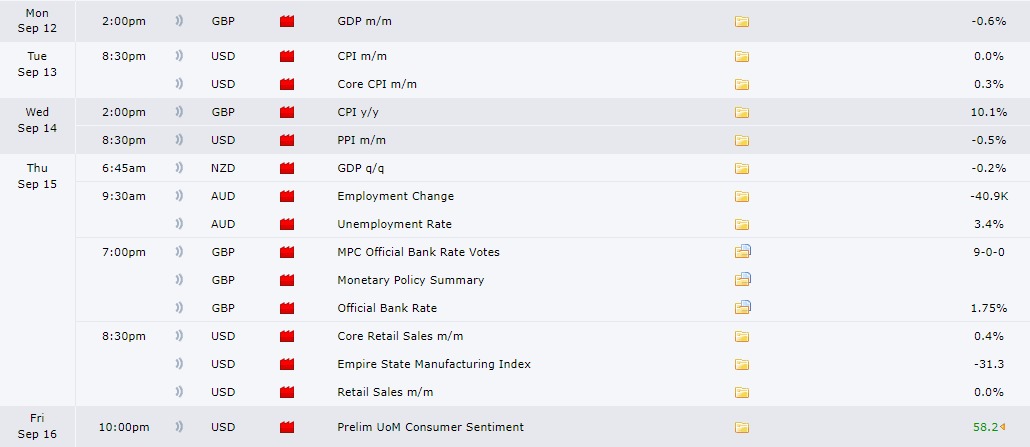
This week, investors will be eyeing inflationary data from the US, UK and Australia. 

The US will release its Consumer Price Index (CPI), Producer Price Index, and Retail Sales data. The market will be watching closely after more neutral labour data were released last week and after the Fed raised interest rates by 0.25%. 

The UK will also release data on CPI, GDP. Australia will release its employment data.

Image source: forexfactory.com

UK Gross Domestic Product | 12 September 2022

Gross domestic product in the UK shrank 0.6% in June from the previous month, following a downwardly revised 0.4% rise in May, according to data released by the Office for National Statistics on 12 September. Economists polled by Bloomberg expected an unchanged reading for July.

US Consumer Price Index | 13 September 2022

In July, consumer prices in the United States held steady from June, following a 1.3% jump in the previous month, which was the most significant rise since January 1992. Analysts expect consumer prices to slow slightly in July, falling 0.1%.

UK Consumer Price Index | 14 September 2022

The annual inflation rate in the United Kingdom reached 10.1% in July of 2022, up from 9.4% in the previous month. Experts predict it will fall below 10% again by the end of the year.

US Producer Price Index | 14 September 2022

In July, US producer prices unexpectedly fell 0.5% month-on-month, following a downwardly revised 1% rise in June. The decline in producer prices was driven by lower costs for agricultural products and energy. Producer prices are forecast to increase by 0.1% for August, after increasing 0.2% in July.

New Zealand Gross Domestic Product | 15 September 2022 

New Zealand’s economy declined 0.2% in the March 2022 quarter, following a 3% rise in the previous period. Analysts expect the economy will improve by 1.5% for the second quarter.

Australian Employment Data | 15 September 2022

Australia’s job market unexpectedly declined in July by 40,900 to 13.56 million; the nation’s unemployment rate dropped to 3.4%, a new record low. We can expect employment to remain positive and the unemployment rate to hold steady in August.

US Retail Sales | 15 September 2022

Markets were disappointed by a 0.1% decrease in retail sales in the US in July 2022, but they expected a 0.2% increase this month.

In July 2022, retail sales unexpectedly stalled in the US, disappointing markets that expected a 0.1% increase. This month, economists expect a 0.2% increase in retail sales figures.

Powell reaffirmed Fed’s commitment to tackle inflation

Jerome Powell, the chairman of the Federal Reserve, reaffirmed the bank’s commitment to combating price increases and remaining upbeat until inflation returns to the Fed’s 2 percent objective on Thursday. Following Powell’s reiteration of the necessity of combating high inflation, the stock market ended a choppy session with solid gains.

The Nasdaq increased by 0.6% and maintained a positive performance. The S&P 500 increased by 0.7%. The Dow Jones Industrial Average added 0.6%. Small caps held up slightly better than the other indexes, with the Russell 2000 index rising 0.8%.

Invesco QQQ Trust (QQQ), which tracks the Nasdaq 100, managed to gain 0.5% despite key Nasdaq companies including Apple (AAPL), Microsoft (MSFT), and Alphabet (GOOGL) trading lower.

Early data showed that NYSE volume increased by 4.1% and Nasdaq volume increased by 0.4%.

The price of crude oil increased by 0.9% to $82.66 per barrel. Natural gas continued to rise, up 1.5%.

Queen Elizabeth II, whose reign took Britain from the age of steam to the era of the smartphone, and who oversaw the largely peaceful breakup of an empire that once spanned the globe, has died. She was 96. She died peacefully at her estate in Balmoral, Scotland on the afternoon of Sept. 8, according to a statement from Buckingham Palace.

Ascending the throne in 1952, Elizabeth led the UK through a time of political upheaval. She began her reign as head of an empire, albeit one in decline. By the time of her death, the future of the UK itself was in doubt, with recurrent calls for independence in Scotland and Britain’s exit from the European Union leading to renewed tension in Northern Ireland. Her eldest son, Prince Charles, was heir to the throne.

Main Pairs Movement

After a turbulent day, the dollar ended the day in a mixed state across the FX board. The European Central Bank increased rates by 75 basis points as anticipated, leaving the EUR/USD pair little altered and close to parity.

The Canadian dollar surged against the greenback, with the pair trading at around 1.3090 as BOC officials reiterated more rate hikes are on the docket as inflation remains stubbornly high. The Australian dollar extended its decline against its American rival on Wednesday, with AUD/USD falling to 0.6698 before recovering, now ending the day near a daily high of 0.6750.

While the USD/JPY pair is stable at about 144.00, the USD/CHF pair fell and is currently trading at roughly 0.9700. While crude oil prices saw minor gains, with WTI closing the day at $83.25 a barrel, gold prices posted losses for the day, ending at about $1,708 a troy ounce.

US Treasury yields increased somewhat for the day’s conclusion. The yield on the 10-year note is at 3.29%, which is almost high enough to spark demand for the dollar.

Technical Analysis

EURUSD (4-Hour Chart)

EURUSD experienced a new packed trading day. The ECB hiked interest rates by 75 basis points, in line with market expectations. However, the ECB also upwardly revised inflation projections for 2022, 2023, and 2024. The interest rate hike allowed EURUSD to trade above parity. During the American trading session, the U.S. initial jobless claims reports came in better than expected, thus sending Dollar demand to new heights as market participants added on bets of a 75 basis point interest rate hike by the Fed. During Fed chair Jerome Powell’s speech, he reinstated the Fed’s hawkish stance, which sent short-term treasury yields back above the 3.3% mark. Further upside for the Euro remains limited as the ECB struggles to keep inflation in check while stimulating positive economic growth amid multiple externalities weighing on the European economy

On the technical side, EURUSD has met a new resistance level at around the parity mark. Short-term support levels remain unchanged at the 0.9902 price level. RSI for the pair sits at 49.8, as of writing. On the four-hour chart, EURUSD currently trades below its 50, 100, and 200-day SMA.

Resistance:  0.9902, 1.0011, 1.0055

Support: 0.9902, 0.985

GBPUSD (4-Hour Chart)

Cable saw a surge in bidding during the start of the European trading session. Market participants tuned in to BoE’s chief economist Huw Pill, who noted that if the central bank observes tightening the central bank would be willing to slow down its pace of tightening. The surprised dovish tone from the BoE allowed the British Pound to gain traction; however, all gains by the Sterling would be erased at the start of the American trading session. The U.S. released better than expected initial jobless claims figures, which boosted the odds of a 75 basis point interest rate hike by the Fed. Stepping away from economics, Britain’s longest reigning monarch, Queen Elizabeth II passed away at the age of 96.

On the technical side, Cable has once again successfully defended our previously estimated support level of 1.1463; however, Cable has displayed a rather strong downward trend thus market participants should be aware of a break below 1.14. RSI for the pair sits at 42.44, as of writing. On the four-hour chart, Cable currently trades below its 50, 100, and 200-day SMA.

Resistance: 1.1561, 1.1854

Support: 1.1463

XAUUSD (4-Hour Chart)

Gold prices advanced during early trading on the 8th, but the non-yielding yellow metal could not retain gains as the American trading session began. The rise in Gold prices, recently, has been entirely dependent on the weakness of the U.S. Greenback; however as better than expected initial jobless claim report was announced, bidding for the Dollar resumed and sent Gold lower towards the $1700 per ounce price level. With a new round of interest rate hikes just on the horizon, Gold prices remain pessimistic as market participants attempt to find any type of yield in other asset classes.

On the technical side, XAUUSD touched our previously estimated resistance level of $1,724 per ounce during the European trading session and soon entered a correction toward the $1,700 per ounce price level. The short-term support level remains at $1695.42 per ounce. RSI for the pair sits at 45.98, as of writing. On the four-hour chart, XAUUSD currently trades below its 50, 100, and 200-day SMA.

Resistance: 1762, 1800

Support: 1688.129, 1695

Economic Data

CurrencyDataTime (GMT + 8)Forecast
KORSouth Korea- Chuseok- Thanksgiving DayAll Day
CADEmployment Change20:3015K

VT Markets PANW股票分割调整通知

尊敬的用户:

您好!

帕罗奥图网路公司即将在 2022 年 09 月 14 日 进行股票分割。
届时,帕罗奥图网路公司的股票(PANW)将会以分割后的合约提供投资者交易。

股票分割的客户须知:

1. 每个客户的PANW持仓量将变为 3 倍。

2. 所有PANW仓位的「开仓价格」与「止盈 / 止损设置价格」将会在股票分割后,变为原始价格的 3 分之 1。

3. 帕罗奥图网路公司即将在 2022 年 09 月 13 日收盘时以 3 分之 1 的比例进行股票拆分。
2022 年 09 月 14 日拆分完成后的报价预计将落在 09 月 13 日收盘价格的 3 分之 1。

4. 股票分割时,所有的PANW挂单设置将会被取消。

5. 「模拟账户」内所有的PANW仓位将会因股票分割而关闭。

注意:以上数据仅供参考,实际执行数据有可能会有变动,具体请依据MT4/MT5软件为准。

您可能想知道更多有关股票分割的详情?

更多详情有关股票分割,请浏览以下文章:
https://helpcentre.vtmarkets.com/hc/zh-cn/articles/8597160316697

如您有任何疑问,我们的团队将十分乐意为您解答。
请留言或发邮件至 [email protected] 或联系在线客服。

Economic growth slowed, US stocks higher

US stocks advanced higher on Wednesday, climbing the most in about a month as the global bond market selloff takes a break. The equity market witnessed fresh upside strength after the release of the minutes from the Federal Reserve (Fed) Beige Book, which showed that price growth has slowed in 9 of the 12 districts and also indicated that economic activity was unchanged but the outlook for future economic growth remained generally weak. Investors tend to wait for the September 13th inflation report as the economic momentum could only improve if inflation continues to soften.

In the Eurozone, the European Central Bank will announce its monetary policy decision on Thursday, which is widely anticipated to hike rates by 50 bps but the focus will be on whether European policymakers are willing to put growth behind taming inflation or not. Skyrocketing prices in the Eurozone are taking their toll on households and businesses and pushing high inflation up amid the European energy crisis.

The benchmarks, S&P 500 and Dow Jones Industrial Average both staged a goodish rebound on Wednesday as the improving market sentiment and the retreating US dollar provided support to the equity markets. The S&P 500 was up 1.8% on a daily basis and the Dow Jones Industrial Average also advanced with a 1.4% gain for the day. Ten out of eleven sectors stayed in positive territory as the Utilities and the Consumer Discretionary sectors are the best performings among all groups, rising 3.14% and 3.08%, respectively. The Nasdaq 100 meanwhile climbed the most with a 2.1% gain on Wednesday and the MSCI World index was up 1.1% for the day.

Main Pairs Movement

The US dollar suffered daily losses on Wednesday, failing to extend its previous rally and retreated towards the 109.5 area during the American session amid a slightly risk-on impulse across the board. The Fed Beige Book also reported that some firms see some easing in labour shortages and price pressures. As for now, Investors expect a hawkish commentary from Fed Powell on interest rates as price pressures are still high.

GBP/USD was little changed on Wednesday as the cable remained under pressure near March 2020 low amid the less-hawkish Bank of England. On the UK front, the BoE policymakers failed to reinforce bets for a 75 bps September rate hike during the Monetary Policy Report Hearings. Meanwhile, EUR/USD advanced sharply and extended the intra-day rally towards the 1.000 area ahead of the ECB’s rate decision. The pair was up almost 1.05% for the day.

Gold surged with a 0.95% gain for the day after touching a daily high above the $1,718 mark during the US trading session, as the yellow metal marked the biggest daily gains in over a week amid a pullback from the 20-year high witnessed in the US dollar. Meanwhile, WTI Oil continued to suffer heavy losses and refreshed its daily low below the $82 mark in the late US trading session, as the speculation about easing Chinese demand following tepid local data kept weighing on the oil price.

Technical Analysis

EURUSD (4-Hour Chart)

EURUSD enjoyed a surge in demand over the course of the previous trading day. The shared currency saw increased bidding as market participants await the ECB’s monetary policy decision, which is scheduled during the late European trading session of today. Markets are currently pricing in a 50 basis point interest rate hike by the ECB; however, interest rate hikes could pose further pressure on a deflating European economy. In addition to a slowing economy, Europe now faces further energy price instability as the Nordstream 1 pipeline halts its supplies. The initial jobless claims figure from the U.S. is also scheduled to be released during today’s American trading session.

On the technical side, EURUSD has successfully defended our previous estimated support level of 0.9902. The short-term bounce of the pair will meet its near-term resistance at around the 0.9983 price region. RSI for the pair sits at 52, as of writing. On the 4-hour chart, EURUSD currently trades below its 50, 100, and 200-day SMA.

Resistance:  0.9902, 1.0033, 1.0055

Support: 0.9902, 0.985

GBPUSD (4-Hour Chart)

Cable traded lower over the course of Wednesday’s trading. The British Pound met strong selling pressure at the start of the Asia trading session. Remarks from members of the BoE further added to the selling pressure. BoE policymakers are still debating whether a further interest rate hike is necessary and some are arguing for a more gradual rate hike in order to prevent over-tightening as the British economy continues to falter. The strong U.S. Greenback further limits any upward movement for the British Pound. Market participants will now turn their attention to the U.S. initial jobless claims figure, scheduled to be released during today’s American trading session. A worse-than-expected initial jobless claims figure could ease bets of a 75 basis point interest rate hike by the Fed and allow the British Pound some breathing room.

On the technical side, GBPUSD has touched our previously estimated support level of 1.1463 and is currently trading around that price region. The next level of support for Cable sits at around the 1.13 price region. RSI for Cable sits at 41, as of writing. On the four-hour chart, GBPUSD currently trades below its 50, 100, and 200-day SMA.

Resistance: 1.1561, 1.1854

Support: 1.1463

XAUUSD (4-Hour Chart)

Gold traded higher over the course of Wednesday’s trading. The non-yielding metal took advantage of a weaker Dollar and was able to find footing above the $1700 per ounce price level. The U.S. Greenback saw a broad-based sell-off as short-term treasury yields retreated below 3.3%. However, as the next FOMC nears, market participants should be aware that the Dollar-denominated and non-yielding metal could see further price depreciation. Furthermore, with the ECB slated to increase interest rates by 50 basis points, demand for the yellow metal is expected to fall even further. A return to normalcy could be on the horizon as breakthroughs in antibody research against COVID-19 have been announced by Duke University. A reverse in risk sentiment could send Gold below the $1650 price level.

On the technical side, XAUUSD has rebounded from our previously estimated support level of $1695 per ounce and is trending toward our estimated short-term resistance level of $1724 per ounce. RSI for XAUUSD sits at 51.7, as of writing. On the four-hour chart, XAUUSD currently trades below its 50, 100, and 200-day SMA.

Resistance: 1762, 1800

Support: 1688.129, 1695

Economic Data

CurrencyDataTime (GMT + 8)Forecast
JPYGDP (Q2)07:500.7%
EURDeposit Facility Rate (Sep)20:150.5%
EURECB Monetary Policy Statement20:15
USDInitial Jobless Claims20:30240K
EURECB Press Conference20:45
USDFed Chair Powell speaks21:10
EURECB President Lagarde Speaks22:15
USDCrude Oil Inventories23:00-0.733M
Back To Top
server

您好 👋

我能帮您什么吗?

立即与我们的团队聊天

在线客服

通过以下方式开始对话...

  • Telegram
    hold 维护中
  • 即将推出...

您好 👋

我能帮您什么吗?

telegram

用手机扫描二维码即可开始与我们聊天,或 点击这里.

没有安装 Telegram 应用或桌面版?请使用 Web Telegram .

QR code