Strong US job report eased recession fears

US stock closed flat on Friday after struggling for direction throughout the session as the strong US job report eased recession fears but further supported the case for a 75 bps rate hike by the Fed to fight inflation. Earlier in the North American session, the Nonfarm Payrolls report added 372K jobs to the economy in June, exceeding market estimations of 268K and fueled the Fed to stay aggressive to combat inflation.

Two of the Federal Reserve’s officials also said that they supported raising the interest rate by 75 basis points for the second month in a row. In the Eurozone, the consensus amongst ECB policymakers remained around a 25 bps rate hike. On top of that, the EU’s ongoing energy crisis kept weighing on the shared currency as the economy is likely to face a shortage of energy after prohibiting oil imports from Russia.
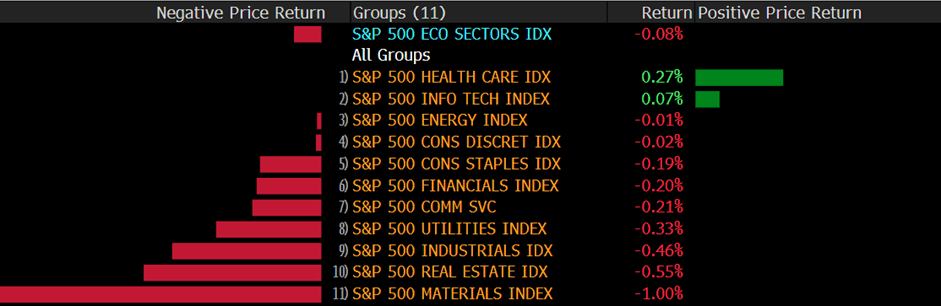
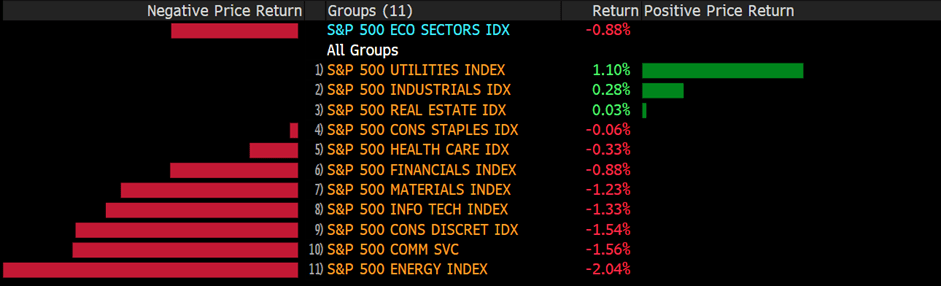
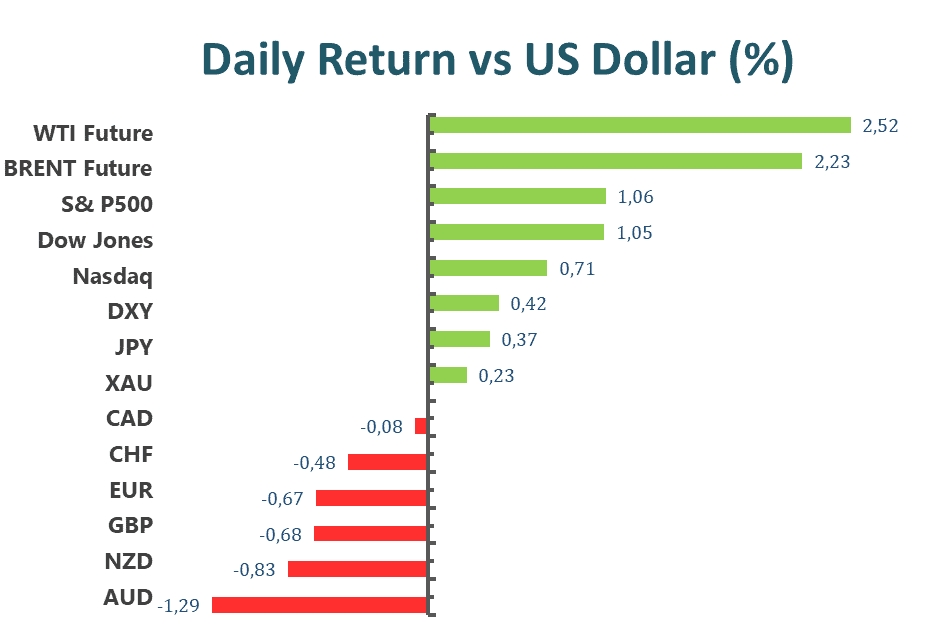
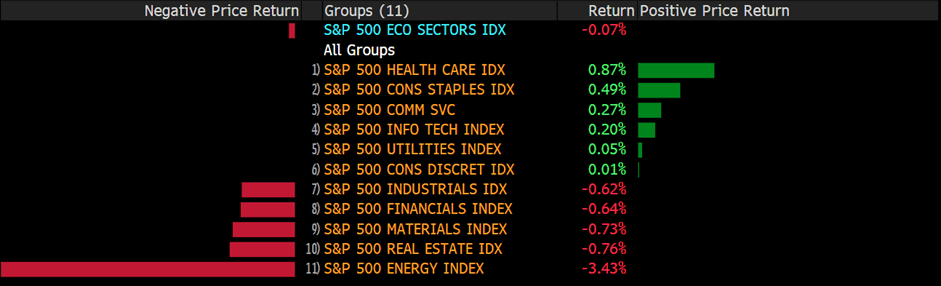
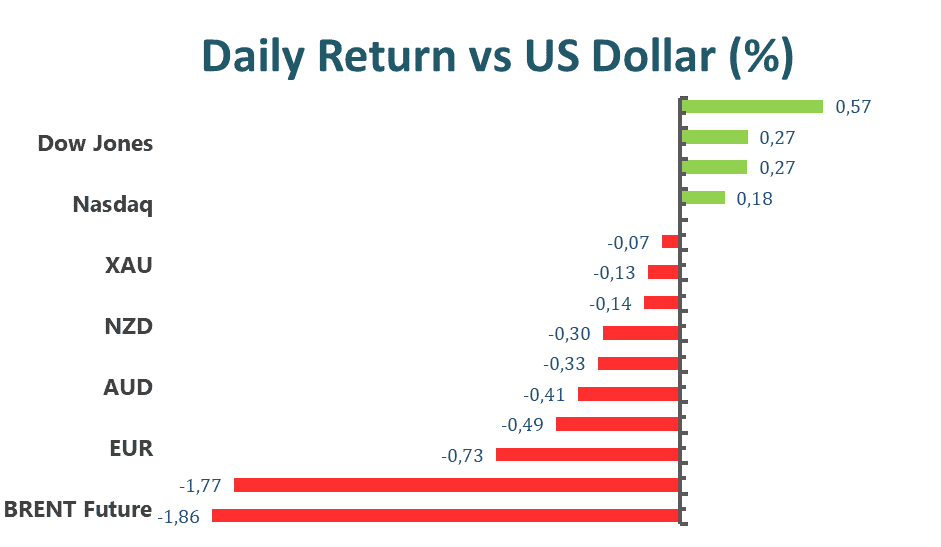
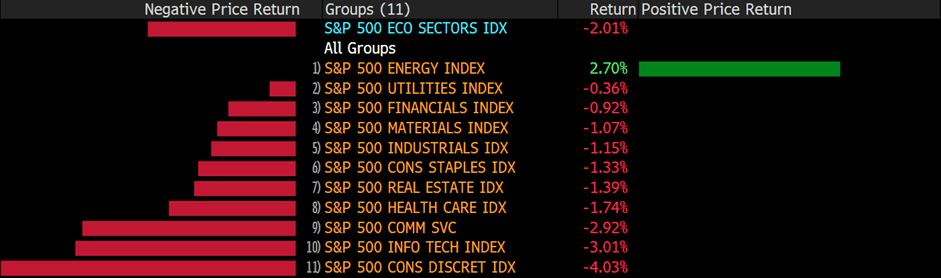
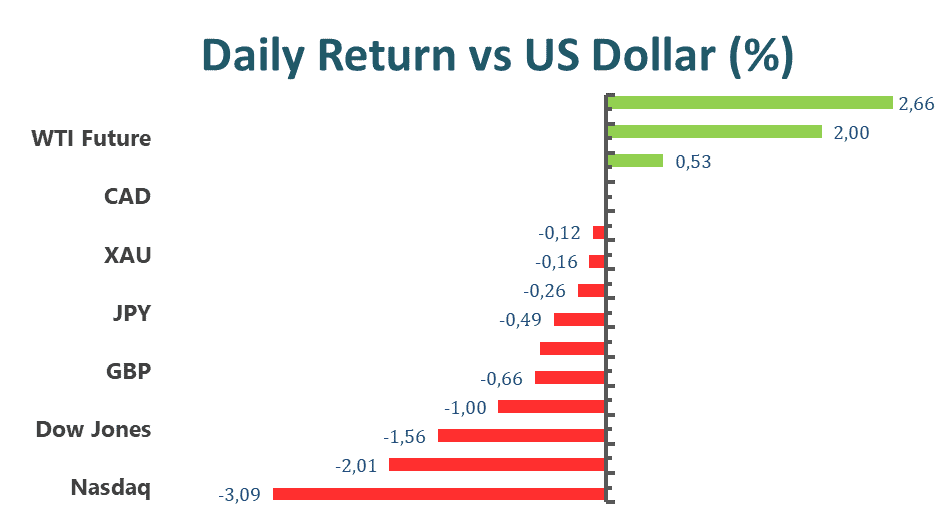
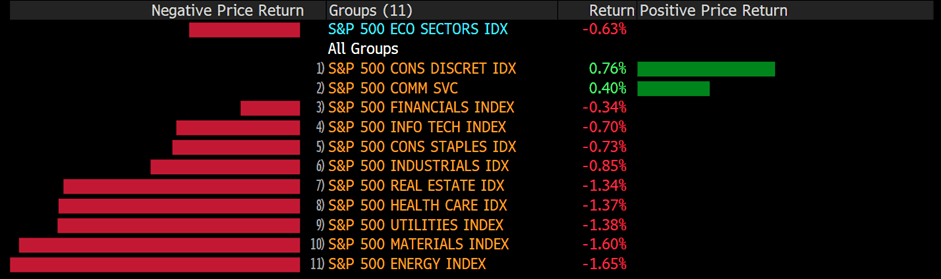
The benchmarks, S&P 500 and Nasdaq 100 both edged higher on Friday as market traders remain mixed on the upbeat job report. The S&P 500 was little changed on a daily basis and the Nasdaq 100 advanced with a 0.1% gain for the day. But nine out of eleven sectors stayed in negative territory as the materials and real estate sectors are the worst-performing among all groups, losing 1.00% and 0.55%, respectively. The Dow Jones Industrial Average meanwhile declined with a 0.1% loss on Friday and the MSCI World index rose 1.6%.

Main Pairs Movement

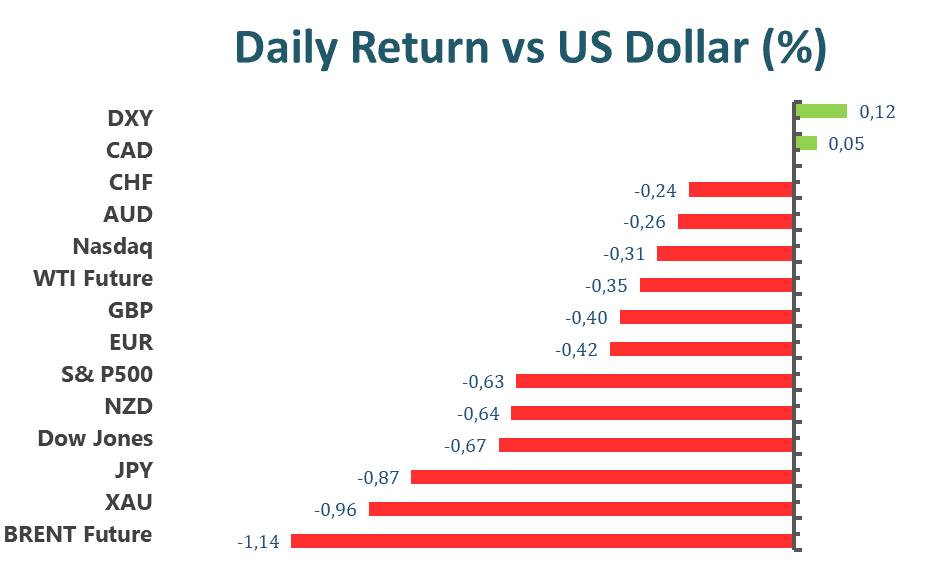
The US dollar edged lower on Friday, losing its upside traction and retreated back to the 106.9 level after the softer risk tone lend support to the safe-haven greenback. The DXY index witnessed heavy bullish momentum and was pushed higher to a daily high above 107.7 level in the early European session, but then started to see fresh selling meanwhile surrendering most of its daily gains. The market focus remained on the Fed’s normalisation process and the next moves regarding interest rates as June’s US Nonfarm Payrolls report exceeded expectations and reaffirmed the economy’s strength.

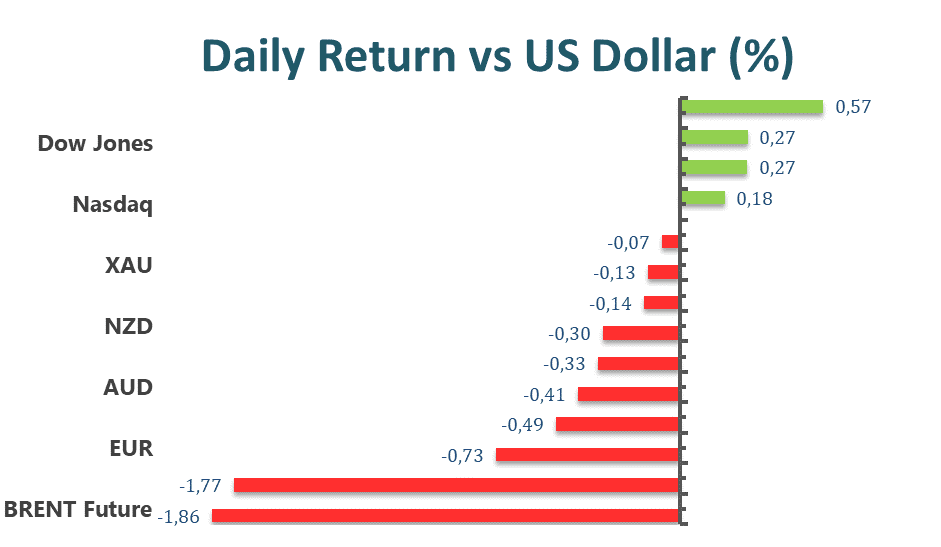
GBP/USD advanced slightly with a 0.08% gain on Friday amid the weaker US dollar across the board. But investors remain concerned that the UK government’s controversial Northern Ireland Protocol Bill could trigger a trade war with the European Union. The cable remained under bearish pressure and dropped to a daily low below the 1.193 mark, but then regained upside strength to recover all of its daily losses. Meanwhile, EUR/USD rebounded back after dropping to a fresh 20-year low at 1.0071 during the European session. The pair was up almost 0.30% for the day.

Gold advanced with a 0.12% gain for the day after touching a daily high above $1750 during the US trading session, despite the US dollar rising to fresh 20-year highs as US bond yields surged. Meanwhile, WTI oil climbed back toward the $105 area as supply fears amongst traders have spurred a rise in oil prices.

Technical Analysis

USDJPY (4-Hour Chart)
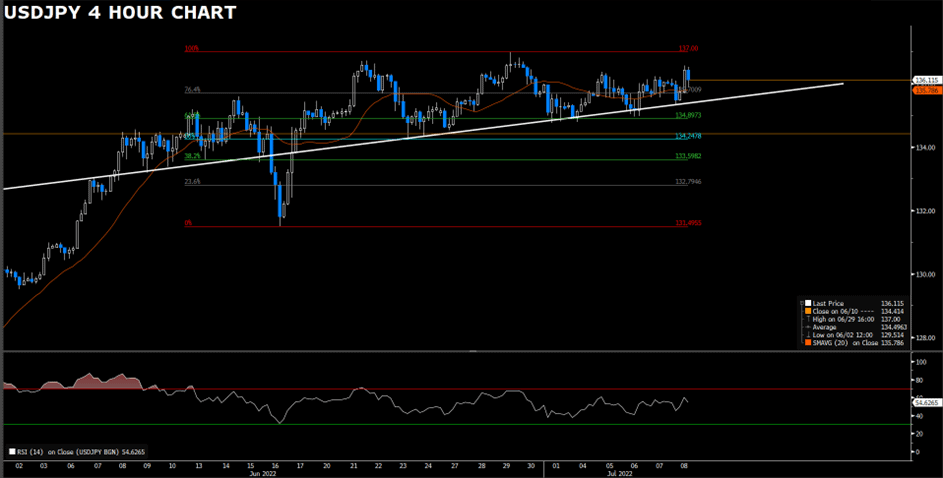
USDJPY oscillates amid the US economic data and the news of Japan ex- leader Shinzo Abe’s assassination. Technical speaking, the outlook remains positive on the four-hour chart. The US dollar remains supported by the fundamental backdrop and the technical perspective.

USDJPY got pushed higher with the formation of a higher high. The breakout of the resistance of 135.70 gives USDJPY an upside momentum toward the next resistance of 137.00. As the RSI indicator is still far from overbought, USDJPY is expected to trade higher. On the flip side, USDJPY needs to fall below the bullish trend line and the support of 134.89 in order to lose traction.

Resistance: 135.7, 137.00

Support: 134.89, 134.24, 133.59

GBPUSD (4-Hour Chart)
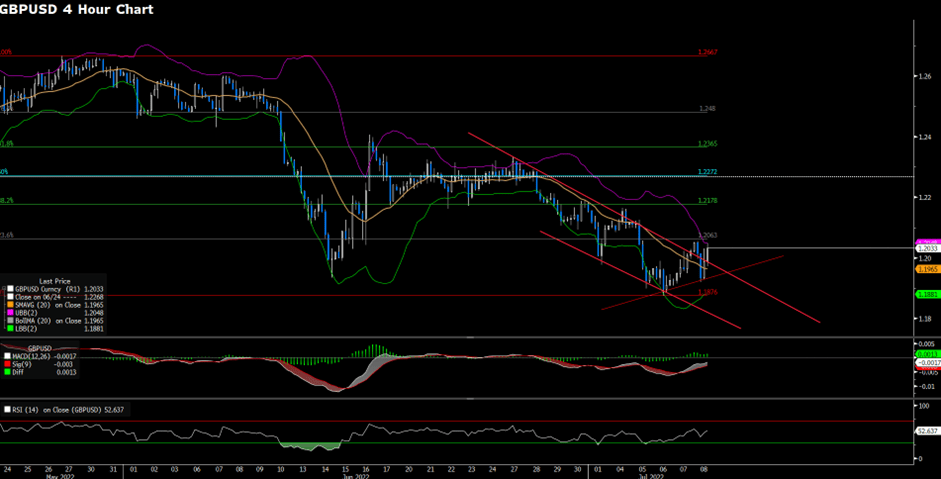
GBPUSD has managed to advance in positive territory above the descending channel. The upside movement of the currency pair witnesses risks sentiment, making it harder for the US dollar to preserve its strength despite better-than-expected Nonfarm Payrolls in June.

From the technical perspective, intraday’s upside momentum boosted GBPUSD above the midline of the Bollinger Band; in the meantime, GBPUSD has advanced above the bearish channel. Both suggest that GBPUSD manages to stage a positive rebound in the near- term. The acceptance above 1.2063 would confirm the positive shift. On the flip side, if GBPUSD fails to hold above the bearish channel and fails to breach the immediate resistance, then it could potentially stage back to negative territory. As both MACD and the RSI indicator are showing signs of bulls, GBPUSD is expected to head further north.

Resistance: 1.2063, 1.2178, 1.2272

Support: 1.1876

Gold (4-Hour Chart)
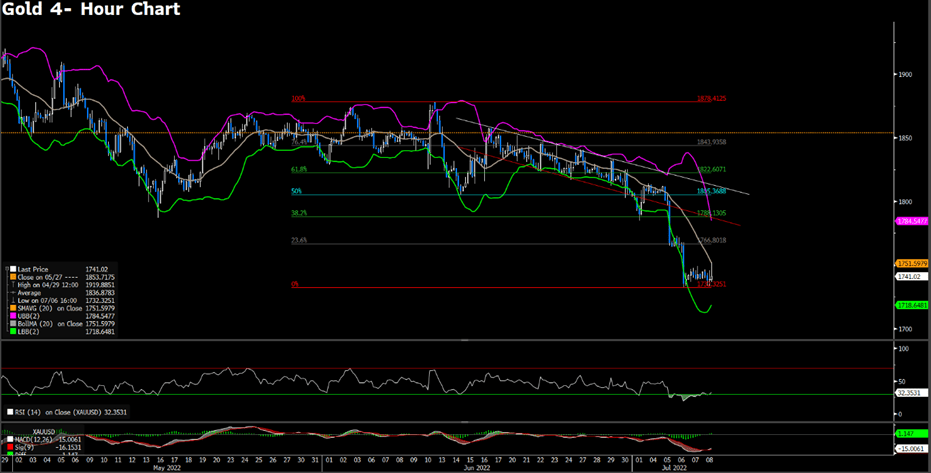
Gold edges slightly higher despite rising US yield and a better- than- expected US economic data.

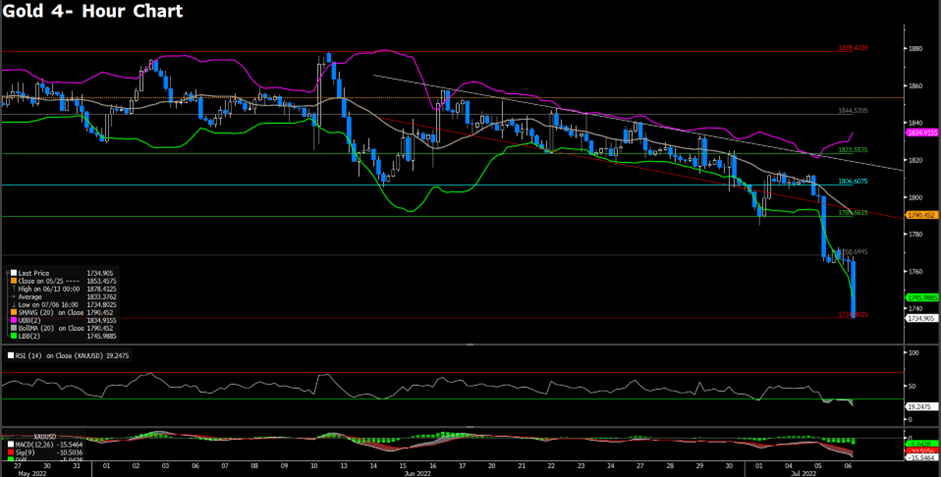
From the technical aspect, gold clings slightly above the support level of 1732.32, trying to defend the last land before heading further south. The lower-low formation has given gold pressure, attracting some follow-through sellers. Current support would be robust as the RSI has reached the oversold territory and the MACD has slightly turned positive, giving some signs of attracting some dip- buyers. If the support ends up failing to defend, then more selling pressures would come into play.

Resistance: 1766.80, 1788.13, 1805.36

Support: 1732.32

Economic Data

CurrencyDataTime (GMT + 8)Forecast
All DaySingapore Holiday   
NZDElectronic Card Retail Sales (MoM) (Jun)06:45  
BRLBCB Focus Market Readout19:25  

VT Markets 七月期货合约展期通知

尊敬的用户:

您好!

VT Markets 平台的期货产品:VIX(波动率指数)、CL-OIL(原油期货)、CHINA50ft(新华富时50期货)、UKOUSDft(布兰特原油期货)、HK50ft(香港恒生50期货) 即将于以下时间展开新合约,如持仓过夜将会收取展期费用。

由于并非市场因素所造成的价格波动,若投资者的仓位于合约切换期间包含期货原油的未平仓头寸,将依据展期方向产生相应的费用扣补,以此反映新旧合约之间的价差。

请留意:
展期时,合约将自动切换,所有持仓中的订单将可继续持有。
投资者应在展期前妥善控制仓位或调整相应的止盈止损设置。

同时,由于展期需做调整,在展期当天开盘前后半小时,我们会禁止所有同名账户内部转账。

如您有任何疑问,我们的团队将十分乐意为您解答。
请留言或发邮件至 [email protected] 或联系在线客服。

S&P500, Nasdaq 100, and the US Dollar gained as the Fed signalled more rate hikes, indicating the market still fears a worldwide recession

US stocks rose for three days in a row, as investors parsed economic data that hinted at slower growth, which also prompted some to brush off the hawkish stance reiterated by Fed in June meeting minutes. All eyes need to be on the Fed, officials ‘’agreed” last month that interest rates may need to keep rising for longer to against entrenching inflation.

However, data released Wednesday showed that US job openings dipped slightly in May but remained near a record, and the growth in the US services sector also eased in June to a two-year low. This prompted some traders convinced that Fed’s stance has a little too real market situation.

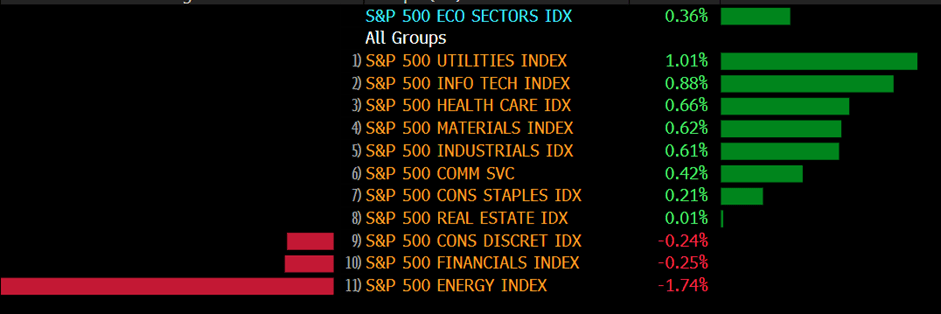
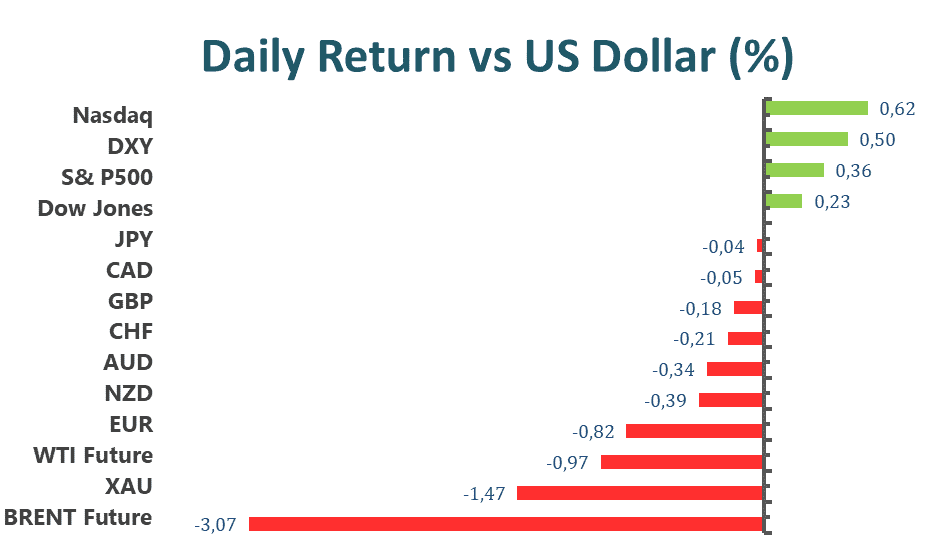
On the benchmark side, both S&P500 and Nasdaq 100 rose on Wednesday although Fed reiterated the hawkish stance in June meeting minutes. S&P500 was up 0.36% daily and the Nasdaq 100 also advanced with a 0.6% gain for the day. In addition, eight of eleven sectors stayed in positive territory as utilities and info tech sectors are the best among all groups, gaining 1.01% and 0.88%, respectively. It is worth noting that, the energy sector remains bad performance on Wednesday and lose 1.74%. The Dow Jones Industrial Average meanwhile increased by 0.2% and the MSCI world index declined by 0.5% on Wednesday.

Main Pairs Movement

The US dollar continued to rise for three straight days, and the DXY index surged up and cling to a 20-year high of 107.05 after the hawkish stance reiterated by Fed. This is a sign of the market still fears the global recession.

The EUR/USD remained bearish, the pair fell to a new 20-year low of 1.0161 at the last hour of Wednesday. Besides the Fed’s hawkish attitude toward US high inflation, the broad pessimism surrounding economic growth, central bankers’ aggregation, and the energy crisis make a downside pressure.

The GBP/USD was also in a bearish momentum despite a bounce-off on late Wednesday from a two-year low around 1.1925. The Cable pairs are still suffering from UK’s political joined Brexit woes and broad recession fears. However, the market anxiety ahead of the Fed’s stance and softer US economic data seems to have probed the bears of late.

Gold has turned into a consolidation phase after a sheer downside move to $1,732 in the NY session. As Fed’s aggressive attitude infused fresh blood into the US dollar, the precious metal suffered a high downside pressure.

Technical Analysis

USDJPY (4-Hour Chart)

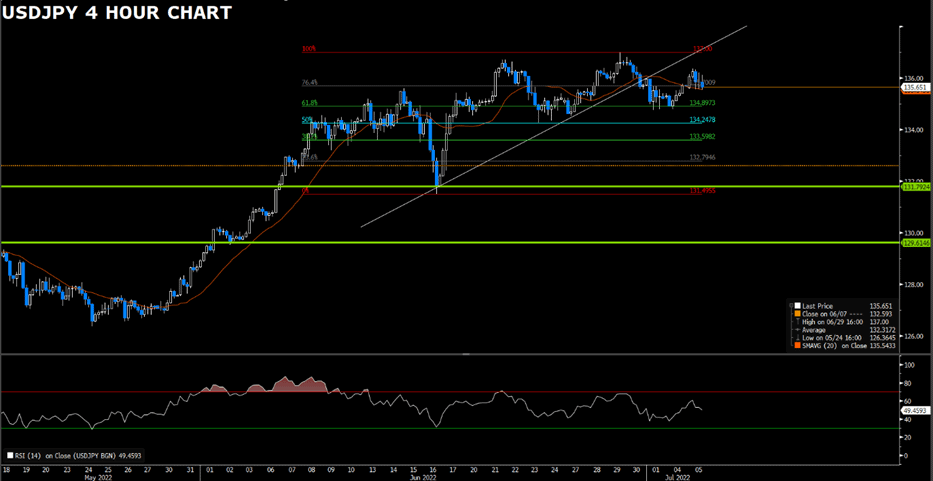
USDJPY edges slightly lower but keeps above the 135.00 level ahead of the FOMC meeting. From the technical perspective, the outlook maintains its bullish trend on the four-hour chart as the pair continues to trade within the ascending line. On the downside, falling below the support of 134.89 would bring the pair to the downside in the near- term. On the upside, the divergent monetary policies between the Fed and the BOJ would capitalize on the USD’s gain and undermine the Japanese Yen. As the RSI remains on the midline, further price action is eye on the FOMC meeting.

Resistance: 135.7, 137

Support: 134.89, 134.24, 133.59

GBPUSD (4-Hour Chart)

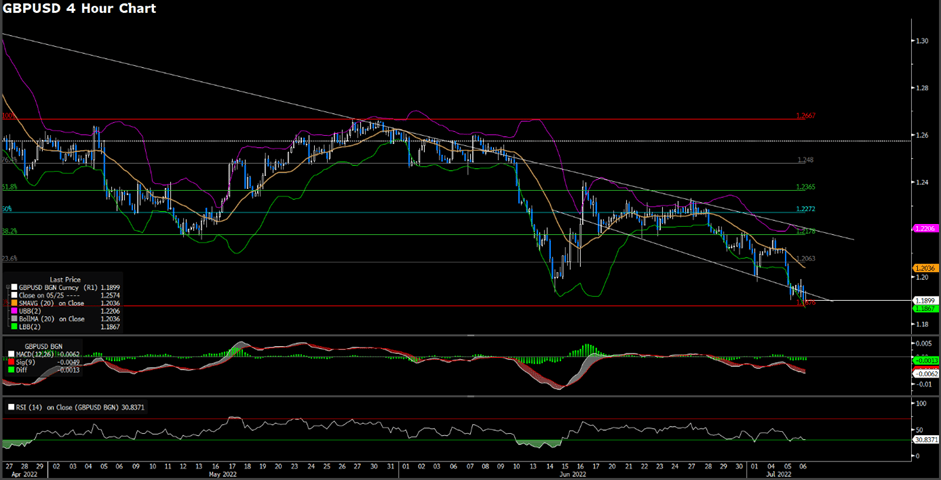
GBPUSD holds above the support level of 1.1876 at the time of writing ahead of the FOMC meeting. The US dollar remains strong and outperforms the British Pound on the back of better-than-expected ISM Service PMI economic data. From the technical aspect, the outlook of GBPUSD remains bearish on the four-hour chart as the pair falls within and below the descending channel, suggesting that GBP is lack attraction. In the meantime, a bearish MACD continues to lend support to bears while the RSI is on the edge of 30 readings. The pivot support of 1.1876 would be viewed as a defending cross-line, whether regaining the buyers’ confidence. If the support cannot sustain, then it is expected to see the currency pair extend further south.

Resistance: 1.2063, 1.2178, 1.2272

Support: 1.1876

Gold (4-Hour Chart)

Gold extends its slump below $1740, a fresh 10- month low ahead of FOMC Minutes. The Dollar Index and the benchmark 10- year US Treasury yield continues to soar, putting additional weight on the precious metal, gold. From the technical perspective, the intraday outlook remains downside as the pivotal support from yesterday fails to defend, now attracting more follow-through sellers. In the meantime, a bearish MACD signal also hints at gold’s further downside toward the next support of $1736.20. However, an oversold RSI might give the selling pressures a break; some dip buyers might start buying at this stage before FOMC Minutes.

Resistance: 1768.69, 1789.66, 1806.60

Support: 1734.80

Economic Data

CurrencyDataTime (GMT + 8)Forecast
EURECB President Lagarde Speaks19:55 
USDNonfarm Payrolls (Jun)20:30268K
USDUnemployment Rate (Jun)20:303.6%
CADEmployment Change (Jun)20:3023.5K

EUR/USD hit a 20-year low, EU economy slipped to a 16-month low

US stock rebounded slightly after falling as much as 2.2% on Tuesday as fears of a globalized recession take their toll on financial markets. The talks of easing tariffs on China imposed by the former administration failed to appease recession fears as concerns about a potential US recession and stubborn inflation remained, despite the reducing tariffs on imported Chinese goods could impact consumer prices in the US. The release of the FOMC minutes in today’s session will remain in focus, providing a detailed view of Federal Reserve policymakers on supporting the Fed’s 75 basis points interest rate hike. In the Eurozone, German Economy Minister Robert Habeck noted that the energy industry crisis could hurt financial markets as Russia has curbed its gas flows to the country. Market participants expect the European Central Bank to hike rates by 130 bps by year-end.

The benchmarks, S&P 500 and Nasdaq 100 both rose on Tuesday despite the safe-haven US dollar taking advantage of the risk-aversion and risk-off market mood. S&P 500 was up 0.2% daily and the Nasdaq 100 also advanced with a 1.7% gain for the day. But eight out of eleven sectors stayed in negative territory as the energy and utilities sectors are the worst-performing among all groups, losing 4.01% and 3.43%, respectively. The Dow Jones Industrial Average meanwhile declined with a 0.4% loss on Tuesday and the MSCI World index rose 0.3%. Global equity markets remain under pressure as investors rushed to the dollar’s safety recently.

Main Pairs Movement

The US dollar advanced and surpasses the 106.00 level to touch a new cycle high on Tuesday. The US dollar soared over 1.3% due to the fears of a globalized recession, continuing to find demand amid risk-averse scenarios. According to analysts, the risk of a US recession is above 70%.

EUR/USD was surrounded by bearish momentum, The EUR/USD pair fell to a 20-year low of 1.0236, recovering some ground later in the day but still hovering below the 1.0300 thresholds. Economic reports show that EU growth slowed to a 16-month low, while Germany struggles to get gas amid gradually increasing tensions with Russia. German Economy Minister Robert Habeck said that the energy industry crisis could hurt financial markets. He did not rule out intervening gas prices. Russia curbed its gas supplies to the country, Germany, therefore, fears a complete blackout of provision, as Russia will temporarily shut down the NordStream-1 pipeline on July 11 for annual maintenance. By contrast, the risk-off dollar seems more attractive to the Euro. Meanwhile, GBP/USD slumped as well yesterday. The pair was down 1.41% for the day.

The gold price plummeted over 2.4% on Tuesday, and rebounded back slightly after touching a daily low below $1764 in the late European session, now hovering slightly below 1770.

Technical Analysis

USDJPY (4-Hour Chart)

USDJPY gains positive traction for the second consecutive day as the risk sentiment favours the US dollar at the time of writing. The outlook of USDJPY consolidates in between 134.89 and 137.00 ahead of the FOMC meeting. However, the divergent monetary policies between the Fed and the BOJ should limit the downside of USDJPY. USDJPY has breached the resistance level of 135.7, suggesting an upside momentum in the near- term. To the upside, if the immediate support can sustain and hold, then it would possibly contest the peak at 137.00. On the flip side, if the support fails to defend, then USDJPY is expected to consolidate.

Resistance: 135.70, 137.00

Support: 134.89, 134.24, 133.59

GBPUSD (4-Hour Chart)

GBPUSD renews multi-year lows in March 2020. The outlook of GBPUSD remains bearish as the pair continues to trade below the descending trend line; in the meantime, the bearish momentum is supported by the double-top formation. At the time of writing, GBPUSD is contesting the immediate support level of 1.1899. If the pair can recover at this stage, then it could potentially attract some dip-buying buyers, but bears are still in charge. On the downside, if the support cannot hold, then the pair would accelerate further south. At the moment, the selling pressure seems to moderate a bit as the RSI has reached the oversold condition and the MACD has turned upside.

Resistance: 1.208, 1.2192, 1.2283

Support: 1.1899

Gold (4-Hour Chart)

Gold slides sharply below $1,770 following the extra pace and renewed upside momentum of the safe- haven, the US dollar. The intraday decline is supported by multiple factors, including a stronger US dollar and a hawkish Fed expectation ahead of the FOMC meeting. From the technical perspective, gold is facing strong selling pressure, suggesting that gold is in the bearish mode. Dropping below the descending channel has brought further gold south. Breaking the channel has accelerated the bearish momentum toward the support level of $1,765. If the support fails to defend, then gold would confront another fresh selling pressure. In the meantime, the double-top formation has been constructed, meaning that gold is in the situation of bears. The current support level might be able to stop the bears a bit as the RSI indicator has reached the oversold territory. Further price action eyes on the upcoming FOMC meeting.

Resistance: 1791.85, 1818.39, 1821.76

Support: 1765.11

Economic Data

CurrencyDataTime (GMT + 8)Forecast
USDFOMC Meeting Minutes02:00 
EURECB Publishes Account of Monetary Policy Meeting19:30 
USDADP Nonfarm Employment Change (Jun)20:15200K
USDInitial Jobless Claims20:30230K
CADIvey PMI (Jun)22:00 
USDCrude Oil Inventories23:00-0.569M

Eurozone PPI below market predictions continues to justify ECB rate hikes; FOMC minutes and Nonfarm Payrolls report in focus

US equity market remained closed yesterday due to the US Independence Day holiday, but the cautious mood ahead of this week’s Monetary Policy Meeting Minutes from the Fed and the European Central Bank has exerted bearish pressure on investors’ sentiment. The futures for the US equity index and European bonds fell as investors worried that a faster pace of monetary tightening from global central banks will slow economic growth. Therefore, the economic fears kept the risk profile weak, which in turn helped the US dollar to remain upside momentum.

On the economic data side, the Producer Price Index from Eurozone rose 0.6% in May and came in weaker than the market’s expectations of 1%, which continues to warrant rate hikes from the European Central Bank. The dismal European data undermined demand for the Euros meanwhile the energy crisis also acted as a headwind for the shared currency amid the Russian invasion of Ukraine. The market focus now shifts to the FOMC minutes of its latest meeting on Wednesday and the Nonfarm Payrolls report on Friday, as market participants expect that the Fed elevated its interest rates by 75 basis points in its June monetary policy meeting.

Main Pairs Movement

A slow beginning to the week, as US markets were closed due to the Fourth of July Holiday. The DXY index was also in the mood of holiday during the first half of Monday and stay steadily around 105.1, and then gained some strength by the end of the day, reaching 105.198, but the action was limited as some traders stayed away from their desks.

GBP/USD was surrounded by bullish momentum at the start of Monday, even reaching a daily high around 1.2154, but then lost its bullish traction and fell to around 1.2105, since Brexit woes undermined demand for the Pound. At the same time, EUR/USD got a rebound from last Friday’s low of around 1.039 to a daily high of around 1.045 at the middie on Monday, but then Dismal European Data undermined demand for shared currency, and EUR/USD closed by 1.0425.

Gold continued the rebound momentum gained from last Friday’s daily low below $1786 and managed to reach above $1812.5, but then fell below $1805 as the expectation of a hike in interest rates makes gold less attractive.

Technical Analysis

USDJPY (4-Hour Chart)

USDJPY advances toward near 135.70 at the time of writing. USDJPY turns upside after experiencing a correction. From current levels, weakness below the resistance level of 135.70 would continue to find robust support at 134.89. If the support level is broken, then it would trigger a fresh technical selling, making USDJPY slide further south. On the flip side, if the pair can break through the resistance at 135.70 and further above the ascending trend line, then USDJPY could potentially attract more buyers to lift the pair above the psychological level of 136.00 and 137.00.

Resistance: 1.35.70, 137.00

Support: 134.89, 134.24, 133.59

GBPUSD (4-Hour Chart)

GBPUSD clings around 1.2100 on Monday. The pair has reversed its direction after reaching near the support level around 1.1934 area. The British Pound looks to regain position as the RSI indicator stays below, suggesting that buyers remain on the sidelines for the time being; in the meantime, the MACD has turned positive, indicating the reversal trend from bearish to bullish. To the upside, GBPUSD is heading toward the next resistance at 1.2227; if the pair can successfully breach the level, then it would continue to head north. On the downside, if the support level of 1.1934 cannot eventually defend the line, then GBPUSD would slide further south.

Resistance: 1.2227, 1.2408, 1.2555

Support: 1.1934

Gold (4-Hour Chart)

Gold struggles to stage a recovery on Monday following last week’s drop. Despite gold attempts to climb above the $1,800 level, it stays under modest bearish pressure, remaining within the descending channel. At the moment, even though the RSI indicator stays below the midline, gold looks to be capped by the midline of the Bollinger Band, having a hard-to-move further north. Gold needs to climb above $1,835 to reclaim bulls in the near- term. On the flip side, if the current support level at $1,784 cannot hold, then gold would accelerate further south.

Resistance: 1835.026, 1866.243

Support: 1784.565

Economic Data

CurrencyDataTime (GMT + 8)Forecast
GBPConstruction PMI (Jun)16:3055
USDISM Non-Manufacturing PMI (Jun)22:0054.3-
USDJOLTs Job Openings (May)22:0011.000M

US Indices climbed on Friday despite a stronger US dollar on recession fears

US stock advanced on Friday and recovered some of the ground lost in Thursday’s session, as the late-day rebound might be exacerbated by low volume ahead of Monday’s holiday. The risk of a renewed selloff in equities is still high due to the pessimistic growth outlook, as investors are worried that the tighter monetary expectations in the face of higher inflation will lead to economic growth slowing and a possible recession. On the economic data side, the Institute for Supply Management’s US manufacturing PMI fell to 53 from 56.1 in May, which was the weakest since June 2020 and showed that the manufacturing activity in the US has weakened as new orders contracted. The market focus now shifts to this week’s minutes of the Federal Reserve’s June meeting, as the central bank is expected to raise interest rates by 75 basis points.

The benchmarks, S&P 500, Nasdaq 100 and the Dow Jones Industrial Average both rose on Friday despite the safe-haven US dollar advanced on recession fears. Nasdaq 100 was up 0.7% daily and the Dow Jones Industrial Average also advanced with a 1.0% gain for the day. All eleven sectors stayed in positive territory as the utilities and consumer discretionary sectors are the best performings among all groups, rising 2.48% and 1.97%, respectively. The S&P 500 climbed the most with a 1.1% gain on Friday and the MSCI World index rose 0.5%. For the week ahead, Nonfarm Payrolls will be the key data that might provide fresh impetus.

Main Pairs Movement

The US dollar advanced on Friday, rebounding from the 104.7 level that touched on Thursday and extending its rally toward the 105 area amid risk-off market sentiment. The DXY index was surrounded by bullish momentum during the first half of the day and reached a daily high near 105.6 level in the early US session, but then lost its bullish traction to surrender some of its daily gains. The safe-haven greenback continued to find demand amid escalating fears about a global recession, as the dismal US manufacturing PMI fueled recession-related concerns.

GBP/USD tumbled with a 0.70% loss on Friday amid the stronger US dollar across the board. The flight to safety increased the appetite for safe-haven assets and weighed on the GBP/USD pair. The cable remained under bearish pressure and dropped to a monthly low below the 1.199 mark, but then regained some upside traction to recover its daily losses. Meanwhile, EUR/USD slumped to the lowest level since June 15th below 1.038 level. The pair was down almost 0.50% for the day.

Gold rebounded back slightly after touching a daily low below $1786 in the late European session, as the US yields collapsed and provided support to the precious metal amid fears of a recession. Meanwhile, WTI oil climbed back to the $109 area despite the escalating recession fears that have overshadowed the supply worries again.

Technical Analysis

EURUSD (4-Hour Chart)

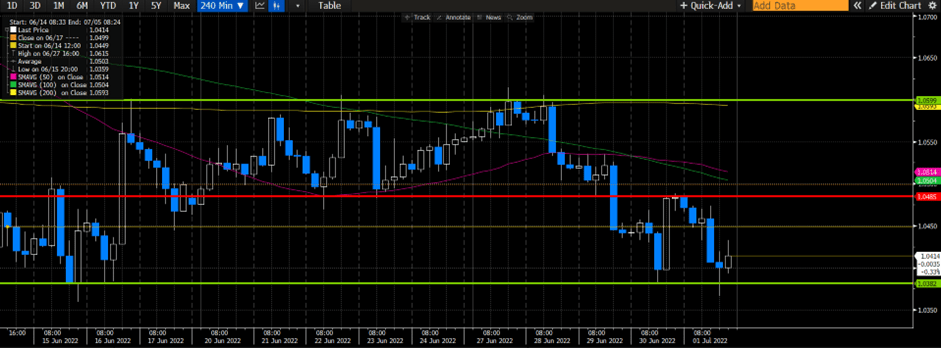
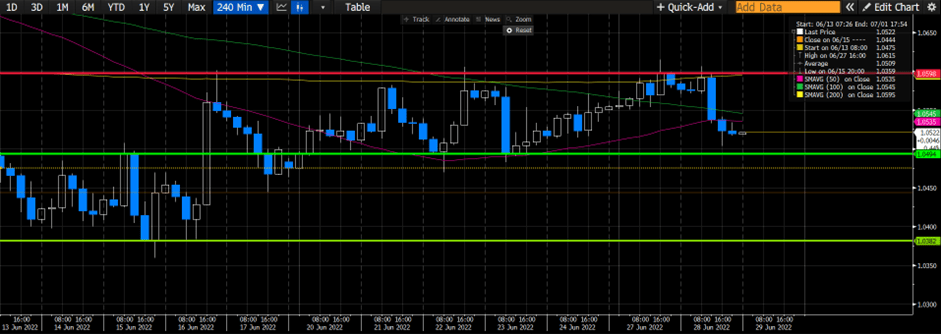
EURUSD traded 0.54% lower over the last trading day of the week. The Eurozone HICP, the harmonised index of consumer prices, jumped to 86% in May, coming in higher than the 8.3% expectations. Despite the ECB’s efforts to tame inflation, prices are still growing at a pace that threatens price stability. The U.S. Greenback continues to be on the rise as market sentiment continues to be risk-averse and the U.S. equity market continues to fall further into bear territory. U.S. PMI data came in at 52.7, compared to estimates of 52.4, showing growth in purchasing and still signs of a healthy economy.

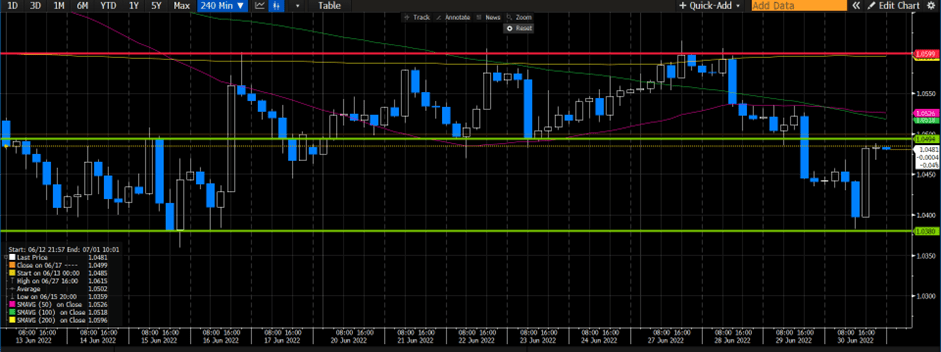
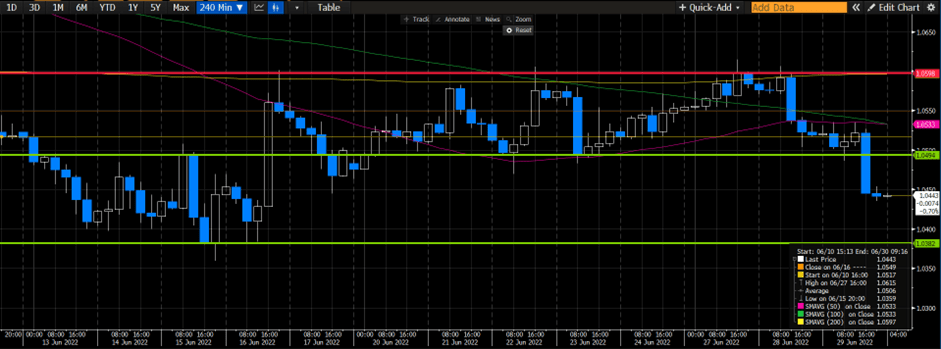
On the technical side, EURUSD was able to recover from our previously estimated support level of 1.0382 despite falling below this level briefly. A new level of resistance has formed around the 1.0485 price region. RSI for the pair sits at 41.02, as of writing. On the four-hour chart, EURUSD currently trades below its 50, 100, and 200-day SMA.

Resistance: 1.0485, 1.05754

Support: 1.0382

GBPUSD (4-Hour Chart)

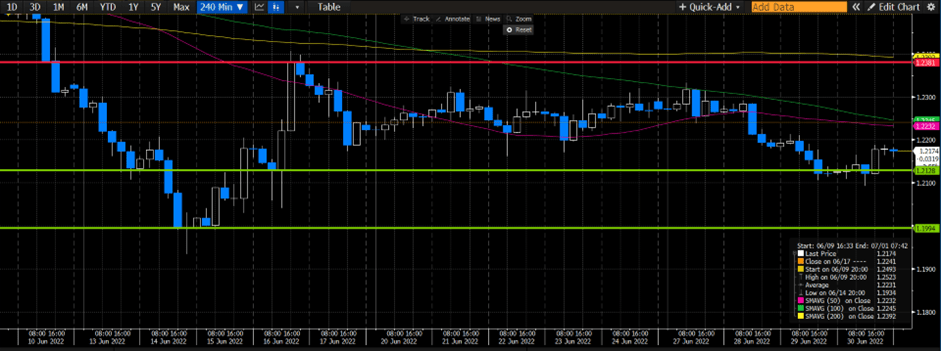
GBPUSD lost 0.68% on the last trading day of the week. The pair gave up gains from the previous day as demand for the U.S. Greenback resumed. The dollar index, which measures the U.S. Dollar against a basket of other major foreign currencies, gained 0.36% to close the week in the green. The U.S. PMI data, which was released during the American trading session, provided fresh optimism for the U.S. Dollar as the figure came in better than expected.

On the technical side, GBPUSD successfully defended our previously estimated support level of 1.20824, despite the pair trading below that level for a brief period during the late European trading session. RSI for Cable sits at 38.1, as of writing. On the four-hour chart, GBPUSD currently trades below its 50, 100, and 200-day SMA.

Resistance: 1.2381

Support: 1.2123, 1.20824

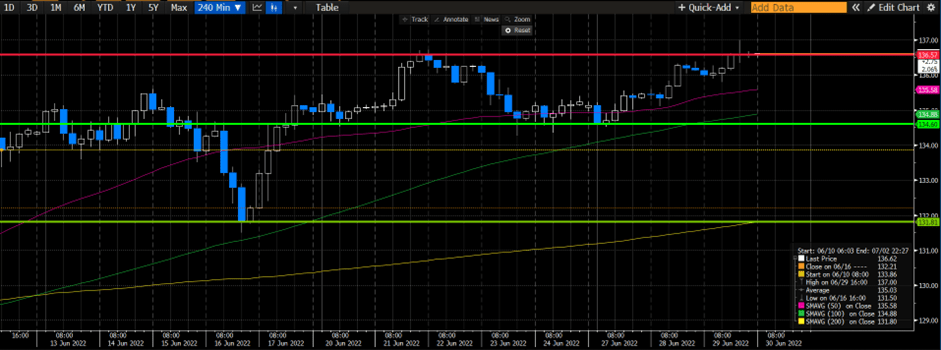
USDJPY (4-Hour Chart)

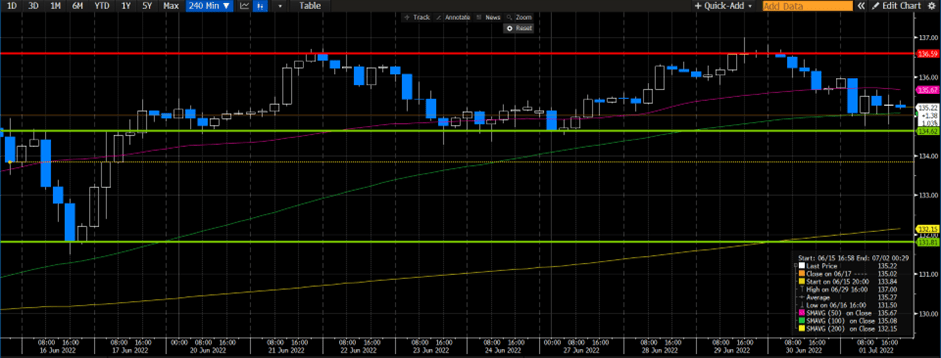
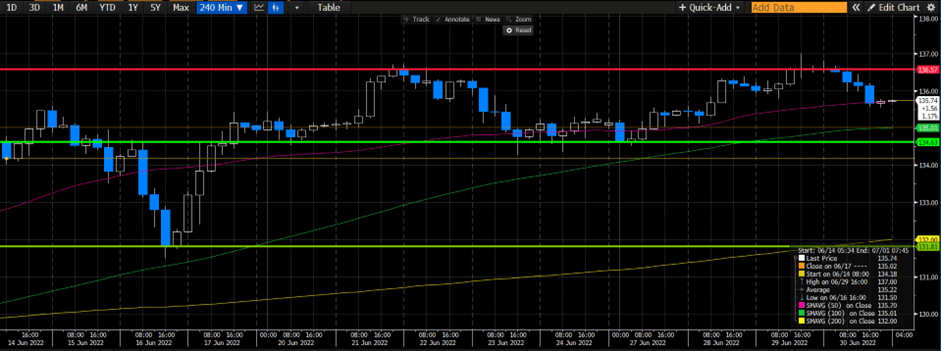
USDJPY retreated a further 0.31% for the last trading day of the week. After touching a 24-year high on the 29th, USDJPY has been on a two-day short-term correction. However, as the U.S. reported better than expected PMI figures, demand for the U.S. Greenback returned towards the end of the American trading session. Carry trade opportunities continue to exist between these two currencies and are expected to increase as the better PMI provides more confidence for the Fed to hike interest rates by the next FOMC meeting.

On the technical side, USDJPY retreated from our previously estimated resistance level of 136.57 and successfully defended our estimated support level at 134.6. RSI for USDJPY sits at 58.39, as of writing. On the four-hour chart, USDJPY currently trades above its 50, 100, and 200-day SMA.

Resistance: 136.57

Support: 134.6

Economic Data

CurrencyDataTime (GMT + 8)Forecast
USDIndependence DayAll Day
AUDRetail Sales21:30

US natural gas futures contract dropped 16 percent, the worst result in more than three years

US stock markets fell on Thursday as the S&P 500 capped its worst first half of the year in more than 50 years. The Dow Jones Industrial Average slid 0.8% and the tech-heavy Nasdaq Composite dropped 1.3%. And the S&P 500 was down 0.9% at the end of the day. Now, the market seems to be forced to adjust back to reality after the unprecedented pandemic and unprecedented monetary policy.

US natural gas future contract plummeted 16%, the worst performance in more than three years. The plunge came after an inventory report showed a larger–than–expected storage build, thus the market rose the concerned over an oversupplied market.

Cryptocurrency exchange FTX is closing a deal to buy struggling cryptocurrency lender BlockFi for $25 million in a fire sale, well below BlockFi’s last valuation. The deal came after FTX provided a $250 million emergency credit to BlockFi. The fallout for BlockFi, a crypto lending company, happened following the major sell-off and the major plunge of crypto assets. Funds have struggled with liquidity issues as counterparties fail to maintain and meet margin calls.

Main Pairs Movement

WTI price plunged 3.44% on Thursday following the news that OPEC+ decided to stick with the planned oil production hike. The Middle East will increase monthly production to 648,000 barrels per day in August with the original plan.

AUD/USD edged 0.40% higher and closed with 0.69013. The Australian dollar out- weighted against the greenback following the concerns that a more aggressive move by major central banks might pose challenges to global economic growth.

EUR/USD advanced 0.43% and finished at 1.04836 at the end of the day. The advance came as Fed Chairman Jerome Powell clarified that the more significant mistake would be to fail to restore price stability.

Gold remained bearish, dropping 0.58%, to $1,807 on Thursday. During the ECB forum, Jerome Powell mentioned that the US economy is well-positioned while imposing more tightening policies in response to inflation. The factor has held back the bets on gold, deteriorating the demand for the precious metal, gold.

Technical Analysis

EURUSD (4-Hour Chart)

EURUSD gained 0.34% over the previous trading day. The U.S. PCE figures came in at 0.3%, below estimates of 0.4%; however, year over year PCE came in at 4.7%, in line with the Fed’s expectations. During Fed Chair Jerome Powell’s speech, he stated that price stability would still be the priority of the Fed, but it would be a mistake if the central bank sacrificed the economy to achieve price stability. On the other hand, ECB president Lagarde’s speech did not shed much light on the central bank’s intentions regarding interest rates shortly. On the economic docket, manufacturing PMI from Germany and the U.S. will be released today during the European trading session and the American trading session, respectively.

On the technical side, EURUSD rebounded from our previously estimated support level of 1.038 and is heading up towards 1.0494, which was previously a support level but has since changed polarity and is acting as a short-term resistance level. RSI for EURUSD sits at 43.69, as of writing. On the four-hour chart, EURUSD currently trades below its 50, 100, and 200-day SMA.

Resistance: 1.05754, 1.06315

Support: 1.0382

GBPUSD (4-Hour Chart)

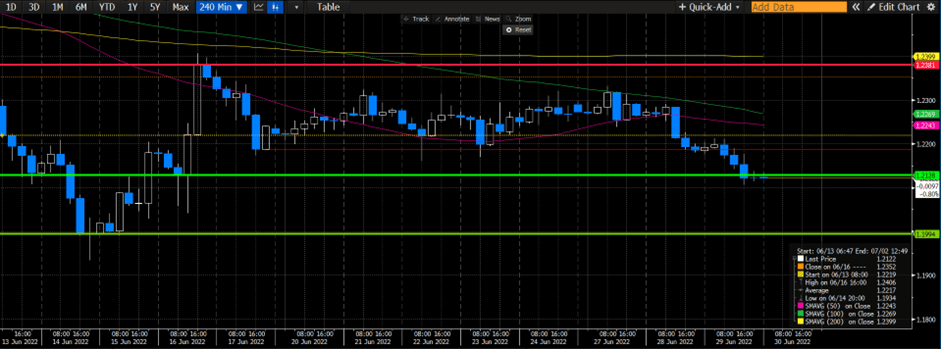
GBPUSD gained 0.48% over the previous trading day. The broad-based U.S. Greenback allowed the British Pound to rise against the Dollar. During Governor Andrew Bailey’s speech at the ECB’s annual forum on central banking, he stated that the U.K. is currently being hit with a large income shock that could hurt the overall U.K. economy. The BoE continues to be stuck between raising interest rates and slowing the economy as the country faces a different situation than the U.S., where the economy still seems to be healthy. PMI figures from the U.S. will be released during the American trading session tomorrow.

On the technical side, GBPUSD has consolidated around our previously estimated support level of 1.2123 and successfully found demand to trade higher. Resistance at 1.2381 remains unchallenged. RSI for Cable sits at 41.17, as of writing. On the four-hour chart, GBPUSD currently trades below its 50, 100, and 200-day SMA.

Resistance: 1.2381

Support: 1.2123, 1.20824

USDJPY (4-Hour Chart)

USDJPY retreated 0.68% over the previous trading day. The retreating Dollar snapped a four-day winning streak for USDJPY. During his speech at the ECB forum, Fed chair Jerome Powell reaffirmed the healthiness of the U.S. economy and reiterated the central bank’s commitment to trimming inflation with interest rate hikes. The near-term decrease of the USDJPY will not be sustained as the Fed and the BoJ continues to adopt diverging monetary policies that will increase the interest rate difference between the two countries.

On the technical side, USDJPY has retreated from our previously estimated resistance level of 136.57, but the pair remains firmly on an upward trajectory. The support level at 134.6 remains unchallenged. RSI for USDJPY sits at 61.13, as of writing. On the four-hour chart, USDJPY currently trades above its 50, 100, and 200-day SMA.

Resistance: 136.57

Support: 134.6

Economic Data

CurrencyDataTime (GMT + 8)Forecast
HKDPublic HolidayAll Day
CADCanada DayAll Day
JPYTankan Large Manufacturers Index (Q2)07:5013
CNYCaixin Manufacturing PMI (Jun)09:4550.1
EURGerman Manufacturing PMI (Jun)15:5552
GBPManufacturing PMI (Jun)16:3053.4
EURCPI (Jun)17:008.4%
USDISM Manufacturing PMI (Jun)22:0054.9

Jerome Powell committed to preventing long-term US inflation

US shares were mixed, fluctuating on Wednesday after the major US indices failed to attempt a bounce in the previous trading session. The market prepared to finish to close out the worst first half of the year since 1970. The Dow Jones Industrial Average closed 0.27% higher. The S&P 500 dropped 0.07% while the Nasdaq Composite edged lower by 0.03%. Investors and markets continue to look for the bottom as the first half of 2022 comes to an end on Thursday. Worry about a slowing economy and aggressive interest rate hikes have mostly consumed much of the first half of 2022, and fears and concerns of an economic recession are rising and happening.

At an ECB forum, the Fed Chairman, Jerome Powell, vowed to prevent inflation from taking a hold of the US economy in the long run. Jerome Powell reiterated that central banks would not allow a transition from a low inflation environment into a high inflation environment. Since the Fed started raising interest rates in March, the expectation of inflation has fallen relatively; the inflation-indexed government bonds to standard Treasurys dropped from 3.6% in March to 2.73% in June. Though the road to tackling inflation is painful, the Fed is responsible and is charged with bringing down those inflations.

Main Pairs Movement

EUR/USD was down 0.74%, to 1.04386 on Wednesday. The euro-dollar was comparably weak against the dollar as the inflation rates in Europe seemed disoriented. For instance, some Mediterranean countries have pushed their annual inflations to double figures; however, Europe’s largest country has not experienced this kind of high figure.

GBP/USD edged lower by 0.54 at the end of the day. The British pound was sniped by the fact that the Bank of England acknowledges the possibility that the British economy tips into a recession in 2023; on the contrary, Jerome Powell remains confident that the US can avoid a recession.

USD/JPY reached as much as 137, and was up 0.34% on Wednesday, gaining follow-through traction for the fourth consecutive day. The US dollar pick up a fresh bid tone following Jerome Powell’s restated bets for a more aggressive monetary policy.

Gold oscillated in a tight range, down 0.12%. Investors remained cautious and looked for a fresh clue about the next monetary policy move by the Fed.

Technical Analysis

EURUSD (4-Hour Chart)

EURUSD lost 0.74% over the previous trading day. The pair extended its previous losing day as inflation data from the EU came in mixed. Spain’s inflation rose by 10%, year over year, and up 8.5% over the previous month; on the other hand, Germany’s CPI came in at 7.6%, lower than the 7.9% consensus. The mixed inflation data acted as a headwind for the Euro and a roadblock to more aggressive rate hikes by the ECB. The Dollar continues its upward movement as markets remain risk-averse.

On the technical side, EURUSD has fallen through our previously estimated support level of 1.0494 and is heading lower towards our next estimated support level of 1.0382. RSI of EURUSD sits at 40.66, as of writing. On the four-hour chart, EURUSD currently trades below its 50, 100, and 200-day SMA.

Resistance: 1.05754, 1.06315

Support: 1.0382

GBPUSD (4-Hour Chart)

GBPUSD lost 0.54% over the previous trading day. The British Pound continues to be held back as members of parliament continue their efforts of overturning a keystone Brexit agreement. Furthermore, hawkish remarks from Fed Chair Jerome Powell have provided a boost to the safe-haven Dollar. Risk-off sentiment across markets has attracted further demand for the U.S. Greenback. On the economic docket, the British GDP is set to release during today’s European trading session.

On the technical side, GBPUSD is consolidating around our previously estimated support level of around the 1.2123 price region. The next level of support for Cable sits at around the 1.20824 price region. RSI for GBPUSD sits at 38.25, as of writing. On the four-hour chart, GBPUSD currently trades below its 50, 100, and 200-day SMA.

Resistance: 1.2381

Support: 1.2123, 1.20824

USDJPY (4-Hour Chart)

USDJPY gained 0.34% over the previous trading day. Hawkish remarks from Fed Chair Jerome Powell have attracted fresh demand for the U.S. Greenback. On top of an already risk-off environment, market participants have continued to bid up the U.S. Dollar as aggressive rate hikes are now expected during the next FOMC meeting. On the economic docket, U.S. PCE and initial jobless claims data will both be released during the American trading session.

On the technical side, USDJPY has once again touched above the 136 level and is consolidating around our previously estimated resistance level of 136.57. Support levels at 134.6 remain firmly intact. RSI for the pair has heated up and sits at 66.14, as of writing. On the four-hour chart, USDJPY currently trades above its 50, 100, and 200-day SMA.

Resistance: 136.57
Support: 134.6

Economic Data

CurrencyDataTime (GMT + 8)Forecast
CNYManufacturing PMI (Jun)09:3050.5
GBPGDP (Q1)14:008.7%
EURGerman Unemployment Change (Jun)15:55-6K
USDCore PCE Price Index (May)20:300.4%
USDInitial Jobless Claims20:30228K
CADGDP (Apr)20:300.3%
EURECB President Lagarde Speaks21:30

Jen Stoltenberg said NATO has reached a deal with Turkey to admit Finland and Sweden

US shares fell heavily on Tuesday following the release of CB Consumer Confidence, worse- than- expected. In the meantime, markets and investors are worried about oil prices stably staying at the high price while the Fed is not interested in slowing down. The Dow Jones Industrial Average dropped 1.56%. The Nasdaq Composite slid 3%, to 11,181.54 while the S&P 500 declined 2.01%. All three major indices erased their gains from last Friday, back into the bear- market. US indices were once up more than 1% during the US session before the release of the economic data. However, as the consumer confidence fell to 98.7, it essentially indicated that investors feared a recession that might happen in the future. At the same time, the officials also mentioned that 12- month inflation expectations were 8% for June, the highest since 1987.

With the war between Russia and Ukraine remaining, NATO Secretary Jen Stoltenberg said that NATO, the most powerful military alliance, has reached a deal with Turkey to admit Finland and Sweden. Before that, Turkey was not interested in signing the agreement as the Turkish President said that he would support the Kurdish organization. The move to add both countries to members of NATO comes after Russia invades Ukraine. Countries fear becoming the next Ukraine.

Main Pairs Movement

AUD/USD was down 0.23% to 0.69055 at the end of the day. The Australian dollar was relatively weak against the US dollar as the US shares fell sharply amid the risk sentiment, which came from the decline in Consumer Confidence that was released by the US.

USD/JPY advanced 0.49%, up for the third consecutive day. The Japanese Yen lost some interest from investors as the BOJ remains its monetary policy, continuously widening the gap between domestic and overseas’ yield rates. In the meantime, some news has said that the BOJ might have been saddled with as much as 600 million Yen in unrealized losses.

USD/CAD oscillated at 1.28727. The strength of the US dollar, boosted by the risk sentiment, was offset by the advance of oil prices, highly related to the Canadian dollar.

WTI was up 1.84%, bullish attacking for the third- consecutive day as the sanctions on Russia remain and the chatters surrounding OPEC+ forecasts for 2022 market surplus.

Technical Analysis

EURUSD (4-Hour Chart)

EURUSD lost 0.62% over the previous trading day. The Euro enjoyed a boost early during the European trading session as ECB president Lagarde reaffirms the central bank’s intent to raise interest rates by 25 basis points in July; furthermore, president Lagarde hints at more aggressive interest rate hikes if the central bank sees fit. On the economic docket, both ECB president Lagarde and Fed chair Jerome Powell are scheduled to speak on the 29th. U.S. GDP for Q1 is also scheduled to be released during the American trading session.

On the technical side, EURUSD retreated from our previously estimated resistance level of 1.0598 and is heading towards our projected support level of 1.0493. RSI for the pair sits at 45.7, as of writing. On the four-hour chart, EURUSD currently trades below its 50, 100, and 200-day SMA.

Resistance: 1.05754, 1.06315

Support: 1.0493

GBPUSD (4-Hour Chart)

GBPUSD lost 0..68% over the previous trading day. Heightened demand for the U.S. Dollar and broader risk-averse market sentiment have sent the U.S. Greenback higher. Market participants will be closely watching the U.S. GDP release and Fed chair Jerome Powell’s speech on the 29th. On the other hand, members of parliament have voted in favour of overturning a previously agreed Brexit deal, the Northern Ireland Protocol.

On the technical side, GBPUSD is trading towards our previously estimated support level of around the 1.2173 price region. Resistance at 1.2381 remains firmly intact. RSI for the pair sits at 40.52, as of writing. On the four-hour chart, GBPUSD currently trades below its 50, 100, and 200-day SMA.

Resistance: 1.2381

Support: 1.2173, 1.20824

USDJPY (4-Hour Chart)

USDJPY rose 0.49% over the previous trading day. Demand for the U.S. Dollar returned as market participants remain risk-averse. The upbeat U.S. durable goods orders, unexpectedly rose 0.7% in May. This could lead to reduced chances of the Fed hiking rates at a more aggressive rate. U.S. GDP and Fed Chairman Jerome Powell’s speech tomorrow could provide price action for the pair as the short-term bullish movement of the pair remains well fueled.

On the technical side, USDJPY has once again begun its march upwards toward our previously estimated resistance level of 136.57. Our previously estimated support level of 134.6 was successfully defended. RSI for the pair sits at 64.94, as of writing. On the four-hour chart, USDJPY currently trades above its 50, 100, and 200-day SMA.

Resistance: 136.57

Support: 134.6

Economic Data

CurrencyDataTime (GMT + 8)Forecast
AUDRetail Sales (May)09:300.4%
GBPBoE Gov Bailey Speaks19:35
USDGDP (Q1)20:30-1.5%
USDFed Chair Powell Speaks21:00
EURECB President Lagarde Speaks21:00

Russia has entered its first major foreign debt default, as the payment period expires

US shares edged lower to start the week following a major rebound from last Friday. The Dow Jones Industrial Average dropped 0.2%, to 31,438.26. The Nasdaq Composite declined 0.7% while the S&P 500 fell 0.3% at the end of the day. US stocks struggled to turn upside down on Monday as investors weighed whether the bottom has been reached and stocks have been oversold in this bear market.

Russia has entered its first major foreign debt default as the payment period expires. Interest payments of $100 million that Russia needed to pay were due on May 27 with the grace period on June 26. However, several bondholders have indicated that they have not received the payments after Russia attempted to pay in Ruble, which is blocked by international sanctions. The next test would be further 2 billion payments are due before the end of the year. If Russia continues to default, it would effectively ostracize the country from the global financial system; however, so far Russia has managed to find ways to get payments to bondholders.

Main Pairs Movement

AUD/USD edged 0.31% lower on Monday. The Aussie traded in the tight range in the absence of domestic data this week other than Retail Sales. At the end of the day, AUD/USD finished at 0.69213.

Gold turned downside after attempting to sustain above the resistance level above $1,840. Mixed US economic data undermined the market sentiment, bringing gold down to $1,822.75; the US Durable Goods Orders were up 0.7%, better- than- expected; in the meantime, Pending Home Sales dropped 13.6 YoY.

EUR/USD advanced 0.24% to 1.05820. The ECB will host the Forum on central banking in Portugal, this week; ECB President Christine Lagarde will offer a speech during the commencement.

GBP/USD consolidated, dropping 0.06% on Monday as there were no major economic events. The UK parliament members will vote on legislation that would possibly allow members to amend or rewrite Brexit deals.

WTI oil price was up 2.39% on Monday, advancing two- consecutive days. Oil prices turned upside as OPEC+ decided to cut the 2022 market surplus from 1.4 million to 1 million BPD. Moreover, due to the political turmoil in Libya, the crude oil output will shrink by approximately 600 K BPD in the oil market.

Technical Analysis

EURUSD (4-Hour Chart)

EURUSD edged higher on the first trading day of the week. The U.S. Greenback witnessed broad-based weakness as mixed data from the U.S. came in and market participants remain worried over a slowing U.S. economy. U.S. pending home sales decreased by a staggering 13.6%, year over year, for May. On the economic docket, U.S. GDP is set to release on the 29th, while EU CPI is scheduled to be released on July 1st.

On the technical side, EURUSD has traded above our previously estimated resistance level of 1.05754, but upward momentum seems to be fading. The next level of resistance sits at around the 1.06315 price region. RSI for the pair sits at 50.33, as of writing. On the four-hour chart, EURUSD currently trades near its 50-day SMA and below its 100 and 200-day SMA.

Resistance: 1.05754, 1.06315

Support: 1.0493

GBPUSD (4-Hour Chart)

GBPUSD traded mostly sideways over the first trading day of the week. Brexit continues to weigh on the British economy as members of parliament will vote on legislation that would allow ministers to rewrite parts of the post-Brexit deal and remove checks on goods entering Northern Ireland from the rest of the U.K. Market sentiment continues to put the British Pound and the U.S. Greenback in contention as the haven currency of choice as global economies show signs of recession.

On the technical side, GBPUSD continues to trade below our previously estimated resistance level of 1.2381. The support level at 1.2173 remains firm. RSI for Cable sits at 44.31, as of writing. On the four-hour chart, GBPUSD currently trades below its 50, 100, and 200-day SMA.

Resistance: 1.2381

Support: 1.2173, 1.20824

USDJPY (4-Hour Chart)

USDJPY built on last Friday’s upward momentum and continued to trade higher throughout Monday’s trading. Despite a broad-based weakness of the U.S. Greenback, the Japanese Yen continues to experience strong selling. The export-reliant country, Japan, continues on its course of a supportive monetary environment to keep exchange rates low. The benchmark U.S. 10-year Treasury yield has resumed trading above 3.2%.

On the technical side, USDJPY has rebounded strongly from our previously estimated support level of 134.6. Resistance at 136.57 remains close by and could be challenged. RSI for the pair has climbed to 62.63, as of writing. On the four-hour chart, USDJPY currently trades above its 50, 100, and 200-day SMA.

Resistance: 136.57

Support: 134.6

Economic Data

CurrencyDataTime (GMT + 8)Forecast
EURECB President Lagarde Speaks02:30
EURECB President Lagarde Speaks16:00
USDCB Consumer Confidence (Jun)22:00100.4
Back To Top
server

您好 👋

我能帮您什么吗?

立即与我们的团队聊天

在线客服

通过以下方式开始对话...

  • Telegram
    hold 维护中
  • 即将推出...

您好 👋

我能帮您什么吗?

telegram

用手机扫描二维码即可开始与我们聊天,或 点击这里.

没有安装 Telegram 应用或桌面版?请使用 Web Telegram .

QR code