Week ahead: Central bank decisions take centre stage

As we approach the second week of April 2024, financial markets and policymakers around the globe are bracing for a series of critical economic reports and central bank decisions. These events are expected to offer valuable insights into the ongoing economic recovery efforts, inflationary pressures, and future monetary policy directions. Here’s a day-by-day breakdown of what to anticipate:

Reserve Bank of New Zealand holds firm

On 10 April 2024, the Reserve Bank of New Zealand (RBNZ) made headlines by maintaining its official cash rate (OCR) at 5.5% during its first policy meeting of the year. This decision marked the fifth consecutive meeting without a change in the rate, signalling a cautious stance by the RBNZ amidst economic uncertainties. Analysts are already looking ahead, predicting the OCR to remain at 5.5% following the upcoming meeting, reflecting a steady approach to monetary policy.

U.S. inflation trends upward

In a surprising turn, the annual inflation rate in the United States nudged up to 3.2% in February 2024 from 3.1% in January. This incremental rise, though slight, has caught the attention of market watchers who now forecast a further increase to 3.4% for March. The data, expected to be released on 10 April 2024, will be pivotal for future Federal Reserve decisions.

Bank of Canada’s rate decision

The Bank of Canada, on its part, held its overnight rate target steady at 5% during its March meeting. The bank’s commitment to normalising its balance sheet, despite inflationary concerns, suggests a cautious optimism. Analysts anticipate this trend to continue, with expectations set for the interest rate to remain at 5% in the Bank of Canada’s next meeting.

Federal Reserve and ECB stance

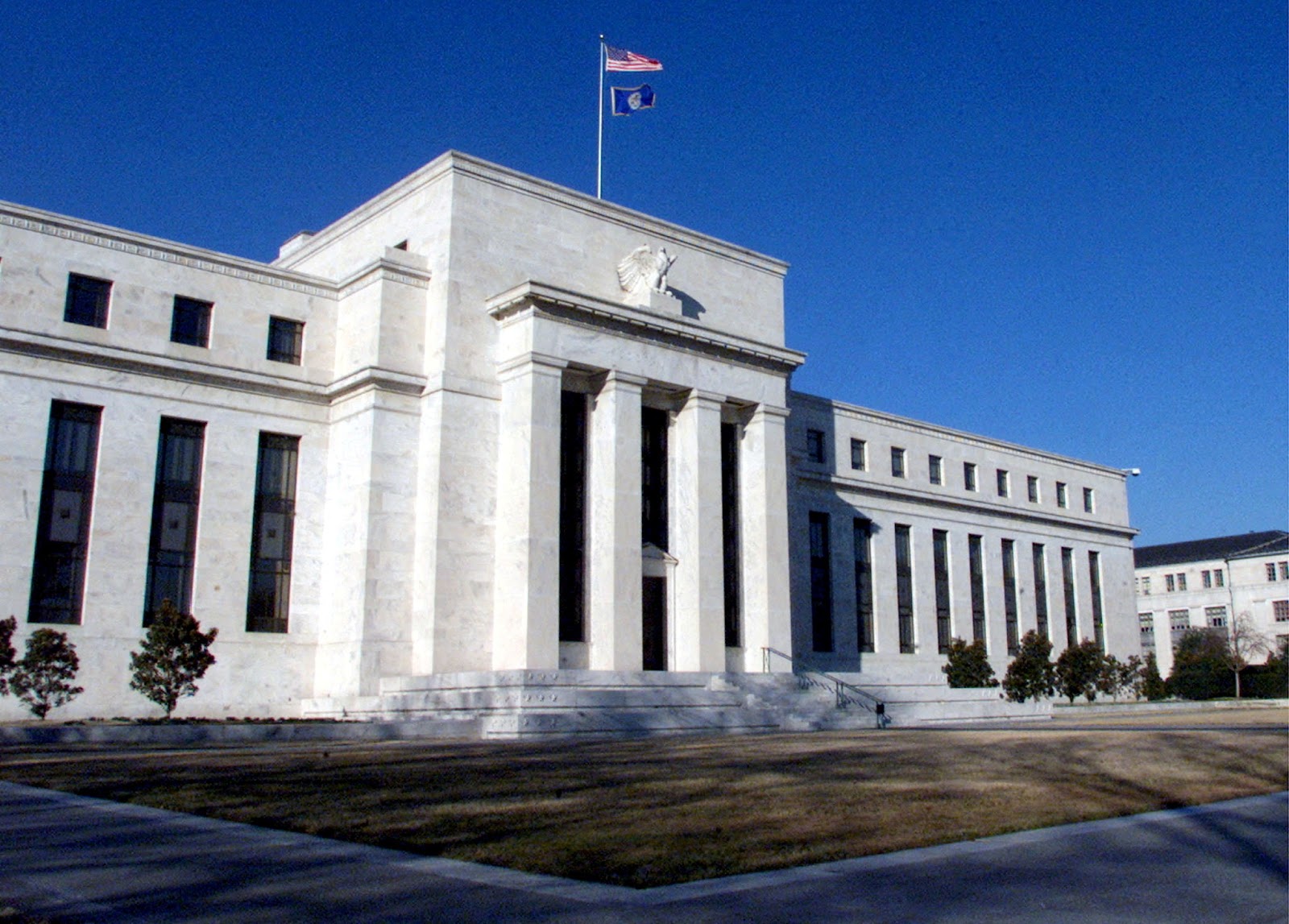
Minutes from the Federal Reserve’s meeting, expected on 11 April 2024, will be closely scrutinised. With the fed funds rate holding steady at a 23-year peak of 5.25%-5.5%, the Federal Reserve’s projections for future rate cuts will be of significant interest. Similarly, the European Central Bank (ECB), which has kept interest rates at historically high levels, faces its own set of challenges balancing recession risks with inflation. Analysts foresee the ECB maintaining its current interest rate levels at 4.5% in its forthcoming meeting.

Upcoming economic data

Additionally, the release of the U.S. Producer Price Index (PPI) on 11 April will offer insights into wholesale price movements, having risen by 0.6% in February. Expectations for March are set at a more modest 0.3% increase. The UK’s GDP data, expected on 12 April, will also be pivotal. After a modest expansion of 0.2% in January, forecasts for February suggest a slight increase of 0.1%, indicating a cautious yet positive economic trajectory.

In summary, the coming week promises a wealth of information for economists, investors, and policymakers alike. With each announcement, the global economic picture for 2024 will become clearer, highlighting the delicate balance central banks are striking between fostering economic growth and managing inflationary pressures.

Forex Market Analysis: Breakout Trading Strategies and March Jobs Report Insights

CURRENCIES:

EUR/USD and Oil Breakout Potential: Awaiting a breakout above Fibonacci resistance levels for bullish trend continuation.

Popular Strategy: Breakout trading aims to capitalize on significant price movements beyond established price boundaries.

Breakout Significance: Indicates strong buying or selling activity, hinting at a market sentiment shift and potential new or continuing trends.

Breakout Trading Essentials:

  • Initiate trades post-breakout to leverage momentum.
  • Place orders beyond support/resistance levels for confirmation.
  • Employ stop-loss to minimize risks from false breakouts.
  • Set profit targets based on technical analysis projections.

Key Breakout Observations:

  • Typically accompanied by increased trading volume.
  • Risk management is crucial due to the possibility of false breakouts.
  • Can signify the beginning of a new trend or continuation of an ongoing one.

Current Focus: Monitoring EUR/USD and oil (WTI futures) for potential breakout opportunities.

STOCK MARKET:

March Jobs Report Overview:

  • Expected to reveal a slowdown in hiring.
  • Anticipated decrease in unemployment rate to 3.8%.

Publication Details:

  • Reported by Josh Schafer on April 4, 2024, at 10:50 PM GMT+3.

Market Context:

  • Follows two months of strong job gains, surprising Wall Street.
  • Bureau of Labor Statistics to release the report at 8:30 a.m. ET, Friday.

Key Figures:

  • Nonfarm payrolls anticipated at +213,000 (down from +275,000 previously).
  • Unemployment rate projected to drop to 3.8% (from 3.9%).
  • Monthly average hourly earnings increase expected at +0.3% (up from +0.1%).
  • Annual average hourly earnings growth forecast at +4.1% (down from +4.3%).
  • Average weekly hours worked predicted to remain steady at 34.3.

Economic Implications:

  • The report is crucial for gauging labor market strength and potential Federal Reserve policy shifts.
  • Jerome Powell highlighted the labor market’s robust yet rebalancing nature.

Recent Labor Market Data:

  • Job Openings and Labor Turnover Survey (JOLTS) and ADP report indicate a resilient labor market.
  • Slight increase in job openings and hires observed in February.

Wage Growth Focus:

  • Economists are closely monitoring wage growth as an indicator of potential inflation trends.
  • March’s expected slowdown in wage growth aligns with a cooling but stable labor market.
  • Investor Sentiment and Federal Reserve Outlook:

Market anticipates continued Federal Reserve rate cuts, influenced by employment and wage growth data.

Market turbulence amid Fed concerns and oil price spike

Stocks plummeted amid rising oil prices and concerns over the Federal Reserve’s interest rate policies, with major indices like the Dow Jones, S&P 500, and Nasdaq experiencing significant drops. The spike in oil prices to over $86 a barrel fueled inflation fears, while remarks from Fed officials suggested a cautious approach to rate cuts, contributing to market volatility. Meanwhile, in currency markets, the USD Index fell, the euro and pound gained, and gold prices briefly touched all-time highs, reflecting a complex interplay of economic indicators and central bank signals affecting investor sentiment.

Stock market updates

Stock markets experienced a significant downturn on Thursday, fueled by a combination of rising oil prices, mounting fears that the Federal Reserve may delay interest rate cuts, and apprehension about the upcoming March jobs report. This cocktail of concerns led to a sharp sell-off, marking the Dow Jones Industrial Average’s worst performance since March 2023, as it plunged by 530.16 points or 1.35%, settling at 38,596.98. The S&P 500 and Nasdaq Composite weren’t spared either, recording declines of 1.23% and 1.40% to close at 5,147.21 and 16,049.08, respectively, highlighting a broader market apprehension.

Amidst the trading day, a sudden spike in crude oil prices exacerbated the market’s woes, with West Texas Intermediate (WTI) crude breaching the $86 per barrel mark, a peak not seen since October. This surge sparked additional inflationary fears among investors, contributing to the market’s downturn. Complicating matters, Minneapolis Fed President Neel Kashkari’s comments added to the uncertainty, hinting at a potential reconsideration of rate cuts if inflation persists. These factors, combined with a rise in the 10-year Treasury yield to 4.305%, underscored the growing caution among investors, reflected in the day’s volatile trading patterns.

Analysts and investors alike are adopting a cautious stance, closely monitoring the 10-year Treasury yield as a key indicator of future Federal Reserve actions. The overarching sentiment is one of caution, with a focus on how the Fed’s interest rate policies and inflationary pressures will shape market dynamics moving forward.

Currency market updates

The currency markets saw varied movements as the USD Index (DXY) experienced a further decline, dipping into the sub-104.00 region. Anticipation is building for April 5, with market participants keenly awaiting the Non-farm Payrolls, Unemployment Rate, and speeches from several FOMC members. The euro maintained a positive trajectory, reaching new multi-day highs near 1.0880, while the British pound edged close to the significant 1.2700 mark, marking its third consecutive session of gains. Meanwhile, the USD/JPY pair fluctuated within a narrow range, signaling a period of consolidation.

In the commodity currency space, the Australian dollar showcased notable strength, surpassing the 0.6600 threshold, amid expectations for the upcoming Balance of Trade results. This movement reflects broader currency market dynamics, where specific data releases and economic indicators are keenly anticipated for their potential impact on currency valuations. Additionally, the trading session for WTI crude remained relatively flat, yet close to its yearly highs, indicating a sustained interest in energy markets.

Precious metals witnessed a mixed session; gold prices paused after reaching an all-time high above $2,300 per troy ounce, while silver prices ended the session with minimal changes, despite hitting new highs earlier. These movements underscore the volatility and diverse influences at play within the currency and commodity markets, as investors navigate through economic data releases, central bank communications, and broader geopolitical factors impacting market sentiment and currency valuations.

Picks of the Day Analysis
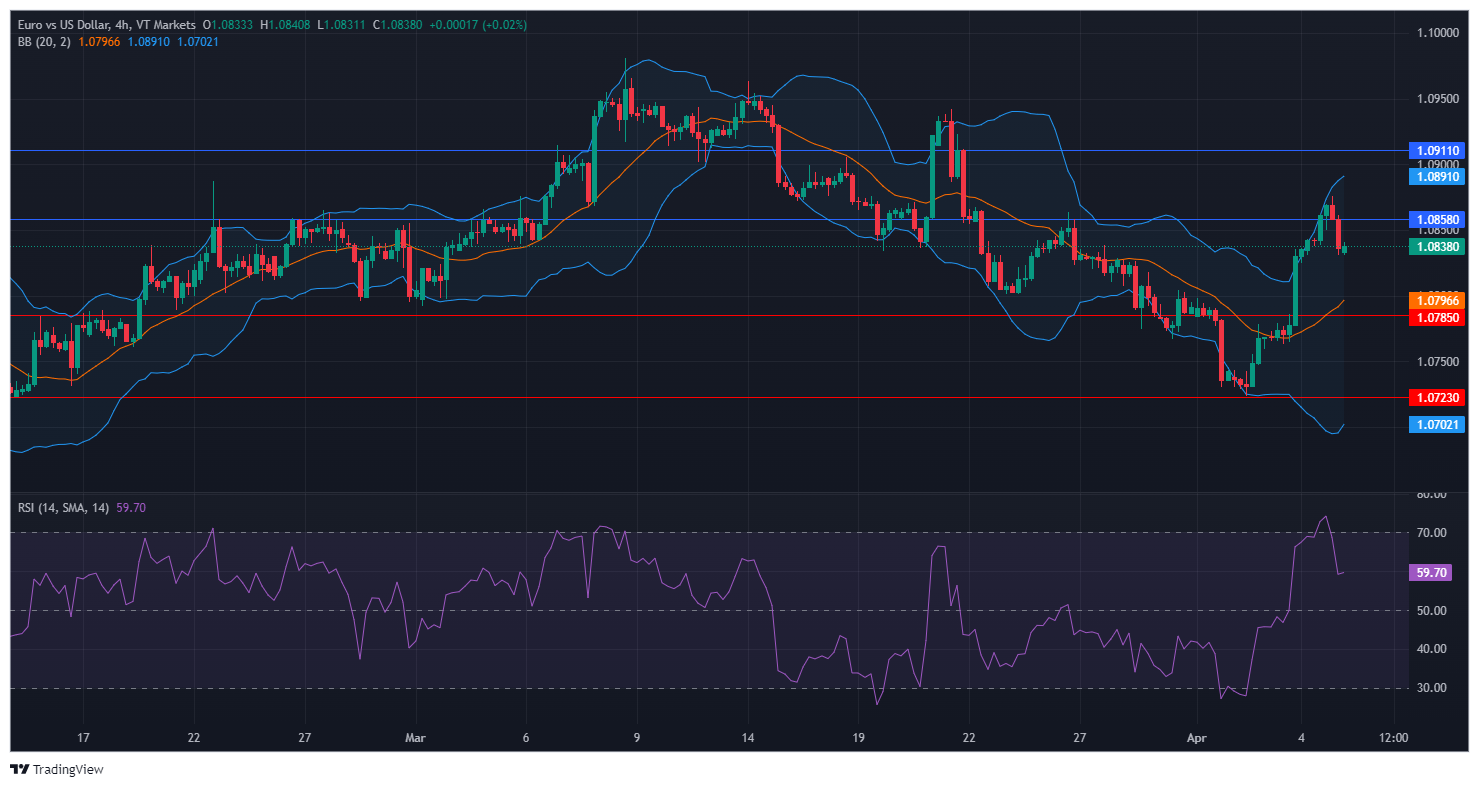
EUR/USD (4 Hours)

EUR/USD rises amid divergent central bank policies and economic outlooks

Despite a significant drop in the US Dollar, leading to a robust increase in EUR/USD to the 1.0870-1.0880 range, the currency pair’s movement reflects broader economic trends, including fluctuating US yields and a steady rise in German bund yields. Central bank policies are in the spotlight, with both the Fed and ECB expected to begin easing cycles possibly by June, although their approaches may diverge. The Fed faces challenges in curbing housing sector inflation, while the ECB grows confident about reaching its inflation target, hinting at upcoming rate cuts. However, the long-term outlook suggests a potential strengthening of the Dollar against the Euro, especially if the ECB and Fed initiate simultaneous easing, potentially driving EUR/USD down to new lows.

Chart EUR/USD by TradingView

On Thursday, the EUR/USD moved lower after reaching the upper band of the Bollinger Bands. Currently, the price is moving in the middle between the middle and upper band, suggesting a potential slight downward movement to reach the lower band before going back higher. Notably, the Relative Strength Index (RSI) maintains its position at 59, signaling a neutral but bullish outlook for this currency pair.

Resistance: 1.0858, 1.0911

Support: 1.0785, 1.0723

 Economic Data
CurrencyDataTime (GMT + 8)Forecast
CADEmployment Change20:3025.9K
CADUnemployment Rate20:305.9%
USDAverage Hourly Earnings m/m20:300.3%
USDNon-Farm Employment Change22:00212K
USDUnemployment Rate22:003.9%

Forex Market Analysis: Analyzing Euro Strength, Fed’s Rate Cut Speculations, and Global Economic Outlook

CURRENCIES:

Euro Gains on US Data: Weaker US economic activities bolster the Euro’s position.

Inflation and ECB Rate Cut: Lower inflation in the eurozone signals a potential ECB rate cut in June.

EUR/USD Movement: Euro rises against the US dollar following dovish remarks from the Fed and weaker US data.

EUR/CHF Progress: Euro reaches a significant resistance level against the Swiss franc.

Looking Ahead:

Eurozone Inflation and Rate Cut Expectations: Decrease in March’s year-on-year inflation to 2.4% prompts anticipation of ECB’s rate cut in June.

ECB and Economic Data: Upcoming ECB meeting and economic data releases, including services PMI and March meeting minutes.

Fed’s Outlook: Observations from Fed speakers on market conditions may influence interest rate decisions.

EUR/USD Analysis:

Market Dynamics: Service sector PMI drop helps Euro, but US employment trends hint at potential Fed rate cut.

Trading Insights: EUR/USD recovers, trading above the 200-day SMA, but faces potential resistance near the 1.0950 mark.

Event Risk: Upcoming Non-Farm Payroll (NFP) data could impact currency movements.

STOCK MARKET:

Rate Cut Optimism: Markets react positively to Fed Chair Jerome Powell’s hints at possible rate cuts.

Stock and Bond Movements:

Stocks ascend, with the S&P 500 up by 0.11%.

Treasury yields decline from recent four-month peaks.

Market Drivers:

Powell’s reassurance on interest rate cuts boosts stocks and lowers Treasury yields.

European Stoxx 600 index gains 0.2%; Nasdaq 100 futures up by nearly 0.5%.

Interest Rate and Economic Outlook:

Powell’s stance on inflation influences Treasury yields and the dollar index.

Market anticipates Fed’s interest rate cuts, despite strong recent economic data.

Market Sentiment and Predictions:

Some caution remains with upcoming US payroll data.

Swap markets show uncertainty about the extent and timing of Fed rate cuts.

Global Perspective:

Euro-area bond yields drop, expecting ECB to start easing in June and further cuts by year-end.

Commodity Price Trends:

Brent oil and copper prices surge, indicating strong commodity market.

Gold price nears record highs, reflecting inflation concerns.

Sector-Specific News:

Semiconductor stocks like Micron Technology and AMD gain amid earthquake impact assessments in Taiwan.

TSMC reports no critical damage from the quake, signaling stability in semiconductor supply.

Start your CFD Shares Trading journey with VT Markets now!

部份产品交易时间调整通知 – 2024年04月04日

尊敬的用户:

您好!

由于澳大利亚地区即将由冬令时切换至夏令时,部份产品的交易时间将于 2024年04月07日有所调整,详情如下:

注意:以上数据仅供参考,实际执行数据有可能会有变动,具体请依据 MT4 / MT5 软件为准。

如您有任何疑问,我们的团队将十分乐意为您解答。
请留言或发邮件至 [email protected] 或联系在线客服。

Dow dips amid rate worries, dollar wavers as markets eye Fed’s next move

On Wednesday, the Dow Jones experienced a slight decline, continuing its downward trend for the third consecutive day, while the S&P 500 and Nasdaq saw modest gains. Market fluctuations were influenced by individual stock performances, such as Intel’s significant drop, and broader economic indicators pointing towards a resilient economy, which in turn affected investor sentiments regarding the Federal Reserve’s interest rate policies. In currency markets, the US dollar faced pressure, with notable movements against the Euro, British pound, and Australian dollar amidst geopolitical tensions and commodity price rallies. Investors remain cautiously optimistic, balancing between the best first quarter since 2019 and the potential for a volatile period ahead as markets adjust to recent gains and anticipate the Federal Reserve’s next moves.

Stock market update

The Dow Jones Industrial Average experienced a slight decline on Wednesday, continuing its struggle to break free from the slump that has characterized the second quarter. The Dow fell by 43.10 points, a 0.11% drop, closing at 39,127.14, marking its third consecutive day of losses. In contrast, the S&P 500 managed a slight increase of 0.11%, closing at 5,211.49, its first gain of the week, while the Nasdaq Composite saw a 0.23% rise, ending the day at 16,277.46. The downturn for the Dow was primarily due to a significant over 8% drop in Intel shares following the announcement of operating losses in its semiconductor manufacturing sector. Despite a positive trend for most of the day, artificial intelligence leader Nvidia ended in the red, hampering the overall market gains. However, substantial increases in major technology stocks like Netflix, up by 2.6%, and Meta Platforms, with a 1.9% gain, provided some support to the market.

Interest rates have continued to place pressure on the stock market. The release of ADP data on Wednesday indicated a higher-than-expected increase in private payrolls for March, signaling a resilient economy but also heightening investor anxiety over the Federal Reserve’s interest rate policies. Comments from Federal Reserve officials dampened hopes for early rate cuts, with Atlanta Fed President Raphael Bostic suggesting a potential rate decrease not occurring until the fourth quarter. Fed Chair Jerome Powell emphasized the need for more evidence of inflation easing before any reduction in borrowing costs. Market predictions now lean heavily towards unchanged rates at the Fed’s May policy meeting, with a diminishing likelihood of a cut by June, as reflected in the shifting odds according to the CME FedWatch Tool and Fed funds futures data.

Despite the challenging start to the quarter, some market analysts remain optimistic, viewing the recent downturn as a period of consolidation after a strong first quarter, the best since 2019 for the S&P 500.

Currency market update

The US dollar experienced additional downward pressure, challenging the 104.00 level as measured by the USD Index (DXY). Upcoming economic data includes February’s Balance of Trade results and weekly Initial Jobless Claims on April 4, alongside speeches from Fed members Barkin, Goolsbee, and Mester. The Euro gained momentum against the dollar, pushing towards the significant 200-day SMA at the 1.0830 region, with market participants looking forward to the final HCOB Services PMIs from Germany and the euro area, as well as the release of the ECB Accounts on the same day. Meanwhile, the British pound surged to new multi-day highs beyond the 1.2600 mark, aligning with the 100-day SMA, ahead of the final S&P Global Services PMI announcement for the UK.

The Japanese yen maintained a steady position against the dollar, staying below the 152.00 mark, with investors eyeing the upcoming release of weekly Foreign Bond Investment figures in Japan. The Australian dollar saw increased buying interest, surpassing the crucial 200-day SMA around 0.6545, with the final Judo Bank Services PMI report due on April 4. In the commodities market, ongoing geopolitical tensions drove West Texas Intermediate (WTI) oil prices to new 2024 highs, exceeding the $86.00 per barrel mark. Safe-haven demand, coupled with anticipations of Federal Reserve rate cuts in June, propelled gold prices to a record peak near the $2,300 per troy ounce, while silver prices continued their rally, reaching new highs just above the $27.00 level per ounce for the first time since June 2021.

Picks of the Day Analysis
EUR/USD (4 Hours)

EUR/USD surges amid diverging central bank policies and mixed economic signals

The EUR/USD pair experienced a significant upswing, breaking past the 1.0800 mark and nearing the 200-day SMA, driven by a noticeable decline in the US Dollar amidst contrasting movements in US and German bond yields. Despite the Federal Reserve and the European Central Bank both indicating the onset of easing cycles potentially beginning in June, divergences in their approach could lead to varied strategies. This period saw mixed messages from Fed officials on interest rate adjustments, amidst indicators suggesting a softer economic landscape in the eurozone but expectations of a resilient US economy. These dynamics, coupled with inflation data below expectations in the euro area, hint at a complex interplay of economic factors influencing the EUR/USD trajectory, with a potential shift towards a stronger Dollar in the medium term as both central banks embark on easing measures, potentially driving the pair to revisit its recent lows.

Chart EUR/USD by TradingView

On Wednesday, the EUR/USD moved higher, able to reach the upper band of the Bollinger Bands. Currently, the price is moving slightly below widen the upper band, suggesting a potential another upward movement to reach the resistance level. Notably, the Relative Strength Index (RSI) maintains its position at 67, signaling a bullish outlook for this currency pair.

Resistance: 1.0858, 1.0911

Support: 1.0785, 1.0723

Economic Data
CurrencyDataTime (GMT + 8)Forecast
CADGDP m/m20:300.4%
USDFinal GDP q/q20:303.2%

Forex Market Analysis: Analyzing US Dollar Trends, Tesla’s Performance in China, and Market Dynamics

CURRENCIES:

US Dollar Performance and Key Currency Pairs

  • The U.S. dollar (DXY index) decreased slightly (-0.2% to 104.75), retracting from a five-month high.
  • Global yield increases outpaced U.S. government rates, affecting the dollar’s strength.
  • Upcoming Economic Events and Market Focus
  • Attention is on the upcoming March U.S. jobs report (nonfarm payrolls) due Friday.
  • This data is crucial for assessing the labor market and influencing Federal Reserve policies.

Technical Analysis for Currency Pairs

  • The article examines the technical outlook for EUR/USD, USD/JPY, and USD/CAD.
  • Labor Market and Monetary Policy Expectations
  • Market anticipates a 200,000 increase in U.S. employment for March, maintaining a 3.9% unemployment rate.
  • Potential for higher than expected job growth, affecting Federal Reserve rate cut expectations.

Implications of Nonfarm Payroll (NFP) Report

  • A strong NFP result may lessen the likelihood of a significant Fed rate cut in 2024.
  • Conversely, a weak NFP could prompt expectations for earlier Fed rate cuts, possibly weakening the U.S. dollar.

STOCK MARKET:
  • Declining Market Share in China
  • Tesla’s market share in China has decreased from 10.5% in Q1 2023 to around 6.7% by December.
  • This reduction reflects intensified competition and weaker consumer demand in China.

Comparison to Local Competitors

  • Tesla faces strong competition from local Chinese EV manufacturers like BYD, Nio, Xpeng, and Xiaomi.
  • Rivals are offering diverse and technologically advanced models, while Tesla has mainly relied on its older Model 3 and Model Y.

Impact of Price Strategies

  • Tesla’s previous price cuts have been countered by aggressive pricing from Chinese automakers.
  • Tesla announced a price hike, prompting competitors to deepen their discounts.
  • Slowing EV Market Growth in China
  • Growth in China’s EV market is slowing, with a 25% increase projected for this year, down from previous years.
  • This slowdown has led Tesla to cut production at its Shanghai factory.

Recent Sales Figures

  • Tesla delivered 89,064 vehicles in China in March, a slight increase from February but consistent with March 2023 figures.
  • Globally, Tesla missed its delivery target by a significant margin, marking a challenging period for the company.

Start your CFD Shares Trading journey with VT Markets now!

Market volatility persists amidst economic uncertainties

The stock market’s continued downturn, driven by concerns over interest rates and persistent inflation, contrasts with a slight recovery in the currency market despite the dollar’s fluctuation. While the stock market’s early 2024 gains face challenges from economic indicators and Federal Reserve officials’ cautious outlooks, currency markets adjust to new data and geopolitical tensions, with notable movements in the Euro, Pound, and Australian Dollar. As investors navigate these turbulent waters, the focus turns to upcoming economic reports and Fed communications, which could further shape market trajectories in both stocks and currencies.

Stock market updates

The stock market experienced another day of declines, marking a continuation of its sluggish start to the quarter. The Dow Jones Industrial Average dropped by 1%, losing 396.61 points to close at 39,170.24, with a session low dipping over 500 points. Similarly, the S&P 500 and Nasdaq Composite fell by 0.72% and 0.95%, respectively, with the Dow and S&P 500 seeing their worst day since March 5. This downturn reflects growing concerns over bond yields and a dampening of expectations for a Federal Reserve interest rate cut in June, further exacerbated by rising oil prices and persistent inflation.

Despite the recent market setbacks, some experts view this as a normal market correction after significant gains in the first quarter. Greg Bassuk of AXS Investments highlighted the market’s reaction to continuous inflation concerns paired with profit-taking activities, while Sarat Sethi from Douglas C. Lane & Associates saw the sell-off as a “natural digestion” of the rapid equity gains. The first quarter saw the S&P 500 enjoying a 10% increase, its best start since 2019, buoyed by hopes of easing inflation and continued economic growth, alongside a strong performance in tech stocks driven by the AI sector. Yet, recent economic indicators and cautious statements from Federal Reserve officials suggest that immediate rate cuts are unlikely, casting doubts on the market’s ability to sustain its early 2024 momentum.

Currency markets updates

In the currency markets, the USD Index (DXY) faced downward pressure, dropping to 104.70 after recent peaks, indicating renewed selling interest. Upcoming economic indicators such as the ADP Employment Change, S&P Global Services PMI, and statements from Federal Reserve officials could further influence the dollar’s trajectory. Meanwhile, the Euro and the British Pound both recovered against the dollar, thanks to its recent weakness, with the Euro area’s inflation rate and unemployment data eagerly anticipated. The Australian Dollar also saw an uplift, moving past the 0.6500 mark, amidst a backdrop of rising WTI oil prices and gold reaching new highs, reflecting increased market volatility and safe-haven demand.

Pick of the day
EURUSD

EUR/USD moved slightly higher on Tuesday and reach our resistance level. Currently, EUR/USD is trading at 1.0768.

At the time of writing, the four-hour Stochastic indicator is moving higher targeting the overbought area, and the price is moving at the 20-period moving average. We expect that EUR/USD might move lower today and reach our support level at 1.0741.

Resistance: 1.0776; 1.0802

Support: 1.0741; 1.0709

Week ahead: Market focus on US jobs report

As the world’s economies continue to navigate the post-pandemic landscape, key indicators from the United States, Switzerland, and Canada offer insights into the ongoing recovery and challenges faced by various sectors. The upcoming weeks are set to deliver pivotal data on services sector performance, inflation rates, and employment changes that will shed light on the economic direction of these countries. Below, we delve into the specifics of each report and what analysts are anticipating.

U.S. ISM Services PMI Takes a Slight Dip

In the United States, the Institute for Supply Management (ISM) Services Purchasing Managers’ Index (PMI) saw a slight decline to 52.6 in February 2024, down from a four-month peak of 53.4 in January. This metric is crucial as it reflects the health of the services sector, which constitutes a significant portion of the U.S. economy. The anticipated PMI for March, set to be unveiled on 2 April 2024, is expected to hold steady at 52.6, signaling continued expansion in the services sector, albeit at a tempered pace.

Switzerland’s Inflation Rate on the Rise

Moving to Europe, Switzerland reported an uptick in its inflation rate to 0.6% in February 2024, a significant jump from the 0.2% recorded in the preceding month. This increase was primarily driven by higher costs for housing rentals and air transport. Analysts are closely watching the Swiss economy and forecast a further inflation rise of 0.3% for March 2024, with the official figures scheduled for release on 4 April 2024. This gradual increase in inflation could signal a strengthening consumer demand and economic activity in the country.

Canadian Employment Figures Show Growth

In Canada, the employment landscape showed positive momentum with the addition of 40.7K jobs in February 2024, an improvement over the 37.3K jobs added in January. However, the unemployment rate edged higher to 5.8% in February, up from 5.7% the month before. The focus now turns to the March 2024 employment report, expected on 5 April 2024. Analysts predict a more modest job growth of 25K, with unemployment anticipated to tick slightly higher to 5.9%. These figures suggest that while the job market remains robust, it faces headwinds that could moderate growth.

U.S. Job Market Shows Resilience Amidst Challenges

Lastly, the U.S. job market continued to demonstrate resilience with the economy adding 275K jobs in February 2024, surpassing the revised figure of 229K in January. Despite this strong job growth, the unemployment rate increased to 3.9%, the highest level since January 2022. Looking ahead to March 2024, analysts are forecasting the addition of 200K jobs, with the unemployment rate expected to remain steady at 3.9%. The upcoming jobs report, due on 5 April 2024, will be crucial in assessing whether the U.S. labor market can sustain its momentum amidst economic uncertainties.

As these economic indicators unfold, they will provide valuable insights into the health and trajectory of the global economy. Stakeholders, from policymakers to investors, will be watching closely to gauge the effectiveness of current economic policies and to strategize for the future amidst a landscape of ongoing challenges and opportunities.

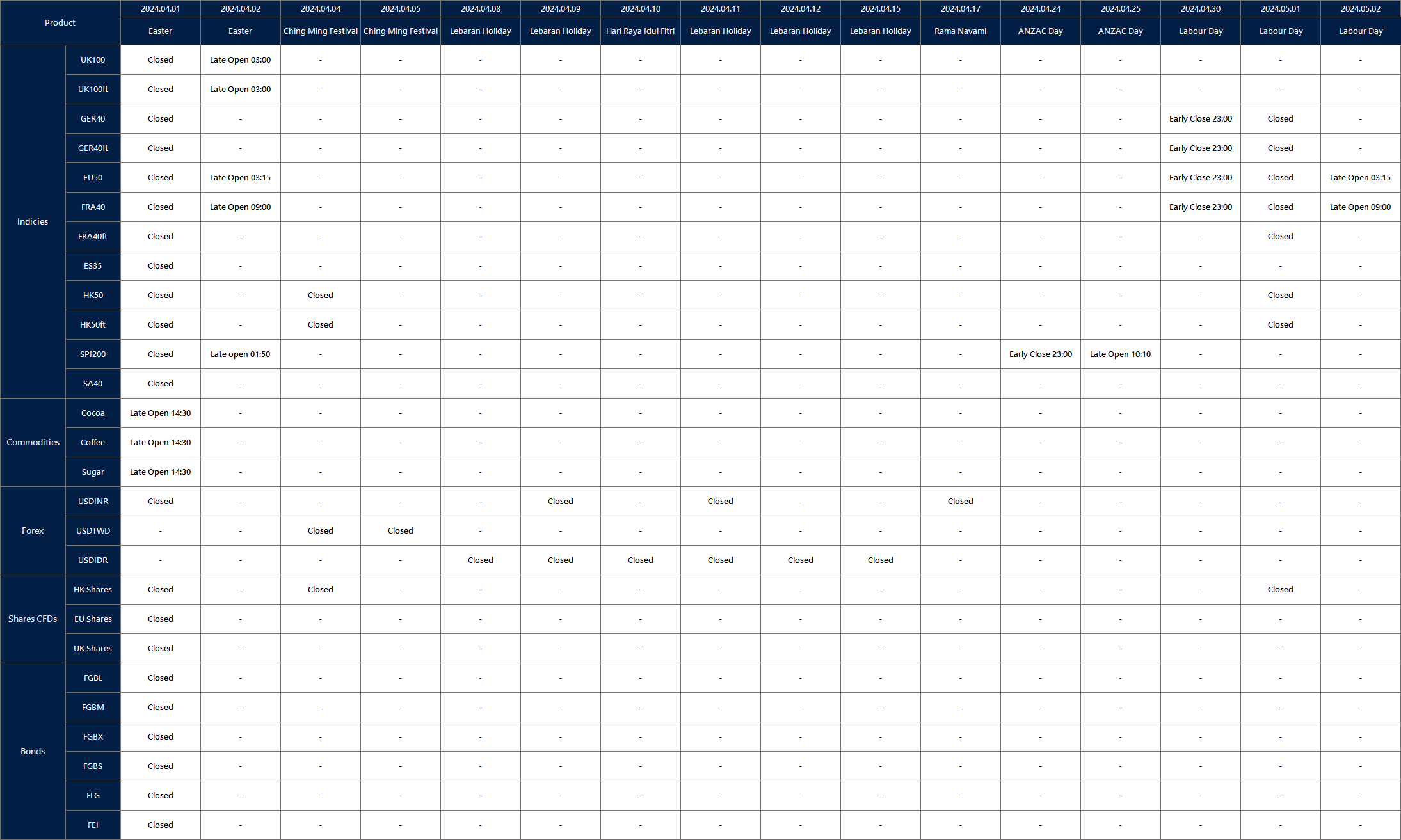
节假日可交易时间变更通知 – 2024年3月29日

尊敬的用户:

您好!

受到国际节假日影响,VT Markets 部份产品交易时间将有所调整。其余节假日受影响产品请见以下链接:

节假日可交易时间变更通知

注:”-” 符号表示正常交易時間。

温馨提醒:
以上时间为MT4/5服务器时间(GMT+3),在极少数情况下,以上信息可能会因流通性供应商的调整而变化,具体请以MT4/5实际交易时间为准。

如您有任何疑问,我们的团队将十分乐意为您解答。
请留言或发邮件至[email protected] 或联系在线客服。

Back To Top
server

您好 👋

我能帮您什么吗?

立即与我们的团队聊天

在线客服

通过以下方式开始对话...

  • Telegram
    hold 维护中
  • 即将推出...

您好 👋

我能帮您什么吗?

telegram

用手机扫描二维码即可开始与我们聊天,或 点击这里.

没有安装 Telegram 应用或桌面版?请使用 Web Telegram .

QR code