Euro Market Sentiment Overview: Market sentiment analysis for EUR/USD, EUR/GBP, EUR/JPY.
Popularity in Trading: Trading can appear as a popularity contest; discerning traders find value in contrarian approaches.
IG Client Sentiment as a Contrarian Indicator: This tool provides insights into market sentiment, helping to identify potential opportunities to go against the mainstream trend.
Sentiment Analysis for EUR/USD:
Retail traders are significantly bullish on EUR/USD, with 60.78% taking long positions.
The long-to-short ratio stands at 1.55 to 1.
There’s been a notable increase in long positions (up 3.99% from yesterday and 35.69% from last week), while short positions have seen a significant decrease.
Contrarian Interpretation: The strong bullish sentiment on EUR/USD may indicate a contrarian signal for a potential decline in the near term.
Combining Strategies for Trading: Contrarian indicators are most effective when used as part of a comprehensive strategy that includes technical and fundamental analysis.
Top of Form
STOCK MARKET:
S&P 500 Record High: Closed the first quarter of 2024 with a record, marking its best performance since 2019.
Market Performance: The S&P 500 and Dow Jones both increased by more than 0.1%, while the Nasdaq slipped by 0.1%.
Consistent Growth: All three major stock averages have risen for five consecutive months.
Quarterly Closure: With markets closing for Good Friday, Thursday was the final trading day of the quarter.
Broadening Rally: Initially driven by megacap stocks, the market rally is now expanding more broadly.
Wall Street Targets: Firms are raising their year-end price targets for the S&P 500 due to its strong performance.
Economic Growth Data: Fourth quarter GDP growth was revised up to 3.4% from 3.2%.
Employment Figures: Initial jobless claims were slightly below estimates at 210,000 for the last week.
Upcoming Key Data: Investors are awaiting the PCE price index, the Federal Reserve’s favored measure of inflation.
Wednesday witnessed a significant uptick in the S&P 500 and Dow Jones, marking a promising close to the first quarter with the best performance since 2019. All sectors of the S&P 500 saw gains, led by utilities, real estate, and industrials, amidst broad market optimism and strategic quarter-end rebalancing. The stock market’s positive trajectory is buoyed by expectations of a soft landing for the U.S. economy and adjusted interest rate cut forecasts. Meanwhile, in the currency market, the dollar index edged up slightly, with USD/JPY experiencing a minor dip amid speculation of Japanese intervention to support the yen. The currency landscape remains cautious, with upcoming U.S. economic data and central bank policy adjustments in focus, especially regarding rate cuts by the Fed and the ECB. Investors and traders are keenly awaiting further indicators, including jobless claims, GDP, and consumer sentiment, to gauge the economic outlook as the second quarter approaches.
Stock market updates
The S&P 500 saw a significant rise on Wednesday, marking a new record high as it continues its journey toward the best first quarter since 2019. The index rose by 0.86%, closing at 5,248.49, while the Dow Jones Industrial Average saw a substantial gain, advancing 477.75 points or 1.22% to close at 39,760.08. The Nasdaq Composite also enjoyed gains, rising by 0.51% to close at 16,399.52. This uplift in the stock market ended a three-day losing streak for both the S&P 500 and the Dow Jones, highlighting a robust broad rally across the market.
In terms of sector performance, all 11 sectors of the S&P 500 experienced gains, with utilities leading the charge with an impressive jump of nearly 2.8%. This was closely followed by real estate and industrials, which advanced 2.4% and 1.6% respectively. This widespread rally underscores the market’s positive sentiment, driven by a strategic rebalance toward the end of the quarter. According to Art Hogan, chief market strategist with B. Riley Wealth, this shift indicates a growing enthusiasm for equities, spurred by quarter-end rebalancing and an overall positive outlook for the stock market as we approach the end of the first quarter.
Looking ahead, the major stock indexes are set to conclude the first quarter on a strong note, with the S&P 500 aiming for a 10% gain, which would be its best first-quarter performance since 2019. The Dow and Nasdaq are also on track for substantial quarterly gains. Additionally, the anticipation of a soft landing for the US economy and adjusted expectations for interest rate cuts contribute to a positive market outlook. Investors are now looking forward to upcoming data on jobless claims, GDP, and consumer sentiment, which will provide further insight into the economic landscape as we move into the second quarter.
Currency market updates
The dollar index experienced a slight increase as the market consolidated gains from the previous week, with traders awaiting further U.S. economic data and navigating quarter-end rebalancing. This period of anticipation comes ahead of the upcoming holiday market closures. Despite a broader increase, the USD/JPY pair saw a minor decline, reflecting market reactions to potential Japanese intervention to support the yen and prevent further decline, contrasting with the aggressive yen support seen in October 2022 following the Fed’s rate hiking cycle commencement.
In currency movements, the USD/JPY dynamics were influenced by speculation around the Federal Reserve’s future rate cuts, with traders eyeing crucial economic data releases for further direction. Meanwhile, the EUR/USD pair dropped slightly amid fluctuations in yield spreads between bunds and Treasuries, indicating a cautious market sentiment towards rate cuts by major central banks. Market pricing shows a significant anticipation of rate adjustments by the ECB and the Fed within the year, highlighting the nuanced interplay between monetary policy expectations and currency valuations.
The British pound found some stability, managing to stay above a recent low, supported by steady yields spreads between Gilts and Treasuries. This steadiness is amidst a broader market focus on upcoming U.S. economic indicators and a keen interest in Federal Reserve Governor Christopher Waller’s speech for insights into the central bank’s rate strategy. As the market approaches the holiday weekend, with key economic data on the horizon, currency traders are closely monitoring shifts in monetary policy outlooks and their potential impact on currency markets.
Picks of the Day Analysis
EUR/USD (4 Hours)
EUR/USD outlook influenced by ECB and Fed’s potential easing cycles
The EUR/USD pair witnessed a slight decline as the US Dollar gained modestly, influenced by expectations of divergent monetary policy strategies between the Federal Reserve (Fed) and the European Central Bank (ECB). Both central banks are anticipated to initiate easing cycles possibly in June, albeit at potentially different paces. ECB’s consideration for a rate cut is supported by moderating wage growth in the eurozone, suggesting a cautious approach towards easing. Meanwhile, the probability of a Fed rate cut in June slightly decreased. Despite these developments, the broader economic outlook hints at a stronger Dollar in the medium term, especially as both banks move towards easing, potentially driving EUR/USD towards its year-to-date low and beyond.
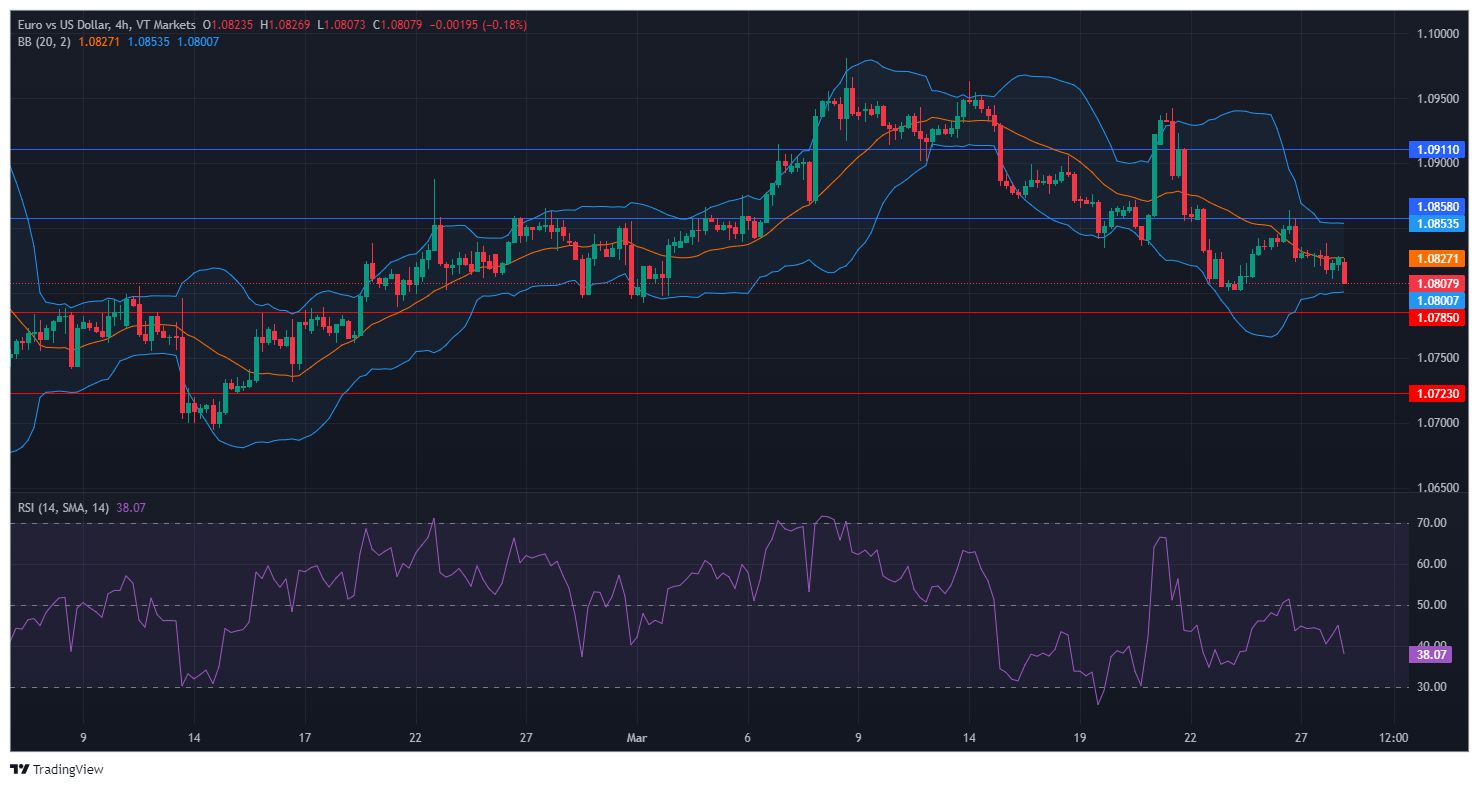
On Wednesday, the EUR/USD moved lower, able to reach near the lower band of the Bollinger Bands. Currently, the price is moving slightly above the lower band, suggesting a potential slight downward movement to reach the lower band. Notably, the Relative Strength Index (RSI) maintains its position at 38, signaling a bearish outlook for this currency pair.
US Dollar’s Current State: The US dollar shows a rangebound pattern, with minimal gains amid mixed Treasury yields and market caution.
Anticipation of Key Events: Traders are in a wait-and-see mode ahead of significant events, including US PCE data and Fed Chair Powell’s speech on Friday.
Bank Holiday Impact: Thinner market liquidity expected due to a bank holiday on Friday and Easter Monday in some European countries, potentially delaying market reactions.
Core PCE Data Significance: Friday’s core PCE data release is crucial for understanding consumer price trends, influencing policymakers’ decisions.
Fed Chair Powell’s Speech: His speech is keenly awaited for hints on the timing of the first interest rate cut in 2024.
Delayed Market Reaction Expected: Market response to these events may be postponed until the following week due to the holiday.
Reduced Liquidity Warning: Traders advised to exercise caution as reduced liquidity over the holiday could lead to larger price swings.
Technical Analysis Focus: The article will next explore the technical setups for EUR/USD, USD/JPY, and GBP/USD, identifying key support and resistance levels for strategic trading.
STOCK MARKET:
Late-Day Reversal: US stocks, after a strong start, reversed gains towards the end of Tuesday’s session.
Nasdaq’s Decline: The Nasdaq Composite fell approximately 0.4%, missing a record close.
S&P 500 and Dow Jones Performance: The S&P 500 dipped nearly 0.3%, and the Dow Jones dropped about 0.1%.
Economic Data Focus: Attention was on economic data, including a 1.4% rise in durable goods orders in February, driven by transportation equipment and machinery orders.
Home Price Index Rise: The S&P CoreLogic Case-Shiller National Home Price Index increased by 6% in January year-over-year, marking the highest annual rise since 2022.
Consumer Confidence: The Conference Board’s Consumer Confidence Index for March showed a slight decrease in consumer confidence about the US economy’s future.
Expectations Index Dip: A decline in the Expectations Index to 73.8 in March from 76.3 indicates potential recession signals for the coming year.
PCE Inflation Data Anticipation: Markets await the Personal Consumption Expenditures Price Index release on Friday, giving insight into inflation trends.
Trump Media & Technology Group’s Debut: Former President Donald Trump’s social media company made its debut on Wall Street, ending the day up 16% after an earlier surge.
This week witnessed a slight retreat in major U.S. stock indexes, with the S&P 500, Nasdaq Composite, and Dow Jones Industrial Average all experiencing downturns, contrasting sharply with their recent record highs. Notably, Tesla, Seagate Technology, and Krispy Kreme outperformed, driven by positive developments. Mixed economic data revealed robust durable goods orders but a drop in consumer confidence, setting a cautious tone for investors as they await key reports on personal consumption and labor market trends. In currency markets, the dollar index recovered, supported by U.S. Treasury yield rebounds and anticipation of upcoming economic data releases. The forex market sees cautious trading, with the USD/JPY pair in focus amid intervention concerns, and the EUR/USD facing downward pressure due to diverging central bank policies and economic forecasts. The market remains watchful, with investors poised for the next set of economic indicators to gauge future directions.
Stock market updates
The S&P 500 experienced a downturn for the third consecutive session, evidencing a modest retreat in the broader market. This downtrend saw the S&P 500 decline by 0.28%, closing at 5,203.58, while the Nasdaq Composite dropped by 0.42%, ending the day at 16,315.70. The Dow Jones Industrial Average slightly decreased by 31.31 points, or 0.08%, to settle at 39,282.33. This cooling period contrasts sharply with the performance seen last week when all three indexes reached record highs on Thursday, and the Dow neared the 40,000 milestone. Notably, Tesla, Seagate Technology, and Krispy Kreme were among the stocks that bucked the day’s downward trend, posting significant gains due to various positive developments.
Market dynamics on Tuesday were influenced by a mix of economic indicators and corporate news. Tesla’s shares surged nearly 3%, marking a notable rebound for the electric vehicle giant amidst a challenging year. Seagate Technology enjoyed a 7.4% uplift after an optimistic rating upgrade by Morgan Stanley, fueled by artificial intelligence prospects. Krispy Kreme’s shares skyrocketed by 39% following the announcement of an expanded partnership with McDonald’s, signaling positive investor sentiment towards these corporate strategies. According to Tom Hainlin, a senior investment strategist, the market’s expansion to include more cyclical sectors is a reflection of enduring economic health and persistently high inflation, despite mixed signals from Tuesday’s economic data, including robust durable goods orders but declining consumer confidence.
As the month draws to a close in a relatively quiet trading environment, expectations are set for the market’s performance in light of upcoming economic reports. Ross Mayfield, an investment strategy analyst, suggests that investors are adopting a wait-and-see approach ahead of crucial updates on personal consumption expenditure and labor market openings. The major stock indexes are poised for their fifth consecutive month of gains, with the S&P 500, Nasdaq Composite, and Dow Jones Industrial Average showing increases of over 2%, 1.4%, and 0.7%, respectively, for March. This resilience underscores the market’s capacity to sustain growth momentum amidst varying economic signals.
Currency market updates
The dollar index witnessed a revival, climbing back to positive territory amidst cautious trading ahead of the quarter-end and upcoming holidays, bolstered by mildly supportive U.S. economic data and anticipation of Friday’s core PCE update. The uplift in Treasury yields and the dollar was partly fueled by a rebound in U.S. durable goods orders, although mixed signals came from regional Fed manufacturing indexes and a dip in consumer confidence below expectations. The two-year Treasury yields saw a brief recovery, influenced by a solid five-year auction, setting the stage for potential shifts in yield and dollar movements post the critical core PCE, income, and consumption data release, with the forex market open for trading despite the closure of bond and stock markets on Friday.
In the currency pairs, USD/JPY modestly increased after overcoming concerns of potential Japanese intervention, which had been a hot topic following the Bank of Japan’s rate hike. Despite speculation and previous interventions aimed at curbing the yen’s decline, the upcoming U.S. economic data could solidify the dollar’s uptrend, making it difficult to justify intervention based on fundamental analysis. Meanwhile, EUR/USD experienced a slight decline, with market sentiment influenced by expectations of policy divergence between the ECB and the Fed, further compounded by pessimistic GDP forecasts for Germany contrasted with an upgraded U.S. GDP outlook by the FOMC.
The Swiss franc emerged as the weakest among major currencies, influenced by expectations of further rate cuts by the Swiss National Bank. Sterling remained stable, facing resistance ahead of recent highs, while the yuan found some footing after a previous setback, hinting at state-supported stabilization efforts. The currency market’s dynamics continue to be shaped by a complex interplay of economic indicators, central bank policies, and geopolitical factors, awaiting more definitive direction from upcoming high-tier U.S. data and its implications for global financial markets.
Picks of the Day Analysis
EUR/USD (4 Hours)
EUR/USD holds steady as central banks signal easing cycles amid mixed economic signals
In a day marked by slight movements, the US dollar saw a marginal rise, leading to a modest decline in the EUR/USD pair, which hovered around 1.0830. This minor fluctuation occurred amidst a backdrop of falling US and German yields, reflecting broader uncertainties and a cautious outlook from investors. Central banks on both sides of the Atlantic are gearing up for anticipated easing cycles starting possibly in June, with the pace of interest rate cuts expected to vary between the Federal Reserve (Fed) and the European Central Bank (ECB). Despite differing strategies, the ECB is poised not to fall significantly behind the Fed in its monetary easing efforts.
The week also highlighted contrasting perspectives within the Fed regarding the timing and necessity of rate cuts, underpinning a broader debate on how to navigate current economic challenges while aiming for a “soft landing.” With the FedWatch Tool indicating a rising probability for a rate cut in June, and ECB officials signaling readiness for easing, the stage is set for potential shifts in monetary policy that could impact currency dynamics.
Amid these developments, the enduring resilience of the US economy, juxtaposed with the euro area’s more tepid fundamentals, suggests a medium-term outlook favoring a stronger dollar. This scenario sets the stage for a potential deeper correction in the EUR/USD pair, with targets looming at the year-to-date low around 1.0700 and possibly extending towards the 1.0500 level observed in late 2023. The interplay of central bank policies, economic indicators, and market sentiment will be critical in shaping the currency pair’s trajectory in the coming months.
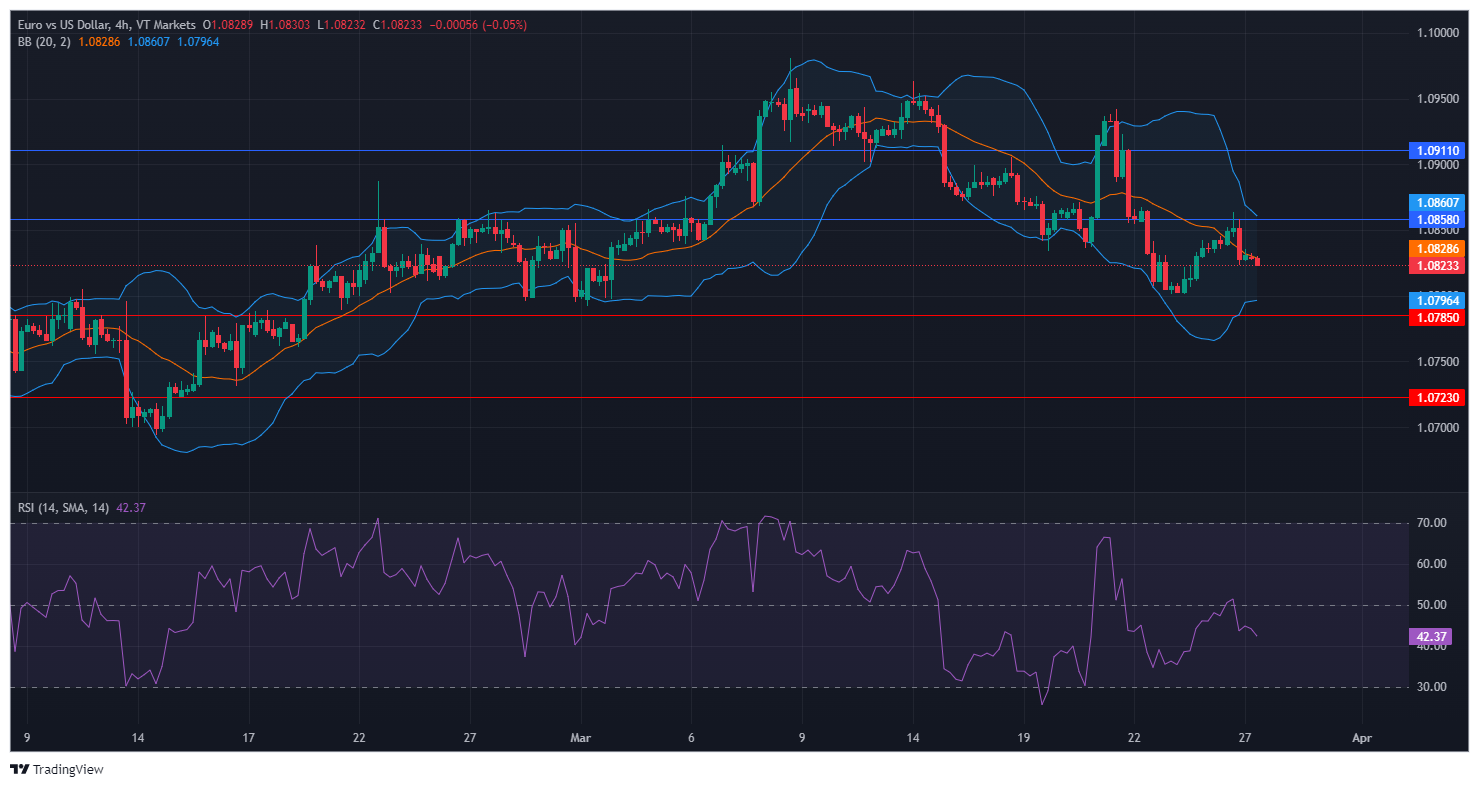
On Tuesday, the EUR/USD moved higher, able to reach near the upper band but then moved back lower to reach the middle band of the Bollinger Bands. Currently, the price is moving slightly below the middle band, suggesting a potential slight downward movement to reach the lower band. Notably, the Relative Strength Index (RSI) maintains its position at 42, signaling a neutral but bearish outlook for this currency pair.
GBP/USD Movement: The British Pound has slightly risen above 1.26 against the US Dollar, fueled by anticipation of interest rate reductions by the Federal Reserve in June.
Market Sentiments: Confidence is high among investors that the US will commence lowering borrowing costs in June, with over a 70% probability indicated by the Chicago Mercantile Exchange’s Fedwatch tool.
Federal Reserve Signals: Statements from the Federal Reserve have led markets to expect a drop in borrowing costs this year, contingent on sustained inflation decreases.
Bank of England Stance: While hinting at reaching the peak of interest rates, the Bank of England suggests it might not cut rates before the US, considering persistent inflation issues.
UK’s Economic Indicators:
Fitch upgraded the UK’s credit rating from ‘negative’ to ‘stable.’
Retail sales in January remained steady despite adverse weather conditions, contradicting economists’ expectations of a decline.
The UK is seen as gradually recovering from a mild recession, presenting a slightly more positive outlook than initially predicted.
Upcoming Economic Data:
US Durable Goods orders, set to be released on Tuesday, will be a key focus for GBP/USD traders.
The UK’s final GDP figures for the fourth quarter will be announced on Thursday, adding to this week’s significant economic updates.
Top of Form
STOCK MARKET:
Key Highlights:
Tesla’s New Promotion: Tesla introduces a one-month free trial of its Full Self-Driving (FSD) technology to U.S. customers.
CEO Announcement: Elon Musk, Tesla’s CEO, announced the trial offer on the social media platform X, aiming to boost sales and margins amid decreasing demand and competitive pricing pressures.
Product Details and Challenges: Despite being marketed at $12,000, FSD has yet to achieve full autonomy as promised by Musk, facing regulatory and safety scrutiny.
Implementation Strategy: Musk instructed Tesla employees to demonstrate FSD features to new buyers and serviced vehicle owners, emphasizing its capabilities in internal communications.
Consumer Response: The uptake of FSD among Tesla customers has decreased, dropping from 53% in Q3 2019 to 14% in Q3 2022 according to researcher Troy Teslike.
Financial Impact: Aggressive price cuts and declining FSD sales have significantly affected Tesla’s profit margins, with the company also anticipating lower delivery growth for the year due to a focus on new electric vehicle (EV) production.
Analyst Perspective: Industry analysts view the FSD demonstration mandate as one of Musk’s tactics to improve quarterly sales figures and revenues, amidst challenges.
Subscription Option: Tesla also offers FSD as a subscription service for $199 a month, highlighting that the technology requires driver supervision and does not fully automate the vehicle.
This week witnessed a modest retreat in stock markets, with key indices like the Dow Jones, S&P 500, and Nasdaq Composite pulling back from recent record highs, while the currency market saw nuanced movements amid varying global fiscal policies and geopolitical tensions. Intel and United Airlines faced declines due to regulatory and operational headwinds, respectively, slightly dampening the otherwise strong momentum driven by tech enthusiasm and Federal Reserve policies. Meanwhile, the dollar index experienced a slight dip, influenced by a mix of foreign exchange interventions, regulatory actions in China, and shifts in bond yields that affected major currency pairs such as EUR/USD and USD/JPY. As investors gear up for the release of the U.S. core PCE data, the market remains attuned to potential signals on inflation and monetary policy directions, balancing optimism with caution amid ongoing economic developments.
Stock market updates
Stocks experienced a slight downturn on Monday, initiating a subdued start to the trading week and momentarily pausing the upward trajectory that had propelled Wall Street to unprecedented highs. The Dow Jones Industrial Average retreated by 162.26 points, or 0.41%, to close at 39,313.64. The S&P 500 also witnessed a minor pullback, dropping 0.31% to end the day at 5,218.19. Similarly, the Nasdaq Composite edged lower by 0.27%, finishing at 16,384.47. Contributing to the market’s tepid performance, Intel’s shares fell by 1.7% following reports from the Financial Times about China’s new guidelines that could potentially restrict the use of the company’s chips in government servers. United Airlines saw a more significant decline, dropping 3.4% after announcements of increased scrutiny from the Federal Aviation Administration due to recent safety concerns.
Despite the day’s losses, the broader market remains on a robust growth path, marking its fifth consecutive month of gains and reaching new all-time highs last week. Last week’s rally was particularly strong, with the S&P 500, Dow, and Nasdaq Composite rising by approximately 2.3%, 2%, and 2.9%, respectively. This surge was buoyed by the Federal Reserve’s reaffirmation of its rate-cutting timeline and a sustained interest in tech stocks, driven partly by the enthusiasm for AI technologies. Market sentiment has remained resiliently optimistic, as evidenced by the American Association of Individual Investors sentiment survey, which continues to reflect a positive outlook above historical averages.
However, some market participants expressed concerns over the sustainability of the rally and the prospect of enduring high-interest rates. With the S&P 500 trading at a 33% premium over its 20-year average price-to-earnings ratio, the stage is set for cautious observation. Investors are keenly awaiting the release of the February personal consumption expenditures price index, the Fed’s preferred inflation gauge, for further clues about inflation’s trajectory. Despite expectations of a muted response to the PCE data, the market’s anticipation underscores the ongoing scrutiny of inflationary pressures and their implications for future monetary policy.
Currency market updates
In the currency markets, the dollar index saw a modest decline of 0.19%, as the EUR/USD pair experienced a rebound of 0.27%. This movement came after the pair managed to recoup some of its previous losses, tracing back to a significant Fibonacci retracement level. Contributing factors to the dollar’s pullback included a temporary dip in USD/JPY after Japan’s Ministry of Finance intensified its rhetoric on foreign exchange intervention and measures by Chinese authorities to stabilize the yuan following a sharp drop. Additionally, reports indicated that Chinese regulators are urging banks to expedite loan approvals for private property developers, adding a layer of complexity to the currency dynamics.
The British pound found its footing and began the week on a stronger note after bouncing off a key Fibonacci support level. Meanwhile, currency markets were also influenced by movements in bond yields, particularly as energy prices continued to climb amid geopolitical tensions and Russia’s compliance with OPEC+ production cuts. The interplay between Treasury and JGB yields, alongside speculation about Japan’s monetary policy, offered a nuanced backdrop for the USD/JPY pair, which remained a focal point of investor attention due to potential interventions and the broader implications for yen valuations.
As the week progresses, market participants are bracing for the release of the U.S. core personal consumption expenditures (PCE) data, with anticipations of how it might influence the Federal Reserve’s policy stance. The timing of the data release, coupled with month-end and fiscal year-end flows, especially for the yen, suggests the potential for heightened volatility in currency markets. The prospect of hawkish signals from the PCE data could embolden USD/JPY bulls, despite looming intervention threats. This week also features several Federal Reserve speakers, whose remarks will be closely monitored for any shifts in the central bank’s outlook, particularly in light of recent economic indicators.
Picks of the Day Analysis
EUR/USD (4 Hours)
EUR/USD rebounds amid mixed sentiments and central bank speculations
As the week commenced, the US Dollar’s (DXY) bullish trajectory moderated, leading to a slight retreat to the low 104.00s, despite rising US yields. This adjustment in momentum coincided with a renewed interest in riskier assets, providing the Euro with an opportunity to recover from its approach to 1.0800. Despite the Federal Reserve’s stance on maintaining interest rates to combat inflation, with an eventual rate cut forecasted for 2025, market sentiment, as indicated by the FedWatch Tool, leans towards expecting three rate cuts within the year, potentially starting in June. This outlook is somewhat countered by Federal Reserve officials’ cautious views on rate adjustments, highlighting a complex landscape of inflation control and economic stimulation. With both the Fed and the European Central Bank (ECB) on the brink of initiating easing cycles, possibly in parallel, the medium-term forecasts suggest a stronger Dollar. Yet, the EUR/USD pairing shows resilience, hinting at a complex interplay of economic fundamentals, central bank policies, and investor sentiment, possibly leading to significant currency fluctuations soon.
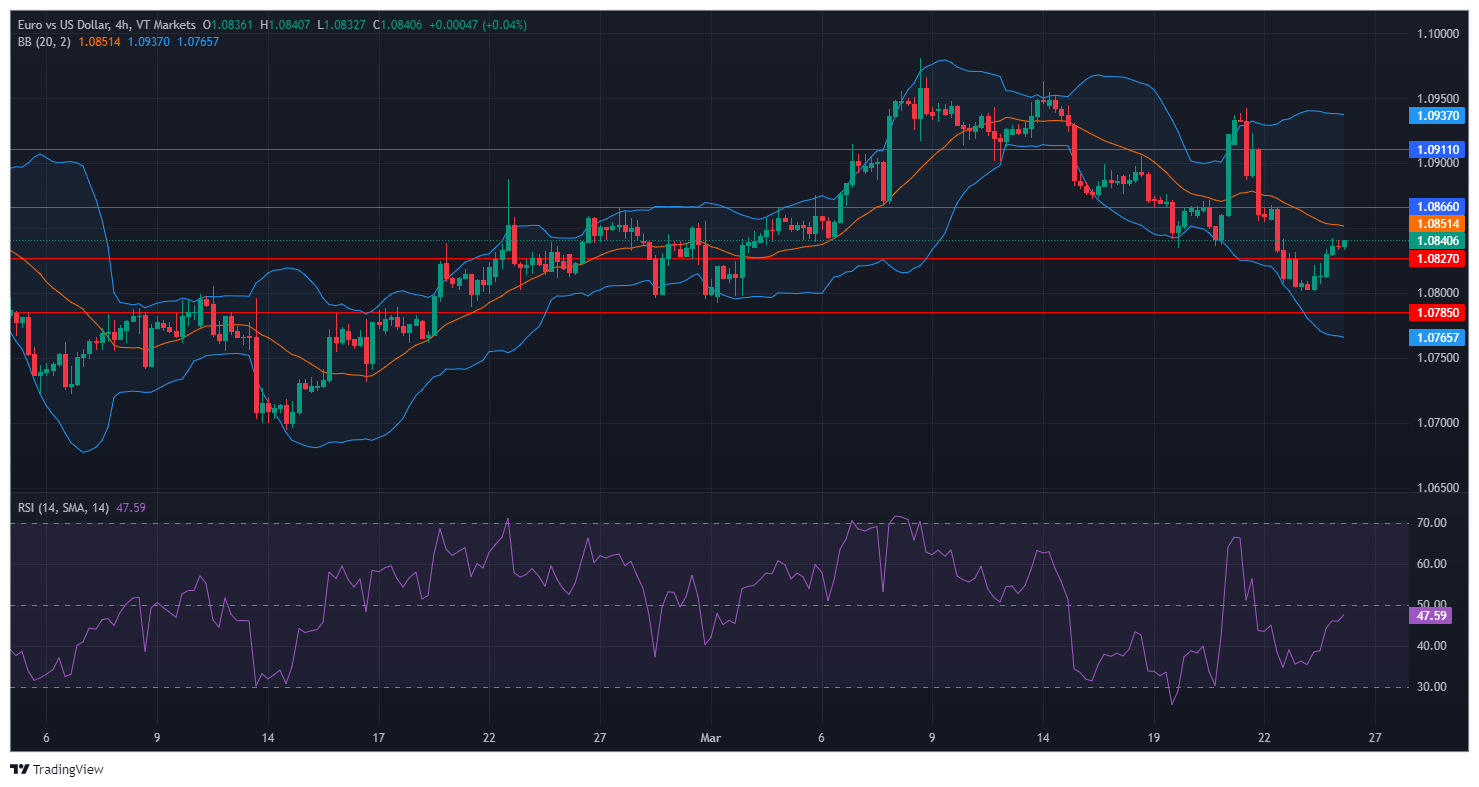
On Monday, the EUR/USD moved higher, able to reach near the middle band of the Bollinger Bands. Currently, the price is moving slightly below the middle band, suggesting a potential slight upward movement to reach the lower band. Notably, the Relative Strength Index (RSI) maintains its position at 47, signaling a neutral outlook for this currency pair.
Join us at Booth S1 at Traders Fair Philippines!
Traders Fair is a renowned financial event series with stops around the globe. Experience interactive seminars, workshops with experts, networking with industry leaders and lucky draws.