Stocks Decline as Powell’s Comments and Bond Yields Add Uncertainty

In the latest trading session, stock markets experienced a decline as investors reacted to Federal Reserve Chair Jerome Powell’s remarks regarding elevated inflation and monitored the rise in the benchmark U.S. 10-year Treasury yield. The Dow Jones Industrial Average fell by 0.75%, concluding at 33,414.17, while the S&P 500 and Nasdaq Composite also saw drops of 0.85% and 0.96%, respectively. Powell’s comments indicated a cautious approach to interest rate adjustments, resulting in a 97% probability of rates remaining unchanged at the upcoming policy meeting. Rising bond yields further added to market unease. Despite strong quarterly earnings reports from some S&P 500 companies, all major indexes are poised for weekly losses. In the currency market, the US dollar retreated, influenced by Powell’s speech and yield spreads between different countries’ bonds. The week ahead will be influenced by Japan’s Consumer Price Index (CPI), UK retail sales, and developments in the Israel-Hamas conflict.

Stock Market Updates

Stocks experienced a decline on Thursday as investors closely examined statements from Federal Reserve Chair Jerome Powell and monitored a crucial development in the Treasury bond yield. The Dow Jones Industrial Average fell by 250.91 points, marking a 0.75% drop, concluding at 33,414.17. Simultaneously, the S&P 500 saw a decrease of 0.85% to reach 4,278, and the Nasdaq Composite ended 0.96% lower at around 13,186. Powell acknowledged that inflation remains elevated and may necessitate slower economic growth, while also acknowledging some recent progress in curbing price increases. He stressed that despite these positive developments, inflation remains too high, emphasizing the need for more sustained progress in this regard. Investors interpreted his comments as a signal that the Federal Reserve is unlikely to adjust interest rates at its upcoming policy meeting, with a 97% chance of rates remaining unchanged as per CME Group’s FedWatch tool. Nevertheless, there is lingering uncertainty about the Fed’s long-term rate strategy, causing market volatility.

Rising bond yields also had a bearing on the market’s performance, with the benchmark U.S. 10-year Treasury yield approaching the significant 5% level, last seen in 2007. Additionally, quarterly earnings reports were a point of interest, with more than 15% of S&P 500 companies having already reported this earnings season. Among these, over 74% have surpassed Wall Street’s expectations. Notable moves in individual stocks included Tesla’s 9% decline after it missed analysts’ Q3 earnings and revenue estimates and CEO Elon Musk’s warning about the Cybertruck’s cash flow. Conversely, Netflix shares surged 16% after exceeding third-quarter earnings estimates, largely due to strong ad-tier subscriptions. Beyond the tech sector, AT&T saw a 6% increase following better-than-expected Q3 results, while Blackstone faced an 8% decline due to a weaker-than-anticipated report. As the week concludes, all three major indexes are poised for losses, with the Nasdaq down 1.7%, the S&P 500 down 1.2%, and the Dow down 0.8%.
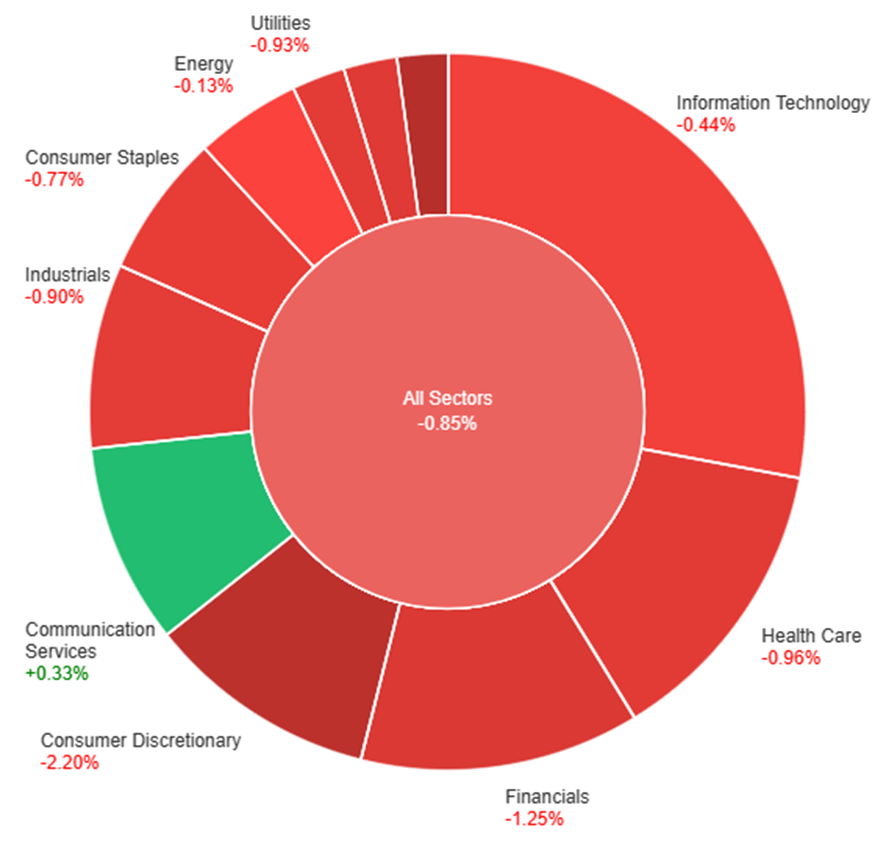
Data by Bloomberg

On Thursday, the stock market experienced a mixed day with varying sector performances. The overall market saw a decline of 0.85%. Some sectors, such as Communication Services (+0.33%) and Energy (-0.13%), showed modest movements, while others, like Consumer Discretionary (-2.20%) and Real Estate (-2.44%), faced significant declines. Financials (-1.25%) and Materials (-1.08%) also had notable losses, contributing to the overall negative trend. The Health Care (-0.96%), Utilities (-0.93%), Industrials (-0.90%), Consumer Staples (-0.77%), and Information Technology (-0.44%) sectors all experienced moderate decreases in their respective values. 

Currency Market Updates

In the latest currency market updates, the US dollar faced a significant retreat, driven by short-term US yield movements in response to Federal Reserve Chair Jerome Powell’s recent speech. Powell’s comments hinted at a reluctance to raise interest rates unless compelling data suggests a sustained reversal in inflation trends. The EUR/USD pair notably gained 0.46%, building on earlier increases despite widening spreads between German bund and US Treasury yields. This development raised concerns about the potential economic repercussions of higher Treasury yields and the rapidly narrowing 2-10-year yield curve, reaching its tightest level since September 2022. These indicators are perceived as potential warnings for the US economy in the long term, particularly impacting interest rate-sensitive sectors. In the currency market, EUR/USD’s movements near the pivotal levels of October’s high and 23.6% of the July-October decline at 1.0640-43 became crucial.

Additionally, USD/JPY’s effort to reattain the 150 level faced challenges, retracting by 0.05% after a broader pullback in the US dollar following Powell’s speech. Despite this retreat, it was modest, as the decrease in 2-year Treasury yields and spreads over Japanese Government Bond (JGB) yields was somewhat offset by an increase in 10-year yield spreads. The attractiveness of these spreads is maintained due to the gradual pace of policy normalization by the Bank of Japan (BoJ). Meanwhile, the British pound experienced a 0.07% gain, albeit not reaching its earlier highs linked to 2-year gilts-Treasury yield spreads, as short-term US Treasury yields decreased in response to Powell’s statements. However, the pound still remains distant from recent recovery highs and key resistance levels compared to the EUR/USD pair, which surged to break its 200-day moving average for the first time since May. In the broader market, the US dollar index dropped by 0.34%, primarily due to the EUR/USD’s rise, but found support at the kijun level at 1.0594. For a more significant retreat to be signaled, the US dollar would need to close below the 30-day moving average at 105.87 and October’s low at 105.53, falling to a key Fibonacci level at 105.50.

Finally, it is noteworthy that Japan’s Consumer Price Index (CPI) and UK retail sales are anticipated as the final major data releases for the week. Moreover, risk sentiment and oil prices, particularly those of crude-related currencies, will be influenced by the Israel-Hamas conflict and its broader implications. Israel’s defense minister’s statement about troops entering Gaza is expected to have a significant impact on these markets.

Picks of the Day Analysis
EUR/USD (4 Hours)

EUR/USD Gains Momentum Despite Obstacles and Weak Dollar

The EUR/USD saw an upward trend on Thursday, aiming for its highest daily close in over a week, fueled by a weaker US dollar amidst market risk aversion. Nevertheless, it struggled to hold above the 1.0600 mark, signaling potential challenges ahead. Key events to watch include Germany’s upcoming Producer Price Index report and the European Central Bank meeting, with expectations of unchanged key rates. In the US, mixed economic data, Federal Reserve Chair Jerome Powell’s stance on rate stability, and concerns about inflation have contributed to the USD’s weakness, maintaining intrigue in the EUR/USD pairing.
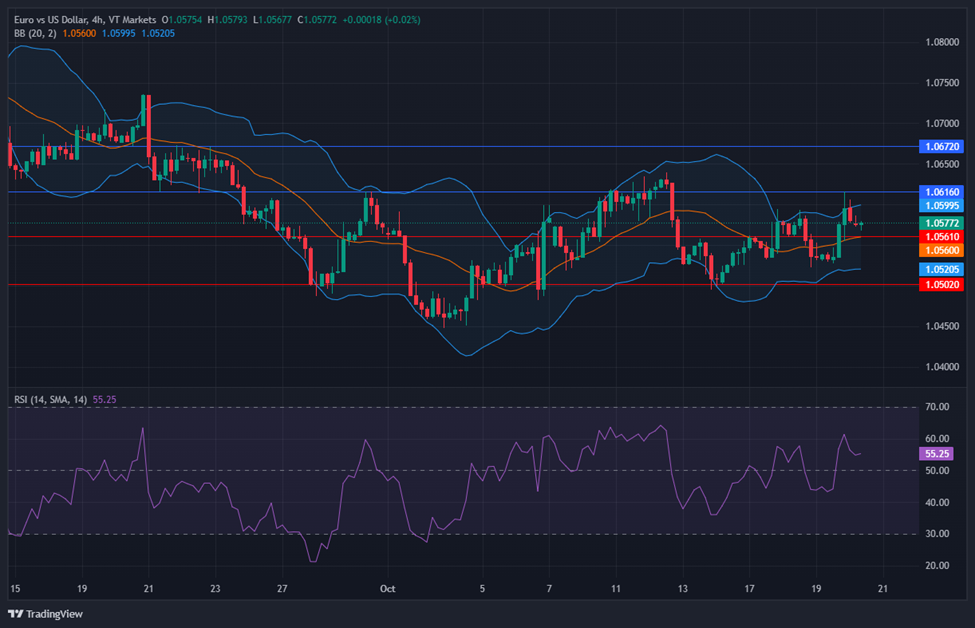
Chart EURUSD by TradingView

Based on technical analysis, the EUR/USD was slightly lower on Thursday, pushing towards the upper band of the Bollinger Bands. Currently, the EUR/USD is trading just above the middle band, suggesting the potential for another lower movement. The Relative Strength Index (RSI) stands at 55, indicating that the EUR/USD is still in neutral bias.

Resistance: 1.0616, 1.0672

Support: 1.0561, 1.0502

XAU/USD (4 Hours)

XAU/USD Surge to Three-Month High as US Dollar Weakens Amid Middle East Tensions and Fed Chairman’s Speech

Gold prices remain on a bullish trajectory, with XAU/USD surpassing $1,970 per troy ounce, its highest level in three months. Initially, the US Dollar found support due to risk-averse sentiment driven by tensions in the Middle East and anticipation of Jerome Powell’s speech at the Economic Club of New York. However, the Greenback later weakened despite global equities’ poor performance and rising government bond yields, as investors interpreted Powell’s words to mean the Federal Reserve would avoid further rate hikes. Speculative interest turned against the USD during Powell’s speech, allowing XAU/USD to maintain its gains. Notably, the 2-year Treasury note yield dropped to 5.16% after reaching a multi-year peak of 5.25%.
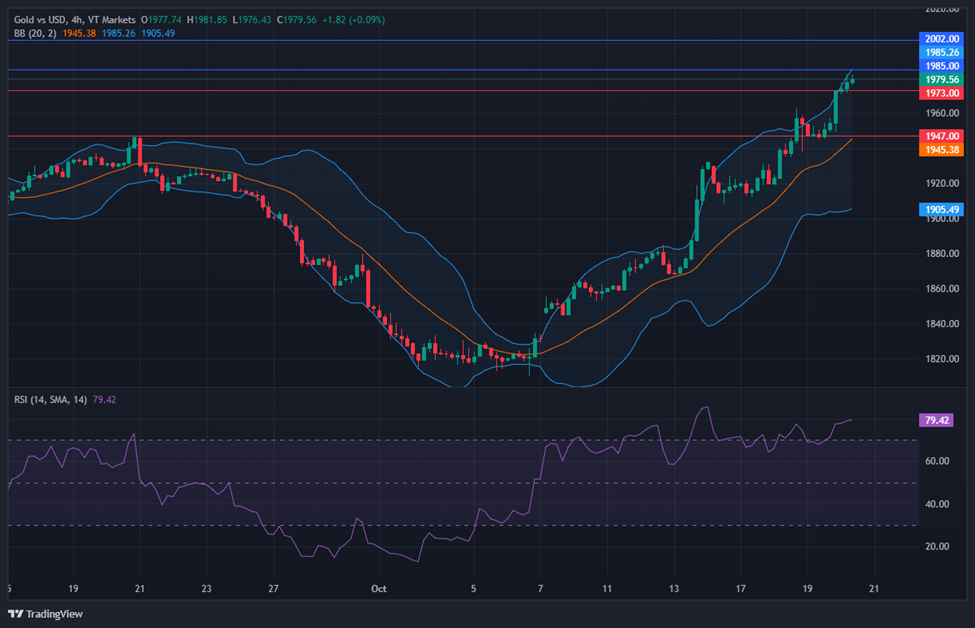
Chart XAUUSD by TradingView

Based on technical analysis, XAU/USD is moving higher on Thursday and able to reach the upper band of the Bollinger Bands. Currently, the price of gold is moving just below the upper band, suggesting a possible continuation movement. The Relative Strength Index (RSI) currently registers at 79, indicating a bullish bias for the XAU/USD pair.

Resistance: $1,985, $2,002

Support: $1,973, $1,947

Economic Data
CurrencyDataTime (GMT + 8)Forecast
GBPRetail Sales14:00-0.3%

服务器升级维护通知 – 2023年10月19日

尊敬的用户:

您好! VT Markets 致力于为客户提供更快速且稳定的交易环境,我们将于周末进行服务器 (MT4/MT5) 升级维护。

维护时段:
2023 年 10 月 21 日 (星期六) 07:00 至 09:00

上述时段采用 GMT+8

维护期间请您务必留意下列事项:

1. 服务器报价将会暂停,客户将无法建立新仓位或是关闭既有持仓。

2. 维护前后的市场价格可能发生跳空,在跳空范围内的挂单或止损/止盈设置将在维护结束后的市场价格成交。

3. 具体维护完毕与开盘时间请依据MT4/MT5软件为准。

望您谅解因此次升级维护为您所带来的不便,我们将继续为您提供更优质的服务。

如您有任何疑问,我们的团队将十分乐意为您解答。
请留言或发邮件至 [email protected] 或联系在线客服。

Stocks Tumble as Earnings Reports Disappoint, Treasury Yields Surge

In a tumultuous day for the stock market, major indexes, including the Dow Jones Industrial Average, S&P 500, and Nasdaq Composite, saw significant declines as corporate earnings reports fell short of expectations. The 10-year Treasury yield reached levels not seen since 2007, signaling rising interest rates, while mortgage rates hit a two-decade high. Individual companies were impacted by their earnings reports, with some facing notable declines and others, like Procter & Gamble, experiencing stock gains. The market’s focus has now shifted to revenue growth during the earnings season, and geopolitical factors, such as the Israel-Hamas conflict and U.S. President Joe Biden’s visit to Israel, also influenced market sentiment. Meanwhile, in the currency market, the U.S. dollar saw a modest increase, driven by losses in the EUR/USD and GBP/USD pairs. The rise in Treasury yields compared to bunds attracted investors seeking safety amid growing geopolitical risks.

Stock Market Updates

Stocks experienced a decline on Wednesday as corporate earnings reports continued to roll in, and Treasury yields reached multiyear highs. The Dow Jones Industrial Average fell 332.57 points, or 0.98%, to close at 33,665.08. Similarly, the S&P 500 dropped 1.34% to 4,314.60, while the Nasdaq Composite slipped 1.62% to 13,314.30. None of these major indexes traded in positive territory throughout the day. A key development was the 10-year Treasury yield surpassing 4.9%, a level not seen since 2007, signaling rising interest rates. Simultaneously, the average 30-year fixed mortgage rate hit 8%, the highest rate since 2000.

Earnings reports had a notable impact on individual companies’ stock prices. Companies like J.B. Hunt and United Airlines faced significant declines due to disappointing earnings and soft guidance. In contrast, Procter & Gamble’s stock rose after beating analyst expectations. The market’s attention is now shifting to revenue growth during this earnings season, as investors assess which companies are experiencing increased demand and which are merely improving earnings through cost-cutting measures. Additionally, chip stocks faced challenges as restrictions on the sale of advanced artificial intelligence chips to China were announced by the U.S. Department of Commerce, leading to continued selling in the sector. Geopolitical factors, such as the ongoing Israel-Hamas conflict and U.S. President Joe Biden’s visit to Israel, also contributed to market sentiment.

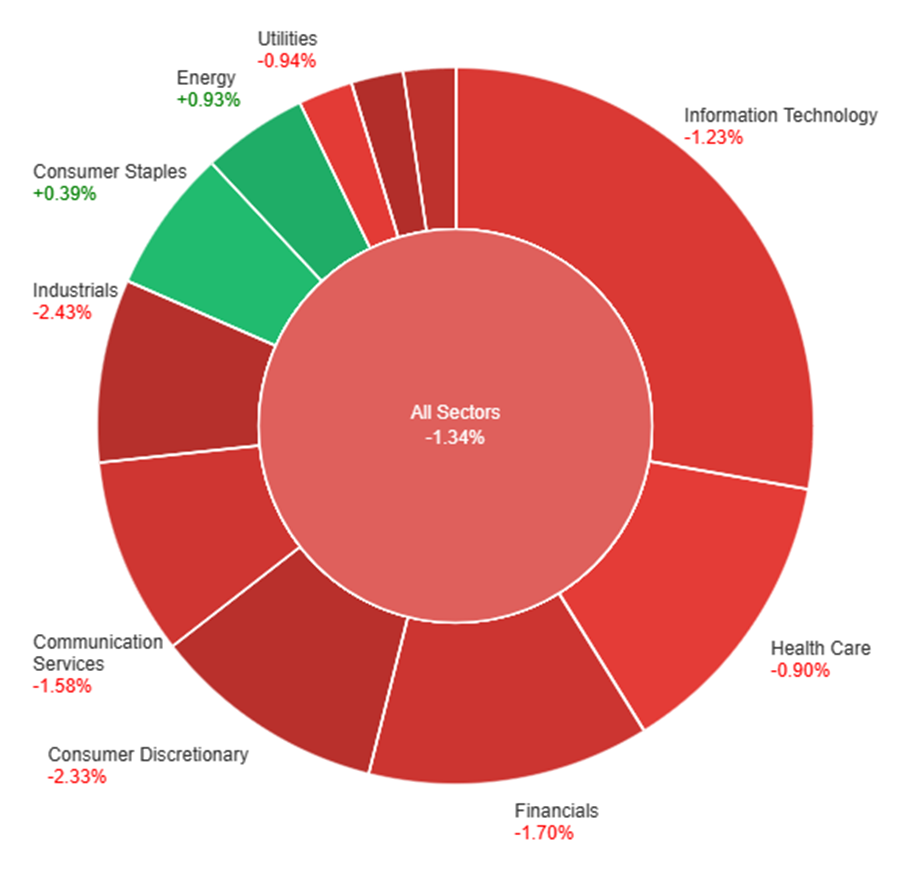
Data by Bloomberg

On Wednesday, the overall market experienced a decline of 1.34%. Among the various sectors, there was a mixed performance. Energy and Consumer Staples saw gains of 0.93% and 0.39%, respectively. In contrast, there were losses in several sectors, with the largest declines in Consumer Discretionary (-2.33%), Industrials (-2.43%), and Materials (-2.58%). Other sectors, including Health Care, Utilities, Information Technology, Communication Services, Financials, and Real Estate, also saw losses ranging from -0.90% to -2.18%.        

Currency Market Updates

In recent currency market updates, the US dollar experienced a modest increase, with the dollar index rising by 0.16%. This rise was primarily driven by losses in the EUR/USD and GBP/USD currency pairs. The increase in Treasury yields compared to bunds attracted investors seeking safety amid growing geopolitical risks. However, it’s worth noting that the yen and Swiss franc appreciated more against other currencies than the US dollar did, particularly against high-beta currencies. EUR/USD faced a decline of 0.23% as the spreads between 2-year bund and Treasury yields reached their most negative levels since August. Additionally, 10-year spreads were at their lowest point since May 2022, but a late pullback in Treasury yields may influence the overall trend. Notably, there hasn’t been a close below 1.0500 for EUR/USD since October 3.

The market also observed that concerns over the Israel-Hamas conflict potentially impacting energy supplies posed a greater threat to eurozone countries that rely more heavily on energy imports than the United States. Meanwhile, the rise in 2-year Treasury yields was influenced by stronger-than-expected US economic data and comments from Federal Reserve speakers favoring maintaining higher interest rates for an extended period while monitoring economic indicators. Unless the Fed decides to raise rates again in January, which is currently priced at a 50% probability, there may be limited upside left for 2-year yields. Other notable movements included a decline in the British pound (GBP) as risk-off sentiment prevailed, though gilt-treasury yield spreads rebounded slightly due to above-forecast UK inflation data. The Australian dollar and other risk-sensitive currencies also fell, while the Chinese yuan slipped following brief gains on above-forecast Chinese data. Upcoming economic events include jobless claims, existing home sales, and comments from Federal Reserve Chair Jerome Powell.

Picks of the Day Analysis
EUR/USD (4 Hours)

EUR/USD Slips Below Key Moving Average as US Dollar Strengthens Amid Geopolitical Concerns and Soaring Treasury Yields

EUR/USD dropped below the 20-day Simple Moving Average (SMA) as it faced resistance at 1.0600, primarily due to the US Dollar’s overall strength driven by deteriorating market sentiment and rising Treasury yields. The initial boost in market sentiment from positive Chinese growth data was short-lived, with geopolitical concerns taking center stage and further supporting the US Dollar. The 10-year Treasury yield reached its highest level since 2007 at 4.92%, adding to the Greenback’s momentum. The upcoming economic data releases and a speech by Federal Reserve Chair Powell, underscore the continuing bearish trend for the EUR/USD pair due to favorable fundamentals for the US Dollar.

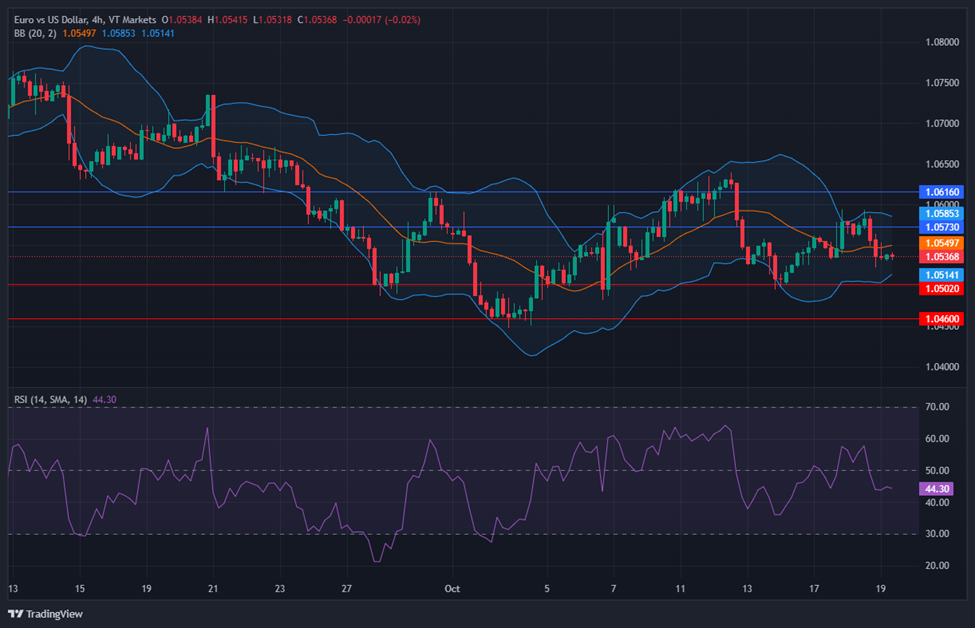
Chart EURUSD by TradingView

Based on technical analysis, the EUR/USD was slightly lower on Wednesday, pushing towards the middle band of the Bollinger Bands. Currently, the EUR/USD is trading just below the middle band, suggesting the potential for another lower movement. The Relative Strength Index (RSI) stands at 44, indicating that the EUR/USD is still in neutral bias.

Resistance: 1.0573, 1.0616

Support: 1.0502, 1.0460

XAU/USD (4 Hours)

XAU/USD Surges to Two-Month High Amid Escalating Middle East Tensions

Gold (XAU/USD) made a strong resurgence, hitting a fresh two-month high at $1,962.62 per troy ounce as Middle East tensions escalated. Despite some mid-American session retracement to around $1,949, XAU/USD maintained its gains, partly due to the U.S. Dollar’s uptick following a decline in stock markets. Meanwhile, President Joe Biden’s brief visit to Israel further heightened the geopolitical situation in the region. Mixed macroeconomic data, including robust Chinese growth and higher-than-expected UK inflation, added to market uncertainty, leading to a 0.52% decline in the Dow Jones Industrial Average amid a challenging day for earnings reports.

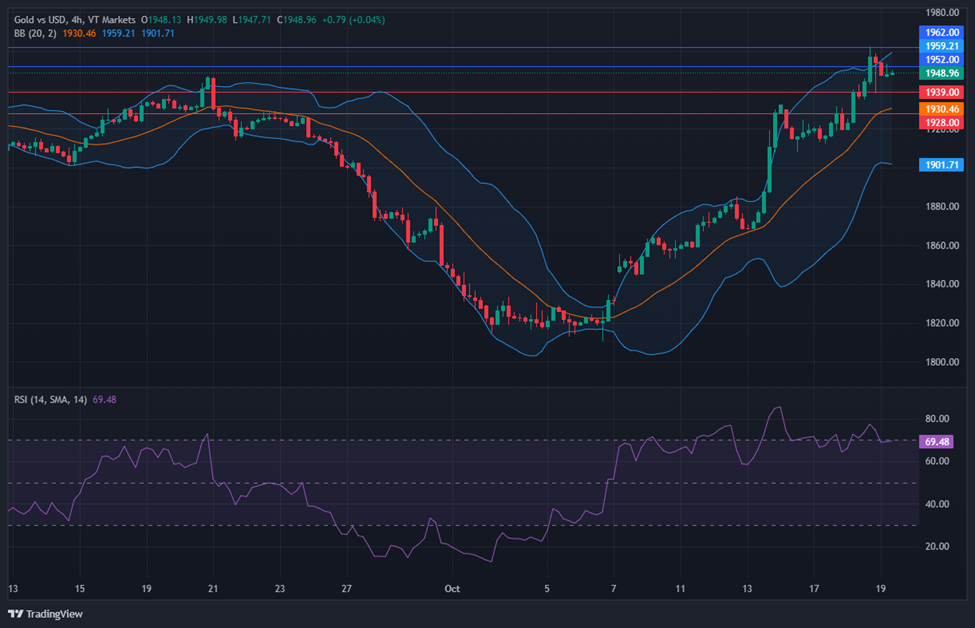
Chart XAUUSD by TradingView

Based on technical analysis, XAU/USD is moving slightly higher on Wednesday and is able to reach the upper band of the Bollinger Bands. Currently, the price of gold is moving just below the upper band, suggesting a possible correction to reach the middle band. The Relative Strength Index (RSI) currently registers at 69, indicating a bullish bias for the XAU/USD pair.

Resistance: $1,952, $1,962

Support: $1,939, $1,928

Economic Data
CurrencyDataTime (GMT + 8)Forecast
AUDEmployment Change08:306.7K (Actual)
AUDUnemployment Rate08:303.6% (Actual)
USDUnemployment Claims20:30210K

Demystifying Japanese Candlesticks: A Beginner’s Guide 

The story of Japanese candlesticks unfolds in 18th century Japan, a time when rice trading was a pivotal economic activity. Merchants and traders required a reliable method to analyse and predict price movements of rice, a commodity of immense importance. This necessity led to the development of what we now know as Japanese candlesticks. 

Dojima Rice Exchange in Japan, 18th century
source: JPX

Japanese traders, in their quest for a more intuitive and visual way to interpret market movements, created a graphical representation that would later revolutionise the world of financial analysis. The candlestick charting technique was born, allowing them to observe the price action in a structured and insightful manner. 

Fast forward to the present day, Japanese candlesticks have become an integral part of technical analysis in financial markets across the globe, particularly in the vast arena of Forex trading. The elegance and effectiveness of this tool have stood the test of time, making it a cornerstone of modern trading strategies. 

Understanding Japanese candlesticks is more than just learning about patterns and shapes. It’s about delving into a historical narrative that encapsulates the evolution of financial markets and the human desire to decode the enigma of market behaviour. 

By grasping the essence of Japanese candlesticks, traders gain a powerful lens through which they can decipher price movements, enabling them to make informed and strategic trading decisions. 

In this guide, we will explore the fundamentals of Japanese candlesticks and equip you with the knowledge needed to navigate the Forex market confidently. 

Understanding Japanese Candlesticks 

Japanese candlesticks serve as the cornerstone of technical analysis in the realm of Forex trading. These simple yet powerful graphical representations offer invaluable insights into price movements, making them an essential tool for traders. 

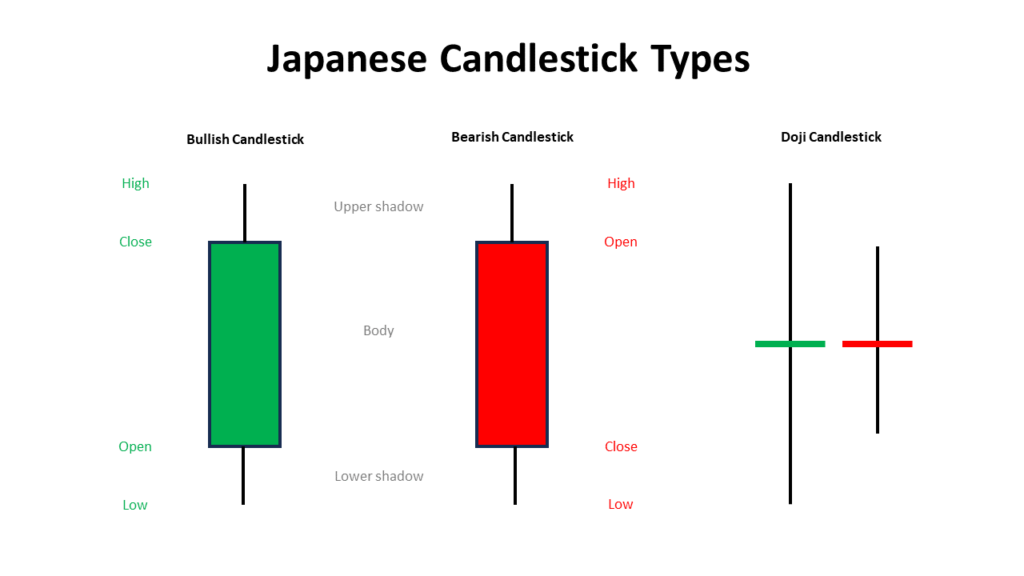
Japanese Candlestick Types

Structure of a Candlestick 

A candlestick is like a visual snapshot of the price movement over a specific time period. It encapsulates three crucial components that provide a comprehensive view of market dynamics: 

  • Body: The central, solid part of the candlestick represents the price range between the opening and closing prices during the given time frame. If the closing price is higher than the opening price, the body is typically coloured green or white, indicating a bullish movement. Conversely, if the closing price is lower than the opening price, the body is coloured red or black, indicating a bearish movement. 
  • Wick (Upper and Lower Shadows): The thin lines, often referred to as the wicks or shadows, extend from the body at both ends. The upper shadow denotes the highest price reached during the time period, while the lower shadow represents the lowest price. These wicks help visualise the price fluctuations and volatility. 
  • Shadow: The entire length from the highest point of the upper shadow to the lowest point of the lower shadow is termed as the shadow, signifying the entire price range for that period. 

Types of Candlesticks 

Candlesticks come in various shapes and forms, each conveying unique market sentiments. They are broadly categorised into three types

  • Bullish Candlesticks: These candlesticks signal a price increase during the specified time period. Their bodies are usually green or white, illustrating a positive market sentiment and a potential uptrend. 
  • Bearish Candlesticks: Conversely, bearish candlesticks indicate a price decrease over the designated time frame. Their bodies are commonly red or black, symbolising a negative market sentiment and a potential downtrend. 
  • Doji Candlesticks: The Doji candlestick is a special case where the opening and closing prices are nearly equal, resulting in a very short or non-existent body. Doji candlesticks signify market indecision and often precede significant price movements. 

Colour Coding of Candlesticks 

Understanding the colour coding of candlesticks aids traders in swiftly identifying market trends and interpreting price movements: 

  • Bullish Candlesticks: Typically, these candlesticks are portrayed in green or white, signifying optimism and an upward price movement. 
  • Bearish Candlesticks: Conversely, bearish candlesticks are usually depicted in red or black, indicating a pessimistic outlook and a downward price movement. 

Interpreting Japanese Candlesticks 

To effectively utilise Japanese candlesticks in Forex trading, understanding common candlestick patterns and their implications is crucial. These patterns can provide valuable insights into market sentiment and potential trend changes, aiding traders in making informed decisions. 

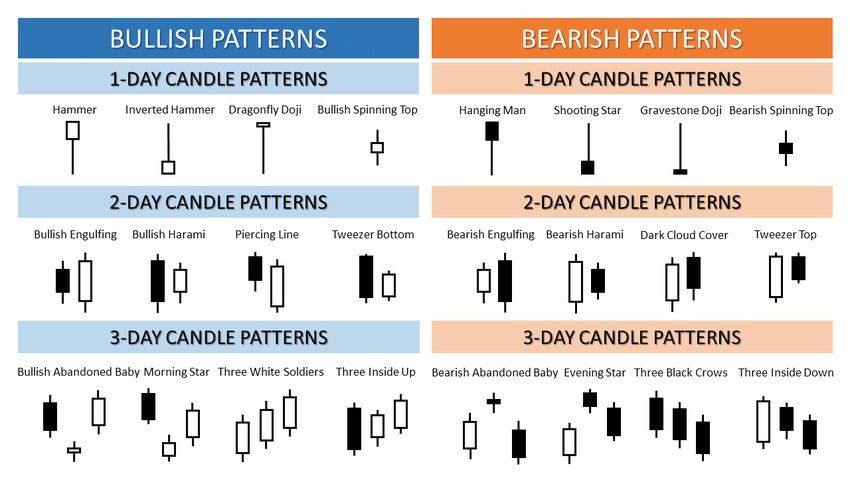
Japanese Candlestick Patterns
source: ResearchGate

Common Candlestick Patterns 

  • The Doji candlestick is a significant pattern that signifies market indecision. It occurs when the opening and closing prices are very close to each other, resulting in a candlestick with a very short or non-existent body. Doji patterns suggest that neither buyers nor sellers have gained control, often preceding major price movements. 
  • The Hammer candlestick pattern is characterised by a small body at the top and a long lower shadow, resembling a hammer. It typically occurs after a downtrend and signals a potential price reversal. Hammers indicate that sellers drove the price lower during the session, but buyers managed to push the price up, showcasing potential buying interest. 
  • A Shooting Star candlestick pattern is the opposite of a hammer. It has a small body at the bottom and a long upper shadow, resembling an inverted hammer. This pattern occurs after an uptrend and implies a potential bearish reversal. It suggests that although buyers pushed the price higher during the session, sellers entered the market and pushed the price down, indicating potential selling pressure. 
  • The Engulfing candlestick pattern involves one candle completely “engulfing” the previous one. In a bullish engulfing pattern, the first candle is smaller and bearish, followed by a larger bullish candle. This suggests a reversal in the current downtrend. Conversely, a bearish engulfing pattern occurs during an uptrend, indicating a potential reversal to a downtrend. 
  • A Spinning Top candlestick is characterised by a small body and long upper and lower shadows. This pattern reflects market indecision, showcasing a battle between buyers and sellers. Spinning tops suggest that neither buyers nor sellers were able to dominate, leaving the market uncertain about its direction. 

Analysing Length and Shape 

Apart from candlestick patterns, the length and shape of the candlestick body and wicks provide additional insights into market sentiment: 

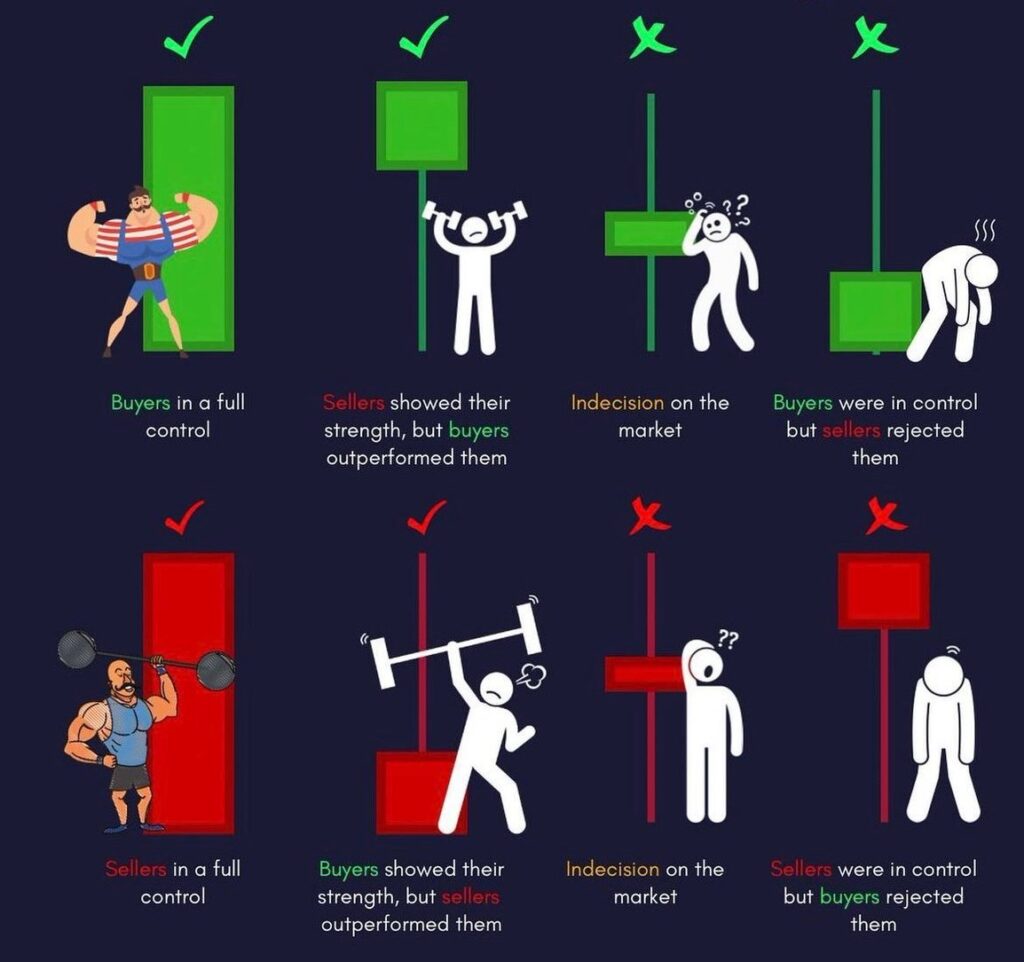
  • Candlestick Body Length: A long bullish (green or white) or bearish (red or black) body indicates strong buying or selling activity during the session, reflecting market conviction. 
  • Wick Length: Long wicks signify price fluctuations and uncertainty. Longer upper shadows indicate potential resistance levels, while longer lower shadows indicate potential support levels. 
Japanese Candlesticks Strength
source: priceNpedia on x.com

Applying Japanese Candlesticks in Forex Trading 

To leverage Japanese candlesticks effectively in your trading strategy, follow these tips

1. Identify Trends 

  • Identifying Trend Reversals: Look for reversal patterns like the Hammer or Shooting Star after a prolonged trend. For instance, a Hammer after a downtrend could signal a potential trend reversal to the upside. 
  • Spotting Continuation Patterns: Patterns like Bullish or Bearish Engulfing can suggest that the existing trend is likely to continue. If the pattern aligns with the current trend direction, it provides confidence in holding or adding to a position. 

2. Combine with Indicators 

  • Moving Averages: Utilise moving averages to identify the overall trend direction. When a candlestick pattern aligns with the moving average direction, it provides a more robust confirmation of potential market movements. 
  • Relative Strength Index (RSI): RSI is excellent for gauging overbought or oversold conditions. When a candlestick pattern suggesting a reversal aligns with RSI indicating an overbought or oversold market, it strengthens the reversal signal. 

3. Set Entry and Exit Points 

  • Entry Points: Use bullish patterns like Bullish Engulfing or Hammer as signals to enter a trade, especially if they align with a trend confirmation from other indicators. Place your entry point just above the high of the pattern. 
  • Exit Points: For exit points, utilise bearish patterns like Bearish Engulfing or Shooting Star. These patterns can indicate potential price declines, prompting you to exit a trade. Set your exit point just below the low of the bearish pattern. 
  • Implement Stop-loss and Take-profit Strategies: Always incorporate stop-loss and take-profit levels to manage your risk effectively. Determine your stop-loss based on the pattern’s low for bullish trades and high for bearish trades. Adjust your take-profit levels based on the potential price movement indicated by the pattern. 

Common Mistakes and How to Avoid Them 

Avoid these common errors to enhance your candlestick analysis: 

  • Overcomplicating Analysis: Keep your analysis simple and focused on the most essential patterns. Overcomplicating can lead to confusion and poor decision-making. 
  • Ignoring Market Context: Consider broader market trends and economic indicators alongside candlestick patterns to make well-informed trading decisions. 
  • Trading Solely Based on Candlestick Patterns: While candlesticks are powerful, relying solely on them can be risky. Always consider a holistic approach to your analysis. 

In conclusion, mastering Japanese candlesticks is a fundamental step towards becoming a successful Forex trader. By understanding their structure, interpreting patterns, and applying them effectively, you can gain valuable insights into market sentiment and potential trends. Avoiding common mistakes and integrating candlestick analysis into a comprehensive trading strategy will set you on the path to success in the dynamic world of Forex trading. Keep learning and practicing to refine your skills and achieve your trading goals. 

Summary: 

  • Japanese candlesticks, originating in 18th century Japan, are crucial in modern financial analysis, especially in Forex trading. 
  • Understanding candlestick structure and types is vital for interpreting market movements. 
  • Colour coding (green/white for bullish, red/black for bearish) helps identify trends quickly. 
  • Common candlestick patterns provide insights into market sentiment and trend changes. 
  • Analysing length and shape of candlestick components (body, wicks) offers additional market insights. 
  • Applying candlesticks in Forex involves identifying trends, combining with indicators, and setting entry/exit points with stop-loss/take-profit strategies. 
  • Avoid overcomplicating analysis and integrate candlestick analysis into a comprehensive trading strategy for success in Forex trading. 

US Dollar Edges Steady as Stock Futures Dip, Wall Street Awaits Key Reports and Examines Earnings Season Performance

Stock futures showed a slight decline in anticipation of crucial financial reports, with Dow Jones Industrial Average futures falling by 0.1% and both S&P 500 and Nasdaq-100 futures edging lower by the same margin. United Airlines and J.B. Hunt faced notable declines due to soft guidance and disappointing results, respectively. As earnings season continues, companies are exceeding earnings and sales expectations, while investors are closely monitoring interest rates. In the currency market, the US dollar remained stable despite brief fluctuations, the EUR/USD pair saw a minimal increase, and the GBP/USD pair depreciated due to concerns about the UK’s economic conditions. The USD/JPY pair recorded modest gains, influenced by various factors, including monetary policies and the situation in the Israel-Hamas conflict. Federal Reserve Chair Jerome Powell’s statements later in the week are eagerly anticipated.

Stock Market Updates

In the stock market update, stock futures showed a slight decline as Wall Street was anticipating key financial reports. Dow Jones Industrial Average futures dipped 0.1%, or 37 points, while S&P 500 futures and Nasdaq-100 futures both edged lower by 0.1%. Notable stocks that faced declines included United Airlines, which fell more than 4% due to soft guidance, and J.B. Hunt, which lost more than 3% due to disappointing results. The previous trading session saw modest movement, with the Dow Jones Industrial Average rising 0.04%, the S&P 500 inching 0.01% lower, and the Nasdaq Composite falling 0.25%. Bond yields rose on stronger-than-expected September retail sales, and the yield on the 10-year U.S. Treasury note reached its highest level since October 6. Chip stocks like Nvidia and Advanced Micro Devices declined as the U.S. announced plans to tighten restrictions on AI chip exports to China. Wall Street was also monitoring the impact of the Israel-Hamas conflict and analyzing third-quarter earnings reports, with many companies surpassing earnings and sales expectations.

As earnings season continues, the outlooks and the direction of interest rates will play a crucial role in determining the near-to-intermediate term direction of stocks. So far, 83% of companies have exceeded earnings expectations, and approximately 70% have exceeded sales estimates. The reporting season continued with results expected from Morgan Stanley, Procter & Gamble, and Travelers before the opening bell on Wednesday, with Netflix and Tesla set to release their results after the market close. Additionally, the market was awaiting housing starts and building permits data for September on the economic front.

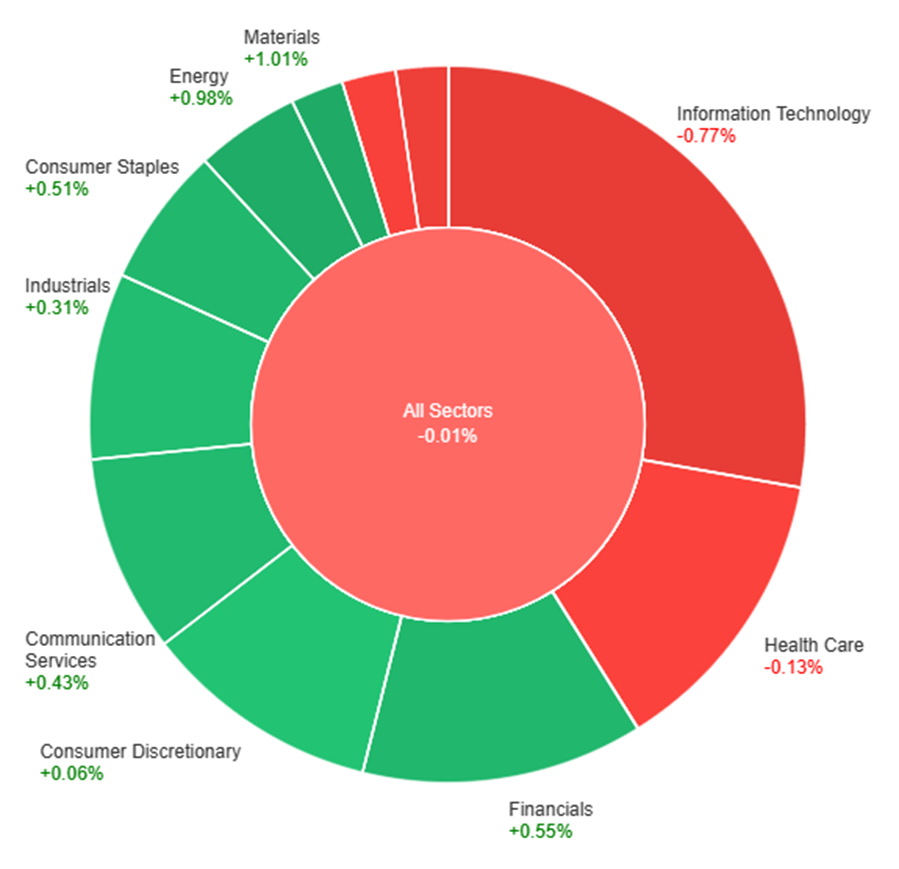
Data by Bloomberg

On Tuesday, the overall performance of the stock market showed a slight decline of 0.01%. Among the sectors, Materials and Energy had the most significant gains, with increases of 1.01% and 0.98%, respectively. Financials and Consumer Staples also saw positive returns, rising by 0.55% and 0.51%. Communication Services and Industrials followed with smaller gains of 0.43% and 0.31%. Consumer Discretionary had a marginal increase of 0.06%. However, Health Care, Utilities, Real Estate, and Information Technology sectors all experienced declines, with Health Care and Utilities decreasing by 0.13% and 0.24%, respectively, and Real Estate and Information Technology declining by 0.54% and 0.77%.            

Currency Market Updates

In recent currency market updates, the US dollar remained relatively stable despite a brief dip. This stability came despite favorable US data, except for a miss in the NAHB data. The dollar has been consolidating its substantial gains since July. The Federal Reserve’s stance that rising Treasury yields have diminished the necessity for another interest rate hike has contributed to this consolidation. The EUR/USD pair experienced a minimal 0.01% increase. It briefly dipped in response to unexpectedly strong US retail sales data but subsequently rebounded to reach a high of 1.0595 on EBS. However, it faced resistance just below the 1.0600 level and along the downtrend line from July’s highs. To initiate a more significant correction to the upside, a close above October’s high at 1.0640 is required.

The GBP/USD pair depreciated by 0.35% due to concerns over the UK’s economic conditions, particularly amid upcoming inflation data. Meanwhile, the USD/JPY pair recorded a 0.2% rise but struggled to surpass the high established on October 3, 2023, at 150.165, as well as the more formidable 32-year peak from 2022 at 151.94. The modest gains were attributed to growing spreads between Treasury and JGB yields, even as 10-year JGB yields reached their highest point since 2013 at 82bp, nearing the Bank of Japan’s hard yield cap of 100bp. Speculation regarding the Bank of Japan raising its inflation forecasts, the divergence in monetary policies, and the possibility of Ministry of Finance (MoF) foreign exchange intervention all played a role in these developments. Additionally, market participants continue to monitor the situation in the Israel-Hamas conflict and eagerly await statements from Federal Reserve Chair Jerome Powell and other policymakers regarding monetary policy later this week.

Picks of the Day Analysis
EUR/USD (4 Hours)

EUR/USD Surges Despite Positive US Data and Rising Treasury Yields; ECB Policy Meeting Looms

The EUR/USD pair defied positive US economic data and surging Treasury yields on Tuesday, reaching a high of 1.0595 before retreating slightly. The Eurozone exhibited encouraging signs with the ZEW survey reporting an improved Eurozone Sentiment Index, while the German ZEW also exceeded expectations. The European Central Bank (ECB) is expected to maintain its interest rates unchanged next week. Although both US and European bond yields increased significantly, the robust US data may limit the EUR/USD pair’s upside potential, as it experienced a brief drop before reversing course. Upcoming economic indicators and the ECB meeting will likely continue to influence this currency pair.

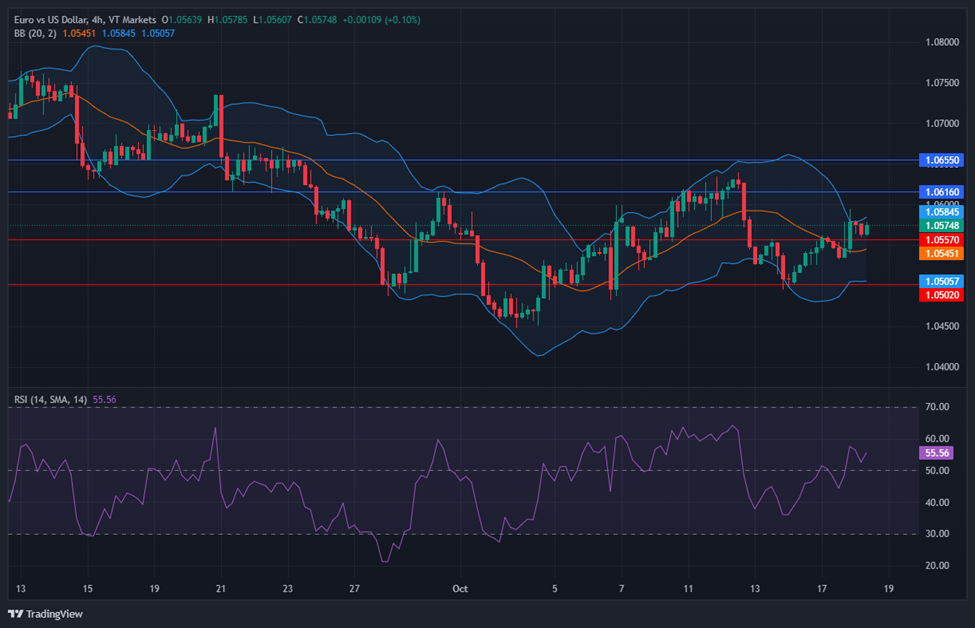
Chart EURUSD by TradingView

Based on technical analysis, the EUR/USD was slightly higher on Tuesday, pushing towards the upper band of the Bollinger Bands. Currently, the EUR/USD is trading just below the upper band, suggesting the potential for another higher movement. The Relative Strength Index (RSI) stands at 55, indicating that the EUR/USD is still in neutral bias.

Resistance: 1.0616, 1.0655

Support: 1.0557, 1.0502

XAU/USD (4 Hours)

XAU/USD Rebounds to Weekly High as Strong US Data Boosts Market Sentiment Despite Rising Bond Yields

In the world of precious metals, spot Gold (XAU/USD) made a significant recovery, trading around $1,923 per troy ounce and hitting a fresh weekly high of $1,913.57, though still slightly below the previous week’s peak. The rally was fueled by upbeat US data, including a 0.7% increase in September Retail Sales, surpassing market expectations, and positive reports on Capacity Utilization and Industrial Production. Meanwhile, global concerns over inflation eased as New Zealand and Canada reported declining inflation rates, providing a further boost to market sentiment. However, rising government bond yields, particularly the 10-year Treasury note, which reached 4.80%, tempered the decline of the US Dollar.

Chart XAUUSD by TradingView

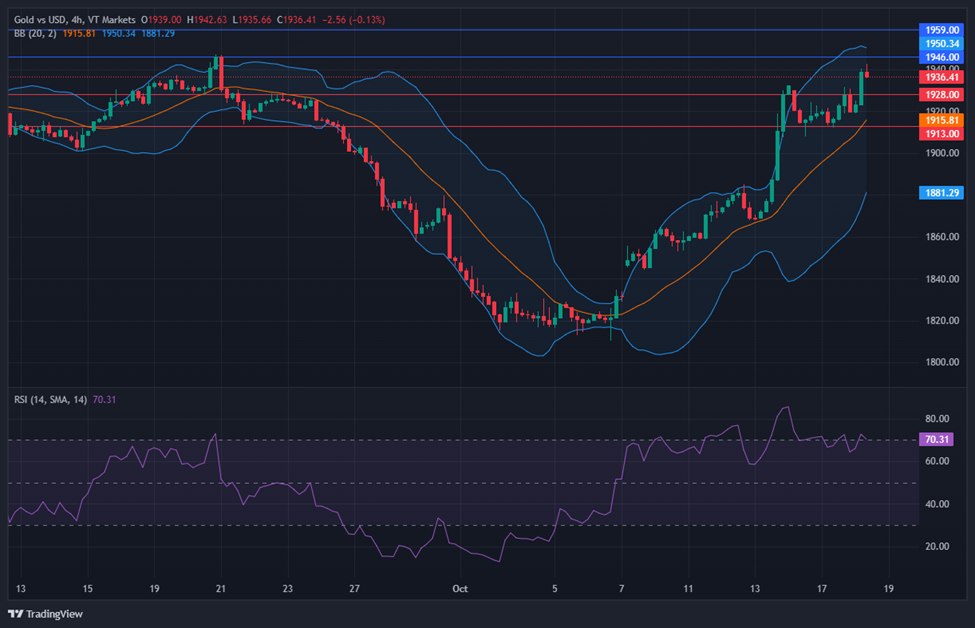
Based on technical analysis, XAU/USD is moving slightly higher on Tuesday and consolidating between the upper and middle bands of the Bollinger Bands. Currently, the price of gold is moving higher with the potential of reaching the upper band. The Relative Strength Index (RSI) currently registers at 70, indicating a bullish bias for the XAU/USD pair.

Resistance: $1,946, $1,959

Support: $1,928, $1,913

Economic Data
CurrencyDataTime (GMT + 8)Forecast
GBPCPI y/y14:006.6%

VT Markets 与玛莎拉蒂 MSG Racing强强联手 迎战电动方程式第十赛季

玛莎拉蒂 MSG Racing 车队和 VT Markets 正式宣布,双方将在电动方程式领域开展全新合作。

两大IP跨界合作 打破圈层壁垒

在 FIA 电动方程式第十赛季即将启动之际,玛莎拉蒂MSG Racing 很荣幸地宣布与金融行业知名线上经纪商品牌VT Markets联手,开展长期全球合作。

这是 VT Markets 首次与体育品牌进行跨界合作,在金融行业中堪称首屈一指,标志着两个行业巨头在赛车体育和金融领域的强强联合。

把握机遇 超越未来

VT Markets 在竞争激烈的金融行业中创新突围,遵循客户为中心的理念,为所有用户提供更简单的交易方式,快速迈向未来。

相信机遇和前进的力量,这是 VT Markets 与玛莎拉蒂MSG Racing不谋而合的发展理念。作为一个经纪商品牌,VT Markets将锐意创新与顶级服务标准相结合,成功简化曾经令人望而却步的复杂交易流程,在金融领域开拓了新疆界。

自 2015 年上线以来,VT Markets 通过官方交易平台和屡获殊荣的移动应用程序,为交易者提供流畅便捷、随心所欲的交易体验,持续创造新的机遇。

为永续发展 为美好明天

玛莎拉蒂 MSG Racing 欢迎 VT Markets 加入电动方程式的世界。车队在第九赛季中创下佳绩,在本赛事中四次登上最高领奖台,创下玛莎拉蒂品牌自 1957 年以来在单人座赛事中的新纪录。随着第十赛季即将开锣,车队已整装待发,准备迎接更多荣耀时刻。
这次合作围绕电动方程式展开,将延续玛莎拉蒂 MSG Racing 和 VT Markets 对最佳性能和技术创新的共同理念,从环境、社会层面创造和维护可持续发展的未来。

双方将为了共同目标在赛道上展开合作,携手并进。此外,车手 Maximilian Günther 和 Jehan Daruvala 的赛车和赛车服、车队车库以及第十赛季的队服,均将出现 VT Markets 的品牌名称。

10 月 23 日至 27 日,电动方程式 2023/24 赛季将在瓦伦西亚的 Ricardo Tormo 赛道进行季前测试,随后于 2024 年 1 月 13 日在墨西哥城进行赛季开场赛。

高层寄语

Scott Swid,玛莎拉蒂 MSG Racing 董事长兼执行合伙人

“非常高兴迎接 VT Markets 加入玛莎拉蒂 MSG Racing 的大家庭。这次合作是这个大家庭中不可或缺的一部分,将对我们的发展道路产生至关重要的积极影响。VT Markets 作为高速发展的金融领域的一员,完全理解我们全力以赴积极备战电动方程式的信念。从第 10 赛季起,双方将秉承对技术创新的共同追求,开启充满活力、令人期待、前景广阔的合作之旅。”

Harry Richards,玛莎拉蒂 MSG Racing 商务总监

“迈入电动方程式第 10 赛季的鏖战,对于玛莎拉蒂 MSG Racing 而言是一个非常重要的时刻,VT Markets 的加入让这一赛事变得更加与众不同。自 2014 年创办以来,电动方程式在赛车领域占据了独特的地位,已成为全球优质品牌展示自我风采的首选平台。作为一支赛车队,创新是我们各项工作的核心。因此吸引了志同道合、拥有共同使命感的合作伙伴,这些伙伴将成为我们前进道路上不可或缺的强力支持。很高兴在即将到来的赛季与 VT Markets 合作,我们迫不及待地希望见证双方共同取得的成就。”

VT Markets 首席执行官

“VT Markets 和玛莎拉蒂 MSG Racing 都是各自领域独占鳌头的品牌,这也赋予本次合作非凡的意义。尽管行业不同,但两家公司的商业抱负和世界愿景却高度一致。长久以来,玛莎拉蒂的三叉戟徽标一直是品质与身份的不二象征,很高兴能与如此尊贵的合作伙伴共同携手,开创未来。”

How to Trade Silver: A Comprehensive Guide 

Silver, often referred to as the “poor man’s gold,” has captivated traders and investors for centuries due to its unique characteristics and historical significance. Recently, it has gained attention as an alternative investment, aligning with the growing interest in precious metals amid economic uncertainties and inflation concerns, highlighting its potential as a viable trading option. The current estimated market cap of silver stands at approximately $1.3 trillion. 

Silver bullion bars
source: Share Market Express

Traders utilise silver for diverse purposes such as investment, speculation, and hedging against economic volatility. It acts as a potential store of value and a hedge against inflation, appealing to those diversifying portfolios or managing risk during uncertain economic times. 

In this guide, we will delve into the world of silver trading, offering valuable insights and essential knowledge for those embarking on their silver trading journey. 

Historical Significance of Silver 

Silver, often referred to as the “white metal,” boasts a rich historical legacy dating back thousands of years. Its journey from ancient civilisations to the modern world is deeply entwined with human society and economic development. 

Silver has been a prized commodity since ancient times. In Mesopotamia around 2500 BC, the first known silver mines were established, signifying the early recognition of silver’s value. It was used for various purposes, including as jewellery, utensils, and as a form of currency. 

Silver’s role as a medium of exchange evolved across civilisations. The Greeks, Romans, and other ancient civilisations used silver in their coinage systems. The Roman denarius, for instance, was a widely recognised silver coin. In medieval Europe, the ‘Troy pound’ of silver emerged as a standard measurement, emphasising its importance in trade and commerce. 

Ancient Greece silver coins
source: CoinsHome.net

During the 19th and early 20th centuries, many nations adopted the silver standard, tying their currency values to a specific amount of silver. The United States, for example, had a bimetallic standard where both gold and silver were used to back the value of the dollar. However, due to economic challenges, many countries later shifted to the gold standard

The Industrial Revolution in the 18th century brought about a transformation in silver’s significance. Its exceptional electrical conductivity and other physical properties made it crucial for various applications. Silver became an essential component in photography, electronics, batteries, and more. This transition from primarily being a monetary asset to an indispensable industrial metal significantly impacted its demand and market dynamics. 

In contemporary times, silver’s historical significance continues to influence its trading appeal. Traders and investors appreciate silver not only for its industrial applications but also for its enduring value as a precious metal. This dual nature positions silver as a unique and versatile asset in the modern financial landscape. 

Understanding Silver as a Commodity 

Silver, a unique commodity, combines both precious and industrial metal qualities. This dual identity drives diverse demand and holds a crucial role in various industries. 

A miner with a silver nugget
source: The Motley Fool:

Historically treasured for its rarity and aesthetic appeal, silver’s shiny appearance and scarcity make it a preferred material for crafting jewellery, ornaments, and prized artifacts. In industry, its exceptional conductivity is indispensable for electronics, solar panels, medical devices, and chemical production. Additionally, silver’s reflective properties make it a fundamental component in specialised mirrors. 

Several factors influence the prices of silver, making it essential for traders and investors to stay informed and analyse these aspects for effective decision-making in the silver market. 

Supply and Demand Dynamics 

The interplay between the supply and demand for silver is a fundamental determinant of its price. Factors such as mining production, recycling rates, industrial demand, and investor interest all impact the overall supply and demand equilibrium. 

Geopolitical Events 

Silver prices can be significantly influenced by geopolitical events, including political instability, wars, trade tensions, and policy changes. These events can create uncertainty in the market, affecting both demand and supply. 

Economic Indicators 

Key economic indicators like GDP growth, employment rates, inflation, and monetary policies directly affect silver prices. Silver often experiences increased demand during times of economic growth and stability. 

Technological Advancements 

Technological advancements play a vital role in shaping silver’s demand. Emerging technologies that rely on silver, such as electric vehicles and renewable energy solutions, can substantially impact its price. 

The Gold-Silver Ratio 

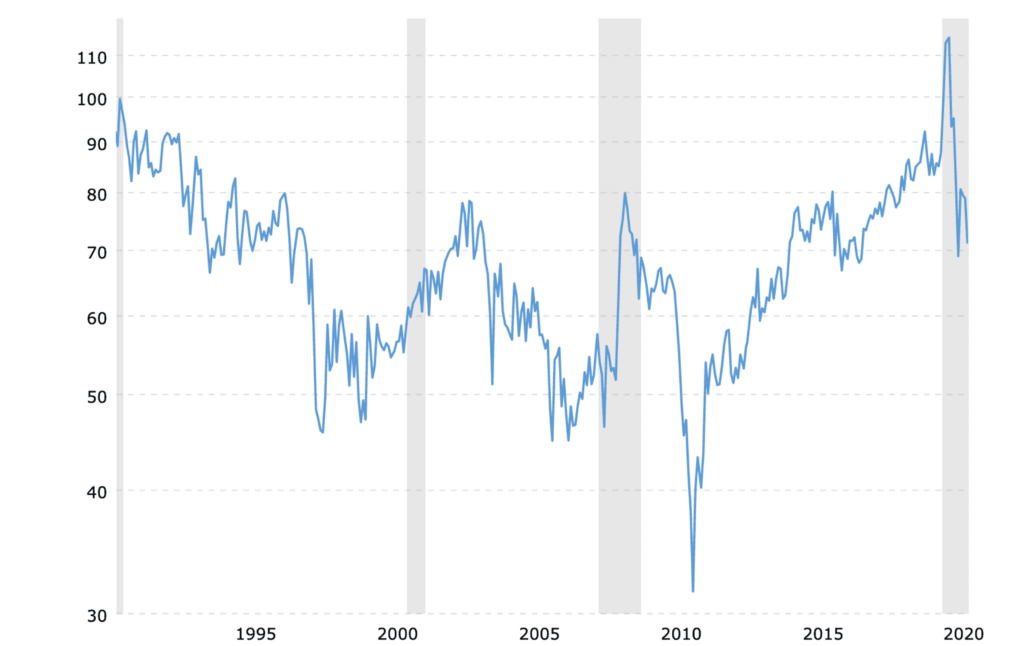
The gold-silver ratio is a fundamental metric in silver trading, indicating the amount of silver needed to purchase one ounce of gold. This ratio is a valuable tool for traders, offering insights into market sentiment and potential overbought or oversold conditions in the silver market. 

The gold-silver ratio
source: Commodity.com

A higher ratio implies that silver is undervalued compared to gold, suggesting it might be an opportune time to buy silver or sell gold. Conversely, a lower ratio suggests silver is overvalued compared to gold, potentially signalling an opportunity to sell silver or buy gold. 

Traders utilise this ratio to strategise their investments, deciding whether to focus on gold or silver based on market conditions. Additionally, shifts in the gold-silver ratio can reflect broader economic trends and investor sentiment, offering valuable insights for traders navigating the silver market. 

Correlation with Other Markets 

Understanding the correlation between silver and other markets is crucial for predicting price movements and making informed trading decisions in the silver market. 

Silver has significant correlations with various markets, including: 

  • Precious Metals Market: Silver shares a close relationship with other precious metals like gold and platinum. It often follows similar trends due to its status as a precious metal. 
  • Commodities Market: Silver’s price can be affected by the broader commodities market, especially other industrial metals. Economic indicators influencing the commodities market often have an indirect impact on silver. 
  • Stock Market: There can be a correlation between the stock market’s performance and silver prices. During economic uncertainties, investors may turn to silver as a safe-haven asset, impacting its demand and price. 
Silver market correlation
source: Investopedia

What is the Silver Market? 

Various avenues exist for trading silver, each offering unique opportunities and considerations. Understanding the diverse forms of silver trading and their respective advantages and risks is essential for navigating the silver market effectively. 

Physical Silver 

Involves purchasing and owning tangible silver bars, coins, or jewellery. Provides ownership and acts as a hedge against inflation. Requires storage and insurance for safeguarding the physical silver. 

  • Advantages: Ownership, hedge against inflation. 
  • Risks: Storage and insurance requirements, potential for physical damage or loss. 

Spot Silver 

Involves buying or selling silver at the current market price for immediate delivery. Provides immediate transactions, enabling quick buying or selling of silver. 

  • Advantages: Immediate transactions, real-time market involvement. 
  • Risks: Market volatility risk, potential price fluctuations. 

Silver Futures 

Involves agreeing to buy or sell silver at a predetermined future date for a set price. Provides price stability and a defined contract for future transactions. 

  • Advantages: Price stability, predetermined contract terms. 
  • Risks: Price speculation risk, contract obligations. 

Silver ETFs 

Allow traders to invest in silver without owning physical silver by tracking the performance of silver prices. Offer diversification within the silver market without direct ownership. 

  • Advantages: Diversification, no need for physical storage. 
  • Risks: Market risk, management fees. 

Silver Stocks 

Involve investing in shares of silver mining companies, providing indirect exposure to silver by owning shares in silver production companies. Traders can benefit from the performance of silver mining companies’ stocks. 

  • Advantages: Exposure to silver mining industry, potential dividends. 
  • Risks: Company-specific risks, market fluctuations. 

Silver CFDs 

Enable traders to speculate on silver price movements without owning the actual silver. Provide leverage, allowing traders to potentially amplify gains, but they carry varying levels of risk due to leverage. 

  • Advantages: Potential for higher returns due to leverage. 
  • Risks: High leverage risk, potential losses exceeding initial investment.
Forex trader
source: Canva

How to Trade Silver with VT Markets? 

When it comes to venturing into the silver market, having a reliable and regulated broker is paramount. VT Markets offers silver spot and CFD trading with tight spreads, low commissions, and leverage of up to 100:1. 

Start trading with VT Markets today by following these three simple steps: 

1. Register: Select your preferred account type and submit your application. 

2. Fund: Choose from a variety of methods to fund your account. 

3. Trade: Select silver in the Precious Metals section or explore more than 1000 instruments across all asset classes. 

Additionally, you can test your silver trading strategies with our risk-free demo account. Wishing you the best of luck! 

In conclusion, trading silver offers a diverse range of opportunities for both seasoned and novice traders. By understanding the historical significance, dual nature, and trading dynamics of silver, and by following effective trading strategies and risk management, you can successfully navigate the silver market. Consider partnering with reputable brokers like VT Markets to enhance your trading experience and embark on your silver trading journey with confidence and knowledge. Happy trading! 

Summary: 

  • Traders use silver for investment, speculation, and hedging against economic volatility, valuing it as a store of value and a hedge against inflation. 
  • Factors influencing silver prices include supply and demand dynamics, geopolitical events, economic indicators, and technological advancements. 
  • The gold-silver ratio is a crucial metric in silver trading, indicating the amount of silver needed to purchase one ounce of gold, offering insights into market sentiment and potential trading strategies. 
  • Silver has correlations with the precious metals market, commodities market, and stock market, affecting its price movements. 
  • Various forms of silver trading exist, including physical silver, spot silver, silver futures, silver ETFs, silver stocks, and silver CFDs, each with its advantages and risks. 

Stock Market Rises on Earnings Optimism, Dollar Slips Amid Geopolitical Tensions

On Monday, the stock market surged as traders eagerly awaited corporate earnings reports, pushing the Dow Jones Industrial Average to its best day since September. Despite concerns about rising Treasury yields, oil prices, inflation, and conflicts in the Middle East, investors were focusing on earnings reports, offering short-term optimism. The US dollar faced a decline due to geopolitical tensions, while the British pound rose, reflecting increased risk appetite. Meanwhile, the currency market monitored the USD/JPY pair and the movements in Treasury-JGB yield spreads, with expectations of higher interest rates driving the push towards a significant breakout at 150. Additionally, the Aussie, Kiwi, and Polish zloty all saw gains.

Stock Market Updates

On Monday, the stock market saw a positive surge as traders eagerly anticipated a wave of corporate earnings reports, seemingly unfazed by an increase in Treasury yields. The Dow Jones Industrial Average experienced its best day since September, climbing 314.25 points, or 0.93%, to close at 33,984.54. Likewise, the S&P 500 recorded a 1.06% gain, ending the day at 4,373.63, and the Nasdaq Composite rose by 1.2% to reach 13,567.98. Leading the Dow’s ascent were Nike and Travelers Companies, both posting gains of approximately 2.1%, while all 11 S&P 500 sectors traded higher during the session. Earnings season was set to intensify, with 11% of the S&P 500 slated to report results, including notable names like Johnson & Johnson, Bank of America, Netflix, and Tesla. A focus on earnings reports was offering investors optimism in the short term, amid concerns about rising yields, oil prices, inflation, and conflicts in the Middle East.

Although the previous week had been marked by mixed performance in the stock market, with the S&P 500 experiencing a 0.5% gain for its second consecutive positive week and the Dow gaining 0.8%, it appeared that the market was beginning to normalize after reacting to geopolitical surprises. Despite potential volatility into the year’s end, investors were increasingly focusing on the fundamentals and corporate performance as the market appeared to adapt to recent uncertainties in the geopolitical landscape.

Data by Bloomberg

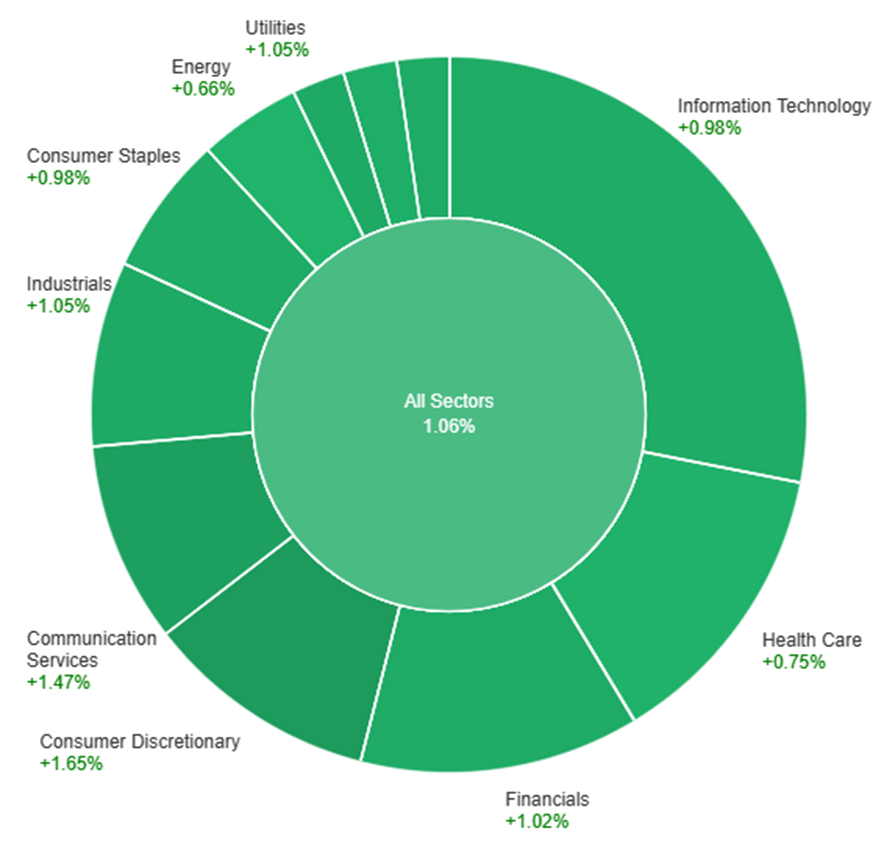
On Monday, across all sectors, the market experienced a positive trend with an overall increase of 1.06%. The highest gains were observed in the Consumer Discretionary sector, which saw a rise of 1.65%, followed by Communication Services at 1.47%, and Industrials at 1.05%. Other sectors also saw positive but relatively smaller gains, such as Utilities, Real Estate, Financials, Consumer Staples, Information Technology, Materials, Health Care, and Energy, with increases ranging from 0.66% to 0.98%.  


Currency Market Updates

In the currency market, the US dollar faced a decline of 0.37% as part of a broader retreat triggered by widespread derisking flows, largely connected to the Israel-Hamas conflict. This geopolitical tension had previously bolstered the US dollar late in the previous week. Despite a slight dip in bund-Treasury yield spreads, the EUR/USD pair managed to rise by 0.4% during this period, as demand for the safe-haven US dollar diminished. Notably, this surge came after eleven consecutive weeks of losses for the EUR/USD pair, a trend potentially signaling an oversold condition. It was also noted that the market sentiment had shifted, with expectations of the Federal Reserve halting its interest rate hikes.

On a similar note, the British pound (GBP) witnessed a 0.55% rise, benefiting from increased risk appetite and wider gilts-Treasury yield spreads. Huw Pill, the Chief Economist of the Bank of England (BoE), issued a warning against prematurely declaring victory over inflation. Sterling traders were anticipating the release of UK inflation data, with market expectations leaning towards the BoE being the sole major central bank likely to implement rate hikes. This expectation effectively ruled out the possibility of a UK rate cut until late 2024. Meanwhile, the USD/JPY pair remained relatively unchanged, lingering below the peak observed in October 2023 at 150.165 and the significant resistance point at 151.94, which had last been reached in 2022. The market was closely monitoring the movements in Treasury-JGB yield spreads, as they played a pivotal role in the carry trade dynamics of the currency pair. Strong US retail sales and other data that fueled expectations of higher interest rates from the Federal Reserve appeared to be the key factor driving the push towards a significant breakout at 150, with 151.94 serving as a major resistance level. Additionally, the absence of Japanese foreign exchange intervention was a critical piece of the puzzle in this scenario. Amid these developments, the Australian and New Zealand dollars, colloquially known as the Aussie and Kiwi, rose by approximately 0.7% as risk appetite rebounded in the market. Furthermore, the Polish zloty witnessed a remarkable increase of 2.2% following weekend election results that were perceived as likely to lead to improved relations within the European Union (EU).

Picks of the Day Analysis
EUR/USD (4 Hours)

EUR/USD Edges Higher Amid Middle East Tensions and Economic Uncertainty

The EUR/USD pair saw a slight uptick, reaching 1.0554 on Monday as it closed trading below this peak. A stronger US Dollar at the start of the week, driven by ongoing Middle East tensions, initially led to a demand for safety. However, as the day progressed, the USD weakened against major currencies. The escalating conflict in the Middle East, marked by attacks from Hezbollah in addition to the ongoing Israel-Palestine conflict, created global economic uncertainty and added pressure on central banks. Data releases were limited, with Germany’s Wholesale Price Index edging up, the Euro Zone showing an improved trade balance, and the US reporting a decline in the NY Empire State Manufacturing Index. Upcoming releases include Germany’s ZEW Survey on Economic Sentiment and US Retail Sales for September, Industrial Production, Capacity Utilization, and Business Inventories for August.

Chart EURUSD by TradingView

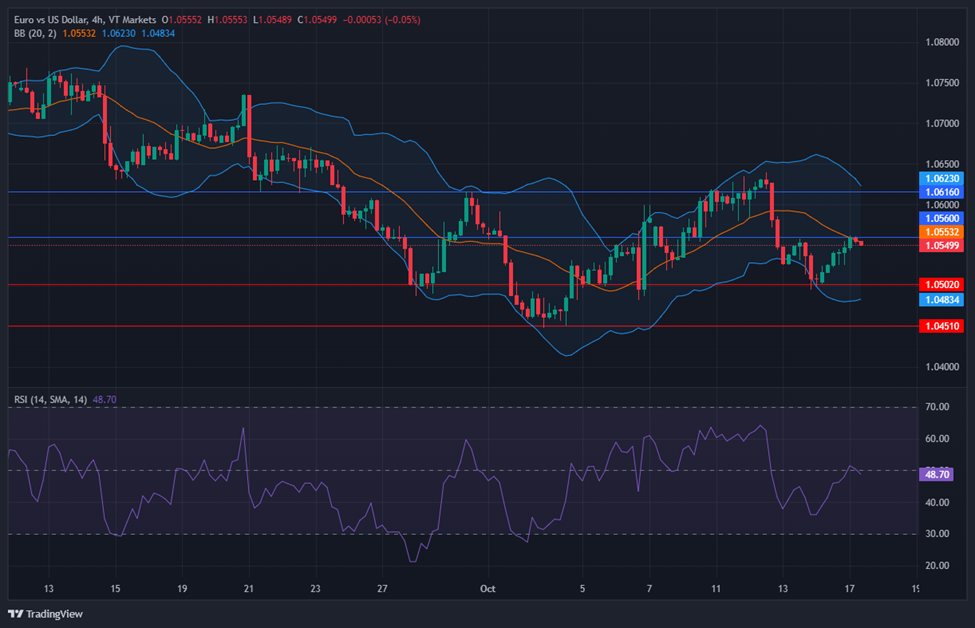
Based on technical analysis, the EUR/USD was slightly higher on Monday, pushing towards the middle band of the Bollinger Bands. Currently, the EUR/USD is trading at the middle band, suggesting the potential for a consolidating move. The Relative Strength Index (RSI) stands at 48, indicating that the EUR/USD is back to neutral bias.

Resistance: 1.0560, 1.0616

Support: 1.0502, 1.0451

XAU/USD (4 Hours)

XAU/USD Faces Volatility Amid Geopolitical Tensions and Fragile Market Sentiment

Spot Gold, represented as XAU/USD, started the week with a gap lower, retreating from a recent multi-week high. Geopolitical concerns in the Middle East, particularly the escalating conflict between Israel and Hamas, kept financial markets on edge. However, the demand for the US Dollar decreased during European trading hours, allowing XAU/USD to recover around the $1,920 price range. While US stock markets posted gains, the market sentiment remains delicate due to uncertainty in the economic outlook and future monetary policies. Major central banks have paused tightening, but the potential for additional rate hikes lingers, given persistent inflationary pressures. This week’s inflation reports from New Zealand, Canada, and the UK will play a crucial role in determining the precious metal’s performance in the face of mounting price pressures.

Chart XAUUSD by TradingView

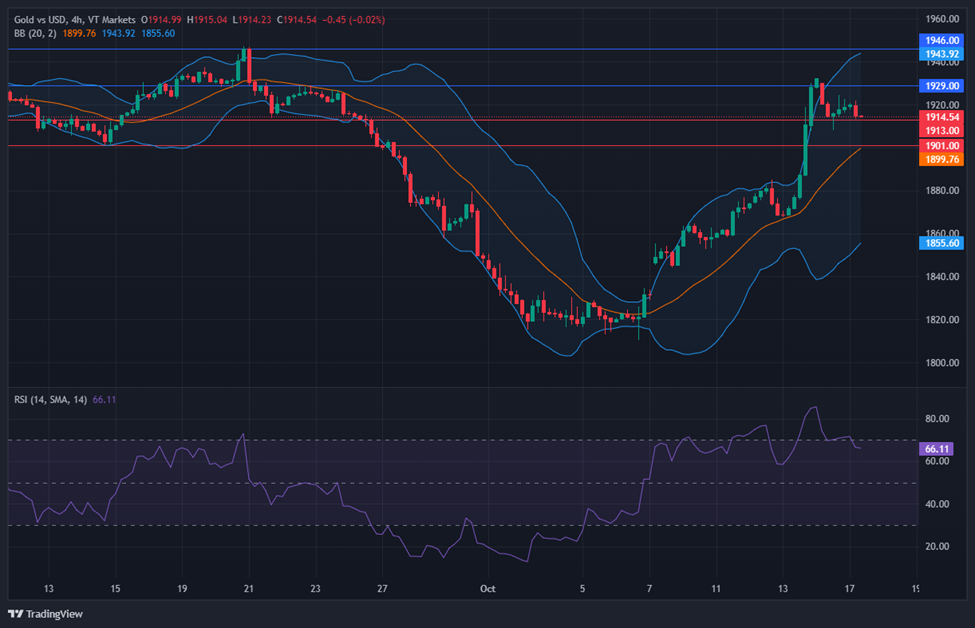
Based on technical analysis, XAU/USD is moving slightly lower on Monday and consolidating between the upper and middle bands of the Bollinger Bands. Currently, the price of gold is still moving near the support level with the potential of moving lower. The Relative Strength Index (RSI) currently registers at 66, indicating a bullish bias for the XAU/USD pair.

Resistance: $1,929, $1,946

Support: $1,913, $1,901

Economic Data
CurrencyDataTime (GMT + 8)Forecast
GBPAverage Earnings Index 3m/y14:008.3%
CADCPI m/m20:300.1%
USDRetail Sales m/m20:300.3%

Week Ahead: Markets to Focus on US Retail Sales and CPI for New Zealand, UK, and Canada

Traders should keep a close eye on US retail sales and the Consumer Price Index (CPI) reports from New Zealand, Canada, and the UK this week, as these updates could have a substantial influence on the market. Exercise caution and stay up to date with the latest developments to ensure a successful week of trading.

Here are some notable market highlights for the upcoming week:

New Zealand Consumer Price Index (17 October 2023)  

In Q2 2023, the CPI for New Zealand increased by 1.1%. 

The CPI data for Q3 is set to be released on 17 October, with analysts anticipating a 1.9% increase.

UK Claimant Count Change (17 October 2023)

The number of people claiming unemployment benefits in the UK increased by 900 in August 2023. 

An additional increase of 22,000 is anticipated in the upcoming data, due for release on 17 October.

Canada Consumer Price Index (17 October 2023) 

Canada’s CPI rose by 0.4% in August 2023 compared to the previous month. 

Analysts expect a 0.1% increase in the September figures, which are scheduled for release on 17 October.

US Retail Sales (17 October 2023) 

US retail sales saw a month-over-month increase of 0.6% in August 2023, surpassing the 0.5% uptick recorded in July 2023. 

Analysts anticipate a 0.3% increase in the data for September, set to be released on 17 October.

UK Consumer Price Index (18 October 2023) 

CPI in the UK eased to 6.7% in August 2023 from 6.8% in the previous month, the lowest rate since February 2022. 

CPI figures for the next reporting period are expected to further decrease to 6.5%. 

Employment in Australia (19 October 2023) 

Employment in Australia increased by 64,900 in August 2023, while the unemployment rate stood at 3.7%.

Analysts anticipate that the employment figures for September 2023 will reflect an increase of 20,900 jobs, with the unemployment rate expected to remain at 3.7%. This data is scheduled for release on 19 October.

UK Retail Sales (20 October 2023) 

Retail sales in the UK rose by 0.4% in August 2023, partially recovering from a 1.1% decline in July. 

The next set of data will be released on 20 October, with analysts expecting a decrease of 0.3%.

Stocks Dip Amid Inflation Fears and Surging Treasury Yields, Dollar Rallies on Strong US Economic Data

On Thursday, the stock market faced a decline driven by concerns over rising Treasury yields and persistent US inflation, marking the end of a four-day winning streak for major indexes. The Dow Jones Industrial Average dropped 0.51%, while the S&P 500 and Nasdaq Composite fell by 0.62% and 0.63%, respectively. Meanwhile, the US Dollar rallied by 0.80% as robust economic data and increased Treasury yields reinforced expectations of prolonged high interest rates. European currencies, such as the Euro and British Pound, experienced declines, while precious metals like Gold and Silver slipped due to rising Treasury yields. Geopolitical concerns, including the Israel-Hamas conflict, also contributed to market sentiment.

Stock Market Updates

Stocks experienced a decline on Thursday due to concerns about rising Treasury yields and persistent U.S. inflation. The Dow Jones Industrial Average closed 0.51% lower, dropping 173.73 points to 33,631.14, while the S&P 500 fell by 0.62%, finishing at 4,349.61, and the Nasdaq Composite lost 0.63%, closing at 13,574.22. This decline marked the end of a four-day winning streak for the major indexes. Treasury yields surged with the 10-year rate increasing by nearly 11 basis points to 4.70%, while the 2-year Treasury yield reached 5.06% after rising more than 6 basis points. Many investors believe that higher yields are becoming a permanent feature, which influenced the equity market’s downturn. The consumer price index released on Thursday revealed a 0.4% increase on the month and a 3.7% increase from a year ago, exceeding Dow Jones estimates of 0.3% and 3.6%, respectively.

In corporate news, Walgreens saw its shares trade 7% higher after reporting narrower losses and progress in cost-cutting plans, although it offered soft profit guidance and missed earnings expectations. Additionally, several major companies, including JPMorgan, BlackRock, and UnitedHealth Group, are scheduled to report earnings on Friday. Geopolitical concerns also played a role in market sentiment, as the ongoing Israel-Hamas conflict raised questions about a potential oil supply crunch and a subsequent increase in fuel prices should the instability spread to neighboring oil-producing regions.

Data by Bloomberg

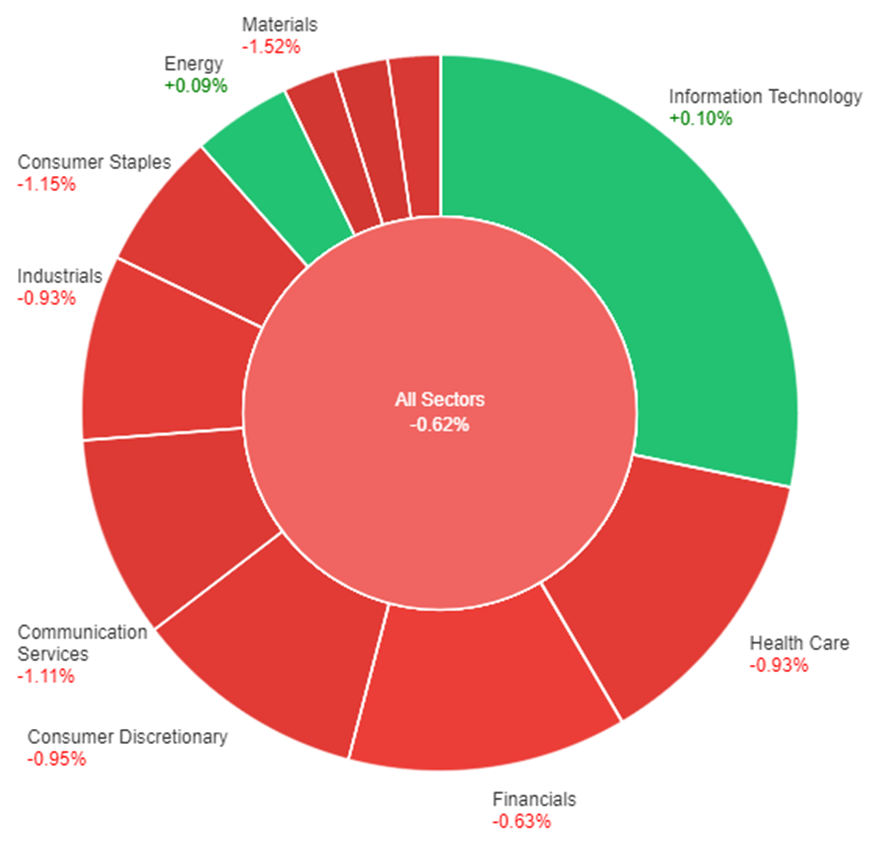
On Thursday, across all sectors, the overall market saw a decline of 0.62%. The Information Technology sector performed the best with a modest gain of 0.10%, while Energy followed closely with an increase of 0.09%. On the other hand, the Utilities sector experienced the most significant drop, with a decline of 1.50%. Additionally, Real Estate, Consumer Staples, and Materials sectors also saw notable decreases, declining by 1.31%, 1.15%, and 1.52%, respectively. The Financials, Health Care, Industrials, Consumer Discretionary, and Communication Services sectors all recorded losses ranging from 0.63% to 1.11%.            

Currency Market Updates

The US Dollar exhibited a significant rally, recovering from previous losses but still below recent cycle peaks. The US Dollar index surged by 0.80% to reach 106.55, primarily propelled by robust US economic data and increased Treasury yields. In September, the US annual Consumer Price Index (CPI) exceeded expectations, registering at 3.7%, surpassing the market consensus of 3.6%. The Producer Price Index (PPI) also outperformed expectations, and Initial Jobless Claims remained slightly below the consensus, at 209,000. This series of strong US economic data and the persistence of inflation above target levels reinforced expectations of prolonged high interest rates. Analysts noted that the Federal Reserve is likely to remain patient as it assesses the overall data, with the focus on the upcoming November FOMC meeting. Meanwhile, US Treasury yields experienced an increase, with the 10-year yield rising from 4.57% to 4.73%, and the 2-year yield from 4.98% to 5.07%.

In the currency markets, the Euro (EUR/USD) saw a significant decline to 1.0525 from around 1.0630 due to the strengthening US Dollar, driven by the robust economic data. Europe is awaiting the release of Industrial Production data for August and an appearance by European Central Bank (ECB) President Lagarde at the annual International Monetary Fund and World Bank meeting. The British Pound (GBP/USD) ended its six-day positive streak, recording a 140-pip drop below 1.2200 amid negative risk sentiment. The New Zealand Dollar (NZD/USD) declined for the second consecutive day, falling below 0.6000 and the 20-day Simple Moving Average (SMA) to reach 0.5925. New Zealand is poised to release Electronic Card Retail Sales data and the Business NZ PMI for September. The Australian Dollar (AUD/USD) posted one of its lowest daily closes for the year, hovering slightly above 0.6300, with a downward bias and attention on the October lows at 0.6285. Meanwhile, the Canadian Dollar (USD/CAD) strengthened, approaching 1.3700 on the back of US Dollar strength, with a potential target of 1.3800 if it closes above 1.3750. Precious metals like Gold and Silver faced declines due to the rise in Treasury yields, with Gold slipping below $1,870 and Silver dropping beneath $22.00. Upcoming data releases from China and Europe, as well as the University of Michigan Consumer Sentiment survey, hold the potential to impact these currency markets, especially those of the antipodean currencies.

Picks of the Day Analysis
EUR/USD (4 Hours)

EUR/USD Slides to 1.0520 as Stronger US Dollar, Rising Yields Pressure Pair

The EUR/USD pair dipped from weekly highs above 1.0630 to 1.0520, driven by a stronger US Dollar bolstered by higher Treasury yields and encouraging US economic data. The European Central Bank’s recent meeting minutes revealed support for a potential interest rate hike, though this had a limited impact on the Euro. Meanwhile, the US Dollar gained further momentum following a 0.4% rise in the Consumer Price Index (CPI) for September, adding to expectations of prolonged higher interest rates. With the 10-year yield surging to 4.72%, the Greenback’s correction ended, leaving it poised to challenge cycle highs.

Chart EURUSD by TradingView

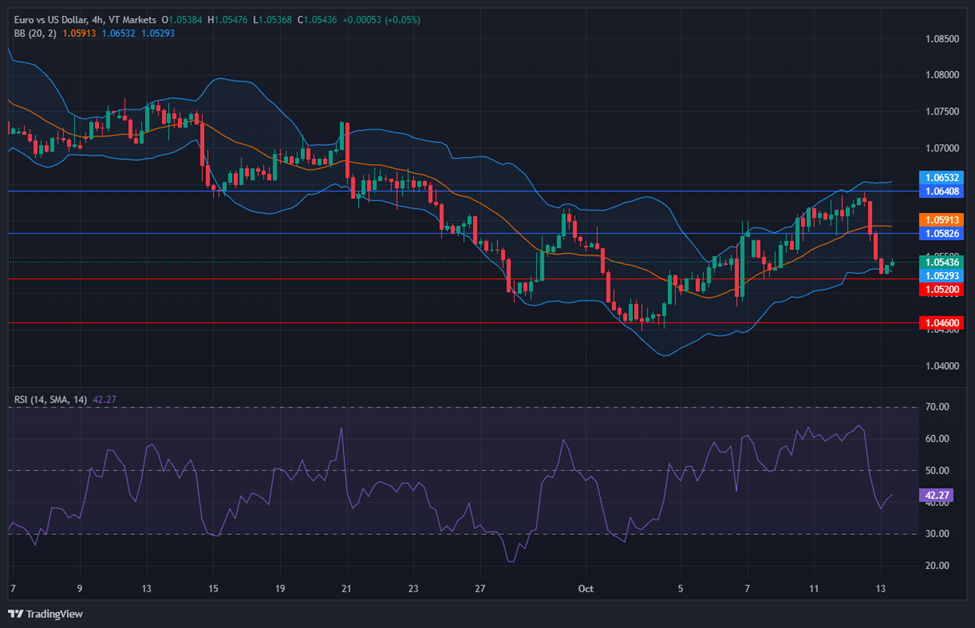
Based on technical analysis, the EUR/USD fell on Thursday, pushing towards the lower band of the Bollinger Bands. Currently, the EUR/USD is trading around the lower band, while the bands are trending upwards, suggesting the potential for consolidating move to retest the middle Bollinger Band. The Relative Strength Index (RSI) stands at 42, indicating that the EUR/USD is back to netural bias.

Resistance: 1.0582, 1.0640

Support: 1.0520, 1.0460

XAU/USD (4 Hours)

XAU/USD Dip as Hawkish Fed Sentiment Surges on Strong US CPI Data

Investors are reevaluating their expectations for the US Federal Reserve as robust Consumer Price Index (CPI) data, revealing a 0.4% increase last month and an annual inflation rate of 3.7% in September, further strengthens the narrative of “higher rates for longer.” This has boosted the US Dollar and Treasury bond yields, causing Gold prices to retreat from their recent two-week high above $1,880 and dip below $1,870. The surge in hawkish Fed sentiments is fueling uncertainty, with markets now placing a 38% probability of a December rate hike, compared to the previous 28%. In addition, softer Chinese CPI and Producer Price Index data are contributing to risk aversion. As we await US Consumer Sentiment and Inflation Expectations data, along with speeches from Fed policymakers, the future of the US Dollar remains uncertain.

Chart XAUUSD by TradingView

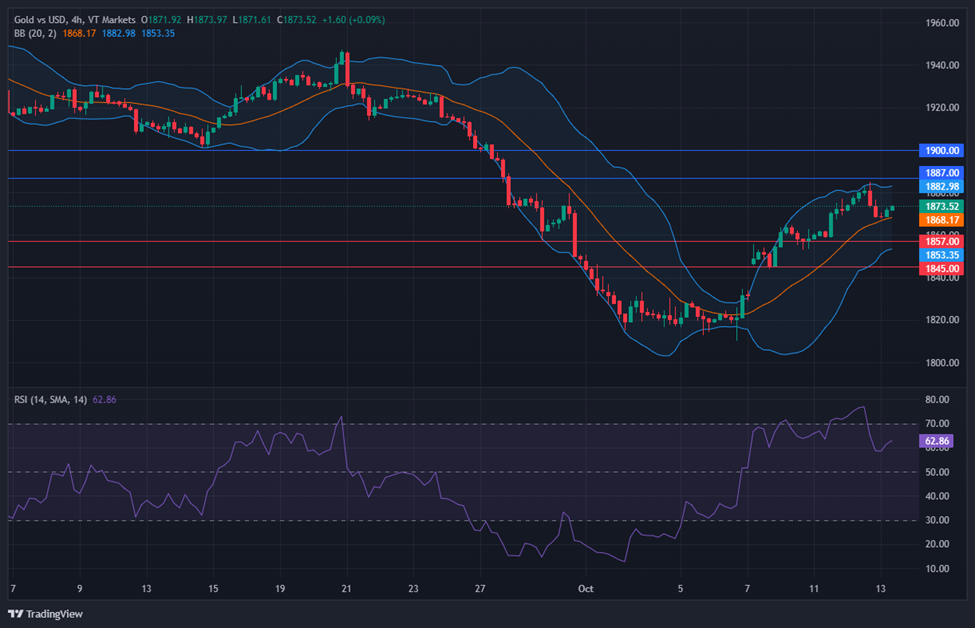
Based on technical analysis, XAU/USD is moving slightly lower on Thursday and able to reach the middle band of the Bollinger Bands. Currently, the price of gold is trading slightly above the middle band with the potential of moving back higher. The Relative Strength Index (RSI) currently registers at 62, indicating a bullish bias for the XAU/USD pair.

Resistance: $1,887, $1,900

Support: $1,857, $1,845

Economic Data
CurrencyDataTime (GMT + 8)Forecast
USDPrelim UoM Consumer Sentiment22:0067.2
Back To Top
server

您好 👋

我能帮您什么吗?

立即与我们的团队聊天

在线客服

通过以下方式开始对话...

  • Telegram
    hold 维护中
  • 即将推出...

您好 👋

我能帮您什么吗?

telegram

用手机扫描二维码即可开始与我们聊天,或 点击这里.

没有安装 Telegram 应用或桌面版?请使用 Web Telegram .

QR code