Stocks Retreat as Market Rally Pauses, Investors Monitor Sentiment

Stocks experienced a decline on Tuesday, marking the first trading day of the week, as the market took a breather after a recent rally that had propelled it to levels not seen in over a year. The Dow Jones Industrial Average fell by 245.25 points (0.72%) to reach 34,053.87, while the S&P 500 and Nasdaq Composite declined by 0.47% and 0.16%, respectively.

Energy stocks, along with Intel, Nike, and Boeing, weighed on the market with notable drops of more than 3%. Conversely, homebuilders, including PulteGroup, D.R. Horton, and Lennar, outperformed following a robust housing report. Nvidia also defied the downward trend, posting a gain of over 2% amidst the broader market decline.

Investors were coming off a strong week, with the S&P 500 and Nasdaq Composite delivering their best weekly performances since March. The S&P 500 rose 2.6% and the Nasdaq gained 3.25%, while both indexes reached their highest levels since April 2022. The market responded favourably to the Federal Reserve’s decision to skip a rate hike in June, although policymakers are projecting two quarter-point increases later in the year.

Despite uncertainties surrounding future Fed policies, investor bullishness has been on the rise, reaching its highest level since November 2021. As economic data remains limited in the current shortened trading week, traders are closely monitoring market sentiment and its potential impact on stock performance.

All sectors' performance as market rally pauses

Data by Bloomberg

On Tuesday, the overall market performance showed a decline of 0.47% across all sectors. However, there were a few sectors that experienced positive movement. Consumer Discretionary had a gain of 0.75%, indicating increased consumer spending on non-essential goods.

In contrast, Health Care saw a slight decrease of 0.15%. Communication Services and Information Technology both experienced declines of 0.29% and 0.44% respectively.

Financials had a larger decline of 0.69%, while Consumer Staples and Industrials experienced decreases of 0.75% and 0.76% respectively. Real Estate and Utilities were among the sectors with the largest declines, with decreases of 1.11% and 1.17% respectively.

Materials and Energy had the most significant declines, with decreases of 1.26% and 2.29% respectively, indicating a negative trend in these sectors.

Major Pair Movement

Last week, the US dollar and Japanese yen experienced declines against major currencies, which were corrected this week. The correction came ahead of Federal Reserve Chair Jerome Powell’s upcoming testimony and was driven by factors such as the Fed’s pause in rate hikes, the ECB’s ongoing rate-hiking efforts, and the Bank of Japan’s commitment to maintaining its easing policies.

The euro faced pressure due to a drop in German PPI and the euro zone’s current account surplus. Additionally, the market responded to a significant increase in US housing starts. Meanwhile, the UK pound fell after a sharp surge, and the yen strengthened against the Australian dollar, pound, and euro, influenced by Treasury yields and safe-haven demand.

This week, all eyes are on Powell’s testimony as the market seeks clarity on the Fed’s future monetary policy direction. Market expectations currently suggest only one more rate hike, contrasting with the Fed’s projection of two additional hikes. Meanwhile, the euro is anticipated to see a slower retreat compared to the US dollar, with the market pricing in two more rate hikes by the ECB.

In the UK, there is anticipation around the BoE meeting and the possibility of a rate hike. The market currently prices in a 25 basis point hike, with a chance of a 50 basis point hike. Overall, market dynamics and central bank actions continue to shape currency movements, with investors closely monitoring economic indicators and policy announcements.

Picks of the Day Analysis
EUR/USD (4 Hours)

EUR/USD Falls as China’s Rate Cut Fails to Calm Markets, US Dollar Gains Momentum

The EUR/USD pair experienced a decline, reaching 1.0891, as market sentiment turned sour, favouring the US Dollar. Concerns about China’s economic health intensified after the local central bank, the People’s Bank of China (PBoC), lowered key interest rates by 10 bps.

However, financial markets remained skeptical of the effectiveness of the rate cuts and sought refuge in the American currency. European Central Bank (ECB) Governing Council member Olli Rehn’s comments on the gradual easing of underlying inflation did not surprise the market, reinforcing the central bank’s previous message.

In addition, disappointing Eurozone data, including the lower-than-expected April Current Account surplus and a decline in Construction Output, contributed to the Euro’s weakness. The US Dollar received a final boost from positive US economic indicators, with Building Permits rising by 5.2% MoM in May and Housing Starts surging 21.7%, surpassing market expectations.

As anticipation builds for Federal Reserve (Fed) Chairman Jerome Powell’s semi-annual testimony before Congress, the US Dollar maintains its strength, with his remarks and subsequent Q&A session expected to influence the markets.

EURUSD pair movement as market rally pauses

Chart EURUSD by TradingView

According to technical analysis, the EUR/USD pair experienced a flat movement on Tuesday and created a narrower range for the upper and lower bands of the Bollinger Bands. The Relative Strength Index (RSI) is currently at 56, indicating that the EUR/USD is back in a neutral stance before deciding on the next movement.

Resistance: 1.0963, 1.1034

Support: 1.0892, 1.0803

XAU/USD (4 Hours)

XAU/USD Plummets as US Traders Return Amid Economic Concerns and Positive US Data

The price of gold (XAU/USD) experienced a significant drop as American traders resumed trading after a long weekend, resulting in a decline of approximately $20, reaching a low of $1,929.94 per troy ounce. This decline was influenced by the strengthening US dollar due to worries about China’s economic slowdown. The People’s Bank of China (PBoC) reduced two key lending rates for the first time since August of the previous year, surprising the market with a 10-basis point cut that fell short of expectations.

While the US dollar initially struggled, it gained momentum after the release of optimistic US macroeconomic data, including a remarkable 21.7% surge in Housing Starts and a 5.2% increase in Building Permits for May, as reported by the US Census Bureau.

Although Asian and European stock markets experienced minor losses, Wall Street saw a significant decline, with the three major indexes down by around 1% each. Meanwhile, demand for government bonds kept Treasury yields in check, with the 10-year note currently offering 3.71%, reflecting a 5-basis point decrease on the day.

Chart XAUUSD by TradingView

According to technical analysis, the XAU/USD pair is moving lower and has reached the lower band of the Bollinger Bands. There is potential for a slight upward movement, aiming to reach the middle band. Currently, the Relative Strength Index (RSI) is at 41, indicating that the XAU/USD is still in a neutral stance.

Resistance: $1,950, $1,963

Support: $1,932, $1,924

Economic Data

CurrencyDataTime (GMT + 8)Forecast
GBPConsumer Price Index14:008.4%
USDFed Chair Powell Testifies22:00

Markets Close on Monday for Juneteenth Holiday Following Strong Week and Fed’s Rate Hike Decision

In observance of the Juneteenth holiday, the regular trading session was suspended on Monday, providing investors with a break after a positive week. Despite minor slips on Friday, the S&P 500 and the Nasdaq Composite recorded their best weekly performances since March, with the S&P 500 rising by 2.6% and the Nasdaq adding 3.25%.

The Federal Reserve’s decision to hold off on a June rate hike was well-received by investors, contributing to the market’s upward momentum. While upcoming economic data is limited, investors remain optimistic about the market’s direction as they await the release of housing starts data and prepare for key appearances by Federal Reserve officials.

Fed Chair Jerome Powell’s remarks at a press conference last week indicated that the central bank has yet to finalize its policy decisions ahead of the July meeting. However, the decision to skip a June rate hike broke the Fed’s streak of ten consecutive interest rate increases. Despite the uncertainty surrounding future Fed policy, stocks have continued to rise, reflecting investors’ confidence.

Looking ahead, investors will closely monitor the housing starts data scheduled for release on Tuesday, while also anticipating appearances by New York Fed President John Williams, Fed Vice Chair for Supervision Michael Barr, and Fed Chair Jerome Powell, who is set to testify before Congress later in the week. Additionally, the market will pay attention to the quarterly report from shipping giant FedEx, which will be released after the closing bell on Tuesday.

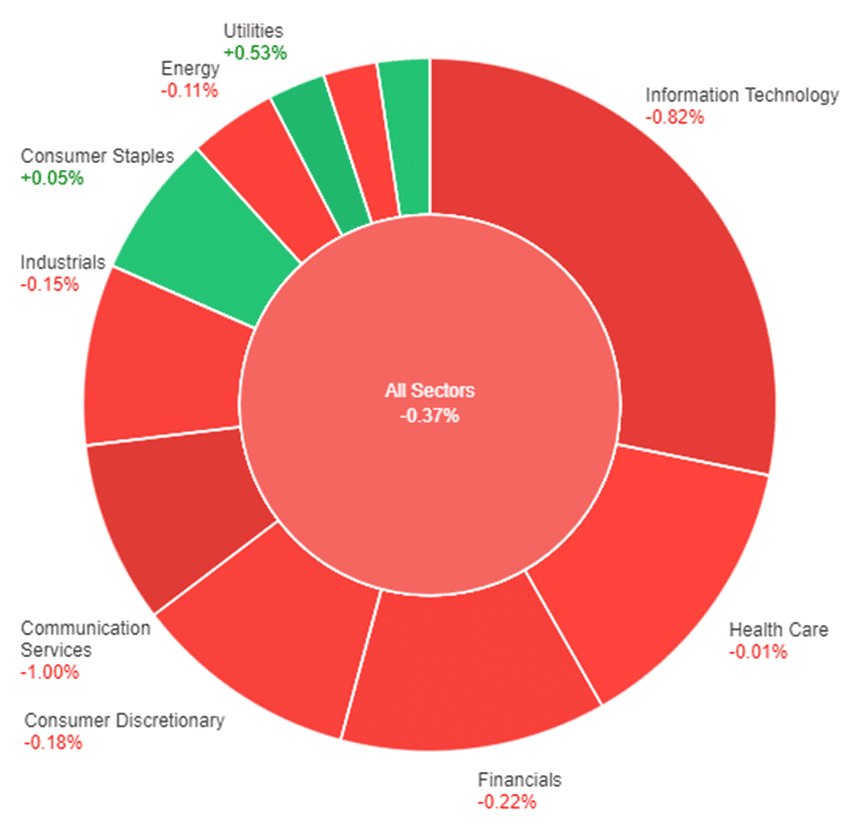
All sectors performance following strong week and Fed's rate hike decision

Data by Bloomberg

On Friday, the overall performance of the market showed a decline, with all sectors experiencing negative movements except for utilities, materials, and consumer staples. The sectors that saw positive gains were utilities with +0.53%, materials with +0.11%, and consumer staples with +0.05%.

On the other hand, the sectors that recorded losses were health care with -0.01%, energy with -0.11%, real estate with -0.11%, industrials with -0.15%, consumer discretionary with -0.18%, financials with -0.22%, information technology with -0.82%, and communication services with -1.00%. These sectors experienced varying degrees of decline, with information technology and communication services being the hardest hit.

Major Pair Movement

In the currency markets, the British pound (GBP) remains strong despite a slight dip of 0.25%. This comes as good news for the Bank of England (BoE) and inflation, as UK supermarkets report a decrease in food production costs for the first time since 2016. The easing of food price inflation contributes to the positive outlook for the British economy.

Meanwhile, the Australian dollar (AUD) has recovered against the US dollar (USD), rising above the 0.6859 level after reaching a low of 0.6835 on Monday. The AUD/JPY cross also saw a boost, increasing by 0.50% from its lowest point. The upcoming release of the Reserve Bank of Australia (RBA) minutes is expected to impact market pricing and potentially influence the RBA’s decision regarding interest rates in July. Currently, the market is anticipating a 58% chance of a 25-basis point hike to 4.35%.

Regarding the USD/JPY pair, the uptrend remains intact, but there are concerns about a divergence in the Relative Strength Index (RSI). In thin trading due to a holiday, USD/JPY has held within a narrow range of 141.50-142.00. The Bank of Japan (BoJ) continues to adopt a dovish stance, preventing excessive appreciation of the yen.

Picks of the Day Analysis

EUR/USD (4 Hours)

EUR/USD Trades with Modest Losses as Speculative Interest Remains Optimistic

The EUR/USD pair experienced slight declines in a quiet Monday session as the markets digested last week’s central bank activities. Speculative interest grew more optimistic as the tightening cycle neared its end, potentially averting potential recessions, and inflation gradually eased from its mid-2022 peak. The US Dollar strengthened due to position adjustments following last week’s sell-off but remained fundamentally weak, reflecting the prevailing preference for riskier assets. While the Eurozone’s macroeconomic calendar had limited impact, statements from European Central Bank (ECB) members, such as Philip R. Lane and Isabel Schnabel, elevated expectations for additional rate hikes. Lane deemed a hike in July appropriate, with September’s decision dependent on data, while Schnabel expressed concerns about past underestimations of inflation and suggested the potential for further rate increases this year. Looking ahead, upcoming releases of the April Current Account and Construction Output in the EU, along with May Building Permits and Housing Starts in the United States (US), will provide further insights. Additionally, Federal Reserve (Fed) Chairman Jerome Powell’s upcoming testimony before Congress on Wednesday may offer fresh clues on future monetary policy directions.

Chart EURUSD by TradingView

According to technical analysis, the EUR/USD pair moves slightly lower on Monday as the US market is in holiday reaching the middle band of the Bollinger Bands, with the potential to reach slightly lower before goes back higher. The Relative Strength Index (RSI) is currently at 58, indicating that the EUR/USD now in slowly back to the neutral stance.

Resistance: 1.0982, 1.1034

Support: 1.0892, 1.0803

XAU/USD (4 Hours)

XAU/USD Trades Range-bound as US Markets Observe Juneteenth Holiday

Spot Gold (XAU/USD) traded within a narrow range around $1,950 on a quiet Monday, as US markets were closed for the Juneteenth Holiday and the macroeconomic calendar lacked significant events. The metal eased slightly as the US Dollar corrected from oversold conditions, but overall market sentiment remained positive, with Asian and European shares posting minor losses. This week’s focus lies on Federal Reserve Chairman Jerome Powell’s congressional testimony and the Bank of England’s monetary policy decision. Powell’s statements, usually released beforehand, will draw speculation as they may provide insights into future monetary policy. The BoE is expected to implement a 25 basis points rate hike while keeping the possibility of additional increases open, with market players eyeing a terminal rate of 6% in early 2024.

Chart XAUUSD by TradingView

According to technical analysis, the XAU/USD pair is moving lower and just break below the middle band of the Bollinger Bands, with the potential of moving lower move to reach the support level and the lower band of the Bollinger Bands. Currently, the Relative Strength Index (RSI) is at 43, indicating that the XAU/USD is in neutral stance but slightly bearish.

Resistance: $1,963, $1,972

Support: $1,939, $1,932

Week Ahead: All Eyes on BOE and SNB Rate Statements

This week, markets brace for key events, including interest rate releases from the Bank of England and Swiss National Bank. Traders are expected to monitor these crucial announcements to shape their strategies and gain insights into the financial landscape. Stay tuned for a round-up of significant market developments. 

UK Consumer Price Index (21 June 2023)

UK’s CPI fell to 8.7% year-on-year in April 2023, the lowest since March 2022, due to a sharp slowdown in electricity and gas prices. 

The next CPI data is set to be released on 21 June, with analysts expecting the index to drop further to 8.4%.

Swiss National Bank Rate Statement (22 June 2023)

The SNB raised its policy rate by 50 bps to 1.5% in its March meeting, following a similar move in December 2022. 

Some analysts expect the next rate hike will be by another 50bps to 2.0%.

Bank of England Rate Statement (22 June 2023)

The BoE raised the bank rate by 25bps to 4.5% in May 2023, marking the twelfth consecutive rate increase. 

Some analysts anticipate that the next rate hike will amount to an additional 25 bps, bringing the interest rate to 4.75%.

German, UK and US Flash Manufacturing PMI (23 June 2023)

In May 2023, Germany’s Manufacturing PMI rose slightly to 43.2 but remained at a three-year low, while the UK’s and US’s PMIs dropped to 47.1 and 48.4, respectively. 

Analysts predict Manufacturing PMIs for June 2023 as follows: Germany at 43, the UK at 46.5, and the US at 49.7.

German, UK and US Flash Services PMI (23 June 2023)

In May 2023, US Services PMI dipped to 54.9 but remained robust since April 2022, while Germany’s hit a year-high of 57.2. The UK’s reached 55.2, marking four months of growth. 

Analysts predict Services PMIs for June 2023 as follows: Germany at 57.5, the UK at 54.4, and the US at 53.

Stocks Surge as Investors Anticipate Fed’s Pause on Rate Hikes

On Thursday, the Dow Jones Industrial Average experienced a significant rally, surging over 400 points, and the S&P 500 reached a 13-month high. Investors speculated that the Federal Reserve would refrain from further interest rate hikes after the central bank decided to skip a hike this week.

The Dow Jones rose by 428.73 points (1.26%), closing at 34,408.06, while the S&P 500 increased by 1.22% to finish at 4,425.84, and the Nasdaq Composite gained 1.15% to close at 13,782.82. The market saw lower bond yields and continued strong performance in the technology sector.

Investors are now considering whether value and cyclical stocks can catch up to the growth and tech sectors. If this occurs, it could fuel further market gains. The S&P 500 is currently on its longest winning streak since November 2021 and is poised for its strongest weekly gain since March.

The index has risen 23% from its October low and 15% year-to-date. The Nasdaq has also performed well, with a gain of over 31% in 2023. Tech giants like Microsoft, Oracle, and Alibaba experienced notable stock increases, further contributing to the market upswing.

During a post-meeting press conference on Wednesday, Fed Chair Jerome Powell stated that the Federal Open Market Committee would consider the cumulative impact of monetary policy tightening over the next six weeks before making a decision on the July policy move. Investors responded positively to Powell’s remarks, indicating a willingness to take risks despite lingering uncertainty.

Powell reiterated that the central bank is likely to raise rates later this year but emphasized that their decisions would depend on monthly data. Economic data released on Thursday, including jobless claims and retail sales figures, provided investors with a better understanding of the labour market and consumer spending trends.

Stocks Surge as Investors Anticipate Fed's Pause on Rate Hikes

Data by Bloomberg

On Thursday, all sectors in the market experienced gains, with the overall market increasing by 1.22%. The health care sector led the way with a notable increase of 1.55%, followed closely by communication services and industrials, both rising by 1.54% and 1.51%, respectively. Information technology also performed well with a gain of 1.28%, while financials saw a rise of 1.26%. Other sectors that recorded gains include utilities (1.06%), energy (1.04%), consumer staples (0.93%), materials (0.85%), consumer discretionary (0.68%), and real estate (0.34%).


Major Pair Movement

The dollar index experienced a decline of 0.78% following recent meetings and underwhelming U.S. economic data. The spread between the 2-year bund and Treasury yields tightened by 21 basis points, contributing to the dollar’s decrease. Although the Federal Reserve’s median dot plot forecast indicated two more 25 basis point rate hikes this year, the market’s expectations were slightly lower, anticipating less than one rate hike before the year’s end.

Despite disappointing U.S. reports on jobless claims, retail sales, industrial production, and regional Federal Reserve surveys, the euro (EUR/USD) and the British pound (GBP/USD) both rose by approximately 1%. The yen (USD/JPY), which initially reached new highs for 2023, experienced a modest gain after encountering resistance.

The anticipation of the Bank of Japan’s meeting and potential continued negative rates impacted the low-yielding yen. The proximity of USD/JPY to the levels where substantial intervention took place in November added to the pressure.

EUR/USD surged above key Fibonacci levels, surpassing the 50% and 61.8% retracements of its April-May decline and moving closer to the 76.4% level at 1.0987. Sterling (GBP/USD) broke out above its downtrend line encompassing highs from 2021, 2022, and 2023, as well as previous peaks from 2023 and the 61.8% retracement of its 2021-2022 decline at 1.2751.

Despite recent volatility in the bond market, the market is still pricing in at least 125 basis points of additional rate hikes from the Bank of England, given the UK’s strong economic growth and elevated inflation.

The Australian dollar (AUD/USD) gained 1.3% as part of the broader decline of the safe-haven U.S. dollar. Support came from positive sentiment surrounding Australia’s economic recovery and improved conditions in China, one of Australia’s key trading partners. Looking ahead, the U.S. economic calendar for the next week is relatively light, with the Bank of England meeting on June 22 being a notable event to watch.

Picks of the Day Analysis
EUR/USD (4 Hours)

EUR/USD Surges to One-Month High on ECB’s Hawkish Tone and Dollar Weakness

The EUR/USD pair experienced a significant surge on Thursday, reaching its highest level in a month at 1.0952. The pair maintained its gains, indicating that the rally may continue. The European Central Bank (ECB) played a key role in this upward movement by raising interest rates as anticipated, while keeping the forward guidance unchanged. ECB President Lagarde’s remarks suggested another rate hike in July, alongside higher inflation forecasts.

This news, combined with rising German bond yields and declining US Treasury yields, further bolstered the EUR/USD. Despite Federal Reserve Chair Powell’s hawkish stance, the US Dollar remained weak due to improving risk sentiment and positive US economic data. The upcoming release of Eurozone inflation data and the University of Michigan Consumer Sentiment Index in the US is anticipated to influence market sentiment.

EUR/USD Surges to One-Month High

Chart EURUSD by TradingView

According to technical analysis, the EUR/USD pair experienced an upward movement on Thursday and was able to reach the upper band of the Bollinger Bands. The Relative Strength Index (RSI) is currently at 78, indicating that the EUR/USD is now in a bullish trend.

Resistance: 1.0982, 1.1034

Support: 1.0892, 1.0803

XAU/USD (4 Hours)

XAU/USD Retreats as Fed Maintains Neutral Stance, US Recession Fears Linger

The price of gold (XAU/USD) faced selling pressure after a tentative recovery, falling back from its near $1,934.74 level during the London session. The retreat came as the Federal Reserve (Fed) delivered a neutral interest rate decision, signalling that further rate hikes are on the horizon to combat persistent inflation. Market sentiment remained cautious amid concerns of a US recession, fueled by the Fed’s emphasis on ongoing inflation and tight labour market conditions.

Additionally, the US Dollar Index (DXY) experienced a decline, hovering around 103.15, as investors awaited the release of monthly Retail Sales data. Preliminary reports indicated a contraction of 0.1%, prompting a closer examination to determine if reduced prices for essentials or economic weakening were the cause.

XAU/USD after Fed maintains neutral stance on rate hikes

Chart XAUUSD by TradingView

According to technical analysis, the XAU/USD pair is moving higher and moves above the middle band of the Bollinger Bands. Currently, the Relative Strength Index (RSI) is at 57, indicating that the XAU/USD is in a neutral stance.

Resistance: $1,963, $1,972

Support: $1,939, $1,932

Economic Data
CurrencyDataTime (GMT + 8)Forecast
JPYMonetary Policy StatementTentative
JPYBOJ Press ConferenceTentative
USDPrelim UoM Consumer Sentiment22:0060.1

Stock Market Reacts to Fed’s Mixed Signals on Rate Hikes and Inflation

Stocks experienced volatility on Wednesday as the Federal Reserve took a pause in its rate-hiking campaign while signalling progress in combating inflation. Despite this, the central bank also indicated its intention to implement two more rate hikes later in the year.

The S&P 500 managed to eke out a marginal gain, closing at 4,372.59 with a 0.08% increase, while the Nasdaq Composite saw a 0.39% rise to end the session at 13,626.48, supported by strong performances from Nvidia and AMD.

On the other hand, the Dow Jones Industrial Average dipped by 0.68%, or 232.79 points, closing at 33,979.33, primarily due to losses in UnitedHealth. Notably, both the S&P 500 and the Nasdaq reached their highest levels since April 2022 during the trading session.

As anticipated by traders, the Federal Reserve announced the maintenance of unchanged interest rates, breaking a streak of 10 consecutive rate hikes. However, the markets initially responded negatively as investors focused on the central bank’s projections, which indicated an imminent resumption of rate hikes. Ed Moya, senior market analyst at Oanda, expressed concerns over the Fed’s forecast, stating that the statement and projections were so hawkish that Wall Street may regret not raising rates that day.

Nonetheless, the sell-off stabilized to some extent when Fed Chair Jerome Powell, during the subsequent press conference, revealed that no decision had been made regarding the July meeting and emphasized the Fed’s progress in tackling inflation.

With the S&P 500 up over 13% this year and more than 25% from its bear market low, investors had been betting on the Fed’s impending cessation of rate hikes. Furthermore, recent economic indicators, such as May’s producer price index and consumer price index, have fueled optimism that the Fed is effectively combating inflation. The Federal Reserve’s next meeting is scheduled for July 25-26.

All sectors performances in reaction to Fed's mixed signals on rate hikes and inflation.

Data by Bloomberg

On Wednesday, the stock market witnessed mixed performances across various sectors. The Information Technology sector led the gains with a significant increase of 1.14%. Consumer Staples and Real Estate sectors also recorded positive growth, rising by 0.56% and 0.32% respectively. Communication Services saw a modest gain of 0.13%.

However, several sectors experienced losses, with Energy and Health Care both declining by 1.12%. Financials, Materials, and Industrials sectors also faced declines of 0.37%, 0.43%, and 0.29% respectively. The Utilities sector saw a slight decrease of 0.07%, while Consumer Discretionary recorded a minor loss of 0.11%. Overall, Wednesday’s trading session displayed a mixed performance across sectors, reflecting the varied market dynamics of the day.

Major Pair Movement

The US Dollar Index (DXY) dropped to its lowest level in a month, reaching around 102.95, as market sentiment leaned towards a dovish stance for the US Federal Reserve (Fed). The Fed decided to keep interest rates unchanged, signalling a pause in the rate hike trajectory.

However, the Fed Chair, Jerome Powell, delivered a bullish speech and hinted at a possible rate hike in July. The dot plot projections showed an increase in rates for 2024 and 2025, and the median rate forecasts suggested two more rate increases in 2023.

Despite the hawkish signals from the Fed, the EUR/USD continued to rise and closed at its highest level in a month above 1.0800. Attention now shifts to the upcoming European Central Bank (ECB) meeting, where a 25 basis point interest rate hike is expected.

The language used in the ECB’s statement and President Lagarde’s comments during the press conference will be crucial for the Euro’s performance. If the meeting turns out to be dovish, with hints of a potential pause in rate hikes, the Euro could face downward pressure. In the meantime, market focus will also be on key US economic data such as Retail Sales, Jobless Claims, and the Philly Fed Index.

Picks of the Day Analysis
EUR/USD (4 Hours)

EUR/USD Rises to Monthly High Despite US Dollar Recovery and Hawkish FOMC; Focus Shifts to ECB Meeting and US Data

The EUR/USD pair achieved its highest daily close in a month above 1.0800, disregarding the US Dollar’s rebound following the hawkish stance of the Federal Open Market Committee (FOMC). Market attention now turns towards the upcoming European Central Bank (ECB) meeting and crucial US economic data, which gain significance in light of Fed Chair Powell’s indication that the July meeting will be a “live” session.

The ECB is expected to raise interest rates by 25 basis points, with the language used in the statement and President Lagarde’s comments during the press conference holding key implications for the Euro’s performance.

Meanwhile, the US dollar gained ground after the FOMC meeting, as the central bank hinted at future rate hikes and projected additional tightening measures by year-end. Market sentiment will likely be influenced by the Fed’s decision and forthcoming US economic indicators, including Retail Sales, Jobless Claims, and the Philly Fed Index.

EUR/USD pair movement reaction to Fed's Mixed Signals on Rate Hikes and Inflation

Chart EURUSD by TradingView

According to technical analysis, the EUR/USD pair experienced an upward movement on Wednesday and was able to reach the upper band of the Bollinger Bands. It then slowly moved lower, targeting the middle band of the Bollinger Bands. The Relative Strength Index (RSI) is currently at 55, lower than the previous higher movement, indicating that the EUR/USD might be returning to a neutral stance.

Resistance: 1.0847, 1.0893

Support: 1.0757, 1.0721

XAU/USD (4 Hours)

XAU/USD Holds Steady Amidst Dovish Fed Outlook, Focusing on Monetary Policy Announcement and Dot Plot

XAU/USD maintains modest gains within the $1,950 price range as investor sentiment improves following US inflation data supporting a dovish Federal Reserve (Fed). The Consumer Price Index (CPI) rose slower than expected in May, while the Producer Price Index (PPI) contracted, indicating downward pressure on prices and validating the Fed’s previous monetary policy measures. Although concerns persist over a tight labor market potentially driving inflation higher, policymakers have anticipated a more dovish approach and a meeting-by-meeting decision.

The market expects the Fed to hold its current stance, with the upcoming monetary policy announcement, dot plot release, and Chairman Jerome Powell’s press conference being the focal points. Market optimism regarding a conservative Fed aiding the economy in avoiding a recession has led investors to seek high-yielding assets, temporarily overshadowing XAU/USD. However, if the Fed deviates from market expectations, significant price volatility can be anticipated, with XAU/USD responding to fluctuations in the broader strength or weakness of the US Dollar.

XAUUSD pair movement reaction to Fed's Mixed Signals on Rate Hikes and Inflation

Chart XAUUSD by TradingView

According to technical analysis, the XAU/USD pair is moving lower creating a push to the lower band of the Bollinger Bands. Currently, the Relative Strength Index (RSI) is at 36, indicating that the XAU/USD is still in a bearish condition.

Resistance: $1,955, $1,972

Support: $1,932, $1,913

Economic Data
CurrencyDataTime (GMT + 8)Forecast
AUDEmployment Change09:3018.6K
AUDUnemployment Rate09:303.7%
EURMain Refinancing Rate20:154.00%
EURMonetary Policy Statement20:15
USDCore Retail Sales m/m20:300.1%
USDEmpire State Manufacturing Index20:30-15.0
USDRetail Sales m/m20:30-0.2%
USDUnemployment Claims20:30246K
EURECB Press Conference20:45

Stocks Rise on Slowing Inflation Data, Fed Rate Hike Speculation

Stocks climbed as new inflation data revealed a slowdown in price pressures in May, fueling optimism among investors that the Federal Reserve might opt to forgo a rate hike during its upcoming policy decision this week. The Dow Jones Industrial Average, S&P 500, and Nasdaq Composite all experienced gains, with the latter two indices reaching their highest closing levels since April 2022. The consumer price index for May showed a 4% year-over-year increase, the slowest annual rate since March 2021, prompting traders to increase their bets on the Fed maintaining the current target rate of 5% to 5.25%. This sentiment was further supported by market expectations and speculation of a “skip” rather than an extended pause in rate hikes.

Tech shares, in particular, led the market surge, benefiting from the positive outlook driven by easing inflation and interest rates. Oracle shares saw a 0.2% increase following better-than-expected results for the fiscal fourth quarter, while streaming giant Netflix experienced a 2.8% climb. Overall, the market responded favorably to the inflation data, reinforcing expectations that the Fed may adopt a cautious approach and provide further clarity on its rate hike plans to maintain stability and assess the impact of prior rate increases.

Data by Bloomberg

On Tuesday, the overall market showed a positive trend with a 0.69% increase across all sectors. The Materials sector had the highest gain, rising by 2.33%, followed by Industrials at 1.16% and Consumer Discretionary at 1.00%. Information Technology also saw a modest increase of 0.71%. Real Estate and Financials sectors both showed a 0.62% gain, while Health Care and Energy had smaller gains of 0.53% and 0.47%, respectively. Consumer Staples and Communication Services sectors experienced more modest gains with increases of 0.42% and 0.27%, respectively. However, the Utilities sector showed a slight decline with a decrease of 0.06%.

Major Pair Movement

On Tuesday, the US dollar experienced a decline against the euro and sterling, as US CPI data indicated that the Federal Reserve would likely not raise interest rates during their upcoming meeting. This news also increased expectations of tighter monetary policy from the Bank of England. The dollar had already been weakening due to risk-on sentiment and pre-Fed selling. While Treasury yields initially dropped, they later rebounded, but the dollar only managed to gain against the yuan and the yen, which had been affected by the Bank of Japan’s efforts to support economic growth. The biggest winner among the major currencies was sterling, which saw a surge after positive UK economic data, including rising average hourly earnings, increased employment, and a lower jobless rate.

EUR/USD experienced a slight gain after Treasury yields recovered, although it encountered resistance from various technical indicators. The European Central Bank is expected to raise rates at upcoming meetings but then enter a period of keeping rates steady. USD/JPY recovered with a 0.46% gain, supported by a rise in 2-year Treasury yields. To surpass previous highs, it may require a more hawkish stance from the Federal Reserve.

Overall, the US dollar faced downward pressure against major currencies on Tuesday, while sterling emerged as a strong performer due to positive economic indicators, and the outlook for central bank actions played a significant role in influencing market sentiment.

Picks of the Day Analysis

EUR/USD (4 Hours)

EUR/USD Reacts to Inflation Data and Central Bank Meetings Amidst Volatility and Risk Appetite

The EUR/USD pair initially rose above 1.0820 on Tuesday following US inflation data but later retreated to around 1.0780 due to high government bond yields and risk appetite. Despite finishing positively, the pair remained far from its peak. The overall sentiment is bullish, but volatility is anticipated as the market awaits the FOMC meeting and the European Central Bank (ECB) decision.

German inflation data indicated a 6.1% annual increase in May, while the German ZEW survey improved unexpectedly in June. The US Consumer Price Index (CPI) for May showed a 0.1% rise, lower than expected, with an annual rate of 4%, suggesting a slowdown in inflation. This data could lead the Federal Reserve to pause its tightening cycle. The US Dollar initially fell but later recovered amid risk appetite and rising government bond yields. The future direction of the EUR/USD pair is expected to be influenced by the US Dollar’s performance ahead of the FOMC statement, with attention on economic projections and guidance from Federal Reserve Chair Jerome Powell.

Chart EURUSD by TradingView

According to technical analysis, the EUR/USD pair experienced an upward movement on Tuesday and was able to reach the upper band of the Bollinger Bands. It then slowly moved lower, targeting the middle band of the Bollinger Bands. The Relative Strength Index (RSI) is currently at 58, lower than the previous higher movement, indicating that the EUR/USD might be returning to a neutral stance.

Resistance: 1.0808, 1.0847

Support: 1.0757, 1.0721

XAU/USD (4 Hours)

Optimism Reigns as Soft US Inflation Data Fuels Dovish Expectations; Gold (XAU/USD) Trades Near Daily Lows

In response to softer-than-anticipated US inflation figures, Spot Gold (XAU/USD) traded near a daily low of $1,942 as optimism prevailed. The US Dollar experienced a decline throughout the day, further accelerating as the Consumer Price Index (CPI) fell below market expectations. The Bureau of Labor Statistics reported a 0.1% month-on-month rise in May’s CPI, accompanied by a 4% year-on-year increase, with the core annual CPI easing from 5.5% to 5.3%. These figures bolstered expectations of a dovish Federal Reserve (Fed), which is set to announce an update on monetary policy. Meanwhile, global stock markets embraced the positive news, while XAU/USD, after reaching a peak of $1,970.96 following the CPI release, felt the weight of optimism.

Chart XAUUSD by TradingView

According to technical analysis, the XAU/USD pair is moving lower due to a shift in market sentiment towards risk-on conditions following lower-than-expected US inflation data. The XAU/USD has reached the lower band of the Bollinger Bands. Currently, the Relative Strength Index (RSI) is at 40, indicating that the XAU/USD is still in a bearish condition but has the potential to move slightly higher towards the middle band of the Bollinger Bands.

Resistance: $1,955, $1,972

Support: $1,939, $1,932

Economic Data
CurrencyDataTime (GMT + 8)Forecast
GBPGDP m/m14:000.2%
USDCore PPI m/m20:300.2%
USDPPI m/m20:30-0.1%

S&P 500 Surges to 13-Month High Amid Optimism Over Fed Rate Hike Decision

The S&P 500 soared to its highest level in over a year as traders anticipated that the Federal Reserve would refrain from raising interest rates during their policy meeting. The index closed at 4,338.93, surpassing its previous high from August and marking the best intraday and closing levels since April 2022. The Nasdaq Composite also experienced significant gains, reaching its highest point since April 2022, while the Dow Jones Industrial Average climbed to 34,066.33.

Market expectations indicate a high probability that the Fed will skip a rate hike this month, with investors pricing in a 72% chance of no increase. While the June hike seems unlikely, the central bank may continue raising rates in the future. Inflation data, expected to show a drop in May’s consumer price index, could support the notion that inflation is receding, reinforcing the case for holding rates steady. Many anticipate that the Fed will emphasize its commitment to controlling inflation and potentially implement a final rate increase at the July meeting before pausing for the rest of the year.

The recent surge in the S&P 500, which gained over 20% from its October low, has sparked optimism among investors, signalling the end of the bear market. The index has experienced a four-week winning streak, while the Nasdaq Composite has seen an even more substantial increase, rising 33% from its 52-week low. On Monday, technology stocks, including Amazon and Tesla, led the market’s upward trajectory, with each stock gaining over 2%.

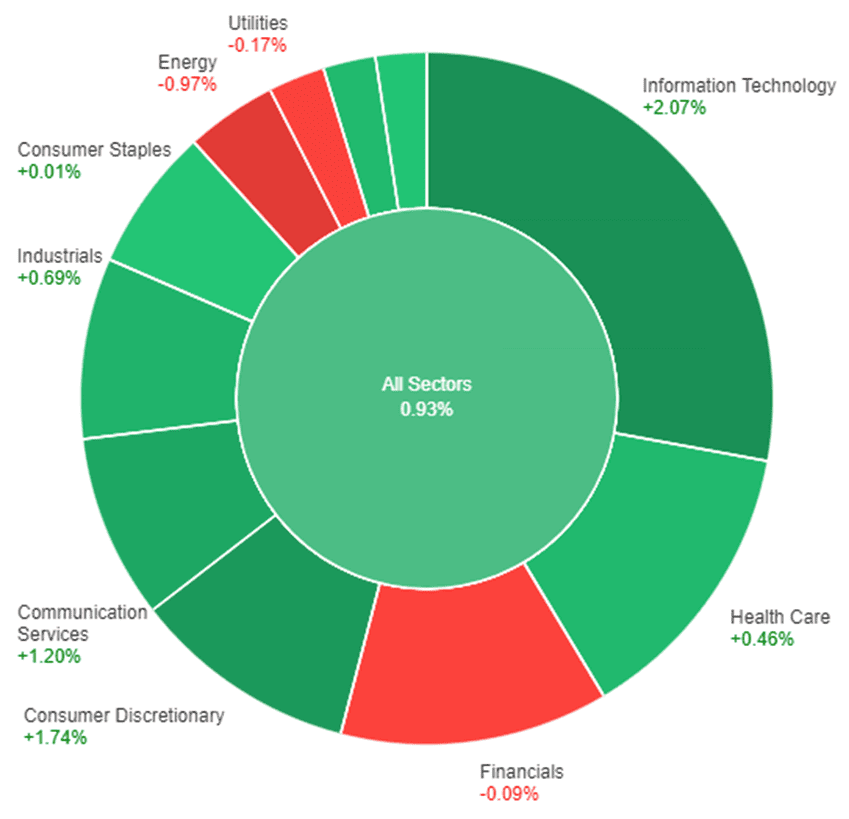
All sectors performance as a result of the recent surge of the S&P 500.

Data by Bloomberg

On Monday, the overall market saw a positive trend, with all sectors collectively increasing by 0.93%. The Information Technology sector performed exceptionally well, with a significant rise of 2.07%. The Consumer Discretionary and Communication Services sectors also experienced substantial gains, growing by 1.74% and 1.20% respectively. The Industrials and Health Care sectors followed suit, showing modest growth of 0.69% and 0.46% respectively. The Materials sector and Real Estate sector saw smaller increases of 0.44% and 0.03% respectively. The Consumer Staples sector and Financials sector experienced minimal gains, with a rise of only 0.01% and a slight decline of 0.09% respectively. On the other hand, the Utilities and Energy sectors faced declines, with drops of 0.17% and 0.97% respectively.

Major Pair Movement

The dollar index initially declined but later recovered as Treasury yields rebounded in cautious trading ahead of the U.S. CPI release, as well as the Federal Reserve and European Central Bank meetings. The dollar and yields received a boost from a sizable $72 billion Treasury issuance, while billionaire investor Ray Dalio expressed concerns about a forthcoming financial crisis and suggested equities would outperform risky U.S. Treasuries. Following the auctions, EUR/USD remained largely unchanged, and the yield curve steepened, with 2s remaining flat and a 2.5 basis point increase in 10s.

Market expectations continue to support the Fed’s guidance of skipping a rate hike this week, with another 25-basis point increase likely in July and potential cuts starting in December, though significantly lower than initial projections in early May. The ECB is priced for a 25-basis point rate hike on Thursday, followed by another in July, and a rate cut is expected by April. Sterling experienced the most notable movement among major currencies, falling by 0.63% due to surging gilts yields and increasing UK political risk. The Bank of England is still seen as needing to raise rates by at least another 100 basis points to address inflation concerns, with average hourly earnings forecasted to rise in Tuesday’s April employment report.

Picks of the Day Analysis

EUR/USD (4 Hours)

EUR/USD Holds within Familiar Range as Market Awaits Key Economic Data and Central Bank Meetings

The EUR/USD pair saw a modest rise on Monday, remaining below the 1.0800 level while showing limited corrections and potential for upside movement. The upcoming US inflation data on Tuesday, alongside the Federal Reserve (Fed) and European Central Bank (ECB) meetings later in the week, are expected to shape the pair’s next direction. This week holds significant importance for financial markets, with the focus on the US Consumer Price Index (CPI) for May and the interest rate decisions from the Fed and ECB. Volatility and potential for erratic moves are expected, making stability more likely after the ECB meeting on Thursday.

Chart EURUSD by TradingView

According to technical analysis, the EUR/USD pair experienced an upward movement on Monday, with the price trading along and above the middle band of the Bollinger Bands. At present, the EUR/USD is still hovering around the middle band of the Bollinger Bands, suggesting that there is a possibility that the market is awaiting the next movement, but the overall sentiment remains bullish. The Relative Strength Index (RSI) is currently at 57, indicating that the EUR/USD is still in a bullish trend.

Resistance: 1.0808, 1.0847

Support: 1.0757, 1.0721

XAU/USD (4 Hours)

Gold (XAU/USD) Dips on Positive Market Sentiment, Investors Await Key Data and Central Bank Decisions

On Monday, spot gold (XAU/USD) prices fell to a daily low of $1,949.20 per troy ounce due to a more positive market sentiment driven by global stock recoveries. Investors are cautious as they await crucial data releases and monetary policy decisions from central banks, including the Federal Reserve (Fed). The unexpected rate hikes by the Reserve Bank of Australia (RBA) and the Bank of Canada (BoC) have raised doubts about the conclusion of the tightening cycle in the US. The upcoming release of the US Consumer Price Index for May will provide further insights, with expectations of a slight decrease in inflation. This week also features monetary policy decisions from the ECB, BoJ, and PBoC, shaping the overall market outlook.

Chart XAUUSD by TradingView

According to technical analysis, the XAU/USD pair is trending lower on Monday as the market awaits today’s US inflation data. The XAU/USD is currently trading around the middle band of the Bollinger Bands, indicating a possibility of a slight upward movement throughout the day. At present, the Relative Strength Index (RSI) stands at 48, suggesting that the XAU/USD is in a neutral state and is awaiting further developments.

Resistance: $1,972, $1,982

Support: $1,955, $1,939

Economic Data

CurrencyDataTime (GMT + 8)Forecast
GBPClaimant Count Change14:0021.4K
USDConsumer Price Index m/m20:300.2%
USDConsumer Price Index y/y20:304.1%
USDCore Consumer Price Index m/m20:300.4%

Week Ahead: Markets to Focus on Major Central Banks Rate Decisions and US PPI and CPI

" "

In the week ahead, market participants will be closely monitoring several vital economic events, including interest rate decisions by major central banks and the release of US Producer Price Index (PPI) and Consumer Price Index (CPI) data.

Market watchers and financial experts are expected to pay close attention to these releases, eager to understand their potential impact on financial markets and the global economy as a whole.

US Consumer Price Index (13 June 2023)

US CPI rose 0.4% month-over-month in April 2023, higher than the 0.1% increase seen in March.

Analysts anticipate a 0.3% rise for May data, scheduled for release on 13 June 2023.

US Producer Price Index (14 June 2023)

Producer prices for final demand in the US increased 0.2% month-over-month in April 2023, following a downwardly revised 0.4% drop in March.

For May 2023 data, set to be released on 14 June 2023, analysts expect a 0.1% increase.

US FOMC Meeting Minutes (14 June 2023)

During its May meeting, the Fed increased the Fed funds rate by 25bps, reaching a range of 5%-5.25%. This marks the 10th hike, setting borrowing costs at their highest since September 2007.

For the upcoming meeting on 14 June 2023, analysts forecast that the Fed will hold the rate steady at 5.25%.

Australia Employment Change (15 June 2023)

In April 2023, Australia’s employment saw an unanticipated drop of 4,300, bringing the total to 13.88 million. The unemployment rate increased unexpectedly to 3.7%.

Data for May 2023 is scheduled for release on 15 June 2023, and analysts predict a 20,000 rise in employment with the unemployment rate staying at 3.7%.

European Central Bank Main Refinancing Rate (15 June 2023)

During its May meeting, the ECB raised its key interest rates by 25 bps to 3.75%, signalling a slower pace of policy tightening. In a press conference, President Lagarde mentioned that the ECB still had progress to make and did not intend to halt the cycle of rate increases soon.

Analysts anticipate that for June, the central will increase its interest rates by 25 bps to 4.0%.

US Retail Sales (15 June 2023)

Retail sales in the US increased 0.4% month-on-month in April 2023, rebounding from two consecutive months of declines.

For May 2023 data, which will be released on 15 June, analysts expect a 0.5% increase.

BOJ Rate Statement (16 June 2023)

In April, the Bank of Japan unanimously voted to maintain its key short-term interest rate at -0.1% and 10-year bond yields at around 0%. They also altered guidance on their policy rate by removing references to guarding against risks from the COVID pandemic and maintaining interest rates at “current or lower levels.”

Analysts predict that for June, the rate will remain unchanged.

服务器升级维护通知 – 2023年06月09日

尊敬的用户:

您好! VT Markets 致力于为客户提供更快速且稳定的交易环境,我们将于周末进行服务器 (MT4/MT5) 升级维护。

维护时段:
2023 年 06 月 10 日 (星期六) 07:00 至 16:00

上述时段采用 GMT+8

维护期间请您务必留意下列事项:

1. 服务器报价将会暂停,客户将无法建立新仓位或是关闭既有持仓。

2. 维护前后的市场价格可能发生跳空,在跳空范围内的挂单或止损/止盈设置将在维护结束后的市场价格成交。

3. 具体维护完毕与开盘时间请依据MT4/MT5软件为准。

望您谅解因此次升级维护为您所带来的不便,我们将继续为您提供更优质的服务。

如您有任何疑问,我们的团队将十分乐意为您解答。
请留言或发邮件至 [email protected] 或联系在线客服。

U.S. Stock Futures Dip Despite S&P 500’s Record High; DocuSign Surges After Beating Expectations

U.S. stock futures experienced a slight decline on Thursday night, even as the S&P 500 reached its highest closing level of the year. Dow Jones Industrial Average futures dropped by 54 points, equivalent to 0.16%, while S&P 500 futures saw a 0.12% dip and Nasdaq 100 futures edged down by 0.08%.

In extended trading, DocuSign shares surged by 5% after the electronic agreements firm exceeded analysts’ expectations for the first quarter, both in terms of revenue and profit. During the regular trading session on Thursday, stocks continued their recent rally, resulting in the S&P 500 reaching a notable level just below 4,300. The broader index recorded a 0.62% climb to close at 4,293.93. Simultaneously, the Dow Jones Industrial Average enjoyed its third consecutive day of gains, adding 168.59 points or 0.5%. The Nasdaq Composite also performed well, rallying by 1.02%.

Investors found encouragement in the broader participation of stocks, including small-cap equities, in the ongoing market rally. However, some market participants cautioned that the gains may not be sustainable, questioning whether this is a short-lived position squeeze reminiscent of August 2022 or a more enduring trend. The current state of the market is perceived as a potential turning point, leading to uncertainty regarding its future trajectory.

While the S&P 500 is set for its fourth consecutive positive week, a feat not seen since last August, with a modest increase of nearly 0.3% as of Thursday’s close, the Dow Jones Industrial Average is on track for its second consecutive week of gains, up 0.2%—a development unseen since April. On the other hand, the Nasdaq Composite is poised to break its six-week winning streak, with a slight decline of 0.02%.

Data by Bloomberg

On Thursday, most sectors of the market experienced a positive performance. Consumer Discretionary showed the strongest gain, rising by 1.56%. Information Technology also had a notable increase of 1.20%. Consumer Staples and Health Care sectors followed with gains of 0.74% and 0.65%, respectively. Utilities and Communication Services sectors showed modest gains of 0.41% and 0.27%, while Industrials had a slight increase of 0.18%.

However, not all sectors saw gains on Thursday. Financials experienced a decline of 0.11%, while Materials and Energy sectors saw larger losses of 0.35% and 0.44%, respectively. The Real Estate sector had the largest decline, dropping by 0.62% on the day. Overall, it was a mixed day for sectors, with most sectors posting gains, but some sectors facing losses.

Major Pair Movement

The dollar experienced a decline on Thursday, accompanied by a drop in Treasury yields, causing concern among traders who held long positions ahead of the upcoming Federal Reserve meeting. Despite some policymakers hinting at a possible pause in interest rate hikes, surprise rate increases from the Reserve Bank of Australia (RBA) and the Bank of Canada (BoC) led to speculation that the Federal Reserve might follow suit. The market pricing for Fed policy did not change significantly following the report, with expectations still indicating a likelihood of no rate hike in June, a final 25 basis point hike in July, and the possibility of rate cuts starting from December onwards. The increase in initial jobless claims, along with other indicators of slowing growth, added to worries about global economic conditions.

Meanwhile, the euro gained 0.75% against the dollar, finding resistance near the daily cloud base and the 100-day moving average. The British pound also climbed 0.9% against the dollar, as the Bank of England (BoE) was expected to raise rates, bringing them closer to the levels set by the Federal Reserve. On the other hand, the USD/JPY pair declined by 0.85%, approaching its 21-day moving average and key support levels. The focus of the market now shifts to the upcoming meetings of the Federal Reserve, the European Central Bank (ECB), and the Bank of Japan (BoJ).

Overall, the dollar weakened, Treasury yields declined, and various factors, including global economic growth concerns, upcoming central bank meetings, and the performance of other major currencies, influenced the currency market on Thursday.

Picks of the Day Analysis

EUR/USD (4 Hours)

EUR/USD Surges as Weaker US Dollar Boosts Sentiment Ahead of FOMC Meeting

The EUR/USD currency pair experienced a notable upswing on Thursday, driven by a declining US Dollar and improved risk appetite. The Greenback weakened across the board following lackluster employment data from the US, which softened expectations ahead of the upcoming Federal Open Market Committee (FOMC) meeting. Although Euro area Q1 GDP saw downward revisions, it did not have a significant impact on the Euro’s performance. Despite mixed growth figures among European countries, the European Central Bank (ECB) meeting next week is still anticipated to include a 25 basis points rate hike. The rally in EUR/USD was further supported by technical factors, while the negative employment numbers in the US contributed to easing hawkish expectations from the Federal Reserve. The release of the May Consumer Price Index (CPI) on Tuesday will be a crucial report to watch before the FOMC decision. As market sentiment favors riskier assets, the US Dollar is expected to remain weak, potentially leading to further losses. However, a deterioration in sentiment could limit upward movements and facilitate a sharp correction in the currency pair.

Chart EURUSD by TradingView

According to technical analysis, the EUR/USD pair moved higher on Thursday as the price creating a push to the upper band of the Bollinger Bands. Currently, the EUR/USD is still running around the upper band of the Bollinger Bands showing that there’s a possibility that the market still trying to move higher. The Relative Strength Index (RSI) is currently at 66 just below the overbought area, indicating that the EUR/USD is still in the bullish trend.

Resistance: 1.0808, 1.0847

Support: 1.0757, 1.0721

XAU/USD (4 Hours)

Gold (XAU/USD) Rallies as Weaker US Dollar and Dismal Employment Report Spur Investor Sentiment

After hitting a weekly low of $1,939 per troy ounce, the XAU/USD pair staged an impressive comeback. The US Dollar initially traded with a soft tone, but its decline accelerated during American trading hours, triggered by a worse-than-expected employment-related report. Initial Jobless Claims unexpectedly surged to 261K for the week ended June 2. The disappointing data pushed investors to increase bets on a dovish Federal Reserve (Fed), with the odds of a rate hike next week surpassing 70% once again. The unexpected interest rate hikes by the Bank of Canada (BoC) and the Reserve Bank of Australia (RBA) also contributed to doubts about the US tightening cycle. Additionally, the US Dollar was influenced by a sharp retracement in government bond yields, with both the 10-year and 2-year Treasury yields experiencing a decline.

Chart XAUUSD by TradingView

According to technical analysis, the XAU/USD pair is moving higher on Thursday and try to cover the losses on previous day, moves higher above the middle band of the Bollinger Bands. There is a possibility that the XAU/USD will continue to moves higher and try to create a push to the upper band of the Bollinger Bands. Currently, the Relative Strength Index (RSI) is at 54, suggesting that the XAU/USD is in neutral with potential bullish trend.

Resistance: $1,972, $1,982

Support: $1,955, $1,939

CurrencyDataTime (GMT + 8)Forecast
CADEmployment Change20:3021.2K
CADUnemployment Rate20:305.1%
Back To Top
server

您好 👋

我能帮您什么吗?

立即与我们的团队聊天

在线客服

通过以下方式开始对话...

  • Telegram
    hold 维护中
  • 即将推出...

您好 👋

我能帮您什么吗?

telegram

用手机扫描二维码即可开始与我们聊天,或 点击这里.

没有安装 Telegram 应用或桌面版?请使用 Web Telegram .

QR code